

To purify aluminum for casting, manufacturers must identify the impurities in the melt and select the appropriate treatment. Degassing removes dissolved hydrogen, filtration removes nonmetallic inclusions, and suitable fluxes support specific refining and metal-protection functions. In many aluminum foundries, these methods work best as parts of a coordinated melt treatment process rather than as isolated solutions. However, none of them automatically corrects every chemical impurity or produces ultra-high-purity aluminum. The correct process depends on the alloy, casting method, raw material quality, production rate, and required final metal cleanliness.
For aluminum foundries, billet and slab casthouses, and casting and rolling plants, purification is not simply about removing visible dirt from molten aluminum. It involves controlling dissolved gases, oxide films, suspended particles, selected chemical impurities, and the conditions under which the metal reaches the casting operation.
Understanding these differences helps manufacturers select the right equipment, avoid unnecessary treatment costs, and reduce defects caused by poor melt quality.
1. What Does Aluminum Purification Actually Mean?
Aluminum purification can refer to different metallurgical processes. Before selecting a treatment, it is necessary to distinguish ordinary molten-metal treatment from the production of high-purity aluminum.
In casting and foundry operations, the immediate objective is usually to improve the cleanliness of molten aluminum before solidification. This generally means reducing dissolved hydrogen and nonmetallic inclusions, managing certain reactive impurities when necessary, and preventing additional contamination during metal transfer.
The distinction matters because each impurity behaves differently.
The main types of impurities in molten aluminum
| Impurity or quality problem | Typical examples | Main concern | Relevant treatment |
|---|---|---|---|
| Dissolved hydrogen | Hydrogen absorbed by the melt | Gas porosity and related casting defects | Rotary or other suitable degassing methods |
| Nonmetallic inclusions | Aluminum oxides, oxide films, refractory particles and other suspended solids | Surface defects, reduced metal cleanliness and impaired casting integrity | Filtration, flotation, suitable flux treatment and controlled skimming |
| Dross and surface oxides | Oxide-rich material formed at the melt surface | Metal loss, contamination and handling difficulties | Appropriate skimming and fluxing practices |
| Selected reactive impurities | Sodium, calcium and lithium in relevant alloy systems | Alloy-specific processing and quality problems | Appropriate chemical refining or reactive-gas treatment, where justified |
| Incorrect alloy composition | Excessive iron, silicon, copper or another alloying element | Failure to meet chemical composition requirements | Controlled charge adjustment, blending, dilution or specialized refining when technically feasible |
These categories overlap to some extent. For example, gas bubbles can transport some inclusions toward the melt surface, while certain refining agents can support both gas removal and oxide separation. Nevertheless, the mechanisms and limitations of the individual processes must be understood.
Does purification mean producing 99.99% pure aluminum?
Not necessarily.
In a conventional aluminum foundry, purification usually means bringing the melt within the required cleanliness and chemistry limits for a particular casting application. An aluminum alloy intended for automotive components, extrusion billets, can stock, or high-purity electrical applications may have very different acceptance criteria.
Producing ultra-high-purity aluminum is a different metallurgical challenge. Specialized methods may involve segregation, electrolysis or other refining technologies rather than ordinary foundry degassing and filtration.
Practical takeaway: Define the desired final metal quality before selecting a purification method. The goal is not to remove every constituent from the aluminum, but to control the unwanted substances without changing the alloy beyond its specification.
2. Why Does Molten Aluminum Need Purification?
The need for purification becomes clearer when the effects of hydrogen and inclusions are considered separately.
Hydrogen absorption and gas porosity
Molten aluminum can absorb hydrogen through reactions involving moisture. Hydrogen may enter the melt through humid conditions, damp charge materials, unsuitable tools or refractory materials, and other sources of contamination.
As aluminum solidifies, the solubility of hydrogen decreases. Hydrogen that can no longer remain dissolved may form gas pores in the casting. These pores can affect mechanical properties, pressure tightness, machining performance and surface quality. Their actual impact depends on the alloy, solidification conditions and component requirements.
Degassing addresses the dissolved hydrogen already present in the melt. Preventing moisture exposure and unnecessary surface disturbance helps limit hydrogen pickup in the first place.
Oxide films and nonmetallic inclusions
Aluminum reacts readily with oxygen, forming an oxide layer at its surface. When the melt surface is disturbed, oxide films can become folded into the liquid metal. Refractory fragments, dross particles and other solids can also enter the melt during melting, holding, transfer and casting.
These contaminants are not necessarily removed by degassing alone. They may need to be separated through filtration, flotation, appropriate flux treatment or controlled settling and skimming.
Ceramic foam filtration is widely used in aluminum casting to capture nonmetallic inclusions as molten aluminum passes through a porous ceramic structure.
Chemical impurities and alloy composition
Chemical purity should not be confused with physical cleanliness.
A filter may remove suspended solid particles, but it does not normally remove dissolved iron or silicon from an aluminum alloy. Similarly, a routine degassing cycle is not a substitute for correcting a charge-composition error.
For selected reactive impurities, chemical refining may be appropriate. The exact method must account for alloy chemistry, acceptable residual concentrations, treatment compatibility and environmental controls. Research on aluminum refining distinguishes the removal of hydrogen and solid inclusions from the removal of dissolved chemical impurities.
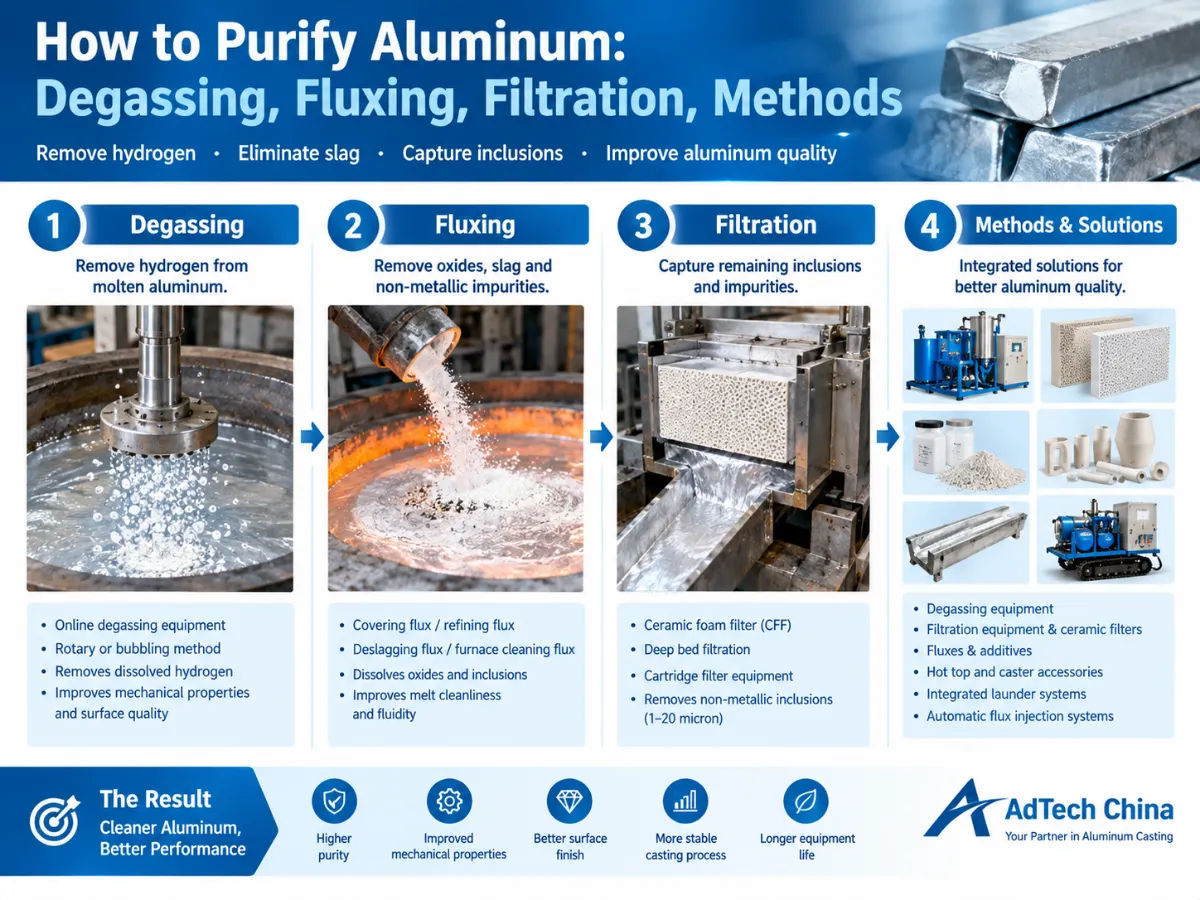
3. How to Purify Molten Aluminum: Five Practical Steps
A reliable process begins with diagnosis, followed by appropriately selected treatment and verification. There is no single sequence suitable for every furnace or casting line, but the following framework helps organize the decision.
Step 1: Identify the source of contamination
Start by examining the type of defect, the metal chemistry, the condition of the charge materials, and the existing treatment process.
Useful questions include:
-
Are the castings developing gas porosity, oxide-related defects, or both?
-
Is hydrogen measured above the plant’s acceptance limit?
-
Has the inclusion level changed after introducing a new scrap source or charge mix?
-
Is the alloy chemistry outside specification?
-
Are defects appearing before or after a change in transfer, holding, or filtration conditions?
Do not assume that every pore is caused exclusively by hydrogen. Shrinkage, feeding conditions and other solidification problems may produce similar symptoms. Nor should every visible surface impurity be interpreted as evidence of excessive dissolved hydrogen.
Sampling and appropriate tests help separate these possibilities before equipment or consumables are selected.
Step 2: Improve melting and holding practices
Purification begins before a degassing rotor or filter is introduced.
Charge materials, tools and equipment that contact molten aluminum must be suitably dry and prepared for service at the relevant temperature. Damp materials can create a serious safety hazard as well as a contamination risk.
Plant procedures should also address:
-
Charge-material selection and segregation.
-
Furnace and refractory condition.
-
Suitable temperature control for the alloy and casting process.
-
Avoidance of unnecessary melt-surface disturbance.
-
Careful transfer and pouring practices.
-
Timely removal of surface dross using the appropriate method.
Operating at an unnecessarily high temperature can increase oxidation and energy consumption. The correct temperature must nevertheless remain within the alloy’s processing requirements and the limits of the equipment.
Skimming should be controlled to remove the surface material without folding additional oxide films into the melt. Prevention is often more economical than repeatedly treating metal that has been contaminated during handling.
Step 3: Select the treatment for the identified impurity
The next step is to match the problem with an appropriate process.
For excessive dissolved hydrogen, investigate degassing. For nonmetallic inclusions, evaluate filtration and other suitable separation techniques. For particular reactive impurities, determine whether an alloy-compatible refining agent or specialized gas treatment is required.
The treatment route should be established from the actual production requirements, not from a generic claim that one method purifies every type of aluminum.
Step 4: Protect the melt after treatment
A melt that meets its cleanliness target immediately after treatment can deteriorate before casting.
Excessive turbulence, long holding periods, moisture exposure, poor transfer practices and unsuitable refractory conditions may create new contamination or allow hydrogen pickup.
For this reason, purification should be evaluated as part of the entire route from furnace to casting station. Online systems may help maintain more consistent treatment and reduce unnecessary transfers, but their actual performance depends on plant configuration and operating discipline.
Step 5: Verify the results
Measure the relevant quality parameters before and after treatment where practical.
Depending on the application, this may include hydrogen measurement, reduced-pressure testing, inclusion analysis and chemical composition testing. The appropriate method depends on what needs to be demonstrated.
A visual inspection alone cannot establish hydrogen concentration or prove that microscopic inclusions have been removed. Results should be assessed against the plant’s alloy-specific and customer-specific acceptance criteria.
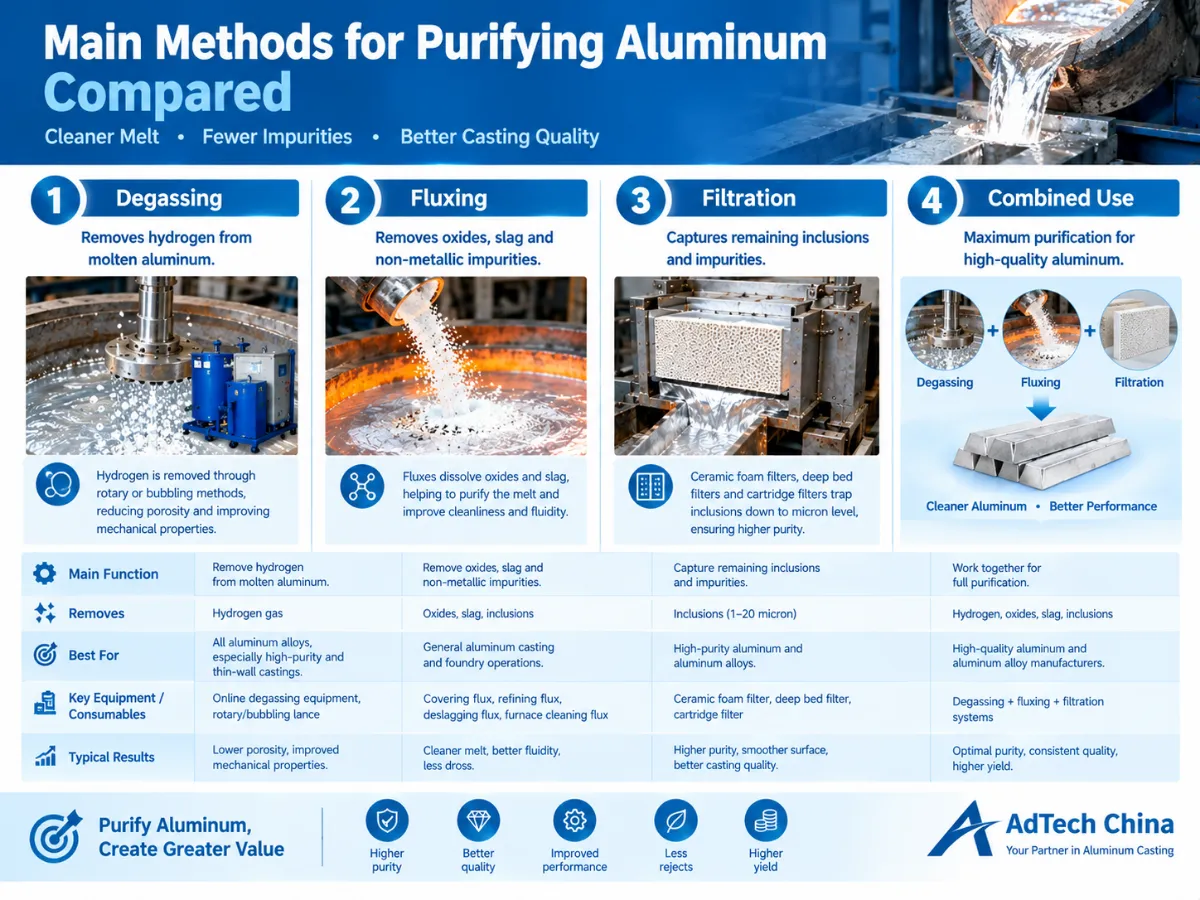
4. Main Methods for Purifying Aluminum Compared
Different technologies solve different problems. The table below summarizes their primary roles.
| Purification method | Primary function | Most relevant when | Important limitation |
|---|---|---|---|
| Rotary degassing | Removes dissolved hydrogen through fine purge-gas bubbles | Hydrogen-related quality problems require controlled treatment | Does not independently remove every solid inclusion or dissolved chemical impurity |
| Ceramic foam filtration | Captures nonmetallic inclusions during metal flow | Melt cleanliness before casting is a concern | Does not directly remove dissolved hydrogen or correct alloy chemistry |
| Refining flux | Supports impurity removal through formulation-dependent physical and chemical mechanisms | Specific refining or gas/inclusion-control requirements have been identified | Effectiveness depends on composition, dosage, temperature, distribution and compatibility |
| Covering flux | Forms a protective surface layer when appropriately formulated | Surface oxidation and moisture exposure need to be controlled | Does not replace degassing where hydrogen removal is required |
| Deep-bed filtration | Uses a bed of suitable filter media to capture inclusions | Production requires a compatible high-capacity filtration arrangement | Performance depends on media, bed geometry, flow conditions and system design |
| Cartridge or tubular filtration | Provides filtration through a compact, porous medium | The application suits the system’s capacity and filter configuration | Selection and service life depend on flow, contamination load and product design |
| Charge adjustment or specialized refining | Corrects selected chemical composition problems | Analytical results show that alloy chemistry is outside the required limits | Ordinary filters and routine degassing are not substitutes for chemistry correction |
The distinctions are consistent with research reviews and industrial melt-treatment guidance. The final selection must be confirmed for the specific alloy and process.
Which method should a foundry choose first?
Use the following problem-oriented guide:
-
High hydrogen or gas porosity: Start by confirming the hydrogen-related problem and evaluating degassing effectiveness, while also checking solidification conditions and moisture sources.
-
Excessive oxide inclusions: Review melt handling, skimming and filtration, and assess whether the existing filter arrangement is appropriate.
-
Selected reactive impurities: Determine the impurity concentration, alloy compatibility and suitable refining method.
-
Incorrect alloy chemistry: Correct the charge or evaluate an appropriate metallurgical refining route.
-
Unstable quality after treatment: Examine contamination introduced downstream, including transfer conditions, holding time, flow turbulence and filtration performance.
A plant may require several complementary measures. Selecting only one technology without diagnosing the problem can increase operating cost without achieving the desired improvement.
5. How Degassing Removes Hydrogen From Molten Aluminum
Degassing is a key treatment for aluminum alloys susceptible to hydrogen-related porosity.
Working principle of rotary degassing
In a common rotary degassing process, an impeller or rotor introduces nitrogen, argon or another approved process gas into molten aluminum. The rotating assembly disperses the gas into smaller bubbles.
Hydrogen diffuses from the melt into the purge-gas bubbles. As the bubbles rise and leave the melt, hydrogen is carried away. The degree of removal depends on factors such as gas dispersion, contact time, melt conditions, equipment design and operating parameters.
Good gas dispersion is important because it increases the contact area between the bubbles and the liquid metal. However, operating conditions should be selected for the specific system, rather than maximizing rotor speed or gas flow without considering the resulting melt disturbance and process performance.
In-furnace versus online degassing
| Consideration | In-furnace degassing | Online degassing |
|---|---|---|
| Treatment location | Furnace or holding vessel | Integrated into the metal-transfer or casting line |
| Main process role | Treats a batch or furnace volume | Treats metal as it moves through the line |
| Key design factors | Bath geometry, metal volume, rotor or gas-delivery system, treatment time | Metal flow rate, required hydrogen reduction, residence time, equipment layout |
| Common evaluation | Hydrogen level before and after treatment | Consistency of treatment and metal quality during production |
| Main consideration | Batch variability and treatment logistics | Continuous operation, flow stability, maintenance and downstream control |
Neither arrangement is universally better. A smaller foundry treating individual furnace batches may have different requirements from a plant supplying a continuous casting line.
How should degassing equipment be specified?
The key criteria include metal flow rate or bath volume, alloy type, incoming hydrogen level, required final quality, available installation space, refractory configuration and maintenance requirements.
Buyers should also ask about rotor or nozzle design, gas supply and control, replacement components, operating records and available methods for verifying hydrogen removal.
Exact cycle time, gas flow, rotor speed and acceptable residual hydrogen should be set for the relevant equipment, alloy and production requirements. A single universal operating recipe is inappropriate.
6. How Ceramic Foam Filters Purify Molten Aluminum
Ceramic foam filters are used to remove nonmetallic inclusions before casting. Their interconnected pores allow molten aluminum to pass through the ceramic structure while trapping contaminants through a combination of interception and surface-related capture mechanisms.
The resulting metal can have improved cleanliness, provided the filter grade, dimensions, installation and operating conditions are suitable.

What should be considered when selecting a ceramic foam filter?
Several variables affect filter selection.
PPI and pore structure. Pores per inch (PPI) is a measure used to describe the filter’s pore structure. It is not a universal guarantee that every particle above a specific size will be removed. Filtration depends on more than nominal pore count alone.
Filter dimensions and available flow area. A filter must accommodate the required metal flow without creating an unacceptable restriction.
Alloy compatibility. The filter material must be suitable for the alloy and the operating temperature. Some high-magnesium applications may require a specific phosphorus-free filter grade, depending on the filter chemistry and application.
Installation and preheating. The filter and filter box must be prepared according to the supplier’s instructions and the plant’s approved procedures. Improper preparation can result in filter damage, unstable flow or metal freezing.
Required cleanliness. A general casting operation and a high-quality foil or aerospace billet application may require different levels of inclusion control. Selection should reflect the actual product specification.
Cost and operating stability. Filter purchase price is only one consideration. Service life, flow capacity, metal losses, replacement frequency, rejected castings and production interruptions also influence total cost.
Ceramic foam filters versus deep-bed filtration
A ceramic foam filter and a deep-bed system both serve filtration needs, but their configurations differ.
| Factor | Ceramic foam filter | Deep-bed filtration |
|---|---|---|
| Filtration medium | Porous ceramic foam | A bed of suitable granular or shaped filter media |
| Typical arrangement | Individual filter installed in a filter box or inline system | Designed filtration unit containing a media bed |
| Selection considerations | Filter grade, size, flow area, alloy compatibility and inclusion load | Media characteristics, bed dimensions, flow rate, pressure or head loss, and operating cycle |
| Production fit | Selected batch or continuous casting processes | Applications suited to the capacity and operating design of the bed |
| Main trade-off | Filter replacement and capacity must suit the metal stream | Equipment integration, media management and process requirements must be evaluated |
A deep-bed filter is not automatically more effective than a ceramic foam filter for every application. The correct comparison must use the same target cleanliness, alloy, flow conditions and production constraints. AdTech identifies both ceramic foam filtration and deep-bed filtration equipment within its aluminum melt purification range.
7. How to Use Aluminum Refining Flux Correctly
Aluminum fluxes are not a single interchangeable product category. Their compositions and functions vary, so the name of the flux and its intended operating conditions must be checked before use.
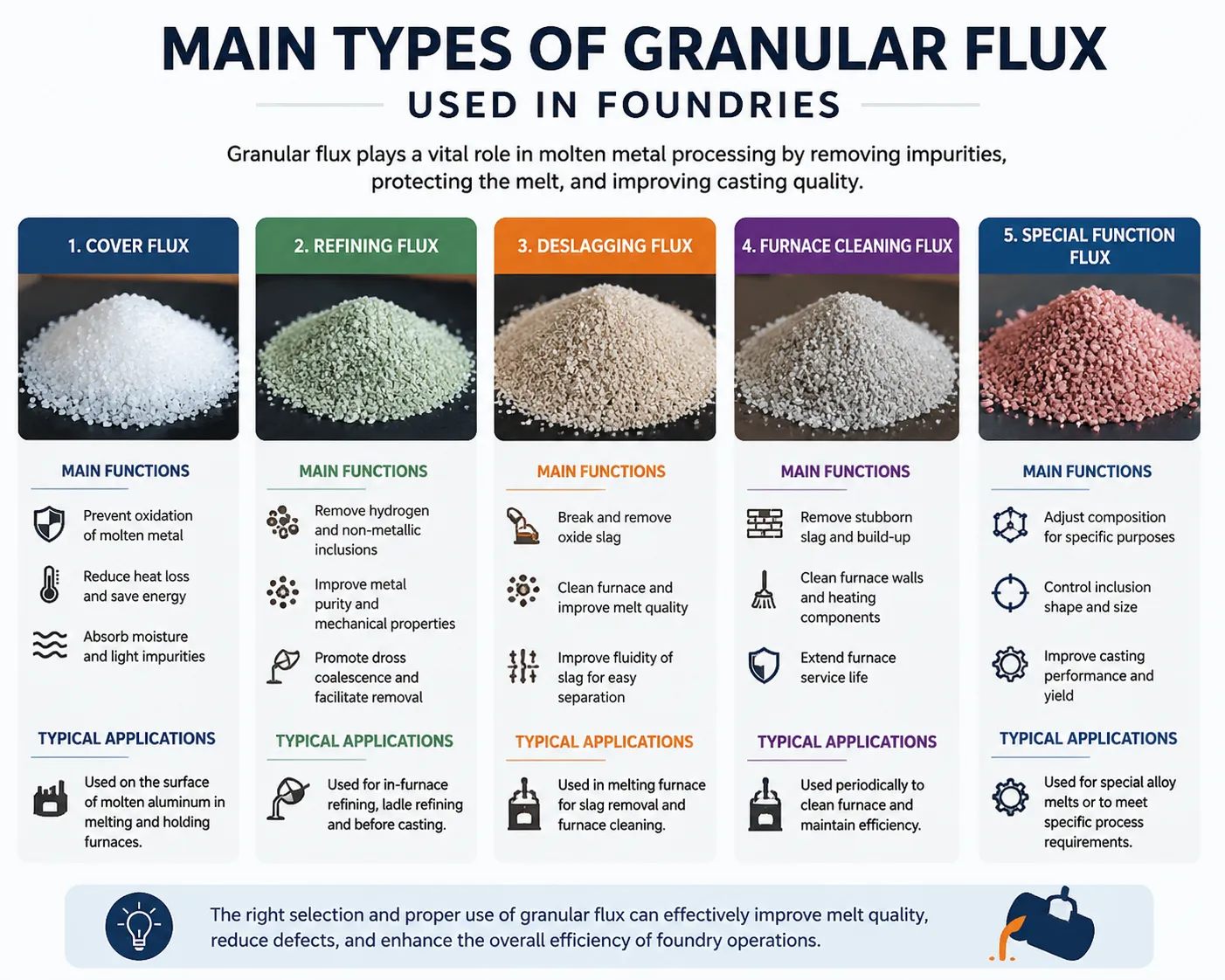
Common categories include covering flux, refining flux, furnace cleaning flux, deslagging flux, recycling flux and granular refining agents. Their purpose and compatibility depend on the particular formulation.
Covering flux
Covering flux is used to form a protective layer on the melt surface when its formulation and process are appropriate. This can help reduce direct exposure of molten aluminum to the surrounding atmosphere and limit oxidation or moisture pickup.
It should not be assumed that covering flux alone will reduce an already elevated hydrogen level to the required target.
Refining flux
Refining flux may support the removal of hydrogen and nonmetallic impurities, depending on its chemistry and method of application. Some formulations are designed for specific alloy families or refining objectives.
Buyers should verify the recommended dosage, operating temperature, application method and alloy compatibility in the product’s technical instructions.
Furnace cleaning and deslagging flux
These products are intended for specific cleaning or dross-management functions. Their primary purpose should not be confused with that of a dedicated hydrogen-removal treatment or a physical filter.
A flux designed for furnace cleaning should not automatically be selected for refining the metal itself.
Manual addition versus automated flux injection
Manual addition can be suitable for certain operations, but distribution and dosage may be less consistent when application depends heavily on operator technique.
Automated injection equipment is designed to control the amount and distribution of flux. AdTech’s published Flux Injection System specification for model LQJL-001 lists a compatible furnace-size range of 20 to 120 tonnes, an adjustable refining speed of 0 to 5 kg/min, 50 kg or 100 kg tank configurations, tracked or wheeled movement, and Z-shaped or fan-shaped refining routes. These are manufacturer-listed equipment parameters, not a guarantee of a particular purification result for every furnace.
For a plant considering automation, the important questions are whether the equipment fits the furnace layout, whether the flux can be injected consistently, and whether the process can be verified through controlled dosage and melt-quality measurements.
8. How to Verify Whether Aluminum Purification Worked
Successful purification should be demonstrated using measurements appropriate to the original problem.
Hydrogen testing
A reduced pressure test (RPT) is commonly used to evaluate the gas-related quality of molten aluminum by examining a sample solidified under reduced pressure. It can be useful for comparing treatment conditions and identifying process changes.
However, RPT results should not automatically be treated as a direct, universally interchangeable measurement of hydrogen concentration. If a numerical hydrogen limit must be met, use a suitable calibrated measurement method and the plant’s approved procedure. RISE describes RPT as a method used to assess hydrogen-related gas content and casting porosity risk.
Inclusion measurement
Inclusion measurement should match the level of cleanliness control needed.
For example, ABB’s LiMCA III system provides information about inclusion size distribution and concentration in molten aluminum. This type of measurement can support process development, quality assurance and comparisons between treatment conditions.
Other suitable laboratory and production methods may be available, depending on the plant’s required sensitivity and technical resources.
Chemical composition testing
When the suspected problem involves alloy chemistry or dissolved metallic impurities, an appropriate chemical analysis is necessary. A clean-looking sample does not prove that the aluminum meets its specified composition.
Use consistent sampling and comparison
When comparing treatment methods, use consistent sampling locations, sample preparation, measurement procedures and operating conditions as far as practical. Otherwise, differences between samples may reflect sampling variation instead of an actual treatment improvement.
A useful process record includes:
-
Alloy grade and charge composition.
-
Melt temperature and treatment conditions.
-
Flux or gas consumption where relevant.
-
Hydrogen test or inclusion measurement results.
-
Filter configuration and operating observations.
-
Final casting quality results.
These records make it easier to determine whether a treatment change is genuinely effective and economically justified.
9. Common Aluminum Purification Mistakes
Mistake 1: Using filtration to solve hydrogen problems
A ceramic foam filter removes nonmetallic inclusions; it is not designed to directly remove dissolved hydrogen. If porosity is primarily caused by hydrogen, filtration alone is unlikely to solve the problem.
Better approach: Confirm the hydrogen-related issue and evaluate degassing, moisture control and solidification conditions.
Mistake 2: Assuming degassing removes every inclusion
Degassing bubbles can assist the separation and flotation of some impurities, but the result depends on operating conditions. Persistent inclusion problems may require dedicated filtration and improved melt-handling practices.
Better approach: Check inclusion levels before and after treatment and examine the filtration arrangement.
Mistake 3: Treating all aluminum fluxes as equivalent
Different formulations have different objectives. A covering product, furnace cleaner and refining flux should not be selected solely because each is described as an aluminum flux.
Better approach: Match the product to the required function and verify the manufacturer’s recommended conditions.
Mistake 4: Overlooking downstream contamination
Even after successful treatment, molten aluminum can pick up additional hydrogen or inclusions during holding, transfer or casting.
Better approach: Review the complete metal-handling route and control unnecessary turbulence, moisture exposure and avoidable delays.
Mistake 5: Buying equipment based only on advertised performance
A product claim without defined testing conditions may not predict actual performance in a specific plant.
Better approach: Request relevant operating limits, reference test methods, compatible alloys, maintenance requirements and a practical plan for validating performance.
10. How to Choose Aluminum Purification Equipment
Equipment selection should begin with the process requirement rather than a preferred product category.
Questions to answer before requesting a quotation
| Purchasing criterion | Information to provide | Why it matters |
|---|---|---|
| Alloy type | Exact alloy grades and relevant chemistry requirements | Determines material compatibility and treatment limitations |
| Production route | Batch furnace, billet casting, slab casting, foundry casting or another process | Determines suitable equipment configuration |
| Production capacity | Furnace volume or metal flow rate | Establishes treatment capacity requirements |
| Main quality problem | Hydrogen, inclusions, reactive impurities or composition deviation | Prevents buying the wrong treatment technology |
| Required output quality | Applicable customer or internal acceptance criteria | Provides a measurable selection target |
| Available space | Installation dimensions, transfer layout and furnace geometry | Determines physical compatibility |
| Consumables | Filter grade, flux type, gas and replacement components | Affects ongoing cost and supply planning |
| Operating requirements | Temperature, maintenance access, service conditions and controls | Helps assess reliability and fit with existing operations |
| Verification | Available hydrogen, inclusion and chemistry testing | Establishes how the result will be measured |
How should competing quotations be compared?
Compare quotations against the same technical specification. A low initial equipment price does not necessarily mean a lower total operating cost.
Consider the equipment price, installation work, energy use where applicable, process gas, filter and flux consumption, maintenance, refractory service, metal losses, downtime and rejected production.
Ask suppliers to identify any parameters that remain dependent on site conditions. Where performance is a major concern, agree on suitable acceptance criteria and verification methods before purchase.
11. How AdTech China Supports Aluminum Melt Purification
AdTech China is a China-based manufacturer and international supplier specializing in equipment and materials for aluminum melt purification and casting operations. Its published product range includes online degassing equipment, filtration equipment, ceramic foam filters, filter media, refining fluxes, flux injection systems and related casting components.
Different parts of the range address different production needs.
Online degassing equipment is relevant when hydrogen reduction and controlled melt treatment are required.
Ceramic foam filters and filtration equipment support the removal of nonmetallic inclusions before casting. Depending on the line, the selection may involve plate-type filtration, deep-bed filtration or cartridge filtration.
Refining flux and granular flux provide options for specified melt-refining requirements. The correct product depends on alloy type, impurity target and the manufacturer’s application instructions.
Flux Injection Systems provide an automated method of distributing refining flux in a furnace. The model, furnace geometry, dosage range and treatment path must be evaluated against the actual installation.
These products should be considered as components of a process solution, not as substitutes for identifying the underlying metallurgical problem.
For example, a foundry experiencing hydrogen-related porosity may need a degassing assessment, while a plant with excessive oxide inclusions may need a review of filtration and metal handling. Some applications require both. The final configuration should follow the technical requirements of the alloy and casting line.
Manufacturers and buyers should establish the appropriate selection criteria together, including flow capacity, treatment targets, alloy compatibility, consumable requirements and methods for verifying the finished metal quality.
Conclusion
Purifying aluminum begins with understanding what needs to be removed.
For conventional molten aluminum treatment, degassing is primarily used to reduce dissolved hydrogen, filtration captures nonmetallic inclusions, and suitable fluxes support specific refining and protection functions. Chemical composition deviations require separate evaluation because ordinary filtration and degassing do not correct every dissolved impurity.
The most effective approach combines appropriate treatment equipment with dry and controlled handling practices, suitable sampling, measurable acceptance criteria and prevention of recontamination.
For aluminum foundries and casting plants, the goal is not simply to install more treatment equipment. It is to identify the quality problem, choose the correct method, verify its effectiveness and maintain the required metal quality until casting.
FAQ
The following nine FAQs are suitable for a dedicated FAQ section at the end of the published article. To avoid duplication, use this section as the article’s FAQ module rather than adding another copy of these questions elsewhere in the body.
1. How do you purify molten aluminum?
Molten aluminum is commonly purified through a combination of degassing, filtration and suitable flux treatment. Degassing reduces dissolved hydrogen, filtration removes nonmetallic inclusions, and fluxes support specific refining or surface-protection functions. The appropriate combination depends on the alloy, production process and required metal cleanliness.
2. What is the best method to remove hydrogen from molten aluminum?
Rotary degassing with a suitable purge gas, commonly nitrogen or argon, is an established industrial method. The process introduces finely dispersed bubbles that facilitate hydrogen transfer out of the melt. The required treatment conditions depend on the alloy, incoming hydrogen level, equipment design and target quality.
3. Can a ceramic foam filter remove hydrogen from aluminum?
A ceramic foam filter is primarily designed to capture nonmetallic inclusions. It does not directly remove dissolved hydrogen. If hydrogen-related porosity is the main problem, degassing and moisture control should be evaluated separately.
4. What impurities can aluminum refining flux remove?
The answer depends on the flux formulation. Certain products support gas and inclusion removal, while others are primarily used for surface protection, furnace cleaning or dross management. Selected reactive impurities may require a specifically formulated refining agent or another compatible treatment. The technical instructions for the exact product should determine its intended application.
5. Does filtration correct the chemical composition of an aluminum alloy?
No, not ordinarily. Filters are used to remove suspended nonmetallic inclusions. If the concentration of a dissolved alloying or impurity element is outside specification, the plant must evaluate charge adjustment, blending, dilution or a suitable specialized refining process.
6. How can a foundry check whether aluminum degassing is effective?
Use a suitable hydrogen measurement method and compare results taken under consistent sampling and operating conditions. Reduced pressure testing can provide useful comparative information, but it should not automatically be treated as a direct measurement of hydrogen concentration. A calibrated measurement method should be selected when a defined numerical limit must be demonstrated.
7. What is the difference between a ceramic foam filter and a deep-bed filter?
A ceramic foam filter uses a porous ceramic structure installed in a suitable filter arrangement. A deep-bed filter passes molten aluminum through a bed of filtration media. Both can remove inclusions, but their capacities, installation requirements, operating characteristics and maintenance needs differ. The choice should depend on the production flow, inclusion target and system configuration.
8. How can hydrogen pickup be prevented after aluminum purification?
Use suitably dry charge materials and equipment, protect the melt from moisture exposure, minimize unnecessary surface disturbance, and control the transfer and holding process. Proper downstream handling is essential because previously treated aluminum can become contaminated again before casting.
9. What should buyers consider when purchasing aluminum purification equipment?
Buyers should specify the alloy, furnace volume or metal flow rate, main impurity problem, required final metal quality, installation conditions, consumables, maintenance requirements and verification method. Quotations should be compared against the same technical requirements, and performance claims should be evaluated under clearly defined conditions.