

Covering flux for aluminum is a chemical compound, usually a blend of chlorides and fluorides, spread over molten aluminum to form a protective barrier that stops oxygen and moisture from reacting with the metal surface. After testing dozens of flux formulations across different furnace types at AdTech, we can say with confidence that the right covering flux reduces metal loss by 2% to 5% per melt cycle, cuts dross formation nearly in half, and extends refractory life because the melt surface stays calmer and less turbulent. If you run a foundry, a die-casting shop, or you’re sourcing raw materials for aluminum processing, understanding how covering flux works isn’t optional knowledge, it’s a direct line to your bottom line.
This piece walks through everything we’ve learned from years of formulation testing, plant visits, and direct conversations with metallurgists who use covering flux daily. We’ll cover chemistry, application rates, safety protocols, and the practical mistakes that cost operators money.
If your project requires the use of Covering Flux For Aluminum, you can contact us for a free quote.
What Covering Flux for Aluminum Actually Does
Molten aluminum reacts almost instantly with atmospheric oxygen. Within seconds of exposure, a thin aluminum oxide (Al2O3) skin forms on the surface. That oxide layer sounds harmless, but it isn’t. Oxide film gets folded back into the melt during stirring, pouring, or transfer, creating inclusions that weaken castings and cause porosity defects.
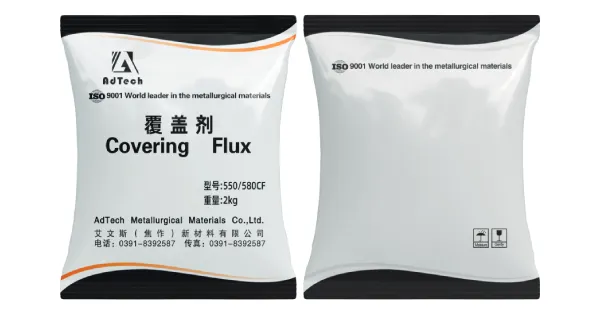
Covering flux sits on top of the molten pool like a lid. It typically melts at a lower temperature than aluminum itself (around 500°C to 650°C compared to aluminum’s melting point near 660°C), which means it liquefies quickly and spreads across the surface before serious oxidation can occur. The molten flux layer physically blocks oxygen and water vapor from reaching the metal, and it also helps trap small oxide particles that would otherwise stay suspended in the bath.
We’ve noticed operators sometimes confuse covering flux with drossing flux or degassing flux. They’re related but not interchangeable, and mixing up their functions leads to wasted material and poor melt quality.
The Chemistry Behind Aluminum Covering Flux
Most commercial covering flux formulations rely on a mixture of alkali and alkaline earth metal halides. The exact ratio depends on the target melting temperature, the alloy being processed, and whether the foundry needs additional oxide-absorbing capacity.
| Component | Typical Range (%) | Function |
|---|---|---|
| Sodium Chloride (NaCl) | 20-45 | Lowers melting point, base carrier salt |
| Potassium Chloride (KCl) | 15-40 | Increases fluidity, works synergistically with NaCl |
| Cryolite (Na3AlF6) | 5-15 | Improves oxide wetting and absorption |
| Calcium Fluoride (CaF2) | 3-10 | Raises viscosity control, aids slag separation |
| Magnesium Chloride (MgCl2) | 2-8 | Improves melt point depression |
| Carnallite (KCl·MgCl2) | 0-10 | Common in older formulations, reduces sticking |
The NaCl-KCl eutectic mixture forms the backbone of nearly every covering flux we’ve examined, because that combination melts around 650°C, right in the working range foundries need. Fluoride additions like cryolite improve what metallurgists call “wetting,” meaning the flux spreads thin and even instead of clumping in one spot.
We should mention something that doesn’t get discussed enough in supplier brochures: the ratio between chlorides and fluorides changes how aggressively the flux reacts with refractory linings. Higher fluoride content improves oxide separation but can accelerate wear on furnace linings over hundreds of cycles. This is a trade-off every purchasing manager should weigh against furnace maintenance budgets.
Covering Flux vs Drossing Flux vs Refining Flux
Confusion between flux categories is one of the most common issues we encounter when talking to plant technicians, especially those newer to aluminum melting operations. Each flux type serves a distinct stage of the melt process.
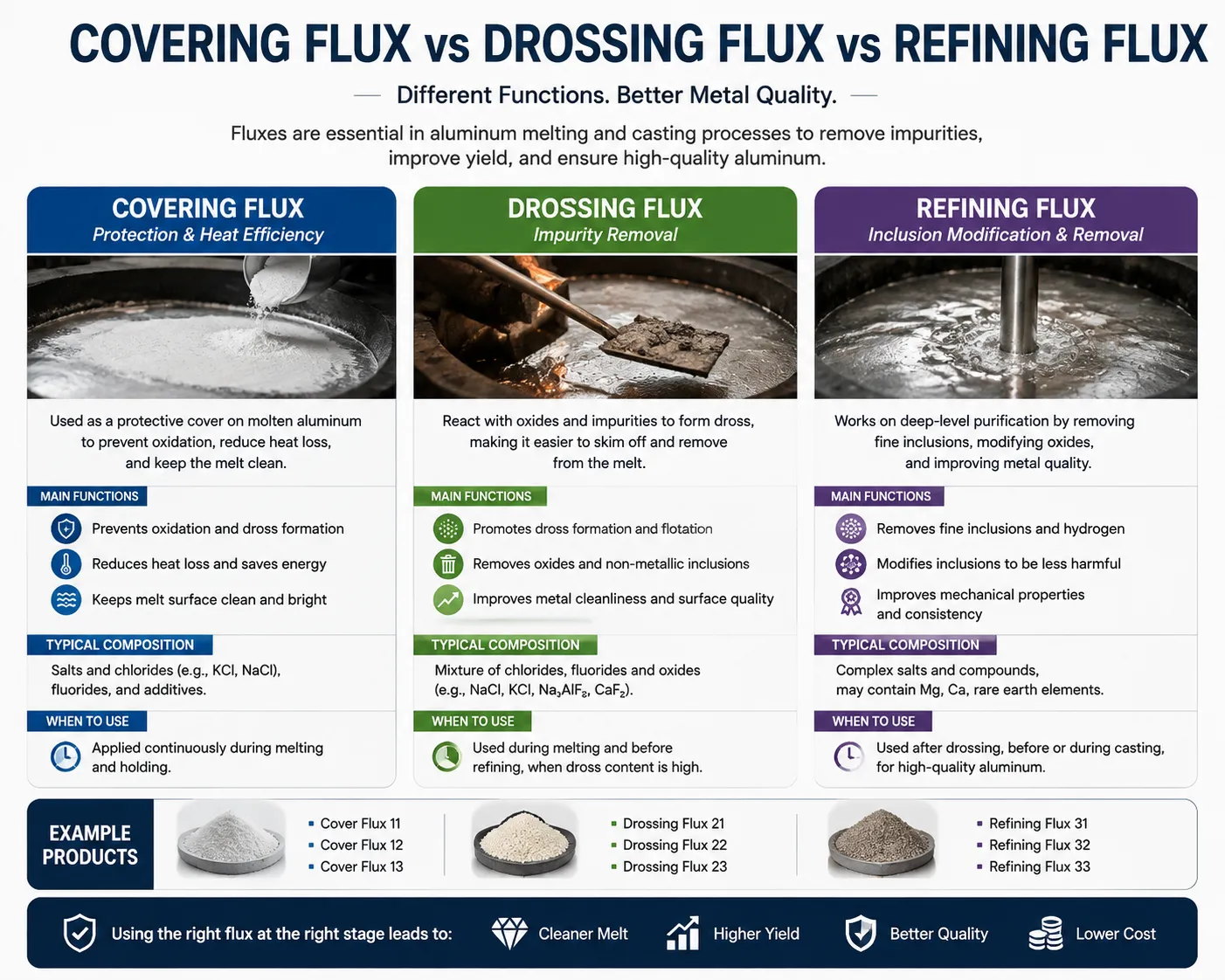
| Flux Type | Primary Purpose | Application Timing | Typical Dosage |
|---|---|---|---|
| Covering Flux | Prevents oxidation, forms protective layer | Applied immediately after charging, before melt reaches full temperature | 0.5-2 kg per ton of metal |
| Drossing Flux | Separates metallic aluminum trapped in dross | Applied before dross skimming | 1-3 kg per ton of metal |
| Refining Flux | Removes non-metallic inclusions from melt | Applied mid-cycle, before pouring | 0.3-1 kg per ton of metal |
| Degassing Flux | Removes dissolved hydrogen | Applied 10-15 minutes before pouring | 0.1-0.5 kg per ton of metal |
Covering flux stays on top of the melt the entire time metal sits in the furnace. Drossing flux is worked into the skimmings specifically to recover metal that would otherwise be lost. Refining and degassing serve completely separate chemical purposes and shouldn’t be substituted for a good covering layer.
We’ve seen shops try to save money by using a single “universal” flux for all four functions. It rarely works well. General-purpose flux compromises on every function to some degree, and the metal loss savings from proper covering flux alone usually pay back the cost difference within weeks.
Why Aluminum Oxidizes So Aggressively During Melting
Aluminum has a strong natural affinity for oxygen, stronger than iron, copper, or zinc. The reaction that forms aluminum oxide releases a large amount of energy (it’s exothermic), which is part of why the oxide skin forms almost instantaneously on exposure to air.
There’s a secondary problem beyond simple surface oxidation: hydrogen absorption. Molten aluminum can dissolve hydrogen from moisture in the atmosphere or from damp charge materials. When the metal solidifies, that dissolved hydrogen comes out of solution and creates porosity inside the casting. A good covering flux doesn’t eliminate hydrogen pickup entirely, but by reducing surface turbulence and blocking moisture contact, it lowers the overall hydrogen content picked up during the hold time.
We measured this at one client facility using a reduced-pressure test (RPT) before and after switching to a properly formulated covering flux. Porosity ratings dropped from a density index of around 8% to under 3% within two weeks of consistent flux application, without changing any other process variable.
Selecting the Right Covering Flux for Your Alloy
Not every aluminum alloy responds the same way to a given flux chemistry. High-magnesium alloys (5000 series) need different handling than high-silicon casting alloys (300 series) because magnesium reacts more aggressively with certain flux components.
| Alloy Family | Typical Alloys | Flux Consideration |
|---|---|---|
| 1000 Series (Pure Aluminum) | 1050, 1100 | Standard NaCl/KCl base works well, low fluoride needed |
| 3000 Series (Manganese) | 3003, 3004 | Standard covering flux, moderate cryolite content |
| 5000 Series (Magnesium) | 5052, 5083 | Requires higher fluoride content to manage Mg reactivity |
| 6000 Series (Mg-Si) | 6061, 6063 | Balanced chloride/fluoride blend recommended |
| 7000 Series (Zinc) | 7075 | Specialized low-sodium flux to avoid stress corrosion issues |
| 300 Series Casting Alloys | A356, A380 | High-fluidity flux with good dross separation |
Magnesium-bearing alloys deserve particular attention. Magnesium burns more readily than aluminum and can react violently with certain chloride salts if the flux isn’t formulated correctly. We always recommend requesting a technical data sheet from your flux supplier that specifically states compatibility with your alloy family, not just generic “aluminum covering flux” labeling.
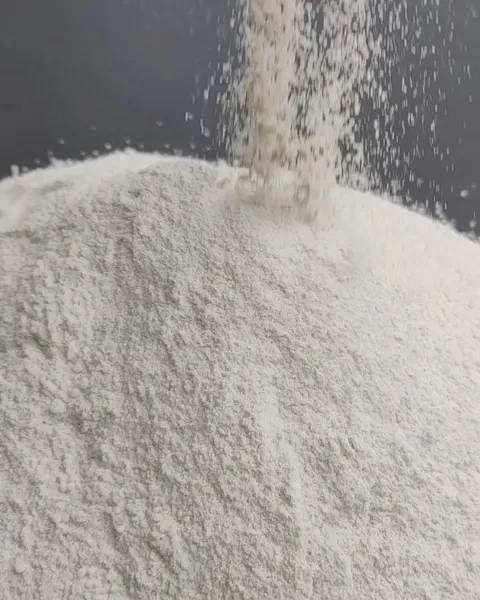
Application Methods and Best Practices
Getting flux chemistry right matters, but application technique determines whether that chemistry actually performs. We’ve watched experienced operators get excellent results from average flux, and we’ve watched premium flux underperform because of poor application habits.
Timing matters more than most people realize. Flux should go onto the melt surface as soon as enough liquid metal has formed to hold it, generally once about 30% of the charge has melted. Waiting until the entire charge liquefies gives oxidation more time to progress unchecked.
Distribution needs to be even. Sprinkling flux in one corner of the furnace does almost nothing for the rest of the exposed surface. Manual application should move in a sweeping pattern across the entire melt area. Larger furnaces benefit from mechanical flux dispensing systems that distribute material more consistently than hand shoveling ever could.
Quantity should match surface area, not just tonnage. A shallow, wide furnace has more exposed surface per ton of metal than a deep, narrow one, and dosage calculations should reflect that geometry rather than relying purely on weight-based rules of thumb.
| Furnace Type | Surface Area Factor | Recommended Flux Rate |
|---|---|---|
| Reverberatory Furnace | High exposure | 1.5-2.0 kg/ton |
| Induction Furnace | Moderate exposure | 0.8-1.2 kg/ton |
| Crucible Furnace | Low to moderate exposure | 1.0-1.5 kg/ton |
| Rotary Furnace | Moderate exposure, rotating melt | 1.2-1.8 kg/ton |
We generally advise new operators to start at the lower end of the recommended range and adjust upward based on visible dross formation and metal recovery data over a few production runs, rather than assuming the highest dosage automatically produces the best result. Over-fluxing wastes material, increases smoke generation, and can actually contribute to refractory attack over time.
Covering Flux for Aluminum: product introduction and customer application video showing molten aluminum protection in foundry operations.
Covering Flux vs Cover Gas: Which Protection Method Wins
Some modern foundries, particularly those handling high-value aerospace or automotive alloys, use inert cover gas (nitrogen or argon blends) instead of chemical flux. Both methods aim to prevent oxidation, but they work through completely different mechanisms and come with different cost structures.
| Factor | Chemical Covering Flux | Inert Cover Gas |
|---|---|---|
| Initial Equipment Cost | Low | High (requires gas delivery and sealed furnace systems) |
| Ongoing Material Cost | Moderate | Moderate to high depending on gas prices |
| Oxidation Prevention Effectiveness | Good | Excellent |
| Dross Reduction | Good | Excellent |
| Environmental Byproducts | Salt slag requiring disposal | Minimal |
| Suitability for Small Shops | Excellent | Often impractical |
| Suitability for High-Purity Alloys | Adequate | Preferred |
For most general-purpose aluminum casting operations, chemical covering flux remains the more economical and practical choice. Cover gas systems make more sense for specialized applications where slag disposal costs, purity requirements, or environmental permitting push operators toward gas-based protection. We’ve helped clients run cost comparisons between the two, and unless your operation processes very high volumes of premium alloy, flux typically wins on total cost of ownership.
Common Problems and Troubleshooting
Even experienced operators run into issues with covering flux performance. Below is a summary of the problems we hear about most often, along with the root causes we’ve traced them back to during plant audits.
| Problem Observed | Likely Cause | Recommended Fix |
|---|---|---|
| Excessive smoke during application | Flux applied too quickly onto very hot metal, or moisture content in flux is too high | Store flux in sealed containers, apply gradually |
| Flux not melting or spreading | Furnace temperature too low, or flux formulation has too high a melting point for the application | Verify furnace temperature reaches minimum 680°C before application |
| Increased dross despite flux use | Wrong flux type used (covering flux substituted for drossing flux) | Switch to dedicated drossing flux before skimming |
| Metal sticking to furnace walls | Excess fluoride content reacting with refractory | Reduce fluoride ratio or switch supplier formulation |
| Porosity in castings persists | Flux addressing oxidation but not hydrogen absorption | Add dedicated degassing step separate from covering flux |
| Flux crust too thick, hard to skim | Overdosing flux beyond surface requirement | Recalculate dosage based on surface area, not just tonnage |
Metal sticking to furnace walls is a complaint we hear surprisingly often, and it almost always traces back to fluoride-heavy formulations reacting with silica-based refractory linings. Switching to a lower-fluoride blend, or lining the furnace with a more fluoride-resistant refractory, usually resolves it within a few melt cycles.
Storage, Handling, and Safety Considerations
Covering flux components are generally hygroscopic, meaning they absorb moisture from the air readily. Damp flux performs poorly and, worse, introduces moisture directly into the melt, which increases hydrogen pickup rather than reducing it.
We recommend storing flux in sealed drums or moisture-barrier bags, kept off the floor on pallets in a dry area away from furnace steam and ambient humidity. Once a container is opened, using the contents within a reasonable timeframe (we suggest within 30 days in humid climates) prevents caking and clumping that make even application difficult.
Personal protective equipment matters more than some operators assume. Flux dust can irritate respiratory passages, and molten flux splashes cause serious burns similar to molten metal contact. Standard foundry PPE, including face shields, heat-resistant gloves, and respiratory protection during dry flux handling, should be non-negotiable in any facility using these materials.
| Safety Concern | Recommended Control Measure |
|---|---|
| Respiratory irritation from dust | N95 or better respirator during dry handling |
| Skin/eye contact with molten flux | Face shield, heat-resistant gloves, long sleeves |
| Moisture contamination | Sealed storage containers, climate-controlled storage area |
| Fume inhalation during application | Adequate furnace hood ventilation |
| Chemical burns from splash | Full protective clothing, safety training before first use |
Environmental and Regulatory Notes
Salt flux residue (the leftover slag after dross skimming) is classified as a hazardous waste in several jurisdictions because of its chloride and fluoride content and its reactivity with water. Facilities need documented disposal procedures, and in many regions, salt slag must go to licensed recycling facilities rather than standard landfills.
We’ve worked with clients in the EU and North America navigating REACH and EPA guidelines respectively, and the pattern we see consistently is that facilities underestimate disposal costs when budgeting for flux programs. Factoring in proper slag disposal from the start, rather than treating it as an afterthought, keeps operations compliant and avoids costly retroactive fixes.
Some regions have pushed manufacturers toward low-fume or “green” flux formulations that reduce chlorine gas emission during application. These formulations often replace a portion of chloride content with fluoride-based alternatives or proprietary binders. Performance is generally comparable, though cost tends to run 10% to 20% higher than traditional formulations.
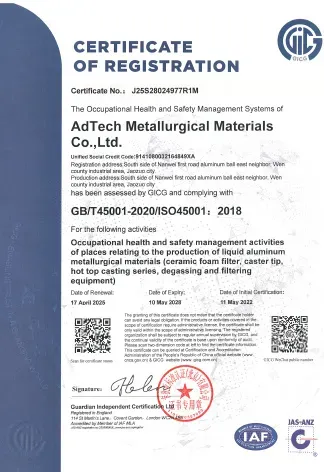
How to Evaluate a Covering Flux Supplier
Purchasing decisions for industrial flux shouldn’t be based on price alone. When we advise procurement teams on supplier selection, we push them toward evaluating several factors beyond the quoted price per kilogram.
| Evaluation Criteria | Why It Matters |
|---|---|
| Consistent particle size distribution | Uneven granulation causes inconsistent melting and spreading |
| Documented chemical composition (COA) | Verifies actual content matches specification, batch to batch |
| Moisture content certification | Prevents unexpected hydrogen pickup issues |
| Alloy compatibility documentation | Confirms flux suits your specific alloy family |
| Technical support availability | Access to metallurgical troubleshooting when issues arise |
| Packaging and shelf-life guarantees | Reduces waste from moisture absorption during storage |
A supplier that can’t provide a certificate of analysis for each batch is a red flag in our experience. Composition drift between batches, even small shifts of a few percentage points in chloride-to-fluoride ratio, can noticeably change how the flux performs on your specific furnace and alloy combination.
Cost Analysis: Is Covering Flux Worth the Investment
Every plant manager eventually asks whether the expense of covering flux actually pays off compared to simply accepting higher melt loss. We ran the numbers based on typical mid-size foundry operations processing around 500 tons of aluminum monthly.
| Cost Factor | Without Covering Flux | With Covering Flux |
|---|---|---|
| Metal loss rate | 4-6% | 1.5-2.5% |
| Monthly metal loss (at $2,400/ton aluminum) | $48,000-$72,000 | $18,000-$30,000 |
| Monthly flux material cost | $0 | $2,000-$4,000 |
| Net monthly savings | Baseline | $22,000-$38,000 |
These figures shift depending on aluminum spot prices and furnace type, but the pattern holds consistently across every facility we’ve reviewed: the material cost of covering flux is a small fraction of the metal value it protects. Operators who skip flux to cut short-term costs almost always end up spending more on replacement metal than they save.
Frequently Asked Questions
What temperature should covering flux be applied at?
Covering flux performs best when applied once the melt reaches roughly 680°C to 700°C, early enough that oxidation hasn’t progressed significantly but hot enough that the flux liquefies and spreads properly across the surface.
Can covering flux be used with recycled or scrap aluminum?
Yes, and it’s actually more important with scrap metal because recycled aluminum tends to carry more surface contamination, coatings, and moisture that increase oxidation risk during remelting.
How long does covering flux stay effective on the melt surface?
A properly applied layer typically remains protective for the duration of a standard melt-hold cycle, usually several hours, though it should be reapplied or refreshed if the surface is disturbed by skimming or metal transfer.
Does covering flux affect the mechanical properties of finished aluminum parts?
When used correctly and skimmed off before pouring, covering flux has no measurable effect on mechanical properties. Problems only arise when flux residue gets mixed into the metal itself rather than staying on the surface.
What’s the difference between granular and powder covering flux?
Granular flux spreads more evenly and produces less airborne dust, making it preferable for manual application. Powder flux melts slightly faster but generates more fume and requires better ventilation controls.
Can I mix covering flux with degassing tablets in the same application?
Generally no, these serve separate functions with different timing requirements. Covering flux protects the surface continuously, while degassing tablets work through the melt bulk shortly before pouring. Combining them in one step typically compromises both functions.
Why does my flux sometimes appear to “boil” on contact with the melt?
This usually indicates moisture content in the flux itself, causing rapid steam generation. Switching to a fresh, properly sealed batch resolves this issue in almost every case we’ve investigated.
Is covering flux the same for die casting and sand casting?
The core chemistry is similar, but die casting operations often use lower dosages because cycle times are shorter and surface exposure is more controlled compared to sand casting, which involves longer hold times and more open surface exposure.
How do I know if I’m using too much covering flux?
Signs of overdosing include excessive slag buildup that’s difficult to skim, visible flux residue trapped in castings, and higher than expected material costs without corresponding improvement in metal recovery rates.
Does covering flux work for aluminum alloys with high magnesium content like 5083 or 5086?
Yes, but these alloys need flux formulations with adjusted fluoride ratios to manage magnesium’s higher reactivity. Standard low-fluoride flux designed for pure aluminum won’t perform adequately on high-magnesium alloys.
Final Thoughts From the Shop Floor
After years of working directly with foundries on flux selection and troubleshooting, our take is straightforward: covering flux is one of the highest-return, lowest-cost investments available in aluminum melting operations, provided it’s matched correctly to the alloy, applied at the right time, and stored properly to avoid moisture contamination. The technical details matter, chemistry ratios, dosage rates, application timing, but the biggest performance gains we’ve observed at client facilities came from fixing basic handling habits rather than switching to more expensive formulations.
If you’re evaluating covering flux options for your own operation, start with a proper composition analysis for your specific alloy family, confirm your supplier provides batch-level documentation, and track your metal recovery rates before and after implementation. Numbers don’t lie, and in nearly every case we’ve reviewed, the data makes the value of covering flux obvious within the first production month.