

Rotary degassing is a molten aluminum treatment process that uses a rotating rotor or impeller to disperse an inert gas, usually nitrogen or argon, into liquid aluminum. The resulting fine gas bubbles provide a large gas-metal contact area, allowing dissolved hydrogen to transfer from the molten aluminum into the bubbles and leave the melt. Rotary degassing can also assist with the flotation and removal of some non-metallic inclusions, although it should not be treated as a replacement for dedicated filtration. The actual treatment performance depends on factors such as rotor design, rotation speed, gas flow rate, treatment time, melt temperature, alloy composition, melt volume and surface turbulence.
For aluminum foundries and aluminum casting plants, the main reason to use rotary degassing is control of dissolved hydrogen and the casting defects associated with excessive hydrogen. During solidification, hydrogen solubility decreases sharply, so hydrogen that remains dissolved in the liquid metal can contribute to gas porosity. The Aluminum Association defines gas porosity as porosity caused by entrapped gas or by the evolution of dissolved hydrogen during solidification.
Rotary degassing is therefore one part of a broader molten aluminum purification system. Depending on the casting process and required metal cleanliness, a production line may combine degassing, flux treatment, ceramic foam filtration, launders and other melt-treatment technologies.
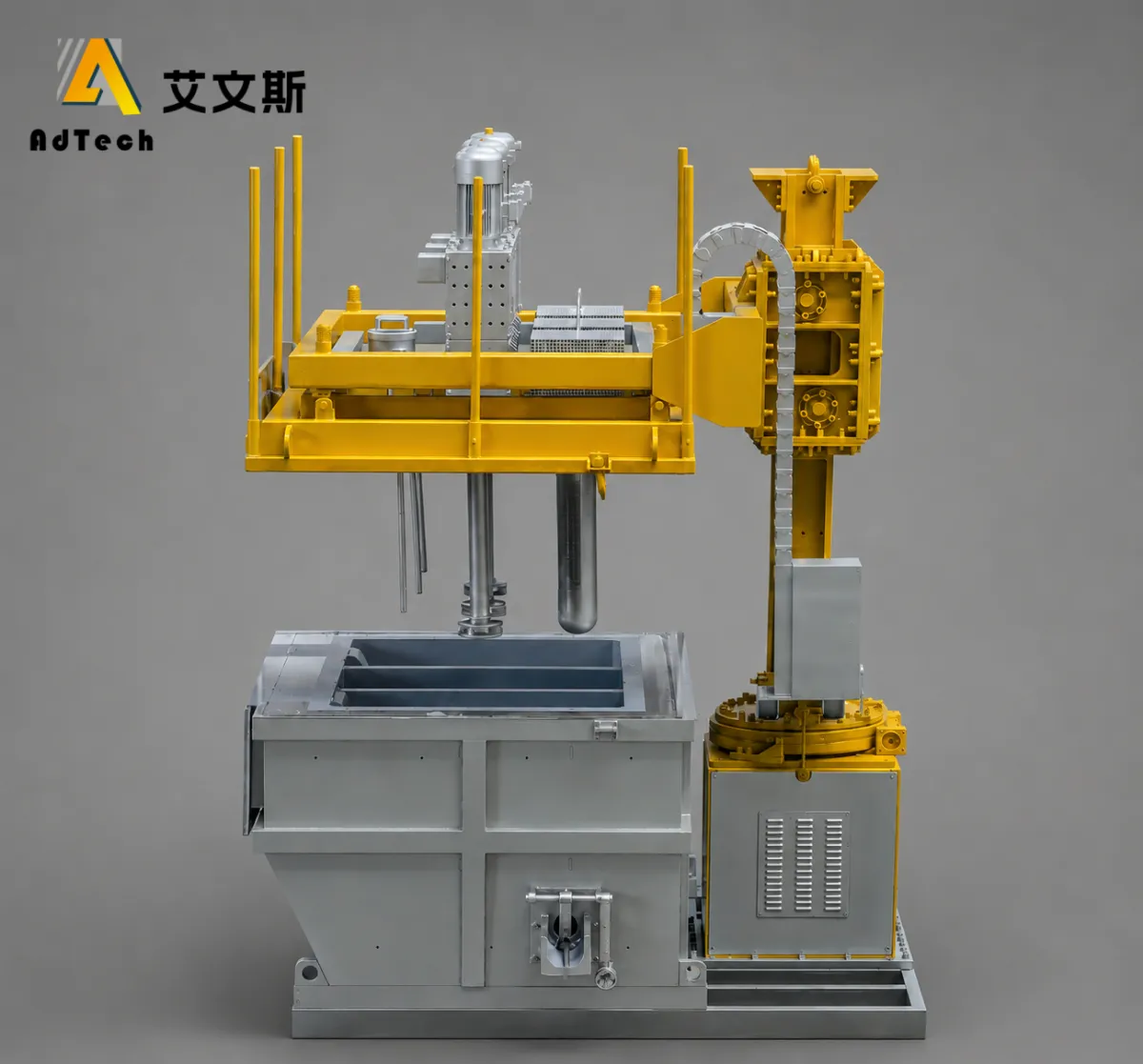
What Does Rotary Degassing Do to Molten Aluminum?
The primary function of rotary degassing is to reduce dissolved hydrogen in molten aluminum.
A simplified process is:
Molten aluminum → inert gas injection → rotor dispersion → fine bubbles → hydrogen transfer → bubbles rise → hydrogen leaves the melt
A rotating graphite rotor is immersed in the molten metal. Inert gas enters through the shaft and is dispersed through the rotor. Rotation breaks up and distributes the gas within the melt.
As the bubbles move through the aluminum, dissolved hydrogen transfers into the gas phase. The hydrogen-containing bubbles then rise toward the surface.
This mechanism is fundamentally different from simply inserting a stationary gas lance into the melt. The rotating rotor adds mechanical agitation and improves gas dispersion.
Research on rotary impeller degassing describes hydrogen removal as a diffusion process in which dissolved hydrogen moves from the aluminum melt into rising gas bubbles. The same process can also assist the removal of solid particles through clustering, flotation and attachment to bubbles.
The main objectives are
| Objective | Role of rotary degassing |
|---|---|
| Hydrogen removal | Primary purpose |
| Reduction of hydrogen-related porosity | Important casting-quality benefit |
| Inclusion flotation | Can assist removal of some inclusions |
| Melt mixing | Rotor circulation can improve treatment uniformity |
| Flux-assisted cleaning | Can be combined with appropriate flux treatment |
| Final filtration | Requires a separate filtration system when high cleanliness is needed |
The distinction between these functions matters.
Degassing is primarily a gas-removal process. Filtration is primarily a physical inclusion-removal process.
A high-quality aluminum casting operation may need both.
Read more: Rotary Degassing Aluminum: High-Efficiency Unit, Graphite Rotor Specs
Why Does Molten Aluminum Need Degassing?
Hydrogen is a particular concern in aluminum casting because its behavior changes significantly between liquid and solid aluminum.
When aluminum is molten, hydrogen can dissolve into the metal. During solidification, hydrogen solubility decreases substantially. If the hydrogen cannot escape before solidification, gas can form inside the casting.
This can contribute to:
- Gas porosity
- Pinholes
- Reduced mechanical properties
- Leakage problems
- Surface defects
- Reduced internal quality
The relationship between hydrogen and porosity is well established in aluminum metallurgy. Recent research describes hydrogen as the primary gas associated with gas porosity in aluminum alloys because its solubility falls sharply during solidification.
However, hydrogen is not the only source of casting defects.
Molten aluminum can also contain:
- Oxide films
- Non-metallic inclusions
- Dross particles
- Alkali metals
- Other unwanted contaminants
This is why a complete melt-treatment strategy should not rely on degassing alone.
The Aluminum Association’s life-cycle documentation describes aluminum melt treatment using gas and fluxing technologies for removing entrained gases and inorganic particulates, followed in relevant processes by inline filtration for oxide removal.
How Does Rotary Degassing Work?
The process can be understood in five stages.
1. The rotor enters the molten aluminum
A graphite or other suitable high-temperature rotor is immersed into the molten aluminum.
The rotor is connected to a rotating shaft. Gas travels through the shaft and exits through the rotor.
The rotor must withstand:
- High temperature
- Chemical attack
- Mechanical rotation
- Thermal cycling
- Contact with molten aluminum
Rotor material, geometry and surface condition therefore affect equipment reliability.
2. Inert gas enters the melt
Nitrogen and argon are commonly used as purging gases.
The purpose of the inert gas is to provide a low hydrogen partial-pressure environment inside the bubbles.
The exact gas selection depends on alloy chemistry, plant practice, required metal quality, equipment design and process objectives.
Some industrial systems also use gas mixtures or combine gas treatment with flux injection. Pyrotek, for example, describes rotary systems capable of degassing and fluxing molten aluminum using configurable gas and flux arrangements.
3. The rotating rotor disperses the gas
This is the defining feature of rotary degassing.
Instead of allowing the gas to enter the melt as one relatively large stream, rotor rotation disperses the gas into smaller bubbles and distributes them through the treatment zone.
The objective is not simply to inject more gas.
The objective is to create an effective combination of:
- Bubble size
- Bubble distribution
- Gas-metal contact area
- Bubble residence time
- Melt circulation
- Treatment volume
Research has demonstrated that rotor rotation speed and gas flow rate both influence degassing efficiency. However, increasing gas flow beyond an appropriate range can reduce efficiency because excessive gas can create unfavorable flow conditions around the rotor.
4. Hydrogen transfers into the bubbles
Dissolved hydrogen moves from the liquid aluminum into the gas bubbles.
The driving force comes from the difference between hydrogen concentration in the melt and hydrogen partial pressure in the bubbles.
As fresh inert gas continues entering the melt, the bubbles can continue carrying hydrogen away from the liquid.
This is why bubble dispersion matters.
For the same gas volume, smaller bubbles provide greater total gas-liquid interfacial area. However, bubble size is not controlled by gas flow alone. Rotor geometry, speed, gas flow, melt properties and operating conditions all interact.
5. Hydrogen-containing bubbles rise to the surface
After traveling through the melt, the bubbles rise toward the surface.
Hydrogen leaves the metal with the gas phase.
Some inclusions can also be transported toward the surface during the treatment process, where they can become part of the dross or surface layer and subsequently be removed.
However, this secondary inclusion-removal effect does not eliminate the need for downstream filtration when the casting process requires high metal cleanliness.
Rotary Degassing vs Simple Gas Bubbling
One common misunderstanding is that rotary degassing is simply gas bubbling with a motor attached.
The difference is gas dispersion.
A stationary lance can introduce gas into molten aluminum, but the gas may form comparatively large bubbles or concentrated flow channels.
A rotating impeller mechanically disperses the gas and creates melt circulation.
| Factor | Simple gas injection | Rotary degassing |
|---|---|---|
| Gas introduction | Through lance or diffuser | Through rotating rotor |
| Mechanical agitation | Limited | Yes |
| Bubble dispersion | Depends strongly on diffuser | Enhanced by rotor design |
| Melt circulation | Limited | Stronger |
| Hydrogen removal | Possible | Generally designed for efficient treatment |
| Process control | Depends on system | Can integrate speed, gas and treatment controls |
| Equipment complexity | Lower | Higher |
| Maintenance | Generally simpler | Rotor and shaft require maintenance |
This does not mean rotary degassing is automatically better in every situation.
The correct question is:
What metal quality target and production conditions must the melt-treatment system achieve?
For a small furnace with relatively modest quality requirements, a simpler treatment method may be sufficient. For continuous production, high-quality alloys or processes with strict hydrogen control, rotary or inline degassing can provide a more controllable treatment approach.
Which Parameters Affect Rotary Degassing Performance?
There is no single universal rotor speed or gas-flow setting that applies to every aluminum foundry.
This is one of the most important points for equipment buyers.
A published research study on 2524 aluminum alloy found that rotor speed and inert-gas flow rate strongly affected degassing efficiency. Under the conditions of that particular study, a rotor speed of approximately 550 to 690 rpm and gas flow of 1 to 3 L/min were identified as appropriate. These values should not be copied directly into another production line because the study conditions, equipment and alloy were specific to that experiment.
A more recent 2026 study on A356 aluminum alloy investigated rotor speed, treatment time and gas flow rate and reported improved melt cleanliness with changes in those parameters. Again, the results belong to the tested alloy and experimental conditions rather than representing a universal recipe.
The major variables include the following.
Rotor speed
Higher rotation speed can improve gas dispersion and reduce bubble size within an appropriate operating range.
However, more speed is not automatically better.
Excessive rotation can increase:
- Surface turbulence
- Oxide formation
- Air entrainment
- Rotor wear
- Energy consumption
The target is effective bubble dispersion without unnecessary surface disturbance.
Gas flow rate
Increasing gas flow can increase the number of bubbles and potentially improve hydrogen transfer.
But excessive gas flow can create unstable flow conditions.
Research on 2524 aluminum found that efficiency improved as gas flow increased within a certain range, but excessive flow reduced efficiency.
Therefore:
Maximum gas flow is not the same as maximum degassing efficiency.
Treatment time
Longer treatment can increase the amount of hydrogen removed, but longer is not automatically better.
A longer cycle may also:
- Increase temperature loss
- Increase energy consumption
- Increase rotor exposure
- Increase surface turbulence
- Reduce production throughput
A 2026 study comparing rotary and ultrasonic degassing found that longer rotary treatment did not necessarily produce proportional improvements in melt quality.
Melt temperature
Temperature influences:
- Hydrogen solubility
- Melt viscosity
- Gas behavior
- Bubble movement
- Treatment kinetics
Therefore, degassing parameters should be established for the actual alloy and production temperature.
Rotor design
Rotor diameter, geometry, gas outlet arrangement and rotational characteristics affect:
- Bubble dispersion
- Circulation pattern
- Treatment volume
- Surface turbulence
- Wear
A rotor designed for one vessel geometry may not produce the same result in another vessel.
Melt volume and vessel geometry
The same rotor can behave differently in:
- A small crucible
- A holding furnace
- A transfer ladle
- An inline degassing chamber
Furnace depth, width, baffles and rotor position influence circulation.
Alloy composition
Different alloys respond differently to melt treatment.
Magnesium content, alloying elements, melt temperature and oxide condition can influence the treatment process.
For this reason, suppliers should evaluate the actual alloy range instead of selecting equipment based only on furnace capacity.
Why Excessive Turbulence Can Be a Problem
Rotary degassing requires agitation, but uncontrolled agitation can create another problem.
The surface of molten aluminum naturally develops oxide films.
When excessive turbulence folds the metal surface into the melt, oxide films can become entrained as bifilms or additional inclusions.
This creates a process trade-off:
Enough agitation to disperse gas effectively, but not so much turbulence that melt quality deteriorates.
Recent research has specifically discussed this issue. Rotary degassing can improve hydrogen and inclusion removal, but surface disturbance can also promote the formation or re-entrainment of oxide films under some conditions.
This is why rotor design, speed, gas flow and vessel geometry should be optimized together.
Does Rotary Degassing Remove Inclusions?
Partly, but it should not be considered a substitute for filtration.
Rotary degassing can assist inclusion flotation.
Gas bubbles can interact with particles, while melt circulation can promote clustering and movement toward the surface. Academic research has modeled rotary degassing as a process capable of removing both hydrogen and solid particles.
However, ceramic foam filtration performs a different function.
A ceramic foam filter provides a physical filtration structure that captures non-metallic inclusions as molten aluminum passes through the filter.
AdTech describes its ceramic foam filters as using adsorption to remove larger inclusions and absorb smaller inclusions from molten aluminum.
The practical distinction is:
| Treatment | Primary purpose |
|---|---|
| Rotary degassing | Reduce dissolved hydrogen |
| Flux treatment | Chemical cleaning and removal of selected impurities |
| Ceramic foam filter | Physical removal of non-metallic inclusions |
| Deep-bed filtration | High-capacity fine filtration |
| Launder system | Controlled transfer of molten aluminum |
For high-cleanliness applications, these technologies can complement each other rather than compete with each other.
Rotary Degassing and Ceramic Foam Filtration: Why Use Both?
A typical aluminum melt-treatment concept may be:
Melting / Holding → Degassing → Filtration → Casting
The exact arrangement depends on the plant and equipment design.
The reason for combining the technologies is straightforward.
Rotary degassing targets dissolved gas, particularly hydrogen.
The ceramic foam filter targets solid inclusions.
If a production line only focuses on hydrogen, non-metallic inclusions may remain.
If it only focuses on filtration, dissolved hydrogen may remain.
This distinction becomes particularly important for:
- High-quality billet
- Slab casting
- High-quality wrought alloys
- Automotive applications
- Aerospace-related aluminum products.
- Electronics-related aluminum products.
- Applications with strict internal cleanliness requirements.
AdTech’s product portfolio includes both online degassing equipment and ceramic foam filtration systems, allowing these treatment functions to be considered as parts of a broader aluminum purification system.
In-Furnace Rotary Degassing vs Inline Degassing
Rotary degassing can be performed in different process configurations.
In-furnace degassing
The rotor is introduced directly into a furnace, crucible or ladle containing molten aluminum.
This approach can be useful when:
- The melt is treated batch by batch
- Production is intermittent
- Furnace-based treatment is convenient.
- The plant requires flexible treatment of different batches.
Mobile rotary degassing systems are available for crucibles and transfer ladles.
Inline degassing
In an inline system, molten aluminum flows continuously through a dedicated treatment chamber.
This approach is particularly suitable for:
- Continuous casting
- Large production volumes
- Controlled metal flow
- Continuous melt treatment
- High-volume billet or slab production
Pyrotek describes inline degassing systems using multiple nozzles depending on flow rate and hydrogen-reduction requirements, while STAS describes sealed inline rotary systems installed directly in the casting trough.
The selection should therefore be based on the production process rather than on the label “rotary degassing” alone.
What Specifications Should Buyers Request?
When purchasing rotary degassing equipment, furnace capacity alone is not enough information.
A supplier should understand the complete process.
Recommended information to provide
| Parameter | Why it matters |
|---|---|
| Alloy grades | Influences treatment requirements |
| Minimum and maximum melt volume | Determines treatment capacity |
| Metal flow rate | Critical for inline equipment |
| Melt temperature | Influences treatment behavior |
| Target hydrogen level | Defines required treatment performance |
| Furnace or vessel dimensions | Determines rotor arrangement |
| Treatment location | Furnace, ladle, crucible or inline |
| Gas type | Nitrogen, argon or approved mixture |
| Existing filtration | Determines complete purification strategy |
| Production hours | Affects equipment durability |
| Required automation | Determines control-system requirements |
| Flux treatment requirements | May require flux injection |
| Available utilities | Important for installation |
| Alloy change frequency | Influences cleaning and maintenance requirements |
A supplier should not select a system based only on “100-ton furnace” or “20-ton furnace.”
Two furnaces with the same nominal capacity can have very different process requirements.
What Should You Ask a Rotary Degassing Equipment Supplier?
Before comparing quotations, ask suppliers for answers to the following questions.
1. What hydrogen-removal performance can the system achieve?
Do not accept only a general statement such as “high efficiency.”
Ask for:
- Initial hydrogen condition
- Target hydrogen condition
- Test method
- Alloy tested
- Melt temperature
- Gas type
- Gas flow
- Treatment time
2. What rotor speed range is available?
The supplier should explain the applicable operating range rather than simply providing one maximum speed.
3. What gas-flow range is recommended?
Ask whether the recommended range changes with:
- Melt volume
- Alloy
- Rotor design
- Treatment time
4. What is the expected rotor service life?
Rotor life depends on:
- Material
- Coating
- Temperature
- Rotation speed
- Alloy
- Maintenance
- Thermal cycling
5. What happens when the rotor wears?
Ask about:
- Rotor replacement
- Shaft replacement
- Coupling
- Spare parts
- Maintenance intervals
6. How is the process controlled?
Modern equipment can include monitoring for:
- Gas pressure
- Gas flow
- Temperature
- Rotor condition
- Abnormal operation
- Maintenance requirements
AdTech’s online degassing equipment, for example, lists monitoring functions for temperature, rotor abnormalities and gas abnormalities.
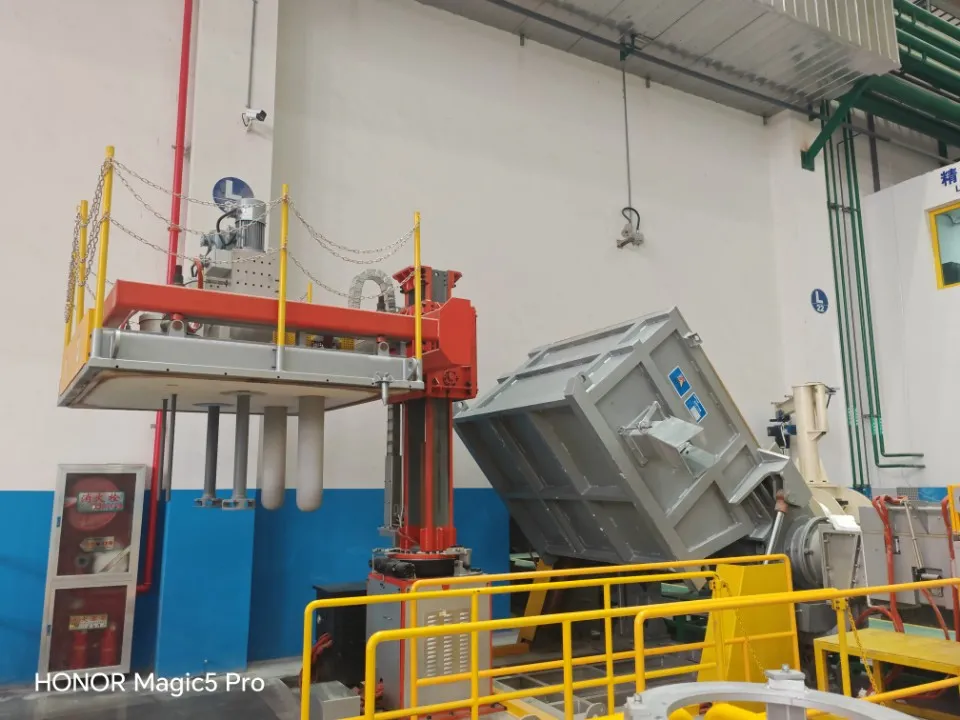
How Does AdTech Approach Molten Aluminum Degassing?
AdTech develops and manufactures equipment and materials for molten aluminum purification, including online degassing equipment, filtration equipment, ceramic foam filters, launders, fluxes and related casting components.
According to AdTech’s published degassing equipment information, its online degassing units use ceramic-manufactured components for the degassing rotor and protective thimbles, with the equipment designed for molten aluminum purification.
The published equipment range includes models from approximately 6 t/h to 75 t/h, with configurations using one, two or three rotors depending on the model. The same published specification table also identifies residual aluminum capacity and gas-system options.
AdTech publishes the following performance targets for its online degassing equipment:
- For melts with Mg content ≤1%, degassing efficiency ≥60% or outlet hydrogen content ≤0.12 ml/100 g Al.
- For melts with Mg content >1%, degassing efficiency ≥55% or outlet hydrogen content ≤0.14 ml/100 g Al.
These are manufacturer-published specifications and should be understood as equipment performance targets under the applicable operating conditions, rather than universal results for every alloy or installation.
AdTech also describes an optional argon-chlorine gas system for applications requiring additional treatment of hydrogen and selected alkali metals.
For plants requiring a broader purification system, AdTech also supplies ceramic foam filters, alumina filter media, plate-type filtration equipment, deep-bed equipment and cartridge filtration equipment.
Common Rotary Degassing Mistakes
Mistake 1: Assuming more gas always means better degassing
It does not.
Research has shown that excessive gas flow can reduce treatment efficiency under certain conditions.
The objective is effective gas dispersion, not maximum gas consumption.
Mistake 2: Increasing rotor speed without considering surface turbulence
Higher speed can improve dispersion, but excessive agitation can increase oxide entrainment.
The operating window must balance gas dispersion and melt stability.
Mistake 3: Treating degassing as a complete filtration process
Rotary degassing primarily addresses dissolved gas.
A ceramic foam filter or another filtration technology may still be required for non-metallic inclusions.
Mistake 4: Copying another plant’s parameters
A rotor speed that works for one alloy and vessel may not be appropriate for another.
The process should be validated against the actual:
- Alloy
- Melt volume
- Temperature
- Rotor
- Gas
- Vessel
- Treatment time
Mistake 5: Comparing equipment only by furnace capacity
Equipment selection should consider metal flow, treatment target, vessel geometry, production rate and required automation.
Mistake 6: Ignoring temperature loss
Long treatment cycles can reduce melt temperature.
This may increase downstream reheating requirements and energy consumption.
A 2023 study of recycled aluminum found that eliminating a rotary degassing step reduced temperature loss and reheating energy under that specific process configuration. This does not mean degassing should generally be eliminated. It demonstrates that treatment energy and thermal losses should be considered when optimizing a real production line.
How Can Rotary Degassing Performance Be Verified?
Equipment specifications are useful, but actual melt quality should be evaluated using appropriate process measurements.
Possible approaches include:
Reduced Pressure Test
RPT is widely used as a practical method for evaluating hydrogen-related melt quality and porosity tendency.
Research on rotary degassing has used RPT and other analytical techniques to compare melt quality before and after treatment.
Hydrogen measurement
Where available, direct or instrument-based hydrogen measurement can provide more quantitative information about dissolved hydrogen.
Density Index
Density index measurements can be used to evaluate changes associated with dissolved gas and porosity tendency. Research on rotary impeller degassing has used density index measurements to assess hydrogen reduction.
Inclusion analysis
If the application requires very high cleanliness, inclusion assessment should also be considered.
This is important because a low hydrogen result does not automatically prove that the melt is free of non-metallic inclusions.
Is Rotary Degassing Always Necessary?
Not necessarily.
The need for degassing depends on:
- Alloy
- Melt source
- Scrap ratio
- Furnace practice
- Moisture exposure
- Holding time
- Casting process
- Product requirements
- Hydrogen specification
- Porosity tolerance
A plant should first identify the actual defect or quality problem.
For example, if the dominant problem is dissolved hydrogen, degassing may be a central treatment.
If the dominant problem is non-metallic inclusion contamination, filtration may have greater importance.
If the problem is both hydrogen and inclusions, a combined melt-treatment strategy may be appropriate.
The right equipment is therefore determined by the quality problem and production process, not simply by the product category.
Rotary Degassing: Key Advantages and Limitations
| Aspect | Advantage | Limitation |
|---|---|---|
| Hydrogen removal | Effective industrial method | Requires correct process parameters |
| Gas dispersion | Rotor improves dispersion | Rotor and shaft require maintenance |
| Melt circulation | Helps treatment uniformity | Excessive agitation can create oxide problems |
| Inclusion flotation | Can assist flotation | Not a replacement for fine filtration |
| Automation | Can be integrated into control systems | Higher system complexity |
| Production | Suitable for batch and continuous processes | Equipment selection depends on process |
| Gas consumption | Can be optimized | Excessive flow wastes gas and may reduce efficiency |
| Treatment time | Can be relatively short | Longer treatment increases thermal and production costs |
| Quality control | Can be monitored and validated | Performance must be verified under actual conditions |
A Practical Selection Framework
For an aluminum foundry considering rotary degassing, the following sequence is more useful than starting with a specific machine model.
Step 1: Identify the quality problem
Is the main problem:
- Hydrogen?
- Porosity?
- Inclusions?
- Dross?
- Alkali metals?
- A combination?
Step 2: Establish the production conditions
Determine:
- Alloy
- Melt temperature
- Melt volume
- Flow rate
- Furnace type
- Casting method
- Production rate
Step 3: Define the target
Examples include:
- Maximum hydrogen content
- Required RPT result
- Inclusion cleanliness
- Production throughput
- Acceptable treatment time
Step 4: Select the treatment architecture
Possible solutions include:
In-furnace rotary degassing
or
Inline rotary degassing
or
Degassing + flux treatment
or
Degassing + ceramic foam filtration
or
Degassing + high-capacity filtration
The final configuration should be based on the actual production requirements.
Step 5: Validate the process
After installation, verify:
- Hydrogen level
- Melt cleanliness
- Casting quality
- Temperature loss
- Gas consumption
- Treatment time
- Rotor condition
This creates a process-based purchasing decision rather than a specification-based purchasing decision.
Frequently Asked Questions
Is rotary degassing the same as aluminum degassing?
Not exactly.
Aluminum degassing is the broader process of removing dissolved gas from molten aluminum. Rotary degassing is one specific technology that uses a rotating rotor or impeller to disperse an inert gas into the melt.
What gas is used for rotary degassing of aluminum?
Nitrogen and argon are commonly used. The appropriate gas depends on alloy chemistry, process requirements, equipment design and the desired melt quality.
What does rotary degassing remove from molten aluminum?
Its primary target is dissolved hydrogen. It can also assist with the flotation and removal of some non-metallic inclusions, but dedicated filtration may still be necessary.
Does rotary degassing prevent porosity?
It can reduce hydrogen-related porosity by reducing dissolved hydrogen before solidification. However, porosity can have multiple causes, so degassing alone cannot guarantee defect-free castings.
Is rotary degassing better than gas lance degassing?
Rotary degassing generally provides more controlled gas dispersion because the rotating rotor mechanically breaks up and distributes the gas. However, whether it is the appropriate solution depends on production scale, quality requirements and process conditions.
What affects rotary degassing efficiency?
Important variables include rotor design, rotor speed, gas flow rate, treatment time, melt temperature, alloy composition, melt volume and vessel geometry.
Can rotary degassing remove oxide inclusions?
It can assist inclusion flotation, but it is not a direct replacement for ceramic foam or deep-bed filtration when high inclusion-removal performance is required.
How long should molten aluminum be rotary degassed?
There is no universal treatment time. It must be established for the alloy, melt volume, equipment, gas flow, rotor design and required hydrogen level. Longer treatment is not necessarily better.
Should degassing happen before ceramic foam filtration?
In many melt-treatment systems, degassing and filtration are complementary processes. The actual sequence depends on the equipment layout and process design, but degassing is commonly used to reduce dissolved hydrogen while filtration provides downstream physical removal of non-metallic inclusions. The Aluminum Association describes inline filtration as a subsequent treatment step in relevant aluminum processing routes.
What information should I provide when requesting a rotary degassing quotation?
Provide the alloy grades, melt volume, furnace or vessel dimensions, metal flow rate if applicable, melt temperature, target hydrogen level, treatment location, gas type, production rate and existing filtration equipment. This allows the supplier to evaluate the complete process rather than selecting a machine only from furnace capacity.
Conclusion
Rotary degassing is a controlled molten aluminum treatment process that combines inert gas injection with mechanical rotor action. Its main purpose is to reduce dissolved hydrogen before casting, while the resulting bubble circulation can also assist with the flotation of some inclusions.
The important point for process engineers and buyers is that rotary degassing performance does not depend on one specification alone. Rotor speed, gas flow, bubble dispersion, treatment time, melt temperature, alloy composition, vessel geometry and surface turbulence interact with one another. Research has repeatedly shown that the optimum parameters are process-specific.
Rotary degassing should also be viewed as one component of molten aluminum purification rather than a complete solution for every melt-quality problem. Where non-metallic inclusions must be controlled to a high level, ceramic foam filters, deep-bed filtration or other filtration technologies may be required alongside degassing.
For an aluminum foundry selecting equipment, the most useful starting point is therefore not simply “Which rotary degasser should I buy?”
A better question is:
“What hydrogen and cleanliness target must my melt-treatment system achieve, under what alloy, flow rate, temperature and production conditions?”
Once those requirements are defined, the appropriate combination of rotary degassing, flux treatment, filtration and casting equipment can be evaluated more accurately.