

To minimize nozzle clogging in aluminum caster operations, control the factors that restrict molten-metal flow: excessive oxide inclusions, deposits inside the caster tip, unsuitable tip materials, temperature instability, damaged or contaminated flow channels, and inconsistent metal distribution. The most reliable approach is to improve upstream melt cleanliness, select a caster tip that matches the alloy and casting line, follow the supplier’s installation and preheating instructions, maintain stable temperature and flow conditions, and monitor changes in casting performance. Ceramic foam filtration and appropriate melt-treatment equipment can reduce the inclusion burden, but no single filter, flux, coating, or operating adjustment can guarantee that a caster tip will never become blocked.
What Causes Caster Tip Clogging in Aluminum Casting?
A caster tip distributes molten aluminum through a shaped flow channel before the metal enters the casting and rolling zone. If part of that channel becomes restricted, the distribution of aluminum can change across the product width, affecting process stability and surface quality.
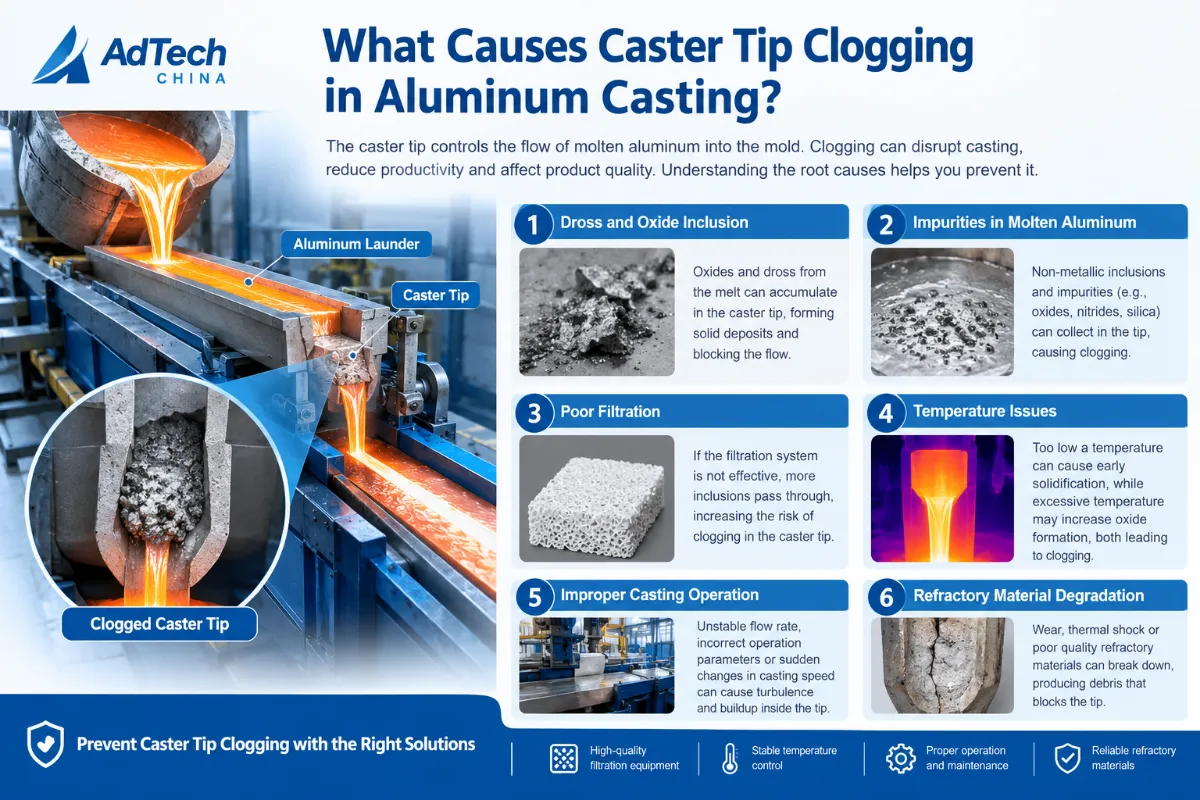
Blockage can develop through several mechanisms. Identifying the likely mechanism matters because different symptoms may require different corrective actions.
1. Oxide films and non-metallic inclusions
Molten aluminum can contain oxide films, oxide particles, dross fragments, and other non-metallic inclusions. These contaminants can originate from melting, melt transfer, turbulence, alloy additions, and inadequate melt handling.
When inclusions accumulate in a narrow flow passage or adhere to an internal surface, the available flow area may decrease. The result can be a gradual change in metal distribution or a more severe restriction.
Research on aluminum melt filtration confirms that inclusion loading, particle characteristics, flow velocity, and filtration behavior affect melt-cleaning performance. It also shows why upstream melt preparation and correct filter selection matter. Source: Hydraulic Characterization of Ceramic Foam Filters Used in Aluminum Filtration.
2. Interaction between molten aluminum and tip materials
Caster tips operate in contact with hot aluminum for extended periods. Depending on the refractory or fiber-composite material, alloy chemistry, operating temperature, and exposure time, chemical interaction, erosion, or surface deterioration may affect the flow channel.
A damaged or increasingly rough internal surface may make deposits more likely to accumulate. Material deterioration can also change the original geometry of the passage.
This is why evaluating a tip solely by its purchase price is insufficient. Material compatibility, dimensional consistency, internal channel design, and suitability for the actual alloy and operating conditions should also be considered.
3. Temperature instability and local solidification
A temperature that is too low for the specific alloy and process can increase the risk of local metal solidification or restricted flow, particularly during startup, prolonged interruptions, or unstable operation.
However, increasing the temperature indiscriminately is not an appropriate universal solution. Excessive temperatures may accelerate material degradation or create other metallurgical problems, depending on the alloy and equipment.
The objective is to maintain the process temperature within the validated operating window for the alloy, caster design, and tip material.
4. Tip damage, contamination, or installation problems
A caster tip can perform poorly even when its material is appropriate if it is chipped, cracked, contaminated, incorrectly positioned, or fitted with unsuitable supporting components.
Dust, loose refractory material, residues, or damage introduced during handling may interfere with the flow channel. Installation errors can also create uneven flow distribution that resembles blockage.
Inspection before installation and adherence to the equipment supplier’s procedures are therefore important parts of clogging prevention.
5. Unstable metal level and uneven flow distribution
Flow instability can originate outside the tip itself. Changes in metal level, flow-control settings, upstream equipment conditions, or the condition of the launder and distribution components may affect how aluminum enters the caster tip.
If the flow becomes uneven across the product width, the problem should not automatically be attributed to a blocked nozzle. The distribution system, mounting arrangement, metal level, and operating conditions should also be examined.
How to Diagnose Nozzle Blockage Before Changing the Process
Before adjusting temperature, replacing the tip, or changing the filter grade, establish what is actually happening.
The following table provides a starting point for investigation. These are diagnostic possibilities, not definitive conclusions based on symptoms alone.
| Observed symptom | Possible cause | Recommended first check |
|---|---|---|
| Metal flow decreases gradually during a run | Deposit accumulation, channel restriction, or changing operating conditions | Compare flow behavior, metal level, and temperature with earlier production records |
| Flow becomes restricted after an extended interruption | Local solidification or a change in the thermal condition of the flow path | Review shutdown duration, restart procedure, and temperature history |
| Flow is uneven across the strip width | Uneven distribution, channel damage, misalignment, or a localized restriction | Inspect the flow-control system, tip alignment, and widthwise flow pattern |
| Similar blockages occur with multiple tips | Upstream melt cleanliness, operating conditions, or a common installation issue | Compare melt-treatment history, filter condition, and installation records |
| A new tip performs poorly immediately after installation | Damage, contamination, unsuitable dimensions, or an installation issue | Inspect the tip, mounting arrangement, and preheating procedure |
| Casting defects increase while flow remains relatively stable | Inclusion contamination or other process-related defects | Investigate melt cleanliness, filtration performance, and defect characteristics |
Distinguish a blocked tip from a melt-quality problem
Not every casting defect indicates physical nozzle blockage.
For example, a high inclusion count may indicate inadequate melt cleaning even when the tip still passes metal adequately. Conversely, a tip may develop a flow restriction because of localized deposits or material degradation even if the incoming melt meets the plant’s routine cleanliness target.
Where practical, examine removed tips for deposits, surface damage, cracks, and dimensional changes. If necessary, use appropriate laboratory examination to establish the composition of deposits or identify material deterioration.
The purpose is to identify the mechanism rather than repeatedly changing consumables without verifying the cause.
How to Reduce the Inclusion Load Before Aluminum Reaches the Caster
One of the most important preventive measures is controlling melt cleanliness before aluminum enters the casting zone.
Improve melting and melt-transfer practices
Oxide-related contamination can increase when molten aluminum is disturbed or exposed to conditions that promote surface oxidation and entrainment.
Review the following practices:
- Control melt transfer to avoid unnecessary turbulence and oxide entrainment.
- Remove surface dross according to the plant’s operating procedure.
- Manage alloy additions and melt treatment consistently.
- Avoid introducing contamination from tools, transfer equipment, and damaged refractory components.
- Maintain consistent handling and transfer conditions between batches or production runs.
These actions support cleaner metal entering the filtration and casting systems. Their effectiveness should be checked using the plant’s own melt-quality measurements and defect data.
Use an appropriate ceramic foam filtration system
Ceramic foam filters are widely used in aluminum casting to capture non-metallic inclusions from molten metal. AdTech’s filtration products include ceramic foam filters, phosphorus-free ceramic foam filters, cartridge filter tubes, and alumina filter media.
Filtration can reduce the quantity of inclusions carried downstream, thereby helping to manage one potential contributor to deposits inside a caster tip.
However, several limitations matter.
First, a ceramic foam filter has finite capacity. Large particles and oxide films can affect its flow resistance and filtration behavior. Second, the filter itself may become restricted if it receives an excessive inclusion load. Third, a cleaner melt does not eliminate other causes of tip blockage, such as unsuitable materials, damage, or temperature instability.
The research literature also warns against selecting filters by nominal PPI alone. Filter structure and hydraulic properties can vary between products that share the same nominal designation. Source: open-access filtration study.
Before choosing a filter, confirm the following:
- Required aluminum flow rate and expected production throughput.
- Alloy chemistry and any relevant compatibility considerations.
- Filter dimensions, thickness, and nominal PPI or grade.
- Available metal head and the equipment’s ability to maintain stable flow.
- Expected inclusion loading and filter replacement requirements.
- Compatibility with the filtration equipment and the wider casting line.
A finer filter is not automatically the better choice. Its performance must be evaluated against the required flow, available pressure head, inclusion burden, and product-quality target.
A separate study on ceramic foam filtration also found that grain-refiner additions can affect filtration performance under certain experimental conditions. This reinforces the importance of considering the full melt-treatment process, rather than evaluating a filter in isolation. Source: The Influences of Grain Refiner, Inclusion Level, and Filter Grade on the Filtration Performance of Aluminum Melt.
Combine degassing and filtration appropriately
Degassing and filtration address different aspects of melt quality.
Online degassing systems are primarily used to reduce dissolved hydrogen and may also support other melt-treatment functions, depending on the equipment and process. Filtration primarily removes or captures solid inclusions.
These processes can complement each other, but they should not be treated as interchangeable solutions. A degassing unit does not directly remove an established physical obstruction from a caster tip, and hydrogen removal alone does not guarantee lower inclusion deposition.
AdTech’s online degassing equipment is designed for molten-aluminum purification. The appropriate treatment sequence should be established according to alloy requirements, melt condition, available equipment, and the plant’s quality-control procedures.
Select a Caster Tip That Matches the Alloy and Production Line
Correct tip selection can help maintain stable metal distribution and avoid compatibility problems that contribute to premature deterioration.
Verify material and alloy compatibility
A tip should be selected for the actual molten aluminum alloy and its working conditions, rather than solely on the basis of a generic material description.
Important considerations include alloy chemistry, operating temperature, exposure time, thermal conditions, and the degree of resistance required against erosion or chemical interaction.
Where a plant processes several alloy grades, confirm whether one tip specification is suitable for all of them. A material that performs acceptably in one application may not provide the same results in another.
Check channel geometry and dimensional compatibility
The caster tip’s internal flow-channel design affects how molten metal is distributed. Dimensions and installation geometry must match the casting line.
For aluminum strip and foil production, review:
- Overall tip length and width.
- Tip thickness and the required opening geometry.
- Internal channel or chamber design.
- Alignment with the mounting frame and adjacent components.
- Compatibility with spacers, ears, the flow-control box, and the launder.
- Requirements for even flow across the product width.
AdTech’s caster tip, spacer, and hard ear products are intended for aluminum plate, strip, and foil casting and rolling lines. The published fixed-size ranges for its caster tips include lengths of 200 to 2,300 mm, widths of 50 to 600 mm, and tip thicknesses of 1.6 to 10 mm. Actual availability and suitability must be confirmed against the application drawing.
These are catalog ranges, not universal dimensions for every caster. Always verify the required configuration before ordering.
Evaluate non-stick surfaces and compatible coatings
Surface treatments may help reduce adhesion between molten aluminum and compatible refractory components. Their effectiveness depends on the substrate, coating formulation, application method, and operating conditions.
AdTech lists boron nitride (BN) coating and refractory repair materials for aluminum-contacting components, including caster tips and launders, with the stated objective of preventing aluminum adhesion. See the company’s official product catalog.
A coating should not be treated as a universal cure for nozzle blockage. Before adopting one, verify:
- Compatibility with the existing tip material.
- Suitability for the alloy and operating conditions.
- Approved application, drying, or curing requirements.
- Whether the treatment affects dimensions, flow behavior, or subsequent maintenance.
- Whether the plant has evidence that the coating addresses the diagnosed failure mechanism.
Material selection, surface treatment, and melt cleanliness should be considered together.
Maintain Stable Temperature and Flow Conditions
Even a suitable caster tip can experience operational problems if the process repeatedly moves outside its intended operating window.
Follow the qualified temperature window
Use the temperature range established for the alloy, casting process, tip material, and equipment configuration.
Avoid two common mistakes:
- Running below the required operating temperature and assuming the tip will remain fully open under all conditions.
- Increasing temperature beyond the validated range in an attempt to compensate for recurring blockages.
The first may increase the risk of local solidification or impaired flow. The second may accelerate refractory interaction, affect alloy quality, or introduce other problems.
Record the temperature at the monitoring points defined by the plant’s procedure. When blockages occur, compare the readings and the time sequence with normal production rather than relying on a single measurement.
Maintain consistent metal level and distribution
The flow system should deliver molten aluminum to the caster tip under stable, repeatable conditions.
Review metal-level control, flow-control settings, launder condition, and any changes made during startup or production. If available, use appropriate flow or level instrumentation to identify deviations before they develop into larger disturbances.
AdTech’s product range includes launder equipment and flow-control products intended for molten-aluminum handling and flow management. Such equipment must be configured for the actual line and should be assessed as part of the complete casting system, not as an isolated component.
Manage startup, pauses, and restart conditions
Startup and interruption procedures should be documented and followed consistently.
Before a run, confirm that the equipment and refractory components have been prepared according to their suppliers’ instructions. After a prolonged interruption, verify that the line is in the correct thermal and operating condition before resuming normal casting.
Do not attempt to clear a restriction by making an unapproved temperature or flow adjustment. Any intervention involving hot equipment or molten metal should follow the plant’s safety procedures.
Prevent Contamination and Damage During Installation
Installation quality is an important part of caster tip performance.
Before fitting a new tip, inspect it for visible damage and confirm that the correct part has been supplied. Check the channel and mounting surfaces for loose material, dust, or other contamination.
A practical installation checklist includes the following:
- Verify the part. Confirm the product drawing, dimensions, material, and intended alloy application.
- Inspect the tip. Reject components with unacceptable cracks, chips, deformation, or other damage.
- Keep the flow channel clean. Handle the component in a way that minimizes contamination and protect it before installation.
- Follow the specified preparation procedure. Use the tip manufacturer’s approved preheating and drying instructions, where applicable. Do not substitute an assumed temperature or heating rate for the actual procedure.
- Check the mounting arrangement. Verify alignment, supports, spacers, ears, and associated flow-path components.
- Record the installation. Log the date, tip identification, alloy, and relevant startup conditions.
A cracked or contaminated tip should not simply be returned to service in the hope that operating adjustments will compensate for its condition.
Likewise, avoid aggressive scraping or other cleaning methods that may damage the channel surface. Cleaning, reuse, and replacement decisions should follow the manufacturer’s instructions and the plant’s established inspection criteria.
Troubleshooting Checklist for Production Engineers
The following sequence helps organize a practical investigation when clogging becomes frequent.
| Step | Action | Purpose |
|---|---|---|
| 1 | Confirm and describe the symptom | Distinguish reduced flow, uneven distribution, and downstream quality defects |
| 2 | Review temperature and interruption history | Identify possible thermal changes or restart-related problems |
| 3 | Review melt-treatment and filtration records | Check for changes in inclusion loading or filtration behavior |
| 4 | Inspect the caster tip and adjacent components | Look for deposits, cracks, damage, contamination, or misalignment |
| 5 | Check the launder and flow-control system | Identify upstream causes of unstable or uneven metal delivery |
| 6 | Change one justified variable at a time | Avoid introducing multiple unverified changes that obscure the root cause |
| 7 | Compare performance after corrective action | Determine whether the change improved stability and reduced blockage frequency |
Establish a simple performance log
Useful records include:
- Caster tip identification and supplier.
- Alloy grade and relevant chemistry.
- Tip installation date and removal date.
- Startup, interruption, and restart times.
- Available temperature and metal-level measurements.
- Casting speed and production conditions.
- Filter specification and time of replacement.
- The time when flow changes or defects first appear.
- Observations from tip inspection after removal.
- Corrective action and the result of the next comparable run.
Use comparable operating conditions when evaluating performance. Otherwise, a change in service life may reflect a different alloy, casting speed, inclusion burden, or production schedule rather than a real improvement in the tip.
A useful operational goal is not merely to increase the number of hours a tip remains installed. It is to maintain acceptable flow and product quality while reducing avoidable stops, scrap, and consumable costs.
How to Evaluate the Cost of Caster Tip Clogging
The lowest-priced caster tip is not necessarily the least expensive option over its operating life.
A more meaningful comparison considers the total cost associated with a given amount of acceptable production.
Relevant costs include:
- Caster tip purchase price.
- Related consumables and coating materials.
- Labor and replacement time.
- Production lost during unplanned stoppages.
- Scrap or rework associated with flow instability and casting defects.
- Inspection and maintenance costs.
For internal analysis, a plant can calculate:
Cost per acceptable tonne = Total relevant tip, maintenance, and downtime costs / Tonnes of acceptable product produced.
The calculation should use the same cost categories and a comparable production period when evaluating different tips or operating procedures.
Do not compare suppliers using service-life claims alone. Ask how the service life was measured, which alloys were processed, what casting conditions applied, what constituted the end of service, and whether the result included periods of unacceptable product quality.
Where a supplier provides comparative test data, request the underlying test conditions and the definition of successful performance.
What Should Buyers Ask a Caster Tip Manufacturer?
A useful supplier discussion should provide enough information to determine whether the proposed product matches the application.
Ask the following questions:
- What tip material and internal channel design are proposed for our alloy and casting-line configuration?
- Which dimensions, tolerances, and installation drawings are available?
- What preparation, preheating, drying, and handling instructions apply?
- Is a coating recommended for our application, and what limitations or preparation requirements apply?
- What operating conditions and product specifications support the proposed selection?
- How should a tip be inspected to distinguish normal wear from premature failure?
- Can the supplier explain the likely cause of recurring blockage using the production records and removed-tip condition?
- What evidence supports any claimed improvements in service life, flow stability, or cost per tonne?
- Are the proposed tip, spacer, ear, and flow-control components compatible with the existing equipment?
- What technical information is needed to confirm suitability before ordering?
A capable supplier should be able to discuss limitations and application conditions, not just quote a price.
How AdTech China Fits Into Aluminum Caster Operations
AdTech China supplies caster tips and related components for aluminum plate, strip, and foil casting and rolling lines. Its published product range includes caster tips, spacers, hard ears, ceramic foam filters, degassing equipment, filtration equipment, launder systems, and BN coating and refractory repair materials.
These products address different parts of the process:
- Caster tips and associated components: Selected to match the required casting-line geometry and metal-distribution requirements.
- Ceramic foam filters: Used to capture non-metallic inclusions before the melt reaches downstream casting operations.
- Online degassing equipment: Used for dissolved-hydrogen control as part of the broader melt-treatment process.
- Launder and flow-control equipment: Used to manage molten-metal transfer and distribution.
- BN coating and refractory repair materials: Considered where the material and operating conditions support their use.
The relevant products can be reviewed through AdTech’s official caster series, filtration products, and product catalog.
Product selection should follow the blockage diagnosis. For example, changing the caster tip may be appropriate when the existing tip is unsuitable or damaged, while recurring inclusion-related restrictions may require a broader review of melting, refining, filtration, and metal-transfer practices.
An equipment or consumables supplier should not promise that replacing one component will solve a problem whose underlying cause has not been established.
Conclusion
Minimizing nozzle clogging in aluminum caster operations requires a systematic approach to melt cleanliness, caster tip compatibility, installation, temperature stability, and flow control.
Start by recording the symptoms and comparing the affected runs with normal production. Investigate the condition of the removed tip, the filtration system, the alloy and melt-treatment history, and the operating conditions. Select corrective actions based on evidence and confirm their effectiveness using comparable production data.
Ceramic foam filtration, appropriate degassing, compatible tip materials, suitable surface treatments, and stable flow management can all contribute to a better-controlled casting process. Their value depends on how well each measure addresses the actual cause of the problem.
For production engineers, the most useful outcome is not simply a tip that lasts longer. It is a process that delivers stable flow, acceptable product quality, predictable maintenance, and lower avoidable production costs.
FAQ
1. What causes caster tip clogging in aluminum casting?
Potential causes include oxide inclusions, accumulated deposits, material deterioration, local solidification, contamination, damaged channels, and uneven flow conditions. The cause should be established by reviewing process records and inspecting the tip rather than assuming that every blockage has the same mechanism.
2. Can ceramic foam filters prevent caster tip blockage?
Ceramic foam filters can reduce the non-metallic inclusion load entering downstream equipment. This may help reduce one contributor to tip deposits, but filtration cannot eliminate every cause of blockage. Filter capacity, melt cleanliness, flow conditions, and tip compatibility must all be considered.
3. Does degassing reduce nozzle clogging?
Degassing primarily targets dissolved hydrogen and other melt-treatment objectives supported by the particular process. It can contribute to overall melt quality, but it does not directly clear an existing nozzle obstruction. Inclusion management and physical inspection remain necessary.
4. Is a finer PPI ceramic foam filter always better?
No. A finer filter may provide different inclusion-capture behavior, but it can also change flow resistance and capacity. Filter selection should consider the alloy, inclusion burden, filter dimensions, available metal head, required flow, and the characteristics of the actual filter product.
5. Should I increase the casting temperature to clear a blocked tip?
Not without confirming the cause and checking the approved operating window. Low temperature may contribute to restricted flow, but excessive temperature may accelerate material degradation or affect product quality. Follow the validated process procedure rather than making an arbitrary temperature increase.
6. How can I distinguish oxide deposits from local solidification?
Process temperature and interruption records may reveal conditions consistent with local solidification, while examination of the removed tip may identify deposits or material damage. Visual inspection alone may not establish the deposit composition. Laboratory analysis may be needed for recurring or unexplained failures.
7. Does boron nitride coating prevent caster tip clogging?
BN coating may help reduce aluminum adhesion on compatible surfaces. Its suitability depends on the component, coating formulation, application procedure, and operating conditions. It should be treated as one possible preventive measure, not a guarantee against all blockages.
8. How often should a caster tip be replaced?
Replacement intervals depend on the alloy, tip material, casting conditions, wear, flow behavior, and product-quality requirements. Establish replacement criteria using inspection findings and production records rather than relying on a universal service-life figure.
9. What information should be recorded when nozzle blockage occurs?
Record the tip identification, alloy, installation and removal times, temperature history, casting speed, flow and metal-level observations, filter condition, interruption history, quality defects, and findings from tip inspection. These details help separate recurring process problems from individual component failures.
10. Are steel continuous-casting nozzle solutions applicable to aluminum caster tips?
Not automatically. Steel submerged entry nozzles and aluminum strip-casting tips operate in different metallurgical and equipment contexts. Steel-specific approaches, including certain inclusion-modification and argon-control practices, must not be treated as universal solutions for aluminum casting.