

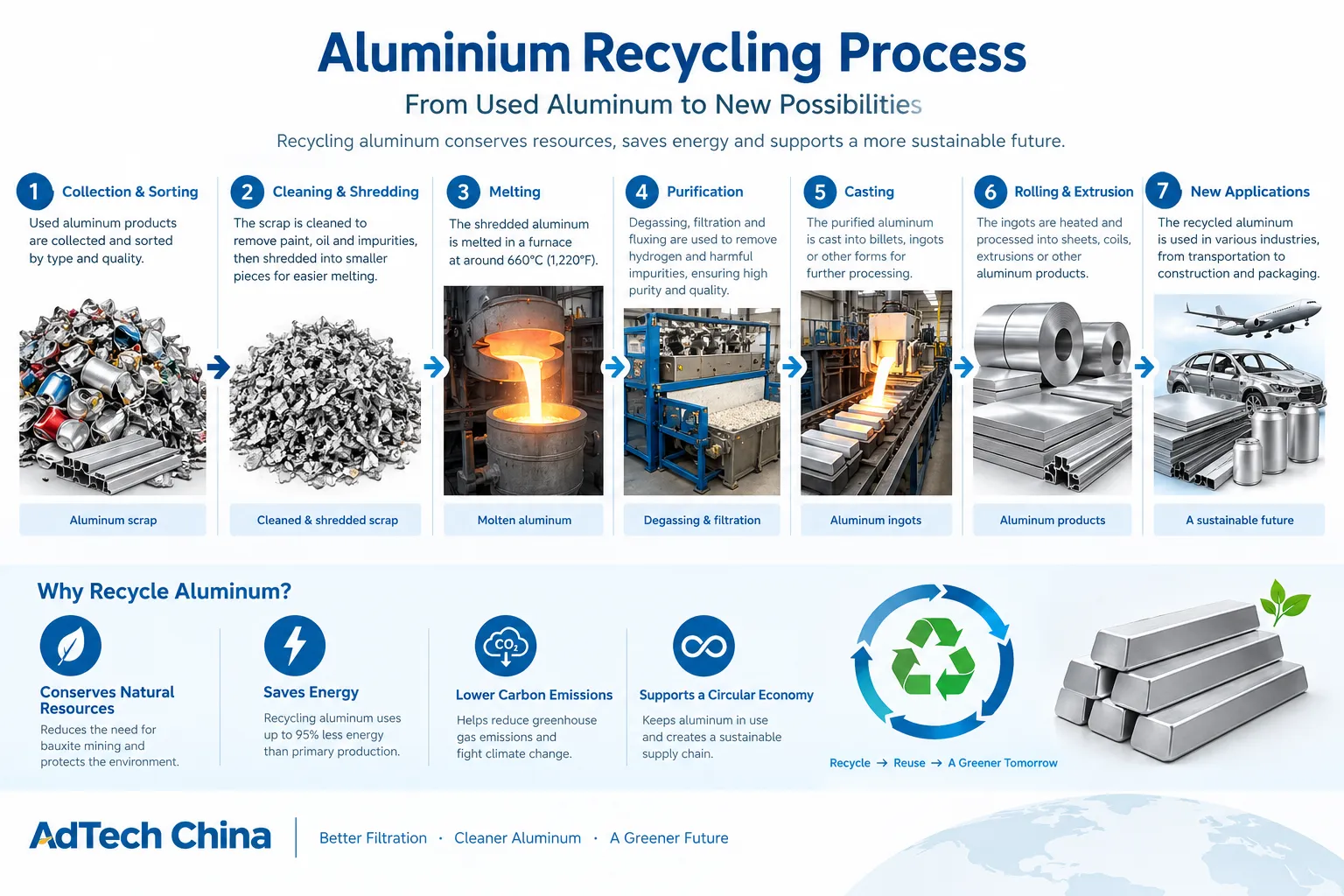
The aluminium recycling process converts aluminium scrap into reusable metal through collection, sorting, pre-treatment, melting, melt refining, alloy adjustment and casting. The exact process depends on the scrap source, alloy composition, contamination, coating, moisture content and the quality required for the final product. For industrial recyclers, the objective is not simply to melt aluminium, but to recover as much usable metal as practical while controlling alloy chemistry, inclusions, hydrogen, emissions and production costs.
Aluminium recycling is widely used to produce secondary aluminium for foundry alloys, extrusion billets, rolling slabs and other applications. Compared with producing primary aluminium from bauxite, recycling generally requires substantially less energy. However, achieving consistent recycled metal quality requires suitable scrap preparation and process control.
1. Aluminium Recycling Process at a Glance
The following table summarizes the main stages of industrial aluminium recycling.
| Sahne | Main operation | Birincil hedef |
|---|---|---|
| 1. Collection | Gather manufacturing scrap and end-of-life aluminium | Establish a usable feedstock supply |
| 2. Sorting | Alüminyumu diğer malzemelerden ayırın ve hurdaları sınıflandırın | Alaşımın tutarlılığını artırın ve kirliliği azaltın |
| 3. Ön işlem | Gerektiği şekilde parçalayın, boyutlandırın, kurutun, yağdan arındırın veya kaplamaları çıkarın | Hurdayı güvenli ve verimli bir şekilde eritmek için hazırlayın |
| 4. Erime | Hurdayı uygun bir fırına yükleyin | Katı alüminyumu erimiş metale dönüştürmek |
| 5. Akıtma ve sıyırma | Gerekli yerlere uygun akı sürün ve yüzeydeki kalıntıları temizleyin | Oksidasyonu kontrol etmek, kalıntıları ayırmak ve metali geri kazanmak |
| 6. Erime arıtımı | Kimyasal bileşimi ayarlayın ve istenmeyen eriyik bileşenlerini giderin | Hedef alaşım ve eriyik kalitesi gerekliliklerini karşılayın |
| 7. Gaz giderme ve filtreleme | Gerektiğinde çözünmüş hidrojeni ve metalik olmayan kalıntıları giderin | Ergitme temizliğini artırın |
| 8. Oyuncu Seçimi | Külçeler, kütükler, levhalar veya diğer döküm şekillerini üretmek | Metali sonraki üretim aşamalarına hazırlayın |
| 9. Kalite kontrolü | Bileşimi analiz etmek ve ilgili kalite özelliklerini doğrulamak | İstenen uygulama için uygunluğunu doğrulayın |
Bu aşamalar her geri dönüşüm tesisinde aynı değildir. Temiz üretim hurdaları nispeten az hazırlık gerektirebilirken, karışık tüketici sonrası hurdaların eritilmeden önce birkaç ayırma ve işleme aşamasından geçmesi gerekebilir. Bazı tesisler eritme ve arıtma işlemlerini birleştirirken, diğerleri erimiş metali ayrı fırınlar veya işleme istasyonları arasında aktarır.
2. Collection and Classification of Aluminium Scrap
Geri dönüşüm süreci, hurdanın nereden geldiğinin ve nelerden oluştuğunun belirlenmesiyle başlar.
Manufacturing scrap
Alüminyum ürünlerinin üretimi sırasında imalat hurdası ortaya çıkar. Buna örnek olarak sac kesim artıkları, ekstrüzyon artıkları, işleme talaşları ve döküm hurdası verilebilir.
Temiz ve türlerine göre ayrılmış üretim artıkları, kaynağı ve malzeme özellikleri nispeten iyi bilindiği için genellikle verimli bir şekilde geri dönüştürülebilir. Bununla birlikte, yağlı talaşlar, karışık alaşımlar ve kaplama içeren malzemeler ek işleme tabi tutulması gerekebilir.
Post-consumer aluminium scrap
Tüketici kullanımından sonra ortaya çıkan hurda, kullanım ömrünün sonuna gelmiş ürünlerden elde edilir. Yaygın örnekler arasında şunlar sayılabilir:
-
Kullanılmış alüminyum içecek kutuları ve ambalajlar.
-
Alüminyum pencere çerçeveleri ve yapı elemanları.
-
Araç bileşenleri.
-
Ev ve endüstriyel alüminyum ürünler.
-
Çelik, plastik, kauçuk veya diğer malzemeler içeren karışık alüminyum bileşenler.
Tüketici kaynaklı hurda, önceki kullanım alanı, alaşım bileşimi ve kirlilik düzeyi belirsiz olabileceğinden, genellikle ayırma açısından daha büyük bir zorluk teşkil eder.
Aluminium dross and other process residues
Alüminyum cürufu, eritme ve metal işleme süreçleri sırasında oluşur. Alüminyum oksit, diğer bileşenler ve geri kazanılma potansiyeli olan metalik alüminyum içerir.
Cüruf, temiz alüminyum hurda ile eşdeğer olarak değerlendirilmemelidir. Geri kazanım yöntemi, bileşimi, sıcaklığı, işleme geçmişi ve mevcut geri kazanım teknolojisine bağlıdır.
Önemli olan ilke, hurda sınıflandırmasının fırın rotası seçilmeden önce yapılması gerektiğidir. Alüminyum içeren her malzemeyi birbirinin yerine kullanılabilir olarak değerlendiren bir tesis, alaşım kontrolünde sorunlar, gereksiz işleme ve daha düşük metal geri kazanımı riskiyle karşı karşıya kalır.
3. Sorting and Separation: Why Alloy Composition Matters
Ayıklama, ikincil alüminyum üretimindeki en önemli adımlardan biridir; zira gelen hurdanın kimyasal bileşimi, nihai metali doğrudan etkiler.
Alüminyum alaşımları, silikon, magnezyum, bakır ve manganez gibi elementleri farklı oranlarda içerir. Bu elementler, mukavemet, korozyon direnci, şekillendirilebilirlik ve dökülebilirlik gibi özellikleri etkiler.
Örneğin, yüksek silikonlu bir döküm alaşımı ile haddeleme için tasarlanmış bir alüminyum işlenmiş alaşımın bileşim gereksinimleri farklı olabilir. Bunları uygun bir işlem planı olmaksızın karıştırmak, hedeflenen nihai alaşımı üretmeyi zorlaştırabilir.
Common aluminium scrap sorting methods
| Yöntem | Amaç | Önemli bir sınırlama |
|---|---|---|
| Manuel ayırma | Gözle görülür yabancı maddeleri ayıklayın ve tanımlanabilir hurda kategorilerini ayırın | Operatörün tutarlılığına ve malzeme farklılıklarının belirginliğine bağlıdır |
| Manyetik ayırma | Çelik parçalar gibi demir içeren malzemeleri ayırın | Alüminyum alaşım sınıflarını birbirinden ayırmaz |
| Girdap akımı ayırma | Uygun atık akışlarından iletken demir dışı metalleri ayırın | Performans, malzemenin boyutu, şekli, besleme şekli ve ekipman tasarımına bağlıdır |
| Sensör tabanlı ayırma | Seçilen malzeme kategorilerini veya alaşım gruplarını belirleyin ve ayırın | Uygun algılama teknolojisi ve doğrulanmış ayırma kriterleri gerektirir |
| Chemical composition analysis | Check alloy composition and support material classification | A representative sample and appropriate analytical method are required |
Laser-induced breakdown spectroscopy and colour-based sorting technologies are among the methods described by the Aluminum Association for improving scrap separation. Their usefulness depends on the feedstock and the recycling objective.
What happens when different aluminium alloys are mixed?
Mixing alloys is not automatically unacceptable. Some secondary aluminium products are designed to use mixed scrap, with composition adjusted through the process.
The problem arises when the mixture cannot meet the intended specification economically or consistently.
For example, an unwanted element that remains dissolved in the melt cannot ordinarily be removed simply by passing the metal through a ceramic filter. Depending on the element and target chemistry, practical responses may include better sorting, blending with suitable metal, changing the target product or using a more specialized metallurgical process.
Therefore, sorting is not merely a waste-handling activity. It is an important form of quality control that takes place before the metal enters the furnace. Research reviews of secondary aluminium production identify scrap composition and unwanted alloying elements as persistent challenges in producing recycled alloys.
4. Pre-Treatment: Shredding, Cleaning, Drying and Decoating
The purpose of pre-treatment is to prepare scrap for the selected melting process. Not every material requires every operation.
Shredding, shearing and sizing
Large or bulky components may be cut, crushed or shredded into manageable sizes. The required size depends on the separation equipment, furnace charging arrangement and characteristics of the scrap.
Size reduction can improve material handling and support downstream separation. However, it also consumes energy and may generate dust, so the equipment should match the actual feedstock.
Removing coatings and organic contaminants
Used beverage cans, painted components and other coated scrap may require decoating or delacquering before melting.
Coatings, oil, grease, lubricants and plastic residues can contribute to emissions and complicate the melting process. Suitable pre-treatment can improve metal recovery and reduce the contaminant load entering the furnace.
The need for thermal treatment depends on the coating and material type. It should not be assumed that every aluminium component requires the same decoating method.
Drying and de-oiling aluminium turnings
Machining chips and turnings deserve special attention because they may retain cutting fluids, oil and moisture. Their shape also gives them a relatively high surface area compared with their mass.
Suitable cleaning and drying can help prepare this material for safer charging and efficient metal recovery. The treatment method must be appropriate for the contaminant and the physical form of the scrap.
Why wet scrap is a serious safety concern
Wet or moisture-contaminated scrap must not be charged into molten metal without appropriate controls. Water contacting molten metal can cause a violent explosion.
The UK’s Health and Safety Executive advises storing scrap in dry, covered areas where possible, checking materials for water contamination and drying scrap when covered storage is not available. It also emphasizes training, appropriate protective equipment and safe operating practices.
Closed containers, trapped liquids and other potentially dangerous contaminants require specific assessment under the facility’s safety procedures.
Pre-treatment should therefore be selected based on three factors: material quality, metallurgical requirements and safe furnace operation.
5. Melting: Turning Prepared Scrap into Molten Aluminium
After preparation, the scrap is charged into a suitable melting furnace.
Pure aluminium has a melting point of approximately 660°C. Commercial alloys and industrial recycling processes operate according to their respective melting ranges and process requirements, so 660°C should not be treated as a universal furnace setpoint.
The actual operating temperature depends on alloy composition, furnace technology, charge condition, required throughput and downstream casting requirements.
Choosing a melting furnace
Different furnace designs suit different forms of scrap and production requirements.
| Fırın tipi | General consideration | What to evaluate |
|---|---|---|
| Reverberatory fırın | Used for melting substantial quantities of aluminium scrap and other suitable feedstocks | Capacity, thermal efficiency, charge characteristics and melt handling |
| Döner fırın | Used in some secondary aluminium operations, particularly where scrap characteristics suit rotary processing | Scrap contamination, process residues, flux requirements and recovery performance |
| İndüksiyon ocağı | Provides electromagnetic heating and may suit particular melting tasks | Furnace capacity, charge characteristics, electrical infrastructure and melt cleanliness |
| Crucible furnace | Used in selected smaller-scale or specialized melting applications | Batch size, alloy range, operating flexibility and handling arrangements |
These are general selection considerations rather than a universal ranking. Furnace suitability cannot be determined from nominal capacity alone.
One important industry distinction is the feedstock and refining route. Cleaner, well-characterized scrap may be remelted through a relatively direct process, while more contaminated or mixed scrap can require more intensive refining. Terminology such as remelter and refiner varies by market and production context, but the underlying distinction is useful when evaluating a process.
Controlling oxidation and metal losses
Aluminium develops oxide films when exposed to oxygen. During charging, melting, transfer and surface disturbance, oxidation can contribute to metal losses and non-metallic residues.
Scrap size, surface condition, furnace operation, temperature control, handling practices and melt exposure all influence the outcome.
A practical process review should therefore measure metal recovery rather than relying only on how quickly the furnace melts the charge.
6. Fluxing, Dross Removal and Alloy Adjustment
After melting, the metal may require additional treatment to meet its target composition and cleanliness requirements.
Fluxes are used in various aluminium recycling operations, but their function depends on the flux formulation and the process in which it is applied.

What does flux do in aluminium recycling?
Depending on the formulation and application, flux can help protect the melt surface, support separation of unwanted material, assist metal recovery from dross or perform a defined refining function.
It is not correct to assume that every flux removes the same contaminants or that fluxing alone can bring every melt to specification.
Common functional categories include:
| Akı kategorisi | Tipik amaç | Key consideration |
|---|---|---|
| Örtücü akı | Helps protect the molten metal surface | Compatibility with the process and melt conditions |
| Rafine akı | Belirtilen erime arıtma işlevlerini destekler | Alaşım, kirlilik türü, işleme yöntemi ve dozaj |
| Cüruf giderici veya cüruf çıkarıcı akı | Yüzeydeki kalıntılardan metalin ayrılmasını kolaylaştırır | Cüruf özellikleri ve geri kazanım prosedürü |
| Fırın temizleme akısı | Fırın yüzeylerindeki uygun birikintileri gidermek için kullanılır | Fırının durumu ve üreticinin kullanım talimatları |
| Akı geri dönüşümü | Cüruf veya külden metalik alüminyumu geri kazanmak amacıyla belirli işlemlerde kullanılır | Atık bileşimi ve geri kazanım ekipmanı |
Uluslararası Alüminyum Enstitüsü, birçok hurda arıtma sürecinde erimiş metali örtmek, safsızlıkların giderilmesine yardımcı olmak ve oksidasyonu azaltmak amacıyla tuz eriticilerin kullanıldığını belirtmektedir. Ayrıca, cüruf, yüzey köpüğü ve tuz cürufunu, uygun işleme ve geri kazanım yöntemleri gerektiren proses kalıntıları olarak tanımlamaktadır. Her geri dönüşüm sürecinde aynı eritic sistem kullanılmamaktadır.
Removing dross
Erimiş metalin yüzeyinde oksit içeren malzeme ve diğer bileşenler birikerek cüruf oluşur. İşleme bağlı olarak, bu malzemenin bir kısmı geri kazanılabilir alüminyum içerir.
Yüzeydeki cürufun giderilmesi, fırın ve metal işleme prosedürüyle uyumlu bir şekilde gerçekleştirilmelidir. Aşırı sert veya yeterince kontrol edilmeyen işleme, oksidasyonu artırabilir; buna karşılık, uygun olmayan cüruf işleme yöntemleri ise önlenebilir kayıplara yol açabilir.
Cüruf, teknik ve ekonomik açıdan uygun olduğu durumlarda geri kazanılabilir bir proses atığı olarak yönetilmeli; elleçleme ve nihai arıtma işlemleri ise söz konusu malzemeye göre seçilmelidir.
Alloy composition adjustment
Erime işleminden sonra, üreticiler gerekli kimyasal bileşimi elde etmek için uygun alaşım maddeleri ekleyebilir veya metal karıştırabilir.
Hedef spesifikasyon katı olduğunda, temsili bir kimyasal analiz yapılması şarttır. İlgili elementler, malzeme sınıfına ve nihai kullanım alanına bağlıdır.
Akı ekleme, yüzeyden arındırma ve alaşım ayarlaması farklı sorunları çözer. İyi tasarlanmış bir süreç, tek bir adımın her tür kirliliği giderebileceğini varsaymak yerine, her bir işlemin amacını net bir şekilde tanımlar.
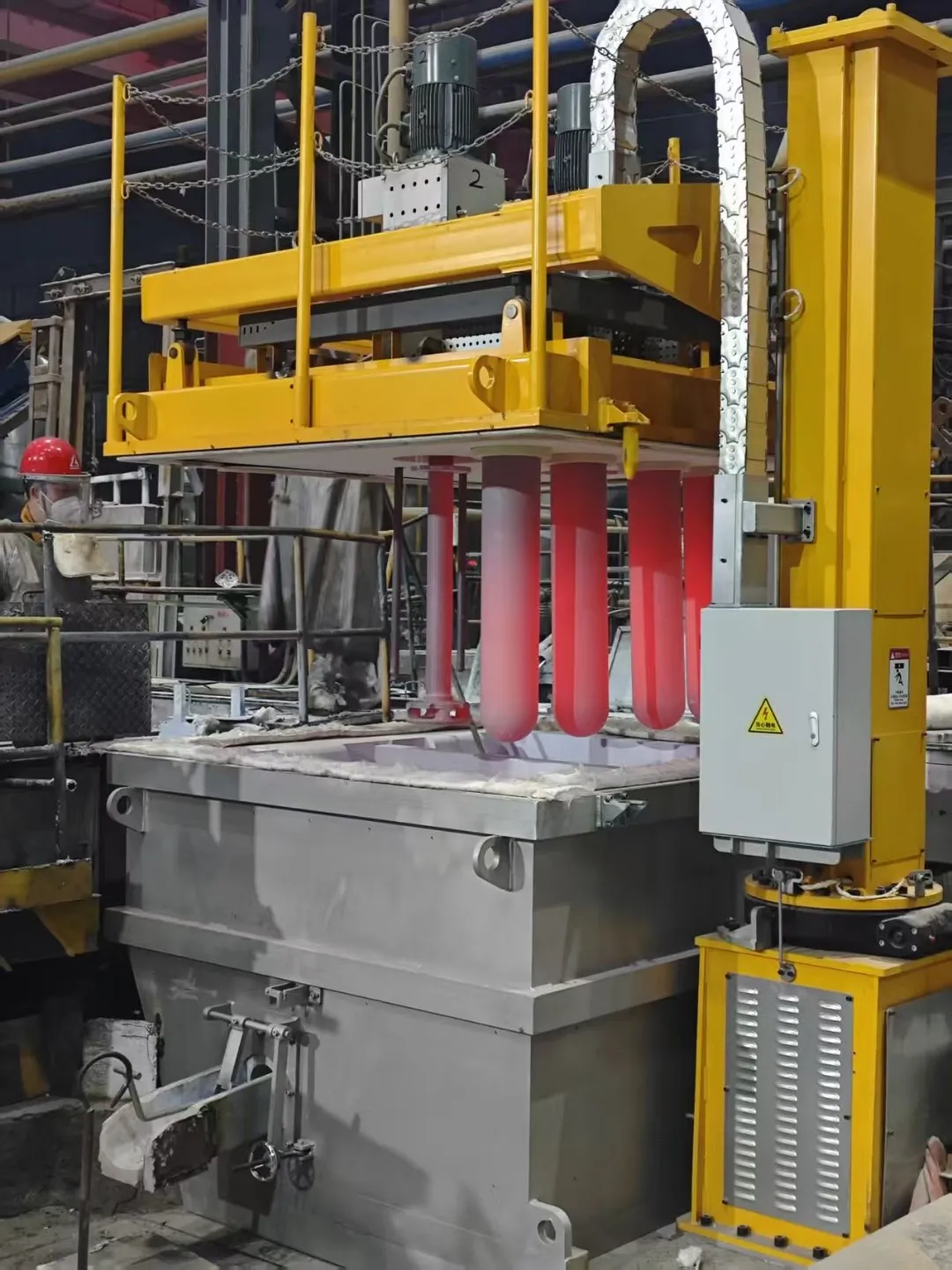
7. Melt Refining: Degassing and Filtration
Zorlu döküm uygulamalarına yönelik geri dönüştürülmüş alüminyumda, eritme ve ilk arıtma işlemlerinden sonra eriyik işleme gerekli olabilir.
Gaz giderme ve filtreleme, iki önemli işlemdir. Bu işlemler birbirini tamamlar, ancak aynı işlevi görmezler.
Daha fazla bilgi: Alüminyumun Arıtılması: Gaz Giderme, Akı Uygulama, Filtreleme, Yöntemler.
7.1 Degassing removes dissolved hydrogen
Hidrojen, erimiş alüminyumda çözünebilir ve metal uygun olmayan koşullar altında katılaştığında gaz gözenekliliğine yol açabilir.
Endüstriyel gaz giderme işleminde genellikle argon veya azot gibi bir inert gaz kullanılır; bu gaz, uygun bir işleme sistemi aracılığıyla eriyik içine verilir. Hidrojen, eriyikten gaz kabarcıklarına geçer ve bu şekilde uzaklaştırılır.
Gaz giderme işleminin etkinliği, gaz beslemesi, uygun olduğu durumlarda rotor veya enjektör tasarımı, eriyik sıcaklığı, işlem süresi, alaşımın durumu ve başlangıçtaki hidrojen içeriği gibi parametrelere bağlıdır.
Bir gaz giderme sistemi, hatalı bir alaşım bileşimini düzeltmez ve bir gaz giderme ünitesinin varlığı tek başına belirli bir nihai hidrojen seviyesini garanti etmez. Uygun çalışma koşulları ve doğrulama gereklidir.
7.2 Filtration removes non-metallic inclusions
Erimiş alüminyumda oksit tabakaları ve diğer metalik olmayan kalıntılar bulunabilir. Bunlar, döküm kusurlarına yol açabilir ve ürün kalitesini düşürebilir.
Seramik köpük filtreler, uygun alüminyum döküm uygulamalarında, çeşitli filtreleme mekanizmaları ve filtre yapısıyla olan etkileşimlerin birleşimi yoluyla kalıntıları yakalamak veya tutmak amacıyla kullanılır.
Filtre, istenen temizlik derecesi, metal akış hızı, alaşım türü, filtreleme düzeni ve döküm koşullarına göre seçilmelidir.
Gerekli akış için çok kısıtlayıcı bir filtre üretimi aksatabilir; buna karşılık, uygun olmayan bir filtre düzeni ise istenen temizlik seviyesini sağlayamayabilir.
Degassing versus filtration
| Süreç | Ana hedef | Neyin yerini almaz |
|---|---|---|
| Gaz Giderme | Çözünmüş hidrojen ve diğer özel olarak hedeflenen eriyik bileşenleri (işlem yapılandırmasına bağlı olarak) | Alaşım bileşiminin kontrolü ve inklüzyonların süzülmesi |
| Seramik köpük filtrasyon | Erimiş metaldeki metalik olmayan kalıntılar | Çözünmüş hidrojen giderimi |
| Akı tedavisi | Akış maddesine bağlı olarak, belirli yüzey koruma, arıtma veya kalıntı ayırma işlevleri | Diğer tüm eriyik işleme işlemleri |
| Alaşım ayarı | Kimyasal bileşim | Tüm kalıntıların veya çözünmüş gazın fiziksel olarak giderilmesi |
Bu ayrım, yüksek kaliteli döküm için metal üreten bir geri dönüşüm tesisinde özellikle önemlidir. Hidrojen kontrolü ve kalıntı kontrolü ayrı ayrı değerlendirilmelidir.
7.3 Which filtration solution should a plant consider?
Farklı filtreleme düzenleri, farklı üretim gereksinimlerine uygun olabilir.
-
Seramik köpük filtreler: Kötü kalıntıların giderilmesinin gerekli olduğu uygun döküm hatlarında kullanılır.
-
Kartuş filtreleme sistemleri: İşlem, belirli bir filtreleme düzeni ve performans seviyesi gerektirdiğinde dikkate alınır.
-
Derin yataklı filtreleme sistemleri: Bu konfigürasyona uygun üretim hatları ve filtreleme görevleri açısından değerlendirilmiştir.
Seçim, en karmaşık filtreleme sisteminin her zaman en iyi seçenek olduğu varsayımından ziyade, gerçek üretim hedefine göre yapılmalıdır.
Yüksek değerli alaşımlar üreten tesislerde, filtreleme işleminin eritme, eriyik işleme, metal akışı ve döküm süreçleriyle entegre edilmesi gerekir. Filtreleme, hatalı hurda ayrıştırmasını veya kabul edilemeyecek derecede kirlenmiş hammaddeyi telafi edemez.
8. Casting and Final Product Quality Control
Erimiş metal, gerekli kimyasal bileşim ve eriyik kalitesi koşullarını karşıladığında, sonraki işleme aşamalarına uygun bir kalıba dökülebilir.
Tipik örnekler şunlardır:
-
Depolama, nakliye veya daha sonra yeniden eritme amaçlı külçeler.
-
Ekstrüzyon için kütükler.
-
Haddeleme için levhalar.
-
Bu ürünleri doğrudan kullanan uygulamalar için kalıplı şekiller.
-
Liquid metal supplied to a downstream manufacturing operation where appropriate.
The correct casting route depends on the intended product and the capabilities of the facility. Secondary aluminium is not a single universal product: different casting applications impose different chemistry, cleanliness and dimensional requirements.
Quality checks before release
Quality control should be defined around the product specification and process risks.
| Quality check | Neden önemli |
|---|---|
| Chemical composition analysis | Confirms that the metal meets the specified alloy composition |
| Hydrogen measurement where relevant | Assesses melt condition for applications sensitive to gas porosity |
| Inclusion or cleanliness assessment | Checks whether melt treatment meets the required cleanliness criteria |
| Sıcaklık doğrulaması | Supports controlled transfer and casting |
| Casting inspection | Identifies relevant surface, dimensional or internal quality problems |
| Process and batch records | Help trace results back to scrap sources and operating conditions |
The appropriate test method and acceptance limits depend on the alloy and product. A generic article should not assign one universal hydrogen limit, inclusion level or defect tolerance to all recycled aluminium.
Traceability also matters. When a defect occurs, records of scrap source, alloy composition, melt treatment, sampling and casting conditions help determine whether the cause originated in the feedstock, melting operation or downstream process.
9. How Energy-Efficient Is Aluminium Recycling?
Aluminium recycling is generally much less energy-intensive than producing primary aluminium from bauxite. However, a percentage should always be interpreted against its stated system boundary.
The International Aluminium Institute reports that, using 2019 global production data and the cited life-cycle inventory modelling, primary aluminium production required approximately 186 GJ of primary energy per tonne from mine to cast house, compared with 8.3 GJ per tonne for recycled aluminium. The resulting estimated energy saving was 95.5%.
The Aluminum Association likewise describes secondary aluminium production as approximately 95% more energy-efficient than primary production.
These are industry-level comparisons. They do not mean that every recycling plant will reduce its own energy consumption by exactly 95%. Actual performance depends on the scrap stream, pre-treatment requirements, furnace type, plant efficiency, residue recovery and accounting boundaries.
What affects the environmental performance of a recycling plant?
Scrap preparation: Removing unsuitable contaminants and preparing scrap correctly can improve processing, but preparation itself consumes energy and resources.
Furnace efficiency: Charging practice, furnace condition, heat transfer, holding time and temperature control influence energy demand.
Metal recovery: Preventing avoidable oxidation and recovering metallic aluminium from suitable residues can improve the usable output obtained from each tonne of feedstock.
Emissions management: Shredding, thermal treatment, coatings, fuel combustion and some flux-based processes may generate dust, organic emissions or other pollutants requiring suitable controls.
Residue management: Dross, skimmings and salt slag must be handled and treated according to their composition and applicable requirements.
The IAI identifies dust, organic compounds, fuel-related carbon dioxide emissions and, in certain salt-flux processes, additional emissions and salt slag as environmental considerations in scrap refining. Suitable furnace design, process optimization and emissions controls are therefore part of responsible recycling.
10. Common Problems in Aluminium Recycling and How to Address Them
The most useful process improvement is often to identify the cause of a problem before increasing treatment intensity or purchasing additional equipment.
| Gözlemlenen sorun | Potential causes to investigate | Appropriate direction |
|---|---|---|
| Final alloy does not meet specification | Mixed alloys, contaminated scrap, incorrect blending or insufficient chemical verification | Improve incoming scrap classification and establish a controlled composition-adjustment procedure |
| Excessive metal loss | Oxidation, unsuitable scrap preparation, handling practices or inefficient dross recovery | Review charge characteristics, melting practice and residue treatment |
| Gas porosity in cast products | Hydrogen, solidification conditions or other casting-related causes | Measure hydrogen where appropriate and review melt treatment and casting conditions |
| Inclusion-related defects | Oxide films, contaminated feedstock, poor handling or inadequate filtration | Identify inclusion sources and verify the effectiveness of melt cleanliness controls |
| High energy consumption | Excessive holding time, unsuitable feed preparation, inefficient furnace operation or unnecessary reheating | Review energy use across preparation, melting, holding and transfer |
| Unstable production rate | Furnace limitations, poor charge consistency, bottlenecks in treatment or downstream casting | Assess the entire process rather than one machine in isolation |
| Excessive dust or fumes | Scrap contaminants, shredding, coatings, thermal treatment or inadequate extraction | Identify the emission source and verify suitable collection and treatment systems |
A defect does not automatically mean the filtration system is inadequate. Likewise, a low metal recovery rate cannot necessarily be solved by changing flux.
Reliable improvement begins with identifying where the loss or defect originates, measuring the problem and matching the solution to the cause.
11. How to Select Aluminium Recycling Equipment
Equipment selection should begin with the actual production requirement.
Before requesting quotations, establish the following:
-
Feedstock: What types of aluminium scrap will be processed, and how consistent are their alloy composition and contamination levels?
-
Capacity: What are the required hourly and annual throughput, operating hours and batch sizes?
-
Target product: Will the plant produce foundry alloys, extrusion billets, rolling slabs or another product?
-
Quality requirements: Which alloy specifications, cleanliness criteria and final product tests are required?
-
Existing equipment: What furnace, holding furnace, degassing, filtration and casting systems are already installed?
-
Operating conditions: What are the existing temperature profile, metal flow, transfer distance and production constraints?
-
Environmental and safety requirements: What treatment is required for dust, coatings, residues and process emissions under the local rules?
These details help determine whether a plant needs better pre-treatment, upgraded melting capacity, more reliable composition control, additional melt treatment or improved casting arrangements.
Where do fluxes and molten aluminium purification equipment fit?
AdTech’s published product portfolio includes refining fluxes, flux injection systems, çevrimiçi gaz giderme ekipmanı, ceramic foam filters, other filtration equipment and integrated launder equipment for molten aluminium processing. These products relate to specific melt-treatment and casting stages, rather than replacing the collection, sorting and pre-treatment stages of recycling.
Örneğin:
-
Flux selection should match the intended treatment function and the manufacturer’s operating instructions.
-
Flux injection equipment may be relevant where controlled and repeatable flux delivery is required.
-
Degassing equipment should be considered when hydrogen control is a defined process requirement.
-
Ceramic foam filters should be evaluated when non-metallic inclusion removal is required.
-
Launder equipment should be considered for controlled transfer of molten aluminium and temperature management in the relevant casting layout.
The right configuration depends on the plant’s process, alloy range, throughput and final quality targets. A supplier should be able to explain the function and limitations of each proposed system, not simply provide a list of machines.
12. Frequently Asked Questions
Does every aluminium scrap type use the same recycling process?
No. Clean production scrap may require minimal preparation, while mixed scrap, coated products and machining turnings may need additional sorting, cleaning, drying or decoating. The route should reflect both the feedstock and the target product.
Can a ceramic foam filter remove hydrogen from molten aluminium?
No. A ceramic foam filter is designed to remove non-metallic inclusions. Dissolved hydrogen generally requires a suitable degassing process when hydrogen reduction is necessary.
Can aluminium recycling recover every kilogram of metal?
No. Metal losses can occur through oxidation, residues, handling and other process inefficiencies. Proper preparation, controlled melting and suitable residue recovery can improve metal yield, but a universal recovery rate would not be appropriate for all scrap types and plants.
How are painted aluminium cans prepared for recycling?
Depending on the coating and process requirements, used cans may be sorted, shredded or otherwise sized, and thermally treated to remove coatings before remelting. The specific treatment depends on the feedstock, equipment and emissions-control requirements.
What temperature is needed to melt aluminium scrap?
Pure aluminium melts at approximately 660°C, but actual furnace operating temperatures depend on alloy composition, furnace design and the requirements of the melting and casting process. The melting point should not be used as a universal operating setpoint.
Why is dross produced during aluminium melting?
Aluminium oxidation and the interaction of the melt with process residues contribute to dross formation. Dross may contain recoverable metallic aluminium, so appropriate handling and recovery methods can help reduce avoidable metal losses.
What are the main environmental concerns in aluminium recycling?
Key considerations include energy use, fuel-related emissions, dust from material handling, emissions associated with coatings and thermal treatment, and the management of dross or salt slag. The actual impact depends on the process route, input scrap and emissions controls.
Sonuç
The aluminium recycling process is a coordinated sequence of material preparation, melting, metal refining and casting. Its performance depends on the condition and composition of the scrap, safe charging practices, appropriate furnace operation and effective control of the final metal quality.
For industrial producers, the most important principle is to match each treatment to a defined problem. Sorting controls feedstock consistency, fluxing supports specific refining and residue-separation functions, degassing addresses dissolved hydrogen, and filtration targets non-metallic inclusions. When these operations are selected and controlled together, a recycling plant is better positioned to achieve consistent metal quality, efficient metal recovery and responsible resource use.