
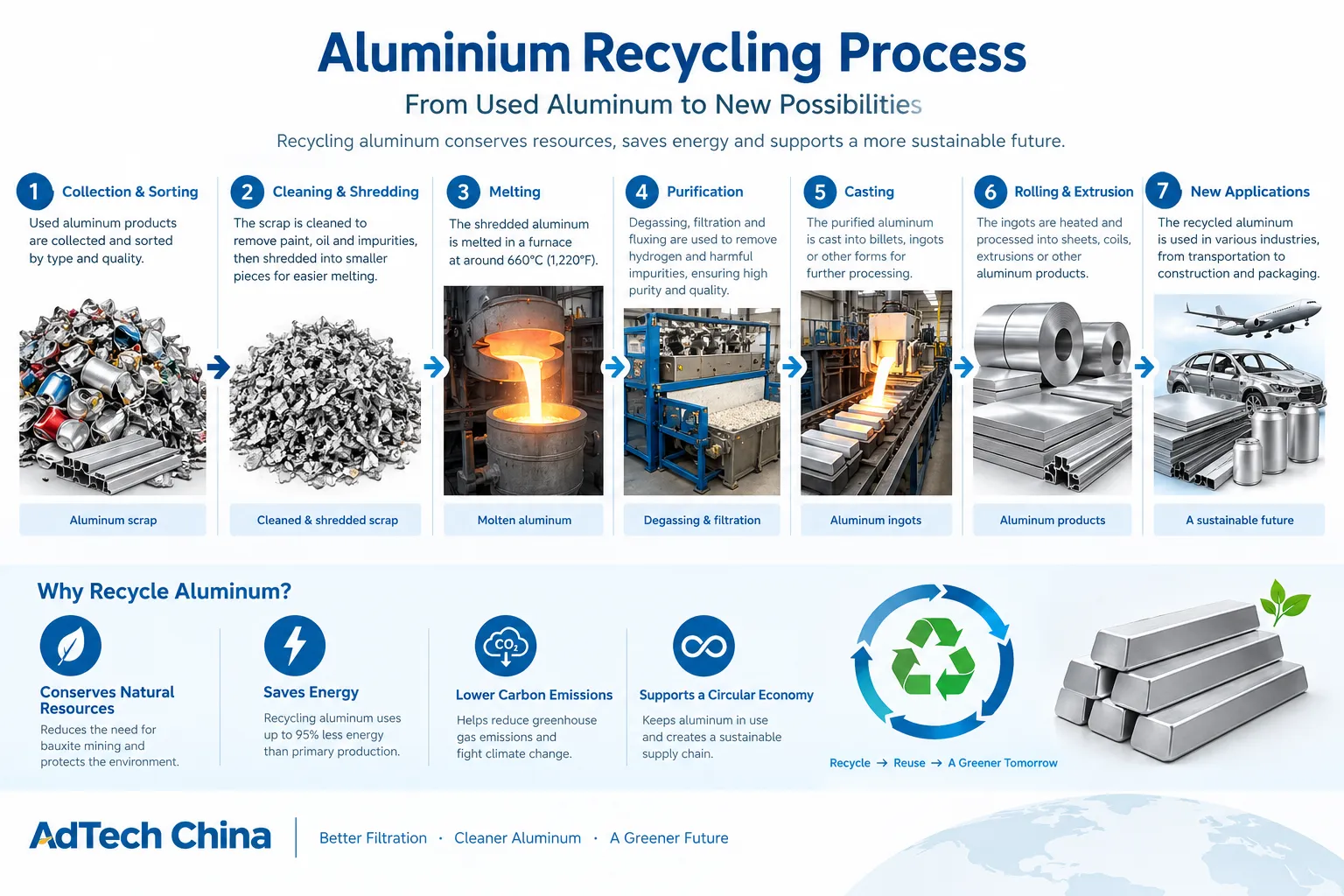
The aluminium recycling process converts aluminium scrap into reusable metal through collection, sorting, pre-treatment, melting, melt refining, alloy adjustment and casting. The exact process depends on the scrap source, alloy composition, contamination, coating, moisture content and the quality required for the final product. For industrial recyclers, the objective is not simply to melt aluminium, but to recover as much usable metal as practical while controlling alloy chemistry, inclusions, hydrogen, emissions and production costs.
Aluminium recycling is widely used to produce secondary aluminium for foundry alloys, extrusion billets, rolling slabs and other applications. Compared with producing primary aluminium from bauxite, recycling generally requires substantially less energy. However, achieving consistent recycled metal quality requires suitable scrap preparation and process control.
1. Aluminium Recycling Process at a Glance
The following table summarizes the main stages of industrial aluminium recycling.
| 스테이지 | Main operation | 주요 목표 |
|---|---|---|
| 1. Collection | Gather manufacturing scrap and end-of-life aluminium | Establish a usable feedstock supply |
| 2. Sorting | 알루미늄을 다른 재료와 분리하고 고철을 분류하십시오 | 합금의 균일성을 높이고 오염을 줄입니다 |
| 3. 전처리 | 필요에 따라 파쇄, 크기 조절, 건조, 탈유 또는 코팅 제거를 수행합니다. | 안전하고 효율적인 용해를 위해 스크랩을 준비하십시오 |
| 4. 용해 | 고철을 적절한 용광로에 투입한다 | 고체 알루미늄을 용융 금속으로 변환한다 |
| 5. 불순물 제거 및 거품 걷어내기 | 필요한 곳에 적절한 플럭스를 도포하고 표면의 잔여물을 제거하십시오. | 산화 억제, 잔류물 분리 및 금속 회수 |
| 6. 용융 정제 | 화학적 성분을 조정하고 원치 않는 용융물 성분을 제거한다 | 목표 합금 및 용융 품질 요건을 충족하십시오 |
| 7. 탈기 및 여과 | 필요한 경우 용존 수소와 비금속 흠을 제거한다 | 용융물의 청정도를 향상시킨다 |
| 8. 캐스팅 | 잉곳, 빌렛, 슬래브 또는 기타 주조 형태를 생산한다 | 후속 제조 공정을 위해 금속을 준비한다 |
| 9. 품질 관리 | 조성 분석 및 관련 품질 특성 검증 | 예정된 용도에 적합한지 확인하십시오 |
이러한 단계들은 모든 재활용 시설에서 동일하지는 않습니다. 깨끗한 제조 스크랩의 경우 비교적 적은 준비 과정만 필요할 수 있는 반면, 혼합된 소비 후 스크랩은 용융 전에 여러 단계의 분리 및 처리 과정이 필요할 수 있습니다. 일부 시설에서는 용융 및 정제 공정을 통합하는 반면, 다른 시설에서는 용융된 금속을 별도의 용광로나 처리 스테이션 간에 이송하기도 합니다.
2. Collection and Classification of Aluminium Scrap
재활용 과정은 폐자재의 출처와 구성 성분을 파악하는 것부터 시작됩니다.
Manufacturing scrap
알루미늄 제품 생산 과정에서 제조 스크랩이 발생합니다. 대표적인 예로는 시트 자투리, 압출 잔여물, 가공 칩, 주조 스크랩 등이 있습니다.
원산지와 재료 특성이 비교적 잘 알려져 있기 때문에, 깨끗하고 종류별로 분리된 제조 공정에서 발생하는 스크랩은 대개 효율적으로 재활용될 수 있습니다. 그러나 기름기가 묻은 칩, 혼합 합금 및 코팅이 된 재료의 경우 추가 처리가 필요할 수 있습니다.
Post-consumer aluminium scrap
소비 후 폐기물은 사용 수명이 다한 제품에서 발생하는 것입니다. 대표적인 예로는 다음과 같은 것들이 있습니다:
-
사용한 알루미늄 음료 캔 및 포장재.
-
알루미늄 창호 및 건축 자재.
-
차량 부품.
-
가정용 및 산업용 알루미늄 제품.
-
강철, 플라스틱, 고무 또는 기타 재료가 포함된 복합 알루미늄 부품.
소비 후 스크랩은 이전 용도, 합금 조성 및 오염 정도가 불확실할 수 있기 때문에 일반적으로 선별 작업에 더 큰 어려움을 초래합니다.
Aluminium dross and other process residues
알루미늄 드로스는 용융 및 금속 취급 과정에서 발생합니다. 여기에는 알루미늄 산화물, 기타 성분 및 회수 가능성이 있는 금속 알루미늄이 포함되어 있습니다.
슬래그는 깨끗한 알루미늄 스크랩과 동등하게 취급되어서는 안 됩니다. 슬래그의 회수 방법은 그 성분, 온도, 취급 이력 및 이용 가능한 회수 기술에 따라 달라집니다.
중요한 원칙은 용광로 처리 경로를 선정하기 전에 스크랩을 분류해야 한다는 점입니다. 알루미늄이 포함된 모든 재료를 서로 대체 가능한 것으로 취급하는 시설은 합금 관리에 차질이 생기고, 불필요한 가공 과정이 발생하며, 금속 회수율이 낮아질 위험이 있습니다.
3. Sorting and Separation: Why Alloy Composition Matters
선별은 2차 알루미늄 생산 과정에서 가장 중요한 단계 중 하나인데, 이는 투입되는 스크랩의 화학 성분이 최종 금속의 품질에 직접적인 영향을 미치기 때문이다.
알루미늄 합금에는 실리콘, 마그네슘, 구리, 망간 등의 원소가 다양한 비율로 포함되어 있습니다. 이러한 원소들은 강도, 내식성, 성형성, 주조성 등의 특성에 영향을 미칩니다.
예를 들어, 고규소 주조 합금과 압연용으로 설계된 알루미늄 가공 합금은 각각 서로 다른 조성 요건을 가질 수 있습니다. 적절한 공정 계획 없이 이 두 합금을 혼합하면 의도한 최종 합금을 생산하기가 더 어려워질 수 있습니다.
Common aluminium scrap sorting methods
| 방법 | 목적 | 중요한 제한 사항 |
|---|---|---|
| 수동 분류 | 눈에 띄는 이물질을 제거하고, 구분 가능한 고철 종류별로 분류한다 | 운영자의 일관성과 실질적인 차이점의 명확성에 따라 달라집니다. |
| 자력 선별 | 강철 조각과 같은 철 재료를 제거하십시오 | 알루미늄 합금 등급을 서로 구분하지 않습니다 |
| 와전류 분리 | 적합한 폐기물 흐름에서 전도성 비철금속을 분리한다 | 성능은 재료의 크기, 모양, 공급 방식 및 장비 설계에 따라 달라집니다. |
| 센서 기반 분류 | 선택된 재료 범주 또는 합금군을 식별하고 분류한다 | 적절한 감지 기술과 검증된 선별 기준이 필요합니다. |
| Chemical composition analysis | Check alloy composition and support material classification | A representative sample and appropriate analytical method are required |
Laser-induced breakdown spectroscopy and colour-based sorting technologies are among the methods described by the Aluminum Association for improving scrap separation. Their usefulness depends on the feedstock and the recycling objective.
What happens when different aluminium alloys are mixed?
Mixing alloys is not automatically unacceptable. Some secondary aluminium products are designed to use mixed scrap, with composition adjusted through the process.
The problem arises when the mixture cannot meet the intended specification economically or consistently.
For example, an unwanted element that remains dissolved in the melt cannot ordinarily be removed simply by passing the metal through a ceramic filter. Depending on the element and target chemistry, practical responses may include better sorting, blending with suitable metal, changing the target product or using a more specialized metallurgical process.
Therefore, sorting is not merely a waste-handling activity. It is an important form of quality control that takes place before the metal enters the furnace. Research reviews of secondary aluminium production identify scrap composition and unwanted alloying elements as persistent challenges in producing recycled alloys.
4. Pre-Treatment: Shredding, Cleaning, Drying and Decoating
The purpose of pre-treatment is to prepare scrap for the selected melting process. Not every material requires every operation.
Shredding, shearing and sizing
Large or bulky components may be cut, crushed or shredded into manageable sizes. The required size depends on the separation equipment, furnace charging arrangement and characteristics of the scrap.
Size reduction can improve material handling and support downstream separation. However, it also consumes energy and may generate dust, so the equipment should match the actual feedstock.
Removing coatings and organic contaminants
Used beverage cans, painted components and other coated scrap may require decoating or delacquering before melting.
Coatings, oil, grease, lubricants and plastic residues can contribute to emissions and complicate the melting process. Suitable pre-treatment can improve metal recovery and reduce the contaminant load entering the furnace.
The need for thermal treatment depends on the coating and material type. It should not be assumed that every aluminium component requires the same decoating method.
Drying and de-oiling aluminium turnings
Machining chips and turnings deserve special attention because they may retain cutting fluids, oil and moisture. Their shape also gives them a relatively high surface area compared with their mass.
Suitable cleaning and drying can help prepare this material for safer charging and efficient metal recovery. The treatment method must be appropriate for the contaminant and the physical form of the scrap.
Why wet scrap is a serious safety concern
Wet or moisture-contaminated scrap must not be charged into molten metal without appropriate controls. Water contacting molten metal can cause a violent explosion.
The UK’s Health and Safety Executive advises storing scrap in dry, covered areas where possible, checking materials for water contamination and drying scrap when covered storage is not available. It also emphasizes training, appropriate protective equipment and safe operating practices.
Closed containers, trapped liquids and other potentially dangerous contaminants require specific assessment under the facility’s safety procedures.
Pre-treatment should therefore be selected based on three factors: material quality, metallurgical requirements and safe furnace operation.
5. Melting: Turning Prepared Scrap into Molten Aluminium
After preparation, the scrap is charged into a suitable melting furnace.
Pure aluminium has a melting point of approximately 660°C. Commercial alloys and industrial recycling processes operate according to their respective melting ranges and process requirements, so 660°C should not be treated as a universal furnace setpoint.
The actual operating temperature depends on alloy composition, furnace technology, charge condition, required throughput and downstream casting requirements.
Choosing a melting furnace
Different furnace designs suit different forms of scrap and production requirements.
| 용광로 유형 | General consideration | What to evaluate |
|---|---|---|
| 잔향로 | Used for melting substantial quantities of aluminium scrap and other suitable feedstocks | Capacity, thermal efficiency, charge characteristics and melt handling |
| 회전로 | Used in some secondary aluminium operations, particularly where scrap characteristics suit rotary processing | Scrap contamination, process residues, flux requirements and recovery performance |
| 인덕션 퍼니스 | Provides electromagnetic heating and may suit particular melting tasks | Furnace capacity, charge characteristics, electrical infrastructure and melt cleanliness |
| Crucible furnace | Used in selected smaller-scale or specialized melting applications | Batch size, alloy range, operating flexibility and handling arrangements |
These are general selection considerations rather than a universal ranking. Furnace suitability cannot be determined from nominal capacity alone.
One important industry distinction is the feedstock and refining route. Cleaner, well-characterized scrap may be remelted through a relatively direct process, while more contaminated or mixed scrap can require more intensive refining. Terminology such as remelter and refiner varies by market and production context, but the underlying distinction is useful when evaluating a process.
Controlling oxidation and metal losses
Aluminium develops oxide films when exposed to oxygen. During charging, melting, transfer and surface disturbance, oxidation can contribute to metal losses and non-metallic residues.
Scrap size, surface condition, furnace operation, temperature control, handling practices and melt exposure all influence the outcome.
A practical process review should therefore measure metal recovery rather than relying only on how quickly the furnace melts the charge.
6. Fluxing, Dross Removal and Alloy Adjustment
After melting, the metal may require additional treatment to meet its target composition and cleanliness requirements.
Fluxes are used in various aluminium recycling operations, but their function depends on the flux formulation and the process in which it is applied.

What does flux do in aluminium recycling?
Depending on the formulation and application, flux can help protect the melt surface, support separation of unwanted material, assist metal recovery from dross or perform a defined refining function.
It is not correct to assume that every flux removes the same contaminants or that fluxing alone can bring every melt to specification.
Common functional categories include:
| 플럭스 카테고리 | 일반적인 목적 | Key consideration |
|---|---|---|
| 커버 플럭스 | Helps protect the molten metal surface | Compatibility with the process and melt conditions |
| 플럭스 정제 | 지정된 용융 정제 기능을 지원합니다 | 합금, 불순물 종류, 처리 방법 및 첨가량 |
| 슬래그 제거용 또는 드로싱용 플럭스 | 표면 잔류물에서 금속을 분리하는 데 도움을 줍니다 | 슬래그의 특성 및 회수 절차 |
| 용광로 청소 플럭스 | 용광로 표면에 적절한 침전물을 형성하는 데 사용됩니다. | 로(Furnace)의 상태 및 제조사의 사용 설명서 |
| 플럭스 재활용 | 특정 공정에서 슬래그나 재로부터 금속 알루미늄을 회수하는 데 사용됨 | 잔류물 조성 및 회수 설비 |
국제알루미늄협회(International Aluminium Institute)는 많은 스크랩 정제 공정에서 용융 금속을 덮고, 불순물을 제거하며, 산화를 줄이기 위해 염류 플럭스를 사용한다고 설명합니다. 또한 드로스, 스키밍, 염류 슬래그를 적절한 처리 및 회수 절차가 필요한 공정 잔류물로 지목하고 있습니다. 모든 재활용 공정이 동일한 플럭스 시스템을 사용하는 것은 아닙니다.
Removing dross
슬래그는 산화물을 함유한 물질과 기타 성분들이 용융 금속 표면에 쌓이면서 형성됩니다. 공정에 따라 이 물질 중 일부에는 회수 가능한 알루미늄이 포함되어 있습니다.
표면 슬래그 제거는 용광로 및 금속 취급 절차와 조화를 이루어야 합니다. 무리한 취급이나 관리가 부실한 취급은 산화를 촉진할 수 있으며, 부적절한 잔류물 처리는 불필요한 손실을 초래할 수 있습니다.
슬래그는 기술적·경제적으로 타당할 경우 회수 가능한 공정 잔류물로 관리되어야 하며, 실제 물질에 맞춰 처리 및 최종 처분 방법을 선정해야 한다.
Alloy composition adjustment
용융 후, 생산자는 필요한 화학 성분을 얻기 위해 적절한 합금 원소를 첨가하거나 금속을 혼합할 수 있습니다.
목표 사양이 엄격한 경우, 대표적인 화학 성분 분석이 필수적입니다. 분석 대상 원소는 등급과 최종 용도에 따라 달라집니다.
플럭싱, 스키밍, 합금 조정은 각각 다른 문제를 해결합니다. 잘 설계된 공정은 하나의 공정 단계만으로도 모든 종류의 불순물을 제거할 수 있다고 가정하기보다는, 각 처리 단계의 목적을 명확히 정의합니다.
7. Melt Refining: Degassing and Filtration
까다로운 주조 용도로 사용되는 재활용 알루미늄의 경우, 용해 및 초기 정제 과정 이후에 용융 처리가 필요할 수 있습니다.
탈기 및 여과는 두 가지 중요한 공정입니다. 이 두 공정은 상호 보완적이지만, 동일한 기능을 수행하는 것은 아닙니다.
더 보기: 알루미늄 정제 방법: 탈기, 플럭스 처리, 여과, 다양한 방법.
7.1 Degassing removes dissolved hydrogen
수소는 용융 알루미늄에 용해될 수 있으며, 금속이 부적절한 조건에서 응고될 때 기포 발생의 원인이 될 수 있다.
산업용 탈기 공정에서는 일반적으로 아르곤이나 질소와 같은 불활성 가스를 적절한 처리 시스템을 통해 용융물 속으로 주입하는 방식을 사용합니다. 수소는 용융물에서 기포로 이동하여 제거됩니다.
탈기 효율은 가스 공급량, 해당되는 경우 로터 또는 인젝터 설계, 용융물 온도, 처리 시간, 합금 상태 및 초기 수소 함량과 같은 매개변수에 따라 달라집니다.
탈기 시스템은 잘못된 합금 조성을 바로잡아 주지 않으며, 탈기 장치가 있다고 해서 그 자체만으로는 특정 최종 수소 농도가 보장되는 것은 아닙니다. 적절한 운전 조건과 검증이 필요합니다.
7.2 Filtration removes non-metallic inclusions
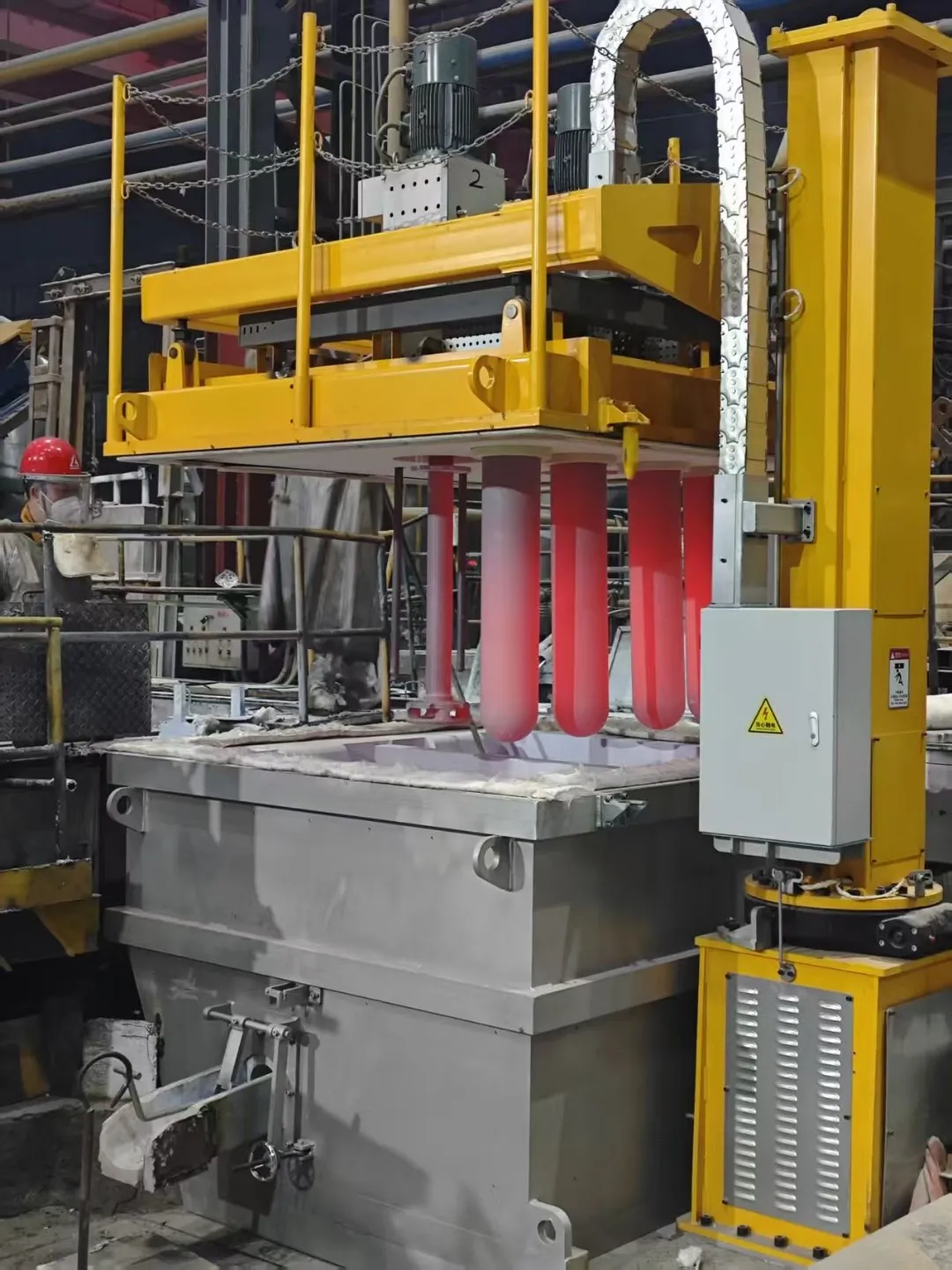
용융 알루미늄에는 산화막 및 기타 비금속 내포물이 포함될 수 있습니다. 이러한 물질은 주조 결함을 유발하고 제품 품질을 저하시킬 수 있습니다.
세라믹 폼 필터는 적절한 알루미늄 주조 공정에 사용되어, 여과 메커니즘과 필터 구조와의 상호작용을 통해 내포물을 포집하거나 걸러냅니다.
필터는 요구되는 청정도, 금속 유량, 합금, 여과 방식 및 주조 조건에 따라 선택해야 합니다.
필요한 유량에 비해 지나치게 제한적인 필터는 생산에 차질을 빚을 수 있으며, 부적절한 필터 배치는 원하는 청정도를 달성하지 못할 수도 있습니다.
Degassing versus filtration
| 프로세스 | 주요 대상 | 대체하지 못하는 것 |
|---|---|---|
| 가스 제거 | 용존 수소 및 공정 구성에 따라 특정 대상으로 지정된 기타 용융물 성분 | 합금 조성 제어 및 흠함물 여과 |
| 세라믹 폼 여과 | 용융 금속 내의 비금속 함유물 | 용존 수소 제거 |
| 플럭스 처리 | 플럭스에 따라 특정 표면 보호, 정제 또는 잔류물 분리 기능을 수행합니다. | 그 외의 모든 용융 처리 공정 |
| 합금 조정 | 화학 성분 | 모든 내포물 또는 용존 가스의 물리적 제거 |
이러한 구분은 고품질 주조용 금속을 생산하는 재활용 공장에서 특히 중요합니다. 수소 관리와 함유량 관리는 별도로 평가되어야 합니다.
7.3 Which filtration solution should a plant consider?
생산 요구 사항에 따라 다양한 여과 방식을 적용할 수 있습니다.
-
세라믹 폼 필터: 내포물 제거가 필요한 적절한 주조 라인에서 사용됩니다.
-
카트리지 여과 시스템: 공정에 특정 여과 방식과 성능 수준이 필요한 경우에 고려됩니다.
-
심층 여과 시스템: 해당 구성에 적합한 생산 라인 및 여과 작업에 대해 평가되었습니다.
가장 복잡한 여과 시스템이 항상 최선의 선택이라고 가정하기보다는, 실제 생산 목표를 기준으로 시스템을 선정해야 합니다.
고부가가치 합금을 생산하는 공장의 경우, 여과 공정은 용해, 용융 처리, 금속 유동 및 주조 공정과 통합되어야 합니다. 여과 공정만으로는 부실한 스크랩 선별이나 허용 기준을 초과하는 오염된 원료의 문제를 보완할 수 없습니다.
8. Casting and Final Product Quality Control
용융 금속이 요구되는 화학 조성 및 용융 품질 조건을 충족하면, 후속 공정에 적합한 형태로 주조할 수 있습니다.
대표적인 형태로는 다음과 같은 것들이 있습니다:
-
저장, 운송 또는 후속 재용융용 잉곳.
-
압출용 빌렛.
-
압연용 슬래브.
-
해당 제품을 직접 사용하는 용도에 맞는 성형품을 제작합니다.
-
Liquid metal supplied to a downstream manufacturing operation where appropriate.
The correct casting route depends on the intended product and the capabilities of the facility. Secondary aluminium is not a single universal product: different casting applications impose different chemistry, cleanliness and dimensional requirements.
Quality checks before release
Quality control should be defined around the product specification and process risks.
| Quality check | 중요한 이유 |
|---|---|
| Chemical composition analysis | Confirms that the metal meets the specified alloy composition |
| Hydrogen measurement where relevant | Assesses melt condition for applications sensitive to gas porosity |
| Inclusion or cleanliness assessment | Checks whether melt treatment meets the required cleanliness criteria |
| 온도 확인 | Supports controlled transfer and casting |
| Casting inspection | Identifies relevant surface, dimensional or internal quality problems |
| Process and batch records | Help trace results back to scrap sources and operating conditions |
The appropriate test method and acceptance limits depend on the alloy and product. A generic article should not assign one universal hydrogen limit, inclusion level or defect tolerance to all recycled aluminium.
Traceability also matters. When a defect occurs, records of scrap source, alloy composition, melt treatment, sampling and casting conditions help determine whether the cause originated in the feedstock, melting operation or downstream process.
9. How Energy-Efficient Is Aluminium Recycling?
Aluminium recycling is generally much less energy-intensive than producing primary aluminium from bauxite. However, a percentage should always be interpreted against its stated system boundary.
The International Aluminium Institute reports that, using 2019 global production data and the cited life-cycle inventory modelling, primary aluminium production required approximately 186 GJ of primary energy per tonne from mine to cast house, compared with 8.3 GJ per tonne for recycled aluminium. The resulting estimated energy saving was 95.5%.
The Aluminum Association likewise describes secondary aluminium production as approximately 95% more energy-efficient than primary production.
These are industry-level comparisons. They do not mean that every recycling plant will reduce its own energy consumption by exactly 95%. Actual performance depends on the scrap stream, pre-treatment requirements, furnace type, plant efficiency, residue recovery and accounting boundaries.
What affects the environmental performance of a recycling plant?
Scrap preparation: Removing unsuitable contaminants and preparing scrap correctly can improve processing, but preparation itself consumes energy and resources.
Furnace efficiency: Charging practice, furnace condition, heat transfer, holding time and temperature control influence energy demand.
Metal recovery: Preventing avoidable oxidation and recovering metallic aluminium from suitable residues can improve the usable output obtained from each tonne of feedstock.
Emissions management: Shredding, thermal treatment, coatings, fuel combustion and some flux-based processes may generate dust, organic emissions or other pollutants requiring suitable controls.
Residue management: Dross, skimmings and salt slag must be handled and treated according to their composition and applicable requirements.
The IAI identifies dust, organic compounds, fuel-related carbon dioxide emissions and, in certain salt-flux processes, additional emissions and salt slag as environmental considerations in scrap refining. Suitable furnace design, process optimization and emissions controls are therefore part of responsible recycling.
10. Common Problems in Aluminium Recycling and How to Address Them
The most useful process improvement is often to identify the cause of a problem before increasing treatment intensity or purchasing additional equipment.
| 발견된 문제 | Potential causes to investigate | Appropriate direction |
|---|---|---|
| Final alloy does not meet specification | Mixed alloys, contaminated scrap, incorrect blending or insufficient chemical verification | Improve incoming scrap classification and establish a controlled composition-adjustment procedure |
| Excessive metal loss | Oxidation, unsuitable scrap preparation, handling practices or inefficient dross recovery | Review charge characteristics, melting practice and residue treatment |
| Gas porosity in cast products | Hydrogen, solidification conditions or other casting-related causes | Measure hydrogen where appropriate and review melt treatment and casting conditions |
| Inclusion-related defects | Oxide films, contaminated feedstock, poor handling or inadequate filtration | Identify inclusion sources and verify the effectiveness of melt cleanliness controls |
| High energy consumption | Excessive holding time, unsuitable feed preparation, inefficient furnace operation or unnecessary reheating | Review energy use across preparation, melting, holding and transfer |
| Unstable production rate | Furnace limitations, poor charge consistency, bottlenecks in treatment or downstream casting | Assess the entire process rather than one machine in isolation |
| Excessive dust or fumes | Scrap contaminants, shredding, coatings, thermal treatment or inadequate extraction | 배출원을 파악하고 적절한 수집 및 처리 시스템을 확인한다 |
A defect does not automatically mean the filtration system is inadequate. Likewise, a low metal recovery rate cannot necessarily be solved by changing flux.
Reliable improvement begins with identifying where the loss or defect originates, measuring the problem and matching the solution to the cause.
11. How to Select Aluminium Recycling Equipment
Equipment selection should begin with the actual production requirement.
Before requesting quotations, establish the following:
-
Feedstock: What types of aluminium scrap will be processed, and how consistent are their alloy composition and contamination levels?
-
Capacity: What are the required hourly and annual throughput, operating hours and batch sizes?
-
Target product: Will the plant produce foundry alloys, extrusion billets, rolling slabs or another product?
-
Quality requirements: Which alloy specifications, cleanliness criteria and final product tests are required?
-
Existing equipment: What furnace, holding furnace, degassing, filtration and casting systems are already installed?
-
Operating conditions: What are the existing temperature profile, metal flow, transfer distance and production constraints?
-
Environmental and safety requirements: What treatment is required for dust, coatings, residues and process emissions under the local rules?
These details help determine whether a plant needs better pre-treatment, upgraded melting capacity, more reliable composition control, additional melt treatment or improved casting arrangements.
Where do fluxes and molten aluminium purification equipment fit?
AdTech’s published product portfolio includes refining fluxes, flux injection systems, 온라인 탈기 장비, ceramic foam filters, other filtration equipment and integrated launder equipment for molten aluminium processing. These products relate to specific melt-treatment and casting stages, rather than replacing the collection, sorting and pre-treatment stages of recycling.
예를 들어:
-
Flux selection should match the intended treatment function and the manufacturer’s operating instructions.
-
Flux injection equipment may be relevant where controlled and repeatable flux delivery is required.
-
Degassing equipment should be considered when hydrogen control is a defined process requirement.
-
Ceramic foam filters should be evaluated when non-metallic inclusion removal is required.
-
Launder equipment should be considered for controlled transfer of molten aluminium and temperature management in the relevant casting layout.
The right configuration depends on the plant’s process, alloy range, throughput and final quality targets. A supplier should be able to explain the function and limitations of each proposed system, not simply provide a list of machines.
12. Frequently Asked Questions
Does every aluminium scrap type use the same recycling process?
No. Clean production scrap may require minimal preparation, while mixed scrap, coated products and machining turnings may need additional sorting, cleaning, drying or decoating. The route should reflect both the feedstock and the target product.
Can a ceramic foam filter remove hydrogen from molten aluminium?
No. A ceramic foam filter is designed to remove non-metallic inclusions. Dissolved hydrogen generally requires a suitable degassing process when hydrogen reduction is necessary.
Can aluminium recycling recover every kilogram of metal?
No. Metal losses can occur through oxidation, residues, handling and other process inefficiencies. Proper preparation, controlled melting and suitable residue recovery can improve metal yield, but a universal recovery rate would not be appropriate for all scrap types and plants.
How are painted aluminium cans prepared for recycling?
Depending on the coating and process requirements, used cans may be sorted, shredded or otherwise sized, and thermally treated to remove coatings before remelting. The specific treatment depends on the feedstock, equipment and emissions-control requirements.
What temperature is needed to melt aluminium scrap?
Pure aluminium melts at approximately 660°C, but actual furnace operating temperatures depend on alloy composition, furnace design and the requirements of the melting and casting process. The melting point should not be used as a universal operating setpoint.
Why is dross produced during aluminium melting?
Aluminium oxidation and the interaction of the melt with process residues contribute to dross formation. Dross may contain recoverable metallic aluminium, so appropriate handling and recovery methods can help reduce avoidable metal losses.
What are the main environmental concerns in aluminium recycling?
Key considerations include energy use, fuel-related emissions, dust from material handling, emissions associated with coatings and thermal treatment, and the management of dross or salt slag. The actual impact depends on the process route, input scrap and emissions controls.
결론
The aluminium recycling process is a coordinated sequence of material preparation, melting, metal refining and casting. Its performance depends on the condition and composition of the scrap, safe charging practices, appropriate furnace operation and effective control of the final metal quality.
For industrial producers, the most important principle is to match each treatment to a defined problem. Sorting controls feedstock consistency, fluxing supports specific refining and residue-separation functions, degassing addresses dissolved hydrogen, and filtration targets non-metallic inclusions. When these operations are selected and controlled together, a recycling plant is better positioned to achieve consistent metal quality, efficient metal recovery and responsible resource use.