

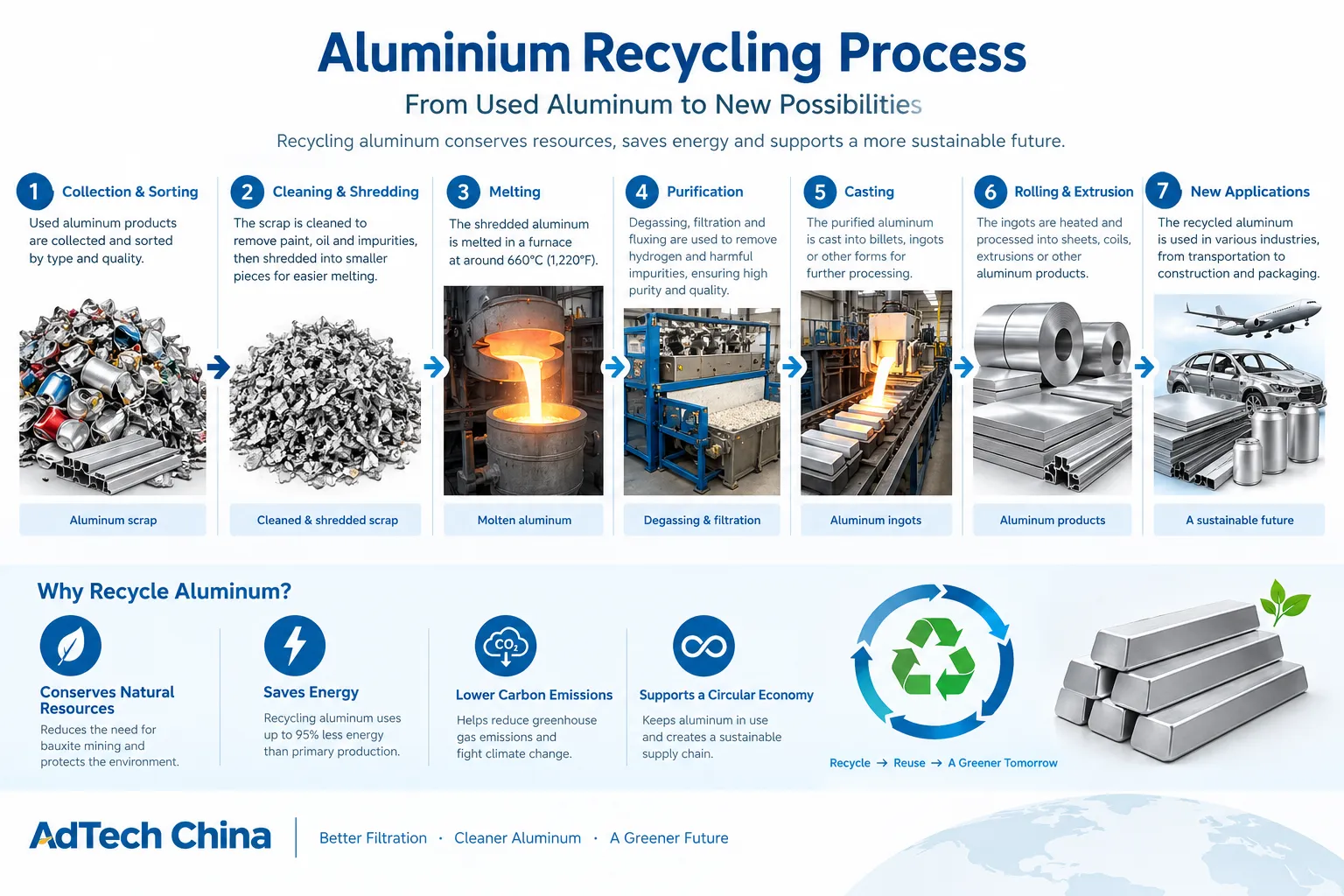
The aluminium recycling process converts aluminium scrap into reusable metal through collection, sorting, pre-treatment, melting, melt refining, alloy adjustment and casting. The exact process depends on the scrap source, alloy composition, contamination, coating, moisture content and the quality required for the final product. For industrial recyclers, the objective is not simply to melt aluminium, but to recover as much usable metal as practical while controlling alloy chemistry, inclusions, hydrogen, emissions and production costs.
Aluminium recycling is widely used to produce secondary aluminium for foundry alloys, extrusion billets, rolling slabs and other applications. Compared with producing primary aluminium from bauxite, recycling generally requires substantially less energy. However, achieving consistent recycled metal quality requires suitable scrap preparation and process control.
1. Aluminium Recycling Process at a Glance
The following table summarizes the main stages of industrial aluminium recycling.
| ステージ | Main operation | 主な目的 |
|---|---|---|
| 1. Collection | Gather manufacturing scrap and end-of-life aluminium | Establish a usable feedstock supply |
| 2. Sorting | アルミニウムを他の材料から分別し、スクラップを分類する | 合金の均一性を向上させ、不純物の混入を低減する |
| 3. 前処理 | 必要に応じて、細断、破砕、乾燥、脱油、またはコーティングの除去を行う | 安全かつ効率的な溶解のためにスクラップを準備する |
| 4. 溶融 | スクラップを適切な炉に投入する | 固体のアルミニウムを溶融金属に変える |
| 5. フラックス処理とアクの除去 | 必要な箇所に適切なフラックスを塗布し、表面の残留物を取り除いてください | 酸化を抑制し、残留物を分離して金属を回収する |
| 6. 溶融精製 | 化学組成を調整し、不要な溶融成分を除去する | 合金および溶湯品質の要件を満たす |
| 7. 脱気およびろ過 | 必要に応じて、溶存水素および非金属介在物を取り除く | 溶融物の清浄度を向上させる |
| 8. キャスティング | インゴット、ビレット、スラブ、その他の鋳造品を製造する | 後工程の製造に向けて金属を準備する |
| 9. 品質管理 | 組成を分析し、関連する品質特性を確認する | 用途への適合性を確認する |
これらの工程は、リサイクル施設ごとに必ずしも同じではありません。製造工程から出るクリーンなスクラップは、比較的少ない前処理で済む場合がありますが、消費者が使用済みの混合スクラップは、溶解する前にいくつかの選別や処理工程を必要とすることがあります。溶解と精錬の工程を一体化している施設もあれば、溶融金属を別の炉や処理ステーション間で移送している施設もあります。.
2. Collection and Classification of Aluminium Scrap
リサイクル工程は、スクラップの出所や成分を特定することから始まります。.
Manufacturing scrap
アルミニウム製品の製造過程では、製造スクラップが発生します。その例としては、シートの端材、押出成形の残材、機械加工の切りくず、鋳造スクラップなどが挙げられます。.
清潔で分別済みの製造くずは、その出所や材料特性が比較的よく把握されているため、多くの場合、効率的にリサイクルすることができます。しかし、油分の多い切削くず、混合合金、およびコーティングが施された材料については、追加の処理が必要になる場合があります。.
Post-consumer aluminium scrap
使用済みスクラップは、耐用年数を終えた製品から発生します。代表的な例としては、次のようなものがあります:
-
使用済みのアルミ製飲料缶および包装材。.
-
アルミ製の窓枠および建築用部材。.
-
自動車部品。.
-
家庭用および工業用のアルミニウム製品。.
-
鋼、プラスチック、ゴム、またはその他の材料を含むアルミニウム製複合部品。.
使用済みスクラップは、以前の用途、合金組成、および汚染レベルが不明確である可能性があるため、一般的に選別がより困難となります。.
Aluminium dross and other process residues
アルミニウムドロスは、溶解や金属の取り扱い過程で発生します。これには、酸化アルミニウム、その他の成分、および回収可能な金属アルミニウムが含まれています。.
ドロスは、清浄なアルミニウムスクラップと同等と見なすべきではありません。その回収方法は、組成、温度、取り扱い履歴、および利用可能な回収技術によって異なります。.
重要な原則として、スクラップの分類は、溶解炉のルートが決定される前に行うべきです。アルミニウムを含むすべての材料を互換性があるものとして扱う施設では、合金の管理が不十分になったり、不必要な処理が行われたり、金属回収率が低下したりするリスクがあります。.
3. Sorting and Separation: Why Alloy Composition Matters
選別は、二次アルミニウム製造において最も重要な工程の一つです。これは、搬入されるスクラップの化学組成が、最終的な金属の品質に直接影響を与えるためです。.
アルミニウム合金には、シリコン、マグネシウム、銅、マンガンなどの元素がさまざまな割合で含まれています。これらの元素は、強度、耐食性、成形性、鋳造性などの特性に影響を与えます。.
例えば、高シリコン鋳造用合金と、圧延用に設計されたアルミニウム加工用合金では、組成要件が異なる場合があります。適切な工程計画なしにこれらを混合すると、意図した最終合金を製造することがより困難になる可能性があります。.
Common aluminium scrap sorting methods
| 方法 | 目的 | 重要な制限事項 |
|---|---|---|
| 手作業による選別 | 目に見える異物を取り除き、識別可能なスクラップの種類ごとに分別する | 事業者の対応の一貫性や、実質的な相違点の可視性次第です |
| 磁気分離 | 鉄片などの鉄系物質を取り除く | アルミニウム合金の各グレードを互いに区別しない |
| 渦電流選別 | 適切な廃棄物ストリームから、導電性のある非鉄金属を分別する | 性能は、材料のサイズ、形状、供給方法、および装置の設計によって異なります。 |
| センサーを用いた選別 | 特定の材料カテゴリまたは合金グループを特定し、分別する | 適切な検知技術と検証済みの選別基準が必要である |
| Chemical composition analysis | Check alloy composition and support material classification | A representative sample and appropriate analytical method are required |
Laser-induced breakdown spectroscopy and colour-based sorting technologies are among the methods described by the Aluminum Association for improving scrap separation. Their usefulness depends on the feedstock and the recycling objective.
What happens when different aluminium alloys are mixed?
Mixing alloys is not automatically unacceptable. Some secondary aluminium products are designed to use mixed scrap, with composition adjusted through the process.
The problem arises when the mixture cannot meet the intended specification economically or consistently.
For example, an unwanted element that remains dissolved in the melt cannot ordinarily be removed simply by passing the metal through a ceramic filter. Depending on the element and target chemistry, practical responses may include better sorting, blending with suitable metal, changing the target product or using a more specialized metallurgical process.
Therefore, sorting is not merely a waste-handling activity. It is an important form of quality control that takes place before the metal enters the furnace. Research reviews of secondary aluminium production identify scrap composition and unwanted alloying elements as persistent challenges in producing recycled alloys.
4. Pre-Treatment: Shredding, Cleaning, Drying and Decoating
The purpose of pre-treatment is to prepare scrap for the selected melting process. Not every material requires every operation.
Shredding, shearing and sizing
Large or bulky components may be cut, crushed or shredded into manageable sizes. The required size depends on the separation equipment, furnace charging arrangement and characteristics of the scrap.
Size reduction can improve material handling and support downstream separation. However, it also consumes energy and may generate dust, so the equipment should match the actual feedstock.
Removing coatings and organic contaminants
Used beverage cans, painted components and other coated scrap may require decoating or delacquering before melting.
Coatings, oil, grease, lubricants and plastic residues can contribute to emissions and complicate the melting process. Suitable pre-treatment can improve metal recovery and reduce the contaminant load entering the furnace.
The need for thermal treatment depends on the coating and material type. It should not be assumed that every aluminium component requires the same decoating method.
Drying and de-oiling aluminium turnings
Machining chips and turnings deserve special attention because they may retain cutting fluids, oil and moisture. Their shape also gives them a relatively high surface area compared with their mass.
Suitable cleaning and drying can help prepare this material for safer charging and efficient metal recovery. The treatment method must be appropriate for the contaminant and the physical form of the scrap.
Why wet scrap is a serious safety concern
Wet or moisture-contaminated scrap must not be charged into molten metal without appropriate controls. Water contacting molten metal can cause a violent explosion.
The UK’s Health and Safety Executive advises storing scrap in dry, covered areas where possible, checking materials for water contamination and drying scrap when covered storage is not available. It also emphasizes training, appropriate protective equipment and safe operating practices.
Closed containers, trapped liquids and other potentially dangerous contaminants require specific assessment under the facility’s safety procedures.
Pre-treatment should therefore be selected based on three factors: material quality, metallurgical requirements and safe furnace operation.
5. Melting: Turning Prepared Scrap into Molten Aluminium
After preparation, the scrap is charged into a suitable melting furnace.
Pure aluminium has a melting point of approximately 660°C. Commercial alloys and industrial recycling processes operate according to their respective melting ranges and process requirements, so 660°C should not be treated as a universal furnace setpoint.
The actual operating temperature depends on alloy composition, furnace technology, charge condition, required throughput and downstream casting requirements.
Choosing a melting furnace
Different furnace designs suit different forms of scrap and production requirements.
| 炉のタイプ | General consideration | What to evaluate |
|---|---|---|
| 反射炉 | Used for melting substantial quantities of aluminium scrap and other suitable feedstocks | Capacity, thermal efficiency, charge characteristics and melt handling |
| 回転炉 | Used in some secondary aluminium operations, particularly where scrap characteristics suit rotary processing | Scrap contamination, process residues, flux requirements and recovery performance |
| 誘導炉 | Provides electromagnetic heating and may suit particular melting tasks | Furnace capacity, charge characteristics, electrical infrastructure and melt cleanliness |
| Crucible furnace | Used in selected smaller-scale or specialized melting applications | Batch size, alloy range, operating flexibility and handling arrangements |
These are general selection considerations rather than a universal ranking. Furnace suitability cannot be determined from nominal capacity alone.
One important industry distinction is the feedstock and refining route. Cleaner, well-characterized scrap may be remelted through a relatively direct process, while more contaminated or mixed scrap can require more intensive refining. Terminology such as remelter and refiner varies by market and production context, but the underlying distinction is useful when evaluating a process.
Controlling oxidation and metal losses
Aluminium develops oxide films when exposed to oxygen. During charging, melting, transfer and surface disturbance, oxidation can contribute to metal losses and non-metallic residues.
Scrap size, surface condition, furnace operation, temperature control, handling practices and melt exposure all influence the outcome.
A practical process review should therefore measure metal recovery rather than relying only on how quickly the furnace melts the charge.
6. Fluxing, Dross Removal and Alloy Adjustment
After melting, the metal may require additional treatment to meet its target composition and cleanliness requirements.
Fluxes are used in various aluminium recycling operations, but their function depends on the flux formulation and the process in which it is applied.

What does flux do in aluminium recycling?
Depending on the formulation and application, flux can help protect the melt surface, support separation of unwanted material, assist metal recovery from dross or perform a defined refining function.
It is not correct to assume that every flux removes the same contaminants or that fluxing alone can bring every melt to specification.
Common functional categories include:
| フラックス部門 | 典型的な目的 | Key consideration |
|---|---|---|
| カバーフラックス | Helps protect the molten metal surface | Compatibility with the process and melt conditions |
| 精製フラックス | 指定された溶融精錬機能をサポートしています | Alloy, impurity type, treatment method and dosage |
| Deslagging or drossing flux | Assists separation of metal from surface residues | Dross characteristics and the recovery procedure |
| 炉内洗浄フラックス | Used to address suitable deposits on furnace surfaces | Furnace condition and the manufacturer’s operating instructions |
| フラックスのリサイクル | Used in selected processes to recover metallic aluminium from dross or ash | Residue composition and recovery equipment |
The International Aluminium Institute describes the use of salt fluxes in many scrap-refining processes to cover molten metal, help remove impurities and reduce oxidation. It also identifies dross, skimmings and salt slag as process residues requiring suitable handling and recovery routes. Not all recycling processes use the same flux system.
Removing dross
Dross forms as oxide-bearing material and other constituents accumulate at the molten metal surface. Depending on the process, some of this material contains recoverable aluminium.
Surface dross removal must be coordinated with the furnace and metal-handling procedure. Aggressive or poorly controlled handling can increase oxidation, while unsuitable residue treatment can lead to avoidable losses.
Dross should be managed as a recoverable process residue where technically and economically appropriate, with handling and final treatment selected for the actual material.
Alloy composition adjustment
After melting, producers may add suitable alloying materials or blend metal to achieve the required chemistry.
A representative chemical analysis is essential when the target specification is strict. The relevant elements depend on the grade and the final application.
Fluxing, skimming and alloy adjustment solve different problems. A well-designed process defines the purpose of each treatment rather than assuming one step can correct every type of impurity.
7. Melt Refining: Degassing and Filtration
For recycled aluminium intended for demanding casting applications, melt treatment may be necessary after melting and initial refining.
Two important operations are degassing and filtration. They are complementary, but they do not perform the same function.
続きを読む: アルミニウムの精製方法:脱ガス、フラックス処理、ろ過、各種手法.
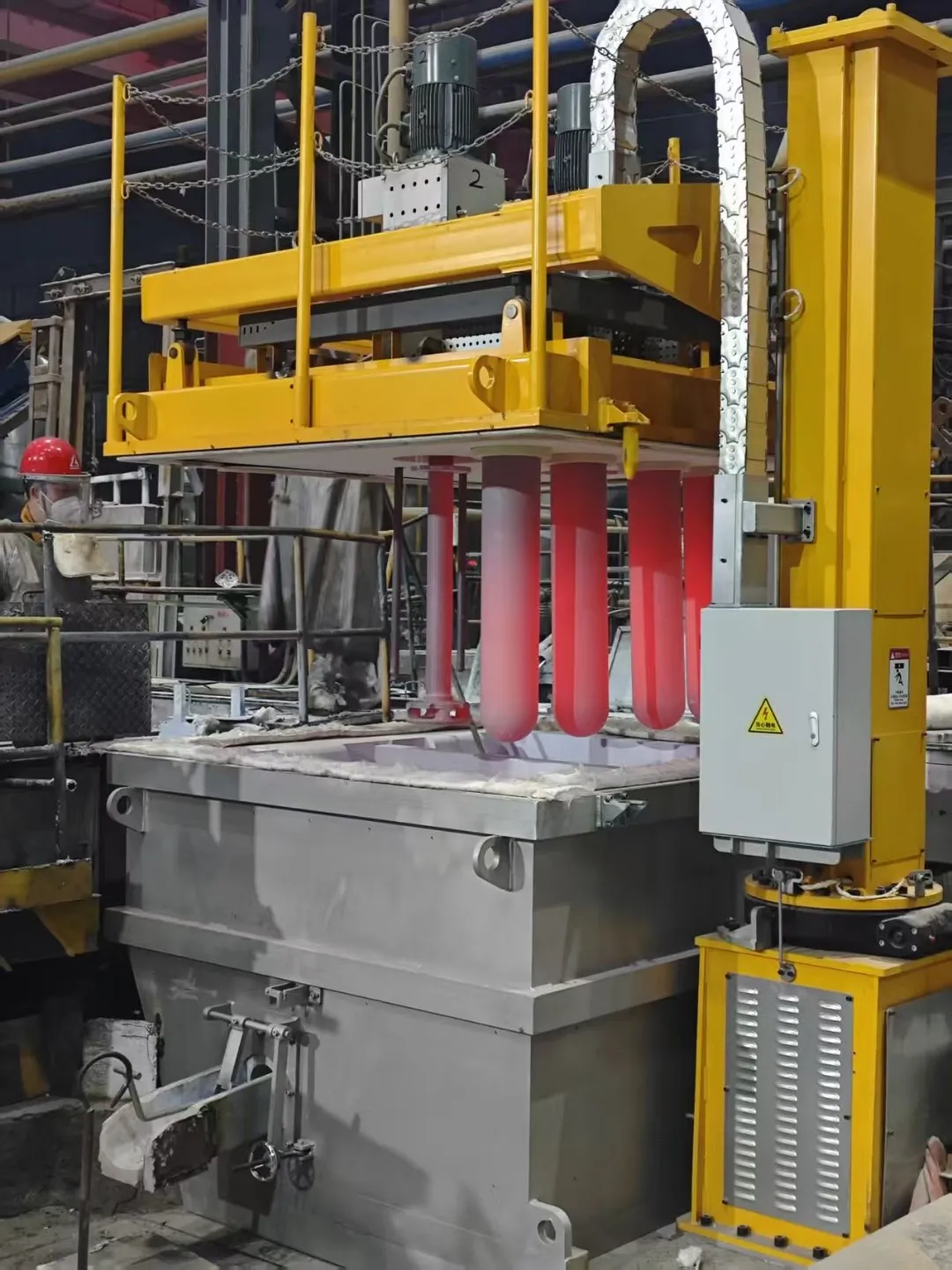
7.1 Degassing removes dissolved hydrogen
Hydrogen can dissolve in molten aluminium and contribute to gas porosity when the metal solidifies under unsuitable conditions.
Industrial degassing commonly uses an inert gas such as argon or nitrogen introduced into the melt through a suitable treatment system. Hydrogen transfers from the melt into the gas bubbles and is carried away.
The effectiveness of degassing depends on parameters such as gas delivery, rotor or injector design where applicable, melt temperature, treatment time, alloy condition and initial hydrogen content.
A degassing system does not correct an incorrect alloy composition, and the presence of a degassing unit does not by itself guarantee a particular final hydrogen level. Appropriate operating conditions and verification are required.
7.2 Filtration removes non-metallic inclusions
Molten aluminium may contain oxide films and other non-metallic inclusions. These can contribute to casting defects and reduce product quality.
Ceramic foam filters are used in suitable aluminium casting applications to capture or retain inclusions through a combination of filtration mechanisms and interactions with the filter structure.
The filter must be selected according to the required cleanliness, metal flow rate, alloy, filtration arrangement and casting conditions.
A filter that is too restrictive for the required flow may disrupt production, while an unsuitable filter arrangement may fail to deliver the desired cleanliness.
Degassing versus filtration
| プロセス | Main target | What it does not replace |
|---|---|---|
| ガス抜き | Dissolved hydrogen and other specifically targeted melt constituents, depending on process configuration | Alloy chemistry control and inclusion filtration |
| セラミックフォームろ過 | Non-metallic inclusions in the molten metal | 溶存水素の除去 |
| フラックス処理 | Specific surface protection, refining or residue-separation functions, depending on the flux | All other melt-treatment operations |
| Alloy adjustment | 化学組成 | Physical removal of all inclusions or dissolved gas |
This distinction is particularly important in a recycling plant that produces metal for high-quality casting. Hydrogen control and inclusion control should be evaluated separately.
7.3 Which filtration solution should a plant consider?
Different filtration arrangements can suit different production requirements.
-
Ceramic foam filters: Used in appropriate casting lines where inclusion removal is required.
-
Cartridge filtration systems: Considered when the process requires a specific filtration arrangement and performance level.
-
Deep-bed filtration systems: Evaluated for production lines and filtration duties suited to that configuration.
Selection should follow the actual production target rather than assuming that the most complex filtration system is always the best choice.
For plants producing high-value alloys, filtration must be integrated with melting, melt treatment, metal flow and casting. It cannot compensate for poor scrap sorting or an unacceptably contaminated feedstock.
8. Casting and Final Product Quality Control
Once the molten metal meets the required chemical composition and melt-quality conditions, it can be cast into a form suitable for downstream processing.
Typical forms include:
-
Ingots for storage, transport or subsequent remelting.
-
Billets for extrusion.
-
Slabs for rolling.
-
それらの製品を直接使用する用途向けの成形品。.
-
Liquid metal supplied to a downstream manufacturing operation where appropriate.
The correct casting route depends on the intended product and the capabilities of the facility. Secondary aluminium is not a single universal product: different casting applications impose different chemistry, cleanliness and dimensional requirements.
Quality checks before release
Quality control should be defined around the product specification and process risks.
| Quality check | なぜそれが重要なのか |
|---|---|
| Chemical composition analysis | Confirms that the metal meets the specified alloy composition |
| Hydrogen measurement where relevant | Assesses melt condition for applications sensitive to gas porosity |
| Inclusion or cleanliness assessment | Checks whether melt treatment meets the required cleanliness criteria |
| 温度の確認 | Supports controlled transfer and casting |
| Casting inspection | Identifies relevant surface, dimensional or internal quality problems |
| Process and batch records | Help trace results back to scrap sources and operating conditions |
The appropriate test method and acceptance limits depend on the alloy and product. A generic article should not assign one universal hydrogen limit, inclusion level or defect tolerance to all recycled aluminium.
Traceability also matters. When a defect occurs, records of scrap source, alloy composition, melt treatment, sampling and casting conditions help determine whether the cause originated in the feedstock, melting operation or downstream process.
9. How Energy-Efficient Is Aluminium Recycling?
Aluminium recycling is generally much less energy-intensive than producing primary aluminium from bauxite. However, a percentage should always be interpreted against its stated system boundary.
The International Aluminium Institute reports that, using 2019 global production data and the cited life-cycle inventory modelling, primary aluminium production required approximately 186 GJ of primary energy per tonne from mine to cast house, compared with 8.3 GJ per tonne for recycled aluminium. The resulting estimated energy saving was 95.5%.
The Aluminum Association likewise describes secondary aluminium production as approximately 95% more energy-efficient than primary production.
These are industry-level comparisons. They do not mean that every recycling plant will reduce its own energy consumption by exactly 95%. Actual performance depends on the scrap stream, pre-treatment requirements, furnace type, plant efficiency, residue recovery and accounting boundaries.
What affects the environmental performance of a recycling plant?
Scrap preparation: Removing unsuitable contaminants and preparing scrap correctly can improve processing, but preparation itself consumes energy and resources.
Furnace efficiency: Charging practice, furnace condition, heat transfer, holding time and temperature control influence energy demand.
Metal recovery: Preventing avoidable oxidation and recovering metallic aluminium from suitable residues can improve the usable output obtained from each tonne of feedstock.
Emissions management: Shredding, thermal treatment, coatings, fuel combustion and some flux-based processes may generate dust, organic emissions or other pollutants requiring suitable controls.
Residue management: Dross, skimmings and salt slag must be handled and treated according to their composition and applicable requirements.
The IAI identifies dust, organic compounds, fuel-related carbon dioxide emissions and, in certain salt-flux processes, additional emissions and salt slag as environmental considerations in scrap refining. Suitable furnace design, process optimization and emissions controls are therefore part of responsible recycling.
10. Common Problems in Aluminium Recycling and How to Address Them
The most useful process improvement is often to identify the cause of a problem before increasing treatment intensity or purchasing additional equipment.
| 確認された問題 | Potential causes to investigate | Appropriate direction |
|---|---|---|
| Final alloy does not meet specification | Mixed alloys, contaminated scrap, incorrect blending or insufficient chemical verification | Improve incoming scrap classification and establish a controlled composition-adjustment procedure |
| Excessive metal loss | Oxidation, unsuitable scrap preparation, handling practices or inefficient dross recovery | Review charge characteristics, melting practice and residue treatment |
| Gas porosity in cast products | Hydrogen, solidification conditions or other casting-related causes | Measure hydrogen where appropriate and review melt treatment and casting conditions |
| Inclusion-related defects | Oxide films, contaminated feedstock, poor handling or inadequate filtration | Identify inclusion sources and verify the effectiveness of melt cleanliness controls |
| High energy consumption | Excessive holding time, unsuitable feed preparation, inefficient furnace operation or unnecessary reheating | Review energy use across preparation, melting, holding and transfer |
| Unstable production rate | Furnace limitations, poor charge consistency, bottlenecks in treatment or downstream casting | Assess the entire process rather than one machine in isolation |
| Excessive dust or fumes | Scrap contaminants, shredding, coatings, thermal treatment or inadequate extraction | 排出源を特定し、適切な回収・処理システムを確認する |
欠陥があるからといって、必ずしもろ過システムが不十分であるとは限りません。同様に、金属回収率が低いからといって、必ずしもフラックスを変更することで解決できるとは限りません。.
確実な改善は、損失や欠陥の原因を特定し、問題を定量的に把握し、その原因に応じた解決策を講じることから始まります。.
11. How to Select Aluminium Recycling Equipment
設備の選定は、実際の生産要件に基づいて行うべきである。.
見積もりを依頼する前に、以下の点を確認してください:
-
原料:どのような種類のアルミニウムスクラップが処理される予定であり、それらの合金組成や不純物含有量はどの程度一定していますか?
-
処理能力:1時間あたりおよび年間の処理量、稼働時間、バッチサイズはそれぞれどの程度必要ですか?
-
対象製品:当該工場では、鋳造用合金、押出用ビレット、圧延用スラブ、あるいはその他の製品を生産する予定ですか?
-
品質要件:どのような合金仕様、清浄度基準、および最終製品試験が必要ですか?
-
既存の設備:現在、どのような溶解炉、保温炉、脱ガス装置、ろ過装置、および鋳造システムが設置されていますか?
-
運転条件:現在の温度分布、金属の流れ、移送距離、および生産上の制約はどのようなものですか?
-
環境および安全に関する要件:現地の規制に基づき、粉塵、コーティング、残留物、およびプロセスからの排出物に対してどのような処理が必要とされているか?
こうした詳細情報をもとに、そのプラントにおいて、より適切な前処理、溶解能力の増強、より確実な組成管理、追加の溶湯処理、あるいは鋳造工程の改善が必要かどうかを判断することができます。.
Where do fluxes and molten aluminium purification equipment fit?
AdTechが公表している製品ポートフォリオには、精製用フラックスなどが含まれており、, フラックス注入システム, オンライン脱ガス装置, 、セラミックフォームフィルター、その他のろ過装置、および 一体型ランドリー設備 溶融アルミニウムの処理用です。これらの製品は、リサイクルにおける回収、選別、前処理の各工程に取って代わるものではなく、特定の溶融処理および鋳造の段階に関連するものです。.
例えば:
-
フラックスの選定は、目的とする処理機能および製造元の取扱説明書に合致するものでなければなりません。.
-
フラックス注入装置は、制御された再現性のあるフラックス供給が求められる場合に有用である。.
-
水素管理が明確なプロセス要件となっている場合は、脱ガス装置の導入を検討すべきである。.
-
非金属の混入物除去が必要な場合は、セラミックフォームフィルターを検討すべきである。.
-
当該鋳造レイアウトにおいて、溶融アルミニウムの制御された移送および温度管理を行うため、ローダー設備の導入を検討すべきである。.
適切な構成は、工場のプロセス、取り扱い合金の種類、処理能力、および最終的な品質目標によって異なります。サプライヤーは、単に機械の一覧を提示するだけでなく、提案する各システムの機能や制限について説明できる必要があります。.
12. Frequently Asked Questions
Does every aluminium scrap type use the same recycling process?
いいえ。クリーンな生産スクラップは最小限の前処理で済む場合がありますが、混合スクラップ、コーティング製品、および切削くずについては、追加の選別、洗浄、乾燥、あるいはコーティング除去が必要になる場合があります。処理工程は、原料と目標製品の双方を考慮して決定する必要があります。.
Can a ceramic foam filter remove hydrogen from molten aluminium?
いいえ。セラミックフォームフィルターは、非金属不純物を除去するように設計されています。水素還元が必要な場合、溶存水素の除去には通常、適切な脱ガス処理が必要となります。.
Can aluminium recycling recover every kilogram of metal?
いいえ。金属の損失は、酸化、残渣、取り扱い、その他の工程上の非効率性によって生じることがあります。適切な前処理、管理された溶解、および適切な残渣回収を行うことで金属の収率を向上させることができますが、すべてのスクラップの種類や工場に適用できる画一的な回収率は存在しません。.
How are painted aluminium cans prepared for recycling?
コーティングや工程の要件に応じて、使用済み缶は選別、破砕、あるいはその他の方法でサイズ調整された後、再溶解の前にコーティングを除去するための熱処理が施される。具体的な処理方法は、原料、設備、および排出ガス規制の要件によって異なる。.
What temperature is needed to melt aluminium scrap?
純アルミニウムの融点は約660°Cですが、実際の炉の運転温度は、合金の組成、炉の設計、および溶解・鋳造プロセスの要件によって異なります。融点を、普遍的な運転設定値として用いるべきではありません。.
Why is dross produced during aluminium melting?
アルミニウムの酸化や、溶融金属とプロセス残渣との相互作用が、ドロスの生成の一因となります。ドロスには回収可能な金属アルミニウムが含まれている場合があるため、適切な取り扱いと回収方法を講じることで、回避可能な金属の損失を減らすことができます。.
What are the main environmental concerns in aluminium recycling?
主な考慮事項としては、エネルギー使用量、燃料由来の排出物、材料の取り扱いによる粉塵、塗装や熱処理に伴う排出物、およびドロスや塩スラグの管理などが挙げられる。実際の影響は、プロセス経路、投入されるスクラップ、および排出物対策によって異なる。.
結論
アルミニウムのリサイクル工程は、原料の前処理、溶解、金属精錬、鋳造という一連の工程が連携して行われるものです。その性能は、スクラップの状態や組成、安全な装入作業、適切な炉の運転、そして最終的な金属品質の効果的な管理にかかっています。.
工業生産者にとって、最も重要な原則は、各処理を明確な課題に合わせて実施することです。選別は原料の一貫性を確保し、フラックス処理は特定の精錬および残渣分離機能を支え、脱ガス処理は溶存水素に対処し、ろ過は非金属介在物を除去することを目的としています。 これらの工程を総合的に選定・管理することで、リサイクルプラントは、安定した金属品質、効率的な金属回収、そして責任ある資源利用を実現しやすくなります。.