

An integrated launder system for aluminum casting is more than a refractory-lined channel for moving molten aluminum. It is a controlled transfer system that connects furnaces, holding or treatment equipment, filtration units and casting machines while helping maintain metal temperature, stable flow and melt cleanliness. For a modern aluminum casting line, the correct design depends on the transfer distance, metal flow rate, alloy, temperature requirements, plant layout, refractory system, heating method and level-control requirements.
A basic launder may be sufficient for a short transfer between two process stations. An integrated system becomes more useful when the casting line requires controlled thermal conditions, enclosed transfer, flow regulation, heating, inspection access, degassing or filtration integration.
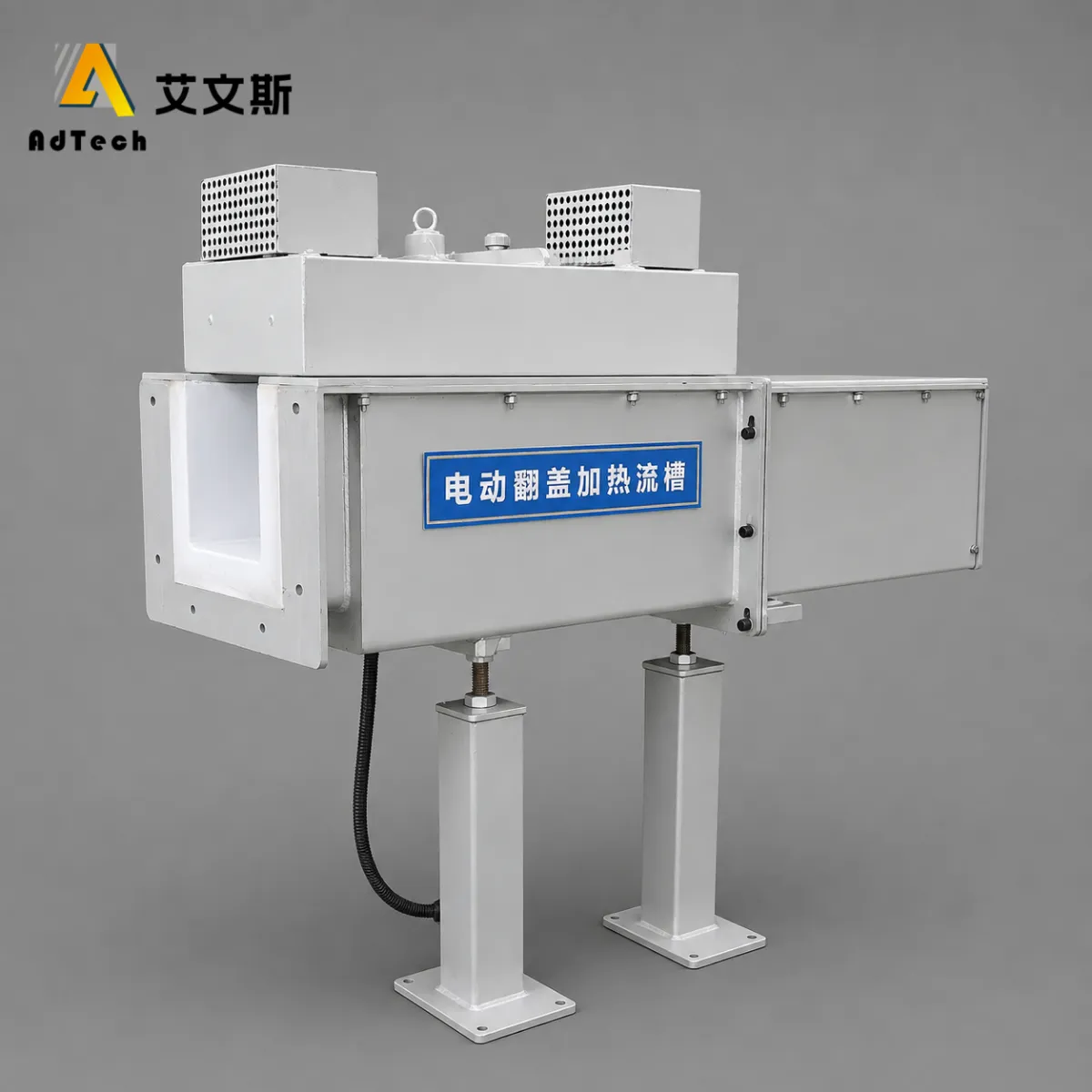
AdTech’s current product information describes its Integrated Launder Equipment as a system using high-fused silica lining, a pneumatic sectional cover structure and several heating options, including radiation heating, electric hot-air heating and flame heating. The company also states that its launder lining is designed for high strength, aluminum non-stick behavior, corrosion resistance and thermal shock resistance.
What Is an Integrated Launder System?
An integrated launder system is a structured molten-metal transfer assembly designed around the complete route between upstream and downstream equipment.
Depending on the casting line, the route can connect:
Melting furnace → holding furnace → launder → degassing → filtration → casting machine
or, in another configuration:
Holding furnace → heated launder → flow control → filtration → tundish/casting machine
The exact sequence depends on the plant process.
A conventional launder can perform the basic function of transferring molten metal. An integrated system adds engineering around that transfer function, such as:
- refractory lining
- backup insulation
- external support structure
- covers
- heating
- flow-control components
- inspection access
- temperature monitoring
- connections to degassing equipment
- connections to filtration equipment
- level-control equipment
- skimming or cleaning access
This distinction matters during procurement. A buyer requesting only “an aluminum launder” may receive a very different scope from a buyer requesting a complete integrated molten aluminum transfer system.
Why the Launder Is an Important Part of Aluminum Casting
The launder is physically located between major process stages, but its influence extends beyond simple transportation.
Molten aluminum can lose heat while traveling from a furnace to a casting machine. At the same time, uncontrolled flow can increase turbulence, surface exposure and oxide formation.
A well-designed launder therefore needs to address several variables simultaneously:
| Requirement | What the launder needs to achieve |
|---|---|
| Metal transfer | Move molten aluminum reliably between process stations |
| Temperature control | Limit unnecessary heat loss |
| Flow stability | Reduce excessive turbulence and splashing |
| Melt cleanliness | Minimize unnecessary oxide or inclusion entrainment |
| Structural stability | Support the refractory and molten-metal load |
| Maintenance | Permit inspection, cleaning and replacement |
| Safety | Reduce operator exposure to molten metal |
| Process integration | Connect properly with treatment and casting equipment |
Research on industrial aluminum casting launder systems has specifically identified temperature control, stable metal flow and integration with degassing and filtration as important design objectives. One published Aluar system, for example, used insulated refractory launders, heated lids and metal-level control as part of its casting-line design.
The important point is that a launder should be considered part of the process, not merely part of the mechanical infrastructure.
How Does an Integrated Launder System Work?
The system normally receives molten aluminum from an upstream furnace or holding vessel and transports it through a controlled refractory channel.
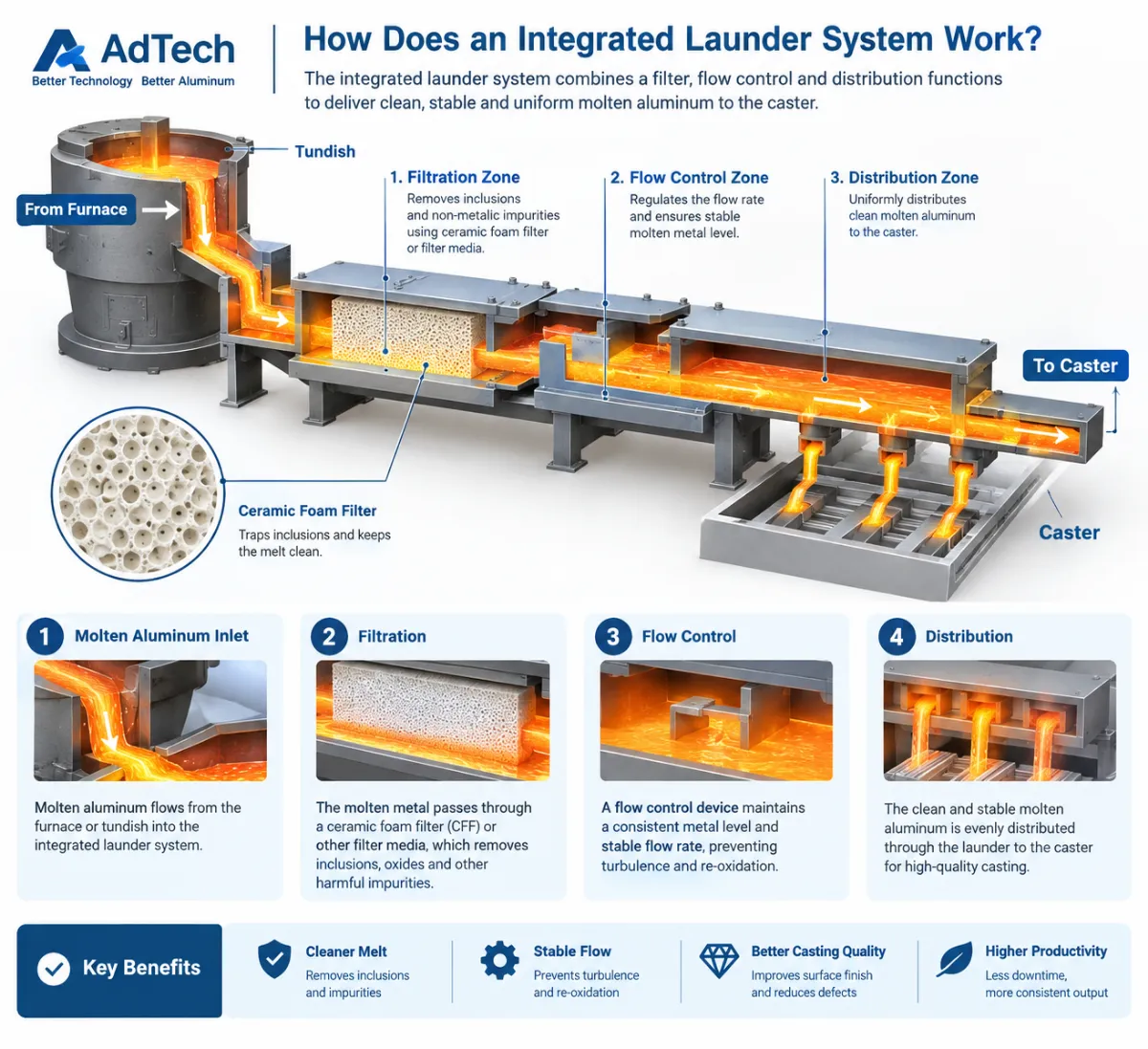
The basic process can be represented as:
Furnace / Holding Furnace
↓
Integrated Launder
↓
Flow Control / Skimming
↓
Degassing
↓
Filtration
↓
Tundish / Casting Machine
Not every plant uses every stage in this exact order.
The position of degassing and filtration depends on the process design. The important requirement is to prevent the launder from creating new flow instability or contamination after the metal has already been treated.
For example, if filtration has already removed non-metallic inclusions, a poorly designed downstream transfer section can still expose the metal to unnecessary turbulence or oxide pickup.
This is why the launder layout should be designed together with the melt-treatment system.
Read more: Refractory Ceramic Launders Systems for Molten Aluminum Transport.
Main Components of an Integrated Aluminum Launder
A complete system generally contains several functional layers rather than one single component.
1. Refractory Hot-Face Lining
The refractory lining is the surface directly exposed to molten aluminum.
Its requirements include:
- chemical compatibility with molten aluminum
- resistance to erosion
- resistance to thermal shock
- dimensional stability
- low aluminum adhesion
- a smooth internal surface
- adequate service life
AdTech’s current Integrated Launder Equipment uses high-fused silica for the lining and describes the finished inner surface as smooth, with resistance to aluminum adhesion, corrosion and thermal shock.
The exact refractory selection should still be based on the alloy, operating conditions, thermal cycling and plant requirements rather than assuming one material is universally suitable.
2. Backup Insulation
The backup insulation sits behind the hot-face refractory.
Its purpose is to reduce heat transfer from the molten aluminum toward the steel shell and surrounding environment.
A system with good refractory but poor insulation can still experience excessive thermal losses.
The insulation design should therefore be evaluated together with:
- launder length
- cover design
- ambient temperature
- transfer time
- required metal temperature
- heating capacity
3. Steel Shell and Support Structure
The steel structure supports the refractory, insulation and covers.
It also determines how the launder is positioned relative to:
- furnace outlets
- filtration units
- degassing equipment
- casting machines
- platforms
- maintenance areas
Mechanical alignment is especially important because changes in elevation or joint alignment can affect metal flow.
4. Covers
Covers reduce the exposed surface area of the molten aluminum.
They can help reduce heat loss and provide a more controlled transfer environment.
AdTech’s system uses a sectional flipping cover operated pneumatically. Individual sections can be opened for inspection and maintenance, while the control system can operate sections individually or together.
This is more than a convenience feature. Maintenance access should be considered during the original design rather than added after installation.
5. Heating System
Heating is not automatically required for every launder.
The need depends on transfer distance, metal temperature requirements, production rate, ambient conditions, insulation quality and acceptable temperature variation.
AdTech lists three heating configurations:
| Heating method | Typical purpose |
|---|---|
| Radiation heating | Maintaining temperature during continuous transfer |
| Electric hot-air heating | Rapid preheating and supplementary heating |
| Flame heating | Higher heating capacity for suitable large-scale applications |
AdTech’s official product information describes silicon carbide rods or radiant tubes for radiation heating, electric hot-air systems for rapid preheating, and flame burners with gas control for flame-heated configurations.
Other manufacturers also offer heated and non-heated launder configurations, demonstrating that heating should be selected according to the process rather than treated as a mandatory feature.
When Does an Aluminum Launder Need Heating?
This is one of the most important purchasing questions.
A heated launder can be useful when:
- the transfer distance is long.
- the metal must remain within a narrow temperature window.
- the casting process is continuous.
- the ambient environment creates significant heat loss.
- the launder contains multiple sections.
- production interruptions require controlled reheating.
- the downstream casting process is sensitive to temperature variation.
A short, well-insulated transfer route may not require active heating.
Therefore, the correct question is not:
“Is a heated launder better?”
It is:
“What temperature loss is acceptable for this particular transfer route, and can insulation alone maintain it?”
That distinction can prevent unnecessary capital expenditure.
Published technical information on aluminum launder systems shows that thermal performance depends on insulation, transfer distance and operating conditions. One industrial study reported approximately 1°C of temperature loss per meter in its continuous-casting system, while AdTech’s current product information states that covered systems can limit temperature loss to within approximately 2°C per meter. These figures should not be treated as universal performance guarantees because actual heat loss depends on system design and operating conditions.
Flow Geometry Matters as Much as Refractory Selection
A common mistake is to evaluate a launder mainly by its refractory material.
The internal geometry is equally important.
Molten aluminum should move through the system without unnecessary:
- sharp directional changes
- sudden drops
- splashing
- dead zones
- excessive velocity
- abrupt cross-section changes
Poor geometry can increase turbulence and oxide entrainment.
The published Aluar launder system specifically emphasized steady metal flow and avoiding turbulence and oxide generation.
AdTech’s technical product information similarly describes smooth internal geometry and tapered transitions as design features intended to reduce vortices and maintain stable flow into treatment equipment.
Practical Flow-Design Questions
When reviewing a proposed launder drawing, ask:
- What is the normal metal flow rate?
- What is the maximum flow rate?
- What is the elevation difference between inlet and outlet?
- How many bends are required?
- Are the transitions gradual?
- Where does the metal enter the degasser?
- Where does it enter the filter box?
- Are there locations where dross can accumulate?
- Is there sufficient access for cleaning?
- Does the final section maintain stable flow into the casting machine?
These questions often reveal design problems that are invisible when comparing refractory specifications alone.
How Does the Launder Integrate With Degassing and Filtration?
An integrated launder system should be considered part of the molten-metal treatment route.
A typical aluminum casting line may use:
Furnace → Launder → Degassing → Filtration → Casting
The degassing stage is used to reduce dissolved hydrogen and can be followed by filtration to remove non-metallic inclusions.
AdTech’s product portfolio includes online degassing equipment, plate-type filtration equipment, deep-bed filtration equipment and integrated launder equipment.
The launder therefore needs compatible:
- inlet dimensions
- outlet dimensions
- elevation
- flow rate
- access space
- thermal conditions
- maintenance clearance
The filtration unit should not be treated as an isolated component.
For example, a filter box can be correctly selected but still perform poorly if upstream flow enters it with excessive turbulence or an unsuitable flow distribution.
Similarly, a degassing unit must receive metal under conditions appropriate for its process design.
The system-level objective is therefore:
stable transfer → effective treatment → stable filtration → controlled casting.
Integrated Launder vs. Simple Transfer Launder
The two terms are sometimes used interchangeably, but they do not necessarily describe the same scope.
| Feature | Simple Transfer Launder | Integrated Launder System |
|---|---|---|
| Basic metal transfer | Yes | Yes |
| Refractory lining | Usually | Yes |
| Insulation | May be limited | Normally engineered |
| Covers | Optional | Commonly integrated |
| Heating | Optional | Available when required |
| Flow control | Basic | Can be integrated |
| Temperature monitoring | Optional | Can be integrated |
| Degassing connection | Limited | Designed as part of process |
| Filtration connection | Limited | Designed as part of process |
| Maintenance access | Basic | Engineered into system |
| Custom plant layout | Limited | Important part of design |
| Automation | Limited | Can be incorporated |
The choice depends on the production line.
A small, short-distance transfer may not justify a highly integrated configuration.
A large continuous casting line with strict temperature and cleanliness requirements may need substantially more engineering.
How to Choose the Right Launder Heating Method
AdTech’s current product range provides three main heating approaches.
Radiation Heating
Radiation heating uses heating elements or radiant tubes positioned above the launder.
It may be suitable when:
- the process is continuous
- temperature stability is important
- the transfer route is relatively long
- controlled supplementary heating is required
Electric Hot-Air Heating
Electric hot-air heating provides heated air to the launder.
It may be useful when:
- rapid preheating is important
- the production schedule changes frequently
- flexible temperature recovery is required
Flame Heating
Flame heating uses burners integrated with the launder cover.
It may be considered when:
- higher heating capacity is required
- the plant already has suitable gas infrastructure
- the control system can safely regulate combustion
The correct choice depends on plant utilities, heat-loss calculations, production schedule, safety requirements and maintenance capabilities.
What Refractory Material Should Be Used?
There is no single refractory material that should automatically be specified for every aluminum launder.
Important selection criteria include:
- aluminum compatibility
- non-wetting behavior
- thermal shock resistance
- erosion resistance
- thermal conductivity
- mechanical strength
- surface finish
- operating temperature
- thermal cycling frequency
- alloy chemistry
AdTech’s current Integrated Launder Equipment uses high-fused silica for its lining and reports a service life of more than 12 months under its stated normal operating conditions.
Another AdTech product page identifies the lining material as high-fused silica and provides technical values including density of 1.8 to 2.0 g/cm³ and a maximum operating temperature of 1340°C for the listed material specification. Those values describe the specified refractory material and should not be interpreted as the recommended molten-aluminum operating temperature.
This distinction is important.
Material maximum temperature is not the same thing as process operating temperature.
A buyer should always ask the supplier to distinguish between:
- refractory material temperature capability
- recommended launder operating temperature
- molten aluminum temperature
- heating-system operating temperature.
What Specifications Should Buyers Provide to a Launder Manufacturer?
A supplier cannot accurately design a custom integrated launder from the phrase “we need an aluminum launder.”
At minimum, provide the following information.
| Specification | Why it matters |
|---|---|
| Aluminum alloy family | Determines material compatibility and process requirements |
| Metal temperature | Determines thermal design |
| Maximum and normal flow rate | Determines channel geometry |
| Transfer distance | Influences insulation and heating requirements |
| Furnace outlet height | Determines system elevation |
| Casting machine inlet height | Determines slope and outlet geometry |
| Number of casting strands | Influences distribution design |
| Degassing equipment | Determines upstream/downstream interfaces |
| Filtration equipment | Determines connection dimensions and flow conditions |
| Required heating | Determines heating system design |
| Available electricity/gas | Determines heating configuration |
| Plant layout | Determines support structure and routing |
| Maintenance access | Determines cover and modular design |
| Automation level | Determines instrumentation and control scope |
A drawing or CAD layout is particularly useful.
The more complete the input information, the less likely it is that two suppliers will quote fundamentally different systems while appearing to offer the same product.
What Should You Ask an Aluminum Launder Supplier?
Before comparing quotations, ask the supplier for more than a price.
Technical questions
- What refractory material is used?
- What is the lining thickness?
- What insulation system is included?
- What flow rate was used for sizing?
- What transfer distance was assumed?
- What temperature loss is expected under the stated operating conditions?
- Is heating included?
- What heating capacity is provided?
- How are expansion joints designed?
- How are refractory sections replaced?
Integration questions
- Can the system connect directly to our degassing unit?
- Can it connect to our existing filter box?
- Can the system accommodate our existing furnace outlet?
- Can flow-control equipment be integrated?
- Can thermocouples or level sensors be included?
- Can the covers be operated pneumatically or automatically?
Maintenance questions
- How are refractory sections inspected?
- Can individual sections be replaced?
- How long does normal refractory service life depend on?
- What spare parts should be kept onsite?
- What preheating procedure is required?
Documentation questions
- Can the supplier provide GA drawings?
- Are installation drawings included?
- Is the heating-system wiring documented?
- Are recommended preheating procedures provided?
- Are maintenance instructions provided?
- Are refractory material specifications provided?
This checklist can substantially improve the quality of technical quotations.
Common Mistakes When Purchasing an Integrated Launder
Mistake 1: Comparing suppliers only by price
Two quotations may have completely different scopes.
One may include:
- refractory
- insulation
- steel structure
- covers
- heating
- controls
- installation
while another may provide only the refractory-lined trough.
Compare the scope before comparing prices.
Mistake 2: Specifying only the launder length
Length alone does not determine the correct system.
The supplier also needs flow rate, elevation, alloy, temperature, casting process and plant layout.
Mistake 3: Assuming heating is always necessary
Heating adds complexity, capital cost and operating requirements.
If insulation and a short transfer route can maintain the required temperature, active heating may not be necessary.
Mistake 4: Ignoring flow geometry
A high-quality refractory does not compensate for poor hydraulic design.
Sharp corners, sudden drops and unsuitable cross-sections can create flow problems.
Mistake 5: Designing maintenance access afterward
Covers, inspection openings and replaceable sections should be part of the original design.
Mistake 6: Ignoring moisture and preheating
Molten aluminum should not be introduced to damp refractory.
Controlled preheating is important for moisture removal and thermal stabilization. Published industrial launder research and supplier documentation both identify preheating as an important commissioning consideration.
Mistake 7: Treating the launder independently from filtration
The launder and filter box should be designed as connected process components.
The flow entering the filter matters.
Installation and Preheating
Installation should begin with mechanical alignment.
A practical sequence includes:
- Install and level the support structure.
- Position the launder sections.
- Align joints according to the engineering drawings.
- Install refractory and insulation components.
- Check covers and moving mechanisms.
- Verify heating-system installation.
- Check joints and seals.
- Install temperature and level instrumentation where specified.
- Perform controlled preheating.
- Confirm operating conditions before introducing molten aluminum.
AdTech’s current product documentation identifies adjustable support legs and sectional pneumatic covers as part of its integrated launder design.
Preheating should follow the supplier’s specified procedure rather than using an arbitrary heating rate.
The objective is to remove moisture and gradually bring the refractory system to an appropriate thermal condition while minimizing thermal shock.
Maintenance of an Integrated Launder System
Maintenance should focus on both the refractory and the mechanical system.
Daily checks
- Inspect visible refractory surfaces.
- Check covers.
- Check for abnormal aluminum buildup.
- Look for signs of leakage.
- Inspect accessible joints.
Periodic checks
- Inspect refractory wear.
- Check support structures.
- Inspect expansion joints.
- Check heating elements.
- Verify temperature sensors.
- Check pneumatic components.
- Remove accumulated dross where appropriate.
Refractory inspection
Look for:
- cracks
- spalling
- erosion
- aluminum penetration
- excessive adhesion
- local wear
- abnormal discoloration
A damaged refractory surface should not simply be ignored until complete failure.
Small defects can develop into larger maintenance problems under repeated thermal cycling.
Troubleshooting Common Launder Problems
| Problem | Possible causes | What to check |
|---|---|---|
| Excessive temperature loss | Damaged insulation, long transfer route, inadequate cover | Insulation, cover condition, heating capacity |
| Excessive dross | Turbulence, excessive exposure, poor flow transitions | Inlet geometry, bends, covers |
| Aluminum sticking | Surface condition or unsuitable refractory interaction | Lining material and surface condition |
| Refractory cracking | Thermal shock, poor preheating, thermal cycling | Preheat procedure and refractory condition |
| Metal leakage | Joint damage, misalignment, refractory failure | Joints, seals and lining |
| Unstable flow | Incorrect slope or geometry | Elevation and cross-section |
| Heating instability | Element, burner or control problem | Heating components and controls |
| Difficult maintenance | Poor access design | Covers, modularity and workspace |
The important principle is to diagnose the system, not only the visible symptom.
For example, repeated refractory erosion near a bend may be a flow-design issue rather than simply a refractory-quality issue.
Can an Existing Aluminum Casting Line Be Retrofitted?
Yes, a modular launder system can be considered for retrofit applications, but the existing plant layout becomes a major design constraint.
Before replacing an existing launder, survey:
- furnace outlet
- casting machine inlet
- existing degasser
- filter box
- available elevation
- crane clearance
- operator access
- maintenance space
- electrical or gas utilities
- existing control system
The retrofit should not simply reproduce the old launder dimensions.
It should identify the reason for replacement.
For example:
If the current problem is temperature loss, investigate insulation and heating.
If the problem is dross generation, investigate flow geometry and metal exposure.
If the problem is maintenance downtime, investigate modular refractory sections and access.
If the problem is unstable casting flow, investigate elevation, slope and flow control.
That approach usually produces a more useful engineering solution than simply replacing the existing trough with a larger one.
Integrated Launder System and Melt Cleanliness
A launder does not replace degassing or filtration.
Its role is to provide a controlled transfer environment before, between or after these treatment stages.
AdTech’s product portfolio combines launder equipment with online degassing, filtration equipment, ceramic foam filters, flow-control systems and other aluminum casting components.
This creates an opportunity to design the melt-treatment route as one connected system.
For example:
Furnace
↓
Integrated Launder
↓
Online Degassing
↓
Ceramic Foam Filtration
↓
Flow Control
↓
Casting
The exact arrangement should be determined by the casting process and plant engineering requirements.
The key objective is to avoid a situation where one treatment stage improves metal quality but a downstream transfer section introduces unnecessary turbulence, temperature variation or contamination risk.
How AdTech Approaches Integrated Launder Equipment
AdTech’s current product portfolio identifies Integrated Launder Equipment as part of its aluminum casting equipment range, alongside degassing equipment, filtration equipment, flow-control equipment and other casting components.
The current AdTech product specification describes:
- high-fused silica launder lining
- smooth inner lining surface
- aluminum non-stick characteristics
- corrosion resistance
- thermal shock resistance
- pneumatic flipping covers
- individually controlled cover sections
- adjustable support legs
- radiation heating
- electric hot-air heating
- flame heating
AdTech states that the lining service life can exceed 12 months under normal operating conditions and that, with the cover, temperature loss can be within approximately 2°C per meter. These are manufacturer-stated specifications and should be evaluated against the actual alloy, temperature, transfer distance and operating conditions of a particular project.
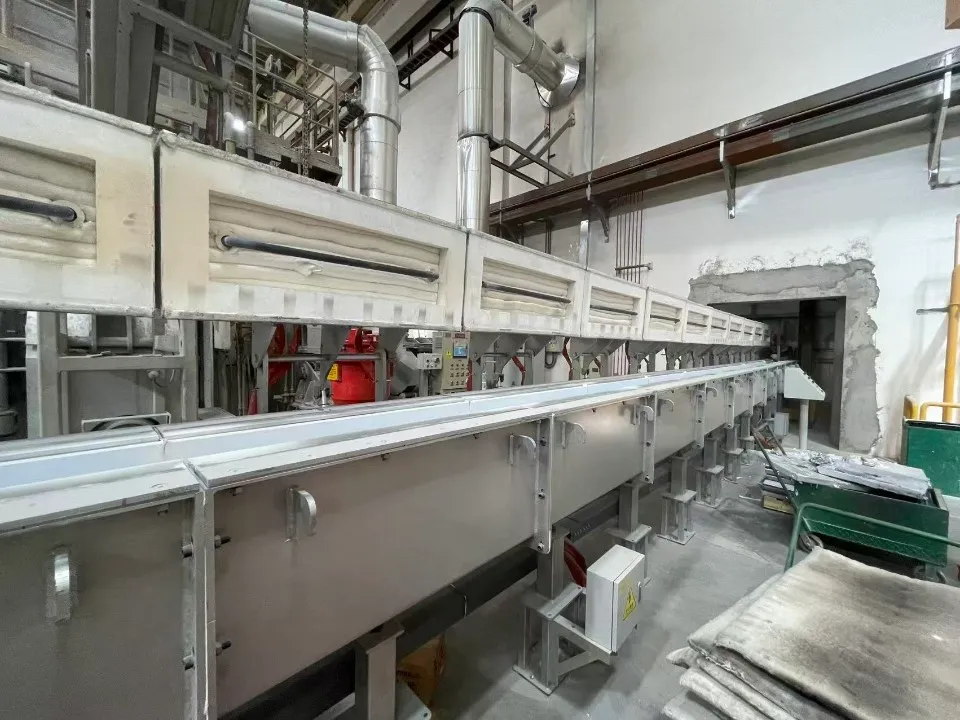
For a custom quotation, the most useful information to provide AdTech is the plant layout, furnace and casting-machine elevations, alloy range, required throughput, transfer distance and desired level of heating and automation.
FAQ
1. What is an integrated launder system for aluminum casting?
An integrated launder system is a refractory-lined molten-metal transfer system designed to connect furnaces, treatment equipment, filtration units and casting machines while controlling temperature and metal flow.
2. What is the difference between an aluminum launder and an integrated launder system?
A basic launder primarily transfers molten aluminum. An integrated system can additionally incorporate insulation, covers, heating, flow control, instrumentation and interfaces with degassing and filtration equipment.
3. Does an aluminum launder need heating?
Not necessarily. Heating depends on transfer distance, temperature requirements, insulation performance, ambient conditions and production conditions. Short transfer routes may not require active heating.
4. What material is used for an aluminum launder lining?
Material selection depends on the process. AdTech’s current Integrated Launder Equipment uses high-fused silica lining and describes properties including aluminum non-stick behavior, corrosion resistance and thermal shock resistance.
5. How much temperature does molten aluminum lose in a launder?
There is no universal value. Temperature loss depends on launder length, insulation, covers, heating, ambient conditions and transfer time. Published systems have reported approximately 1°C per meter under specific conditions, while AdTech specifies within approximately 2°C per meter for its covered system.
6. Can a launder be connected to an aluminum degassing system?
Yes. Integrated launder systems can be designed around the inlet and outlet requirements of degassing equipment. The relative position of the furnace, launder, degasser, filter and casting machine should be established during system design.
7. Can an integrated launder system include filtration?
Yes. Launder systems can be engineered to connect with plate-type, ceramic foam or other filtration equipment, depending on the casting process and treatment configuration.
8. What information does a supplier need for a custom aluminum launder?
At minimum, provide alloy information, metal temperature, flow rate, transfer distance, furnace outlet elevation, casting-machine elevation, plant layout, treatment equipment interfaces and heating requirements.
9. Can an existing aluminum casting line be retrofitted with an integrated launder?
Potentially yes. The supplier needs to evaluate the existing furnace, casting machine, elevations, equipment interfaces, support structure, utilities and maintenance access before designing the retrofit.
10. What should I compare when evaluating launder suppliers?
Compare the complete engineering scope, refractory material, insulation, heating, flow geometry, covers, automation, maintenance design, installation support, documentation and spare-parts availability, not only the initial equipment price.
Final Takeaway
An integrated launder system for aluminum casting should be selected as a process-transfer system, not simply as a refractory trough.
The most important factors are the relationship between flow geometry, temperature control, refractory performance, insulation, heating, maintenance access and integration with degassing, filtration and casting equipment.
A short transfer route with moderate thermal requirements may need only an insulated launder. A longer or continuous casting route may justify heated covers and active temperature management. A line with strict melt-cleanliness requirements should pay particular attention to flow transitions, filtration interfaces and the risk of turbulence or oxide entrainment.
For purchasing teams, the most useful starting point is not a request for “the price of an aluminum launder.” Instead, provide the supplier with the casting-line layout, alloy range, flow rate, temperature requirements, transfer distance, equipment interfaces and desired automation level.
That information allows the supplier to design a system around the actual production process rather than quoting a generic trough.
For aluminum casting plants considering a new or replacement system, AdTech’s Integrated Launder Equipment can be evaluated together with its online degassing equipment, filtration systems and flow-control equipment to create a coordinated molten-aluminum transfer and treatment route.