

Automating aluminum melt refining can help foundries reduce repetitive manual work around the furnace while making flux injection more controlled and consistent. Instead of relying entirely on an operator to manually add or distribute refining flux, an automatic flux injection system can control the refining speed, treatment time, flux dosage, and movement route according to the equipment configuration and furnace structure. For aluminum foundries handling larger furnaces or seeking more consistent process control, this approach can be an important step toward furnace automation.
The goal is not simply to replace an operator with a machine. The more important objective is to create a repeatable molten aluminum treatment process. When the amount of refining flux, injection rate, treatment route, and operating procedure can be controlled systematically, the foundry has a better basis for maintaining consistent refining conditions from one treatment cycle to the next.
AdTech China manufactures an automated Flux Injection System designed for molten aluminum refining. Its published configuration includes applications for 20–120T furnaces, adjustable refining speeds from 0–5 kg/min, tracked and wheeled movement options, Z-shaped and fan-shaped refining routes, and 50 kg or 100 kg refining tanks.
What Is Aluminum Melt Refining?
Aluminum melt refining is a group of processes used to improve the condition of molten aluminum before casting.
Depending on the alloy, raw materials, furnace conditions, and quality requirements, molten aluminum may contain unwanted oxides, inclusions, dissolved hydrogen, alkali or alkaline-earth elements, and other impurities. Different treatment technologies address different problems.
Flux treatment is one part of this process.
A refining flux can be introduced into molten aluminum to interact with impurities and assist their separation from the metal. Technical literature on molten aluminum processing describes both gaseous and solid fluxes as established methods for melt treatment, with their effects depending on the flux chemistry and the refining conditions.
This distinction matters because “refining” is not a single operation.
A foundry may use several technologies in sequence or combination:
| Treatment | Main purpose | Typical equipment |
|---|---|---|
| Flux treatment | Chemical treatment and impurity separation | Flux injection system |
| Gas degassing | Reduction of dissolved hydrogen and gas-related defects | Rotary degassing system |
| Filtration | Removal of solid inclusions from molten aluminum | Ceramic foam filter or deep-bed filter |
| Dross treatment | Separation and recovery of aluminum from dross | Dross treatment equipment |
| Furnace cleaning | Removal of accumulated furnace residues | Furnace cleaning flux |
The exact combination depends on the alloy, charge material, casting process, and required metal quality.
Therefore, an automatic flux injection system should normally be viewed as part of the molten aluminum treatment system rather than as a universal replacement for every refining technology.
Why Manual Aluminum Melt Refining Becomes a Production Problem
Manual refining can be workable in smaller operations. However, repetitive manual intervention becomes more difficult as production volume and furnace capacity increase.
Several problems can appear.
1. The operator has to work close to the furnace
Molten aluminum processing is a high-temperature industrial operation. Manual furnace-side work requires operators to repeatedly perform tasks around hot metal, furnace openings, tools, flux containers, and other equipment.
Reducing unnecessary exposure to the furnace area is therefore a meaningful automation objective.
The purpose of automation is not necessarily to remove all human involvement. Operators still need to supervise the process, maintain equipment, prepare materials, verify settings, and respond to abnormal conditions.
The difference is that they do not need to perform every repetitive refining movement manually.
2. Manual flux addition can be difficult to standardize
A manual process may depend heavily on operator technique.
For example, the actual process can be influenced by:
- Where the flux is introduced
- How quickly it is added
- How long the treatment lasts
- How the operator moves the lance or injection device
- How the flux is distributed through the melt
- How much flux is added during each treatment
- Whether the same operating procedure is followed every time
Even when experienced operators perform the work, these variables can make process standardization more difficult.
Automation provides a way to define these operating parameters more systematically.
3. Larger furnaces require better distribution control
As furnace size increases, simply adding flux at one location may not provide the same distribution as a controlled movement pattern across the furnace.
The physical geometry of the furnace matters.
The location and size of furnace doors, the available working area, the melt depth, and the required treatment region can all influence how a refining system should operate.
This is why an automatic refining system should not be selected only by looking at its maximum injection rate.
The refining route is also important.
How Automatic Flux Injection Changes the Refining Process
An automatic flux injection system combines material feeding, movement, control, and injection into one process.
A simplified process looks like this:
Flux preparation → Parameter setting → Equipment positioning → Controlled movement → Flux injection → Completion of treatment → Operator inspection
Instead of an operator manually controlling every movement, the equipment can execute the predefined refining procedure.
The most important advantages are process control and repeatability.
Controlled refining speed
The amount of flux entering the melt over time is an important operating variable.
If the equipment allows the refining speed to be adjusted, the operator can establish a defined injection rate rather than relying entirely on manual feeding.
The AdTech Flux Injection System has a published refining speed range of 0–5 kg/min, adjustable.
The actual setting should not be interpreted as a universal recommended value. The appropriate rate depends on the flux, furnace conditions, treatment objective, and production process.
Controlled treatment time
A refining process can also be defined by treatment duration.
An automatic system can allow the operator to establish a treatment time within the equipment’s operating parameters.
This can help convert an individual operator’s procedure into a documented process.
For production management, this is particularly useful because a repeatable procedure is easier to train, monitor, and adjust than an informal manual process.
Controlled movement route
Flux distribution is not only about how much material is injected.
Where the injection device moves inside the furnace also matters.
AdTech’s published Flux Injection System provides two refining route options:
- Z-shaped route
- Fan-shaped route
The route can be selected according to furnace structure and opening conditions.
This is an important distinction between a simple flux feeder and a mobile automatic refining system.
The equipment is not only feeding material. It is controlling where the refining operation takes place.
Why a Z-Shaped or Fan-Shaped Refining Route Matters
A furnace is not an ideal laboratory vessel.
Its shape, doors, walls, burners, refractory lining, and other internal structures influence the available refining area.
A single fixed injection point may therefore not be suitable for every furnace configuration.
A programmed movement route can distribute the treatment operation over a larger area.
Z-shaped refining route
A Z-shaped route can be considered when the furnace opening and internal working area are better suited to a back-and-forth movement pattern.
The actual route should be determined according to the furnace geometry and equipment configuration.
Fan-shaped refining route
A fan-shaped route provides another movement pattern for distributing treatment across the available furnace area.
Again, the objective is not to claim that one route is universally better.
The appropriate route depends on the actual furnace.
This is one reason buyers should provide the equipment manufacturer with furnace drawings, opening dimensions, capacity, and operating conditions before finalizing the system.
AdTech China Automatic Flux Injection System
AdTech China’s Flux Injection System is designed specifically for automated refining of molten aluminum.
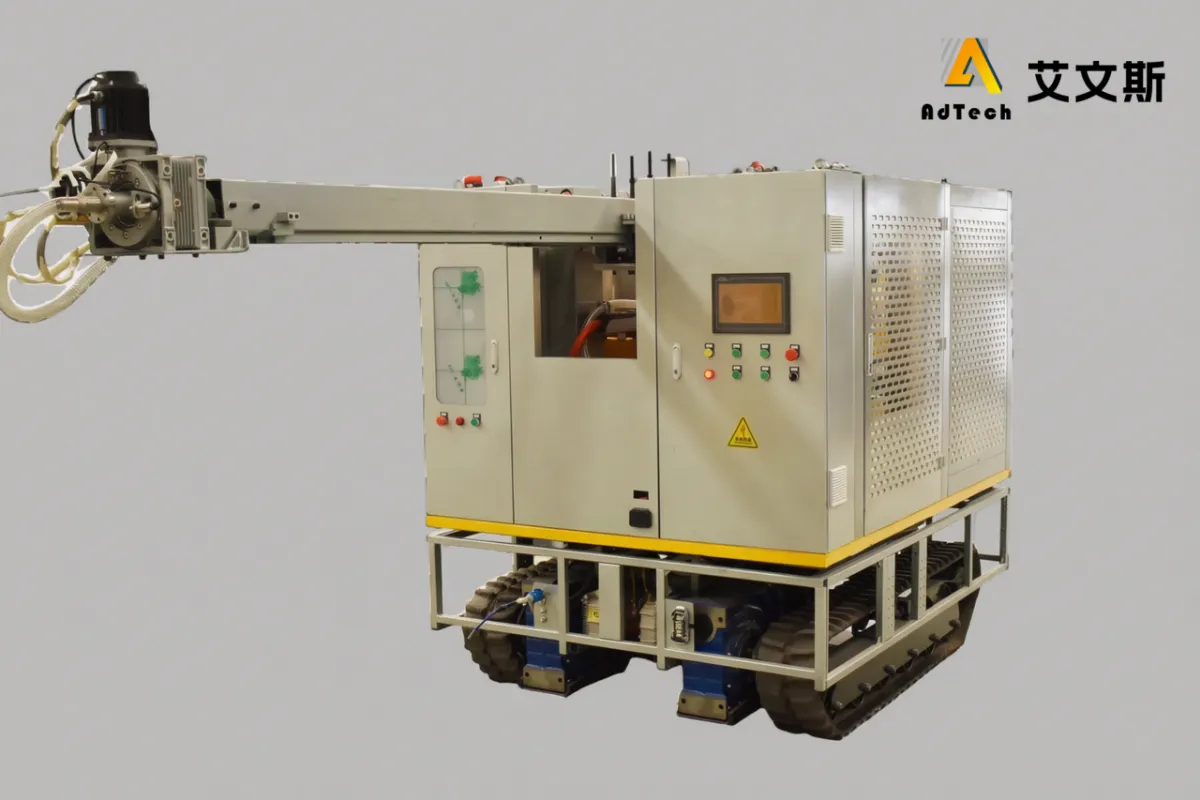
The AdTech’s unit specifications, the equipment is designated LQJL-001 and is designed for furnace sizes from 20T to 120T. This equipment uses a hydraulic wireless remote control system for movement and features a rechargeable design.
Its published specifications include:
| Parameter | AdTech published specification |
|---|---|
| Model | LQJL-001 |
| Applicable furnace size | 20–120T |
| Movement method | Tracked and wheeled types |
| Drive method | Energy storage power supply |
| Refining speed | 0–5 kg/min, adjustable |
| Refining route | Fan-shaped and Z-shaped |
| Refining tank capacity | 50 kg and 100 kg |
The equipment structure includes:
- Drive chassis
- Control system
- Telescopic arm mechanism
- Reserve power
- Refining tank
- Refining tube
This configuration allows the system to combine mobility, flux storage, injection, and automated control in one unit.
How the Automatic Refining System Reduces Manual Furnace Work
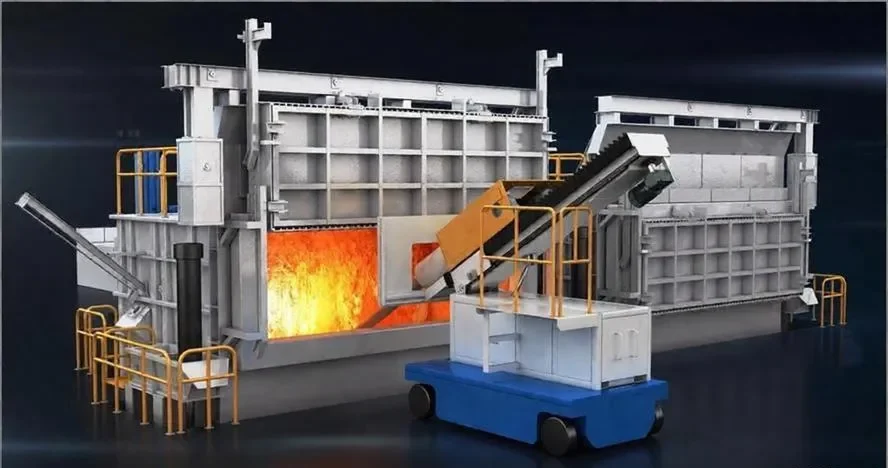
The most direct benefit is that the operator does not have to continuously perform the physical refining movement.
The AdTech system is designed to be remotely controlled and positioned for the refining operation. After the required parameters are set, the equipment can automatically execute the refining process.
This changes the operator’s role.
Manual process
Operator prepares flux → approaches furnace → manually operates injection equipment → controls movement → controls treatment → completes operation
Automated process
Operator prepares flux → sets parameters → positions equipment → starts automatic refining → supervises process
The second process does not eliminate the need for skilled personnel.
Instead, it moves the operator away from repetitive physical operation and toward process supervision.
That distinction is important for realistic factory automation.
What Does “Uniform Refining” Actually Mean?
Uniform refining should not be interpreted as a guarantee that every part of a furnace will have identical chemical conditions.
In practical terms, the goal is to improve the distribution of the refining treatment through controlled movement and injection.
AdTech’s equipment uses programmable movement routes, including Z-shaped and fan-shaped patterns, to adapt the refining path to furnace structure and door dimensions.
This can reduce the dependence on a single manual injection position.
The actual refining result still depends on several factors:
- Flux chemistry
- Flux condition
- Flux dosage
- Injection rate
- Carrier gas, when applicable
- Melt temperature
- Alloy composition
- Furnace geometry
- Melt depth
- Treatment time
- Operator settings
- Subsequent filtration or degassing
Therefore, an automatic machine should be understood as a process-control tool, not as a guarantee of a particular metallurgical result regardless of operating conditions.
Automatic Refining Does Not Replace Every Melt Treatment Process
This is one of the most important points for buyers.
An automatic flux injection system and a rotary degassing system do not necessarily perform the same function.
Flux treatment and gas degassing can have different objectives.
For example, technical literature describes fluxes as part of molten aluminum treatment and also describes inert-gas treatment for removing dissolved hydrogen. In some industrial processes, flux treatment and gas treatment may be used as complementary stages.
Similarly, ceramic foam filtration addresses solid inclusions downstream of the melt treatment process.
A simplified aluminum melt treatment chain could therefore look like:
Melting → Flux Treatment → Degassing → Filtration → Casting
The exact sequence depends on the production process.
A foundry producing high-quality aluminum alloy products may need several treatment stages rather than relying on one machine.
Automatic Flux Injection vs Manual Flux Addition
The choice between manual and automated operation depends on the plant’s production conditions.
| Factor | Manual refining | Automatic flux injection |
|---|---|---|
| Initial equipment cost | Lower | Higher |
| Operator involvement | High | Lower during treatment |
| Process repeatability | Operator dependent | Parameter controlled |
| Movement control | Manual | Programmed |
| Large furnace operation | More demanding | Better suited to automation |
| Refining speed control | Manual | Adjustable |
| Route control | Manual | Z-shaped/fan-shaped options |
| Furnace-side repetitive work | Higher | Lower |
| Process documentation | More difficult | Easier to standardize |
This does not mean automatic equipment is always necessary.
A small foundry with relatively simple production and low treatment frequency may find manual treatment adequate.
Automation becomes more relevant when repetitive manual operations, furnace size, production volume, process consistency, or labor requirements become significant concerns.
When Should an Aluminum Foundry Consider Automated Refining?
Several situations can justify evaluating automatic flux injection.
High-frequency refining operations
If operators perform refining many times per shift, reducing repetitive manual work can have a meaningful operational benefit.
Medium and large furnaces
The AdTech system is specified for 20–120T furnaces, making furnace scale one of the intended application factors.
Multiple operators using different procedures
If several operators perform the same refining process but use slightly different operating habits, parameterized automation can help standardize the procedure.
Need for better process records
Automated equipment can make it easier to establish defined settings for:
- Treatment time
- Injection speed
- Flux quantity
- Movement route
This creates a more structured process for production management.
Furnace-side labor is a bottleneck
If operators spend substantial time performing repetitive furnace operations, automation can allow them to focus on supervision, inspection, material preparation, quality control, and other tasks.
What Should Buyers Check Before Purchasing an Automatic Flux Injection System?
A buyer should not select an automatic refining system based only on the machine’s advertised capacity.
The following information should be prepared before requesting a quotation.
1. Furnace capacity
Provide the actual furnace capacity and clarify whether the stated capacity refers to nominal furnace capacity or typical operating melt weight.
For AdTech’s published system, the applicable furnace size is 20–120T.
2. Furnace opening dimensions
The furnace opening is particularly important because the injection system needs to reach the required treatment area.
Provide:
- Door dimensions
- Door location
- Furnace length and width
- Approximate melt depth
- Available operating space around the furnace
3. Refining flux
The equipment should be matched to the actual refining flux.
Provide:
- Flux type
- Powder or granular form
- Particle characteristics
- Bulk density if available
- Recommended dosage
- Moisture condition
- Supplier’s application instructions
Do not assume that every flux can be injected using identical settings.
4. Required refining speed
The required treatment rate should be established based on the flux and process.
AdTech’s published range is 0–5 kg/min, adjustable.
This does not mean every process should operate at 5 kg/min.
The correct setting should be determined by the actual treatment requirements.
5. Required refining route
Ask whether the furnace is better suited to:
- Z-shaped movement
- Fan-shaped movement
The route should be evaluated against the furnace structure rather than selected simply because one pattern sounds more efficient.
6. Refining tank capacity
AdTech offers published refining tank options of:
- 50 kg
- 100 kg
The appropriate size depends on treatment frequency, flux consumption, equipment operating cycle, and production requirements.
Common Mistakes When Automating Aluminum Melt Refining
Automation can solve operational problems, but it cannot compensate for an incorrectly designed refining process.
Mistake 1: Treating automation as a substitute for process control
Installing an automatic machine without defining the refining parameters does not automatically create a standardized process.
The plant should first determine what it is trying to control.
Mistake 2: Choosing equipment only by furnace tonnage
Two furnaces with the same capacity can have very different shapes and openings.
Furnace geometry should therefore be part of the equipment-selection process.
Mistake 3: Ignoring flux characteristics
A flux feeder must be compatible with the actual material being injected.
Particle size, flowability, moisture, dosage, and chemical composition can all influence the process.
Mistake 4: Assuming faster injection is always better
A higher injection rate is not automatically equivalent to better refining.
The process should be optimized around the flux, melt, furnace, and required treatment objective.
Mistake 5: Expecting flux injection to replace filtration
Flux treatment and filtration address different parts of molten metal cleanliness.
Ceramic foam filtration can provide a physical barrier for solid inclusions downstream.
A foundry should evaluate the complete melt treatment chain rather than expecting one technology to perform every function.
Mistake 6: Ignoring operator training
Automation reduces repetitive physical work, but operators still need to understand:
- Flux preparation
- Parameter setting
- Equipment inspection
- Furnace conditions
- Abnormal situations
- Maintenance
- Safety procedures
Automation should improve the process, not remove process knowledge from the plant.
How to Build a More Automated Aluminum Melt Treatment Process
For foundries planning broader automation, flux injection can be considered as one stage of a larger system.
A possible process architecture is:
1. Melting
Raw materials and alloying additions are melted according to the production recipe.
2. Flux Treatment
An automatic flux injection system introduces the selected refining flux according to the defined treatment procedure.
3. Degassing
Where required, an aluminum degassing system can be used to address dissolved hydrogen and related melt-quality requirements.
4. Filtration
A ceramic foam filter, filter box, deep-bed filter, or another appropriate filtration technology can remove solid inclusions before casting.
5. Launder Transfer
A properly designed launder system transfers molten aluminum while maintaining controlled flow and minimizing unnecessary disturbance.
6. Casting
The treated metal enters the casting process.
This system-based approach is more useful than viewing individual pieces of equipment in isolation.
Where AdTech China Fits Into an Aluminum Melt Treatment System
AdTech China supplies equipment and consumables for molten aluminum treatment, including ceramic foam filters, aluminum degassing systems, filtration equipment, fluxes, launder systems, and Flux Injection Systems.
For a foundry looking specifically to automate refining, the AdTech Flux Injection System is the most directly relevant solution.
Its published configuration is designed around:
- 20–120T furnace applications.
- Adjustable 0–5 kg/min refining speed.
- 50 kg or 100 kg refining tanks.
- Tracked or wheeled movement.
- Z-shaped or fan-shaped refining routes.
- Automated parameter control.
- Remote operation.
- Independent energy-storage power supply.
The value of this configuration is not simply that it injects flux.
It combines flux feeding, movement, and process control into an automated refining operation.
For a plant considering this type of equipment, the most useful next step is to provide the equipment supplier with the furnace capacity, furnace drawing or dimensions, furnace door size, refining flux information, target treatment procedure, and expected production conditions.
That information allows the supplier to determine whether the proposed equipment configuration is appropriate rather than relying on a generic machine specification.
Frequently Asked Questions
Is automatic flux injection suitable for aluminum foundries?
It can be suitable for foundries that want to reduce repetitive manual refining work and establish more controlled flux treatment. Suitability depends on furnace size, furnace geometry, flux characteristics, production volume, and treatment requirements.
What is an automatic flux injection system?
It is an automated equipment system that feeds refining flux into molten aluminum according to defined operating parameters. Depending on the equipment design, it can control injection rate, treatment time, movement route, and other operating variables.
What furnace sizes can the AdTech Flux Injection System handle?
The published AdTech specification for model LQJL-001 lists an applicable furnace size of 20–120T.
What is the refining speed of the AdTech system?
The published refining speed is adjustable from 0 to 5 kg/min. The appropriate operating rate depends on the flux and the actual refining process.
What refining routes are available?
The published system supports both Z-shaped and fan-shaped refining routes. The appropriate route should be selected according to furnace structure and opening conditions.
Can automatic refining completely eliminate operators?
The purpose of the system is to reduce repetitive manual intervention, not to eliminate the need for personnel. Operators are still required for setup, supervision, material handling, inspection, maintenance, and process control.
Does flux injection replace aluminum degassing?
Not necessarily. Flux treatment and gas degassing can address different melt-treatment objectives. A foundry may use both processes depending on its alloy, raw materials, casting requirements, and quality targets.
Can automatic flux injection replace ceramic foam filtration?
No. Flux treatment and physical filtration are different processes. A ceramic foam filter can be used downstream to physically remove solid inclusions from molten aluminum.
What should I provide when asking for an automatic refining system quotation?
At minimum, provide furnace capacity, furnace dimensions, furnace opening dimensions, refining flux type, approximate flux consumption, desired treatment procedure, production volume, and any existing degassing or filtration equipment.
Can the automatic refining system be customized for a specific furnace?
The published system provides different movement configurations and refining routes. For a specific furnace, the supplier should evaluate the furnace structure, door dimensions, working area, and process requirements before confirming the equipment configuration.