

For most aluminum billet casting operations, 30 PPI is a practical starting point for a 세라믹 폼 필터, particularly when the objective is to balance molten aluminum cleanliness with stable flow. However, 30 PPI is not a universal specification. A 20 to 30 PPI filter may be more appropriate when the casting system requires high throughput or the incoming melt carries a relatively high inclusion load, while 40 PPI can be considered when a higher level of inclusion control is required and the available filter area and metal head can support the additional flow resistance. Higher grades such as 50 or 60 PPI should be selected only when the cleanliness requirement justifies them and the complete filtration system has been validated.
The important point is that PPI should not be selected by itself. Aluminum billet producers should consider the alloy, casting rate, incoming melt cleanliness, required product quality, filter dimensions, filter area, filter thickness, metal temperature, available metallostatic pressure and the performance of the complete filtration system.
What Does PPI Mean in an Aluminum Billet Casting Filter?
PPI는 다음을 의미합니다. 인치당 기공 수. It is a commonly used way to describe the cellular structure of a ceramic foam filter.
A lower-PPI filter has a relatively coarse open-cell structure. A higher-PPI filter has a finer cellular structure.
일반적으로:
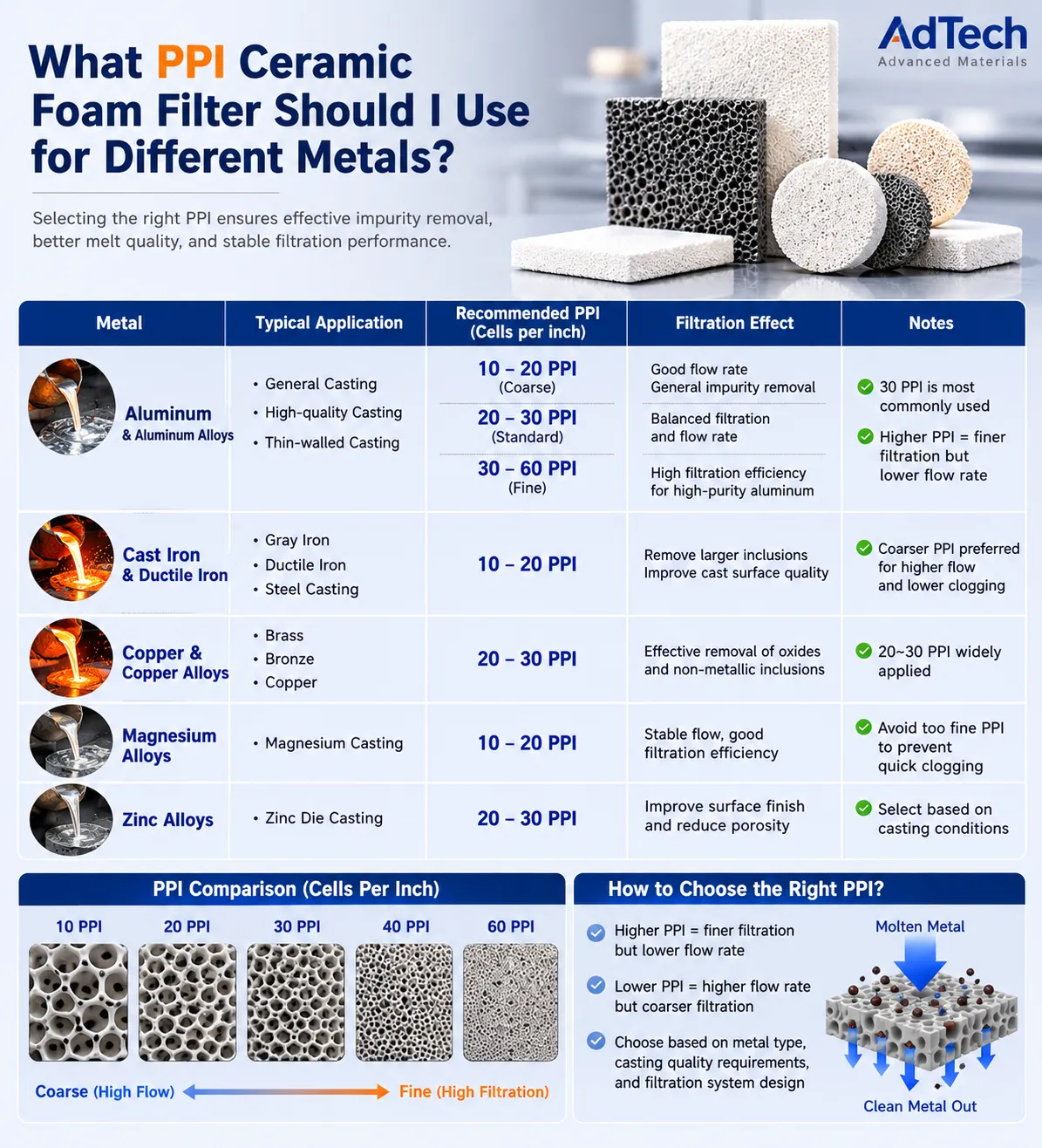
| PPI | General Structure | 흐름 저항 | Fine Inclusion Capture Potential |
|---|---|---|---|
| 10 PPI | 굵은 | 낮음 | Lower |
| 20 PPI | Relatively coarse | 낮음에서 보통 | 보통 |
| 30 PPI | Medium | 보통 | Good |
| 40 PPI | 좋아요 | 보통에서 높음 | 더 높음 |
| 50 PPI | 더 세밀하게 | 높음 | 더 높음 |
| 60 PPI | 매우 좋음 | 매우 높음 | 매우 높음 |
These relationships are useful for initial selection, but they should not be interpreted as exact engineering rules.
더 보기: 10 PPI, 30 PPI, 60 PPI 세라믹 폼 필터 비교.
A ceramic foam filter is not a conventional screen with uniform circular holes. It has a three-dimensional, interconnected pore structure. The actual filtration behavior depends on the morphology of the filter, including cell size, window size, porosity, strut geometry and thickness.
Research comparing commercial alumina ceramic foam filters found that filters carrying the same PPI designation can have different morphological and hydraulic properties. This means that “30 PPI” alone does not completely describe a filter’s filtration behavior.
For purchasing purposes, this distinction is important.
Two suppliers may both quote:
Alumina Ceramic Foam Filter, 30 PPI, 50 mm thick
but the filters may not necessarily have identical permeability, pressure drop, mechanical properties or filtration performance.
Why Is Ceramic Foam Filtration Important in Aluminum Billet Casting?
Aluminum billet casting requires control of non-metallic inclusions because inclusions can affect downstream processing and final product quality.
Depending on the alloy and process, relevant contaminants can include:
- 알루미늄 산화물 필름
- Oxide particles
- Spinel-containing inclusions
- 드로스 입자
- 내화성 입자
- Other non-metallic inclusions
Ceramic foam filters provide a three-dimensional filtration path through which molten aluminum flows. Inclusions can be captured through a combination of interception, inertial effects, adhesion and depth filtration.
This is different from treating the filter as a simple sieve.
Research on aluminum filtration has shown that depth filtration is an important mechanism. Inclusions can enter the open structure of the ceramic filter and become attached to the internal surfaces rather than simply being stopped at the first pore opening.
This is one reason why a ceramic foam filter can remove inclusions that are smaller than a simple interpretation of its nominal PPI might suggest.
The effectiveness of filtration depends on particle size, metal velocity, filter geometry, porosity and other properties of the filter and casting system.
What PPI Should You Start With for Aluminum Billet Casting?
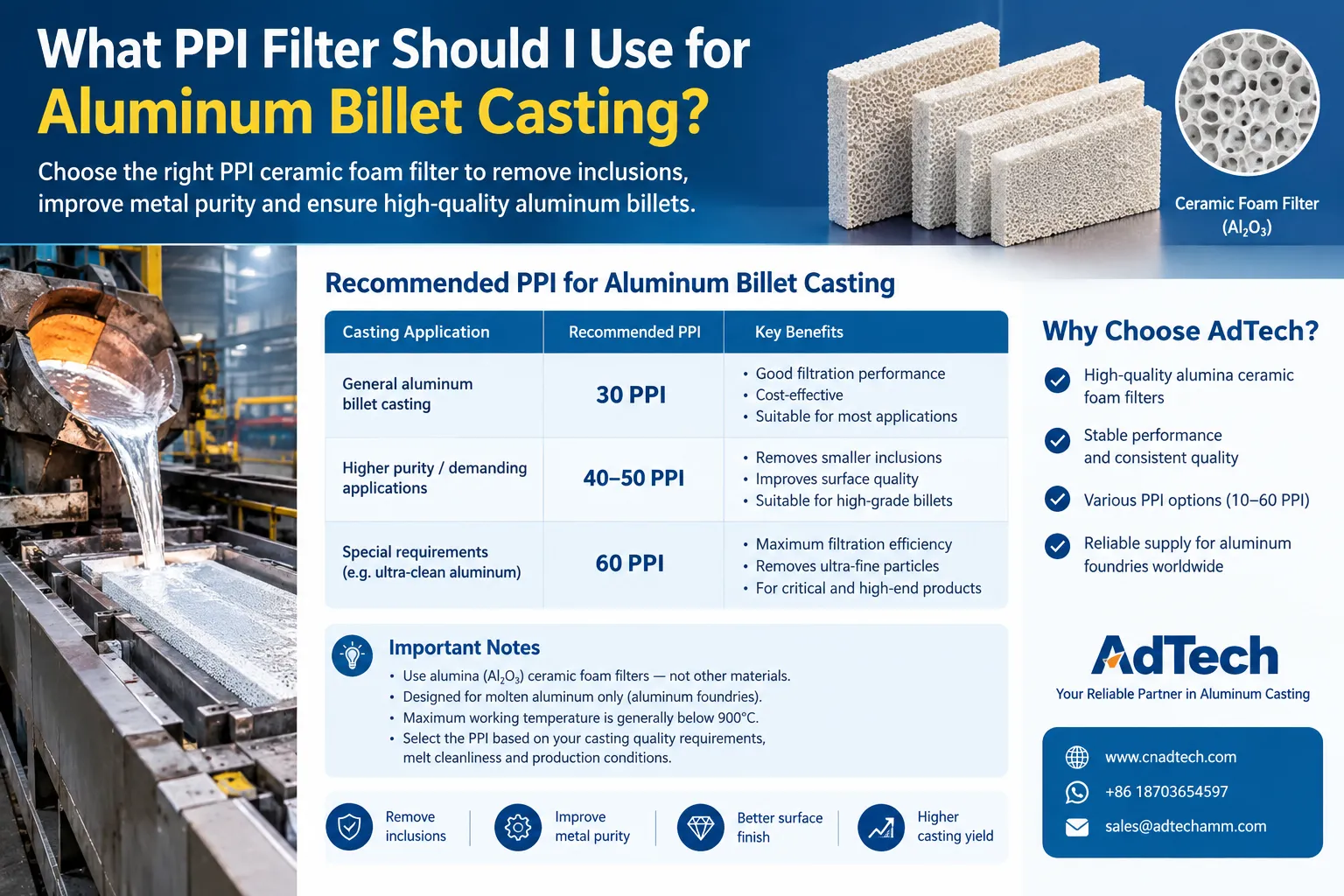
For a typical aluminum billet casting operation, 30 PPI is a sensible starting grade.
A practical selection range is:
| Billet Casting Condition | Initial PPI Range to Evaluate | Main Consideration |
|---|---|---|
| High inclusion loading or very high throughput | 20-30 PPI | Flow capacity and blockage resistance |
| General billet casting | 30 PPI | Balance of filtration and flow |
| 더 높은 청결도 요구 사항 | 30-40 PPI | Improved inclusion control |
| Very high cleanliness requirement | 40–50+ PPI | Fine filtration, subject to system validation |
This table should be treated as a starting framework, not a fixed specification.
The correct PPI depends on the actual production conditions.
For example, increasing a filter from 30 PPI to 40 PPI may improve filtration of smaller inclusions, but the change can also increase flow resistance. If the filtration area is not increased accordingly, the result may be an unstable casting process.
Therefore:
Do not automatically choose the highest available PPI.
Instead, select the lowest PPI that reliably achieves the required metal cleanliness under the actual production conditions.
더 보기: 세라믹 폼 필터의 PPI는 어떻게 선택하나요?
20 PPI vs. 30 PPI for Aluminum Billet Casting
The choice between 20 and 30 PPI often comes down to the balance between throughput and cleanliness.
When 20 PPI May Be Appropriate
A 20 PPI 필터 can be considered when:
- Metal throughput is high
- The incoming aluminum contains a relatively high inclusion load
- Filter blockage is a concern
- The casting system has limited pressure available
- The required product cleanliness does not justify finer filtration
- A large filter area is not practical
- The process already has effective upstream melt treatment
A coarser filter generally provides greater flow capacity and lower resistance.
This can be useful in high-throughput billet casting.
However, choosing 20 PPI simply because it has lower flow resistance is not sufficient. The producer must still confirm that the resulting billet cleanliness meets the required specification.
When 30 PPI Is Preferable
30 PPI is often a better starting point when the producer wants a stronger balance between:
- 포함 제거
- Flow capacity
- 필터 수명
- Casting stability
- Production throughput
This is why 30 PPI appears frequently in aluminum filtration applications.
Published research has also examined 30 PPI ceramic foam filters specifically in aluminum filtration, including their ability to remove non-metallic inclusions.
For many billet producers, 30 PPI is therefore a reasonable first grade to qualify.
Is 40 PPI Better Than 30 PPI for Aluminum Billet?
자동이 아닙니다.
A 40 PPI filter has a finer cellular structure than a 30 PPI filter and may provide greater potential for removing smaller inclusions.
But finer filtration also introduces additional resistance to metal flow.
The correct question is not:
“Is 40 PPI better?”
It is:
“Does the additional filtration provided by 40 PPI justify the additional flow resistance and cost in this billet casting process?”
Choose 30 PPI when:
- Standard billet cleanliness is sufficient
- Production throughput is important
- The incoming melt has a moderate inclusion level
- Filter blockage must be controlled
- The existing filtration system operates reliably with 30 PPI
Consider 40 PPI when:
- The billet has stricter cleanliness requirements
- Downstream processing is sensitive to inclusions
- The existing 30 PPI filtration does not provide adequate cleanliness
- The filter area can be increased if necessary
- The casting system has enough pressure head
- The incoming melt is already reasonably clean
A useful production strategy is to change one major parameter at a time.
If the producer changes:
- PPI
- filter size
- 필터 두께
- metal temperature
- casting speed
- degassing conditions
all at the same time, it becomes difficult to determine which change caused the result.
When Should You Consider 50 PPI or 60 PPI?
50 PPI and 60 PPI provide finer filtration structures, but they should not be treated as the default choice for aluminum billet casting.
They may be considered when:
- Very high melt cleanliness is required
- Fine inclusion control is particularly important
- The billet is intended for demanding downstream applications
- The upstream melt treatment is well controlled
- The filtration system provides sufficient area
- The available metallostatic pressure is adequate
- The production team has validated the filter’s flow capacity
The main risk is that a finer filter can become overloaded more quickly when the incoming metal contains a high concentration of inclusions.
This creates an important principle:
A finer filter cannot compensate indefinitely for poor upstream melt cleanliness.
If the melt reaches the filter carrying excessive dross or oxide material, simply changing from 30 PPI to 50 PPI may increase blockage rather than solve the underlying problem.
In some applications, improving furnace cleaning, melt handling, degassing and upstream filtration can be more effective than continuously increasing PPI.
더 보기: 알루미늄 파운드리 여과에 적합한 PPI를 선택하는 방법
PPI Is Only One Part of Filter Selection
One of the most important findings from technical research is that PPI does not completely define a ceramic foam filter.
Important specifications include:
| 사양 | 중요한 이유 |
|---|---|
| PPI | Indicates nominal pore density |
| 재료 | Determines compatibility with molten aluminum |
| Al₂O₃ 함량 | Relevant to ceramic composition and performance |
| 필터 치수 | Determines available filtration area |
| 두께 | Influences filtration path and pressure loss |
| 개방형 다공성 | 투과성에 영향을 미침 |
| Window structure | Influences hydraulic behavior and particle capture |
| 기계적 강도 | Important during handling and installation |
| 치수 공차 | Important for proper filter-box fit |
| Permeability / flow data | Helps evaluate hydraulic performance |
| Thermal-shock behavior | Important during startup |
| 엣지 씰링 | Prevents molten aluminum bypass |
A peer-reviewed study comparing commercial alumina CFFs from three suppliers demonstrated that identical PPI classifications do not necessarily produce identical hydraulic properties.
For a buyer replacing an existing filter supplier, this is especially important.
If the current filter is 30 PPI and a new supplier also offers 30 PPI, the buyer should not assume the replacement will behave identically.
Why Filter Area Can Be More Important Than Increasing PPI
Suppose a billet casting line needs better filtration but is already operating close to its flow limit.
There are two possible approaches:
Option A: Increase from 30 PPI to 40 PPI.
Option B: Maintain 30 PPI but increase the effective filtration area.
Option B can sometimes provide a better balance.
Increasing filtration area can reduce the specific flow loading on the filter. This can help maintain flow while providing sufficient filtration.
The correct solution depends on the filter box and casting system design.
A supplier should therefore evaluate:
Metal flow rate ÷ effective filter area
rather than looking only at PPI.
This is particularly important in continuous billet casting, where the filter must handle a sustained molten-metal flow rather than a short intermittent pour.
How Does Casting Throughput Affect PPI Selection?
Higher casting throughput generally increases the hydraulic demand placed on the filter.
If a filter is too small for the required flow rate, several problems can occur:
- Increased pressure drop
- Reduced metal flow
- Premature blockage
- Unstable casting
- Difficulty maintaining the required casting speed
A higher PPI filter can make these effects more pronounced because the finer structure generally provides greater resistance to flow.
Therefore, if the production rate increases, the correct response may be:
- increase filter area
- use multiple filters
- optimize the filter-box design
- improve upstream melt cleanliness
- adjust PPI
- or combine several of these measures
It is usually better to solve the complete hydraulic problem than to change PPI alone.
How Does Incoming Melt Cleanliness Affect PPI?
This is one of the most overlooked factors.
Consider two billet casting lines.
Line A
The furnace charge is relatively clean, dross management is controlled, melt treatment is stable and the metal reaches the filter with a low inclusion load.
A 30 PPI filter may provide sufficient performance.
Line B
The charge contains more recycled material, furnace cleaning is inconsistent and the incoming metal carries a higher inclusion load.
Using the same 30 PPI filter may produce a shorter filter campaign.
Moving directly to 50 PPI may make the problem worse if the fine filter becomes loaded quickly.
The better approach may be:
- Improve upstream melt cleanliness.
- Stabilize degassing.
- Control dross.
- Maintain appropriate melt transfer practices.
- Evaluate the existing filter.
- Only then determine whether a finer PPI is necessary.
This is why PPI selection should be regarded as part of the molten aluminum filtration system, rather than an isolated consumable purchase.
Does Degassing Affect Ceramic Foam Filter Selection?
Yes, but degassing and ceramic foam filtration solve different problems.
Online degassing primarily addresses dissolved hydrogen and helps improve melt quality by removing dissolved gas.
Ceramic foam filtration primarily targets non-metallic inclusions.
A simplified process can therefore be viewed as:
Melting → Melt Treatment → Degassing → Filtration → Casting
The exact process layout varies by casting plant.
The important point is that a ceramic foam filter should not be expected to perform the same function as a degassing system.
If hydrogen-related porosity is the primary problem, simply changing from 30 PPI to 50 PPI is unlikely to solve the underlying issue.
If oxide inclusions are the main problem, filtration may have a more direct role.
How Do You Know if Your PPI Is Too High?
A PPI grade may be too high for the current filtration system if the filter creates excessive flow resistance or blocks prematurely.
Potential warning signs include:
- Casting flow becomes unstable
- Metal throughput decreases
- The filter does not prime reliably
- Pressure requirements increase
- Filter life becomes unexpectedly short
- Metal level rises upstream of the filter
- Casting speed cannot be maintained
- The filter accumulates inclusions rapidly
These symptoms should not automatically be interpreted as “the PPI is too high.”
The problem could also be:
- insufficient filter area
- excessive incoming inclusion load
- incorrect filter installation
- inadequate preheating
- poor sealing
- unsuitable filter thickness
- unstable metal temperature
- excessive casting speed
Diagnosis should therefore consider the complete system.
How Do You Know if Your PPI Is Too Low?
The opposite problem can also occur.
A filter may be too coarse if:
- Required billet cleanliness is not achieved
- Inclusion levels remain above the target
- Surface defects persist
- Downstream processing continues to show inclusion-related problems
- Quality measurements indicate insufficient filtration
In this situation, moving from 20 PPI to 30 PPI may be reasonable.
Moving directly from 20 PPI to 50 or 60 PPI is not necessarily justified.
The best approach is normally incremental qualification.
A Practical PPI Selection Decision Tree
A simple decision process for aluminum billet casting is:
Step 1: Define the billet quality requirement
Ask:
- What alloy is being cast?
- What is the final application?
- What downstream process follows casting?
- What level of melt cleanliness is required?
Step 2: Determine the metal flow rate
기록:
- 주조 속도
- Metal flow rate
- Number of casting strands
- Typical campaign duration
Step 3: Evaluate incoming melt cleanliness
Determine whether the melt has:
- Low inclusion loading
- Moderate inclusion loading
- High inclusion loading
If possible, use an objective melt-cleanliness measurement rather than visual inspection alone.
PoDFA, for example, is specifically designed to identify and quantify inclusions in aluminum melts. LiMCA provides real-time information about inclusion concentration and size distribution.
Step 4: Select an initial PPI
A practical starting point is:
20–30 PPI for high-throughput or higher-inclusion-load conditions
30 PPI for general billet casting
30–40 PPI for higher cleanliness requirements
40–50+ PPI only when the application justifies finer filtration and the system can support it
Step 5: Check filter area
Do not finalize PPI without checking the effective filtration area.
Step 6: Validate production performance
Monitor:
- 흐름 안정성
- Filter pressure behavior
- Filter life
- 주조 속도
- Inclusion level
- Billet surface quality
- Downstream rejection
This provides a much stronger basis for finalizing the specification.
What Should Buyers Tell a Ceramic Foam Filter Supplier?
If you are requesting a quotation, do not send only:
“Please quote 30 PPI ceramic foam filters.”
Provide as much process information as possible.
A useful RFQ should include:
| Information | Example of What to Provide |
|---|---|
| 애플리케이션 | Aluminum billet casting |
| 합금 | Specific alloy grade |
| Casting process | DC / continuous casting |
| Metal flow rate | kg/min or t/h |
| PPI 필터링 | Current or requested grade |
| 필터 치수 | Length × width × thickness |
| Filter box | Existing or new |
| 금속 온도 | Actual operating range |
| Required cleanliness | Internal specification if available |
| 전류 필터 | Existing supplier and grade |
| Filter problems | Blockage, cracking, bypass, etc. |
| 주조 속도 | Actual production rate |
| 캠페인 기간 | Typical operating period |
This information allows the supplier to evaluate the filter as part of the actual process.
What Should You Ask When Comparing Two 30 PPI Filters?
If two manufacturers quote the same PPI, ask more questions.
For example:
- What is the ceramic composition?
- What is the Al₂O₃ content?
- What is the filter thickness?
- What is the dimensional tolerance?
- What is the open porosity?
- PPI는 어떻게 측정되나요?
- Is pore distribution controlled?
- Is permeability or flow data available?
- What is the compressive strength?
- How is thermal-shock performance controlled?
- What quality inspection is performed?
- Is batch traceability available?
- Can the supplier provide samples for production trials?
- Can the supplier recommend filter area based on actual flow rate?
The purpose is not to create unnecessary paperwork.
It is to prevent a common purchasing mistake:
Assuming that identical PPI numbers mean identical filtration performance.
Common Mistakes When Selecting Aluminum Billet Filters
Mistake 1: Choosing the highest PPI
Higher PPI does not automatically mean better overall performance.
A filter must provide adequate filtration without compromising production stability.
Mistake 2: Selecting PPI without considering flow rate
A filter specification that works at one casting rate may not work at another.
Mistake 3: Ignoring filter area
Increasing PPI while keeping insufficient filter area can create excessive resistance.
Mistake 4: Using PPI as an exact pore-size measurement
PPI describes pore density, not a perfectly uniform pore opening.
Mistake 5: Assuming every 30 PPI filter is equivalent
Research has demonstrated measurable differences between commercial filters carrying the same nominal classification.
Mistake 6: Using a finer filter to compensate for poor melt treatment
If the incoming metal contains excessive inclusions, a finer filter can load more quickly.
Mistake 7: Changing several process variables simultaneously
If PPI, filter size, temperature and casting speed all change together, production trials become difficult to interpret.
Mistake 8: Ignoring the filter box
A good filter cannot compensate for poor sealing or unsuitable filter-box design.
Mistake 9: Looking only at unit price
The lowest-priced filter is not necessarily the lowest-cost solution.
A more useful metric is:
Filter cost per tonne of acceptable billet produced.
This considers:
- Filter price
- Filter area
- Filter life
- Casting throughput
- 교체 빈도
- Scrap
- Production interruptions
Recommended Starting Point by Billet Application
The following is a practical framework rather than a universal specification.
| 적용 조건 | Starting Point | When to Consider a Change |
|---|---|---|
| High-throughput billet casting | 20-30 PPI | Move finer only if cleanliness requires it |
| General extrusion billet | 30 PPI | Evaluate 40 PPI if inclusion control is insufficient |
| Cleaner primary-metal operation | 20-30 PPI | Increase PPI only when quality data supports it |
| Recycled-material-heavy operation | 30 PPI | Improve melt treatment before simply increasing PPI |
| Higher-cleanliness billet | 30-40 PPI | Consider 40–50 PPI after system validation |
| Very demanding cleanliness requirement | 40–50+ PPI | Validate pressure drop, area and filter life |
This table should be treated as an engineering starting point, not as a guarantee for every alloy or casting machine.
What Is the Best PPI for Aluminum Billet Casting?
If a single starting grade must be selected without additional process information, 30 PPI is generally the most practical starting point for aluminum billet casting.
But the final selection should follow this logic:
30 PPI first, then adjust according to melt cleanliness, throughput, filtration area and measured casting performance.
사용 20 PPI when flow capacity and large-inclusion handling are more important than fine filtration.
사용 30 PPI when a balanced solution is required.
고려 사항 40 PPI when the billet requires higher cleanliness and the filtration system has enough capacity.
고려 사항 50 PPI or higher only when there is a specific technical reason and the system has been validated.
The correct objective is not to select the finest filter.
It is to select the coarsest filter that can consistently achieve the required billet cleanliness without compromising production stability.
How AdTech Can Support Aluminum Billet Filtration
AdTech manufactures ceramic foam filters for molten aluminum filtration and offers different PPI grades for different casting requirements.
For aluminum billet applications, the filter should be selected together with the actual casting conditions rather than treated as a standard one-size-fits-all consumable.
Relevant information for a technical evaluation includes:
- Aluminum alloy
- Casting rate
- 필터 치수
- Existing filter PPI
- Filter-box configuration
- 금속 온도
- Required cleanliness
- Current filtration problems
AdTech’s ceramic foam filter range includes multiple PPI options for aluminum filtration, allowing the filter grade and dimensions to be matched to the intended application.
The company also supplies supporting molten aluminum treatment equipment, including filter equipment and online degassing systems, allowing filtration to be considered as part of the broader melt-treatment process.
Final Recommendation
For most aluminum billet casting operations, 30 PPI is the best grade to evaluate first.
However, the final decision should not be based on PPI alone.
A better selection process is:
Define cleanliness requirement → measure flow rate → evaluate incoming melt cleanliness → select initial PPI → size the filtration area → validate pressure and flow → measure final melt cleanliness → confirm production performance.
If the process requires higher flow capacity, evaluate 20 to 30 PPI.
If the process requires a balanced solution, start with 30 PPI.
If higher cleanliness is required, evaluate 30 to 40 PPI.
If considering 50 PPI or higher, verify that the additional filtration is actually required and that the complete system can handle the additional resistance.
The most important purchasing lesson is simple:
Do not buy a PPI number. Buy a filtration solution that is matched to your aluminum billet casting process.
자주 묻는 질문
1. What PPI filter should I use for aluminum billet casting?
30 PPI is a practical starting point for many aluminum billet casting operations. Depending on flow rate, melt cleanliness and product requirements, 20 to 30 PPI may be suitable for high-throughput applications, while 30 to 40 PPI can be considered for higher cleanliness requirements.
2. Is 30 PPI good for aluminum billet casting?
Yes. 30 PPI is a common and practical starting grade because it provides a balance between inclusion removal and molten-metal flow. The final specification should still be validated against the actual casting process.
3. Should I use 20 PPI or 30 PPI for aluminum billet?
Choose 20 PPI when flow capacity and resistance to blockage are major concerns. Choose 30 PPI when greater inclusion control is required while maintaining reasonable flow capacity.
4. Is 40 PPI better than 30 PPI for aluminum billet?
Not necessarily. 40 PPI provides a finer filtration structure, but it can also increase flow resistance. It may be preferable when billet cleanliness requirements are higher and the filter system has sufficient capacity.
5. Can I use 50 PPI for aluminum billet casting?
Yes, but 50 PPI should generally be treated as a specialized choice rather than a default billet filter. The additional filtration should be justified by the cleanliness requirement and validated against flow rate, filter area and filter life.
6. Does higher PPI always remove more inclusions?
Not automatically. Higher PPI generally provides a finer filtration structure, but actual filtration performance depends on pore morphology, permeability, filter thickness, metal velocity, inclusion characteristics and other process conditions.
7. Why can two 30 PPI ceramic foam filters perform differently?
Because PPI does not completely define the filter structure. Different manufacturers can produce filters with different porosity, window dimensions, strut geometry, permeability and pressure-drop characteristics even when the nominal PPI is the same.
8. Can a higher PPI filter cause the aluminum filter to block faster?
Yes. A finer filter can have greater flow resistance and can become loaded more quickly when the incoming aluminum contains a high concentration of inclusions.
9. Should I increase PPI if my billet has inclusion problems?
Not automatically. First determine whether the problem originates from the incoming melt, melt treatment, degassing, dross management, filter area, filter installation or the PPI itself.
10. What information should I send a ceramic foam filter supplier?
Provide the aluminum alloy, casting process, metal flow rate, current filter PPI, filter dimensions, filter-box design, metal temperature, required cleanliness and any current filtration problems. This gives the supplier enough information to evaluate the filter as part of the complete system.