

Boron nitride paste is primarily used as a high-temperature release agent, protective coating, and lubricant in metal casting, foundry operations, glass manufacturing, semiconductor processing, and refractory applications — anywhere that surfaces must resist adhesion, oxidation, or chemical attack at temperatures ranging from 500°C to over 1800°C. In aluminum casting specifically, boron nitride paste is applied to dies, molds, ladles, launders, and crucibles to prevent molten metal adhesion, reduce aluminum wetting, and extend the service life of expensive tooling.
Based on our direct experience specifying and applying boron nitride paste across aluminum foundry and high-temperature industrial environments, this material consistently outperforms conventional release agents, graphite coatings, and calcium silicate-based barriers when operating conditions exceed 800°C or when contamination of the processed material is unacceptable. This article covers every functional application, technical specification, selection criterion, and practical usage consideration relevant to engineers and procurement professionals working with boron nitride paste.
If your project requires the use of Boron Nitride Paste, you can contact us for a free quote.
What Is Boron Nitride Paste and What Makes It Unique as a Material?
Boron nitride (BN) is a synthetic ceramic compound composed of equal proportions of boron and nitrogen atoms arranged in a hexagonal crystalline lattice structure — a configuration that gives it properties strikingly similar to graphite, which is why it is sometimes called “white graphite.” Unlike graphite, however, boron nitride is electrically non-conductive, chemically inert to most molten metals, and stable in oxidizing atmospheres at temperatures where graphite burns away.
Boron nitride paste is manufactured by suspending hexagonal boron nitride (hBN) powder in a carrier medium — typically water, organic solvents, or polymer-based binders — to create a brushable, sprayable, or dippable coating that can be applied to complex surface geometries before drying and hardening into a continuous protective layer.
The Hexagonal Boron Nitride Crystal Structure and Why It Matters
The hexagonal form of boron nitride (hBN) has a layered structure where each layer consists of alternating boron and nitrogen atoms in a flat honeycomb arrangement. These layers are held together by weak van der Waals forces, allowing them to slide over each other easily under shear stress — the same mechanism that makes graphite an effective dry lubricant.
This layered sliding behavior gives hBN paste its lubrication capability at temperatures where conventional lubricants have long since decomposed. At 1000°C, most organic lubricants are ash. Boron nitride retains its lubrication mechanism up to 900°C in air and beyond 1400°C in inert or reducing atmospheres.
Physical and Chemical Properties of Boron Nitride Paste
| Property | Value / Range |
|---|---|
| BN Content in Paste (typical) | 20% to 60% by weight |
| Crystal Structure | Hexagonal (hBN) |
| Color | White to off-white |
| Density of hBN Powder | 2.27 g/cm³ |
| Maximum Service Temp (air) | 850°C to 950°C |
| Maximum Service Temp (inert gas) | 1400°C to 1800°C |
| Thermal Conductivity (bulk hBN) | 25 to 400 W/m·K (anisotropic) |
| Electrical Resistivity | >10¹⁴ Ω·cm (excellent insulator) |
| Hardness (Mohs) | 1.5 to 2.0 |
| Chemical Reactivity with Molten Al | Extremely low |
| Chemical Reactivity with Molten Cu | Very low |
| Chemical Reactivity with Molten Glass | Extremely low |
| Coefficient of Friction | 0.15 to 0.40 (dry) |
| Solubility in Water | Insoluble |
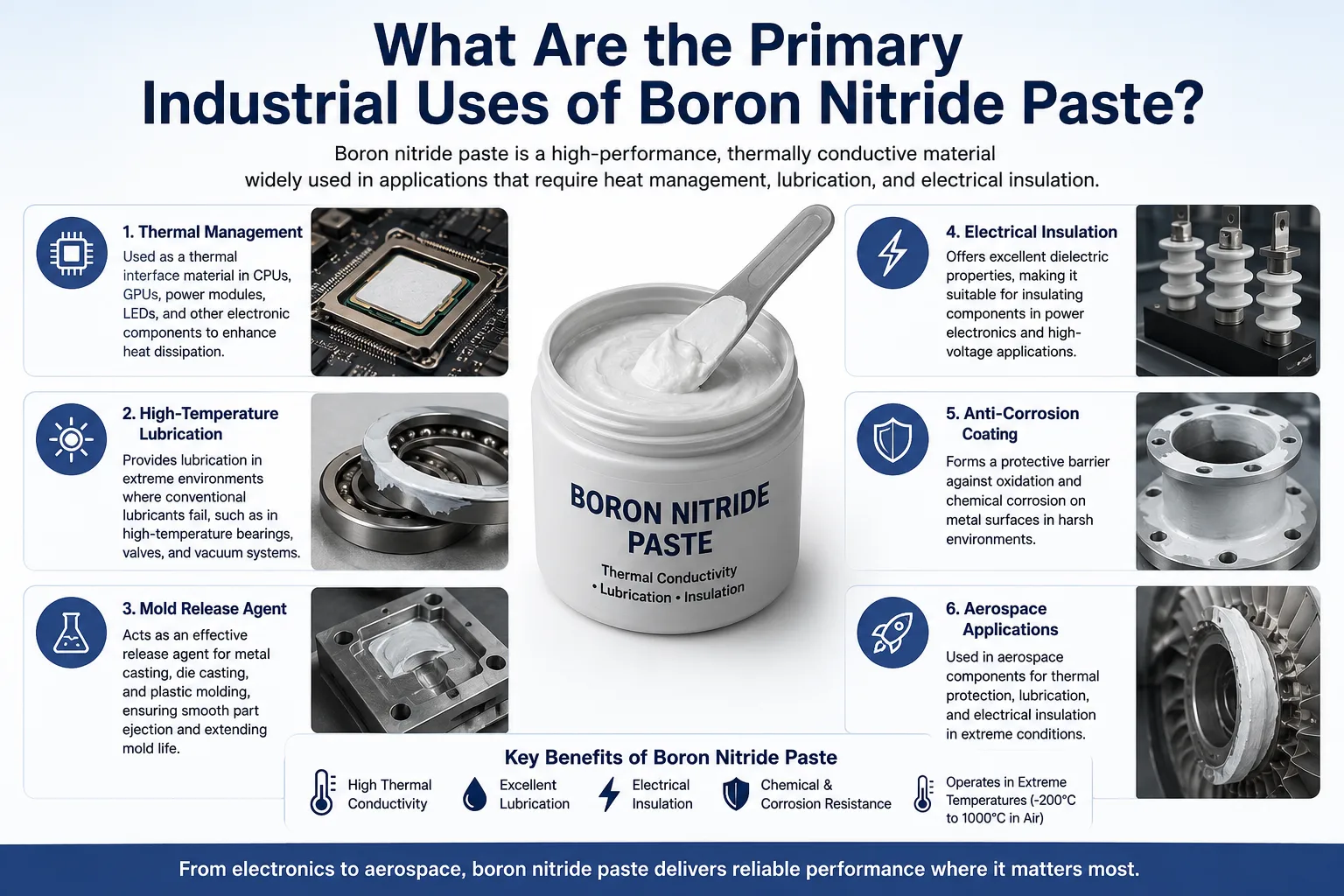
What Are the Primary Industrial Uses of Boron Nitride Paste?
The application range of boron nitride paste spans more industries than most engineers initially realize. Its combination of thermal stability, non-wetting behavior toward molten metals and glass, electrical insulation, and lubrication makes it relevant across a remarkably broad set of manufacturing processes.
Aluminum Casting and Foundry Applications
This is the highest-volume commercial application for boron nitride paste globally. In aluminum casting, the primary challenge is preventing molten aluminum — which is chemically aggressive and highly wetting toward many refractory and metallic surfaces — from adhering to molds, dies, ladles, and transfer equipment.
Die Casting
In aluminum high-pressure die casting (HPDC), conventional water-based die lubricants are applied between shots to provide release and cooling. However, boron nitride paste is applied separately to specific areas of the die that experience the most severe aluminum adhesion or where die soldering (the welding of aluminum to the die steel) is chronic.
Die soldering is one of the most economically damaging defects in HPDC — it causes surface defects on castings, accelerates die wear, and requires die polishing or repair that interrupts production. Boron nitride paste applied to gate areas, biscuit zones, and sliding cores creates a barrier layer that prevents direct aluminum-to-steel contact and the diffusion bonding mechanism behind die soldering.
Permanent Mold (Gravity Die) Casting
Permanent molds for aluminum casting require surface coatings that survive hundreds or thousands of cycles without breakdown. Boron nitride paste applied as a base coat under conventional wash coatings, or used directly as the sole coating, provides exceptional release and reduces the frequency of recoating cycles compared to standard calcium silicate washes.
Investment Casting Shell Molds
Investment casting molds used for aluminum aerospace components require precise dimensional control. Any reaction between molten aluminum and the ceramic shell produces surface inclusions that compromise part quality. BN paste applied as a face coat on the investment shell creates a non-reactive barrier between the aluminum and the ceramic.
Ladles, Crucibles, and Transfer Equipment
Graphite crucibles, silicon carbide crucibles, and refractory-lined ladles used in aluminum melting and transfer operations benefit significantly from boron nitride paste coating. The paste prevents aluminum skull (frozen metal) from bonding to the container walls, dramatically reducing the mechanical effort and crucible damage associated with skull removal.
We have seen boron nitride paste coating extend graphite crucible service life by 30% to 50% in our work with aluminum secondary smelters, simply by reducing the mechanical stress of skull removal.
Application-Specific Performance Data for Aluminum Casting
| Application | Key Benefit | BN Paste Type | Reapplication Frequency |
|---|---|---|---|
| HPDC die soldering prevention | Prevents aluminum-steel bonding | High-solids, solvent-based | Every 50 to 200 shots |
| Permanent mold release | Reduces mold wash recoating | Water-based, medium solids | Every 10 to 50 cycles |
| Ladle/crucible coating | Prevents skull adhesion | High-viscosity brushing grade | Every 5 to 20 heats |
| Launder coating | Reduces metal adhesion and bridging | Brush or spray grade | Every campaign |
| Thermocouple protection tube | Prevents aluminum attack | High-temp spray grade | Monthly inspection |
| Filter box coating | Non-reactive barrier | Brush grade | Per filter change |
How Is Boron Nitride Paste Used in Glass and Ceramic Manufacturing?
Glass manufacturing presents a set of challenges that are in many ways analogous to aluminum casting — extremely high temperatures, highly corrosive process materials, and the need to prevent adhesion between the processed material and the forming equipment.
Glass Forming Tool Coatings
Glass forming tools including plungers, molds, blowheads, and ring molds in container glass and flat glass production are coated with boron nitride paste to prevent glass adhesion, reduce heat transfer from the hot glass to the tool surface, and extend tool life.
- Glass forming temperature range: 800°C to 1100°C
- BN paste survives this range without decomposition or chemical reaction with glass.
- Tool coating reduces thermal shock to tools by providing an insulating buffer layer.
- Release properties allow glass articles to separate cleanly without dragging or tearing.
Fiber Glass Manufacturing
Boron nitride paste is applied to platinum-rhodium bushings used in continuous filament glass fiber drawing. The BN coating prevents glass melt adhesion to the precious metal bushing tips, maintains consistent fiber diameter control, and protects the expensive platinum alloy from glass-induced corrosion at temperatures around 1200°C to 1300°C.
Ceramic Sintering and Firing Applications
In advanced ceramic manufacturing — technical ceramics, piezoelectric components, fuel cell materials — parts must be sintered at high temperatures on setter plates and kiln furniture without bonding to these support surfaces.
Boron nitride paste applied to setter plates:
- Prevents ceramic parts from sticking to alumina or silicon carbide setters during sintering.
- Allows free thermal expansion and contraction without stress cracking.
- Does not contaminate the ceramic surface chemistry (unlike graphite which leaves carbon).
- Suitable for sintering in air at up to 850°C or in nitrogen/argon atmospheres at much higher temperatures.
What Role Does Boron Nitride Paste Play in Semiconductor and Electronics Manufacturing?
The semiconductor and electronics industries use boron nitride paste in applications that exploit its combination of electrical insulation and thermal management properties rather than primarily its release function.
Crystal Growth Applications
Single crystal growth processes — including Czochralski pulling (for silicon), Bridgman method growth, and zone refining — require crucibles and containment vessels that are chemically inert to the molten semiconductor material. Boron nitride paste is used to:
- Coat quartz and graphite crucibles in silicon crystal pulling to reduce contamination.
- Provide release layer on boron nitride crucibles for III-V semiconductor (gallium arsenide, indium phosphide) crystal growth.
- Seal gaps in crystal growth furnace components where atmospheric contamination could affect crystal purity.
Semiconductor Packaging and Assembly
In semiconductor device packaging and assembly processes involving high-temperature brazing or sintering:
- BN paste serves as a barrier coating on graphite fixtures and carriers used in chip sintering furnaces.
- Applied to ceramic substrates during co-firing processes to prevent unwanted bonding between substrate layers and setter plates.
- Used on jig and fixture surfaces in flip-chip assembly reflow operations..
Thermal Interface Applications in Electronics
Specialized boron nitride thermal paste formulations (distinct from industrial BN paste) are used as thermal interface materials between power electronic components and heat sinks. These formulations exploit BN’s combination of high thermal conductivity and electrical insulation — properties that common thermal greases based on silver or copper cannot offer when electrical isolation is required.
How Is Boron Nitride Paste Applied and What Surface Preparation Is Required?
Proper application technique is at least as important as product selection. The most expensive, highest-quality boron nitride paste will underperform if applied incorrectly, and understanding application methodology is essential for engineers specifying or using this material.
Surface Preparation Before BN Paste Application
Metallic Surfaces (die steel, cast iron molds, ladle shells):
- Remove all existing coatings, oxide scale, and contamination by grit blasting, grinding, or chemical cleaning.
- Degrease thoroughly with acetone or isopropyl alcohol — oil or grease contamination prevents BN paste adhesion.
- Preheat the surface to 100°C to 200°C before application — this drives off surface moisture and helps the paste adhere.
- Apply BN paste to the warm surface for best bonding.
Refractory Surfaces (castable, ceramic fiber, calcium silicate):
- Ensure refractory is fully cured and at operating temperature (or pre-dried).
- No aggressive surface preparation needed — refractory porosity aids BN paste adhesion.
- Apply by brush, spray, or roller to the refractory surface.
- Allow to dry completely before first metal contact.
Graphite Surfaces:
- Clean with compressed air or brush to remove loose graphite particles and debris.
- No grit blasting — this damages graphite structure.
- Apply BN paste directly to clean graphite surface.
- Multiple thin coats produce better performance than a single thick coat.
Application Methods
| Application Method | Tools Required | Suitable Viscosity Grade | Coating Thickness | Best Suited For |
|---|---|---|---|---|
| Brush application | Natural or synthetic bristle brush | Medium to high viscosity | 0.1 to 0.5 mm | Ladles, crucibles, complex mold surfaces |
| Spray application | Airbrush, spray gun | Low to medium viscosity | 0.05 to 0.2 mm | Large flat surfaces, launder channels |
| Dip coating | Container sized to part | Low viscosity | 0.05 to 0.15 mm | Small parts, thermocouple sheaths |
| Roller application | Foam or short-nap roller | Medium viscosity | 0.1 to 0.3 mm | Large flat mold surfaces |
| Trowel/spatula | Flexible trowel | High viscosity (paste grade) | 0.5 to 2.0 mm | Gap filling, thick protective coatings |
Drying and Curing After Application
- Water-based BN paste: allow 15 to 60 minutes air drying at room temperature, then heat to 100°C to 200°C for complete moisture removal before high-temperature service.
- Solvent-based BN paste: allow solvent to evaporate in ventilated area (5 to 30 minutes depending on solvent type and coat thickness), then preheat.
- Never apply to a surface that will go immediately to high temperature without intermediate drying — rapid steam generation can blister or delaminate the coating.
- Multiple thin coats with intermediate drying between coats produce better coating integrity than single thick applications.
What Are the Different Types and Grades of Boron Nitride Paste?
Not all boron nitride pastes are the same. Product formulations vary significantly in BN content, carrier medium, binder system, additives, and viscosity — all of which affect performance in specific applications.
Classification by Carrier Medium
Water-Based Boron Nitride Paste
The most commonly used formulation type. Water is the suspension medium, with thickeners, dispersants, and sometimes polymer binders added to control viscosity and coating adhesion.
- Easier to apply and clean up.
- Lower VOC emissions compared to solvent-based products.
- Suitable for most industrial applications up to 900°C in air.
- Must be thoroughly dried before high-temperature exposure to prevent steam blistering.
Solvent-Based Boron Nitride Paste
Organic solvents (alcohols, ketones, or hydrocarbons) replace water as the carrier medium. Solvent-based formulations often provide better adhesion to metallic surfaces and faster drying times.
- Better wetting of metallic surfaces than water-based grades.
- Faster drying enables quicker turnaround in production environments.
- Requires ventilation during application due to solvent vapors.
- Higher cost than water-based equivalents.
Polymer Binder Boron Nitride Paste
These formulations incorporate high-temperature-resistant polymer binders — typically silicone, polyimide, or ceramic precursor systems — that enhance coating durability and adhesion at elevated temperatures.
- Superior coating adhesion compared to basic water-based formulations.
- Maintains coating integrity through more thermal cycles.
- Higher cost — justified in critical applications with expensive tooling.
Classification by BN Content
| BN Content (wt%) | Grade Classification | Typical Application |
|---|---|---|
| 10% to 20% | Light / Thin-film grade | Semiconductor fixtures, precision tooling |
| 20% to 35% | Standard industrial grade | General aluminum casting, glass forming |
| 35% to 50% | High-solids grade | Severe service ladles, crucibles, HPDC dies |
| 50% to 65% | Ultra-high solids | Maximum temperature, repeated cycling applications |
| >65% | Near-solid paste | Gap-filling, specialized refractory protection |
Specialty Formulations
BN Paste with Alumina or Silica Additives
Additional ceramic oxide particles are incorporated to increase coating hardness and resistance to mechanical wear. These grades are used in applications where the BN coating experiences abrasive contact.
BN Paste for Titanium Casting
Titanium reacts aggressively with most refractory materials at casting temperatures (1680°C+). Specialized BN paste formulations with yttria or zirconia additions create barriers that resist titanium attack during investment casting of aerospace and medical components.
BN Paste for Copper and Copper Alloy Casting
Copper and brass casting presents different challenges than aluminum — higher temperatures (up to 1200°C), different wetting behavior, and susceptibility to contamination from carbon (graphite cannot be used). BN paste is ideal for copper casting tooling.
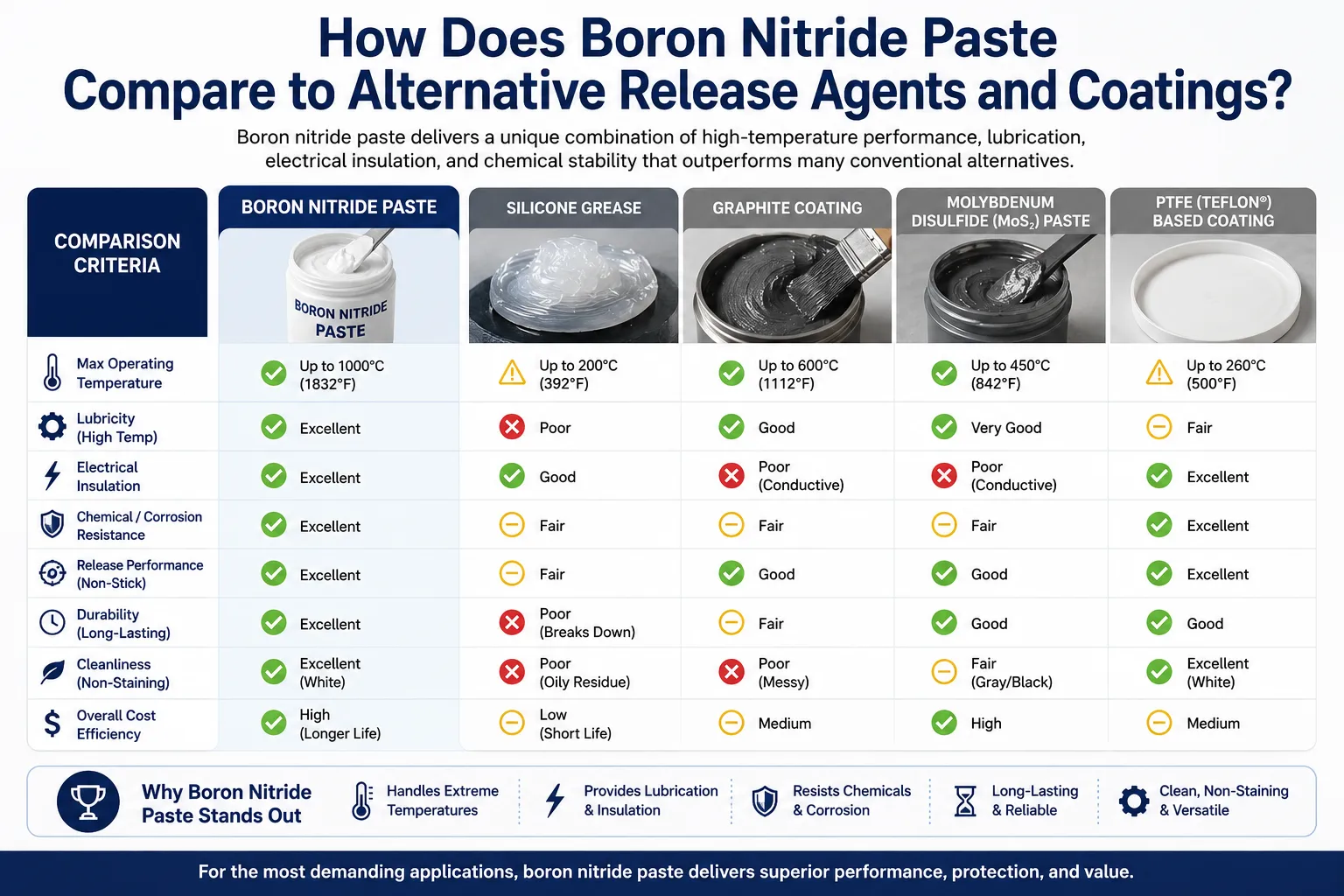
How Does Boron Nitride Paste Compare to Alternative Release Agents and Coatings?
Understanding where boron nitride paste fits relative to other protective coating options helps engineers make cost-justified product selections.
Comparative Performance: BN Paste vs. Alternative Coatings
| Property | BN Paste | Graphite Coating | Calcium Silicate Wash | Zirconia Wash | MoS₂ Lubricant |
|---|---|---|---|---|---|
| Max service temp (air) | 900°C to 950°C | 400°C to 500°C | 800°C | 1600°C+ | 350°C to 400°C |
| Max service temp (inert) | 1400°C to 1800°C | 2000°C+ | 800°C | 1600°C+ | 450°C |
| Electrical conductivity | Insulating | Conductive | Insulating | Insulating | Conductive |
| Chemical inertness to molten Al | Excellent | Good | Moderate | Good | Poor |
| Lubricating ability | Good | Excellent | Poor | Poor | Excellent |
| Release from molten glass | Excellent | Good | Good | Moderate | Poor |
| Surface contamination risk | Very low | Carbon contamination | Low | Very low | Moderate |
| Cost per m² of coating | Medium-High | Low | Low | Medium | Low-Medium |
| Reapplication frequency | Low-Medium | Low | High | Low | High |
| Health/environmental concerns | Low | Low-moderate | Low | Low | Moderate |
What Are the Limitations and Restrictions of Boron Nitride Paste?
No material is universally suitable for all applications. Boron nitride paste has specific limitations that engineers must understand to avoid specification errors.
Temperature Limitations in Oxidizing Atmospheres
At temperatures above 850°C to 950°C in air, boron nitride begins to oxidize. The oxidation reaction produces boron trioxide (B₂O₃), which forms a glassy layer on the surface. At low temperatures, this oxide layer is partially protective, but at higher temperatures, B₂O₃ becomes liquid (melting point 450°C) and can flow away from the surface, leaving the underlying material unprotected.
This means BN paste is not suitable as a standalone coating in applications above 900°C in air. In these conditions, either an inert atmosphere must be maintained, or alternative coatings (zirconia wash, alumina-based coatings) must be used.
In inert or reducing atmospheres, boron nitride is stable to temperatures above 1400°C, making it suitable for vacuum furnaces, hydrogen atmosphere furnaces, and nitrogen atmosphere processing.
Mechanical Strength Limitations
Boron nitride coatings are soft (Mohs hardness 1.5 to 2.0) and do not withstand mechanical abrasion well in isolation. In applications where the coating will be mechanically scraped, abraded by flowing solid particles, or impacted by charges of solid metal, BN paste alone may not provide adequate durability. In these cases, BN paste is often used in combination with harder ceramic coatings.
Moisture Sensitivity During Application
Water-based BN paste requires thorough drying before high-temperature exposure. If applied to a surface that has not been adequately dried, steam generation during heating causes coating delamination, blistering, and failure. This is a particularly common problem in foundry environments where production pressure encourages rushing through the coating application and drying process.
Compatibility Limitations with Specific Metals
| Metal or Alloy | BN Paste Compatibility | Notes |
|---|---|---|
| Aluminum alloys (all series) | Excellent | Preferred coating |
| Copper and copper alloys | Excellent | No carbon contamination risk |
| Zinc and zinc alloys | Good | Suitable for most die casting |
| Iron and steel | Good | Use at appropriate temperature range |
| Titanium alloys | Requires specialty grade | Standard BN may react at 1700°C+ |
| Nickel superalloys | Good to Excellent | Check binder chemistry |
| Magnesium alloys | Good | Check for binder reactivity |
| Reactive metals (Zr, Nb, Ta) | Consult supplier | May require yttria or other additives |
What Are the Safety, Handling, and Environmental Considerations for Boron Nitride Paste?
Occupational Health Profile
Hexagonal boron nitride is generally considered to have a low toxicity profile compared to many industrial ceramic materials. It is not classified as a carcinogen under current EU or US regulatory frameworks. The main occupational health considerations are:
- Inhalation of fine BN powder: fine particulate inhalation is always a respiratory concern; P2 dust mask recommended during powder handling or spray application.
- Skin contact: generally non-irritating, but some binder systems or solvent carriers may cause skin irritation — check the product-specific Safety Data Sheet (SDS)
- Eye contact: BN powder can cause mechanical eye irritation — safety glasses or goggles recommended during application.
- Solvent vapors: solvent-based formulations require adequate ventilation to prevent accumulation of organic solvent vapors.
Environmental Considerations
- Water-based BN paste is generally classified as non-hazardous waste for disposal purposes.
- Solvent-based formulations require disposal in accordance with local VOC waste regulations.
- Boron compounds are regulated in some jurisdictions regarding aquatic toxicity — check local regulations before draining wash water to sewage.
- BN paste is not biodegradable but is not classified as persistent bioaccumulative or toxic (PBT)
Storage and Shelf Life
| Storage Parameter | Recommendation |
|---|---|
| Storage temperature | 5°C to 35°C |
| Avoid freezing | Yes — freezing causes irreversible separation |
| Shelf life (unopened) | 12 to 24 months typical |
| Container type | Keep in original sealed container |
| Separation behavior | Normal — stir thoroughly before use |
| Contamination prevention | Do not introduce water into solvent-based products |
How Do You Select the Right Boron Nitride Paste for Your Application?
Selection Criteria Framework
Step 1: Define service temperature and atmosphere
The operating temperature and atmosphere type are the primary selection drivers:
- Below 900°C in air: standard water-based or solvent-based BN paste.
- Above 900°C in air: consider alternative coatings or accept BN paste limitations.
- Above 900°C in inert/reducing atmosphere: high-purity BN paste with appropriate binder.
Step 2: Identify the substrate material
Substrate chemistry affects the required BN content and binder system:
- Metallic substrates (die steel, cast iron): solvent-based or high-adhesion polymer binder grades.
- Graphite and carbon: standard grades with good wetting characteristics.
- Refractory ceramics: water-based grades typically suitable.
Step 3: Determine the application method available
Viscosity selection follows from the available application method:
- Brush application: medium to high viscosity (2,000 to 20,000 mPa·s)
- Spray application: low viscosity (500 to 3,000 mPa·s)
- Dip coating: low viscosity (200 to 1,500 mPa·s)
Step 4: Consider contamination sensitivity
- Electronic or semiconductor applications: highest purity grade, minimal impurities in BN and binder.
- Food-contact or pharmaceutical-adjacent: verify regulatory compliance of all formulation components.
- Standard industrial: standard grades acceptable.
Step 5: Evaluate cost and reapplication cycle
- High-value tooling with difficult access: premium grades with longer service life justify higher unit cost.
- High-volume, easy-access applications: standard grades with more frequent reapplication may be more economical.
Cost-Performance Trade-off Table
| Application Priority | Recommended Grade | Cost Level | Expected Service Life |
|---|---|---|---|
| Maximum release performance | Ultra-high solids (50%+ BN) | High | Long |
| Maximum temperature resistance | Inert atmosphere, high-purity | Very High | Long |
| Lowest total cost of ownership | High-solids water-based | Medium | Medium |
| Easiest application | Low-viscosity spray grade | Medium | Short to Medium |
| Minimum contamination risk | High-purity, low binder | High | Medium |
| Maximum convenience | Ready-to-use aerosol | High per unit | Short |
Frequently Asked Questions About Boron Nitride Paste
Q1: What is boron nitride paste primarily used for in aluminum casting?
In aluminum casting, boron nitride paste is used to prevent molten aluminum from adhering to molds, dies, ladles, crucibles, launders, and other tooling surfaces. It creates a non-wetting barrier between the molten aluminum and the tooling surface, dramatically reducing die soldering in HPDC, extending permanent mold coating life, and making skull removal from ladles and crucibles much easier. It also protects expensive graphite crucibles from aluminum penetration and chemical attack.
Q2: What temperature can boron nitride paste withstand?
In air (oxidizing atmosphere), boron nitride paste is functional up to approximately 850°C to 950°C, above which oxidation of the BN layer begins. In inert atmospheres (nitrogen, argon) or reducing atmospheres (hydrogen), boron nitride is stable to temperatures exceeding 1400°C, and in vacuum to even higher temperatures. The specific temperature limit depends on the formulation — the binder system often limits performance before the BN itself does.
Q3: Is boron nitride paste electrically conductive?
No. Hexagonal boron nitride is an excellent electrical insulator with electrical resistivity exceeding 10¹⁴ Ω·cm. This is one of the key properties that distinguishes BN paste from graphite coatings and makes it essential in applications where electrical continuity between the coating and process material must be prevented — such as in semiconductor processing equipment and certain electronic manufacturing applications.
Q4: How often does boron nitride paste need to be reapplied?
Reapplication frequency depends heavily on application type, temperature, and mechanical conditions. In HPDC die coating, BN paste at gate areas may last 50 to 200 shots before performance degrades. Ladle and crucible coatings typically survive 5 to 20 heats. Launder coatings in aluminum casting can last an entire production campaign. Static, non-contact applications at lower temperatures last the longest — months or even years in some cases.
Q5: Can boron nitride paste be used on graphite crucibles?
Yes, and this is one of the most common and effective applications. BN paste applied to graphite crucibles before aluminum melting prevents molten aluminum from penetrating the graphite pores, reduces metal skull adhesion, and significantly extends crucible service life. Multiple thin coats applied to a preheated crucible provide the best results. The BN coating also reduces carbon pickup in aluminum melts where low carbon content is specified.
Q6: What is the difference between boron nitride paste and boron nitride spray?
Boron nitride spray uses the same base material (hBN particles) but in a much lower-viscosity, aerosol-delivered formulation. Sprays are more convenient for coating large areas or difficult-to-reach surfaces but typically deposit thinner coatings than brush-applied paste and cost more per unit area of coverage. Paste grades allow thicker coating application and better gap-filling, making them preferable for ladle and crucible coating where coating thickness and durability are important.
Q7: Is boron nitride paste safe to use without special protective equipment?
Standard industrial boron nitride paste has a relatively benign health profile — BN is not classified as a carcinogen and is generally non-irritating. However, inhalation of fine BN powder during spray application warrants respiratory protection (P2 dust mask minimum), and some solvent-based formulations require ventilation to manage organic solvent vapor exposure. Always consult the product-specific Safety Data Sheet before use and follow the PPE recommendations provided by the manufacturer.
Q8: Can boron nitride paste be used in vacuum furnaces?
Yes, boron nitride paste is one of the preferred release agent coatings for vacuum furnace applications. In vacuum, BN is thermally stable to very high temperatures without oxidation concerns. It is used to coat graphite fixtures, setter plates, and support structures in vacuum sintering furnaces, vacuum brazing furnaces, and vacuum heat treatment equipment. Verify that the specific binder system used in the paste formulation is compatible with vacuum conditions — some binders outgas significantly and may contaminate the furnace atmosphere or vacuum system.
Q9: How does boron nitride paste compare to graphite paint for aluminum casting?
Graphite paint is an effective lubricant and release agent at lower temperatures but has critical limitations in aluminum service: it burns away above 400°C to 500°C in air, it is electrically conductive (problematic in some applications), and it introduces carbon contamination into aluminum melts — potentially affecting alloy chemistry. Boron nitride paste avoids all three of these limitations, making it the preferred alternative when operating temperatures exceed graphite’s air-stable range or when melt cleanliness is a priority. The main advantage of graphite paint is significantly lower cost.
Q10: Where can boron nitride paste be purchased and what should procurement engineers look for when selecting a supplier?
Boron nitride paste is available from specialty industrial ceramic suppliers, refractory product distributors, and chemical specialty companies. Key supplier evaluation criteria include: BN particle purity and size distribution specifications (ask for certificates of analysis), consistency of BN content between production batches, availability of technical data sheets with measured performance data at temperature, willingness to provide application support, and compliance documentation for relevant industry standards. For aluminum foundry applications, AdTech supplies qualified boron nitride paste products specifically formulated for molten aluminum contact service, with documented performance data from aluminum casting production environments.
Conclusion: Matching Boron Nitride Paste to Your Specific Application
Boron nitride paste is one of the most technically versatile protective coating materials available to high-temperature industrial processing. Its unique combination of thermal stability, chemical inertness to molten metals and glass, lubrication capability, and electrical insulation makes it irreplaceable in a set of applications where no other single material provides equivalent performance.
The key practical conclusions from our technical analysis:
- Aluminum foundry applications: BN paste is the optimal release agent and protective coating for ladles, crucibles, launders, and precision mold surfaces — particularly where carbon contamination from graphite is unacceptable.
- Temperature limits in air: plan for reapplication or alternative protection above 900°C in oxidizing atmospheres.
- Construction type matters: select viscosity and carrier medium based on substrate and application method, not just on BN content.
- Inert atmosphere applications: BN paste genuinely excels above 1000°C when protected from oxidation.
- Cost justification: the higher unit cost versus graphite or calcium silicate coatings is consistently justified by longer tooling life, fewer rejects, and reduced maintenance labor in critical applications.
Specifying the right grade and applying it correctly transforms boron nitride paste from an expensive consumable into a genuine productivity and quality investment.