

Furnace cleaning flux is used to remove accumulated oxide and other deposits from the bottom and inner walls of aluminum melting and holding furnaces. It is different from a conventional refining flux, covering flux, or drossing flux because its primary purpose is furnace cleanliness rather than general molten-metal treatment. The correct product and application method depend on the furnace condition, alloy, treatment temperature, deposit type, and cleaning procedure.
In aluminum casting, furnace cleanliness is closely connected with melt quality. Oxide buildup can accumulate on furnace walls, furnace bottoms and other areas exposed to molten aluminum. Aluminum fluxing is widely used in foundry practice to control oxide formation, remove nonmetallic inclusions and address oxide buildup on furnace walls. ASM International classifies furnace wall cleaners separately from cover, drossing and other flux functions.
For buyers and foundry engineers, the most important point is simple: do not select a furnace cleaning flux only because a supplier describes it as an “aluminum cleaning flux.” First identify whether the problem is furnace-wall buildup, floating dross, suspended oxide inclusions, hydrogen, or an unwanted alloying element. Each problem may require a different treatment.
What Is Furnace Cleaning Flux?
Furnace cleaning flux is a chemical flux designed to assist in removing oxide-rich buildup and deposits from surfaces inside aluminum melting or holding furnaces.
During aluminum melting and holding, the molten metal is exposed to air. Oxidation can generate aluminum oxide and other reaction products. Some of these materials remain on the melt surface as dross, while deposits can also accumulate on furnace walls and bottoms.
A furnace cleaning flux is formulated for the specific task of attacking or loosening these deposits so they can be removed during furnace cleaning.
This is different from simply treating the molten aluminum.
Pyrotek classifies wall-cleaning fluxes as a separate category from covering, cleaning, drossing and refining fluxes. Its description states that wall-cleaning fluxes contain compounds intended to remove oxide buildup and are often applied directly to the buildup.
Furnace cleaning flux vs aluminum cleaning flux
The terminology can be confusing because suppliers may use “cleaning flux” in different ways.
In practical purchasing terms, ask what surface or material the product is intended to clean.
| Flux function | Primary target | Typical purpose |
|---|---|---|
| Furnace cleaning flux | Furnace walls and bottom deposits | Remove accumulated oxide buildup |
| Molten-metal cleaning flux | Oxide inclusions in molten aluminum | Improve melt cleanliness |
| Drossing flux | Surface dross | Separate aluminum from oxide-rich dross |
| Covering flux | Melt surface | Reduce oxidation and protect molten aluminum |
| Refining flux | Specific chemical or metallurgical impurities | Modify or remove targeted elements |
| Recycling flux | Aluminum contained in dross | Improve aluminum recovery from dross |
These categories can overlap in some commercial products, but the primary function and application procedure should be confirmed from the manufacturer’s technical documentation.
Why Does Aluminum Furnace Buildup Form?
Furnace deposits are not caused by a single factor.
The buildup can be influenced by:
- Repeated exposure to molten aluminum
- Oxidation of the aluminum surface
- Dross accumulation
- Furnace operating temperature
- Alloy chemistry
- Furnace design
- Holding time
- Charging practice
- Skimming practice
- Interaction between molten aluminum and refractory surfaces
- Frequency of furnace cleaning
Aluminum oxide is particularly important because aluminum has a strong affinity for oxygen. During melting and handling, oxide films and dross can form at the metal surface.
Some oxide material is removed during normal skimming. However, not all oxide remains on the surface. Deposits can adhere to furnace linings and accumulate over repeated production cycles.
ASM International identifies preventing and removing oxide buildup on furnace walls as one of the purposes of aluminum fluxing practice.
Why buildup matters
Heavy deposits can create several operational concerns.
First, they reduce the effective working volume of the furnace.
Second, accumulated material can become mechanically difficult to remove.
Third, deposits can interact with molten aluminum and create additional opportunities for oxide or nonmetallic contamination.
Fourth, heavy buildup can make routine furnace maintenance more difficult.
The exact effect depends on furnace design, refractory condition, alloy, operating practice and deposit composition. Therefore, furnace cleaning should be treated as part of the overall melt-management and furnace-maintenance procedure rather than as a universal cure for casting defects.
What Does Furnace Cleaning Flux Actually Do?
A suitable furnace cleaning flux helps chemically react with or loosen oxide-rich deposits so that they can be removed more effectively.
The objective is not simply to make the furnace surface look cleaner.
A properly selected furnace cleaning treatment should support:
- Removal or loosening of accumulated deposits.
- Easier mechanical removal of the reacted material.
- Better control of furnace cleanliness.
- Reduction of excessive oxide buildup.
- More consistent furnace operating conditions.
The exact chemical mechanism depends on the flux formulation. Commercial furnace cleaning fluxes can contain combinations of salts selected for their melting behavior, wetting characteristics and interaction with oxide deposits.
This is one reason buyers should avoid selecting a product based solely on a generic ingredient list.
Application temperature, deposit type, furnace construction and treatment method are equally important.
Pyrotek notes that flux recipes vary according to purpose and process variables such as alloy and temperature. It also identifies temperature, alloy chemistry and addition technique as important considerations when selecting powder fluxes.
Furnace Cleaning Flux vs Other Aluminum Fluxes
One of the most common purchasing mistakes is treating every aluminum flux as interchangeable.
They are not.
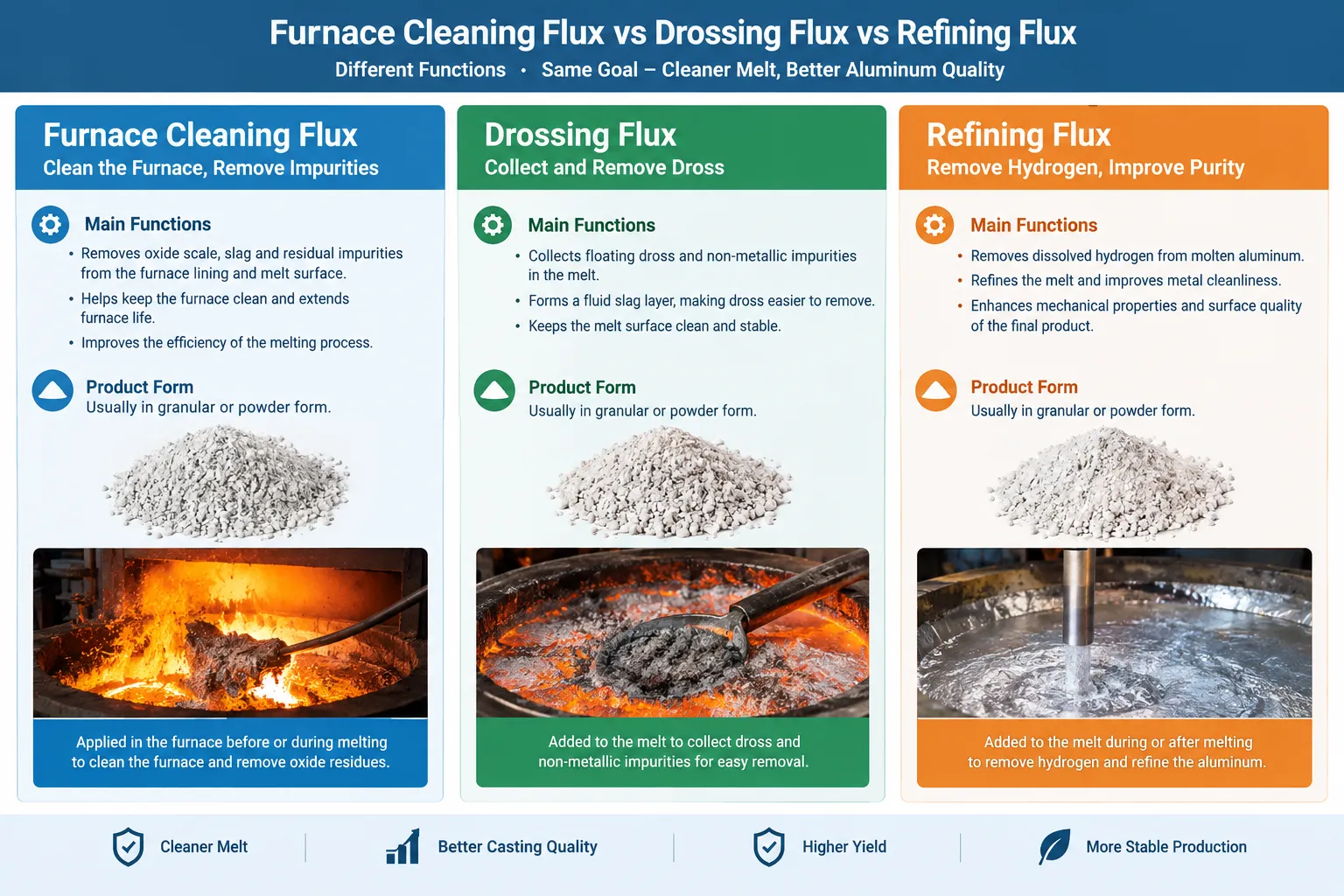
Furnace Cleaning Flux vs Drossing Flux
A drossing flux is primarily used to treat the dross layer and promote separation of metallic aluminum from oxide-rich material.
A furnace cleaning flux is intended primarily for deposits on furnace surfaces.
For example, AdTech describes its 6330DF refining/drossing product as being used for separation of aluminum dross in furnaces, with an application procedure involving spreading the product on the dross and mixing it before skimming.
That is a different operation from furnace-wall cleaning.
Practical distinction
If the problem is a large amount of floating dross, investigate a drossing or refining treatment.
If the problem is hardened or accumulated deposits on the furnace bottom or inner wall, investigate a furnace cleaning flux.
Furnace Cleaning Flux vs Refining Flux
Refining fluxes are normally selected to perform a particular metallurgical treatment of molten aluminum.
Depending on the formulation, refining products may be used for:
- Degassing-related treatment
- Inclusion removal
- Modification of melt chemistry
- Removal of certain unwanted elements
- General melt cleaning
They should not automatically be used as furnace-wall cleaners.
AdTech’s product information separates refining flux, drossing flux, furnace cleaning flux and recycling flux as different product functions.
This separation is important when preparing a purchase order.
A request such as “Please quote aluminum cleaning flux” may be too vague.
A better request would specify:
“We need a flux for removing oxide buildup from the inner wall and bottom of an aluminum holding furnace.”
That gives the supplier a much clearer technical requirement.
Furnace Cleaning Flux vs Covering Flux
Covering flux is intended primarily to protect the molten aluminum surface.
Pyrotek describes covering flux as a physical barrier against oxidation, while wall-cleaning flux is intended to remove oxide buildup.
Therefore:
- Covering flux protects.
- Drossing flux treats surface dross.
- Cleaning flux treats oxide inclusions.
- Furnace cleaning flux addresses furnace deposits.
The same foundry may use several of these products as part of its overall melt-treatment process.
When Should a Foundry Use Furnace Cleaning Flux?
There is no universal cleaning interval that applies to every aluminum furnace.
The required frequency depends on operating conditions.
Possible indicators include:
- Visible buildup on furnace walls.
- Heavy deposits on the furnace bottom.
- Increasing difficulty during mechanical cleaning.
- Significant accumulation around areas exposed to the melt.
- Changes in furnace working volume.
- Persistent oxide-related contamination concerns.
- A scheduled furnace maintenance procedure.
Some commercial furnace-wall cleaning products are designed for periodic treatment. For example, Nikkei MC Aluminium lists a furnace-wall scum removal flux intended for use at 800°C or above, with the product applied to the scum and left for several hours before removal.
This illustrates an important point:
Cleaning temperature and treatment time are product-specific.
A foundry should not copy the temperature or dwell time of another manufacturer’s product.
How Is Furnace Cleaning Flux Applied?
The exact procedure must follow the supplier’s technical documentation and the foundry’s safety procedures.
For AdTech’s STOVE390 Furnace Cleaning Flux, the published instructions specify:
- Remove the packaging.
- Pour out the aluminum liquid from the furnace and remove it.
- Spread the furnace cleaning flux onto the hot slag.
- Close the furnace door.
- Allow it to simmer for approximately 10 to 20 minutes.
- Clean the furnace afterward.
AdTech lists STOVE390 for cleaning the bottom and inner-wall deposits of melting and holding furnaces, with a stated dosage of 8–10 kg/m² and a refining temperature of 850–950°C.
These figures should be understood as product-specific specifications, not universal operating parameters for all furnace cleaning fluxes.
A simplified process
Drain or remove molten aluminum → expose the hot deposit → apply the specified cleaning flux → allow the specified reaction time → mechanically remove loosened deposits → inspect the furnace → return to normal operation according to the furnace procedure.
The actual procedure should be adapted to the furnace design and the manufacturer’s instructions.
What Temperature Is Used for Furnace Cleaning Flux?
Temperature is one of the most important specifications when selecting furnace cleaning flux.
There is no single temperature that applies to every product.
Examples from published manufacturer information demonstrate this variation.
Nikkei MC Aluminium lists a furnace-wall scum removal flux for 800°C or above.
AdTech’s STOVE390 is specified at 850–950°C.
Other aluminum fluxes used for molten-metal cleaning can operate at considerably lower temperatures. Nikkei, for example, lists several molten-metal cleaning products in ranges around 650–800°C depending on product and function.
This is why a buyer should never assume:
“All aluminum fluxes work at the same temperature.”
They do not.
Temperature factors to verify
Before purchasing, confirm:
| Parameter | Why it matters |
|---|---|
| Furnace temperature | Determines whether the flux can function correctly |
| Metal temperature | Relevant when molten metal remains in the furnace |
| Flux melting behavior | Influences chemical interaction |
| Deposit condition | Hardened deposits may require different treatment |
| Furnace construction | Determines safe application procedure |
| Alloy chemistry | May affect flux selection and residue considerations |
| Treatment time | Determines reaction and cleaning efficiency |
How Much Furnace Cleaning Flux Is Required?
The dosage depends on the product and application method.
For AdTech’s STOVE390, the published dosage is:
8–10 kg/m²
This is expressed relative to the furnace surface area rather than simply kilograms per ton of aluminum.
That distinction is important.
Some aluminum fluxes are specified as a percentage of molten metal weight, while a furnace cleaning product may instead be specified according to the area or amount of deposit being treated.
For example, Nikkei MC Aluminium lists many molten-metal fluxes using addition rates such as 0.2–0.5%, while its furnace-wall cleaning product is not given an equivalent metal-weight dosage on the published table.
Therefore, buyers should not convert one manufacturer’s dosage system into another manufacturer’s dosage without technical justification.
What to provide when requesting a quotation
A supplier can make a more meaningful recommendation if the buyer provides:
- Furnace type
- Furnace dimensions
- Approximate wall and bottom area
- Furnace capacity
- Melting or holding function
- Alloy families
- Normal operating temperature
- Deposit thickness
- Deposit appearance
- Cleaning frequency
- Current cleaning method
- Photos of the buildup, if available
Can Furnace Cleaning Flux Replace Mechanical Cleaning?
Usually, furnace cleaning flux should be viewed as a chemical cleaning aid, not automatically as a complete replacement for mechanical cleaning.
A typical treatment may loosen or react with accumulated material, after which the deposit still needs to be removed from the furnace.
This is particularly important when deposits are thick or strongly adhered.
The final procedure may involve:
chemical treatment + reaction time + mechanical removal + inspection
rather than chemical treatment alone.
The supplier’s instructions should determine the appropriate sequence.
If a deposit remains after treatment, the problem may involve:
- Excessive buildup
- Incorrect temperature
- Insufficient contact time
- Incorrect product selection
- Incorrect application method
- Deposit chemistry outside the intended range
- Furnace refractory or process issues
The correct response is diagnosis rather than simply increasing the dosage.
Read More: How to Automate Aluminum Melt Refining and Reduce Manual Furnace Operations
What Should Buyers Check Before Purchasing Furnace Cleaning Flux?
A technical quotation should contain more than a product name and price.
At minimum, buyers should request the following information.
| Purchasing item | What to verify |
|---|---|
| Product name | Exact product/model |
| Intended application | Furnace bottom, wall, ladle or molten metal |
| Applicable furnace | Melting, holding or other furnace type |
| Operating temperature | Recommended treatment range |
| Dosage | kg/m², kg/t or another defined basis |
| Physical form | Powder, granular or other form |
| Application method | Manual, broadcast, injected or other method |
| Reaction time | Recommended treatment duration |
| Alloy compatibility | Applicable alloy groups |
| Packaging | Unit weight and packaging configuration |
| Storage | Storage conditions and shelf life |
| SDS/TDS | Safety and technical documentation |
| Residue considerations | Recommended post-treatment cleaning |
| Cleaning procedure | Recommended sequence |
| Technical support | Selection and application support |
Ask one particularly important question
“Is this product designed specifically for furnace-wall and furnace-bottom deposits, or is it primarily a molten-metal cleaning/drossing flux?”
This single question can prevent a significant amount of confusion during procurement.
Common Mistakes When Using Furnace Cleaning Flux
1. Buying a generic “aluminum flux”
“Aluminum flux” is a broad category.
A supplier may offer covering flux, cleaning flux, drossing flux, refining flux, recycling flux or furnace-wall cleaning flux.
The application must be specified before selecting the product.
2. Using drossing flux to solve a furnace-wall buildup problem
Drossing flux and furnace cleaning flux have different primary functions.
A product designed to separate aluminum from surface dross should not automatically be considered a furnace-wall cleaner.
3. Copying another product’s dosage
Different products use different formulations and application methods.
For example, one product may specify kg/m² while another uses a percentage of metal weight.
Use the manufacturer’s dosage recommendation rather than applying a generic conversion.
4. Ignoring furnace temperature
A flux may be designed for a particular operating range.
Using it outside the recommended temperature can change its behavior and may reduce the effectiveness of the treatment.
5. Focusing only on price per kilogram
The purchase price of the flux is only one part of the cost.
A more useful comparison considers:
- Required dosage
- Cleaning frequency
- Reaction time
- Labor
- Furnace downtime
- Residue removal
- Metal loss
- Packaging
- Transportation
- Technical support
A lower price per kilogram does not automatically mean lower treatment cost.
6. Treating every furnace deposit as the same
The appearance of a deposit can provide useful information, but visual appearance alone is not enough to determine its chemical composition.
If a furnace develops unusually hard, thick or rapidly accumulating deposits, investigate the process conditions instead of simply increasing the amount of flux.
7. Using a furnace cleaning product without checking the complete procedure
The product temperature, contact time, application location and post-treatment cleaning procedure should be considered together.
Changing one parameter can affect the overall process.
Furnace Cleaning Flux and Overall Aluminum Melt Treatment
Furnace cleaning should not be viewed in isolation.
A typical aluminum foundry may need several different treatments throughout the production cycle.
A simplified process can look like this:
Charging and melting
↓
Covering / oxidation control
↓
Dross management
↓
Molten-metal cleaning or refining
↓
Degassing
↓
Filtration
↓
Casting
↓
Scheduled furnace cleaning
Each operation addresses a different source of contamination or process requirement.
For example, AdTech’s product range includes furnace cleaning flux alongside refining flux, drossing flux, recycling flux, ceramic foam filters, degassing equipment and other aluminum melt-treatment products.
This matters because furnace cleaning flux should not be expected to replace downstream melt treatment.
Furnace Cleaning and Filtration Are Different Operations
Furnace cleaning and molten-aluminum filtration solve different problems.
A furnace cleaning flux addresses deposits on furnace surfaces.
A ceramic foam filter is used to remove solid nonmetallic inclusions from molten aluminum as the metal passes through the filtration system.
Therefore, a foundry can potentially require both:
Furnace cleaning → maintain the furnace
and
Molten-metal filtration → improve metal cleanliness before casting
These are complementary operations rather than direct substitutes.
The same principle applies to degassing.
Hydrogen removal is a different metallurgical problem from removing furnace-wall oxide buildup. A furnace cleaning flux should not be selected as a replacement for an aluminum degassing system when hydrogen control is the actual requirement.
How to Choose the Right Furnace Cleaning Flux
A practical selection process can be reduced to six questions.
1. What needs to be cleaned?
Is the target:
- Furnace wall?
- Furnace bottom?
- Ladle lining?
- Floating dross?
- Suspended inclusions?
- Molten aluminum?
If the answer is not clear, product selection should wait.
2. What type of furnace is involved?
Provide:
- Furnace type
- Melting or holding function
- Furnace capacity
- Internal dimensions
- Heating method where relevant
3. What is the operating temperature?
Temperature should be stated in °C and should reflect the actual treatment condition.
4. What does the buildup look like?
Useful information includes:
- Approximate thickness
- Location
- Color
- Texture
- Frequency of formation
- Whether it is soft, powdery, glassy or strongly adhered
Photos can also help a supplier understand the problem, although visual inspection should not be treated as a chemical analysis.
5. How is the flux applied?
Possible methods vary by product and application.
The manufacturer should specify whether the flux is:
- Spread manually
- Applied directly to deposits
- Mixed with dross
- Injected
- Applied during a particular furnace condition
6. What documentation is available?
For industrial purchasing, request the relevant:
- Technical Data Sheet
- Safety Data Sheet
- Application instructions
- Packaging information
- Storage requirements
- Compatibility information
What Makes a Furnace Cleaning Flux Suitable for a Foundry?
There is no single specification that makes a furnace cleaning flux suitable for every foundry.
A suitable product should match the actual operating conditions.
The most important factors are:
Application → temperature → deposit → furnace → alloy → dosage → treatment time → cleaning procedure
This is more useful than comparing products only by chemical composition.
Commercial manufacturers also emphasize process variables when selecting aluminum fluxes. Pyrotek specifically identifies metal/furnace temperature, alloy chemistry and flux addition technique as selection considerations.
AdTech Furnace Cleaning Flux for Aluminum Furnaces
AdTech provides aluminum melt-treatment fluxes for different functions, including furnace cleaning.
Its published STOVE390 Furnace Cleaning Flux is specified for:
- Application: cleaning furnace bottoms and inner-wall deposits
- Equipment: melting furnaces and holding furnaces
- Dosage: 8–10 kg/m²
- Refining temperature: 850–950°C
- Application: spread the flux onto hot slag after the aluminum has been removed, then close the furnace and allow it to simmer for approximately 10–20 minutes before cleaning
These specifications come directly from AdTech’s published product information and should be treated as product-specific rather than as universal values for all furnace cleaning fluxes.
For a foundry with a different furnace design, alloy system or cleaning problem, the product should be evaluated against the actual operating conditions.
A useful quotation request should therefore include furnace dimensions, furnace type, operating temperature, deposit condition and current cleaning procedure.
Read more: Rotary Flux Injector System for Aluminum Degassing, Refining.
Furnace Cleaning Flux: A Practical Decision Guide
| Your main problem | Product category to investigate |
|---|---|
| Oxide buildup on furnace walls | Furnace cleaning / wall-cleaning flux |
| Deposits on furnace bottom | Furnace cleaning flux |
| Excess floating dross | Drossing flux |
| Aluminum trapped in dross | Recycling or dross-recovery flux |
| Oxide inclusions in molten aluminum | Cleaning/refining flux |
| Hydrogen in molten aluminum | Degassing treatment |
| Solid inclusions before casting | Ceramic foam filter or other filtration system |
| Protection of molten aluminum surface | Covering flux |
| Specific unwanted alloying element | Appropriate refining/removal flux |
The key is to identify the process problem before choosing the chemical product.
FAQ
1. What is furnace cleaning flux?
Furnace cleaning flux is a chemical flux designed to help remove oxide-rich deposits and buildup from the bottom and inner walls of aluminum melting and holding furnaces.
2. Is furnace cleaning flux the same as drossing flux?
No. Drossing flux primarily treats surface dross and promotes separation of aluminum from oxide-rich dross. Furnace cleaning flux is primarily intended for deposits accumulated on furnace surfaces.
3. What temperature is required for furnace cleaning flux?
It depends on the product. AdTech’s STOVE390 is specified for 850–950°C, while other manufacturers publish different operating ranges.
4. How much furnace cleaning flux should be used?
The dosage is product-specific. AdTech specifies 8–10 kg/m² for STOVE390. Other fluxes may use a different dosage basis, such as percentage of molten metal weight.
5. Can furnace cleaning flux remove all furnace deposits without mechanical cleaning?
Not necessarily. Furnace cleaning flux is generally used to chemically treat or loosen deposits, after which mechanical removal may still be required.
6. Can refining flux be used for furnace-wall cleaning?
Not automatically. Refining flux and furnace cleaning flux have different primary functions. The product’s technical documentation should specifically confirm suitability for furnace-wall or furnace-bottom deposits.
7. How often should an aluminum furnace be cleaned?
There is no universal interval. Cleaning frequency depends on furnace operation, alloy, oxidation, deposit formation, production schedule and furnace condition.
8. What information should I send a furnace cleaning flux supplier?
Provide the furnace type, capacity, dimensions, operating temperature, alloy types, deposit location, approximate deposit thickness, current cleaning method and photos if available.
9. Does furnace cleaning flux remove hydrogen from aluminum?
Furnace cleaning and hydrogen removal are different treatments. A furnace cleaning flux should not be considered a substitute for a dedicated aluminum degassing process when hydrogen control is required.
10. Can furnace cleaning flux replace molten aluminum filtration?
No. Furnace cleaning addresses deposits on furnace surfaces, while filtration is used to remove solid nonmetallic inclusions from molten aluminum. They address different process problems.
Final Takeaway
Furnace cleaning flux is a specialized aluminum foundry treatment intended primarily to help remove oxide-rich deposits from furnace walls and bottoms. It should not be treated as a generic substitute for drossing flux, refining flux, covering flux or molten-metal cleaning flux.
For procurement, the most important information is not simply the product name. Buyers should confirm the target deposit, furnace type, operating temperature, dosage basis, application method, treatment time, alloy compatibility and post-treatment cleaning procedure.
For AdTech’s STOVE390, the published specification identifies furnace-bottom and inner-wall cleaning in melting and holding furnaces, with a dosage of 8–10 kg/m² and a stated treatment temperature of 850–950°C.
The broader industry literature supports treating furnace-wall cleaning as a distinct function within aluminum fluxing practice. ASM International separates furnace wall cleaners from cover, drossing and cleaning fluxes, while manufacturers such as Pyrotek and Nikkei MC Aluminium publish different product categories and operating conditions for different melt-treatment purposes.
The safest purchasing approach is therefore:
Define the deposit → define the furnace → confirm temperature → specify the cleaning objective → compare application procedures → verify TDS/SDS → then compare quotations.