

La elección del filtro de espuma cerámica con el PPI adecuado depende, en primer lugar, del metal que se vaya a filtrar, del tamaño y tipo de inclusiones que deban eliminarse, de la pureza de la aleación, de la temperatura de colada, del caudal requerido, del peso de la pieza fundida, de las dimensiones del filtro y del proceso de fundición. En la práctica, un filtro de espuma cerámica con un PPI más bajo tiene poros más grandes y suele ofrecer una mayor capacidad de flujo de metal con menor riesgo de obstrucción, mientras que un filtro con un PPI más alto tiene poros más pequeños y puede capturar inclusiones más finas, pero crea una mayor resistencia al flujo del metal fundido. Por lo tanto, no existe un PPI universalmente “óptimo”. Normalmente seleccionamos la estructura de poros más gruesa que permita alcanzar de forma constante la limpieza de fundición requerida y, a continuación, confirmamos esa elección mediante cálculos de capacidad de flujo y ensayos controlados en la fundición. Los grados comerciales habituales incluyen 10, 20, 30, 40, 50 y 60 PPI, aunque las especificaciones disponibles varían según la composición cerámica y el fabricante. Para muchas aplicaciones, los valores de entre 10 y 30 PPI se asocian a la filtración de hierro y acero, mientras que la filtración de aleaciones de aluminio suele utilizar valores de entre 20 y 60 PPI aproximadamente. Estos rangos son puntos de partida más que reglas de ingeniería fijas.
En AdTech, consideramos que la selección del PPI es una decisión relacionada con el sistema de filtración, más que una mera decisión de compra de un filtro. El PPI nos indica el número nominal de poros por pulgada lineal, pero no define por sí solo la eficiencia de filtración, la permeabilidad, el tamaño de la ventana porosa, la resistencia al choque térmico ni la capacidad de retención de metales. Dos filtros marcados como “30 PPI” pueden comportarse de forma diferente debido a que difieren en la composición química de la cerámica, la morfología de la espuma, el espesor del recubrimiento, la porosidad abierta, la distribución de los poros y la uniformidad de fabricación. Por lo tanto, los ingenieros y los compradores deben evaluar el PPI junto con el material del filtro, la superficie filtrante, el espesor, el proceso de moldeo y los parámetros de calidad cuantificables.
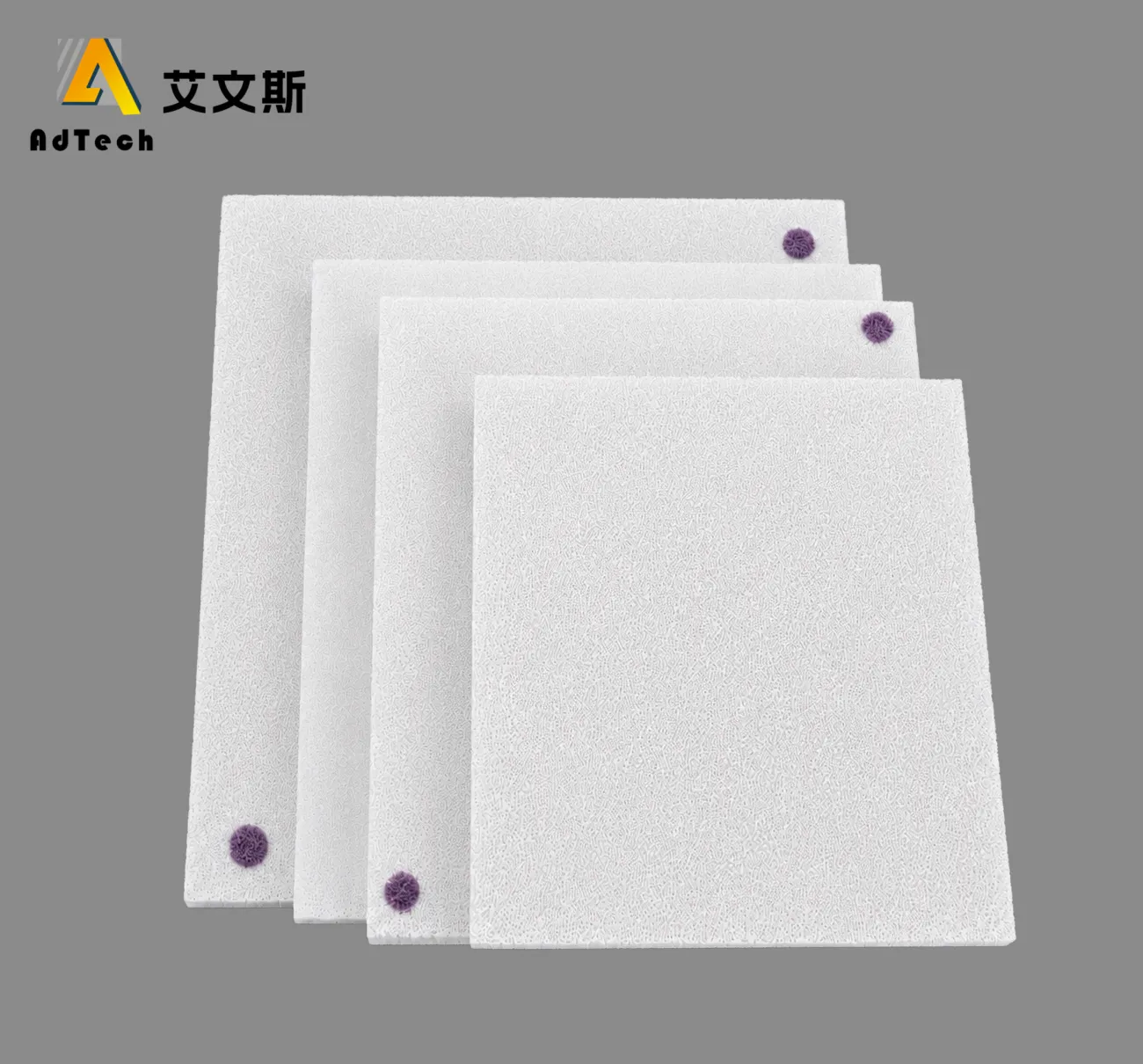
¿Qué significa «PPI» en un filtro de espuma cerámica?
PPI significa “poros por pulgada”. Es una descripción muy utilizada para referirse a la estructura celular de la espuma cerámica reticulada.
Una espuma de 10 PPI presenta una estructura celular relativamente gruesa. A 30 PPI El producto presenta una estructura más fina, mientras que un PPI de 50 o 60 corresponde a un grado nominal de porosidad aún más fino. Al aumentar el PPI, por lo general se reducen las dimensiones características de las ventanas de poros y se incrementa la superficie interna disponible para interactuar con las inclusiones.
Esto parece sencillo, pero el PPI no debe interpretarse como el tamaño exacto de una malla.
Los filtros de espuma cerámica son estructuras reticuladas tridimensionales, en lugar de mallas tejidas con aberturas cuadradas uniformes. Los poros y las aberturas varían en forma y diámetro. El metal fundido circula a través de conductos sinuosos interconectados y, por lo tanto, la filtración depende de varios mecanismos, en lugar de un simple tamizado mecánico.
Esta distinción es importante a la hora de comparar proveedores.
Un pliego de condiciones de compra en el que solo se especifique “filtro de espuma cerámica de 30 PPI” deja sin definir varias propiedades importantes. La densidad, la porosidad abierta, la permeabilidad, la composición cerámica y las tolerancias dimensionales pueden afectar al rendimiento de la colada.
¿Un PPI más alto significa que el filtro es mejor?
No automáticamente.
Un PPI más alto suele indicar una estructura celular nominal más fina. Esto no significa que todos los procesos de fundición se beneficien de elegir el valor más alto disponible.
Pasar a una estructura más detallada puede:
- aumentar la probabilidad de retener inclusiones no metálicas de menor tamaño.
- aumentar el contacto entre el metal fundido y la red cerámica interna.
- aumentar la pérdida de presión.
- reducir la capacidad de caudal disponible.
- aumentar la sensibilidad a los metales muy contaminados.
- aumentar el riesgo de obstrucción prematura.
- exigen un mejor control de la temperatura y del sistema de inyección.
Por lo tanto, un filtro de grano grueso puede ofrecer mejores resultados que uno de grano más fino cuando este último dificulta el llenado y provoca defectos de fundición.
El objetivo de ingeniería no es alcanzar el máximo PPI. Se trata de lograr un nivel de limpieza adecuado, junto con un llenado del molde estable y repetible.
¿Qué filtro de espuma cerámica PPI debo utilizar para los distintos metales?
Los siguientes valores constituyen unos rangos preliminares útiles. No deben sustituir a la validación realizada con la aleación real, la geometría del filtro y las condiciones de fundición.
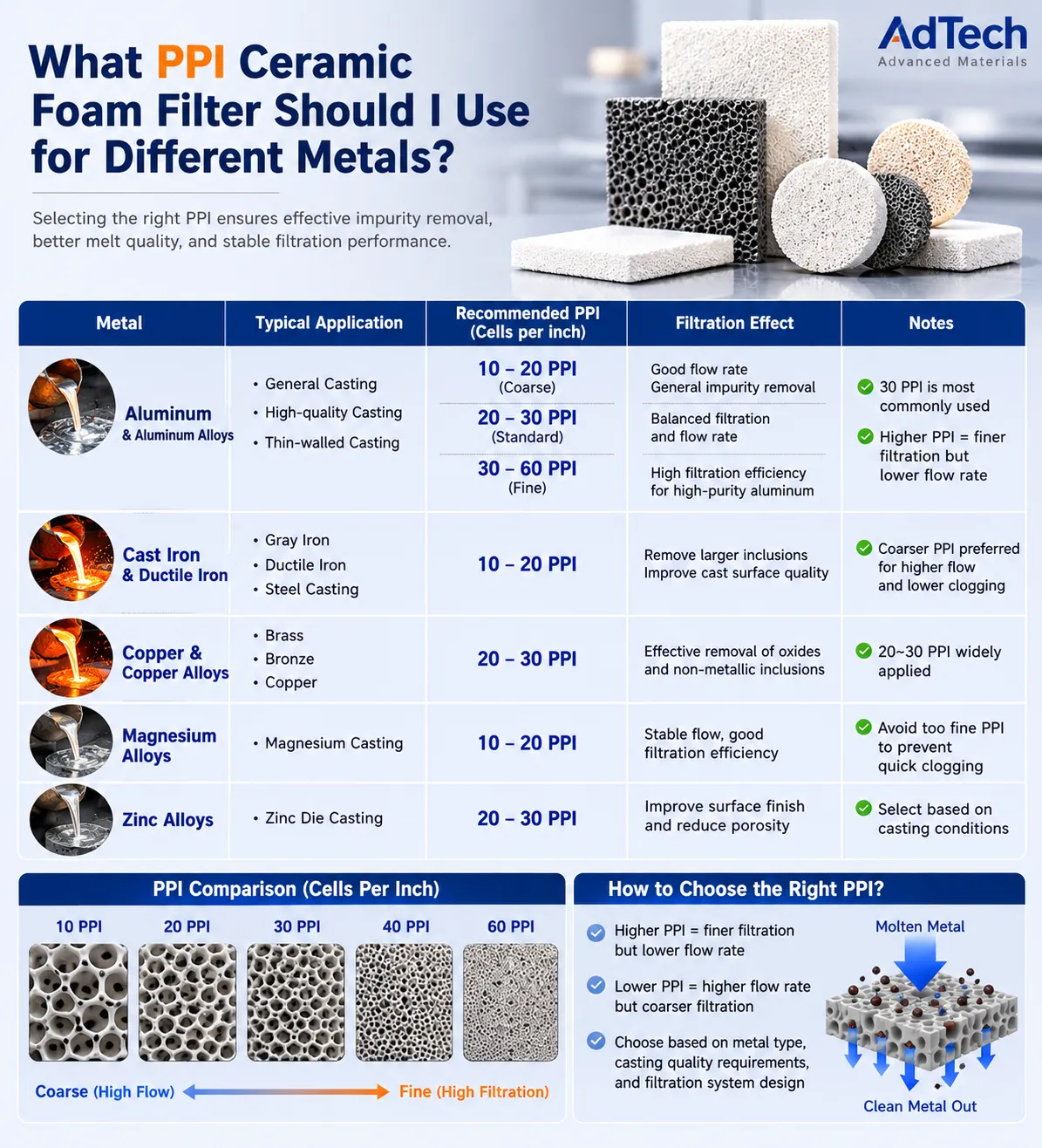
| Metal fundido/aplicación | Rango habitual de dosis iniciales de los inhibidores de la bomba de protones (IBP) | Problema habitual en la selección |
|---|---|---|
| Aleaciones de aluminio | De 20 a 60 PPI | películas de óxido, inclusiones, estabilidad del flujo |
| Fundición de aluminio, uso general | 20 a 40 PPI | equilibrio entre la limpieza y el rendimiento |
| Aluminio de alta pureza | 30 a 60 PPI | mayor reducción de las inclusiones finas |
| Cobre y aleaciones de cobre | 10 a 30 PPI | temperatura, eliminación de óxidos, caudal |
| Hierro dúctil | 10 a 30 PPI | escoria, productos de reacción, capacidad |
| Hierro gris | 10 a 30 PPI | eliminación de escoria y llenado fiable del molde |
| Acero fundido | 10 a 30 PPI | carga térmica, capacidad de caudal, estabilidad refractaria |
| Níquel/aleaciones de alta temperatura | Depende de la aplicación | Compatibilidad con la cerámica y resistencia térmica |
Estos valores son, a propósito, rangos y no recomendaciones estrictas. A Filtro de 20 PPI Lo que funciona eficazmente en una línea de fundición de aluminio puede no proporcionar la limpieza suficiente en otra. Del mismo modo, cambiar un proceso de fundición de hierro que funciona bien de 10 PPI a 30 PPI sin ajustar el tamaño del filtro puede afectar negativamente al llenado.
En primer lugar, identificamos el problema metalúrgico y, solo entonces, concretamos las especificaciones de los poros.
¿Cómo se debe seleccionar el PPI en función del tamaño de la inclusión?
Una suposición habitual es que los poros de la espuma cerámica deben ser más pequeños que la inclusión que se desea eliminar. Ese modelo describe bastante bien la filtración por tamiz, pero no refleja plenamente la filtración mediante espuma cerámica.
La espuma cerámica puede retener inclusiones gracias a varios efectos que interactúan entre sí:
- Las partículas de gran tamaño pueden ser interceptadas mecánicamente en la superficie del filtro o cerca de ella.
- Las partículas más pequeñas pueden chocar contra los puntales cerámicos al desplazarse por conductos sinuosos.
- Los aglomerados de inclusiones pueden quedar atrapados en el interior del cuerpo del filtro.
- Las partículas depositadas pueden alterar el comportamiento de la filtración posterior.
- Los cambios en el flujo del metal fundido pueden reducir el transporte de escoria y aglomerados de óxidos hacia aguas abajo.
Por consiguiente, la relación entre el “tamaño de las partículas” y el “tamaño de los poros” no es de uno a uno.
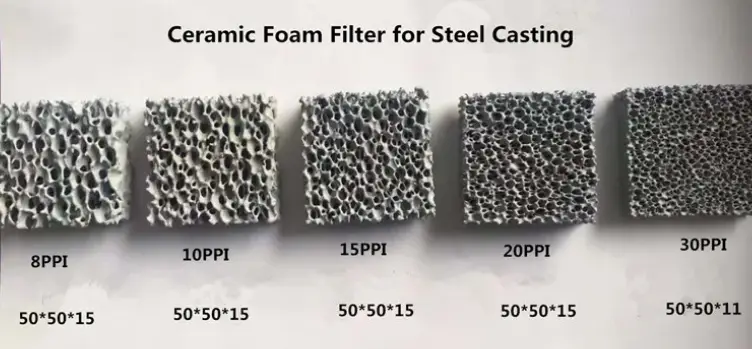
¿Por qué es importante la filtración en profundidad?
Un filtro de espuma cerámica tiene una superficie interna tridimensional considerable.
A diferencia de lo que ocurre con una malla fina, el metal fundido no se limita a atravesar un único plano. Se desplaza a través de una red de ligamentos cerámicos. Esto hace que las inclusiones en suspensión tengan repetidas oportunidades de entrar en contacto con una superficie o con material capturado anteriormente.
Esta es una de las razones por las que el PPI por sí solo no puede predecir con precisión la eficiencia de la inclusión y la eliminación.
En el caso de programas que exigen una alta calidad, los ingenieros deben evaluar la limpieza real del metal en las fases posteriores del proceso. En función de la aleación y de las instalaciones, entre las técnicas útiles pueden figurar la metalografía, el examen de fracturas, el análisis de tipo PoDFA, los métodos de tipo LiMCA, la inspección por ultrasonidos, la inspección por rayos X o los datos cuantitativos sobre rechazos de fundición.
La técnica de medición debe ajustarse a la cuestión metalúrgica que se esté investigando.
¿Cómo influye el PPI en el caudal del metal fundido?
El aumento del PPI tiende a incrementar la resistencia al flujo del metal líquido, ya que los conductos de flujo se vuelven más estrechos y sinuosos. El grosor del filtro, la porosidad abierta, la estructura cerámica y la carga de inclusiones influyen además en dicha resistencia.
El filtro debe dejar pasar suficiente metal antes de que se supere el límite de tiempo de llenado de la pieza fundida.
Esto hace que la capacidad de caudal sea uno de los parámetros clave a la hora de dimensionar un filtro.
Supongamos que dos filtros tienen las mismas dimensiones y el mismo grosor:
| Propiedad | Filtro PPI inferior | Filtro PPI superior |
|---|---|---|
| Estructura celular nominal | Más grueso | Más fino |
| Pasajes característicos | Más grande | Más pequeño |
| Resistencia al flujo con el filtro limpio | Normalmente inferior | Normalmente más alto |
| Potencial de interceptación de inclusiones finas | En general, más bajo | Más alto en general |
| Resistencia a la obstrucción | Normalmente más alto | Normalmente inferior |
| Capacidad potencial de procesamiento de metal | Normalmente más alto | Normalmente inferior |
| Sensibilidad a bajas temperaturas de vertido | En general, más bajo | Más alto en general |
Las palabras “normalmente” y “en general” son importantes. El PPI no es la única variable que influye en la permeabilidad.
¿Por qué dos filtros de 30 PPI pueden tener caudales diferentes?
Consideremos dos filtros de 30 PPI adquiridos en fábricas diferentes.
Ambas cajas llevan el mismo marcado PPI, pero uno de los productos puede presentar puntales cerámicos gruesos, ventanas de poros parcialmente cerradas y una porosidad abierta menor. El otro puede presentar una estructura reticulada más uniforme y una mayor permeabilidad.
Por lo tanto, su comportamiento en cuanto al caudal de líquido medido puede variar considerablemente.
Durante la evaluación de proveedores, recomendamos no limitarse al grado nominal de porosidad y preguntar por:
- porosidad abierta
- permeabilidad o datos de caudal validados
- densidad aparente
- espesor del filtro
- tolerancia dimensional
- uniformidad de los poros
- poros obstruidos o cerrados
- resistencia a la compresión
- comportamiento ante los choques térmicos
- composición cerámica
- coherencia entre lotes
Esa distinción cobra especial importancia a la hora de sustituir a un proveedor consolidado. Que el “PPI sea el mismo” no significa necesariamente que el “rendimiento de la fundición sea el mismo”.”
Más información: Cómo elegir el EPI adecuado para la filtración de fundiciones de aluminio en 2026
¿Qué PPI es adecuado para la fundición de aluminio?
En la filtración del aluminio se suele utilizar espuma cerámica relativamente fina, ya que el aluminio fundido puede contener películas de óxido, partículas de óxido, compuestos intermetálicos y otros contaminantes no metálicos.
Entre los valores nominales más habituales se encuentran 20, 30, 40, 50 y 60 PPI.
Un marco de selección inicial útil es el siguiente:
| Condiciones de fundición del aluminio | Índice de precios al productor que merece la pena evaluar | Objetivo principal |
|---|---|---|
| Alta carga de inclusión / alto rendimiento | De 20 a 30 | mayor capacidad y menos atascos |
| Filtración general en fundición | De 30 a 40 | limpieza/equilibrio de flujo |
| Requisitos de limpieza más estrictos | De 40 a 50 | filtración más fina |
| Aplicación muy exigente | De 50 a 60 | alto nivel de limpieza, sujeto a validación del proceso |
Estas cifras no son especificaciones universales.
Un filtro de alta calidad de 30 PPI, combinado con un tratamiento riguroso de la masa fundida, puede ofrecer mejores resultados que un filtro de 50 PPI instalado en un proceso mal controlado.
¿Por qué se suelen utilizar filtros de espuma cerámica de alúmina con el aluminio?
Los productos de espuma cerámica a base de alúmina se asocian ampliamente con la filtración de aluminio y aleaciones de aluminio debido a su comportamiento refractario y a su idoneidad para el contacto con el material fundido, siempre que se fabriquen y utilicen correctamente.
La composición exacta del filtro sigue mereciendo atención. Los filtros comerciales de “alúmina” pueden presentar diferencias en cuanto a su formulación, sistema aglutinante y propiedades físicas.
Por lo tanto, la selección debería incluir tanto la química de los PPI como la de la cerámica.
¿Qué es mejor para el aluminio: 30 PPI o 40 PPI?
Ninguno de los dos números es intrínsecamente mejor.
Puede ser preferible utilizar un grado de 30 PPI cuando:
- El proceso de fundición requiere un caudal relativamente elevado.
- el material fundido entrante presenta una mayor carga de inclusiones.
- El margen de temperatura de vertido es limitado.
- No es fácil aumentar la superficie de filtrado.
Se puede considerar un grado de 40 PPI cuando:
- Hay que mejorar la limpieza en las fases posteriores del proceso.
- La superficie de filtrado disponible ofrece una capacidad suficiente.
- La calidad de la masa fundida está razonablemente controlada.
- los requisitos relativos al tiempo de llenado siguen siendo factibles.
Normalmente, durante las pruebas de producción solo modificamos una variable principal cada vez. Si se modifican simultáneamente el PPI, las dimensiones del filtro, la geometría de la entrada y el tratamiento de la masa fundida, resulta difícil identificar la causa de cualquier mejora.
¿Qué PPI se utiliza para la fundición de hierro y acero?
La filtración del hierro y el acero crea un entorno térmico y metalúrgico diferente al de la filtración del aluminio. Las temperaturas más elevadas del metal fundido hacen que la estabilidad de los refractarios y su comportamiento ante los choques térmicos sean especialmente importantes.
Los grados más gruesos, que suelen oscilar entre 10 y 30 PPI, son puntos de partida habituales.
La filtración de hierro puede estar destinada a eliminar escorias, residuos, restos de materiales refractarios, productos de reacción y otros materiales no metálicos no deseados. La filtración de acero impone requisitos térmicos especialmente exigentes a la cerámica.
¿Por qué se utiliza la circonia en la filtración de metales a alta temperatura?
Los filtros de espuma cerámica a base de circonio se utilizan habitualmente en aplicaciones con acero y otras aplicaciones en las que se alcanzan temperaturas muy elevadas, ya que las formulaciones adecuadas de circonio ofrecen resistencia a altas temperaturas y estabilidad química.
Los filtros de espuma cerámica de carburo de silicio se utilizan ampliamente en fundiciones de hierro y en algunas fundiciones de metales no ferrosos.
La relación general se puede resumir de la siguiente manera:
| Familia de filtros cerámicos | Asociación de solicitudes comunes | Factor de selección importante |
|---|---|---|
| Alúmina | Procesamiento del aluminio y de metales no ferrosos | limpieza y fluidez |
| Carburo de silicio | Aplicaciones en hierro fundido y en determinados metales no ferrosos | comportamiento térmico y resistencia mecánica |
| Zirconia | Acero/fundición a alta temperatura | estabilidad refractaria a temperaturas extremas |
La idoneidad real debe confirmarse consultando las especificaciones del producto del proveedor. Los nombres de las cerámicas por sí solos no bastan para determinar la compatibilidad con todas las aleaciones.
¿Cómo se relacionan entre sí el tamaño del filtro y el PPI?
Este es uno de los aspectos más importantes que se pasan por alto cuando el PPI se considera un parámetro de compra aislado.
Un filtro debe cumplir dos funciones:
- eliminar o reducir las inclusiones específicas.
- introducir la cantidad necesaria de metal en el tiempo de llenado disponible.
Un filtro más fino con una superficie de contacto insuficiente puede suponer una grave limitación.
Calcula primero el caudal de metal necesario
Si un molde requiere que entre una masa metálica M en un tiempo de llenado t, el caudal másico medio necesario es:
Qm = M / t
donde:
Qm = caudal másico requerido.
M = masa de metal fundido que atraviesa el filtro.
t = tiempo de llenado necesario.
Si el flujo másico admisible validado del filtro seleccionado en condiciones comparables es G, una relación preliminar simplificada con respecto al área de la superficie es:
A = Qm / G
donde:
A = superficie efectiva de filtrado necesaria
G = caudal másico admisible por unidad de superficie de filtro
Por lo tanto, suele ser necesario prever un margen de diseño, ya que un filtro real acumula impurezas y no se mantiene en su estado inicial de limpieza.
El flujo permitido debe basarse en datos validados aplicables al tipo de filtro, la aleación, la temperatura y el proceso. No se debe considerar un valor genérico encontrado en Internet como una constante de diseño.
¿Qué es la carga del filtro?
La carga del filtro es otro concepto práctico y puede expresarse en términos como el número total de kilogramos de metal fundido por unidad de superficie del filtro.
Si se hace pasar una cantidad excesiva de metal contaminado a través de un filtro de tamaño insuficiente, el material retenido va reduciendo progresivamente la capacidad de caudal. La caída de presión aumenta y es posible que la última parte del vertido se llene de forma diferente a la primera.
Por eso, limitarse a comprar un filtro más fino sin tener en cuenta la superficie puede solucionar un problema, pero generar otro.
¿Cómo influye la temperatura de vertido en el PPI correcto?
La temperatura del metal fundido influye en su fluidez y, por lo tanto, influye considerablemente en la permeabilidad del filtro.
Un proceso que se desarrolla cerca del límite inferior aceptable de la temperatura de vertido tiene menos tolerancia a las restricciones de flujo innecesarias. Además, durante el llenado se transfiere calor al filtro cerámico.
Un filtro más fino puede requerir un control más minucioso de:
- temperatura de vertido
- tiempo de transferencia
- prácticas de servicio con cucharón
- ubicación del filtro
- dimensiones del filtro
- diseño de la compuerta
- tiempo de llenado del molde
La solución no consiste simplemente en aumentar la temperatura de colada cada vez que un filtro provoca una restricción. Una temperatura excesiva puede provocar otros problemas metalúrgicos y de proceso. La temperatura debe mantenerse dentro del rango de proceso homologado para la aleación y la pieza fundida.
La elección del filtro debe adaptarse al proceso, sin imponer una práctica de vertido que, de otro modo, resultaría indeseable.
¿Qué ocurre si el PPI del filtro de espuma cerámica es demasiado alto?
Un PPI innecesariamente alto puede aumentar la resistencia hidráulica y reducir el margen de seguridad frente a posibles obstrucciones.
Entre los posibles síntomas se incluyen:
- un llenado del molde más prolongado.
- flujo de metal interrumpido o inestable.
- relleno incompleto.
- cierres en frío o fallos de funcionamiento.
- obstrucción prematura del filtro.
- una mayor dependencia de la temperatura de vertido.
- rendimiento irregular en el colado entre cada vertido.
Por lo tanto, encontrar inclusiones en una pieza fundida no significa automáticamente que haya que “utilizar un PPI más alto”.”
La causa principal podría ser, en cambio, una superficie de filtrado insuficiente, un desvío del filtro, una contaminación excesiva del material fundido, un mal desnatado, turbulencias tras la filtración, daños en el filtro, una colocación incorrecta o una reoxidación posterior.
¿Qué ocurre si el PPI es demasiado bajo?
Utilizar un grano demasiado grueso conlleva sus propios riesgos.
Un filtro con un PPI bajo puede ofrecer un buen caudal, pero es posible que su rendimiento de filtración resulte insuficiente en relación con los requisitos de limpieza. Es posible que los materiales finos no metálicos o los aglomerados de inclusiones más pequeños no se retengan con la misma eficacia.
Esto puede manifestarse de las siguientes formas:
- rechazos relacionados con la inclusión.
- superficies mecanizadas de menor calidad.
- menor uniformidad en las propiedades mecánicas.
- fugas en componentes a prueba de presión.
- fallos en las inspecciones.
- disminución del rendimiento en las fases posteriores del proceso.
El punto óptimo se encuentra entre una filtración insuficiente y una restricción excesiva.
¿El tamaño de los poros es lo mismo que el PPI?
No.
Este aspecto merece una atención especial en las especificaciones de compra.
El PPI es un recuento nominal relacionado con la frecuencia de las celdas de espuma. Las dimensiones de los poros de una cerámica reticulada se distribuyen en un intervalo, en lugar de tener un diámetro preciso.
Por lo tanto, afirmaciones como “30 PPI equivalen exactamente a X milímetros” deben tomarse con cautela, a menos que el fabricante haya facilitado una definición basada en mediciones y un método de ensayo.
Los distintos procesos de producción pueden dar lugar a estructuras notablemente diferentes, incluso con el mismo PPI nominal.
¿Qué características deben incluir las especificaciones de un PPI?
En el caso de aplicaciones críticas, una especificación técnica puede incluir:
| Parámetro | Por qué es importante |
|---|---|
| IPP nominal | Calidad básica de espuma |
| Dimensiones del filtro | Controla la instalación y la superficie visible disponible |
| Espesor | Influye en el volumen y la resistencia de la filtración |
| Composición cerámica | Determina la idoneidad metalúrgica y térmica |
| Porosidad abierta | Influye en la permeabilidad |
| Densidad aparente/volumétrica | Indica coherencia estructural |
| Fuerza | Importante para la integridad del transporte y el servicio |
| Resistencia al choque térmico | Importante durante el contacto con metal fundido |
| Tolerancia dimensional | Evita problemas de instalación y de derivación |
| Uniformidad de los poros | Ayuda a mantener un caudal constante |
| Condiciones máximas de funcionamiento | Facilita la homologación de aplicaciones |
| Criterios de control de calidad | Mejora la repetibilidad entre lotes |
Los equipos de compras pueden tener en cuenta estas características a la hora de comparar técnicamente las ofertas, en lugar de evaluar únicamente el precio por filtro.
¿Cómo deben elegir los ingenieros el PPI paso a paso?
Nuestro método de trabajo parte del riesgo de defectos de fundición y culmina con las pruebas de producción. No consiste en elegir el mayor número de poros que figure en un catálogo.
Una secuencia de selección práctica es:
- Identifica la aleación y el intervalo real de temperatura de colada. Esto determina las familias de cerámicas que pueden considerarse de forma razonable.
- Define el objetivo de limpieza. Determina qué inclusiones o defectos de fundición deben reducirse y cómo se medirá el éxito.
- Caracterizar la calidad del material fundido entrante. Una carga elevada de inclusiones puede alterar drásticamente la capacidad de un filtro fino.
- Determina el peso de la colada y el tiempo de llenado necesario. Estos valores proporcionan el caudal medio de metal requerido.
- Define las dimensiones de filtrado disponibles. Se deben evaluar conjuntamente la superficie de la cara, el espesor y la geometría de instalación.
- Selecciona un rango preliminar de PPI. Basate en la experiencia con aleaciones, el historial de procesos existente y los datos de ensayo de los proveedores, en lugar de recurrir a una tabla de consulta universal.
- Comprueba el caudal y la capacidad. Asegúrate de que el filtro propuesto pueda procesar la masa de metal requerida con un margen técnico adecuado.
- Realiza ensayos de producción controlados. Compara la calidad de la filtración, el llenado del molde, los defectos de fundición y la estabilidad del proceso.
- Revisa los filtros usados cuando sea necesario. La inspección puede revelar el comportamiento de retención, una acumulación local o una obstrucción inesperada.
- Fijar la especificación técnica completa. Registrar más datos que los del PPI para que en las entregas posteriores se reproduzca el filtro homologado.
Este enfoque contribuye a salvar la brecha entre la terminología de laboratorio y el rendimiento diario de la fundición.
¿Cómo podemos validar un nuevo fármaco en fase de desarrollo (PPI) en un ensayo clínico de fase III?
Para que un ensayo sea útil, es necesario contar con una referencia objetiva.
Antes de cambiar un filtro, anota los parámetros de rendimiento del proceso actual. Entre ellos pueden figurar la tasa de rechazo, el recuento de inclusiones, la temperatura de colada, el peso de la pieza fundida, el tiempo de llenado, las propiedades mecánicas, los resultados de los rayos X, los defectos de mecanizado y los resultados de las pruebas de fugas de presión.
A continuación, introduce el filtro candidato manteniendo los demás parámetros influyentes lo más constantes posible, dentro de lo razonable.
Una comparación de prueba podría tener este aspecto:
| Medición | Filtro de corriente | Filtro de candidatos | Objetivo |
|---|---|---|---|
| PPI | 20 | 30 | Definido por ensayo |
| Área de la cara del filtro | Grabado | Grabado | Capacidad adecuada |
| Temperatura de vertido | Grabado | Controlado | Ventana de proceso |
| Tiempo de llenado | Grabado | Grabado | Dentro del límite |
| Rechazos relacionados con la inclusión | Línea de base | Medido | Baja |
| Defectos de impresión/cortacargas en frío | Línea de base | Medido | Sin aumento |
| Rotura del filtro | Línea de base | Medido | Especificación: cero/aceptable |
| Rendimiento global de la fundición | Línea de base | Medido | Mejorado o mantenido |
Un vertido satisfactorio es una prueba poco concluyente. Es más importante que se pueda repetir el proceso a pesar de las variaciones normales del mismo.
También tenemos en cuenta las condiciones límite. Un candidato que solo ofrece un buen rendimiento a la temperatura de vertido más alta, pero que falla cerca del límite inferior normal, presenta poca robustez del proceso.
¿Puede un PPI más alto compensar la presencia de impurezas en el metal fundido?
Solo hasta cierto punto, y confiar en el filtro de esta manera supone un control deficiente del proceso.
Un filtro forma parte de un sistema más amplio de control de calidad del metal fundido. Una contaminación excesiva agota la capacidad del filtro y aumenta la caída de presión.
En el caso del procesamiento del aluminio, las prácticas previas pueden incluir la limpieza adecuada de los hornos, la aplicación de fundente cuando sea necesario, la desgasificación, la sedimentación y el trasvase cuidadoso. Las operaciones relacionadas con el hierro y el acero cuentan con sus propios procedimientos de gestión de escorias y de manipulación de la masa fundida.
El tratamiento exacto depende de la aleación y de las instalaciones, pero la jerarquía general de ingeniería sigue siendo útil:
Reducir la contaminación en las fases iniciales, evitar generar nueva contaminación durante el trasvase y, a continuación, utilizar la filtración para controlar el material que queda.
Un PPI más riguroso no debe sustituir a las normas básicas de control de la calidad de la masa fundida.
¿Cómo influye el diseño de las rejillas en la elección de los filtros de espuma cerámica?
El filtro y el sistema de control de paso interactúan hidráulicamente.
Un filtro de espuma cerámica correctamente colocado puede ayudar a regular el flujo del metal, pero la geometría aguas abajo sigue siendo importante. Las expansiones repentinas, los cambios bruscos de dirección, las velocidades excesivas, las corrientes en caída libre y las entradas mal diseñadas pueden generar turbulencias indeseables.
La filtración no puede evitar todos los defectos de inclusión que se produzcan una vez que el metal sale del filtro.
Este eficaz sistema incluye:
cuenca de vertido o copa → canal de colada → canal principal → ubicación del filtro → canal secundario → entradas de colada → cavidad del molde
Es necesario tener en cuenta todo el recorrido del flujo.
¿Debería el filtro controlar todo el sistema de activación?
Un filtro suele introducir una restricción deliberada, pero diseñar todo un sistema en torno a una restricción arbitraria impuesta por el filtro puede acarrear problemas.
Los ingenieros deben comparar el área del estrangulador, el área efectiva del filtro, la altura de vertido y los requisitos de tiempo de llenado. La simulación puede resultar útil en piezas de fundición costosas o técnicamente exigentes, sobre todo cuando la distribución del flujo es compleja.
Los ensayos físicos siguen siendo importantes porque los modelos numéricos se basan en supuestos relativos a la permeabilidad, las condiciones de contorno y las propiedades del material fundido.
¿Influye el grosor del filtro de espuma cerámica en la elección del PPI?
Sí.
El PPI describe el grado celular, pero no la distancia que el metal debe recorrer a través de esa estructura.
A un mismo PPI nominal, el aumento del espesor modifica el volumen de filtración interno y también puede afectar a la resistencia al flujo. Por lo tanto, el espesor debe figurar en las especificaciones del filtro.
Una afirmación como “actualmente utilizamos 30 PPI” es incompleta.
Una descripción más significativa desde el punto de vista técnico podría incluir el tipo de cerámica, el PPI nominal, la longitud, la anchura, el espesor, la tolerancia de fabricación y los datos verificados de permeabilidad o capacidad.
Este nivel de detalle resulta especialmente valioso a la hora de evaluar a proveedores alternativos.
¿Cómo puedo comparar proveedores de filtros de espuma cerámica?
El precio debe evaluarse una vez que se haya determinado la equivalencia técnica.
En la producción a gran escala, las pequeñas diferencias en el coste de los filtros pueden parecer importantes. Sin embargo, un rechazo en el mecanizado debido a la presencia de impurezas puede costar mucho más que el propio filtro.
Damos prioridad a la rentabilidad global del proceso:
Coste total de la filtración = coste de adquisición de los filtros + costes de manipulación + desechos relacionados con los filtros + desechos relacionados con las impurezas + costes de inspección y reelaboración posteriores + costes derivados de la inestabilidad de la producción
Por lo tanto, es posible que el precio unitario más barato no suponga el coste más bajo por pieza fundida aceptada.
¿Qué deberían preguntar los equipos de compras a un proveedor?
Entre las preguntas útiles que se pueden plantear al proveedor se incluyen la composición cerámica, los grados de PPI disponibles, las tolerancias dimensionales, las especificaciones de las propiedades físicas, los métodos de inspección durante la producción, la trazabilidad de los lotes, el método de embalaje, el rango de temperaturas recomendado y la documentación que acredite el caudal y la capacidad específicos para cada aplicación.
Solicitar una muestra no equivale a homologar a un proveedor.
Las muestras deben someterse a una inspección de recepción y a una evaluación controlada de la producción antes de su aprobación comercial. Siempre que sea posible, se conservarán muestras de referencia o registros de inspección del material aprobado.
¿Qué problemas de calidad pueden hacer que un PPI adecuado funcione mal?
Un número seleccionado correctamente y impreso en una caja de cartón no puede compensar una fabricación irregular de los filtros.
Entre los posibles problemas relacionados con la calidad de los filtros se incluyen:
- estructura celular no uniforme.
- ventanas excesivamente obstruidas.
- grietas
- partículas de cerámica sueltas.
- bordes dañados.
- deformación.
- variación dimensional.
- recubrimiento irregular.
- resistencia insuficiente.
- mal comportamiento ante los choques térmicos.
- contaminación introducida durante el almacenamiento o la manipulación.
El embalaje también merece especial atención. La espuma cerámica es porosa y, por su propia naturaleza, requiere una manipulación cuidadosa. Los daños en los bordes que se produzcan durante el transporte pueden afectar a la instalación y, potencialmente, crear vías de derivación.
Los filtros deben guardarse limpios y secos, siguiendo las recomendaciones del fabricante.
¿Por qué el bypass del filtro es a veces más importante que el PPI?
Supongamos que una fundición pasa de 20 PPI a 40 PPI, pero deja un espacio mal controlado alrededor del filtro.
Es posible que parte del metal fundido siga la ruta de menor resistencia rodeando el filtro, en lugar de atravesar su cuerpo poroso. En ese caso, el grado nominal de porosidad tiene poca relevancia para la parte que se ha desviado.
Por lo tanto, es fundamental sentarse correctamente.
Comprueba:
- Dimensiones de la bolsa filtrante.
- ajuste al borde.
- diseño de la junta o del sellado, cuando proceda.
- tolerancias dimensionales.
- orientación del filtro.
- rotura durante la colocación.
- movimiento durante el vertido.
Cuando un ensayo de filtración arroja resultados inesperadamente deficientes, conviene examinar estos aspectos mecánicos básicos antes de dar por sentado que el PPI es incorrecto.
¿Cómo pueden los filtros de espuma cerámica reducir los defectos de fundición?
Una filtración adecuada puede reducir la cantidad de material no metálico indeseado que entra en la cavidad del molde. Dependiendo de la aleación y de la pieza fundida, una mayor pureza del metal puede contribuir a mejorar la calidad de la superficie, el comportamiento durante el mecanizado, la uniformidad de las propiedades mecánicas y el rendimiento de la producción.
Sin embargo, la filtración cerámica no debería comercializarse como una solución universal.
La porosidad provocada principalmente por gases disueltos, la contracción por solidificación o problemas de alimentación no desaparecerá automáticamente tras cambiar el PPI del filtro. Del mismo modo, los defectos relacionados con el molde requieren medidas correctivas específicas para el molde.
Esta distinción es fundamental a la hora de analizar las causas fundamentales.
Si un defecto se clasifica erróneamente como un problema de inclusiones, la fundición puede pasar semanas probando filtros sin abordar el mecanismo real.
¿Qué PPI ofrece el mejor equilibrio entre eficiencia de filtración y caudal?
El grado óptimo depende de la aplicación concreta, pero una regla eficaz consiste en elegir una finura suficiente para cumplir los requisitos de limpieza, al tiempo que se mantiene una permeabilidad y una capacidad de carga adecuadas en las condiciones normales de producción menos favorables.
En la práctica, eso significa que el filtro debería seguir funcionando cuando:
- La temperatura de vertido se aproxima al límite inferior autorizado.
- La limpieza de la masa fundida varía dentro de los límites normales.
- El peso de fundición se encuentra en el límite superior de tolerancia permitido.
- Las propiedades del filtro varían dentro de los límites de las especificaciones.
- Las condiciones de vertido muestran las variaciones normales propias del operario.
Se trata de un enfoque centrado en el proceso y no en las pruebas en condiciones óptimas.
Una especificación de filtro que solo funciona en condiciones ideales no es lo suficientemente robusta para la producción en serie.
Ejemplo de selección del índice PPI de un filtro de espuma cerámica
Imaginemos una fundición de aluminio que utiliza un filtro a base de alúmina de 20 PPI. La inspección de las piezas fundidas indica que el porcentaje de rechazos en el mecanizado debidos a inclusiones es mayor de lo deseado.
Pasar inmediatamente a 50 o 60 PPI sería una respuesta demasiado drástica.
En primer lugar, verificaríamos el defecto mediante un análisis metalúrgico. Si se confirman las inclusiones, revisaríamos la manipulación de la masa fundida, el bypass del filtro y la capacidad actual. Suponiendo que esas condiciones sean aceptables, un paso lógico a seguir podría ser una evaluación controlada de 30 o 40 PPI.
Supongamos que el 40 PPI reduce los defectos relacionados con la inclusión, pero provoca problemas de llenado en los vertidos a temperaturas más bajas. Existen varias opciones técnicas:
Aumentar la superficie de contacto del filtro, evaluar 30 PPI, mejorar la uniformidad de la temperatura, reducir la carga de inclusiones en la fase anterior o reconsiderar la geometría de la entrada de material.
Limitarse a volver a los 20 PPI o aumentar la temperatura más allá de un rango adecuado desde el punto de vista metalúrgico no resolvería el problema a nivel del sistema.
Este ejemplo ilustra por qué la selección del PPI es, en esencia, un problema de optimización.
¿Qué debe figurar en las especificaciones de compra de un filtro de espuma cerámica?
Un pliego de condiciones de compra bien definido debe identificar suficientes características para mantener el proceso que ha validado el departamento de ingeniería.
En lugar de limitarse a ordenar simplemente:
“Filtro de espuma cerámica, 30 PPI”
Considera la posibilidad de especificar:
“Tipo de filtro de espuma cerámica homologado, composición cerámica, PPI nominal, dimensiones externas, espesor, tolerancias dimensionales, límites de las propiedades físicas requeridos, criterios de inspección, requisitos de embalaje, trazabilidad y aplicación homologada”.”
Las características exactas dependen de tu sistema de calidad.
Cuando los filtros se utilizan en piezas de fundición críticas para la seguridad o sometidas a una estricta regulación, el control de los cambios de proveedor también puede resultar importante. Un cambio aparentemente menor en la formulación cerámica o en las condiciones de fabricación puede alterar el comportamiento del filtro, incluso aunque la designación PPI no varíe.
Preguntas frecuentes sobre el filtro de espuma cerámica PPI
1. ¿Qué significa «30 PPI» en un filtro de espuma cerámica?
«30 PPI» se refiere a una estructura nominal de espuma cerámica con aproximadamente 30 poros por pulgada lineal, según el método de clasificación del fabricante. No debe interpretarse como 30 aberturas idénticas ni como un diámetro exacto de poro, ya que la espuma reticulada presenta una estructura tridimensional irregular y distribuida.
2. ¿Son 10 PPI más finos o más gruesos que 30 PPI?
El PPI 10 es más grueso. Normalmente presenta poros más grandes y una menor resistencia al flujo. Un filtro de 30 PPI tiene una estructura más fina y, por lo general, ofrece una mayor capacidad para retener partículas más pequeñas, al tiempo que reduce el caudal en comparación con un filtro grueso de características similares.
3. ¿Cuál es el mejor filtro de espuma cerámica PPI para el aluminio?
No existe un único grado adecuado para todas las piezas de fundición de aluminio. Un rango de entre 20 y 60 PPI cubre muchas aplicaciones comerciales, y suele merecer la pena evaluar los grados de entre 30 y 40 PPI para la filtración de uso general. La limpieza de la pieza de fundición, los requisitos de fluidez, la superficie filtrante y la temperatura de colada determinan la elección final.
4. ¿Un PPI más alto elimina las partículas más pequeñas?
En general, una espuma de poros más finos aumenta las posibilidades de interceptar inclusiones más pequeñas, pero la filtración con espuma cerámica no es un simple tamizado. La composición química de las inclusiones, la aglomeración, la morfología del filtro, la velocidad del metal, la humectabilidad y el comportamiento de la filtración en profundidad también influyen en el rendimiento de la eliminación.
5. ¿Puedo sustituir un filtro de 20 PPI por uno de 30 PPI con las mismas dimensiones?
Es posible, pero no se debe hacer sin comprobar la capacidad de caudal. Un filtro de 30 PPI suele ofrecer una mayor resistencia. Comprueba el tiempo de llenado, el margen de temperatura, la carga total de metal y la calidad de la fundición antes de aprobar la sustitución.
6. ¿Determina el PPI de los filtros de espuma cerámica la porosidad?
No. El PPI y la porosidad abierta son descriptores estructurales relacionados, pero no son intercambiables. Los filtros con un PPI nominal idéntico pueden presentar diferentes valores de porosidad abierta, dimensiones de los ligamentos y permeabilidad.
7. ¿Por qué se obstruye mi filtro de cerámica antes de que se llene el molde?
Entre las posibles causas se encuentran una carga excesiva de inclusiones, un PPI demasiado fino, una superficie de contacto insuficiente, una baja fluidez de la masa fundida, una estructura deficiente del filtro o unas condiciones de inyección inadecuadas. Examina la masa fundida, el filtro utilizado y los datos del proceso antes de modificar ningún parámetro.
8. ¿Qué filtro de espuma cerámica es adecuado para la fundición de acero?
Los filtros de espuma cerámica a base de circonio se utilizan habitualmente en entornos exigentes de filtración de acero, ya que los productos de circonio adecuadamente formulados pueden soportar condiciones térmicas extremas. El PPI suele partir de un rango relativamente grueso, pero el grado, el tamaño y la composición química exactos deben adaptarse al acero y al proceso de fundición.
9. ¿Puede un filtro de espuma cerámica eliminar el gas del aluminio fundido?
Un filtro de espuma cerámica está diseñado principalmente para reducir las inclusiones no metálicas e influir en el flujo de la masa fundida. No debe considerarse un sustituto de la desgasificación cuando sea necesario controlar el hidrógeno disuelto. El control de gases y la filtración de inclusiones abordan mecanismos distintos relacionados con la calidad de la masa fundida.
10. ¿Cómo puedo saber si mi PPI actual es correcto?
Mide el rendimiento de la producción en lugar de basarte únicamente en la etiqueta del filtro. Un PPI adecuado garantiza la limpieza del metal requerida, al tiempo que mantiene un tiempo de llenado aceptable, la estabilidad del flujo, la capacidad y los índices de defectos dentro del margen normal de producción. Si la limpieza o el flujo son insuficientes, revisa todo el sistema de filtración antes de cambiar el grado de porosidad.
¿Cómo llegamos a una decisión definitiva sobre el PPI?
El PPI del filtro de espuma cerámica más fiable no es el de mayor finura que un proveedor pueda fabricar. Es aquel que cumple de forma sistemática con los requisitos de control de inclusiones, al tiempo que permite que la pieza fundida se llene correctamente, incluso con las variaciones normales de la producción.
En AdTech, resumiríamos el proceso de selección en cinco preguntas relacionadas entre sí: ¿Qué metal fundido estamos filtrando? ¿Qué tipo de contaminación hay que controlar? ¿Qué grado de limpieza debe tener la pieza fundida? ¿Qué cantidad de metal debe pasar por el filtro en el tiempo requerido? ¿Puede el filtro propuesto mantener ese rendimiento en condiciones reales de fundición?
El PPI pasa así a ser una variable de ingeniería más dentro de una especificación completa de filtración.
En el caso del aluminio, un rango de 20 a 60 PPI constituye un amplio intervalo de evaluación útil, y los grados intermedios suelen ofrecer un equilibrio práctico entre limpieza y rendimiento. Las aplicaciones relacionadas con el hierro y el acero suelen partir de estructuras más gruesas, a menudo entre 10 y 30 PPI, mientras que la composición cerámica cobra cada vez más importancia a temperaturas elevadas. Ninguna de estas cifras debe sustituir a la validación específica de cada aplicación.
La regla definitiva más útil es sencilla: seleccionar el PPI junto con la composición química de la cerámica, la superficie frontal, el espesor, la permeabilidad, la limpieza del metal, la temperatura de colada y las condiciones de la entrada de colada; a continuación, validar la combinación con datos de fundición repetibles. Este método proporciona a los ingenieros una especificación técnica fundamentada y ofrece a los equipos de compras algo mucho más valioso que una simple cifra de recuento de poros: un filtro de espuma cerámica que ha demostrado ser adecuado para el proceso real.