

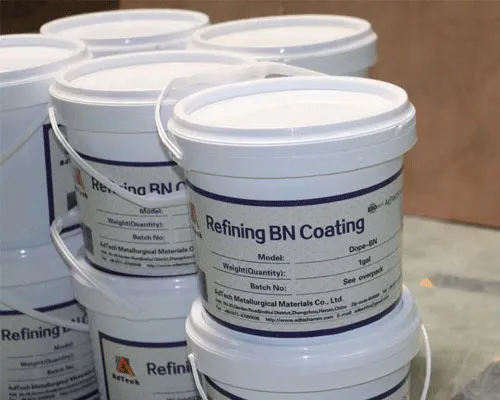
Boron nitride coating is a ceramic surface treatment made from hexagonal or cubic boron nitride (BN) particles that gets applied to metals, graphite, ceramics, and composite substrates to provide release properties, thermal stability, and electrical insulation at temperatures most organic coatings simply cannot survive. We’ve worked with this material across dozens of high-temperature manufacturing projects, and the short answer is this: if your process runs above 500°C and you need a non-stick, chemically inert barrier, boron nitride coating is probably the material your engineers should be testing right now.
Unlike graphite-based release agents or silicone sprays that break down under thermal stress, boron nitride retains its structural integrity up to roughly 1800°C in inert atmospheres and around 1000°C in oxidizing environments. This single property explains why the material shows up in aluminum die casting, glass forming, semiconductor manufacturing, and hot-press molding operations where nothing else survives the operating conditions.
If your project requires the use of Boron Nitride Coating, you can contact us for a free quote.
Why Manufacturers Choose Boron Nitride Over Other Release Agents
Most engineers come to boron nitride coating after something else has already failed. Graphite coatings leave carbon residue that contaminates molten aluminum. Silicone-based mold releases carbonize and stick permanently once temperatures climb past 300°C. Even PTFE, the go-to non-stick material for consumer products, degrades above 260°C and releases toxic fumes.
Boron nitride sidesteps all three problems because of its unique crystal structure. The hexagonal form (h-BN) arranges atoms in layered sheets similar to graphite, but with alternating boron and nitrogen atoms rather than pure carbon. This layered structure gives it lubricity without the electrical conductivity that makes graphite unsuitable for certain electronic applications.
We tested both materials side by side on an aluminum die casting line a few years back. The graphite-coated dies needed cleaning every 40 to 60 cycles. The boron nitride coated dies ran over 300 cycles before showing meaningful buildup. That difference translates directly into labor savings and reduced downtime, which is usually what gets procurement teams to approve the higher upfront material cost.
Hexagonal BN vs Cubic BN: Which One Are You Actually Buying?
Not all boron nitride coating is the same material, and this distinction trips up a surprising number of buyers.
Hexagonal boron nitride (h-BN) is the soft, lubricious form used in nearly all coating applications. It’s sometimes called “white graphite” because of its physical similarity to graphite’s layered structure and its slippery feel. This is what you’re getting in mold release sprays, ceramic slurry coatings, and most industrial BN products.
Cubic boron nitride (c-BN) is an extremely hard crystalline form, second only to diamond in hardness. It’s used almost exclusively in cutting tools and abrasives, not as a release coating. If a supplier quotes you c-BN for a mold release application, something is wrong with either the quote or your understanding of what you need.
| Property | Hexagonal BN (h-BN) | Cubic BN (c-BN) |
|---|---|---|
| Crystal structure | Layered, graphite-like | Zinc-blende, diamond-like |
| Hardness (Mohs) | 2 (soft, lubricious) | 9.5 (extremely hard) |
| Primary use | Release coatings, lubricants | Cutting tools, grinding wheels |
| Typical form | Powder, slurry, spray | Sintered inserts |
| Thermal conductivity | High (up to 400 W/m·K) | Very high |
| Cost per kg | Moderate | Significantly higher |
We’ve seen procurement teams waste weeks sourcing the wrong material simply because a spec sheet said “boron nitride” without clarifying the crystal form. Always confirm you’re purchasing h-BN for coating applications unless you have a specific cutting tool project.
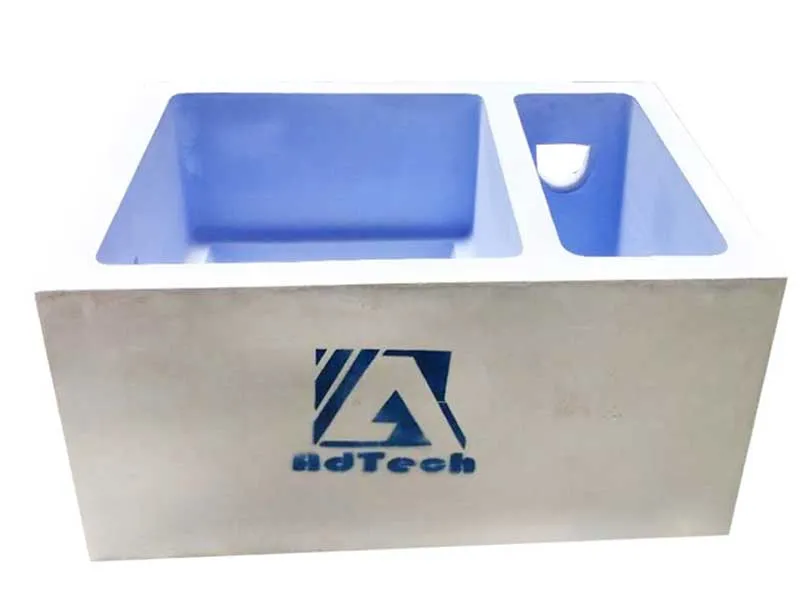
How Boron Nitride Coating Actually Gets Applied
The application method matters as much as the material itself, and this is where a lot of technical buyers get stuck comparing suppliers.
Spray coating is the most common method for die casting, glass molding, and general industrial release applications. Manufacturers mix BN powder with a water or solvent-based carrier and a binder system, then spray it onto pre-heated tooling. The binder burns off during the first thermal cycle, leaving pure BN bonded to the surface.
Dip coating works better for complex geometries where spray guns can’t reach every surface. Parts get submerged in a BN slurry, pulled out at a controlled rate, and cured. We’ve used this method on graphite crucibles with internal cavities where spray application left uneven coverage.
Chemical vapor deposition (CVD) produces the highest purity, most uniform BN films, typically used in semiconductor and electronics manufacturing where contamination tolerance is measured in parts per billion. This method costs significantly more and requires specialized equipment, so it only makes sense for high-value applications.
Physical vapor deposition (PVD) is less common for BN specifically but shows up in some thin-film electronic applications requiring precise thickness control down to nanometers.
| Application Method | Typical Thickness | Best For | Relative Cost |
|---|---|---|---|
| Spray coating | 25-100 microns | Die casting, glass molds | Low |
| Dip coating | 50-150 microns | Complex geometries, crucibles | Low-Moderate |
| CVD | 1-10 microns | Semiconductors, electronics | High |
| PVD | 0.1-5 microns | Thin-film electronics | High |
| Hand-applied paste | 100-300 microns | Repair, touch-up, small runs | Low |
We generally recommend spray coating for anyone running standard die casting or hot forming operations. It’s cost-effective, well understood, and the equipment for reapplication is inexpensive enough that most shops can handle recoating in-house rather than sending parts back to a supplier.
The Physical Properties That Actually Matter for Your Application
Spec sheets throw a lot of numbers at buyers, and not all of them matter equally depending on your use case. Here’s what we pay attention to first.
Thermal stability sits at the top of the list for most applications. Hexagonal BN maintains structural integrity up to 1800°C in inert or vacuum atmospheres. In air, oxidation becomes a concern above roughly 1000°C, forming a boric oxide layer that can actually protect the underlying BN in short exposures but degrades performance over sustained high-temperature air exposure.
Thermal conductivity ranges from 20 to 400 W/m·K depending on crystal orientation and purity, which is unusually high for a ceramic material. This matters enormously in electronics packaging where you need electrical insulation but still need heat to escape efficiently.
Electrical resistivity makes BN valuable in applications where graphite’s conductivity would cause problems. h-BN acts as an excellent electrical insulator, with resistivity values around 10^13 to 10^17 ohm-cm depending on purity and temperature.
Chemical inertness means BN resists attack from most molten metals, including aluminum, zinc, and even some steel alloys, along with resistance to most acids and bases at room temperature. This is why it dominates the die casting release agent market.
Coefficient of friction typically runs between 0.15 and 0.7 depending on humidity, load, and surface finish, giving it genuinely useful lubricating properties without oil or grease.
| Property | Typical Value | Why It Matters |
|---|---|---|
| Max service temp (inert) | 1800°C | Determines process compatibility |
| Max service temp (oxidizing) | 1000°C | Sets realistic operating limits in air |
| Thermal conductivity | 20-400 W/m·K | Heat dissipation in electronics |
| Electrical resistivity | 10^13-10^17 ohm-cm | Insulation in high-temp electronics |
| Coefficient of friction | 0.15-0.7 | Release performance, wear reduction |
| Density | 2.1-2.3 g/cm³ | Weight considerations in coatings |
| Mohs hardness | 2 | Soft, non-abrasive to tooling |
Industries and Applications Where This Coating Shows Up
We’ve supplied and sourced BN coating for a wide enough range of industries that a pattern becomes obvious: anywhere you combine high heat with a need for release or insulation, someone eventually tries boron nitride.
Aluminum and magnesium die casting represents probably the largest volume application. Dies coated with BN release castings cleanly without the carbon buildup that plagues graphite-based alternatives, extending time between mold cleanings substantially.
Glass manufacturing uses BN-coated molds and forming tools because molten glass doesn’t stick to it and the coating survives the repeated thermal cycling glass forming requires.
Continuous casting of steel relies on BN coatings on rolls and other components that contact molten or semi-molten metal, reducing sticking and improving surface finish on the final product.
Semiconductor manufacturing uses high-purity BN in wafer processing equipment, crucibles for crystal growth, and as an insulating layer in some device structures.
Solar cell production applies BN coatings to crucibles used in silicon ingot growth, where contamination control directly affects cell efficiency.
Powder metallurgy uses BN-coated sintering trays and setter plates because parts release cleanly without contaminating the metal powder compact.
Electronics packaging increasingly uses BN as a thermal interface material because it moves heat away from components while maintaining electrical isolation between circuit elements.
Cosmetics might surprise people, but pharmaceutical-grade h-BN powder appears in makeup products for its smooth, silky feel and light-reflecting properties, completely unrelated to its industrial coating applications.
Boron Nitride Coating Compared to Other Release and Barrier Materials
Buyers frequently ask us to justify the cost difference between BN and cheaper alternatives. Here’s the honest comparison based on what we’ve tested.
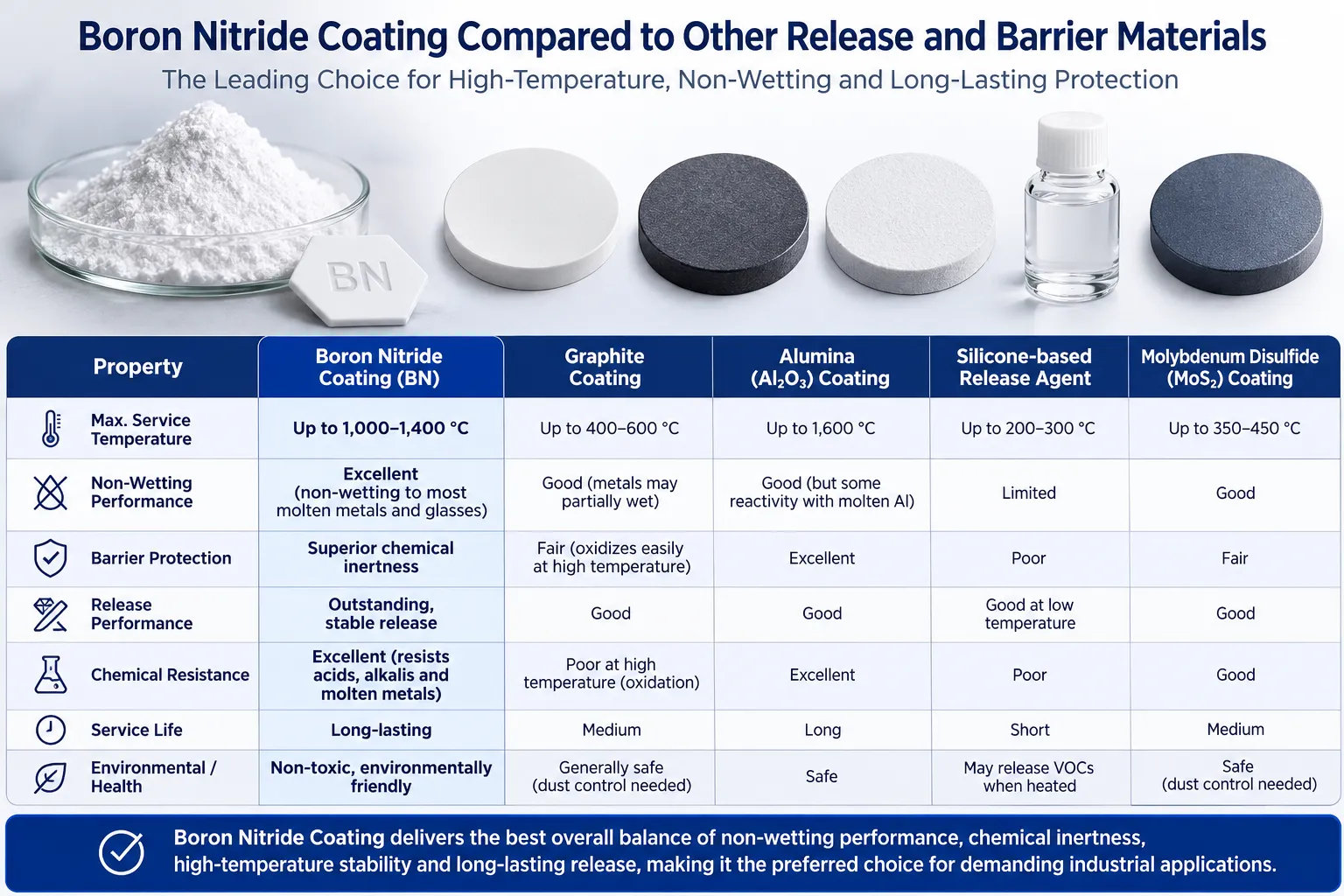
| Coating Type | Max Temp (Air) | Electrical Property | Release Performance | Relative Cost |
|---|---|---|---|---|
| Boron nitride | 1000°C | Insulator | Excellent | Moderate-High |
| Graphite | 450°C | Conductor | Good | Low |
| PTFE | 260°C | Insulator | Excellent (low temp only) | Low |
| Silicone | 300°C | Insulator | Fair | Low |
| Aluminum oxide | 1700°C | Insulator | Poor (no lubricity) | Moderate |
| Zirconia coating | 2200°C | Insulator | Poor (no lubricity) | High |
The comparison makes clear why BN occupies a specific niche. Alumina and zirconia coatings survive higher temperatures, but they don’t provide release properties, they’re barrier coatings, not lubricious release agents. Graphite provides similar lubricity at a fraction of the cost, but conducts electricity and oxidizes at lower temperatures. PTFE and silicone are cheaper and easier to apply, but simply cannot survive industrial furnace or die casting temperatures.
We tell clients that if their process temperature stays under 300°C and electrical conductivity isn’t a concern, they’re probably overspending by choosing BN. Above 500°C with any electrical insulation requirement, BN becomes difficult to substitute.
What Actually Drives the Price of Boron Nitride Coating
Procurement teams want straight answers on pricing, and this is genuinely one of the more variable cost categories we deal with.
Purity level affects price more than almost any other factor. Technical grade h-BN suitable for industrial die casting runs considerably cheaper than semiconductor-grade material with contamination levels measured in parts per million.
Particle size and morphology matter for application quality. Finer, more uniform particles produce smoother coatings but cost more to manufacture and often require more careful handling during spray application.
Application method adds substantial cost variation. A basic spray-applied coating costs a fraction of what CVD-deposited BN film costs per square inch, simply because of equipment and process complexity.
Substrate preparation requirements can add unexpected costs. Some substrates need surface roughening, pre-heating, or intermediate bonding layers before BN coating adheres properly, and these prep steps sometimes cost more than the coating itself.
Order volume follows normal economies of scale, but we’ve noticed BN suppliers apply steeper volume discounts than typical industrial coatings because raw material sourcing costs drop meaningfully at bulk purchase quantities.
Geographic sourcing matters too. Chinese and other Asian suppliers often quote 30-50% lower than North American or European suppliers for equivalent technical-grade material, though quality consistency varies more between suppliers in that price tier.
How to Choose the Right Boron Nitride Product for Your Process
We get asked constantly which grade or format to specify, and the honest answer depends heavily on the specific application.
For die casting operations, we typically recommend water-based h-BN spray coatings in the 99% purity range. This balances cost against performance well for most aluminum and zinc casting operations, and water-based formulations are easier to handle from an EHS standpoint than solvent-based alternatives.
For crucibles used in crystal growth or high-purity metal melting, purity requirements jump significantly, often to 99.5% or higher, with tight controls on oxide content and metallic impurities that could contaminate the melt.
For electronics thermal management applications, particle size distribution and thermal conductivity specifications matter more than general purity, since you’re optimizing for heat transfer rather than chemical inertness alone.
For glass forming molds, we look for coatings specifically formulated with binders that survive the repeated thermal cycling glass forming requires, since generic BN coatings sometimes flake off after a few hundred cycles under this specific stress pattern.
| Application | Recommended Grade | Key Spec to Verify |
|---|---|---|
| Aluminum die casting | Technical h-BN, 99% | Release cycle count |
| Crystal growth crucibles | High-purity h-BN, 99.5%+ | Metallic impurity levels |
| Electronics thermal pads | Fine particle h-BN | Thermal conductivity rating |
| Glass forming molds | Formulated h-BN with high-temp binder | Thermal cycling durability |
| General lubrication | Standard h-BN powder | Particle size, coefficient of friction |
We always recommend requesting a small sample batch before committing to a full production order, regardless of how detailed the supplier’s spec sheet looks. Real-world performance on your specific substrate and process conditions sometimes differs from lab test results, and a few hundred dollars in sample testing saves a lot of headaches compared to discovering problems mid-production run.
Common Problems We’ve Seen With Boron Nitride Coating
No coating performs perfectly in every application, and BN has its own set of failure modes worth knowing about before you commit.
Coating flaking or spalling happens most often when substrate preparation was inadequate or when thermal cycling exceeds what the binder system can handle. This shows up as visible chips or flakes in the coating after repeated use, usually starting at edges or high-stress contact points.
Uneven coverage from spray application creates thin spots that wear through faster than the rest of the coating, leading to localized sticking issues even while the majority of the surface still performs well.
Hydration sensitivity affects some BN formulations, where moisture absorption during storage degrades coating performance before it even gets applied. This is why proper storage in sealed, low-humidity conditions matters more than most buyers initially realize.
Oxidation in extended high-temperature air exposure gradually converts surface BN to boric oxide, which is water-soluble and washes away, exposing fresh BN underneath but slowly consuming the coating thickness over many cycles.
Incompatibility with certain binders occasionally causes adhesion failures, particularly when switching suppliers without re-validating the full coating system rather than assuming all BN products behave identically.
Maintenance and Reapplication Best Practices
Getting the most life out of BN coating comes down to a few practices we’ve refined through actual production experience rather than just following supplier manuals.
Clean surfaces thoroughly before reapplication, removing any residual metal, oxide buildup, or degraded coating material. Skipping this step is probably the single most common cause of premature coating failure we’ve diagnosed in the field.
Pre-heat substrates to the temperature range specified by your coating supplier before spray application. Applying BN slurry to a cold substrate often results in poor binder curing and weak adhesion.
Apply thinner coats more frequently rather than thick single applications. This sounds counterintuitive to people used to paint or other coatings, but BN adheres better in thin layers and thick applications are more prone to cracking during initial thermal cycling.
Track cycle counts and establish a reapplication schedule based on actual performance data from your process rather than generic supplier recommendations, since real-world wear rates vary considerably based on your specific temperature profile, contact pressure, and material being processed.
Store BN coating materials in sealed containers away from moisture, and rotate stock so older material gets used before newer shipments, since some formulations have limited shelf life once opened.
Environmental and Safety Considerations
Boron nitride is generally considered low-toxicity and safe to handle with standard industrial hygiene practices, but a few points deserve mention for anyone setting up handling procedures.
Fine BN powder can cause respiratory irritation if inhaled in significant quantities during spray application or powder handling, so standard dust control measures including local exhaust ventilation and appropriate respiratory protection remain good practice, particularly during spray application in enclosed spaces.
Unlike some competing high-temperature coatings, BN doesn’t release toxic decomposition products under normal operating temperatures, which is part of why it’s preferred over PTFE-based coatings in applications where thermal degradation is a realistic possibility.
Disposal of BN coating waste generally doesn’t require special hazardous waste handling in most jurisdictions, though local regulations vary and should be confirmed before establishing waste disposal procedures.
Frequently Asked Questions
Is boron nitride coating safe for food contact applications?
Certain high-purity grades of h-BN are approved for food contact use in specific applications like bakeware release coatings, but not all commercial BN coating products meet food-grade purity standards. Always verify FDA or equivalent regulatory approval for the specific product before using it in food processing equipment.
How long does boron nitride coating typically last before needing reapplication?
This varies enormously by application, but die casting operations typically see 100 to 400 cycles before performance degrades noticeably, while less demanding applications like glass mold release can last considerably longer. Actual lifespan depends on temperature, mechanical stress, and coating thickness.
Can boron nitride coating be applied over existing coatings?
Generally not recommended without complete removal of prior coatings first. Layering BN over degraded or incompatible existing coatings usually results in poor adhesion and premature failure, so surface preparation should return the substrate to bare material whenever possible.
What’s the difference between boron nitride spray and boron nitride paste?
Spray formulations use lower viscosity carriers for even application over large or complex surfaces through spray equipment, while paste formulations have higher solid content and work better for touch-up applications, small areas, or hand application where spray equipment isn’t practical.
Does boron nitride coating conduct electricity?
No, hexagonal boron nitride is an excellent electrical insulator, which is one of its key advantages over graphite-based coatings in applications near electrical components or where conductivity would cause problems.
Is boron nitride coating more expensive than graphite coating?
Yes, typically BN coating costs more per unit area than equivalent graphite coating, but the extended service life, superior release properties, and electrical insulation properties often justify the price difference in applications where graphite’s limitations cause production problems.
Can boron nitride coating be used in vacuum furnace applications?
Yes, BN performs exceptionally well in vacuum environments since oxidation isn’t a concern, allowing it to reach its maximum theoretical temperature limits around 1800°C without the degradation seen in oxidizing atmospheres.
What substrates can accept boron nitride coating?
Most common industrial substrates work with BN coating including steel, aluminum, graphite, ceramics, and various composite materials, though surface preparation requirements differ significantly between substrate types.
Does humidity affect stored boron nitride coating materials?
Yes, some formulations are hygroscopic and moisture absorption during storage can degrade coating performance and binder curing behavior, making proper sealed storage in controlled humidity conditions important for maintaining product quality until use.
How do I know if my supplier is providing genuine hexagonal boron nitride versus a lower-quality substitute?
Request a certificate of analysis showing purity percentage, particle size distribution, and crystal structure confirmation through XRD testing. Reputable suppliers provide this documentation routinely, and unwillingness to share basic quality documentation is a legitimate red flag worth pursuing with alternative suppliers.
Final Thoughts From Our Testing Experience
We’ve spent enough time specifying, testing, and troubleshooting boron nitride coating across different industries to say this confidently: it earns its reputation as a premium release and insulation material, but it’s not automatically the right choice for every high-temperature application. The decision comes down to matching your actual temperature range, electrical requirements, and budget constraints against what BN specifically offers versus alternatives like graphite, alumina, or specialized high-temperature polymers.
If you’re evaluating this material for a new application, we’d suggest starting with small-batch sample testing on your actual production equipment rather than relying purely on supplier spec sheets. Real production conditions reveal performance characteristics that lab testing sometimes misses, and the relatively low cost of proper sample validation prevents much larger problems down the line when you’ve already committed to full production volumes.