

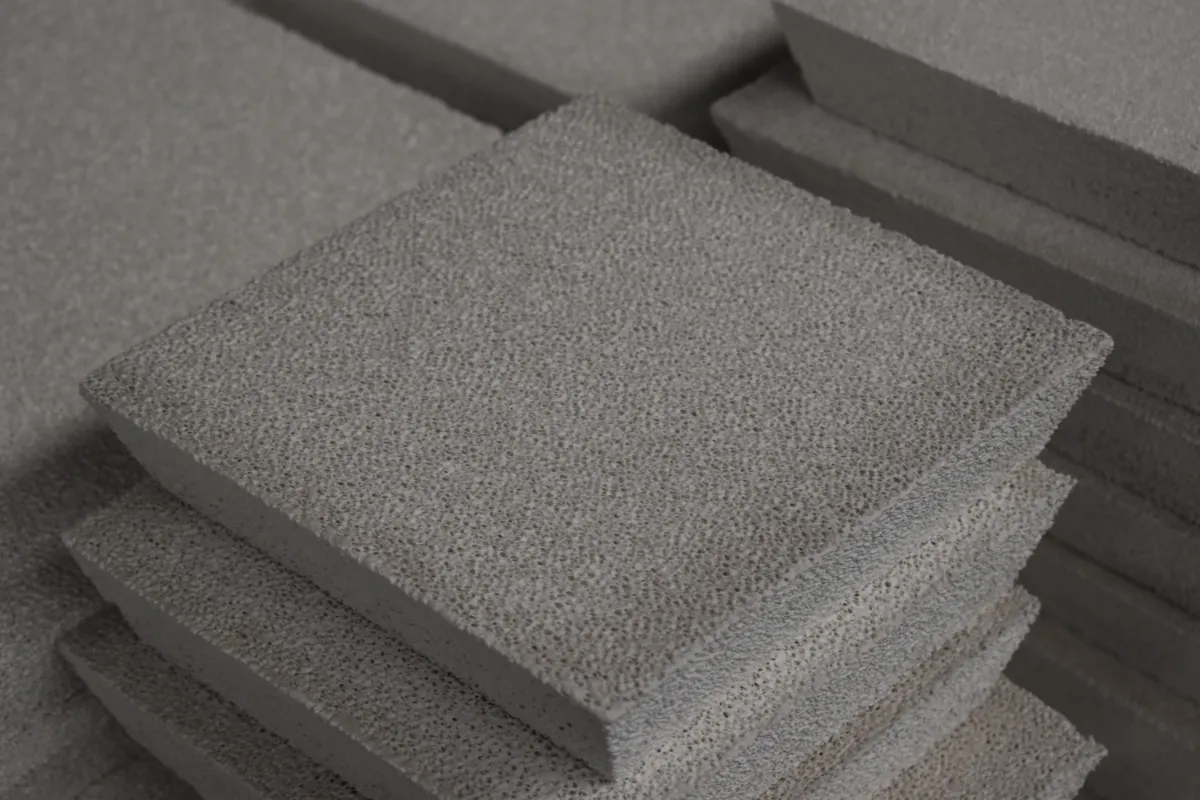
A phosphate-free ceramic foam filter is a ceramic foam filter designed for molten aluminum filtration without relying on phosphorus-based additives in its formulation. Its purpose is still the same as other ceramic foam filters: to remove non-metallic inclusions from molten aluminum while promoting more stable metal flow into the casting process. The main reason to consider a phosphate-free formulation is that conventional phosphate-bonded alumina ceramic foam filters can have chemical compatibility concerns when used with certain magnesium-containing aluminum alloys. Research has documented degradation of phosphate-bonded alumina filter structures in contact with magnesium-containing aluminum melts.
For aluminum foundries, the important point is that phosphate-free does not simply mean “a better ceramic foam filter.” It addresses a specific material and melt-chemistry consideration. The correct choice still depends on alloy composition, required metal cleanliness, casting speed, molten aluminum flow rate, filter area, PPI, filter-box design and the overall melt-treatment process.
AdTech’s PHF, or Phosphorus Free Ceramic Foam Filter, is designed for molten aluminum applications where phosphorus contamination needs to be strictly controlled. AdTech states that the PHF formulation does not contain phosphorus-based additives and positions it for high-quality aluminum alloy production and sensitive downstream applications.
What Does “Phosphate-Free” Mean?
The term can cause confusion because ceramic foam filters have historically been manufactured using phosphate-based bonding systems.
A conventional phosphate-bonded alumina ceramic foam filter can use an aluminum phosphate bonding phase to hold alumina particles together. Aluminum phosphate binders are widely documented in refractory and ceramic applications because they provide useful bonding characteristics during manufacturing.
The problem is that the bonding phase does not behave identically in every molten aluminum environment.
In particular, magnesium can react with phosphate-containing bonding phases. Experimental research has shown degradation of phosphate-bonded alumina ceramic foam filters when exposed to magnesium-containing aluminum melts. The study observed changes in filter structure and phosphorus-related changes near the filter-metal interface.
This is why the term phosphate-free ceramic foam filter is relevant to aluminum foundries.
A phosphate-free filter is designed to avoid phosphorus-based additives in the filter formulation rather than depending on a conventional phosphate bonding system.
However, buyers should still ask suppliers exactly what they mean by “phosphate-free.” If a production process has a strict phosphorus specification, it is reasonable to request the supplier’s material declaration, technical data and, where necessary, analytical test information rather than relying only on the product name.
Why Does Phosphorus Matter in Aluminum Filtration?
The reason phosphorus control matters depends on the aluminum alloy and the downstream application.
Phosphorus can be an unwanted contaminant in certain high-quality aluminum production processes. AdTech identifies several areas where phosphorus contamination may be a concern, including electrical conductivity, surface treatment performance, foil and sheet quality, downstream processing stability and high-purity alloy requirements.
This does not mean that every aluminum casting operation requires a phosphate-free filter.
For many conventional aluminum casting applications, the standard filtration solution may be perfectly adequate. The need for a phosphate-free formulation becomes more relevant when the alloy chemistry, product specification or downstream processing makes phosphorus control important.
A practical decision therefore starts with the alloy and product requirements, not with the filter itself.
A useful purchasing question
Instead of asking:
“Is phosphate-free better?”
ask:
“Does my alloy and product specification require phosphorus contamination to be controlled?”
If the answer is yes, a phosphate-free ceramic foam filter becomes a relevant filtration option.
Why Are Conventional Phosphate-Bonded Filters a Concern in Magnesium-Containing Alloys?
Magnesium is an important alloying element in many commercial aluminum alloys. Its presence can change the chemical environment experienced by refractory and ceramic materials in contact with molten aluminum.
Research on phosphate-bonded alumina CFFs has found that magnesium-containing aluminum melts can attack the phosphate bonding phase. The reported mechanism involves reactions between magnesium and aluminum phosphate, with the degradation becoming more significant as exposure conditions change.
The consequence is not merely a theoretical change in chemistry.
If the bonding phase is degraded, the mechanical integrity of the ceramic structure can be affected. In severe conditions, degradation can contribute to filter material loss and potentially introduce unwanted material into the melt.
This is one reason phosphate-free formulations have attracted attention for applications involving magnesium-containing alloys.
It is important, however, not to turn this into an absolute rule that every aluminum-magnesium alloy must use a phosphate-free filter. The appropriate filter depends on the actual alloy chemistry, process temperature, exposure time, filtration configuration and product requirements.
How Does a Phosphate-Free Ceramic Foam Filter Work?
The basic filtration mechanism remains that of a ceramic foam filter.
A CFF contains an interconnected three-dimensional network of pores. Molten aluminum passes through these tortuous channels rather than moving through a simple straight hole.
During filtration, non-metallic inclusions can be captured through several mechanisms, including:
- mechanical interception
- surface adsorption
- inertial effects
- changes in flow direction
- attachment to the ceramic structure
- depth filtration within the interconnected pore network
The filter can therefore capture inclusions that are smaller than the nominal pore size.
The important distinction is that PPI is not the same thing as a guaranteed particle-removal size.
A 30 PPI filter does not mean that every particle larger than a fixed 30-based threshold will be removed and every smaller particle will pass through. Actual filtration depends on the ceramic structure, inclusion characteristics, melt flow, filter area, filter depth, wetting behavior and operating conditions.
This distinction is important when comparing suppliers.
Phosphate-Free vs Conventional Ceramic Foam Filters
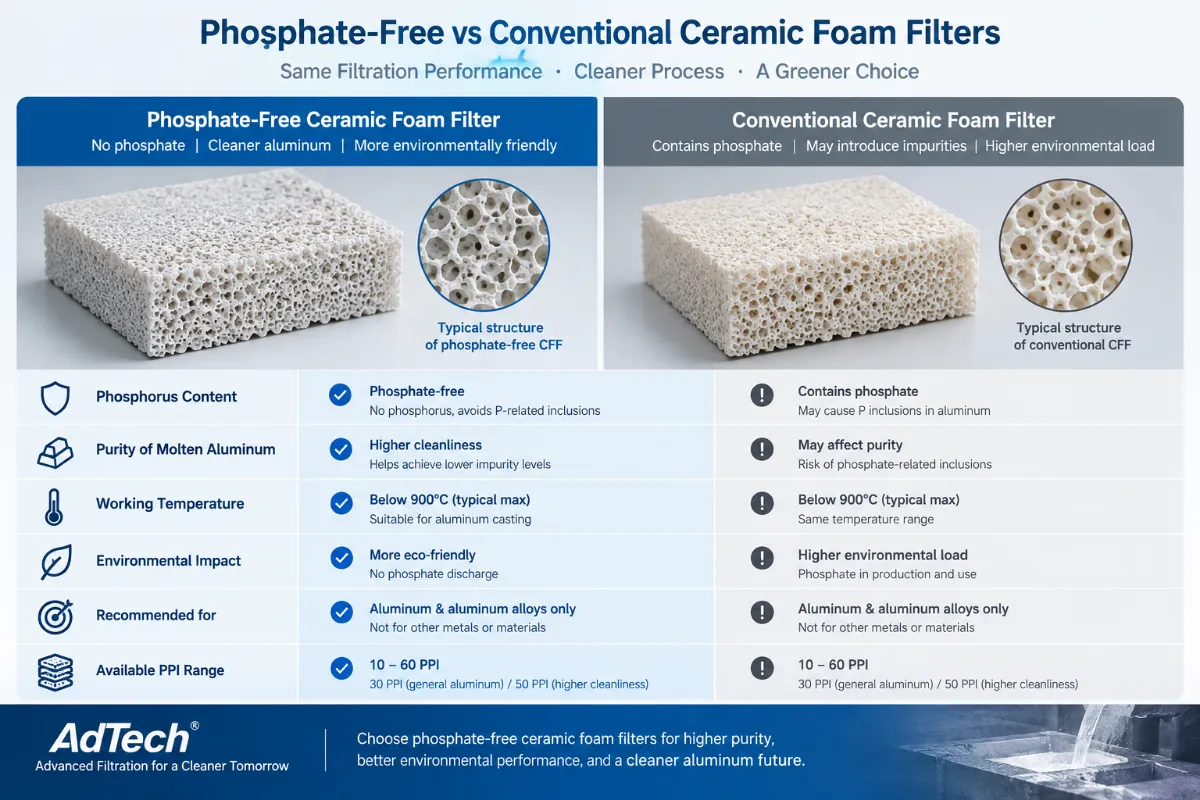
The following table summarizes the main difference.
| Factor | Conventional Phosphate-Bonded CFF | Phosphate-Free CFF |
|---|---|---|
| Basic purpose | Molten aluminum filtration | Molten aluminum filtration |
| Typical ceramic base | Often alumina-based | Often alumina-based |
| Phosphate-based formulation | May be used | Designed without phosphorus-based additives |
| Main filtration function | Removes non-metallic inclusions | Removes non-metallic inclusions |
| Concern in Mg-containing alloys | Chemical compatibility may require attention | Designed to address phosphate-related concerns |
| Phosphorus contamination control | Requires consideration of filter formulation | Specifically intended where phosphorus control is important |
| PPI selection | Based on cleanliness and flow requirements | Still based on cleanliness and flow requirements |
| Filter-box compatibility | Must be checked | Must be checked |
| Preheating | Required according to process requirements | Still required |
| Replaces degassing? | No | No |
The key point is that the filtration mechanism and the material chemistry are two different questions.
A phosphate-free formulation does not automatically mean that the filter has higher filtration precision. PPI, filter area, pore structure and process conditions still determine filtration behavior.
What Are the Main Applications?
Phosphate-free ceramic foam filters are particularly relevant to aluminum casting and processing applications where control of phosphorus contamination is important.
AdTech lists applications including:
- high-purity aluminum alloy casting
- aluminum foil production
- battery foil applications
- electronic aluminum materials
- automotive aluminum alloys
- precision aluminum casting
- aluminum billet casting
- rolling slab casting
- high-quality wrought alloy production
The same principle applies across these applications: the filter should be selected according to the actual alloy and casting process rather than simply according to the end-use industry.
For example, a foil producer and a conventional billet caster may both use ceramic foam filters, but their cleanliness targets and process conditions may be different.
Is a Phosphate-Free Filter Suitable for High-Magnesium Aluminum Alloys?
It can be an appropriate option when magnesium-related chemical compatibility and phosphorus control are important.
This is one of the most important reasons to investigate phosphate-free ceramic foam filters.
AdTech specifically identifies its PHF filters for aluminum applications requiring phosphorus contamination control, while its product information also identifies PHF as being mainly used for filtration and purification of high-magnesium aluminum alloys.
The correct selection should still consider:
- Alloy composition
- Magnesium content
- Melt temperature
- Casting speed
- Required filtration precision
- Filter area
- Filter-box configuration
- Expected inclusion load
- Required metal cleanliness
- Downstream product requirements
A supplier should therefore not recommend a filter based only on the statement “this is a magnesium alloy.”
The alloy grade and process conditions matter.
Read more:How do I choose ceramic foam filter PPI?
How Do You Choose the Correct PPI?
PPI means pores per inch and is one of the commonly used specifications for ceramic foam filters.
Higher PPI generally represents a finer pore structure. However, finer filtration usually comes with a corresponding reduction in flow capacity or an increased pressure drop under comparable conditions.
AdTech currently lists PHF options from 10 PPI through 60 PPI:
| PPI | General positioning |
|---|---|
| 10 PPI | Larger flow applications |
| 20 PPI | Larger flow and general filtration |
| 30 PPI | Standard filtration |
| 40 PPI | Finer filtration |
| 50 PPI | Higher cleanliness requirements |
| 60 PPI | Fine filtration requirements |
AdTech’s current selection guidance suggests approximately 20 to 30 PPI for general casting and billet/slab casting, 30 to 50 PPI for higher-quality foil and sheet applications, and 50 to 60 PPI for fine filtration requirements.
These values should be treated as selection guidance rather than universal rules.
Read more: What PPI Filter Should I Use for Aluminum Billet Casting?
Why not simply use the highest PPI?
Because filtration is a balance.
A finer filter may improve the removal of smaller inclusions, but if the filtration area is insufficient for the required metal flow, the filter can restrict flow or become loaded more quickly.
A practical approach is therefore:
Required cleanliness + inclusion load + metal flow rate + available filter area = appropriate filtration configuration
Not:
Higher PPI = automatically better filtration
Filter Area Can Be as Important as PPI
Suppose two filters use the same ceramic formulation and PPI, but one has significantly more filtration area.
Their practical behavior can be different because the available cross-sectional area affects the metal velocity through the filter.
Higher flow rates normally require either:
- greater filtration area,
- a more open filter structure,
- multiple filters,
- or a filtration system specifically designed for the required throughput.
AdTech’s PHF product information also notes that higher flow rates normally require larger filtration areas and lower PPI structures to maintain stable melt flow.
This is why a quotation request should include the casting flow rate rather than only the desired PPI.
Does Phosphate-Free Mean the Filter Removes Smaller Inclusions?
Not necessarily.
The term phosphate-free describes the formulation or material chemistry.
The ability to capture inclusions is influenced by other factors such as:
- PPI
- pore structure
- filter thickness
- filter area
- inclusion concentration
- inclusion morphology
- melt flow velocity
- filter wetting
- filter placement
- operating temperature
- sealing quality
These factors should not be mixed together.
A phosphate-free 30 PPI filter is still fundamentally a 30 PPI filtration product. Its phosphate-free characteristic addresses material compatibility and phosphorus control, not a magical increase in filtration precision.
Does a Phosphate-Free CFF Replace an Aluminum Degassing System?
No.
This is an important distinction for aluminum foundries.
A ceramic foam filter is primarily used to remove solid and non-metallic inclusions from molten aluminum.
An aluminum degassing system addresses dissolved hydrogen and related gas-removal requirements.
The two processes therefore solve different problems.
A typical molten aluminum treatment sequence may include:
Melting → fluxing/refining → degassing → filtration → casting
The exact process depends on the foundry and alloy.
AdTech supplies both PHF ceramic foam filters and online degassing equipment, allowing these technologies to be considered as parts of the same molten aluminum treatment system. Its PHF product information specifically describes online degassing as a supporting process for removing hydrogen before filtration.
The important lesson for buyers is simple:
Do not purchase a ceramic foam filter when the actual problem is dissolved hydrogen.
Likewise, degassing alone does not perform the same function as physical inclusion filtration.
What Filter Size Should You Order?
Filter dimensions should match the filter box or filtration chamber.
AdTech currently lists common PHF dimensions including:
- 7 × 7 inch
- 9 × 9 inch
- 12 × 12 inch
- 15 × 15 inch
- 17 × 17 inch
- 20 × 20 inch
- 23 × 23 inch
- 26 × 26 inch
The listed standard thickness is 50 mm, with customized dimensions and edge structures available according to filter-box requirements.
Dimension should not be treated as an independent purchasing parameter.
The buyer should verify:
- filter length
- filter width
- thickness
- seating configuration
- sealing arrangement
- filter-box dimensions
- expected molten aluminum flow
- number of filters used simultaneously
An incorrectly matched filter can allow molten aluminum to bypass the ceramic structure. In that situation, the nominal PPI may be correct but the actual filtration performance can still be poor.
Why Is Filter Sealing Important?
The molten aluminum should pass through the ceramic filter rather than around it.
This makes the interface between the filter and filter box an important part of the filtration system.
AdTech’s PHF design includes an expanding fiber edge intended to improve sealing during preheating and reduce small gaps around the filter seat.
The general principle is applicable to ceramic foam filtration systems:
Filter media + filter box + sealing = filtration system
A high-quality filter cannot compensate for significant bypass around the filter.
What Should Buyers Ask a Phosphate-Free CFF Supplier?
A purchasing engineer should request more than a price per piece.
A useful RFQ should include at least the following information:
| Information to provide or request | Why it matters |
|---|---|
| Alloy grade | Determines material compatibility |
| Magnesium content | Relevant to phosphate-related chemical stability |
| Casting process | Determines filtration configuration |
| Metal flow rate | Determines required filtration area |
| Existing filter size | Ensures physical compatibility |
| Required PPI | Defines the desired pore-density range |
| Filter thickness | Affects installation and filtration behavior |
| Required cleanliness | Helps determine filtration precision |
| Phosphorus specification | Determines whether phosphate-free formulation is necessary |
| Filter-box type | Determines sealing and installation |
| Preheating procedure | Important for thermal shock control |
| Material declaration | Helps verify the formulation |
| Dimensional tolerance | Important for proper seating |
| Quality-control documents | Helps evaluate batch consistency |
For a strict phosphorus-control application, buyers should specifically ask:
Does the filter formulation contain phosphorus-based additives?
They can also request the applicable technical documentation or material analysis when phosphorus content is a controlled specification.
Common Mistakes When Buying Phosphate-Free Ceramic Foam Filters
Mistake 1: Assuming phosphate-free automatically means better
It does not.
The main advantage is relevant to specific material-compatibility and contamination-control requirements.
If the application does not have such a requirement, other factors may dominate the purchasing decision.
Mistake 2: Selecting PPI only
PPI is important, but it is not the entire specification.
Flow rate, filter area, filter dimensions, thickness and inclusion load must also be considered.
Mistake 3: Choosing the highest PPI available
Higher PPI is not automatically the correct choice.
If the filtration area and flow conditions are not appropriate, an excessively fine filter can create operational problems.
Mistake 4: Ignoring magnesium content
For alloys containing magnesium, the chemical compatibility of the filter material should be considered.
This is particularly relevant when evaluating conventional phosphate-bonded alumina filters.
Mistake 5: Treating the filter as a degassing product
A ceramic foam filter removes inclusions. It is not a replacement for an online hydrogen-removal system.
Mistake 6: Buying by size only
A filter that physically fits the box may still be unsuitable for the required flow rate and cleanliness target.
Mistake 7: Ignoring bypass
Poor sealing can undermine filtration performance even when the ceramic filter itself meets specification.
Mistake 8: Asking only for unit price
The lowest price per filter does not necessarily represent the lowest filtration cost.
Buyers should also consider:
- filter life
- required replacement frequency
- filtration capacity
- rejection rate
- melt loss
- installation time
- casting quality
- downstream defect costs
How Should Phosphate-Free CFF Suppliers Be Compared?
A useful supplier comparison should separate the following categories.
Material
Ask what ceramic material and bonding system are used.
Chemistry
Confirm whether phosphorus-based additives are used and whether the supplier can provide relevant documentation.
Geometry
Compare PPI, thickness, dimensions, pore structure and edge design.
Process compatibility
Confirm alloy type, magnesium content, casting speed and metal flow rate.
Quality control
Check dimensional consistency, packaging, inspection procedures and available technical documentation.
Technical support
A technically useful supplier should be able to discuss more than the price per piece.
For example, the supplier should be able to evaluate:
alloy + flow rate + filter area + PPI + filter-box configuration + cleanliness requirement
rather than simply asking which PPI the customer wants.
What Makes AdTech PHF Different From a Standard CFF?
AdTech identifies its PHF product as a Phosphorus Free Ceramic Foam Filter designed for molten aluminum filtration where phosphorus contamination needs to be strictly controlled. The company states that the filter does not contain phosphorus-based additives and lists applications including high-purity aluminum alloys, foil, battery foil, electronic aluminum materials, automotive alloys, billet and slab casting.
The product information also lists PPI options from 10 to 60 PPI, common dimensions from 7 × 7 inch to 26 × 26 inch, a standard 50 mm thickness, and customized dimensions or edge structures according to filter-box requirements.
AdTech’s broader product range includes ceramic foam filters, PHF filters, cartridge filter tubes, alumina filter media, degassing equipment, plate-type filtration equipment, deep-bed filtration equipment and integrated launder systems.
This broader range matters because the correct molten aluminum treatment solution is often a combination of processes rather than one standalone product.
When Should You Consider a Phosphate-Free Ceramic Foam Filter?
A phosphate-free ceramic foam filter deserves consideration when one or more of the following conditions apply:
- The aluminum alloy contains magnesium.
- Phosphorus contamination is a controlled material specification.
- The final product has strict cleanliness requirements.
- The application involves high-purity aluminum.
- Foil or sheet quality is sensitive to melt cleanliness.
- Downstream processing is sensitive to phosphorus.
- The foundry wants to avoid phosphate-related filter chemistry.
- The existing filtration system is compatible with a phosphate-free CFF.
It may be less relevant when the application has no meaningful phosphorus-control requirement and a conventional filtration solution already meets the technical specification.
The decision should therefore be based on the process rather than the product label.
Final Selection Checklist
Before ordering a phosphate-free ceramic foam filter, confirm these points:
1. Alloy
What exact aluminum alloy is being filtered?
2. Magnesium
What is the approximate Mg content?
3. Phosphorus requirement
Is phosphorus contamination actually controlled by the product specification?
4. Flow rate
How many tonnes per hour pass through the filter?
5. Filter area
Is the existing filter area sufficient?
6. PPI
What level of inclusion removal is required?
7. Dimensions
Will the filter fit the existing filter box?
8. Sealing
How is molten aluminum prevented from bypassing the filter?
9. Preheating
What preheating procedure is required?
10. Documentation
Can the supplier provide technical data and material information relevant to the application?
These questions provide a much better basis for purchasing than simply asking for the cheapest phosphate-free filter.
FAQ
1. What is a phosphate-free ceramic foam filter?
A phosphate-free ceramic foam filter is a ceramic foam filter designed without phosphorus-based additives in its formulation. It is used to filter non-metallic inclusions from molten aluminum, particularly where phosphorus contamination needs to be controlled.
2. Why use a phosphate-free ceramic foam filter for aluminum?
The main reason is material compatibility and phosphorus control. Conventional phosphate-bonded alumina filters can experience chemical degradation in magnesium-containing aluminum melts, making phosphate-free formulations relevant to certain alloy and product requirements.
3. Is a phosphate-free ceramic foam filter better than a conventional CFF?
Not universally. It can be more appropriate when phosphorus contamination or phosphate-related chemical compatibility is an important concern. For other applications, conventional ceramic foam filtration may be sufficient.
4. Are phosphate-free ceramic foam filters suitable for magnesium alloys?
They can be particularly relevant for magnesium-containing aluminum alloys because phosphate-bonded filter systems can have chemical compatibility concerns with magnesium. The exact choice should still be based on alloy chemistry and process conditions.
5. What PPI should I use for a phosphate-free ceramic foam filter?
The correct PPI depends on the required cleanliness, flow rate, filter area and casting process. AdTech currently offers PHF grades from 10 to 60 PPI, with 20 to 30 PPI generally positioned for standard applications and higher PPI grades for finer filtration requirements.
6. Does a phosphate-free filter remove hydrogen from molten aluminum?
No. A ceramic foam filter primarily removes non-metallic inclusions. Hydrogen removal is normally addressed through an aluminum degassing process.
7. Can a phosphate-free ceramic foam filter be installed in a standard filter box?
The filter must be matched to the specific filter-box dimensions and sealing arrangement. AdTech states that its PHF filters are compatible with standard filter-box systems and that customized dimensions and edge structures are available.
8. What information should I provide when requesting a quotation?
Provide the alloy grade, magnesium content, metal flow rate, filter-box dimensions, required PPI, filter thickness, casting process and cleanliness requirements. If phosphorus control is important, state the phosphorus specification as well.
9. Does higher PPI always provide better filtration?
No. Higher PPI generally represents a finer pore structure, but the appropriate PPI must be balanced against flow rate, filtration area and inclusion loading.
10. What should I ask a phosphate-free CFF supplier?
Ask about the ceramic composition, phosphorus-based additives, PPI, dimensions, thickness, dimensional tolerance, filter-box compatibility, recommended operating conditions and available material or quality documentation.
Conclusion
A phosphate-free ceramic foam filter is a molten aluminum filtration product designed without phosphorus-based additives in its formulation. Its main relevance is in applications where phosphorus contamination needs to be controlled or where the chemical compatibility of conventional phosphate-bonded ceramic filters is a concern.
The issue becomes particularly relevant for magnesium-containing aluminum alloys because research has documented chemical degradation of phosphate-bonded alumina ceramic foam filters in magnesium-containing melts.
However, phosphate-free should not be treated as a universal replacement for every conventional ceramic foam filter.
The correct filter still depends on:
alloy chemistry + phosphorus requirement + inclusion load + flow rate + filter area + PPI + filter-box design + operating conditions.
For aluminum foundries, the most useful approach is therefore to select the filter as part of the complete molten aluminum treatment process rather than treating “phosphate-free” as the only specification that matters.
AdTech’s PHF, or Phosphorus Free Ceramic Foam Filter, is designed specifically for molten aluminum filtration applications where phosphorus contamination control is important. Its current product range includes multiple PPI grades and filter dimensions, with customized dimensions and edge structures available according to filter-box requirements.