

A 50 PPI ceramic foam filter is a relatively fine-pore ceramic foam filter used when an aluminum casting process requires stronger control of non-metallic inclusions than a coarser filter can provide. However, 50 PPI should not be selected simply because a higher PPI number sounds better. Increasing PPI generally means a finer pore structure and greater resistance to molten-metal flow, so the correct choice depends on the required melt cleanliness, inclusion load, flow rate, available filter area, alloy, casting process, and acceptable pressure loss. Commercial aluminum ceramic foam filters are commonly available in grades such as 10, 20, 30, 40, 50 and 60 PPI.
What Does 50 PPI Mean in a Ceramic Foam Filter?
PPI means pores per inch. It is used to describe the nominal pore density of a ceramic foam filter.
Read More: How do I choose ceramic foam filter PPI?
A 50 PPI filter has a nominal pore density of approximately 50 pores per linear inch across the filter structure. Compared with a 30 PPI filter, the 50 PPI grade generally has a finer interconnected pore network.
The relationship can be summarized as follows:
| Filter Grade | General Pore Structure | Relative Filtration Fineness | Relative Flow Resistance |
|---|---|---|---|
| 20 PPI | Coarser | Lower | Lower |
| 30 PPI | Medium-coarse | Moderate | Moderate |
| 40 PPI | Medium-fine | Higher | Higher |
| 50 PPI | Fine | High | High |
| 60 PPI | Finer | Very high | Very high |
This table is a directional comparison, not a universal performance specification. Actual pore dimensions, permeability and pressure drop depend on the ceramic formulation, manufacturing process, filter thickness, pore morphology and test conditions.
A peer-reviewed study of alumina ceramic foam filters from three suppliers found measurable differences in porosity and cell/window dimensions among filters with comparable PPI classifications. For example, measured 50 PPI samples from different suppliers did not have identical pore structures.
This is why buyers should avoid treating PPI as the only technical specification.
How Does a 50 PPI Ceramic Foam Filter Work?
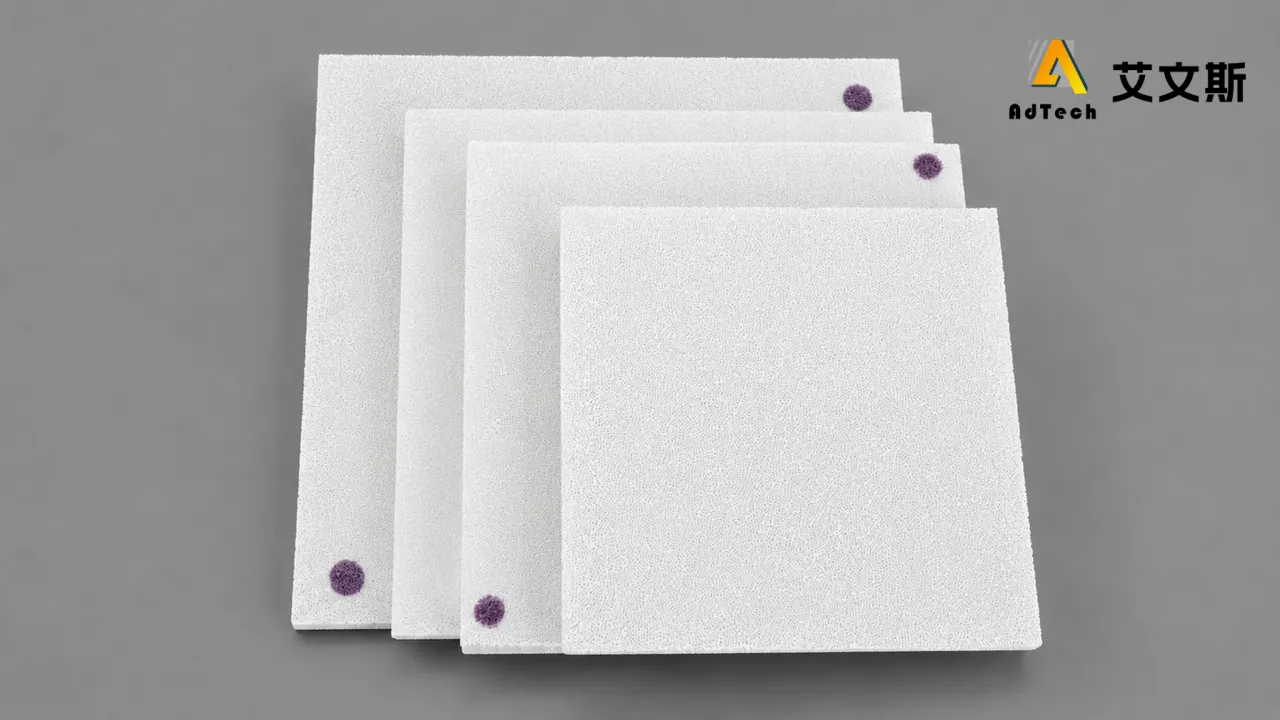
A ceramic foam filter is an open-cell structure containing interconnected passages through which molten aluminum flows.
During filtration, non-metallic inclusions encounter the ceramic structure and can be retained through a combination of mechanisms including:
- Mechanical interception
- Changes in flow direction
- Depth filtration
- Particle adhesion to ceramic surfaces
- Capture within the interconnected pore structure.
The purpose is primarily to reduce non-metallic inclusions in the molten aluminum before the metal reaches the casting operation.
Ceramic foam filters are widely used in aluminum melt filtration, and research has specifically examined their hydraulic behavior, porosity, pore dimensions and pressure-drop characteristics.
The filter therefore has two functions that must be considered together:
Filtration performance
The filter should capture unwanted inclusions.
Hydraulic performance
The filter must still allow the required quantity of molten aluminum to pass through at an acceptable pressure loss.
A 50 PPI filter addresses the first requirement more aggressively than a coarser filter, but the second requirement becomes more demanding.
Why Use 50 PPI Instead of 30 or 40 PPI?
The main reason to consider 50 PPI is the need for finer inclusion control.
Higher PPI grades generally provide a finer filtration structure. AdTech’s product information classifies 40, 50 and 60 PPI as finer filtration options compared with 10, 20 and 30 PPI grades.
However, the decision should be based on the casting process rather than the PPI number alone.
A 50 PPI filter may be considered when:
- The final product has demanding cleanliness requirements.
- Fine non-metallic inclusions are a significant concern.
- A 30 or 40 PPI filter does not provide the required melt cleanliness.
- The casting process can tolerate the additional flow resistance.
- Sufficient filter area is available.
- The incoming melt has been properly treated before filtration.
- The casting system can maintain stable metal temperature and flow.
By contrast, a 30 PPI filter may be more appropriate when the primary requirement is stable high throughput and the inclusion-control requirement does not justify the additional resistance of a finer filter.
This is why higher PPI should not be treated as an automatic upgrade.
50 PPI vs 30 PPI vs 40 PPI vs 60 PPI
A useful way to understand 50 PPI is to compare it with adjacent grades.
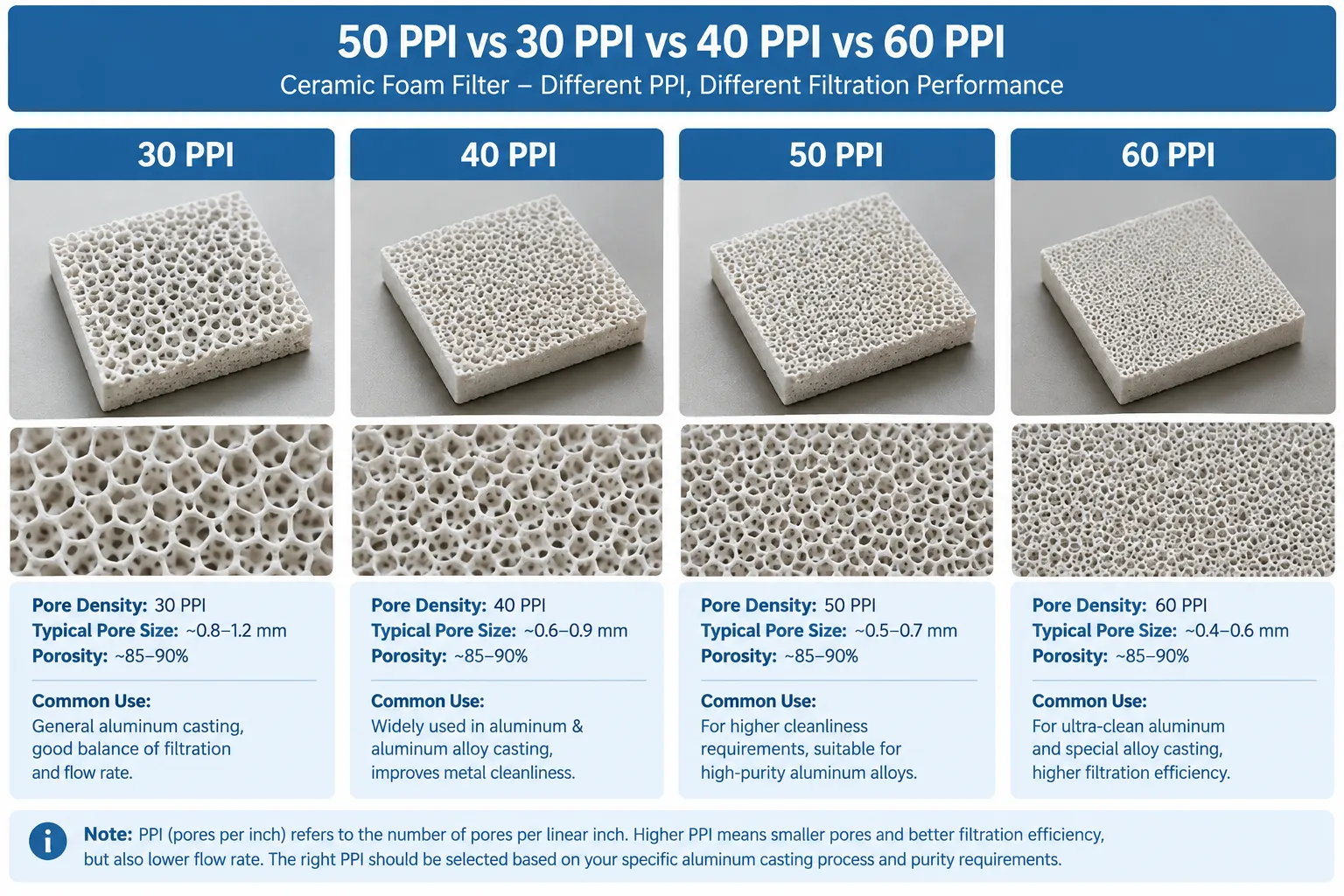
| PPI | Filtration Fineness | Flow Resistance | Typical Decision Consideration |
|---|---|---|---|
| 30 | Moderate | Lower | General aluminum filtration |
| 40 | Medium-fine | Medium-high | Higher cleanliness with controlled flow |
| 50 | Fine | High | Fine inclusion control where flow capacity is adequate |
| 60 | Very fine | Very high | More demanding cleanliness requirements, subject to process limitations |
These descriptions are relative. They should not be interpreted as universal performance guarantees.
One manufacturer, for example, publishes substantially different optimum flow capacities for different PPI grades and filter dimensions. For a 20 × 20 × 2 inch filter, its published reference is 31.5 t/h for 30 PPI, 24.0 t/h for 40 PPI, 18.0 t/h for 50 PPI and 14.4 t/h for 60 PPI.
The exact numbers should not be transferred directly to another manufacturer’s filter. They demonstrate the important engineering relationship: as pore density increases, the available flow capacity can decrease when other design factors remain comparable.
Read more: 10 PPI vs 30 PPI vs 60 PPI Ceramic Foam Filters
What Is the Main Advantage of a 50 PPI Ceramic Foam Filter?
The main potential advantage is finer filtration compared with coarser PPI grades.
For aluminum casting, this can be useful when small non-metallic inclusions are important to the final product.
Potential benefits include:
Finer inclusion control
A finer pore structure provides more opportunities for smaller inclusions to be retained.
Improved melt cleanliness
When correctly matched to the process, a fine-grade filter can contribute to improved molten aluminum cleanliness.
Suitability for quality-sensitive applications
Applications involving demanding surface quality or internal cleanliness may justify a finer filtration grade.
Compatibility with staged filtration
In some systems, a coarse filter can be used upstream and a finer filter downstream. This approach can reduce the inclusion load reaching the finer filter.
However, these benefits depend heavily on the actual melt condition and filtration system design.
A 50 PPI filter cannot compensate for every upstream melt-quality problem.
What Are the Limitations of 50 PPI?
The primary limitation is increased flow resistance.
A finer ceramic foam structure generally provides less open flow area and a more restrictive flow path than a coarser grade.
This creates several practical concerns.
1. Higher pressure drop
As molten aluminum passes through a finer structure, the pressure required to maintain a given flow can increase.
2. Greater blockage sensitivity
If the incoming metal contains a high concentration of inclusions, a fine filter can accumulate material more rapidly.
3. Reduced flow capacity
For the same filter dimensions, a 50 PPI filter generally cannot be assumed to provide the same flow capacity as a 30 PPI filter.
4. Greater sensitivity to process conditions
Metal temperature, inclusion loading, head pressure, filter area and casting duration can all affect actual performance.
5. Higher replacement risk if incorrectly sized
If a filter is undersized for the required throughput, the fine structure may become overloaded before the casting operation is completed.
Therefore:
A 50 PPI filter should be selected because the process needs its filtration characteristics, not simply because it has a higher PPI number.
Is 50 PPI Suitable for Aluminum Casting?
Yes, 50 PPI ceramic foam filters can be used for molten aluminum filtration, provided that the filter material, dimensions and process conditions are appropriate.
AdTech’s current aluminum ceramic foam filter product range includes 50 PPI as one of its available pore-density grades. Standard filter sizes listed by AdTech include dimensions from 7 × 7 inches through 26 × 26 inches, with a standard thickness of 50 mm and custom dimensions available.
The important point is that 50 PPI suitability depends on the complete filtration system.
A buyer should evaluate:
- Aluminum alloy
- Melt cleanliness before filtration
- Expected inclusion loading
- Required metal flow rate
- Filter dimensions
- Filter thickness
- Filter-box design
- Metal temperature
- Casting duration
- Required final cleanliness
- Available pressure/head
- Replacement interval
A 50 PPI filter may be technically appropriate but operationally unsuitable if the filter area is too small for the required throughput.
50 PPI Ceramic Foam Filter Flow Capacity
Flow capacity is one of the most frequently misunderstood aspects of ceramic foam filter selection.
There is no single universal flow rate for a 50 PPI filter.
Flow capacity depends on several variables, including:
- Filter area
- Filter thickness
- PPI
- Ceramic structure
- Molten aluminum temperature
- Alloy
- Metal head
- Inclusion loading
- Filter-box geometry
- Pressure drop
- Casting configuration
For example, published manufacturer data show that increasing filter dimensions can substantially increase the nominal optimum flow rate even when the PPI grade remains the same. One published table lists 50 PPI flow references ranging from 1.8 t/h for a 7 × 7 × 2 inch filter to 24.0 t/h for a 23 × 23 × 2 inch filter.
The practical lesson is simple:
Do not order a 50 PPI filter by PPI alone.
The required flow rate and available filter area must be specified at the same time.
How Do You Size a 50 PPI Ceramic Foam Filter?
A practical sizing process starts with the production requirement.
Step 1: Determine the required molten aluminum flow rate
Identify the actual or target flow rate through the filter.
For example, a buyer may specify:
- kg/min
- kg/h
- tonnes/h
The unit should be clearly defined.
Step 2: Determine the required filtration grade
Decide whether 50 PPI is actually necessary.
If a 30 or 40 PPI filter already achieves the required cleanliness, moving to 50 PPI may add unnecessary hydraulic resistance.
Step 3: Determine the available filter-box dimensions
The filter must physically fit the filtration equipment.
Important dimensions include:
- Length
- Width
- Thickness
- Seating arrangement
- Gasket or edge configuration
Step 4: Check the required filtration area
Higher throughput generally requires greater filtration area.
A larger filter can reduce the loading imposed on each unit of filter area.
Step 5: Check the supplier’s flow data
Do not rely on generic Internet flow-rate tables.
Ask the supplier what test conditions were used to generate the flow data.
Step 6: Consider inclusion loading
A filter exposed to a relatively clean melt and a filter exposed to heavily contaminated recycled melt may behave very differently.
Step 7: Confirm the complete casting process
The final specification should be evaluated against the actual production conditions.
What Pore Size Does a 50 PPI Filter Have?
This question requires caution.
It is tempting to convert PPI directly into one exact pore diameter. That can be misleading.
PPI is a nominal pore-density classification. Ceramic foam filters have three-dimensional, interconnected structures rather than perfectly uniform cylindrical pores.
Research comparing CFF samples from different suppliers found differences in measured cell and window dimensions even among comparable PPI grades. For 50 PPI samples in that study, measured mean window diameters varied between suppliers.
Therefore, a purchasing specification should ideally include more than:
“50 PPI.”
Depending on the application, buyers may also request:
- PPI tolerance
- Pore-count verification
- Pore-size distribution
- Porosity
- Permeability
- Pressure-drop data
- Filter thickness
- Material composition
- Dimensional tolerance
- Thermal properties
- Quality inspection information
This provides a more meaningful description of the filter.
Read more: What PPI Filter Should I Use for Aluminum Billet Casting?
What Material Should a 50 PPI Aluminum Filter Be Made From?
For molten aluminum applications, alumina ceramic foam filters are a common choice.
The material selection should match the molten-metal chemistry and operating conditions.
For AdTech’s aluminum filtration products, alumina ceramic foam filters are positioned specifically for molten aluminum applications.
A buyer should distinguish between:
- Alumina ceramic foam filter
- Silicon carbide ceramic foam filter
- Zirconia ceramic foam filter
These materials are not interchangeable simply because they have the same PPI rating.
For an aluminum foundry purchasing an alumina 50 PPI filter, the specification should therefore identify the ceramic material explicitly rather than specifying only:
50 PPI ceramic foam filter
A clearer requirement would be:
50 PPI alumina ceramic foam filter for molten aluminum filtration.
When Should You Consider 50 PPI?
50 PPI may be worth considering when the process requires finer filtration than a general-purpose grade can provide.
Potential situations include:
Quality-sensitive aluminum products
Where inclusion control is strongly connected with surface quality or downstream product requirements.
Fine inclusion control
Where the objective is to reduce smaller non-metallic inclusions rather than only remove large particles.
High-quality billet or other demanding casting operations
Where the filtration system has sufficient area and hydraulic capacity for a finer filter.
Downstream critical processing
Where the consequences of inclusions become more significant during rolling, extrusion, machining or other subsequent operations.
The exact grade should still be validated against the actual process.
When Should You Not Choose 50 PPI?
A 50 PPI filter may be inappropriate when:
- The required flow rate is too high for the available filter area.
- The incoming melt has a very high inclusion load.
- A coarser filter already provides sufficient cleanliness.
- The filtration system cannot tolerate the additional pressure loss.
- The filter-box design was developed around a substantially coarser grade.
- The process experiences repeated filter blockage.
- The casting operation is highly sensitive to reduced metal flow.
In these cases, a lower PPI grade or a larger filtration area may be worth evaluating.
The correct solution could also involve improving upstream melt treatment rather than simply increasing PPI.
Can a 50 PPI Filter Remove Hydrogen From Aluminum?
No.
A ceramic foam filter is primarily a solid-inclusion filtration device.
Hydrogen dissolved in molten aluminum is a different problem and normally requires a degassing process.
This distinction is important because aluminum foundries sometimes combine:
Degassing + filtration
rather than expecting one process to perform both functions.
AdTech’s product portfolio includes both ceramic foam filtration products and aluminum degassing systems, which address these different melt-treatment requirements.
A simplified process may therefore look like:
Melting → Fluxing / Melt Treatment → Degassing → Ceramic Foam Filtration → Casting
The exact process arrangement depends on the foundry’s equipment and production method.
50 PPI vs 50 PPI: Why Supplier Quality Still Matters
Two suppliers can sell filters labeled 50 PPI, but that does not necessarily mean the filters will behave identically.
The peer-reviewed hydraulic characterization study examined alumina CFFs from three suppliers and measured differences in:
- Porosity
- Cell dimensions
- Window dimensions
- Permeability
- Pressure-drop behavior
The study included 50 PPI filters from multiple suppliers, providing direct evidence that nominal PPI alone does not fully describe hydraulic performance.
For procurement teams, this is a significant point.
If two quotations both say:
Alumina ceramic foam filter, 50 PPI
they are not necessarily technically equivalent.
The buyer should compare the complete specification.
What Should You Ask a 50 PPI Ceramic Foam Filter Supplier?
Before placing an order, ask for the following information.
| Item | What to Verify |
|---|---|
| Material | Alumina or other ceramic |
| PPI | Confirm nominal grade and tolerance |
| Dimensions | Length × width × thickness |
| Pore structure | Available supporting specification |
| Porosity | Test value or range |
| Flow capacity | Test conditions and reference values |
| Pressure drop | Test conditions |
| Thermal performance | Applicable operating conditions |
| Dimensional tolerance | Manufacturing tolerance |
| Edge/gasket design | Compatibility with filter box |
| Inspection | Batch inspection method |
| Packaging | Protection during transport |
| Quantity | MOQ and production quantity |
| Lead time | Actual manufacturing schedule |
| Customization | Custom size or drawing availability |
For critical applications, buyers should also request representative samples and evaluate them under controlled production conditions.
Common Mistakes When Buying 50 PPI Ceramic Foam Filters
Mistake 1: Assuming higher PPI is always better
It is not.
Higher PPI can provide finer filtration, but it can also increase resistance to molten-metal flow.
Mistake 2: Specifying only PPI
“50 PPI” does not fully describe the filter.
Material, dimensions, thickness, pore structure and hydraulic characteristics also matter.
Mistake 3: Choosing filter size according to casting weight alone
The filter needs to be sized according to the required molten-metal flow and filtration conditions.
Mistake 4: Ignoring inclusion loading
A filter operating with heavily contaminated melt can behave very differently from one filtering relatively clean aluminum.
Mistake 5: Comparing supplier quotations only by unit price
A lower-priced filter is not necessarily lower cost in operation if it produces unstable flow, frequent replacement or inadequate filtration.
Mistake 6: Treating laboratory data as universal
Published flow or filtration data should always be evaluated with their test conditions.
Mistake 7: Expecting filtration to solve hydrogen problems
Ceramic foam filtration and hydrogen degassing address different melt-quality issues.
50 PPI Ceramic Foam Filter Selection Checklist
Before purchasing, confirm:
Process
- What aluminum alloy is being cast?
- What is the required melt flow rate?
- What is the casting duration?
- What is the expected inclusion load?
Quality
- What inclusion level must be controlled?
- Is fine inclusion removal required?
- What final product quality requirement drives the filtration specification?
Filter
- Is alumina the required material?
- Is 50 PPI necessary?
- What filter dimensions are required?
- What thickness is required?
- Is a gasket or special edge design needed?
Hydraulic performance
- What is the supplier’s tested flow capacity?
- What pressure-drop data are available?
- Under what temperature and test conditions were these values obtained?
Purchasing
- What are the dimensional tolerances?
- How is PPI inspected?
- Is batch inspection available?
- Can the supplier provide samples?
- Can the supplier manufacture custom dimensions?
This checklist can prevent a common procurement mistake: comparing filters based on PPI and price while ignoring actual operating conditions.
How AdTech Fits Into 50 PPI Aluminum Filtration
AdTech supplies ceramic foam filters for molten aluminum filtration in multiple PPI grades, including 50 PPI. Its current product information lists 10, 20, 30, 40, 50 and 60 PPI options, together with standard filter dimensions and custom-size capability.
For buyers evaluating 50 PPI alumina ceramic foam filters, the important starting information is not simply the requested PPI.
A useful RFQ should include:
Aluminum alloy + required flow rate + filter-box dimensions + desired PPI + filter thickness + casting application + estimated melt cleanliness.
This gives the supplier enough information to assess whether 50 PPI is appropriate and whether the filter area is sufficient.
For more demanding filtration requirements, the discussion can also include upstream melt treatment, degassing and filtration-system configuration rather than treating the ceramic filter as an isolated consumable.

Final Takeaway: Is 50 PPI the Right Ceramic Foam Filter?
A 50 PPI ceramic foam filter can be an appropriate choice for molten aluminum when finer inclusion control is required and the filtration system has sufficient flow capacity and filter area.
The important trade-off is:
Finer filtration ↔ greater flow resistance
A 50 PPI filter should therefore not automatically replace a 30 or 40 PPI filter.
The correct choice depends on the actual casting process.
For a purchasing decision, the minimum useful specification should include:
ceramic material + PPI + dimensions + thickness + required flow rate + application conditions.
If the process requires fine inclusion control, 50 PPI may be worth evaluating. If the process is highly flow-sensitive or has a high inclusion load, a coarser filter, a larger filtration area, or a staged filtration arrangement may provide a more suitable solution.
The most important point is that PPI is a selection parameter, not a complete performance specification.
For critical aluminum filtration applications, compare the actual filter structure, hydraulic data and operating conditions rather than comparing PPI numbers alone.
FAQ
1. What is a 50 PPI ceramic foam filter?
A 50 PPI ceramic foam filter is a porous ceramic filtration element with a nominal pore density of 50 pores per inch. It is used for molten-metal filtration and can provide finer filtration than lower-PPI grades, subject to the specific filter structure and operating conditions.
2. Is 50 PPI suitable for molten aluminum?
Yes. 50 PPI ceramic foam filters are available for molten aluminum filtration. Whether they are appropriate depends on the required cleanliness, flow rate, inclusion load, filter area and filtration-system design.
3. Is 50 PPI better than 30 PPI?
Not universally. 50 PPI generally provides a finer filtration structure, while 30 PPI generally offers lower flow resistance. The appropriate grade depends on the casting process.
4. Does higher PPI mean smaller pores?
Generally, yes. Higher PPI corresponds to a finer nominal pore structure. However, PPI does not define every physical characteristic of a ceramic foam filter. Research has demonstrated differences in actual pore structures among filters from different suppliers.
5. Can a 50 PPI ceramic foam filter remove hydrogen?
No. Ceramic foam filters are used primarily to remove non-metallic inclusions. Dissolved hydrogen requires an appropriate degassing process.
6. Does 50 PPI reduce molten aluminum flow?
It can. Compared with a coarser filter of otherwise comparable design, the finer structure can increase flow resistance and reduce flow capacity. Actual performance depends on filter dimensions and structure.
7. What size 50 PPI filter should I buy?
The size should be determined from the required molten-aluminum flow rate, available filter-box geometry, casting duration and required filtration performance. PPI alone is not enough to determine filter size.
8. What material should a 50 PPI aluminum filter use?
For molten aluminum applications, alumina ceramic foam filters are commonly used. The material should be specified explicitly when requesting quotations.
9. Can two 50 PPI filters from different suppliers perform differently?
Yes. Studies have found differences in porosity and pore structure among ceramic foam filters from different suppliers, even when comparable PPI grades are involved.
10. What should I provide when requesting a quotation for a 50 PPI filter?
Provide the aluminum alloy, required flow rate, filter dimensions, thickness, filter-box design if available, desired PPI, casting application and any specific cleanliness requirement. This gives the supplier a much better basis for selecting the filter.