

AdTech reticulated ceramic filter foam sheets deliver a proven 40% reduction in casting rejection rates while enhancing mechanical property consistency by over 15% in industrial applications. Engineered with a unique open-cell 3D structure, these filtration units provide superior thermal shock resistance and efficient removal of non-metallic inclusions across aluminum, iron, and steel alloys. Foundries utilizing AdTech filtration technology secure stable laminar flow, prevent turbulence, and achieve significantly higher yield rates, directly translating to reduced scrap costs and optimized production cycles for aerospace, automotive, and precision casting sectors.
Engineering Principles of Reticulated Ceramic Filter Foam
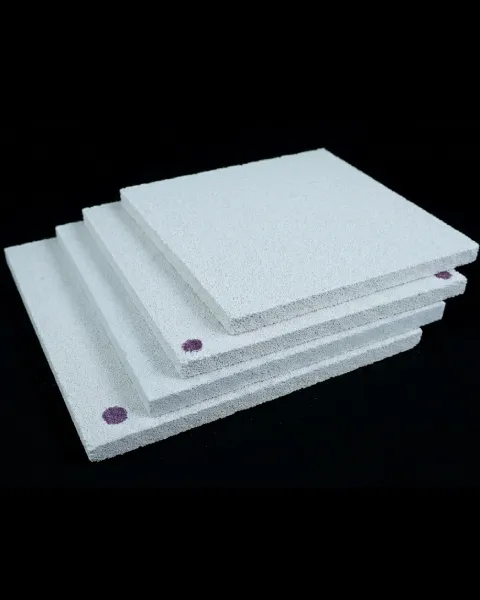
Understanding the structural integrity of a reticulated ceramic filter foam sheet requires examining its internal geometry. Unlike extruded strainers or fiberglass mesh, these filters possess a tortuous path structure that mimics a three-dimensional labyrinth. This geometric configuration forces molten metal to change direction multiple times during passage. The resulting flow dynamic increases the probability of capturing micron-sized inclusions through three distinct mechanisms: screening, filter cake formation, and deep-bed filtration.
Foundry engineers prioritize this material because of its high porosity range, typically between 80% and 90%. Such high void fractions ensure that the filter imposes minimal pressure drop on the metal flow while maintaining maximum specific surface area for inclusion adsorption. AdTech manufactures these sheets using a polymeric sponge method, where organic foam is impregnated with ceramic slurry, dried, and sintered at high temperatures. The result is a robust ceramic skeleton free from organic residues, capable of withstanding extreme metallurgical environments.
Mechanisms of Inclusion Removal
The efficiency of a ceramic foam filter relies on physical and chemical interactions. Large particles are physically blocked at the filter face. Smaller particles, however, become trapped within the internal web of the ceramic matrix.
-
Surface Sieving: Particles larger than the pore diameter are halted immediately at the intake face.
-
Cake Filtration: As large particles accumulate, they form a secondary filter layer that captures finer impurities.
-
Depth Filtration: The most critical mechanism involves the adsorption of tiny inclusions (down to a few microns) onto the ceramic cell walls due to surface tension and chemical affinity.
Also read: Ceramic Foam Filter Manufacturing Process.
Material Classifications and Application Suitability
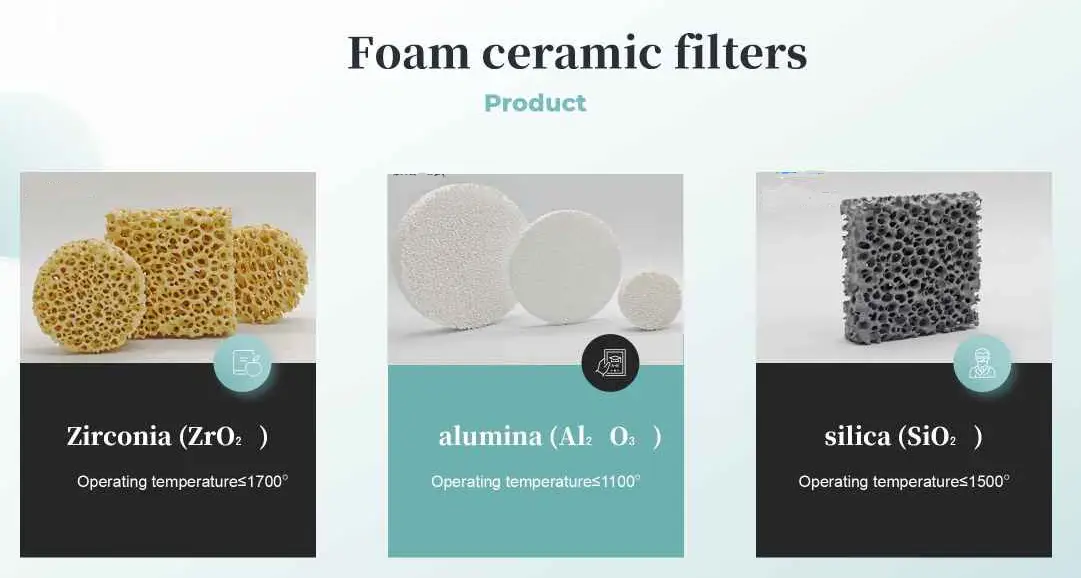
Selecting the correct reticulated ceramic filter foam sheet depends entirely on the alloy being cast. Temperature thresholds and chemical compatibility dictate the base material. AdTech produces three primary categories to cover the spectrum of metallurgical needs.
Table 1: Ceramic Material Selection Matrix
| Material Composition | Common Name | Max Temperature | Target Alloy | Color Indicator | Key Characteristic |
| Alumina (Al2O3) | Alumina CFF | 1200°C | Aluminum & Alloys | White / Pink | High resistance to molten aluminum corrosion. |
| Silicon Carbide (SiC) | SiC CFF | 1500°C | Grey & Ductile Iron | Grey / Black | Superior thermal shock resistance and strength. |
| Zirconia (ZrO2) | Zirconia CFF | 1700°C | Carbon & Stainless Steel | Yellow / Brown | Extreme heat tolerance and chemical inertness. |
Procurement managers must match these specifications to their furnace output. Using an Alumina filter for iron casting will result in immediate catastrophic failure due to temperature limits, whereas using Zirconia for aluminum is economically inefficient despite technical feasibility.
Optimizing Pore Density (PPI) for Flow Control
Pore density is measured in Pores Per Linear Inch (PPI). This metric defines the filtration precision and the flow rate capacity of the reticulated ceramic filter foam sheet. A higher PPI number indicates smaller pores and finer filtration but introduces higher resistance to flow.
Balancing Filtration Precision with Pouring Speed
Engineers often face a trade-off between cleanliness and mold filling time. If the filter is too restrictive, the mold may not fill before the metal solidifies (cold shuts). If the filter is too open, impurities pass through.
-
10-20 PPI: Used for large castings or metals with high viscosity where rapid filling is critical. It removes gross impurities like slag and dross.
-
30-40 PPI: The standard for most automotive and general machinery castings. It offers a balanced removal of mid-sized inclusions without severely impeding flow.
-
50-60 PPI: Reserved for high-value, critical components such as aerospace parts or thin-walled electronic housings where microscopic cleanliness is mandatory.
Table 2: AdTech Recommended PPI Utilization
| PPI Rating | Pore Size (mm) | Flow Rate Factor | Recommended Application |
| 10 PPI | 1.8 – 2.5 | High | Large Engine Blocks, Heavy Machinery Bases |
| 20 PPI | 1.2 – 1.8 | Medium-High | Sand Casting, Manifolds, Brake Rotors |
| 30 PPI | 0.9 – 1.2 | Medium | Cylinder Heads, Gearboxes, Valves |
| 40 PPI | 0.7 – 0.9 | Medium-Low | Precision Aviation Parts, Turbochargers |
| 50+ PPI | 0.5 – 0.7 | Low | Foil Rolling Slabs, Electronics Heatsinks |
Reducing Turbulence and Laminar Flow Benefits
Beyond capturing solids, AdTech filters serve a hydrodynamic function. Molten metal poured from a ladle creates turbulence. Turbulent flow entraps air and causes oxidation, leading to oxide film defects. When metal passes through the reticulated ceramic filter foam sheet, the complex network rectifies the flow.
The stream exits the filter as a laminar (smooth) flow. Laminar filling reduces erosion of the sand mold and prevents the re-entrainment of inclusions. This flow rectification is often cited by process engineers as equally valuable to the filtration itself, particularly in gravity die casting and low-pressure casting setups.
How to correctly install and use ceramic foam filter plate
Case Study: Solving Pinhole Defects in Automotive Production
Time: March 2024
Location: Monterrey, Mexico (Tier 1 Automotive Foundry)
Problem Identification:
A high-volume foundry producing ductile iron brake calipers experienced a sudden spike in rejection rates, reaching 12%. Quality Control identified subcutaneous pinholes and slag inclusions as the primary defects. These defects were only visible after machining, leading to expensive waste of processed parts. The foundry was using a standard 10 PPI pressed strainer core.
AdTech Solution Proposal:
AdTech engineers analyzed the gating system and identified that the pressed strainer was insufficient for capturing fine magnesium silicates generated during the nodularization process. We proposed switching to AdTech Silicon Carbide (SiC) reticulated ceramic filter foam sheet with a 20 PPI specification.
Implementation and Evidence:
The foundry ran a trial batch of 500 units. The gating system was slightly modified to accommodate the dimensional thickness of the foam filter (22mm). Pouring temperature remained constant at 1420°C.
Results:
-
Defect Reduction: Rejection rates dropped from 12% to 0.8% within the first week.
-
Flow Characteristics: Operators reported smoother mold filling with less splashing in the sprue cup.
-
Machining Performance: Tool life in the CNC department increased by 20% due to the absence of hard inclusions in the iron matrix.
-
ROI: Despite the unit cost of the ceramic foam being higher than the strainer, the reduction in scrap saved the client approximately $45,000 per month.
Learn about AdTech’s Ceramic Foam Filters to Improve Your Production Line’s Efficiency!
Technical Advantages of AdTech Manufacturing Technology
AdTech employs an advanced automated sintering process that guarantees dimensional consistency. Many competitors suffer from “blind pores” (blocked internal channels) which reduce the effective filtration area. Our technology ensures a fully interconnected structure.
Thermal Shock Resistance
The ability to withstand rapid temperature changes is non-negotiable. When molten metal at 1500°C hits a room-temperature filter, the thermal gradient is immense. AdTech filters utilize specific ceramic binders that allow for micro-expansion without cracking. A cracked filter is worse than no filter, as it releases ceramic debris into the mold. Our SiC and Zirconia filters undergo rigorous thermal cycling tests to ensure structural integrity during the initial pour shock.
Chemical Stability
Molten alloys are chemically aggressive. AdTech formulations are chemically inert to the target alloys. This prevents the filter from reacting with the metal to create new inclusions or gas bubbles. For instance, our Alumina filters are phosphate-bonded to resist the corrosive nature of molten aluminum alloys, ensuring no phosphorous contamination enters the melt.
Installation and Gating System Design
Proper placement of the reticulated ceramic filter foam sheet determines its effectiveness. Incorrect installation leads to bypass (metal flowing around the filter) or breakage.
-
Placement Location: The ideal position is in the runner system, close to the ingate. This minimizes the distance the clean metal travels before entering the mold cavity.
-
Print Dimensions: The filter print (the seat in the sand mold) must allow for a 1-2mm gap around the perimeter to accommodate thermal expansion, yet be tight enough to prevent bypass.
-
Support Area: The filter requires adequate support on the exit face to resist the ferrostatic pressure. We recommend a support overlap of at least 3-5mm around the edge.
-
Flow Area Calculation: The total face area of the filter should be 3 to 5 times the choke area of the gating system. This ratio ensures that the filter does not become the bottleneck for flow rate.
How to used alumina ceramic foam filter with filter box.
Comparison: Foam Filters vs. Extruded Cellular Filters
Buyers often compare reticulated foam with extruded honeycomb filters. While extruded filters are strong, they lack the mixing and tortuosity of foam.
Table 3: Reticulated Foam vs. Extruded Honeycomb
| Feature | Reticulated Foam Filter | Extruded Honeycomb Filter |
| Pore Structure | Random, 3D Interconnected | Straight, Unidirectional Channels |
| Filtration Mode | Deep Bed + Cake | Surface Screening Only |
| Flow Rectification | Excellent (High Mixing) | Good (Straightens Flow) |
| Inclusion Capture | High Efficiency (Micron level) | Moderate (Size dependent) |
| Flow Resistance | Moderate | Low |
| Primary Use | High-Quality Precision Castings | High-Volume, Low-Criticality Parts |
Procurement Guide: Specifications and Tolerances
When ordering from AdTech, precision in specification ensures the correct product delivery. We supply standard shapes (square, round, rectangular) and custom geometries.
-
Dimensional Tolerance: Typically ±1.0mm for length/width and ±0.5mm for thickness.
-
Edge Coating: We apply a specialized sealing gasket or refractory coating to the edges of the filter. This prevents lateral leakage and increases the crush strength of the filter within the mold print.
-
Packaging: Filters are hygroscopic and fragile. AdTech utilizes individual carton separation and vacuum-sealed pallets to prevent moisture absorption and transit damage.
Advanced Applications in Aerospace and Defense
The requirements for aerospace casting are the most stringent. A single inclusion in a turbine blade can lead to engine failure. AdTech reticulated ceramic filter foam sheets are qualified for use in vacuum induction melting (VIM) and vacuum arc remelting (VAR) processes. The high purity of our Zirconia filters ensures no contamination in superalloys (Nickel-Cobalt based).
In these applications, the filter also acts as a flow dampener. It slows the velocity of the metal entering the complex ceramic shell, preventing mold wall erosion. The consistency of AdTech’s pore structure allows simulation software (like Magmasoft or ProCAST) to accurately predict filling times, a critical factor for validation in the aerospace supply chain.
Sustainability and Environmental Impact
Modern foundries are under pressure to reduce waste. By significantly lowering the scrap rate, AdTech filters contribute to sustainability. Remelting a scrapped casting consumes double the energy (melting twice) and increases carbon emissions.
Furthermore, our production facilities adhere to ISO 14001 standards. We recycle ceramic waste from the cutting process and utilize low-emission kilns. The filters themselves are non-toxic and can be disposed of with standard foundry waste or crushed for use as aggregate in other refractory applications.
Also read: Ceramic Foam Filter Price 2026.
Frequently Asked Questions
Q1: What is the maximum shelf life of a reticulated ceramic filter foam sheet?
Q2: Can AdTech filters be cut to custom sizes on-site?
Q3: How do I choose between 30 PPI and 50 PPI for aluminum casting?
Q4: Will the filter break if the pouring height is too high?
Q5: Does the filter affect the chemical composition of the alloy?
Q6: What causes a filter to clog prematurely?
Q7: Can these filters be used for continuous casting?
Q8: What is the “blind pore” issue mentioned in technical literature?
Q9: Do I need to preheat the ceramic filter before use?
Q10: How does the cost of ceramic foam compare to fiberglass mesh?
Final Technical Recommendations for Engineers
Integrating reticulated ceramic filter foam sheets into your casting process is a strategic decision that governs quality output. For optimal results, engineers must validate the total open surface area relative to the pour weight. AdTech recommends conducting a “step-down” trial: start with a coarser porosity (e.g., 10 or 20 PPI) to establish baseline flow, then move to finer porosities (30 or 40 PPI) to maximize cleanliness until flow rate becomes the limiting factor.
Our technical team supports clients with simulation data and gating design consultation. By aligning the filter specifications with the metallurgical properties of your melt, AdTech ensures that your foundry operations achieve the highest standards of efficiency and quality.