

Ceramic foam filters for molten metal filtration are most reliably produced by the organic foam impregnation route, using high-purity ceramic powders, controlled slurry rheology, repeatable impregnation and excess-slurry removal, followed by careful drying, binder burnout and controlled sintering. Proper raw material selection, process control and quality verification yield filters that remove oxide inclusions and non-metallic particles while minimizing turbulence and metal loss, which is why correctly manufactured ceramic foam filters are an essential consumable for modern aluminum foundries.
What ceramic foam filters do and why they matter

Ceramic foam filters are open-cell, three-dimensional ceramic networks that trap non-metallic inclusions and smooth molten metal flow. In aluminium foundries they reduce oxides and dross, protect molds and dies, and improve mechanical properties of the final castings. Their performance depends on pore geometry, wall-thickness and surface chemistry, which are all set by upstream manufacturing choices. Also read: How to Make a Ceramic Filter.
Key performance roles in aluminium casting
- Mechanical inclusion capture and retention within the network.
- Flow smoothing to reduce turbulence and gas entrainment.
- Thermal and chemical stability in contact with molten aluminium.
Raw materials and typical slurry formulations
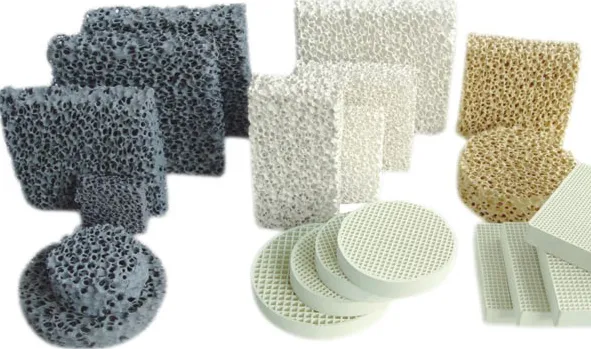
Main matrix materials include high-purity alumina (Al2O3) for balanced cost and chemical stability, silicon carbide (SiC) for improved thermal shock resistance, and zirconia blends where extreme toughness is required. Binders such as PVA or methylcellulose provide green strength. Dispersants and controlled water content produce the rheology needed for full infiltration of the foam template.
| Component | Typical wt% | Role |
|---|---|---|
| Ceramic powder (Al2O3/Sic mix) | 60 – 92 | Structural network after sinter |
| Binder (PVA, PVOH) | 0.5 – 6 | Green strength |
| Colloidal silica / soluble glass | 2 – 10 | Assists sintering |
| Water / solvent | 8 – 30 | Rheology control |
Major manufacturing routes and their trade-offs
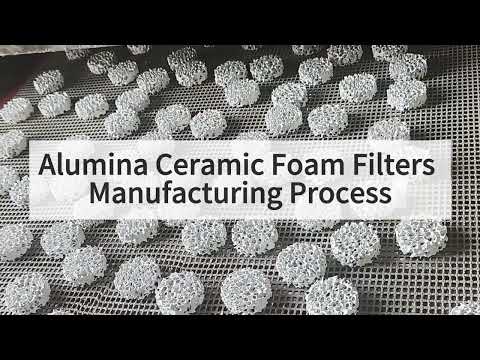
The main industrial methods are polymeric-sponge replication (replica method), direct foaming of the slurry, extrusion for honeycomb-like cellular shapes, and additive manufacturing for bespoke or low-volume parts. For aluminium foundry filters, the polymeric-sponge replica method dominates because it reliably reproduces open-cell topology from inexpensive template foams at scale.
Step-by-step process: polymeric-sponge (replica) method
1. Template selection and cutting
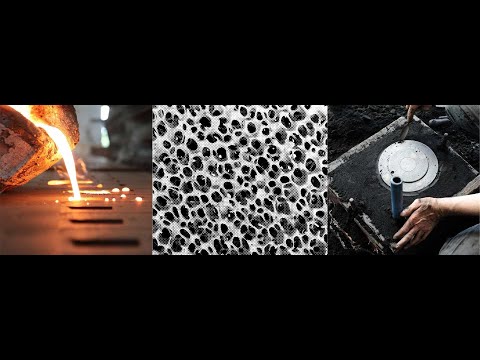
Select open-cell polyurethane or other polymer foam; cell count determines final pore size. For aluminium foundry filters common cell counts range 10 to 60 ppi. Cut blanks slightly oversize to allow trimming after sinter.
2. Slurry preparation
High-shear mixing of ceramic powder, binder, dispersant and water to a homogeneous slurry free of lumps. Target solids loading is usually 60 to 85 wt% depending on required wall thickness and powder characteristics.
3. Impregnation
Dip and squeeze, vacuum impregnation, or pressure cycling ensures slurry penetrates all open cells. Excess removal is performed with calibrated rollers; the roller gap sets residual coating thickness and thus final wall thickness.
4. Drying
Controlled drying at low temperatures (80-120 C) and slow ramping prevents cracks from differential shrinkage. Oven dwell times depend on part thickness.
5. Binder burnout
Slow ramp to 300-700 C in air to remove organic template and binders. Hold steps and controlled venting prevent internal blowout and maintain strut integrity.
6. Sintering
Final sinter to densify ceramic particles. For alumina peak temperatures commonly range 1100 to 1600 C; ramp and soak profiles control shrinkage and final strength. Careful control here determines chemical resistance and the absence of undesired glassy phases.
Process control and critical parameters
| Parameter | Typical range / target | Why it matters |
|---|---|---|
| Foam cell count | 10 – 60 ppi | Sets pore size and head loss |
| Slurry solids | 60 – 85 wt% | Controls wall thickness |
| Drying temp | 80 – 120 C | Avoids cracking |
| Burnout ramp | 0.5 – 2 C/min to 350-700 C | Prevent blowouts |
| Sinter peak (Al2O3) | 1100 – 1600 C | Densifies struts |
Quality control and acceptance tests
Common QC checks: open porosity (Archimedes or porometry), pore distribution, compressive strength, thermal shock resistance, and in-foundry filtration trials measuring inclusion count reduction. Traceability by powder lot and kiln batch is recommended for critical applications. Typical open porosity targets are 70 to 92% depending on grade.
Design selection: pore size, thickness and application mapping
| Pore (ppi) | Typical application | Practical note |
|---|---|---|
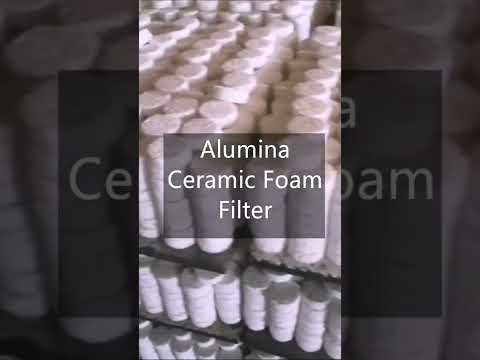
| 10 – 20 | Large ingots, riser flow | Low head loss |
| 20 – 30 | Billet casting, semi-continuous | Balance capture vs flow |
| 30 – 45 | Thin sections, finishing | Finer inclusion removal |
| >45 | Special finishing | Higher head loss |
Environmental, health and production scale points
Burnout emissions from polymer templates require capture and treatment. Dust control is essential when handling fine ceramic powders. For scale, continuous roller impregnation lines and tunnel kilns reduce unit cost per part. Many producers offer turnkey production lines with intelligent kiln control for repeatable cycles.
How AdTech product range supports foundry workflows
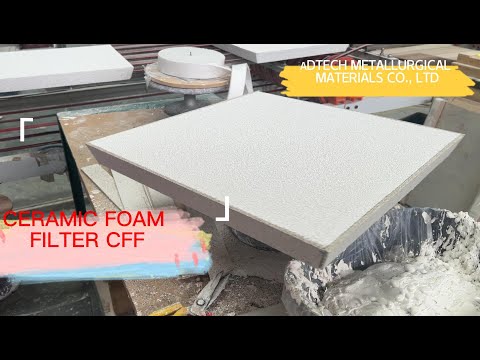
AdTech supplies alumina ceramic foam filters across common ppi grades and thicknesses, alongside ceramic insulation boards and ceramic fiber rope and blanket to protect pouring systems. For production adoption, request trial packs and matched technical support to optimize filter grade for your alloy and pouring geometry. AdTech’s manufacturing notes match standard industry process sequences.
Installation, storage and troubleshooting
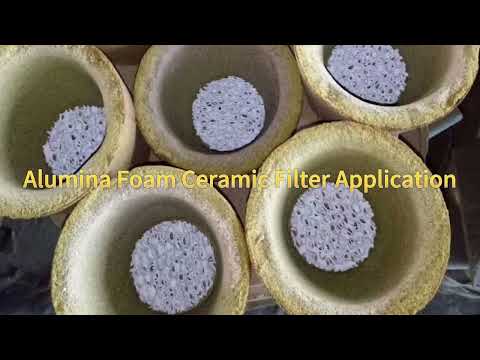
Preheat filters to minimize thermal shock and to ensure good wetting on first use. Store in dry, ventilated conditions. Common failure modes include cracking from rapid heating and clogging due to upstream dross; address with slower ramps and upstream degassing.
Final remarks and recommended qualification steps
To qualify a grade for production: run side-by-side cast trials with inclusion counting, mechanical test coupons and surface-finish inspection. Track batch and kiln zones to trace any anomalies. For large-scale use consider supplier audit for QC systems and environmental controls.
Ceramic Foam Filters: Selection & Advanced Technical FAQ
1. What pore count should I use for 6xxx series aluminum billets?
2. Can ceramic foam filters be reused?
3. Will alumina filters react with molten aluminum?
4. How does cell size affect flow and filtration efficiency?
5. Are Silicon Carbide (SiC) filters better than Alumina?
6. What is the standard sintering temperature for these filters?
7. How should I test filters before committing to production use?
8. What causes filter cracking during the first pour?
9. Do filters change the final metal chemistry?
10. How do I pick a supplier for high-volume filtration needs?
Final notes
If you plan to qualify a filter grade for production, request trial samples in the exact geometry you use, run a side-by-side casting test with and without the filter, and measure inclusion counts, mechanical properties and surface finish. For scale production, consider a supplier offering turnkey lines or contract manufacturing with environmental controls for burnout emissions.
If you want to know more about ceramic foam filter plates, you can browse our other guides:
Is Ceramic Porous or Nonporous?
Ceramic foam filter manufacturers in China.