

A high-temperature ceramic filter for aluminium casting must be designed for contact with molten aluminum, not simply described as a refractory ceramic product. The correct choice depends on the filter’s ceramic composition, actual metal temperature, pore density, filtration area, required flow rate, thermal-shock resistance, and installation conditions. For aluminum foundries, an alumina-based ceramic foam filter is a common option for removing non-metallic inclusions, but its suitability must be confirmed against the intended alloy and casting process. AdTech supplies ceramic foam filters, phosphorus-free CFF products, alumina filter media, and aluminum filtration equipment for these applications.
What Is a High-Temperature Ceramic Filter for Aluminium Casting?
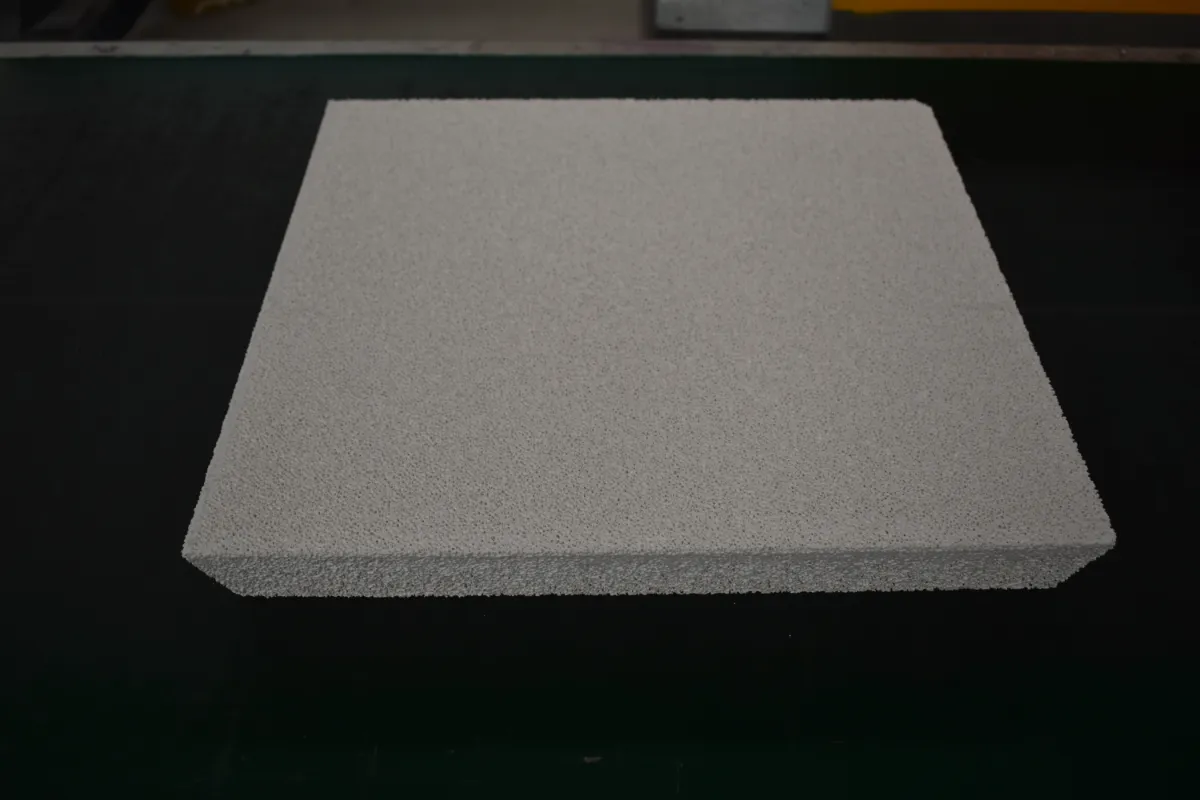
A ceramic foam filter is a porous refractory component through which molten metal passes during casting. Its interconnected, three-dimensional pore structure helps capture and retain non-metallic inclusions while allowing the required volume of metal to flow downstream.
In aluminum casting, these inclusions may include oxide particles, oxide-film fragments and other solid contaminants present in the melt. Their presence can contribute to casting defects, inconsistent product quality, and additional inspection or rework.
The term high-temperature ceramic filter requires some context, however. It does not identify a single material or guarantee that every ceramic filter can operate under the same conditions.
Two products described as ceramic filters may differ in chemical composition, pore structure, mechanical strength, thermal properties, and compatibility with molten metal. A filter designed for steel casting, for example, should not be assumed suitable for aluminum simply because both products are ceramic.
For an aluminum foundry, the first question is therefore not the highest temperature printed in a catalogue. It is whether the specified filter is engineered for molten aluminum and whether the complete filtration arrangement is appropriate for the actual production conditions.
Maximum Temperature and Actual Operating Temperature Are Not the Same
Temperature is one of the most important considerations when selecting a ceramic filter. It is also an area where product descriptions can be misleading if the terminology is not clearly defined.
Buyers should distinguish among three concepts.
| Temperature term | What it means | What buyers should verify |
|---|---|---|
| Material refractoriness | A material’s ability to withstand high temperatures under defined conditions | Whether this property is relevant to the intended application |
| Maximum service temperature | The upper operating temperature claimed for a particular material or product under stated conditions | The exact filter grade, test conditions and limitations |
| Actual process temperature | The temperature experienced by the filter in the casting line | Metal temperature at the filter, operating fluctuations and thermal exposure |
A material’s sintering temperature or general refractory classification should not be substituted for a documented operating-temperature rating.
The actual metal temperature at the point of filtration matters because the filter must remain suitable throughout the process, including initial contact with the melt and subsequent exposure during production.
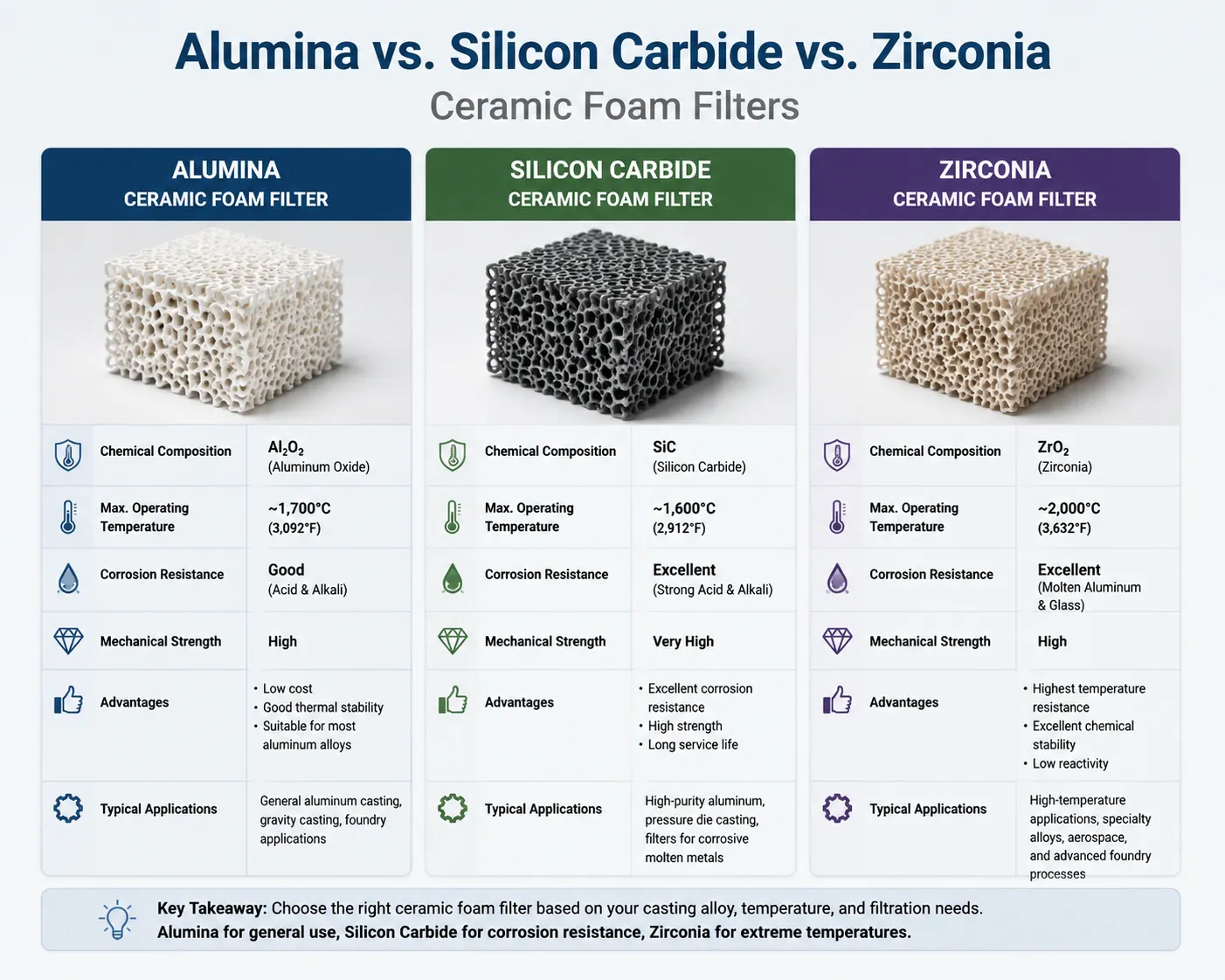
For AdTech’s aluminum-casting product context, temperature claims should be kept consistent with the specified aluminum application. Do not advertise a filter as suitable for service above 900°C, or describe it as a universal 1,000°C filter, without documentation for the exact product and operating conditions.
Before ordering, ask the supplier to confirm the maximum recommended operating temperature, the intended alloy family, and any restrictions relating to thermal cycling or contact time. If the published specification does not define these conditions, obtain clarification rather than assuming that a generic ceramic temperature figure applies.
Read more: What is ceramic foam filter?
Why Temperature Compatibility Involves More Than Heat Resistance
A filter may tolerate a stated temperature under one set of conditions but still perform poorly if it experiences rapid, uneven heating or mechanical stress.
The relevant questions include:
- Is the ceramic composition suitable for molten aluminum?
- Can the filter tolerate the expected operating temperature and thermal changes?
- Does its structure retain adequate integrity during handling and installation?
- Is the filter supported correctly within the filter box?
- Is the sealing arrangement compatible with the selected filter and heating procedure?
These questions connect material selection with the design of the complete filtration system.
Which Ceramic Material Is Suitable for Molten Aluminum?
Ceramic filters are manufactured from different material systems for different metal-processing applications. Material selection must therefore precede comparisons based on advertised temperature or price.
For the aluminum-casting applications discussed here, alumina-based ceramic foam filters are directly relevant to AdTech’s filtration product range. The company also supplies phosphorus-free CFF products for specific aluminum filtration requirements, alumina filter media, and cartridge filter tubes.
Alumina Ceramic Foam Filters
Alumina, or aluminum oxide (Al₂O₃), is widely used in products designed for aluminum-melt filtration.
A ceramic foam filter provides an interconnected pore structure rather than a simple straight-through opening. Inclusions can be retained through interactions with the filter structure as the melt passes through it.
AdTech describes its CFF products as using an adsorption-based filtration principle to remove larger inclusions and capture smaller inclusions in molten aluminum. The actual result depends on the filter specification and operating conditions, rather than material composition alone.
Phosphorus-Free Ceramic Foam Filters
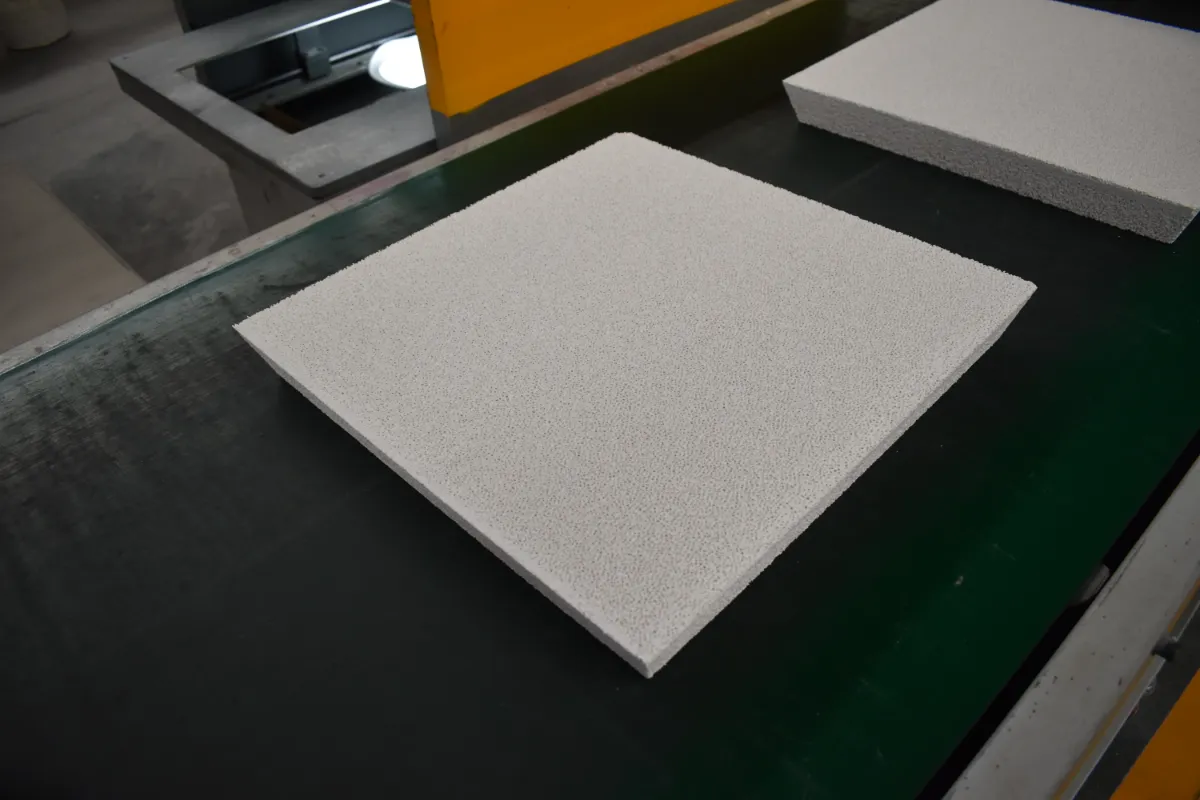
AdTech’s PHF, or phosphorus-free CFF, is described for aluminum casting lines with relatively low flow rates and lower filtration volumes. The product range is also intended for the filtration and purification of high-magnesium aluminum alloys.
This makes alloy composition and production requirements important selection inputs. Buyers working with high-magnesium alloys should disclose the alloy series and magnesium content instead of choosing a filter solely by dimensions or PPI.
Why a Filter for Another Metal May Be Unsuitable
A ceramic filter described as suitable for steel, iron, copper alloys or other high-temperature applications does not automatically meet the chemical and process requirements of aluminum casting.
Even when two products have similar shapes, their compositions, pore structures, thermal behavior and suitability for metal contact may differ.
The safest procurement process is to specify the metal being filtered, the exact alloy family and the actual process conditions. The supplier should then confirm compatibility for the intended application.
How Does a Ceramic Foam Filter Remove Inclusions?
A ceramic foam filter works by forcing molten metal through a network of connected pores. The structure provides opportunities for solid inclusions to contact the ceramic surfaces and become retained inside the filter.
This differs from a simple screen that only blocks particles larger than a single opening. The behavior of a foam filter depends on its pore geometry, the distribution and characteristics of inclusions, the filter’s orientation, and the flow of the melt.
Research published in the Journal of Japan Foundry Engineering Society investigated inclusion removal from aluminum alloy using ceramic foam filters. The study found that inclusion removal was influenced by filter pore size, installation arrangement and flow rate. Under the study’s model-experiment conditions, removal of approximately 90% of inclusions was found to be possible with suitable choices of these parameters. This is a study-specific finding, not a universal performance guarantee for every filter or foundry.
The practical implication is that selecting the correct filter is a system-design decision. Filter material and PPI matter, but they should be evaluated alongside metal flow and the physical arrangement of the filtration stage.
Which Contaminants Can Filtration Address?
Ceramic foam filtration is intended to reduce solid inclusions carried in molten aluminum. Its suitability depends on the types of contaminants present and the level of cleanliness required.
Filtration should not be treated as a substitute for every other melt-treatment operation.
For example, dissolved hydrogen is a separate concern. AdTech’s online degassing equipment is designed for molten-aluminum treatment, including hydrogen removal. Filtration and degassing address different aspects of melt quality and may be used together when the process requires both.
How to Choose the Correct PPI for High-Temperature Aluminum Filtration
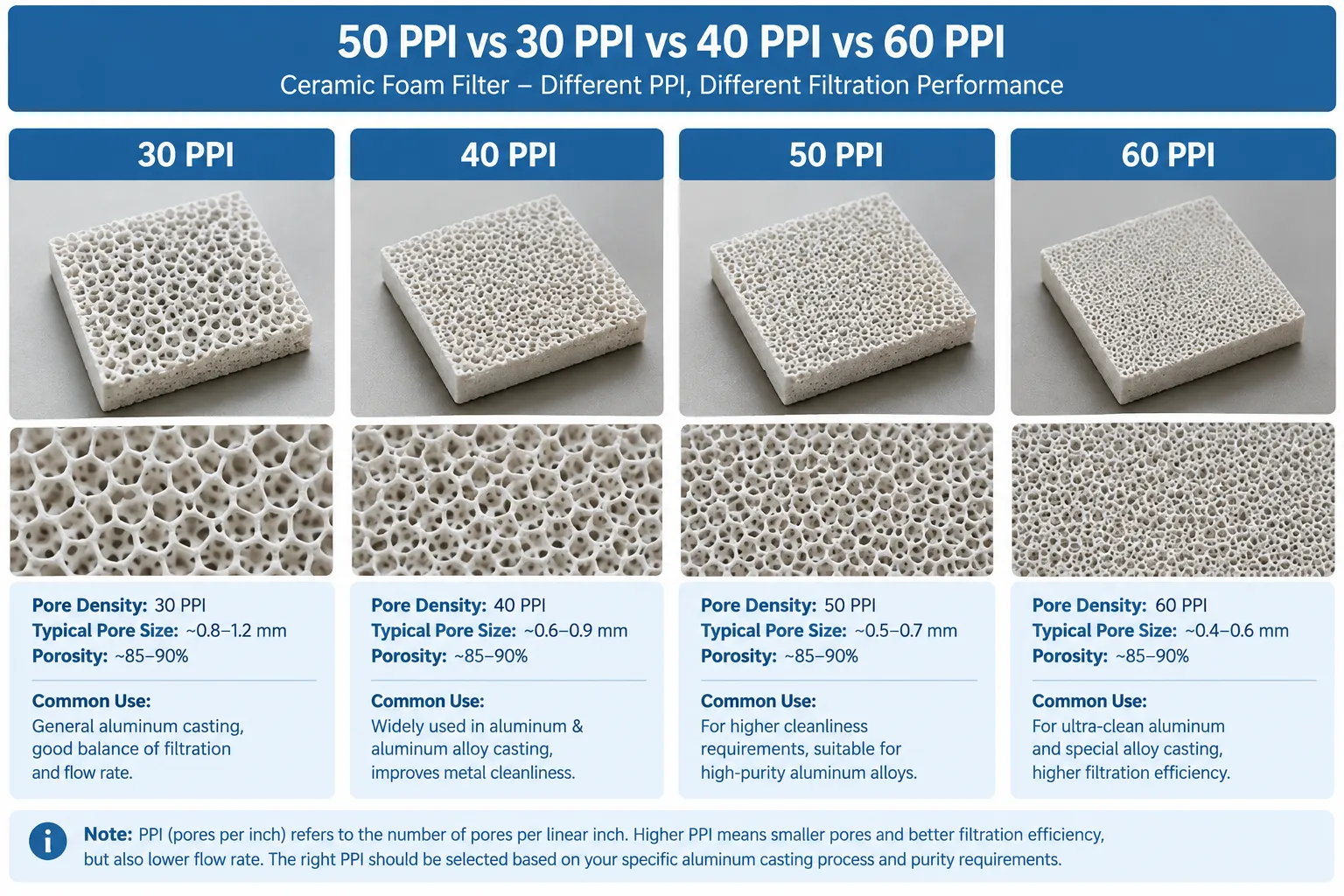
PPI means pores per inch. It describes the nominal number of pores along a linear inch of the filter structure. It does not directly indicate an exact filtration cutoff in micrometers.
As a general selection principle, higher PPI indicates a finer pore structure. This may improve the retention of certain inclusions, but it can also increase flow resistance and reduce the filter’s capacity under otherwise comparable conditions.
AdTech’s plate-type filtration equipment documentation likewise notes that filtration results depend on the specifications, quantity and PPI of the ceramic foam filters, and that greater filtration accuracy can mean lower capacity.
Preliminary PPI Selection Guide
The following table is an initial screening guide, not a substitute for application-specific testing or supplier recommendations.
| Nominal PPI | Initial consideration | Main trade-off |
|---|---|---|
| 10–20 PPI | Applications prioritizing flow capacity or handling a relatively high inclusion load | Coarser structure may be less effective for some finer inclusions |
| 30 PPI | A practical starting point for many general aluminum-casting applications | Must still be matched to flow and cleanliness requirements |
| 40–50 PPI | Applications that need to evaluate finer filtration | Higher resistance and earlier blockage may become concerns |
| 50–60 PPI | More demanding cleanliness requirements where the process can support finer filtration | Requires careful validation of flow capacity and production stability |
These ranges are not universal specifications. Alloy, casting speed, inclusion loading, filter area, filter-box design and other process conditions can change the appropriate choice.
Is 50 PPI Always Better Than 30 PPI?
No.
A 50 PPI filter may be worth evaluating when finer inclusion control is required, but it is not inherently the best choice for every aluminum casting line.
If the production line needs a high flow rate and has limited filter area, a finer filter can create excessive resistance or become blocked sooner. That may affect filling time, process stability or casting quality.
A 30 PPI filter may be a more appropriate starting point for general production, while a 50 PPI filter may be considered for a more demanding cleanliness target when flow capacity remains sufficient.
The correct decision should be based on the result required, not on an assumption that a higher number automatically means a better overall filter.
A useful production trial changes one major variable at a time where practical. Comparing different PPI grades while also changing filter dimensions, metal flow and process settings makes it more difficult to determine which change affected the result.
Why Filter Dimensions and Flow Rate Matter
PPI is only one part of filter selection. The available filtration area and the volume of metal passing through the filter also affect performance.
A filter that is too small for the required throughput may experience a high loading rate, increasing resistance and making the operation less stable. A suitably sized filter or filtration arrangement can provide more capacity without relying entirely on coarser pores.
Before selecting a size, establish the following:
- Required mass flow rate, expressed in kilograms per minute or tonnes per hour.
- Total metal volume expected to pass through the filter during the production cycle.
- Available filter-box dimensions and support geometry.
- Required casting speed and acceptable filling time.
- Expected inclusion loading and the required level of metal cleanliness.
- Whether the current process has sufficient filtration area.
Do not assume that a filter’s nominal dimensions establish its flow capacity. Request model-specific operating data and confirm the recommended filtration arrangement with the supplier.
Preheating, Thermal Shock and Filter-Box Sealing
A technically suitable filter may still fail if it is installed or heated incorrectly.
Thermal shock occurs when a material experiences a sufficiently rapid or uneven temperature change. During casting preparation, a cold or unevenly heated filter can experience stress when contacted by hot molten aluminum.
Preheating procedures must be matched to the specific filter, filter box, refractory lining, sealing material and heating system.
Follow a Product-Specific Preheating Procedure
There is no single preheating temperature or heating schedule that should automatically be applied to every ceramic foam filter.
Before operation, ask the supplier to specify:
- The required preheating temperature.
- The recommended heating rate and holding time.
- Whether the filter and filter box must be preheated together.
- The approved heating method.
- Whether direct flame exposure is permitted.
- Any preparation required for the sealing gasket or refractory lining.
Where the approved operating procedure requires preheating above 500°C, heat the filter uniformly and follow the specified ramp and holding conditions. Do not interpret that example as a universal target for every product.
The objective is to achieve the required thermal condition without creating localized overheating or unnecessary thermal stress. Use the applicable product and equipment instructions rather than copying an unrelated manufacturer’s schedule.
Prevent Molten Aluminum from Bypassing the Filter
A filter only performs its intended filtration function when molten metal passes through the filter medium.
If gaps remain between the filter edge and its seat, metal may travel around the filter rather than through it. This bypass can undermine filtration even when the filter itself is in good condition.
Before introducing molten metal, inspect the filter seat, support surfaces and specified sealing materials. Confirm that the filter is correctly positioned, that the seal matches the design, and that the box is suitable for the selected filter dimensions.
Do not use excessive force to compensate for an incompatible filter or damaged seat. Mechanical stress can create another failure risk.
Maintain Stable Metal Flow
Sudden impact, vibration, inappropriate pressure conditions or unstable metal transfer can affect filter integrity and operation.
Follow the equipment’s startup procedure and avoid introducing molten metal in a way that creates an unnecessary shock load. Monitor metal levels and flow behavior according to the filtration-system design.
The filter must be evaluated as part of the complete transfer arrangement, not as an independent consumable.
Ceramic Foam Filter vs. Other Aluminum Filtration Solutions
Ceramic foam filters are one option in a broader aluminum-melt purification system. The correct solution depends on the line’s filtration requirements, available space, production capacity and existing equipment.
AdTech’s product portfolio includes CFF, cartridge filter tubes, alumina filter media, plate-type filtration equipment and deep-bed filtration equipment.
| Solution | Primary role | Key selection consideration |
|---|---|---|
| Ceramic foam filter (CFF) | Capture solid inclusions as molten aluminum passes through the porous filter | PPI, area, alloy, flow rate, sealing and compatibility |
| Phosphorus-free CFF (PHF) | Specialized ceramic foam filtration for suitable aluminum-casting applications | Alloy chemistry, including high-magnesium applications, and operating capacity |
| Cartridge filter tube | Provides a large surface area for filtration within a limited space | Required throughput, filtration grade and equipment configuration |
| Alumina filter medium | Provides filtration media for aluminum melt in a suitable filtration arrangement | Media specification, system design and required performance |
| Deep-bed filtration equipment | Provides a different filtration configuration for batch or continuous production | Capacity, available space, process requirements and system design |
| Online degassing equipment | Treats dissolved hydrogen in molten aluminum | Hydrogen-removal target, flow rate and operating conditions |
These solutions are not necessarily interchangeable. A buyer should explain the current problem before requesting a replacement product.
For example, if a casting line has acceptable hydrogen levels but experiences inclusion-related defects, filtration may be the main issue to investigate. If the principal concern is dissolved hydrogen, simply changing from 30 PPI to 50 PPI is not an adequate substitute for evaluating melt treatment.
Where both inclusion control and hydrogen removal are required, filtration and degassing should be considered as complementary process stages.
Common Ceramic Filter Problems and How to Investigate Them
When a filter-related problem occurs, avoid assuming immediately that the ceramic material is defective. Several process and installation factors can produce similar symptoms.
| Observed problem | Possible causes to investigate | Recommended checks |
|---|---|---|
| Filter cracks during startup | Uneven preheating, rapid temperature changes, handling damage or uneven support | Inspect the filter, review the heating procedure and verify correct seating |
| Metal flow becomes restricted | Filter specification too fine for the required flow, accumulated inclusions or insufficient filtration area | Check PPI, flow demand, filter loading and available area |
| Filtration results remain poor | Metal bypass, unsuitable filter selection, unstable flow or an upstream melt-quality issue | Inspect edge sealing, verify process conditions and evaluate the inclusion problem |
| Filter shifts during operation | Incorrect seating, incompatible dimensions or inadequate retention | Check filter-box geometry, seals and installation procedure |
| Production becomes inconsistent | Changes in alloy, temperature, metal flow, filter loading or equipment condition | Compare operating records and isolate changes in one process variable at a time |
These are diagnostic starting points, not confirmed causes in every case. Where a filter cracks or the system behaves abnormally, suspend operation as required by the site’s safety procedure and have the equipment inspected before returning to production.
What Should Buyers Ask a Ceramic Filter Manufacturer?
A useful quotation request gives the manufacturer enough information to determine whether the proposed filter fits the intended application.
Sending only a photograph or a nominal PPI value may lead to repeated clarification and an inaccurate specification.
Provide the following information wherever available.
1. Alloy and Application
Identify the alloy series, relevant composition details and final product application. State whether the line produces billets, slabs, rolled products or other cast forms.
This is particularly important for high-magnesium aluminum alloys and other applications with specific filtration requirements.
2. Temperature Conditions
Provide the actual molten-metal temperature at the filtration stage, including the expected operating range where known.
Ask the manufacturer to confirm the product’s recommended service temperature and any restrictions that apply to the intended process. Do not rely exclusively on a general material temperature or a value copied from a different ceramic product.
3. Current Filter Specification
If replacing an existing filter, supply its PPI, dimensions, thickness, edge design and filter-box opening.
Also indicate whether the existing filter meets the required cleanliness and throughput targets. A replacement should not be selected solely because it matches the old filter’s outside dimensions.
4. Production Flow and Filtration Requirements
Specify the required flow rate, production duration, metal volume, casting speed and desired metal-cleanliness target.
If filtration capacity is currently insufficient, explain whether the problem is slow flow, premature blockage, inclusion defects or another measurable issue.
5. Equipment and Installation
Describe the filter box, heating arrangement, sealing method and available installation space.
Ask the supplier to confirm compatibility and provide the appropriate installation and preheating procedure.
6. Quality Documentation
Request the product specification, applicable inspection records, batch identification and any documented performance data relevant to the order.
Where a supplier quotes a filtration-efficiency percentage, ask what the figure measures, how it was determined, and which filter grade and operating conditions were used.
A useful technical quotation should connect the proposed product with the actual application rather than merely repeat general marketing specifications.
What Affects the Price of a High-Temperature Ceramic Filter?
There is no reliable universal price for a ceramic foam filter based on the phrase high temperature alone.
Cost can vary with the ceramic formulation, PPI, dimensions, thickness, manufacturing tolerances, edge structure, order quantity, packaging requirements and any agreed inspection or documentation.
Custom dimensions and special application requirements may also affect production and delivery.
Buyers comparing quotations should therefore check whether the quoted filters use equivalent material specifications, dimensions, PPI, tolerances and quality requirements.
A lower initial price is not necessarily the lowest operating cost if the filter is incompatible with the line, has insufficient capacity or produces inconsistent results. Conversely, a more expensive specification is not automatically better if it exceeds the production requirements.
The practical objective is to purchase a filter that provides the required cleanliness and flow performance under verified operating conditions.
How AdTech Supports Aluminum Melt Filtration
AdTech Metallurgical Materials Co., Ltd. focuses on filtration and purification for aluminum and aluminum-alloy casting and rolling applications. Its published product range includes ceramic foam filters, phosphorus-free CFF, cartridge filter tubes, alumina filter media, filtration equipment and online degassing equipment.
This range allows buyers to evaluate filter media alongside the equipment and melt-treatment stages in which the product will operate.
For ceramic foam filter inquiries, the most useful starting information includes the alloy series, flow rate, required PPI, current filter dimensions and intended end application. AdTech’s contact page specifically requests product and alloy information, flow rate, current filter brand and PPI, and feedback on whether the existing filter meets the required flow and filtration performance.
The technical objective is to match the filter and filtration arrangement to the production process, not to recommend the highest PPI or the highest advertised temperature without considering the other requirements.
For an accurate recommendation, buyers should request confirmation of material compatibility, the recommended service temperature, filter dimensions, PPI, capacity and installation requirements for the specific product.
Conclusion
Choosing a high-temperature ceramic filter for aluminium casting requires more than checking a maximum temperature figure. The filter must be suitable for molten aluminum and the intended alloy, while its PPI, dimensions, filtration area, thermal behavior and installation must meet the production requirements.
For many applications, an alumina ceramic foam filter provides a practical starting point for inclusion control. More demanding filtration requirements may justify evaluating a finer PPI, but the choice must still preserve adequate metal flow and production stability.
Before purchasing, confirm the exact product specification with the manufacturer, provide the actual casting conditions, and verify preheating and sealing requirements. These steps provide a more reliable basis for selecting a filter than choosing by a generic temperature claim alone.