

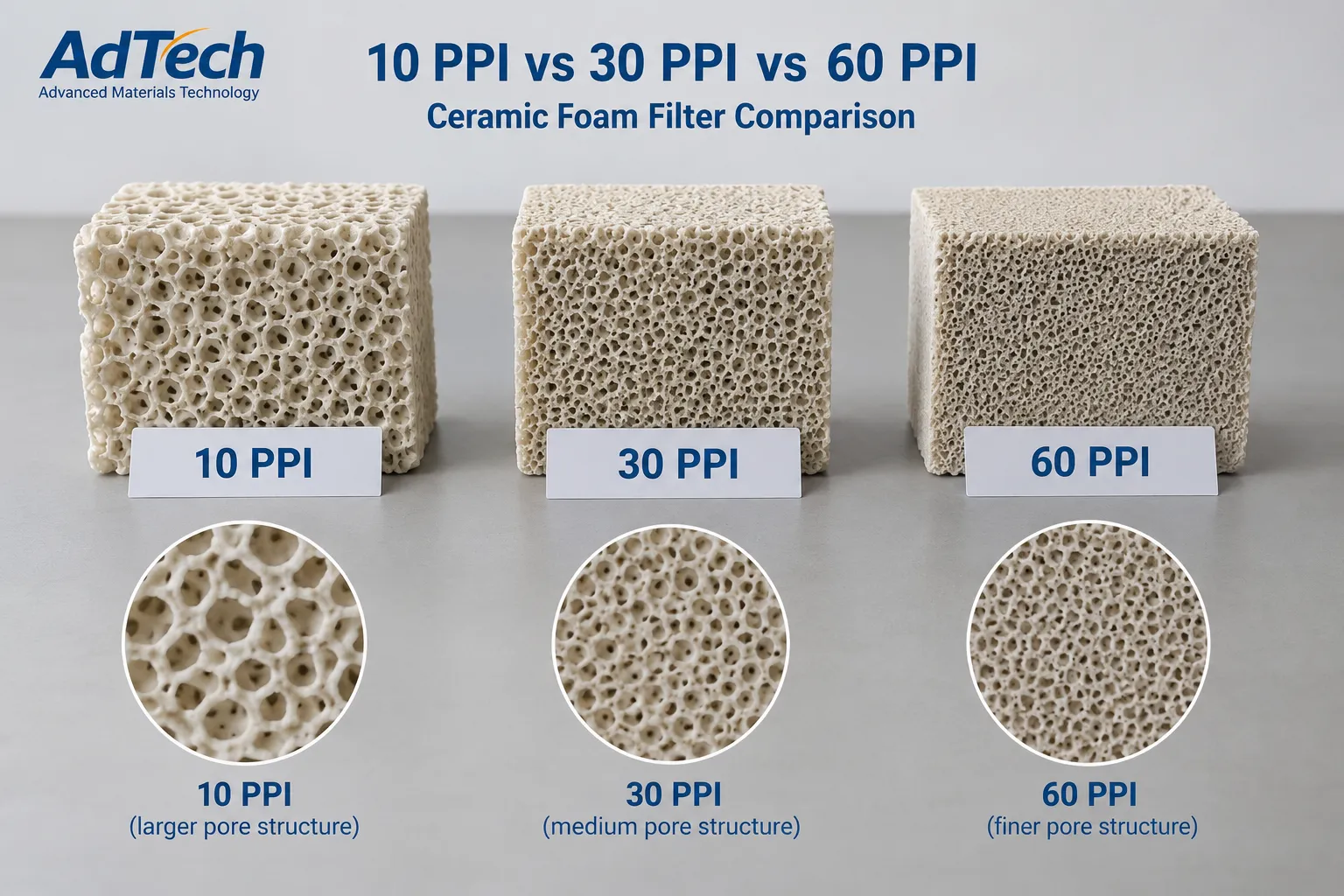
Filtros de espuma cerámica de 10 PPI, 30 PPI y 60 PPI están diseñadas para distintos requisitos de filtración, pero el PPI más alto no es necesariamente la mejor opción. Un filtro de 10 PPI suele presentar una estructura más abierta y una menor resistencia al flujo. A Filtro de 30 PPI Ofrece una estructura más fina y es un punto de partida habitual para muchas aplicaciones de fundición de aluminio. Un filtro de 60 PPI proporciona una estructura de filtración aún más fina, pero puede requerir prestar más atención a la capacidad de caudal, la superficie filtrante y la limpieza del metal.
La elección correcta depende de las inclusiones que deban eliminarse, del caudal de metal requerido, de las dimensiones del filtro, del proceso de fundición y del riesgo de producción aceptable. Por lo tanto, el PPI debe utilizarse como un elemento más de la especificación, y no como el único requisito de compra.
¿Qué significa «PPI» en un filtro de espuma cerámica?
PPI significa poros por pulgada. Describe la densidad nominal de poros de la estructura cerámica de célula abierta.
En general:
- 10 PPI: Estructura más gruesa y más abierta.
- 30 PPI: Estructura más detallada.
- 60 PPI: Una estructura aún más fina.
A medida que aumenta el PPI, la estructura porosa característica tiende a reducirse. Esto puede mejorar la capacidad del filtro para retener inclusiones más pequeñas, pero también aumenta la resistencia al flujo del metal fundido.
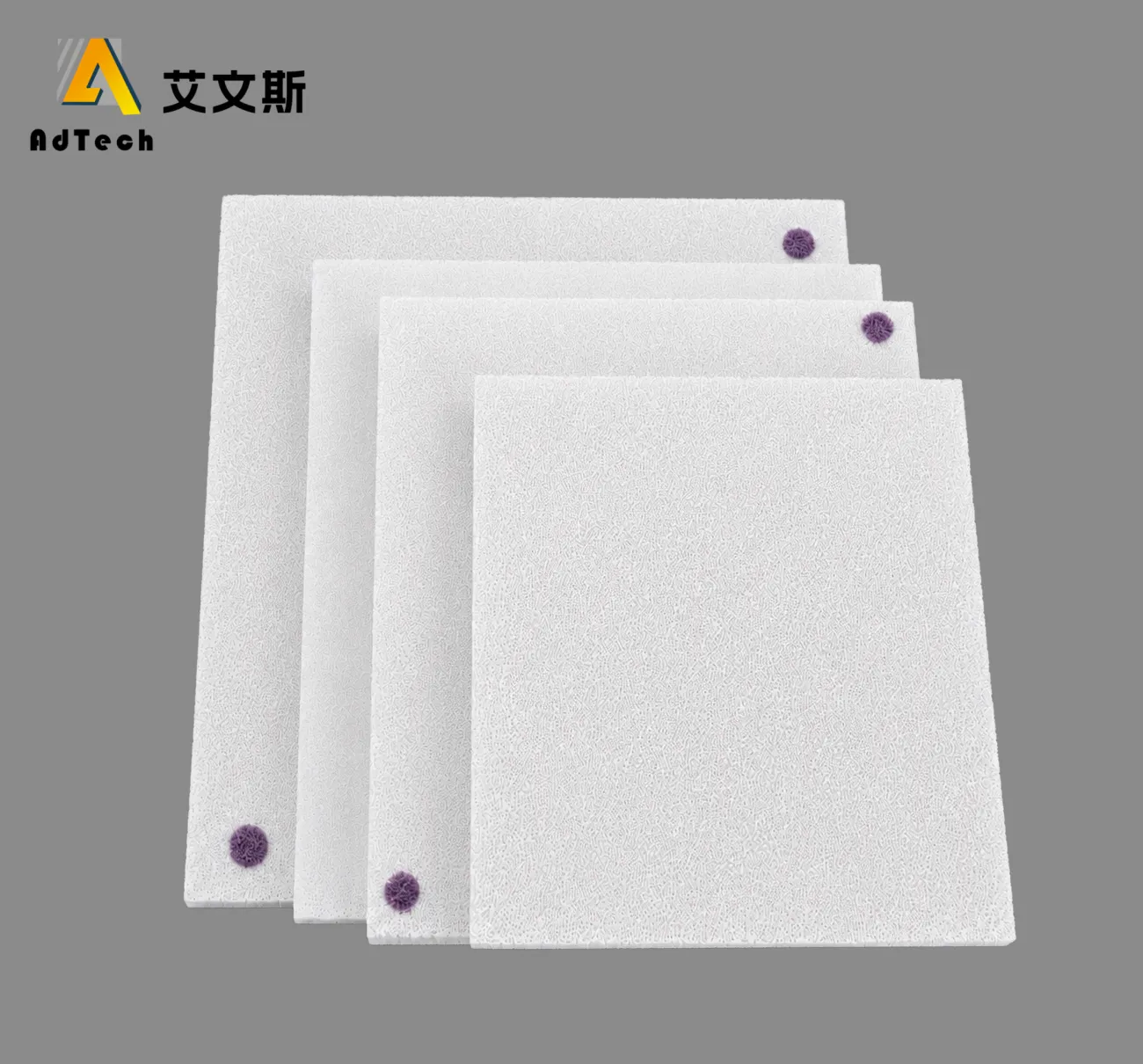
El PPI no es lo mismo que la abertura de un tamiz
Un filtro de espuma cerámica es una red tridimensional de conductos interconectados. No se trata de una malla tejida con aberturas cuadradas uniformes.
El aluminio fundido recorre un trayecto sinuoso, y la filtración no se limita a un simple tamizado mecánico. La captura de inclusiones depende de la estructura del filtro, las características de las inclusiones, las condiciones de flujo y el estado de la masa fundida.
Por eso no se debe dar por sentado automáticamente que dos filtros con el mismo PPI nominal tengan un rendimiento de filtración idéntico. Una especificación de compra que solo indique “filtro de espuma cerámica de 30 PPI” deja sin definir varias propiedades importantes.
Más información: ¿Qué es un filtro de espuma cerámica?
10 PPI frente a 30 PPI frente a 60 PPI: la diferencia principal
La forma más útil de comparar los tres niveles es tener en cuenta la capacidad de caudal, el grado de filtración y los requisitos de funcionamiento en su conjunto.
| Factor | 10 PPI | 30 PPI | 60 PPI |
|---|---|---|---|
| Estructura porosa nominal | Tosco | Medio-fino | Bien |
| Resistencia relativa al flujo | Por lo general, más bajo | Por lo general, superior a 10 PPI | Por lo general, superior a 30 PPI |
| Enfoque de filtración | Captura de inclusiones más gruesas | Equilibrio entre filtración y caudal | Filtración de inclusiones más finas |
| Problema habitual en la selección | Si se requiere una filtración más fina | Si el saldo es adecuado | Si la capacidad de caudal y el riesgo de obstrucción son aceptables |
| Principal ventaja | Trayectoria de flujo más abierta | Una balanza práctica para numerosas aplicaciones | Posibilidad de una filtración más fina |
| Limitación principal | Es posible que no garantice una limpieza suficiente | Puede que no sea suficiente para todas las aplicaciones que requieran un alto nivel de limpieza | Puede que sea necesario un diseño más minucioso del sistema |
| La mejor base de selección | Caudal requerido y carga de inclusión | Nivel de limpieza y estabilidad del flujo requeridos | Requisitos de limpieza, capacidad de caudal y homologación |
Estos son características generales, no son garantías para todos los filtros ni para todos los procesos de fundición. El resultado real depende de la estructura cerámica, la superficie del filtro, el espesor, la pureza del material fundido y las condiciones de funcionamiento.
¿Para qué se utiliza un filtro de espuma cerámica de 10 PPI?
A Filtro de espuma cerámica de 10 PPI Tiene una estructura porosa relativamente abierta. Se suele tener en cuenta cuando el proceso requiere una alta capacidad de caudal y una filtración de inclusiones gruesas.
Entre sus posibles aplicaciones se incluyen:
- Filtración gruesa previa a una etapa de filtración más fina.
- Procesos con una carga de inclusiones relativamente elevada.
- Aplicaciones en las que el mantenimiento de la capacidad de caudal es una cuestión fundamental.
- Procesos de fundición de aluminio en los que se puede alcanzar el nivel de limpieza requerido sin necesidad de utilizar un filtro de mayor finura.
Sin embargo, un PPI de 10 no debe interpretarse como un “filtro de alto caudal” universal. El caudal real depende de las dimensiones del filtro, su grosor, la estructura cerámica, la temperatura del metal, la presión de alimentación y el estado de la masa fundida.
Cuándo puede ser preferible un PPI de 10
Un PPI de 10 puede ser un punto de partida razonable cuando:
- El proceso debe procesar un gran volumen de aluminio fundido.
- La población de inclusión es relativamente heterogénea.
- Un filtro más fino provocaría una resistencia al flujo excesiva.
- El filtro se utiliza como etapa de filtración preliminar.
Cuándo un PPI de 10 puede no ser adecuado
Es posible que un PPI de 10 no sea suficiente cuando:
- La fundición requiere un mayor nivel de control de las impurezas.
- Las inclusiones finas son motivo de gran preocupación.
- Se espera que el filtro ofrezca una capacidad de filtración superior a la que su estructura puede proporcionar razonablemente.
La pregunta importante no es “¿Es 10 PPI la opción más barata?”, sino:
¿Puede este filtro garantizar el grado de limpieza requerido sin provocar una restricción del caudal inaceptable?
¿Para qué se utiliza un filtro de espuma cerámica de 30 PPI?
A Filtro de espuma cerámica de 30 PPI ofrece una estructura más fina que 10 PPI, al tiempo que, por lo general, conserva una mayor capacidad de caudal que un filtro mucho más fino.
Es un punto de partida habitual para muchas aplicaciones de fundición de aluminio, ya que ofrece un equilibrio práctico entre la filtración y el rendimiento del caudal. Sin embargo, “punto de partida habitual” no significa “adecuado para todas las líneas de fundición”.”
Entre sus posibles aplicaciones se incluyen:
- Fundición general de aluminio.
- Filtración de aleaciones de aluminio en la que se requiere un control de inclusiones de tamaño moderado a fino.
- Procesos de fundición que requieren un equilibrio entre la limpieza y la estabilidad de la producción.
- Aplicaciones en las que se está barajando la posibilidad de utilizar un filtro más fino, pero la capacidad de caudal sigue siendo un motivo de preocupación.
Cuándo puede ser preferible un valor de 30 PPI
30 PPI puede ser un punto de partida razonable cuando:
- El proceso requiere un mayor grado de filtración del que puede ofrecer un filtro de grano grueso.
- La fundición debe encontrar el equilibrio entre la eliminación de inclusiones y la capacidad de flujo.
- Los requisitos de limpieza de la masa fundida y de la fundición no justifican el uso de un grado más fino.
- La superficie de filtración y las condiciones de fundición son adecuadas para el tipo de aleación seleccionado.
Cuándo puede que 30 PPI no sea adecuado
Es posible que 30 PPI no sean suficientes cuando:
- El nivel de limpieza requerido es superior al que el proceso puede alcanzar con este grado.
- El proceso de fundición presenta una carga de inclusiones especialmente elevada.
- El filtro tiene un tamaño insuficiente para el caudal requerido.
- La fundición está utilizando el índice PPI como sustituto de un diseño completo de filtración.
Un filtro de 30 PPI no es necesariamente mejor que uno de 10 PPI. Se trata simplemente de una opción de filtración más fina con unas características de funcionamiento diferentes.
¿Para qué sirve un filtro de espuma cerámica de 60 PPI?
A Filtro de espuma cerámica de 60 PPI tiene una estructura porosa nominal más fina que la de 10 PPI y 30 PPI.
Se puede considerar cuando el proceso requiera una filtración más fina y las condiciones de funcionamiento permitan soportar la resistencia adicional al flujo. Sin embargo, un filtro más fino no garantiza que se eliminen todas las impurezas de menor tamaño.
Entre sus posibles aplicaciones se incluyen:
- Procesos de fundición de aluminio con requisitos de limpieza más exigentes.
- Aplicaciones en las que es importante un control más preciso de las inclusiones.
- Procesos en los que el sistema de filtración tiene capacidad suficiente para el grado seleccionado.
- Situaciones en las que se ha evaluado un filtro de mayor precisión y se ha demostrado que cumple con los requisitos de rendimiento exigidos.
Cuándo puede ser preferible un valor de 60 PPI
60 PPI puede ser un punto de partida razonable cuando:
- El nivel de limpieza requerido es superior al que puede ofrecer un filtro de mayor porosidad.
- El proceso puede soportar la resistencia adicional al flujo.
- La superficie de filtración y el diseño del sistema son adecuados.
- La fundición tiene una razón clara para optar por un grado más fino.
Cuándo puede que 60 ppp no sea lo más adecuado
Es posible que una resolución de 60 PPI no sea adecuada cuando:
- El filtro es demasiado pequeño para el caudal de metal requerido.
- La masa fundida contiene una alta concentración de inclusiones.
- No hay suficientes cabezales metálicos disponibles.
- La estructura más fina provoca una resistencia excesiva o una obstrucción prematura.
- El proceso no ha sido homologado para el grado seleccionado.
La conclusión correcta no es que 60 PPI sea siempre mejor, sino que Puede ser preferible optar por 60 PPI cuando el beneficio adicional de filtración compense los requisitos operativos adicionales..
Más información: ¿Cómo elijo el PPI de un filtro de espuma cerámica?
¿Qué PPI es el más adecuado para la fundición de aluminio?
No existe un único PPI que sea el más adecuado para todas las aplicaciones de fundición de aluminio.
Una comparación preliminar útil es la siguiente:
| Requisitos de casting | Posible punto de partida | Por qué |
|---|---|---|
| Alta capacidad de caudal y filtración gruesa | 10 PPI | Una estructura más abierta |
| Filtración general que combina un flujo adecuado con un alto nivel de limpieza | 30 PPI | Opción habitual de alcance medio |
| Requisitos de filtración más precisa | 60 PPI | Estructura nominal más detallada |
| Condiciones de proceso inciertas o variables | Requisitos de titulación | El PPI por sí solo no es suficiente |
Esta tabla es una punto de partida de la selección, no se trata de una norma de aplicación universal. El grado definitivo debe seleccionarse teniendo en cuenta la aleación concreta, la concentración de inclusiones, el proceso de fundición, las dimensiones del filtro y el nivel de limpieza requerido.
Por qué un PPI más alto no siempre es mejor
Un error habitual es dar por sentado que:
Un PPI más alto = mejor filtración = mejor fundición.
La primera parte de esa afirmación puede ser cierta, en términos generales, en lo que respecta a la estructura porosa nominal, pero la conclusión es incompleta.
Un filtro de mayor finura puede ofrecer un mayor potencial de filtración, al tiempo que aumenta la resistencia al flujo del metal fundido. Si el filtro se sobrecarga o la presión disponible es insuficiente, el resultado puede ser un flujo inestable, un llenado incompleto u otros problemas de producción.
La pregunta más acertada es:
¿Qué nivel de filtración requiere la fundición y de qué condiciones de caudal se dispone para lograrlo?
Por eso, un filtro de 30 PPI puede ser preferible a uno de 60 PPI en un proceso, mientras que en otro puede ser preferible uno de 60 PPI.
Más información: Cómo elegir el PPI adecuado para la filtración en fundiciones de aluminio
Cómo influye el área de filtrado en la decisión sobre el PPI
El PPI nunca debe considerarse independientemente del tamaño del filtro.
Un filtro con una estructura más fina puede requerir una mayor superficie de filtración para mantener una capacidad de caudal aceptable. Un filtro de tamaño insuficiente puede saturarse más rápidamente, incluso si su PPI es el adecuado.
Entre los factores importantes se incluyen:
- Superficie del filtro.
- Espesor del filtro.
- Caudal de aluminio fundido.
- Duración del hechizo.
- Diseño de la caja de filtro.
- Cabezal metálico disponible.
- Carga de inclusión.
- Nivel de limpieza requerido de la pieza fundida.
Una selección de filtros que no tenga en cuenta estos factores puede dar lugar a una especificación que parezca correcta sobre el papel, pero que no funcione de forma fiable en producción.
La elección del PPI debe partir del metal, no del filtro
Antes de elegir un tipo de acero, identifica cuál es el problema metalúrgico real.
1. ¿Qué inclusiones hay que eliminar?
Piensa en lo siguiente:
- Películas de óxido.
- Partículas de escoria.
- Fragmentos refractarios.
- Otras inclusiones no metálicas.
El tamaño, el tipo y la concentración de las inclusiones son factores importantes. No cabe esperar que un filtro diseñado para la retención de inclusiones gruesas ofrezca el mismo resultado que uno con un grado de filtración más fino.
2. ¿Qué nivel de limpieza se requiere?
Los distintos productos de fundición tienen distintos requisitos de calidad.
Es posible que un filtro destinado a una aplicación general de fundición no resulte adecuado para un proceso en el que el control de inclusiones sea más exigente. Antes de seleccionar el PPI, se debe definir el grado de limpieza requerido.
3. ¿Qué caudal se necesita?
Un filtro que ofrezca una filtración más fina pero que no pueda soportar el caudal necesario puede que no sea una buena opción.
En la selección se debe tener en cuenta lo siguiente:
- Capacidad de procesamiento de metal requerida.
- Velocidad de colada.
- Área de filtrado.
- Espesor del filtro.
- Presión disponible.
- Duración prevista de funcionamiento.
4. ¿Qué grado de pureza tiene la masa fundida antes de la filtración?
Los filtros de espuma cerámica no sustituyen a un tratamiento adecuado de la masa fundida.
Si la masa fundida contiene una elevada cantidad de inclusiones, un filtro más fino puede saturarse más rápidamente. Mejorar el tratamiento de la masa fundida en las fases previas puede resultar más eficaz que limitarse a seleccionar un PPI más fino.
Qué deben comparar los compradores además del PPI
A la hora de comparar proveedores de filtros de espuma cerámica, el PPI solo debería ser uno de los criterios de la especificación.
Un pliego de condiciones de compra más completo podría incluir:
| Especificación | Por qué es importante |
|---|---|
| Composición cerámica | Determina la idoneidad para el metal fundido al que va destinado |
| IPP nominal | Define el grado de densidad de poros previsto |
| Dimensiones del filtro | Influye en la superficie de filtración y en la capacidad de caudal |
| Espesor | Influye en el recorrido del flujo y en el comportamiento de la filtración |
| Tolerancias dimensionales | Ayuda a garantizar la compatibilidad con la caja del filtro |
| Requisitos relativos a las propiedades físicas | Ayuda a evaluar la idoneidad para las condiciones de funcionamiento previstas |
| Criterios de inspección | Ayuda a mantener la uniformidad entre lotes |
| Requisitos de embalaje | Ayuda a proteger el filtro antes de su uso |
| Trazabilidad | Apoya el control de calidad y la gestión de cambios de proveedores |
| Solicitud aprobada | Ayuda a evitar su uso fuera del proceso validado |
Las especificaciones exactas deben basarse en el sistema de calidad de la fundición y en los requisitos de la aplicación.

Errores habituales a la hora de elegir filtros de espuma cerámica
Error n.º 1: Elegir el PPI más alto sin comprobar la capacidad de caudal
Un filtro más fino puede generar mayor resistencia. Si el sistema no puede soportarla, el resultado puede ser un llenado deficiente o una producción inestable.
Un enfoque más adecuado: Evalúa el PPI junto con la superficie del filtro, el caudal y la presión disponible.
Error 2: Considerar el PPI como el diámetro exacto de los poros
El PPI es una descripción nominal de la estructura de la espuma. No equivale a un tamaño de malla uniforme.
Un enfoque más adecuado: Solicita a los proveedores la información pertinente sobre la estructura porosa y las condiciones de ensayo.
Error n.º 3: Utilizar el mismo tamaño de filtro para todos los PPI
Cambiar de 10 PPI a 60 PPI sin revisar el área del filtro y las condiciones de funcionamiento puede provocar un problema de producción que se podría haber evitado.
Un enfoque más adecuado: Revisa todo el sistema de filtración al cambiar el PPI.
Error n.º 4: Dar por sentado que un filtro más fino puede resolver cualquier problema de inclusiones
Un filtro no puede solucionar todos los problemas de tratamiento de material fundido que se producen en las fases anteriores del proceso.
Un enfoque más adecuado: Analicen conjuntamente la limpieza del material fundido, el diseño del sistema de filtración y las condiciones de funcionamiento.
Error n.º 5: Comparar los presupuestos de los proveedores basándose únicamente en el índice de precios al consumo (IPC)
Dos proveedores pueden ofrecer el mismo PPI nominal, pero con dimensiones, espesores, estructuras cerámicas o criterios de inspección diferentes.
Un enfoque más adecuado: Compara las especificaciones completas y solicita datos técnicos comparables.
Error n.º 6: Considerar una tabla de aplicaciones general como una garantía
Una recomendación sobre el PPI que funcione en un proceso de fundición puede que no funcione en otro.
Un enfoque más adecuado: Utiliza las tablas de aplicaciones como guía preliminar y, a continuación, comprueba la idoneidad del grado seleccionado en condiciones reales de funcionamiento.
Cómo elegir entre 10 PPI, 30 PPI y 60 PPI
Un proceso de selección práctico es:
Paso 1: Definir los requisitos de fundición
Identifica la aleación, el método de fundición, el grado de limpieza requerido y el ritmo de producción.
Paso 2: Identificar el problema de filtración
Determina si la principal preocupación son las inclusiones gruesas, el control de las inclusiones más finas, la estabilidad del flujo o una combinación de estos factores.
Paso 3: Seleccionar un rango preliminar de PPI
Utiliza los requisitos de limpieza y capacidad de caudal para reducir las opciones.
Paso 4: Comprueba las dimensiones del filtro
Comprueba la superficie del filtro, su grosor y su compatibilidad con la caja del filtro o el sistema de canalización.
Paso 5: Comparar las especificaciones de los proveedores
Comprueba que los proveedores estén ofreciendo productos comparables.
Paso 6: Validar la calificación seleccionada
Utilice ensayos controlados o un proceso de homologación establecido para confirmar que el filtro cumple con los requisitos de rendimiento exigidos.
Paso 7: Revisa el resultado
Si el filtro no garantiza un nivel de limpieza suficiente, puede ser necesario utilizar un grado de filtración más fino o mejorar el tratamiento previo. Si el filtro genera una resistencia excesiva, puede ser más adecuado aumentar la superficie de filtración o utilizar un grado diferente.
¿Qué debes preguntar a un proveedor de filtros de espuma cerámica?
Antes de realizar la compra, los compradores deberían preguntarse:
- ¿Qué composición cerámica se utiliza?
- ¿Cuál es el grado nominal del PPI?
- ¿Cuáles son las dimensiones y los espesores disponibles de los filtros?
- ¿Qué requisitos relativos a las propiedades físicas se especifican?
- ¿Cómo se comprueba la consistencia del PPI?
- ¿De qué datos de inspección o ensayo se dispone?
- ¿Es el filtro adecuado para la aleación de aluminio y el proceso de fundición previstos?
- ¿Qué datos se necesitan para recomendar la superficie de filtrado adecuada?
- ¿Qué requisitos de envasado y almacenamiento se aplican?
- ¿Puede el proveedor llevar a cabo una prueba de homologación?
Un proveedor debería ser capaz de explicar las especificaciones, en lugar de limitarse a recomendar el PPI más alto.
Cómo puede la tecnología publicitaria (AdTech) facilitar la selección de filtros de espuma cerámica
AdTech fabrica filtros de espuma cerámica de alúmina para aplicaciones de fundición de aluminio en múltiples grados de PPI. La gama de productos incluye opciones de 10, 20, 30, 40, 50 y 60 PPI, con tamaños estándar y dimensiones personalizadas disponibles para diferentes sistemas de filtración.
Para una solicitud concreta, la información pertinente incluye:
- Aleación de aluminio.
- Proceso de fundición.
- Caudal requerido.
- Filtrar por dimensiones.
- Nivel de limpieza exigido.
- Diseño actual de la caja de filtrado o del canal de descarga.
- Calificación actual del PPI, si está disponible.
- Problemas de producción que hay que resolver.
Esta información ayuda a reducir la selección a una especificación adecuada, en lugar de considerar el PPI como una cifra aislada.

Conclusión final
Por lo general, se opta por un valor de 10 PPI cuando la capacidad de caudal y la filtración gruesa son importantes. Un valor de 30 PPI suele ser un punto de partida habitual para equilibrar la filtración y el caudal. Se opta por un valor de 60 PPI cuando se requiere una filtración más fina y el sistema puede soportar la resistencia adicional.
El mejor filtro de espuma cerámica no es necesariamente el que tiene el PPI más alto. Es aquel que ofrece el rendimiento de filtración necesario y, al mismo tiempo, mantiene una producción estable en las condiciones reales de fundición.
PREGUNTAS FRECUENTES
1. ¿Son mejores 30 PPI que 10 PPI?
No necesariamente. El de 30 PPI tiene una estructura nominal más fina, pero el de 10 PPI puede ser preferible cuando los requisitos principales son una mayor capacidad de caudal y una filtración más gruesa. La elección correcta depende del proceso de fundición y del grado de limpieza requerido.
2. ¿Son mejores los 60 PPI que los 30 PPI?
Un PPI de 60 puede ofrecer un mayor potencial de filtración, pero también puede generar una mayor resistencia al flujo. Solo es preferible cuando los requisitos de funcionamiento justifican esa mejora adicional en la filtración.
3. ¿Qué significa «PPI» en un filtro de espuma cerámica?
PPI significa «poros por pulgada». Describe la densidad nominal de poros de la estructura de la espuma cerámica.
4. ¿Un PPI más alto implica poros más pequeños?
En general, sí. Un PPI más alto indica una estructura porosa nominal más fina. Sin embargo, el PPI no debe considerarse como un diámetro exacto de los poros ni como una abertura uniforme del tamiz.
5. ¿Puedo sustituir un filtro de 30 PPI por uno de 60 PPI sin cambiar nada más?
No necesariamente. Modificar la presión de impulsión (PPI) puede afectar a la resistencia al flujo y al comportamiento de filtración. Antes de realizar el cambio, conviene revisar la superficie del filtro, su espesor y las condiciones de funcionamiento.
6. ¿Qué PPI es el más adecuado para la fundición de aluminio en general?
30 PPI es un punto de partida habitual para muchas aplicaciones generales de fundición de aluminio, pero no es una recomendación universal. La elección concreta depende de la aleación, los requisitos de limpieza y las condiciones de flujo.
7. ¿Qué PPI debo utilizar para la fundición de aluminio de alta pureza?
Cuando se requiera un control más preciso de las inclusiones, se puede considerar un grado más fino, como 60 PPI. No obstante, el filtro debe seleccionarse y homologarse de acuerdo con los requisitos reales del proceso.
8. ¿Puede un filtro de espuma cerámica eliminar todas las impurezas?
No. La filtración mediante espuma cerámica es solo una parte del proceso global de tratamiento de la masa fundida. Su rendimiento depende de la estructura del filtro, el estado de la masa fundida, los parámetros de funcionamiento y otros factores.
9. ¿Qué debo tener en cuenta a la hora de comprar un filtro de espuma cerámica?
Especifique la composición cerámica, el PPI, las dimensiones, el espesor, los requisitos pertinentes en cuanto a propiedades físicas, los criterios de inspección y la aplicación prevista. El PPI por sí solo no constituye una especificación de compra completa.
10. ¿Cómo elijo el tamaño de filtro adecuado?
El tamaño del filtro debe seleccionarse en función del caudal requerido, la superficie filtrante, el espesor, la duración de la colada, la presión disponible y el diseño del sistema de filtración. El proveedor debe evaluar la aplicación en su conjunto, en lugar de recomendar un tamaño basándose únicamente en el PPI.