

Ceramic filters are fundamentally composed of a porous refractory skeleton created from high-purity oxides—primarily Aluminum Oxide (Al2O3), Silicon Carbide (SiC), or Zirconia (ZrO2)—bonded together with specific ceramic binders and sintering agents. The internal structure replicates a polyurethane foam precursor, which burns off during firing, leaving behind a ceramic network. This specific chemical makeup dictates the filter’s thermal shock resistance, maximum operating temperature, and chemical inertness against molten metals like aluminum, iron, and steel.
1. The Core Chemical Framework of Ceramic Filters
To truly understand the performance of an ADtech filtration product, we must analyze the raw materials at a molecular level. The composition is not merely about the base aggregate; it involves a complex balance of aggregates, binders, and rheological modifiers.
1.1 Base Refractory Aggregates
The primary component, constituting 70% to 90% of the final mass, is the refractory aggregate. This material bears the thermal load.
-
Alumina (Al2O3): Used predominantly for aluminum filtration. It offers stability up to 1100°C. The composition usually involves alpha-alumina particles which provide high mechanical strength.
-
Silicon Carbide (SiC): The standard for iron and copper casting. SiC filters are composed of silicon carbide grains bonded with a silica-rich glassy phase. This composition resists temperatures up to 1500°C and provides excellent thermal conductivity.
-
Zirconia (ZrO2): Required for steel filtration. Partially Stabilized Zirconia (PSZ) is used, often stabilized with Magnesia (MgO) or Yttria (Y2O3) to prevent phase transformation cracking. It withstands temperatures exceeding 1700°C.

1.2 The Binder System
The binder acts as the “glue” that holds the refractory grains together before and after sintering.
-
Inorganic Binders: These include colloidal silica, aluminum phosphates, and bentonite clay. In Silicon Carbide filters, a clay-based binder allows for the formation of a mullite or cristobalite bonding phase during firing.
-
Rheological Modifiers: To ensure the ceramic slurry adheres to the polyurethane foam during manufacturing, thixotropic agents are added. These ensure the slurry thins under stress (dipping) and thickens when static (drying).
Also read: How to Make a Ceramic Filter.
2. Detailed Analysis of Material Types
Different foundry environments demand distinct chemical compositions. We categorize these based on the molten metal they interact with.
2.1 Aluminum Oxide (Alumina) CFF Composition
Alumina Ceramic Foam Filters (CFF) utilize a phosphate-bonded high-alumina system.
-
Main Ingredient: Calcined Alumina (Al2O3).
-
Active Binder: Aluminum Orthophosphate (AlPO4). This binder cures at lower temperatures and gains strength during the sintering process.
-
Additives: Small amounts of Magnesium Oxide (MgO) may be introduced to control crystal growth and improve thermal shock resistance.
The chemistry here focuses on non-reactivity with molten aluminum. If the composition contains free silica (SiO2), it could react with Magnesium in certain aluminum alloys, causing structural failure. Therefore, ADtech maintains a strict low-silica formula for aluminum applications.
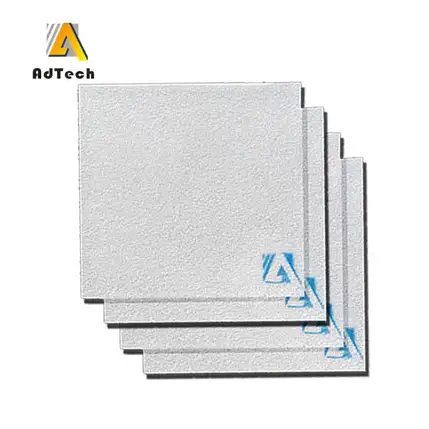
2.2 Silicon Carbide (SiC) Filter Composition
SiC filters are chemically more complex due to the need to resist oxidation while maintaining strength.
-
Main Ingredient: Alpha-Silicon Carbide grit.
-
Bonding Phase: An aluminosilicate bond. This is often created using Aluminum powder and Silica fume which react during firing to form Mullite (3Al2O3·2SiO2).
-
Impurities Control: Iron Oxide (Fe2O3) and Alkalis (Na2O, K2O) must be kept minimal to prevent the lowering of the refractoriness under load.
2.3 Zirconia Filter Composition
The composition of Zirconia filters is the most critical due to the extreme heat of molten steel.
-
Main Ingredient: Monoclinic Zirconia.
-
Stabilizers: Pure Zirconia undergoes a destructive volume change when heating. We add Magnesium Oxide (MgO) to create “Magnesia Stabilized Zirconia.” This locks the crystal structure into a cubic form that remains stable during casting.
Table 1: Chemical Composition Comparison by Filter Type
| Component Feature | Alumina CFF | Silicon Carbide (SiC) CFF | Zirconia (ZrO2) CFF |
| Primary Oxide | Al2O3 (>85%) | SiC (>70%) | ZrO_2 + HfO2 (>90%) |
| Secondary Phase | AlPO4 (Binder) | SiO2 / Al2O3 (Mullite bond) | MgO or Y2O3 (Stabilizer) |
| Color | White / Pink | Dark Grey / Black | Yellow / Off-White |
| Max Temp | 1150°C | 1500°C | 1700°C |
| Target Metal | Aluminum Alloys | Grey & Ductile Iron | Carbon & Stainless Steel |
| Porosity | 70-90% | 75-85% | 70-80% |
3. The Role of the Polyurethane Precursor
While not present in the final product, the polyurethane foam is a critical “ghost” component of the composition. The manufacturing process starts with this reticulated foam.
-
Selection: A specific pore size (measured in PPI – Pores Per Inch) foam is selected.
-
Hydrolysis: The foam undergoes treatment to ensure it is hydrophilic (water-absorbing). This ensures the ceramic slurry penetrates deep into the foam strands.
-
Burn-out: During sintering, the polyurethane decomposes. The ceramic composition must be self-supporting before the foam creates gas and exits the structure. If the ceramic formulation is too weak (low green strength), the filter collapses when the foam vanishes.
4. Impact of Sintering Additives on Performance
Sintering aids are minor elements in the composition list that have major impacts. These chemicals lower the temperature at which the ceramic particles bond.
-
Kaolin Clay: Used in SiC filters. It provides plasticity during the forming stage and forms a ceramic bond upon firing.
-
Talc: Sometimes used to introduce Magnesium, which aids in thermal shock resistance by lowering the coefficient of thermal expansion (CTE).
-
Carbon: In some specialized filters, carbon is retained in the bond to improve non-wetting properties against slag.
ADtech engineers strictly monitor the ratio of these additives. An excess of sintering aids can create a “glassy phase” that softens at high temperatures, leading to filter deformation during the pour.
5. Physical Properties Derived from Chemical Composition
The chemistry directly dictates the physical behavior of the filter in the foundry.
5.1 Thermal Shock Resistance
This is the ability to withstand rapid temperature changes without cracking.
-
The Chemistry Factor: Materials with low thermal expansion coefficients (like Fused Silica or SiC) handle shock better. Alumina has higher expansion, so the binder system must be flexible enough to absorb stress.
-
The Mechanism: When molten metal hits a cold filter, the temperature jumps from ambient to 700°C+ in seconds. The SiC composition conducts heat rapidly, equalizing the temperature gradient. Zirconia conducts heat poorly, so its composition relies on the phase stabilization discussed earlier to prevent shattering.
5.2 Compressive Strength
The filter must withstand the weight of the molten metal (metallostatic pressure).
-
SiC: The covalent bonds in silicon carbide provide immense hardness and compressive strength at room temperature (Cold Crushing Strength).
-
Zirconia: Offers the highest hot strength, retaining rigidity even when steel is poured at 1650°C.
Table 2: Physical Properties vs. Chemical Base
| Property | Alumina Based | SiC Based | Zirconia Based |
| Bulk Density | 0.35 – 0.45 g/cm³ | 0.38 – 0.50 g/cm³ | 0.80 – 1.0 g/cm³ |
| Thermal Conductivity | Low | High | Very Low |
| Thermal Expansion | Moderate | Low | Moderate |
| Hardness (Mohs) | 9 | 9.5 | 8.5 |
| Main Failure Mode | Chemical erosion | Oxidation over time | Thermal shock (if poor quality) |
6. Advanced Manufacturing: From Slurry to Sintering
The transformation from raw chemicals to a functional ADtech filter involves a precise thermodynamic cycle.
-
Slurry Preparation: The oxide powders are mixed with water, dispersants, and binders. The viscosity is controlled to ensure it coats the foam struts without clogging the pores.
-
Impregnation: The foam is compressed and submerged. Upon expansion, it sucks the slurry into its void space.
-
Drying: Moisture is removed. This is a delicate phase where the “green body” (unfired ceramic) relies on organic binders (like PVA or CMC) for strength.
-
Firing (Sintering): The filter enters a kiln.
-
Zone 1 (300-500°C): Polyurethane burns out.
-
Zone 2 (1000°C+): Ceramic bonds form. For SiC, the atmosphere must be controlled to prevent uncontrolled oxidation of the carbide grains.
-
Zone 3 (Cooling): Controlled cooling prevents micro-cracking.
-
7. Case Study: Solving Slag Inclusions in Vietnam
To demonstrate the importance of correct filter composition, we review a specific project executed by ADtech.
Client Profile: A mid-sized automotive foundry located in Hai Phong, Vietnam.
Time: May 2023.
Application: Casting Aluminum Alloy A356 for motorcycle wheel hubs.
The Challenge:
The foundry was experiencing a 12% scrap rate due to oxide inclusions and sand erosion. They were previously using a fiberglass mesh filter. The mesh was mechanically weak and reacted chemically with the magnesium in the A356 alloy, creating brittle phases that broke off into the casting.
The ADtech Solution:
We analyzed the alloy composition and pouring temperature (720°C). We replaced the fiberglass mesh with ADtech 40 PPI Alumina Ceramic Foam Filters.
Why this composition worked:
-
Chemical Inertness: The high-purity Al2O3 composition of the ADtech filter did not react with the magnesium in the A356 alloy.
-
Depth Filtration: Unlike the thin mesh, the ceramic foam structure (composition of open pores) trapped inclusions deep inside the filter body (cake filtration mechanism).
-
Thermal Stability: The phosphate binder system maintained integrity throughout the 45-second pour time.
The Result:
By July 2023, the client reported a drop in scrap rate from 12% to 3.5%. The switch to a proper ceramic composition saved the foundry an estimated $45,000 USD annually in wasted material and rework costs.
8. Why Composition Dictates Filtration Efficiency
The “filtration efficiency” is not magic; it is physics and chemistry working together.
-
Rectification (Laminar Flow): The physical structure reduces turbulence. A turbulent flow entrains air and oxides. The ceramic composition’s surface roughness helps slow down the metal velocity, converting turbulent flow into laminar flow.
-
Adhesion (Chemical Affinity): This is a subtle factor. Specific ceramic compositions have a chemical affinity for inclusion particles. For example, an Alumina filter can attract and capture aluminum oxide skins floating in the melt better than a neutral material could. This “active filtration” is only possible with the correct surface chemistry.
Table 3: Filtration Mechanisms by Composition
| Mechanism | Description | Dependency on Composition |
| Sieving | Blocking particles larger than pore size. | Dependent on pore precision (PPI), not chemistry. |
| Cake Filtration | Buildup of impurities creates a finer filter. | Chemical stability ensures the “cake” doesn’t collapse the filter. |
| Deep Bed Filtration | Trapping small particles on internal surfaces. | High surface area composition is required. |
| Surface Adhesion | Chemical attraction of oxides. | Critical. The filter surface energy must attract the inclusion. |
9. Quality Control and EEAT Standards
At ADtech, we adhere to strict quality protocols. The composition is verified using X-Ray Fluorescence (XRF) to ensure the oxide ratios are exact. X-Ray Diffraction (XRD) is used to verify the crystal phases (e.g., ensuring Zirconia is cubic and not monoclinic).
A deviation in composition of even 1% can lead to catastrophic failure in a foundry. For instance, excess Sodium Oxide (Na2O) in an Alumina filter acts as a flux, lowering the melting point and causing the filter to turn into mush during casting.
10. Environmental Impact of Ceramic Filter Composition
Modern manufacturing demands sustainability. The composition of ceramic filters is increasingly scrutinized for environmental impact.
-
Recyclability: Spent ceramic filters usually end up in landfills. However, ADtech is researching compositions where spent Alumina filters can be crushed and reused as aggregate for refractory bricks.
-
VOC Emissions: The burnout of the polyurethane foam releases volatile organic compounds. Advanced compositions use foams with lower VOC precursors or water-based binders to minimize factory emissions during the sintering phase.
11. Common Misconceptions About Filter Composition
Myth: “All white filters are Alumina.”
Fact: While Alumina is white, some Zirconia filters are also off-white. Using a Zirconia filter for aluminum is expensive but safe, whereas using an Alumina filter for steel will result in immediate melting and contamination.
Myth: “The foam remains inside the filter.”
Fact: The polyurethane foam is purely a template. The final composition is 100% inorganic ceramic.
Myth: “Higher PPI means better composition.”
Fact: PPI (Pores Per Inch) is a physical measurement, not a chemical one. A 10 PPI filter and a 60 PPI filter can have the exact same chemical composition.
Frequently Asked Questions (FAQs)
1. What is the main ingredient in a ceramic filter for iron casting?
The main ingredient is Silicon Carbide (SiC). It is chosen for its high thermal conductivity and resistance to the thermal shock typical in iron foundries.
2. Can an Alumina filter be used for steel casting?
No. Alumina filters have a maximum operating temperature of roughly 1150°C. Molten steel is poured at temperatures above 1600°C, which would melt the Alumina filter immediately.
3. What happens to the polyurethane foam during manufacturing?
The polyurethane foam is a fugitive material. It is coated with ceramic slurry and then burned away in a kiln at temperatures between 300°C and 500°C, leaving only the ceramic skeleton.
4. Why is Magnesia added to Zirconia filters?
Magnesia (MgO) acts as a stabilizer. Without it, Zirconia changes crystal structure when heated, expanding and cracking. Magnesia locks it into a stable “cubic” phase.
5. Are ceramic filters chemically inert?
Generally, yes. They are designed to be non-reactive with the specific molten metal they are intended for. However, using the wrong filter type (e.g., silica-based binder with reactive alloys) can cause chemical reactions.
6. What is the shelf life of a ceramic filter?
Due to their hygroscopic composition (tendency to absorb moisture), filters should be stored in a dry environment. While the ceramic itself doesn’t degrade, moisture absorption can cause steam explosions during casting. ADtech recommends using them within 1-2 years.
7. How does porosity affect the filter’s strength?
There is a trade-off. Higher porosity (more open space) improves flow rate but reduces the total mass of the ceramic skeleton, thereby slightly lowering mechanical strength.
8. What is the difference between CFF and Extruded filters?
CFF (Ceramic Foam Filters) have a random, sponge-like structure. Extruded filters have a honeycomb structure with straight channels. CFFs provide better turbulence reduction and depth filtration.
9. Do ceramic filters contain asbestos?
No. ADtech ceramic filters are manufactured using safe, industrial-grade refractory oxides and contain no asbestos or hazardous fibers.
10. How does ADtech ensure the composition consistency?
We utilize automated slurry mixing and regular laboratory testing (XRF/XRD) on every batch to ensure the chemical makeup aligns strictly with our technical data sheets.
Conclusion: The ADtech Advantage
Understanding what is the composition of ceramic filter products allows foundry engineers to make informed decisions. It is not just a piece of foam; it is a highly engineered ceramic composite designed to withstand extreme thermal and chemical environments. Whether it is the phosphate-bonded Alumina for your aluminum wheels or the sintered Silicon Carbide for your iron blocks, the chemistry defines the quality.