

AdTech Aluminum Flux is engineered to deliver cleaner melts, lower dross metal losses, and safer, dust-free handling for both primary and secondary aluminum production. For foundries and smelters seeking predictable chemistry, consistent dosing, and compatibility with modern flux injection systems, a well-designed 1–3 mm granular flux dramatically reduces operator exposure, improves inclusion removal and (when integrated with rotary degassing or FIT systems) contributes to measurable reductions in hydrogen porosity and dross-related metal loss.
1. The Critical Role of Flux in Modern Aluminum Smelting
Flux is not an optional accessory — it is a process control tool that sits at the intersection of chemistry and operations. In both primary and secondary aluminum workflows, flux manipulates interfacial chemistry to liberate oxide films, capture dissolved hydrogen, and promote coalescence of entrapped metal droplets in dross. The correct flux selection and application strategy is therefore a high-leverage lever for metallurgists and plant engineers who need to deliver consistent melt cleanliness, minimize metal loss to dross, and meet environmental and worker-safety goals.
2. The Chemistry of Aluminum Flux: Understanding the Reaction
Chemical composition — the common building blocks
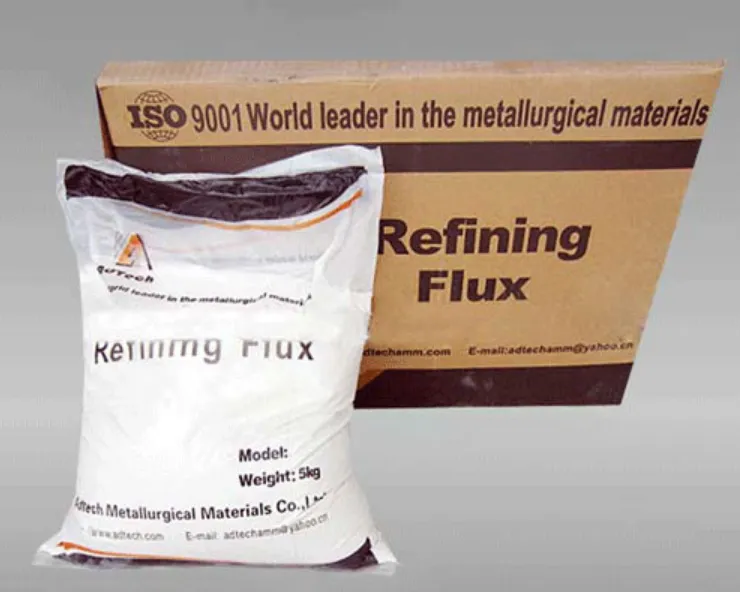
Modern aluminum fluxes are typically blends of chloride and fluoride salts. Typical constituents include sodium chloride (NaCl) and potassium chloride (KCl) as chloride bases and cryolite/fluoride components such as NaF and Na₃AlF₆ (cryolite) to adjust melting behavior and oxide solubility. These salts are chosen because they form low-surface-tension molten layers that wet oxides and change interfacial energy to mobilize alumina (Al₂O₃).
A historically common cover flux recipe used in many mills is roughly 47.5% NaCl, 47.5% KCl and 5% cryolite — though modern refining blends are more sophisticated and may include minor agents for fluidity and emission control.
The dissolution mechanism
Fluxing works by chemically interacting with alumina films and oxide fragments so they can be removed from the metal surface or trapped in slag. Fluoride components promote complex formation (fluoroaluminates), while chlorides lower viscosity and encourage coalescence of non-metallic films.
A simple thermodynamic snapshot
At a simplified level, fluoride-rich reactions can be represented in the literature by salt-alumina exchange reactions (one illustrative balance is shown below — used to explain the principle of converting alumina into flux-soluble species):
6NaF+Al2O3→2AlF3+3Na2O
This reaction family shows how fluoride donors can form fluoroaluminates that change the phase behavior and interfacial chemistry of oxide films; practical flux formulations tune the relative proportions to control melting point, viscosity and hygroscopicity.
Wetting vs. non-wetting
On a microscopic scale, the flux lowers the interfacial energy between molten aluminum and alumina, enabling the oxide film to detach or be incorporated into a mobile slag. Fluoride salts promote complexation; chlorides ease spreading and fluidity. The balance between these roles determines whether a flux behaves primarily as a cover, a drossing agent, or a refining reagent.
Request a Competitive Factory Quote for Aluminum Flux
3. Comprehensive Classification of Aluminum Fluxes
A practical taxonomy helps engineers choose the right product for the job.
3.1 Covering Flux
Purpose: Create a protective, low-vapor-pressure layer that prevents further oxidation and hydrogen pickup during holding or transfer. Key attributes: low melting range, low chloride volatility, good surface spread.
3.2 Drossing / Skimming Flux
Purpose: React with the surface dross to generate a “dry dross” that separates cleanly and minimizes entrained metal. Desired features: strong thermite-like activity to coalesce trapped Al droplets and promote metal recovery. Fluxes in this class often emphasize chloride content and reactive additives.
3.3 Refining & Degassing Flux
Purpose: Work in tandem with inert gas degassing (rotary or static) to remove microscopic inclusions and reduce dissolved hydrogen. These formulas often contain specially tuned fluoride content and flux particle morphology optimized for contact and residence time.
3.4 Specialized Fluxes
-
Magnesium removal flux (Demagging): Designed for Al-Mg alloys — the chemistry avoids “sodium poisoning” and targets Mg-rich oxides.
-
Wall-cleaning flux: Formulated to dissolve corundum and extend refractory life.
-
Sodium-free flux: Developed for high-Mg aerospace alloys where Na contamination is unacceptable.
4. Solving the 10 Major Foundry Challenges
4.1 Reducing Metal Loss
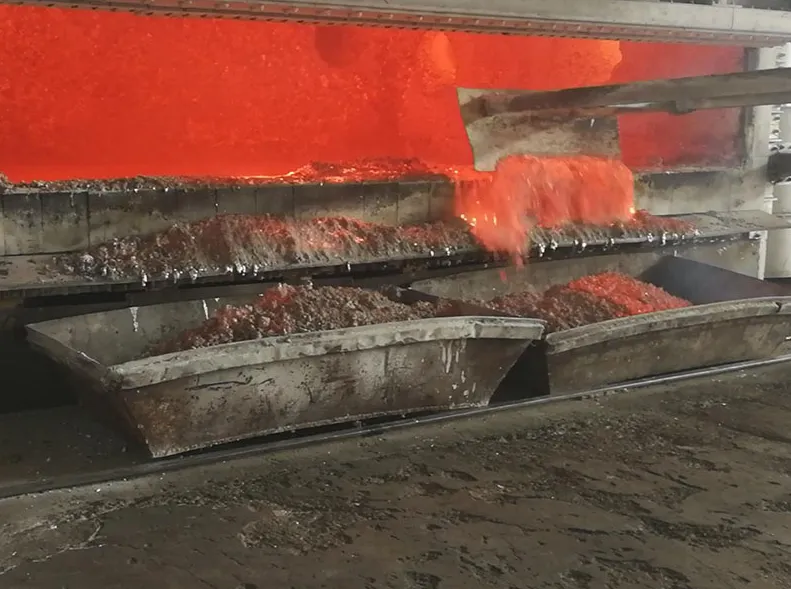
Strategy: Use a drossing flux with optimized chloride:fluoride balance, active stirring or mechanical skimming, and precise temperature control. Granular flux morphology improves contact and reduces powder-driven oxidation losses. Track metal recovered vs. metal lost to objectively measure <5% performance.
4.2 Hydrogen Control
Strategy: Combine fluxing with rotary degassing (graphite or ceramic rotors) and inert gas (N₂/Ar) flushing. Flux removes surface hydrogen traps and provides a cleaner interface enabling gas bubbles to escape. Monitor hydrogen ppm and correlate with flux dose.
4.3 Inclusion Management
Strategy: Use refining fluxes with fluoroaluminate activity to dissolve microscopic Al₂O₃ and promote coalescence. Ensure adequate contact time — granular flux remains physically present longer than powder, improving kinetics.
4.4 Furnace Longevity
Strategy: Choose non-exothermic granular blends for routine cleaning and a wall-cleaning flux for scheduled maintenance. Avoid hydrates in packaging and minimize NaCl/KCl crystallization on refractory surfaces.
4.5 Environmental Compliance
Strategy: Use low-fuming granular blends and pre-dosed injection systems to reduce visible smoke. There is industry movement to reduce fluorine content and adopt low-emission formulas that still achieve refining objectives.
4.6 Consistency (Batch-to-Batch Variation)
Strategy: Insist on certificates of analysis (COAs) for each lot, standardized moisture limits, and granular sizing control. Automated dosing reduces operator variability.
4.7 Automation Compatibility
Strategy: Select granular flux with controlled bulk density and anti-bridging additives for reliable flow into FIT systems or rotary injectors. Granular morphology dramatically improves metering vs. powders.
4.8 Storage Stability
Strategy: Use vacuum-sealed, moisture-proof packaging. Granular flux typically hydrates less and resists caking compared to hygroscopic powders, especially when kept in desiccated storage.
4.9 Slag Fluidity
Strategy: Tailor flux melting point to alloy liquidus. If slag viscosity is too high, dross traps metal; if too low, it erodes refractory surfaces. Additives can fine-tune fluidity.
4.10 Cost Efficiency (TCO vs Unit Price)
Strategy: Compare full TCO — flux consumption per ton, metal recovery yields, handling losses, worker safety and environmental fines — not just $/kg. Granular flux often shows lower TCO due to reduced consumption, lower exposure, and automation compatibility. (See Section 5: case evidence and industry reports.)
5. Granular Flux vs. Powder Flux: The Future of Smelting
Physical form matters
Granular flux (typically 1–3 mm) offers predictable flow, dust-free handling, and improved residence time on the melt surface compared with fine powder. Powder flux can aerosolize, creating fume, worker exposure and dosing inconsistency; granules remain where placed and dissolve gradually.
Dust-free operations and ESG
Dust and fugitive emissions are significant operational hazards. Granulated blends were developed to minimize airborne particulates and worker exposure, improving ESG profiles and simplifying emissions control. Industry suppliers and suppliers’ product literature report improved worker safety and lower visible smoke with granular products.
Reaction kinetics & efficiency
Because granules deliver mass and maintain localized contact longer, overall flux consumption can drop — many manufacturers and foundries report significant consumption reductions when switching from powder to granules (case yields vary by process, alloy and dosing strategy). Granular morphology also enables better mechanical metering and compatibility with FIT systems, further improving effective usage.
Check Aluminum Flux Stock Availability & Price
6. Application Methods: From Manual Addition to Flux Injection
6.1 Manual addition — best practices
-
Pre-heat flux to eliminate moisture in high-humidity climates.
-
Add in measured doses at recommended melt temperatures (see your TDS).
-
Use careful stirring or skimming techniques to avoid entrapment and excessive splashing.
Manual “throwing” remains common in small crucible operations and pilot lines, but it’s inherently variable.
6.2 Flux Injection Technology (FIT)
Flux injection systems improve delivery consistency and reduce operator exposure. Core parameters:
-
Carrier gas: Nitrogen or Argon are industry standards; selection depends on alloy sensitivity (N₂ is economical; Ar is inert but costlier).
-
Operating pressures and flow: Equipment vendors specify different pressure ranges; many flux injectors operate with input or injection pressures in the multiple-bar range (typical systems often require 3–6 bar input gas pressure, with optimized operating regimes determined by the vendor and flux type). Always follow your FIT vendor’s guidance for pressure and flow to avoid over-agitation or under-delivery.
6.3 Rotary degassing integration
Graphite rotors and rotary degassing are highly synergistic with flux use. The rotor creates fine bubble dispersion for hydrogen removal while fluxing agents alter interfacial chemistry to release trapped hydrogen and oxides. ROTARY + granular dosing is widely recommended for high-spec castings.
7. The Procurement “Red Flag” Guide: How to Identify Low-Quality Flux
Procurement should think like a metallurgist.
-
Raw material purity: Avoid fluxes made from reclaimed salts without validated purity tests; impurities increase fuming and inconsistent chemistry.
-
Moisture & caking: Do a simple clump test — if the product cakes under moderate pressure, it indicates poor drying/packaging and a short shelf life. Hygroscopic chlorides are particularly vulnerable.
-
Odor & fume signature: Excessive acrid or sulfurous smells during test melting can indicate harmful additives or organics.
-
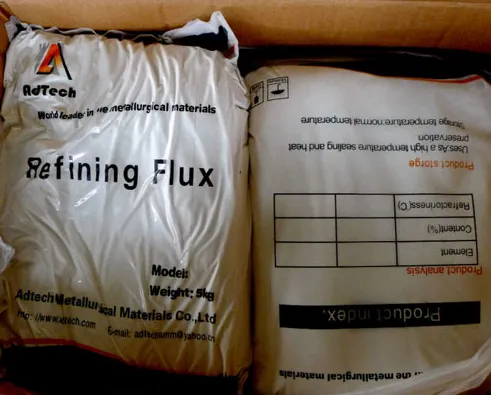
Packaging standards: Vacuum-sealed, moisture-proof bags with lot numbers and COAs are non-negotiable for production continuity.
-
Traceability: Ask for mill test reports for each lot and an independent moisture analysis.
8. Industry-Specific Flux Selection
Automotive Grade
Automotive casting demands strict control of Sr and Ti modifiers (used for porosity and grain refinement). Flux choice must avoid interaction with these modifiers that would compromise mechanical properties.
Aluminum Foil & Can Stock
Ultra-high purity is required to avoid pinholes in thin foil (e.g., 6 μm). Sodium and certain fluorides are controlled tightly in foil production — specialized low-Na or Na-free fluxes are recommended.
Secondary Smelters (Scrap Recycling)
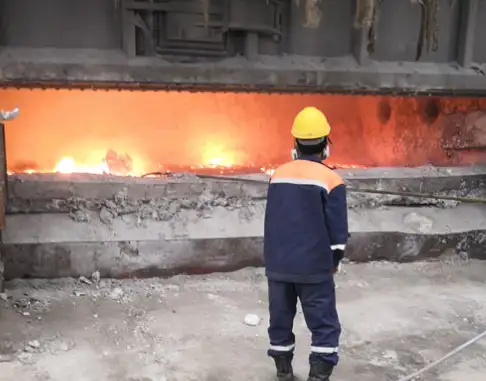
Secondary streams carry high impurity loads — painted, coated, or contaminated scrap. Fluxes for scrap must be robust, with higher scavenging power and careful emissions management.
9. Comparative Analysis: Top Global Brands vs. AdTech Innovations
Technical benchmarking
Global vendors such as Pyrotek and other foundry specialists provide well-engineered granulated fluxes and flux injection systems. AdTech’s granular series is engineered to match international benchmarks in purity, particle sizing (typ. 1–3 mm), and hygroscopic stability while focusing on customization for alloy families and injection system tuning. See Pyrotek and other vendor literature for industry examples.
Supply chain resilience
Direct-to-factory supply reduces lead times and allows lot-level customization (e.g., low-Na for foil mills). In volatile logistics environments, localized warehousing and predictable packaging (vacuum sealed, desiccant inserts) are competitive advantages.
Customization as a necessity
Modern metallurgy demands alloy-specific tweaks — “one-size-fits-all” fluxes are often the cause of batch variability. AdTech’s approach: tailor minor additive concentrations and particle sizing per alloy family (Al-Si, Al-Mg, high-Sr, foil, etc.) and validate with in-house dross and hydrogen testing.
10. Environmental Impact & Future Trends: The “Green” Foundry
Eco-friendly formulations
There is industry momentum toward reduced fluorine or fluorine-free refining aids and lower volatile chloride content where possible, driven by emission regulations and worker safety. Research into alternative chemistries aims to retain refining efficacy while lowering airborne F and Cl emissions.
Sustainable sourcing & circularity
Flux that supports high metal recovery improves the circular economy by reducing scrap losses and reprocessing needs. Responsible sourcing of raw salts and efficient packaging cuts lifecycle impacts.
Industry 4.0 — digital dosage & tracking
Automated dosing tied to MES/SCADA enables precision flux control (dose per ton, time-stamped lots) — lowering consumption and creating data trails for process optimization and compliance.
Contact Us for a Quote Within 24 Hours
11. Aluminum Fluxing & Refining: Technical FAQ
1. What is the ideal temperature for adding aluminum flux?
2. How much flux is needed per ton of molten aluminum?
3. Can I use the same flux for primary and secondary aluminum?
4. Why does my flux produce excessive smoke during refining?
5. What are the signs of “Sodium Poisoning” in Al-Mg alloys?
6. Is granular flux compatible with automated flux injection systems (FIT)?
7. How should I store flux in humid climates?
8. Does granular flux lower dross metal content?
9. Can flux replace rotary degassing?
10. How do I verify flux quality on arrival?
Standard verification steps:
- Check the Certificate of Analysis (COA) for chemical purity.
- Verify moisture content and particle size distribution.
- Inspect packaging integrity for any seal breaks.
- Perform a small pilot test to monitor dross metal content and fume signature.
12. Conclusion & Engineering Support
AdTech Granular Flux is designed to deliver consistent, dust-free performance tuned for modern smelters and foundries. Whether your priority is foil purity, automotive casting strength, or maximizing recovery in secondary operations, granular formulations combined with FIT and rotary degassing form a powerful, industry-proven solution. For procurement teams, focus on TCO, lot traceability, and handling characteristics — not just unit price.