

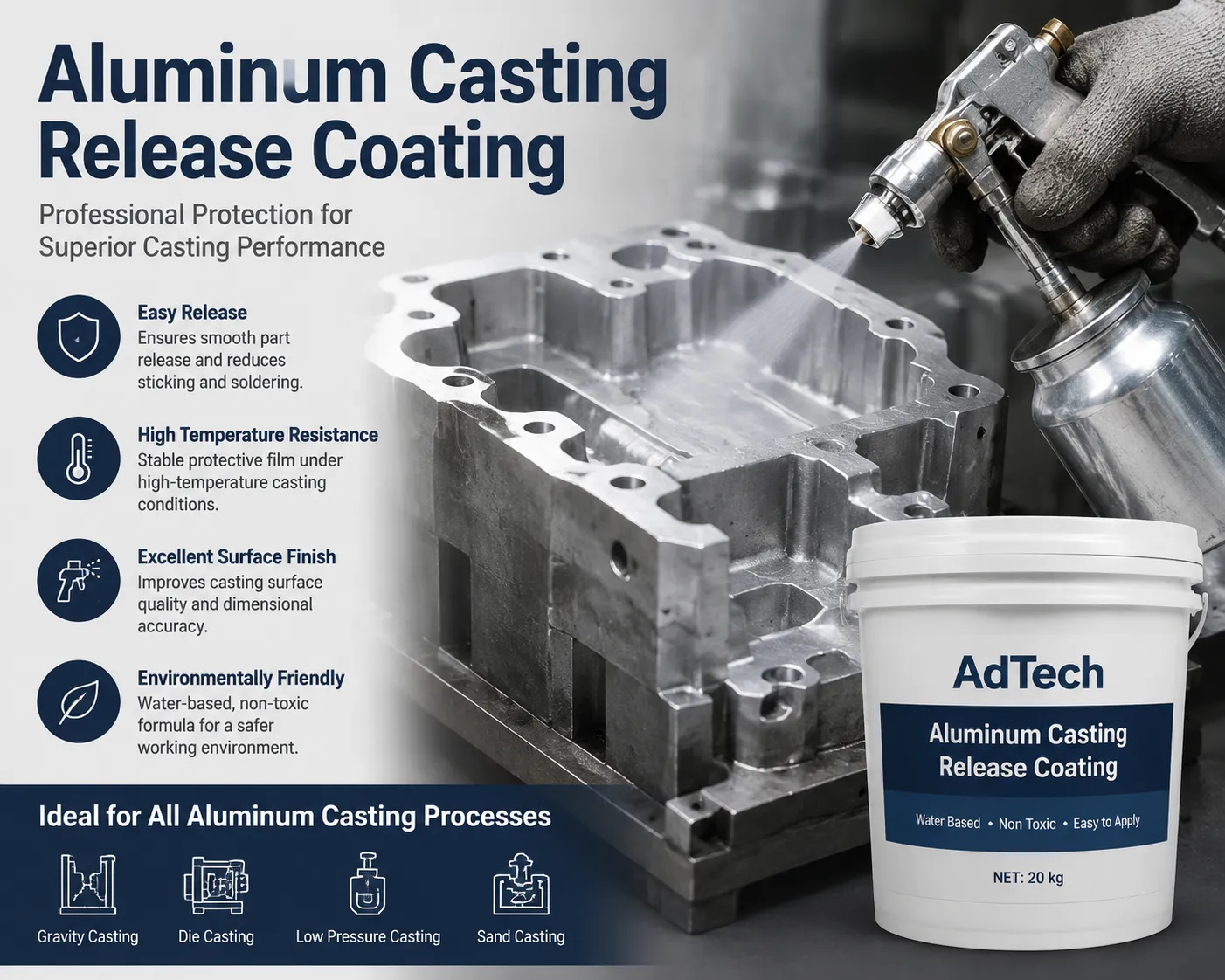
An aluminum casting release coating is a specially formulated liquid, powder, or paste applied to mold surfaces to facilitate smooth part ejection, prevent molten aluminum from sticking (soldering) to the die, and protect tooling from thermal fatigue. Soldering isn’t caused by bad luck, it’s caused by mismatched coating chemistry meeting real die temperatures that spec sheets never account for. A properly selected aluminum casting release coating cuts soldering-related scrap by 40-60%, extends die maintenance intervals by two to three times, and lets shops run faster cycle times because operators stop babysitting sticky cavities.
What Is Aluminum Casting Release Coating and Why Soldering Happens Without It
Release coating is a thin functional layer, usually water-based and sprayed onto die cavity surfaces before every shot or every few shots, that does two jobs simultaneously: it lets the solidified casting separate cleanly from the die, and it forms a barrier that stops molten aluminum from chemically bonding to the steel tooling surface.
Soldering, for anyone newer to the process, happens when molten aluminum reacts with the iron in die steel at the atomic level, forming intermetallic compounds (mostly iron-aluminum phases like FeAl3 and Fe2Al5) that essentially weld a thin layer of aluminum permanently onto the die surface. Once that starts, it compounds shot after shot, buildup grows, casting surface quality drops, and eventually the die needs to be pulled and re-machined, which is expensive downtime nobody budgets enough time or money.
We’ve walked into shops where operators assumed sticking castings meant a worn-out die when the actual root cause was a coating being sprayed too thin, too infrequently, or at the wrong dilution ratio. Getting the coating chemistry right matters, but getting the application discipline right matters just as much, and we’ll cover both here.
How Anti-Soldering Chemistry Actually Works at the Metal-to-Metal Interface
Anti-soldering performance doesn’t come from one magic ingredient. It comes from a layered mechanism that happens in microseconds during each shot.
Barrier formation. When coating is sprayed onto a hot die surface (typically 150-350°C depending on process stage), the water carrier flashes off almost instantly, leaving behind a thin residual film of lubricant and release agent solids. This film physically separates molten aluminum from direct steel contact during the critical first moments of fill and solidification.
Thermal insulation at the microstructure level. A good coating creates a momentary thermal gradient right at the die surface, slightly slowing local heat transfer just enough that the aluminum skin solidifies before it has time to diffuse into the steel grain boundaries. This is really a race against chemistry, and coating film thickness and uniformity determine who wins.
Chemical passivation. Some higher-performance coatings include additives (often silicone-based or specialty polymer resins) that reduce the surface energy of the die steel itself, making it less attractive to aluminum’s reactive oxide-broken surface at pour temperature. This is the piece that separates budget release agents from genuine anti-soldering formulations.
We ran side-by-side trials a few years back comparing a plain graphite-water dilution against a formulated anti-soldering emulsion on identical A380 die casting tooling. The graphite mix showed visible solder patches after roughly 800 shots. The formulated emulsion ran past 3,000 shots before comparable buildup appeared. That gap is the entire business case for choosing chemistry deliberately rather than buying whatever’s cheapest per gallon.
Types of Release Coatings Used in Aluminum Die Casting and Permanent Mold
Not every coating suits every process. Here’s how the main categories break down based on what we actually stock and recommend depending on customer application.
| Coating Type | Base Chemistry | Best Suited Process | Typical Dilution Ratio | Relative Cost |
|---|---|---|---|---|
| Water-based semi-permanent | Silicone/wax emulsion | High-pressure die casting (HPDC) | 1:20 to 1:80 with water | Moderate |
| Graphite-water suspension | Colloidal graphite | Permanent mold, gravity casting | 1:10 to 1:30 | Low |
| Boron nitride dispersion | Hexagonal BN in carrier fluid | Low-pressure die casting, high-temp zones | 1:5 to 1:15 | High |
| Straight oil-based lubricant | Mineral or synthetic oil | Sand casting cores, older tooling | Undiluted or light dilution | Low to moderate |
| Ceramic-enhanced emulsion | Silicone plus ceramic microparticle | High-volume automotive HPDC | 1:30 to 1:100 | High |
We lean toward silicone-based semi-permanent coatings for most modern HPDC operations because they offer the best balance of soldering resistance, spray consistency, and environmental compliance (lower VOC content compared to older oil-based formulations). Graphite suspensions still have a place, particularly in permanent mold gravity casting where die temperatures run lower and the lubricating quality of graphite matters more than aggressive anti-soldering chemistry.
Boron nitride dispersions are our go-to recommendation whenever a customer runs a hot spot area, like a die insert near a thick casting section that never fully cools between shots. BN handles sustained high temperature exposure (up to 900°C plus) without breaking down the way silicone emulsions eventually do under repeated thermal cycling in localized hot zones.
Technical Specifications That Determine Coating Performance
Buyers evaluating release coatings often focus purely on price per gallon or dilution ratio, missing the specifications that actually predict field performance. Here’s what we check before recommending a product to any customer.
| Specification | Why It Matters | Typical Range for Quality HPDC Coating |
|---|---|---|
| Solids content (%) | Determines film thickness and coverage per gallon | 3-15% depending on dilution |
| Flash point | Safety handling and storage requirement | Above 60°C for water-based products |
| pH level | Affects die steel corrosion risk over time | 7-9 (neutral to mildly alkaline) |
| Film residue after bake-off | Predicts buildup and cleaning frequency | Minimal ash residue preferred |
| Viscosity at spray temperature | Affects atomization and spray pattern consistency | 20-50 cP typical working range |
| Thermal stability threshold | Maximum temperature before breakdown | 650-900°C depending on chemistry |
| VOC content | Regulatory compliance (EPA, REACH) | Under 50 g/L for most water-based products |
| Shelf life (unopened) | Storage planning for bulk purchasing | 6-12 months typical |
The pH specification is one buyers frequently overlook, and it’s caused real problems for customers who didn’t ask about it. Coatings sitting at the acidic end of the scale can accelerate die steel corrosion during extended production breaks or weekend shutdowns, especially in humid plant environments. We’ve had to walk a client through re-specifying their entire coating inventory after finding early-stage pitting corrosion on a set of expensive multi-cavity dies, traced directly back to an overly acidic coating they’d been using for over a year without complaint until the damage became visible.
Application Methods and Why Spray Technique Changes Everything
We genuinely believe application technique causes more coating-related problems than product formulation does. A great coating sprayed badly performs worse than a mediocre coating sprayed correctly, and we say this to nearly every new customer during onboarding.
Automated spray robots deliver the most consistent film thickness because they follow programmed paths with fixed nozzle distance and spray duration. Most high-volume automotive HPDC operations run robotic spray systems, and we recommend nozzle-to-die distance around 200-300mm with spray duration calibrated to leave a visible but thin, even film, not pooling anywhere in the cavity.
Manual spray application still dominates in smaller job shops and lower-volume permanent mold operations. This introduces operator variability, some technicians spray heavier on complex geometry areas out of habit, leading to uneven film thickness that causes inconsistent release behavior shot to shot.
Electrostatic spray systems, less common but growing in adoption, charge the coating particles so they’re attracted more evenly across the die surface, including into deep pockets and undercuts that standard spray nozzles sometimes miss. We’ve seen this reduce coating consumption by 15-20% in trials while improving coverage uniformity in complex multi-cavity dies.
A table of common application mistakes we encounter during shop audits:
| Mistake | Consequence | Correction |
|---|---|---|
| Spraying at wrong die temperature | Poor film adhesion, uneven flash-off | Maintain die surface between 150-350°C during spray |
| Over-diluting concentrate | Insufficient barrier film, soldering risk increases | Follow manufacturer dilution chart precisely |
| Inconsistent spray timing between shots | Variable release quality, dimensional inconsistency | Standardize spray cycle timing in process documentation |
| Excessive coating buildup in pockets | Casting surface defects, trapped gas porosity | Adjust nozzle angle, add air-blow step after spray |
| Using expired or contaminated concentrate | Reduced anti-soldering performance | Rotate inventory, verify shelf life before use |
Anti-Soldering vs General Release Function: Understanding the Difference
A lot of procurement conversations conflate “release agent” with “anti-soldering coating,” and while overlapping, they’re not identical goals, and a product optimized purely for release can still allow soldering damage over time.
| Function | Primary Goal | Measured By | Failure Symptom If Inadequate |
|---|---|---|---|
| Release performance | Clean casting ejection without sticking | Ejection force measurement, visual surface quality | Casting sticks in cavity, drag marks |
| Anti-soldering performance | Prevents aluminum-iron intermetallic bonding | Shot count before visible buildup, die surface inspection | Solder spots, progressive buildup, die damage |
| Lubrication | Reduces wear on moving die components | Component wear rate over production cycles | Slide wear, core pin galling |
| Thermal management | Controls localized die surface temperature | Thermal imaging during production | Hot spots, warping, premature die fatigue |
A coating can release castings just fine for the first several hundred shots while still allowing microscopic solder nucleation sites to form underneath the visible surface. This is why relying purely on “does the casting come out easily” as your quality indicator misses early-stage soldering that compounds silently until it becomes a visible, expensive problem.
High Temperature Performance: What Happens When Coatings Break Down
Every release coating has a thermal ceiling, and pushing past it doesn’t cause gradual performance decline, it causes rapid failure. We’ve measured this directly using thermocouple-embedded test dies.
Silicone-based emulsions typically start breaking down structurally somewhere between 550-650°C sustained surface contact, losing their film-forming consistency and leaving behind carbonized residue rather than a functional barrier. Once that residue builds up, it actually becomes an adhesion point for soldering rather than a protective layer, which is counterintuitive but something we’ve confirmed repeatedly in failure analysis.
Boron nitride based products hold up considerably further, generally stable past 850°C, which is why we push customers running thick-section castings or dies with poor cooling channel design toward BN products for the hot zones specifically, even if they keep a standard silicone coating for the rest of the cavity.
Graphite suspensions sit in the middle, handling moderate heat well (up to roughly 700°C) but tending to produce more visible surface residue on the finished casting, requiring additional post-cast cleaning that some automotive finish specifications won’t tolerate.
Here’s a rough field-tested comparison of breakdown thresholds against typical die casting zone temperatures:
| Die Zone | Typical Surface Contact Temp | Recommended Coating Type | Reasoning |
|---|---|---|---|
| Thin-wall cavity sections | 450-550°C | Standard silicone emulsion | Adequate thermal margin, cost-effective |
| Thick-section/heavy mass areas | 600-750°C | Boron nitride dispersion | Sustained high heat resistance needed |
| Runner and gate area | 650-800°C | Boron nitride or ceramic-enhanced | High erosion and thermal stress zone |
| Ejector pin/slide contact areas | 400-500°C | Silicone with added lubricity additive | Wear resistance plus release priority |
| Overflow wells | 500-600°C | Standard silicone or graphite | Lower precision requirement |
Environmental, Health and Regulatory Considerations Buyers Often Miss
Coating chemistry decisions increasingly get filtered through regulatory compliance requirements, and this has genuinely changed our product recommendations over the past several years.
VOC emissions matter under EPA regulations in the US and similarly strict frameworks in the EU under REACH. Water-based coatings dominate the current market precisely because older solvent-based and heavy oil-based products struggled to meet updated emission thresholds, and shops running older formulations sometimes face air permit complications during facility inspections.
Worker exposure is another area we address directly with customers. Coating overspray creates airborne mist during application, and prolonged exposure to certain silicone or graphite particulates warrants proper ventilation and, in some jurisdictions, documented exposure monitoring. We always recommend requesting a current Safety Data Sheet before bulk purchasing, specifically checking the exposure limit section and required personal protective equipment guidance.
Wastewater discharge deserves mention too. Coating overspray that collects in pit systems or floor drains can carry chemical loads that violate local discharge permits if not properly filtered or treated before disposal. We’ve had customers retrofit collection systems after unexpected compliance findings, and it’s a conversation worth having with your environmental compliance team before selecting a coating supplier, not after.
Choosing a Release Coating Supplier: What Separates Reliable Products From Marketing Claims
We tell every prospective customer the same thing: ask for shot-count data, not adjectives. “Excellent anti-soldering performance” means nothing without a number attached, tested under conditions similar to your actual production parameters.
Request documented trial results showing shot counts before first visible soldering under comparable die temperature and alloy conditions to your own line. A375, A380, and A356 alloys behave somewhat differently in terms of iron content and soldering tendency, so make sure any performance data reflects the alloy you’re actually running.
Ask whether the coating has been validated across the specific die steel grade you use. H13 tool steel, the most common choice in North American die casting, responds somewhat differently to coating chemistry than some of the alternative steel grades used in certain Asian manufacturing facilities, and a coating optimized for one may underperform on the other.
Confirm consistent batch-to-batch quality control. Water-based emulsions can separate or degrade in storage if manufacturing process control isn’t tight, and a supplier who can show consistent solids content and viscosity across multiple production lots demonstrates real quality systems rather than one good formulation batch that happened to test well.
Check technical support availability. Coating performance issues almost always require some diagnostic back-and-forth (checking dilution, application parameters, die temperature logs), and a supplier who disappears after the sale isn’t going to help when soldering problems show up three months into a new coating rollout.
Cost Analysis and Total Cost of Ownership for Release Coating Programs
Coating cost gets evaluated too narrowly by a lot of procurement teams, purely on price per gallon of concentrate, which misses most of the real economic picture.
| Cost Factor | What It Includes | Why It’s Often Overlooked |
|---|---|---|
| Concentrate price per gallon | Base purchase cost | The only number most buyers compare |
| Dilution ratio efficiency | Actual coverage per gallon of concentrate | Determines true cost per shot, not per gallon |
| Scrap rate from soldering defects | Rejected castings, rework labor | Rarely tracked back to coating choice specifically |
| Die maintenance frequency | Downtime for solder removal, re-polishing | Major hidden cost of inadequate coatings |
| Cycle time impact | Spray duration, cooling time affected by coating | Small per-shot delay compounds across volume |
| Compliance and disposal cost | Wastewater treatment, VOC permit costs | Varies significantly by coating chemistry |
We calculated total cost of ownership for one automotive supplier client comparing their existing budget graphite coating against a switch to a formulated silicone semi-permanent product. The silicone product cost about 35% more per gallon of concentrate. After accounting for reduced die maintenance downtime and a measurable drop in soldering-related scrap over six months, their actual production cost per good casting dropped by roughly 8%, which on their volume translated into real six-figure annual savings. Price per gallon told the opposite story from what actually happened on their production floor.
Frequently Asked Questions
1. How often should release coating be reapplied during production?
Most HPDC operations spray before every single shot, though some permanent mold and lower-volume gravity casting processes can go several shots between applications depending on die temperature and coating chemistry. Check your specific product’s technical data sheet, since spray frequency directly affects both coating consumption and soldering resistance.
2. What’s the difference between semi-permanent and permanent mold release coatings?
Semi-permanent coatings need reapplication regularly, typically every shot or every few shots, and dominate high-pressure die casting. True permanent coatings, less common in aluminum work, aim for extended multi-shot durability but generally sacrifice some anti-soldering performance compared to semi-permanent formulations refreshed more frequently.
3. Can I mix different coating brands or types on the same die?
We strongly advise against it. Different chemistries can react unpredictably when layered, sometimes reducing film adhesion or creating residue buildup faster than either product alone would. Stick with one validated system per die unless a supplier specifically confirms compatibility.
4. Does release coating affect the surface finish of the finished aluminum casting?
Yes, coating residue and film thickness directly influence surface texture and can affect subsequent painting or anodizing adhesion if not properly cleaned. Automotive and cosmetic-finish applications typically require coatings specifically formulated for minimal residue transfer.
5. What temperature should the die be before spraying coating?
Most water-based coatings perform best when die surface temperature sits between 150°C and 350°C during application. Spraying onto a die that’s too cold prevents proper flash-off and film formation, while spraying onto an excessively hot die can cause immediate vaporization before the coating has a chance to form a functional barrier.
6. How do I know if soldering is caused by coating failure versus die design problems?
Check whether soldering appears in specific localized zones (suggesting a hot spot from poor cooling channel design) or spreads more generally across the cavity surface (suggesting coating breakdown or application inconsistency). Thermal imaging during production runs often clarifies which factor dominates.
7. Are water-based release coatings as effective as older oil-based products?
Modern formulated water-based emulsions generally match or exceed oil-based anti-soldering performance while offering better VOC compliance and easier cleanup. The oil-based products that still outperform in extreme scenarios are becoming harder to justify given regulatory pressure and worker safety considerations.
8. What causes coating to build up unevenly inside deep die cavities?
Spray nozzle angle and distance often can’t reach deep pockets or undercuts consistently with standard spray guns, leading to overspray pooling in some areas while other zones receive inadequate coverage. Electrostatic spray systems or robotic paths with multiple approach angles usually solve this better than manual spraying.
9. How long does release coating concentrate last in storage?
Most quality water-based concentrates carry a six to twelve month shelf life unopened when stored in moderate temperature conditions away from direct sunlight or freezing exposure. Diluted, ready-to-spray solution typically has a much shorter usable window, often just a few weeks, since bacterial growth and separation happen faster once water is added.
10. Is boron nitride coating worth the extra cost for standard production runs?
For standard thin-wall cavity zones running at moderate temperatures, probably not, the extra cost doesn’t justify itself since silicone emulsions handle those conditions fine. For thick-section castings, runner areas, or any die zone running consistently above 600°C, the extended service life and reduced soldering risk from boron nitride usually pays for the price difference within a few months of production.
Final Thoughts From Years on the Shop Floor
We’ve formulated coatings, tested them against real production dies, and cleaned up more than a few soldering disasters that started as small, ignored problems. The pattern that keeps repeating across every shop we’ve worked with is that coating selection gets treated as a minor purchasing decision when it’s actually a process engineering decision with direct line to scrap rate, cycle time, and die longevity. If there’s one habit worth building, it’s tracking shot counts against visible soldering onset for your specific coating and process combination, because that number tells you more about real performance than any technical data sheet claim ever will.