

An aluminum casting adapter plate is the transitional refractory or metallic component that connects a launder trough to a casting machine, filter box, degasser, or furnace outlet in a molten metal handling line. After specifying and troubleshooting these components across foundries, extrusion plants, and rolling mills for many years, the plate you choose determines whether your casting line runs clean for six months or fails within six weeks. The right adapter plate combines a thermal-shock-resistant material (fused silica, silicon carbide, or a ceramic-bonded composite), a mating surface machined to within half a millimeter of tolerance, and a surface treatment that resists wetting by molten aluminum. Get those three variables correct, and the plate will typically outlast several campaigns of the launder system itself. Get them wrong, and you’ll be chasing leaks, iron pickup, and unplanned downtime for months.
If your project requires the use of Aluminum Casting Adapter Plate, you can contact us for a free quote.
What Is Aluminum Casting Adapter Plate?
In plain terms, an adapter plate is a flat or contoured refractory piece placed at a junction point in a molten aluminum transfer system. Launder systems move liquid aluminum from a holding furnace or tundish toward a casting wheel, DC casting mold, continuous caster, or ingot mold. At each junction, the geometry of one component rarely matches the geometry of the next perfectly. A furnace spout might be round, a launder channel might be trapezoidal, and a filter box inlet might be rectangular. The adapter plate bridges that mismatch while sealing the joint against metal leakage and air infiltration.
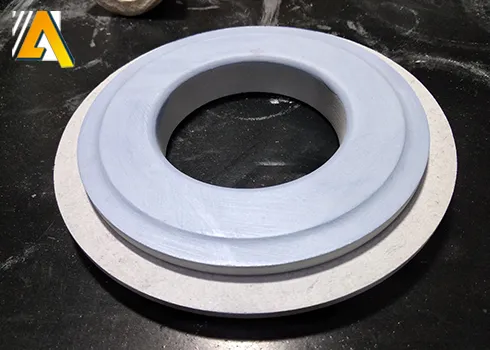
We often describe it to new engineers this way: think of it as a gasket, but one that has to survive contact with liquid metal at 700 to 780 degrees Celsius, resist thermal cycling every shift, and hold its shape under the static pressure of flowing metal for weeks or months without cracking.
Adapter plates show up under several names in the industry, including transition plates, flow control plates, launder connector plates, and casting interface plates. Regardless of the name, the function stays the same: controlled, leak-free, contamination-free transfer of molten aluminum from point A to point B.
Where Adapter Plates Sit in the Casting Line
A typical molten aluminum flow path looks like this: holding furnace, tap-out launder, degassing unit, ceramic foam filter box, distribution launder, and finally the casting mold or wheel. Adapter plates appear at nearly every junction:
- Furnace-to-launder connection.
- Launder-to-filter box connection.
- Filter box-to-distribution trough connection.
- Distribution trough-to-mold or wheel connection.
Each location has slightly different thermal and mechanical demands, which is why a single “universal” plate design rarely performs well everywhere.
How Does an Adapter Plate Actually Function Inside the System?
Molten aluminum behaves differently than steel or iron when it comes to surface interaction. It oxidizes rapidly on contact with air, forming an oxide skin, and it has a strong tendency to react with silica-based refractories at elevated temperatures if the wrong grade is chosen. The adapter plate’s job is threefold:
First, it maintains a continuous, sealed channel so metal doesn’t drip, splash, or seep at the joint. Even a small leak at a junction can cause a frozen skull of metal to build up, which then disrupts flow rate and can eventually block the entire launder.
Second, it controls flow geometry. Many adapter plates include a machined channel, weir, or step that regulates how fast metal moves through the transition point. This matters enormously for degassing efficiency and for filter performance, because turbulent flow at a junction can re-introduce oxide inclusions that the filter box just removed.
Third, it acts as a thermal buffer. Because the plate sits at a joint where two refractory or metallic sections meet, it absorbs the differential expansion between components during heat-up and cool-down cycles. Without this buffer, rigid refractory sections would crack at the seams within days.
We’ve watched plants try to skip this component by welding launder sections directly together or by using loose refractory mortar as a stopgap. Both approaches fail quickly. The mortar erodes under metal flow, and welded metallic sections warp under repeated thermal cycling, opening gaps that leak molten metal onto the plant floor, which is a serious safety hazard.
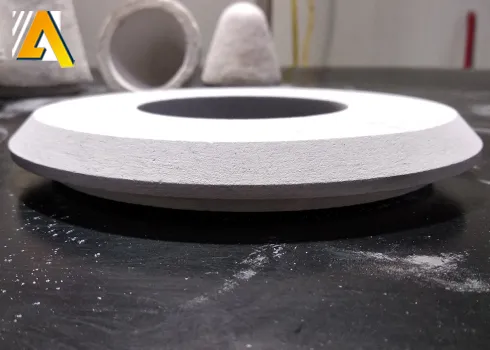
What Materials Are Used to Manufacture These Plates?
Material selection is probably the single most important decision in this entire product category, so we’ll spend real time on it. Below is a comparison table based on what we actually specify for customers, broken down by application severity.
| Material Type | Max Service Temp | Thermal Shock Resistance | Typical Lifespan | Best Use Case | Relative Cost |
|---|---|---|---|---|---|
| Fused Silica Refractory | 1000°C | Excellent | 3-6 months | High-cycling launder joints | Medium |
| Silicon Carbide (SiC) | 1400°C+ | Very Good | 6-12 months | High-wear filter box interfaces | High |
| Calcium Silicate Board | 950°C | Fair | 1-3 months | Low-cost, short-run applications | Low |
| Castable Alumina Composite | 1200°C | Good | 4-8 months | General purpose junctions | Medium |
| Ductile Iron (coated) | 700°C (metal contact) | Poor without coating | Varies with coating | Structural backing plates, not direct metal contact | Low |
| Boron Nitride Coated Ceramic | 1000°C | Excellent | 6-12 months | Non-wetting applications, high-purity alloys | High |
We recommend fused silica for most standard launder-to-launder transitions because it strikes the right balance of thermal shock tolerance and cost. Silicon carbide earns its higher price tag in filter box interfaces, where erosion from higher velocity flow and abrasive oxide particles is a constant threat.
One point we always stress to new customers: never use raw ductile iron or steel plates in direct contact with molten aluminum without an appropriate refractory coating or ceramic liner. Aluminum is aggressive toward iron-bearing alloys at casting temperatures, and iron pickup contamination in the final cast product is a defect that quality control teams cannot easily reverse. Iron content specifications in aerospace and automotive aluminum alloys are tight, and a single contaminated batch traced back to a metallic adapter plate can cost far more than the plate itself.
Why Boron Nitride Coatings Matter
Boron nitride (BN) coatings deserve their own mention because they solve the wetting problem directly. Molten aluminum naturally wants to adhere to many refractory surfaces, forming buildup that narrows the flow channel over time. A BN coating creates a non-wetting surface, so metal flows across it without sticking. Plants running high-purity or specialty alloys, including those destined for aerospace billet or lithium battery foil stock, benefit the most from this treatment because even trace surface contamination affects downstream quality metrics.
What Design Specifications and Tolerances Should You Require?
Dimensional accuracy is where many buyers underestimate the complexity of this product. A plate that looks correct on paper can still fail if the mating surface isn’t machined properly. Here’s a breakdown of the specifications we typically require in our own production runs and recommend customers request from any supplier.
| Specification | Typical Requirement | Why It Matters |
|---|---|---|
| Flatness tolerance | ±0.3mm to ±0.5mm | Prevents leak paths at the joint |
| Surface finish | 3.2 µm Ra or better | Reduces metal adhesion and buildup |
| Channel depth accuracy | ±0.2mm | Maintains correct flow velocity and residence time |
| Bolt hole alignment | ±1mm | Ensures proper seating without stress cracking |
| Thickness consistency | ±2% of nominal | Prevents uneven thermal expansion |
| Edge chamfer | 3-5mm at 45° | Reduces chipping during installation |
We’ve seen plants receive plates that were technically the right material grade but machined so poorly that they had to be hand-fitted on-site with grinding tools, adding hours to installation time and introducing dimensional inconsistency that shortened the plate’s service life. A quality supplier will provide a dimensional inspection report with every shipment, not just a material certificate.
Custom Geometry Considerations
Not every junction is a simple flat interface. Many launder systems require plates with integrated weirs, steps, or curved transitions to manage flow separation, particularly at points where the channel changes width or where a degasser rotor introduces turbulence upstream. When ordering custom geometry, we always ask customers for the actual flow rate (measured in kg per minute or liters per minute) and the launder cross-section dimensions on both sides of the joint. Without that data, even an experienced manufacturer is guessing at the correct internal channel profile.
How Should You Select the Right Plate for Your Specific Operation?
Selection comes down to matching the plate to three operational variables: alloy chemistry, flow rate, and campaign duration.
For alloy chemistry, high-magnesium alloys (5xxx series) are more chemically aggressive toward certain refractories than commercially pure aluminum. If your plant runs 5182 or similar can-body stock, we generally steer customers toward silicon carbide or BN-coated options rather than standard fused silica, because magnesium vapor and oxide interactions accelerate wear on lower-grade refractories.
For flow rate, higher throughput lines (above 20 tonnes per hour) generate more erosive wear at transition points. Plants running at this scale should budget for shorter replacement intervals or invest in the higher-durability material grades from the start, since the labor cost of frequent plate changes can exceed the price difference between a mid-grade and premium plate within a single quarter.
For campaign duration, a plant that runs continuously for eight months between planned shutdowns needs a plate rated to survive that full duration without intermediate replacement, since unplanned mid-campaign changeouts require a full furnace and launder cool-down, which can cost tens of thousands of dollars in lost production time.
A Practical Selection Checklist
We give this list to procurement teams before every quote:
- What alloy series are you casting (1xxx, 3xxx, 5xxx, 6xxx, 7xxx)?
- What is your average and peak flow rate through this junction?
- What is your planned campaign length before shutdown?
- Is this a high-wear location (filter box, degasser outlet) or a low-wear location (simple launder-to-launder transition)?
- Do you have any existing iron pickup or inclusion issues traced to refractory components?
- What is your installation window (hours available for changeout)?
Answering these six questions before requesting a quote typically cuts sourcing time in half, because it allows a supplier to recommend the correct material grade on the first pass rather than through several rounds of trial and error.
What Manufacturing Processes Produce a High-Quality Plate?
There are generally three production methods used across the industry: pressed and fired ceramic, vibration-cast refractory, and precision-machined composite. Each has trade-offs worth understanding.
Pressed and fired ceramic plates are formed under high pressure and then fired in a kiln at controlled temperatures. This method produces excellent dimensional consistency and density, which translates to better thermal shock performance. It’s our preferred method for standard catalog sizes because the tooling investment pays off across high production volumes.
Vibration-cast refractory plates are poured into molds and vibrated to remove air pockets, then cured and fired. This method is better suited to custom, low-volume geometries because it doesn’t require expensive pressing dies. The trade-off is slightly higher porosity compared to pressed plates, which can marginally reduce service life in high-erosion locations.
Precision-machined composite plates start as a cast or pressed blank and are then machined on CNC equipment to achieve the tight tolerances described earlier. This adds cost but is essential for plates going into automated casting lines where robotic handling or precision mold alignment requires exact dimensions.
We machine nearly all of our filter box interface plates because the tolerance stack-up in that part of the system is unforgiving. A launder-to-launder transition can tolerate a bit more variance; a filter box seat generally cannot.
What Are the Common Failure Modes, and How Do You Prevent Them?
Understanding failure modes helps buyers ask better questions during the sourcing process and helps plant engineers diagnose problems faster when they occur.
| Failure Mode | Root Cause | Prevention Strategy |
|---|---|---|
| Surface cracking | Thermal shock during rapid heat-up | Preheat plates gradually before metal contact |
| Metal penetration/leakage | Poor flatness or worn gasket seating | Verify flatness tolerance before installation |
| Erosion channeling | High velocity flow, abrasive inclusions | Upgrade to silicon carbide in high-flow zones |
| Metal buildup/freezing | Wetting of refractory surface | Apply BN coating or non-wetting wash |
| Iron contamination | Use of uncoated ferrous material | Never use bare metallic plates in direct contact |
| Bolt hole spalling | Over-tightening or misalignment | Follow torque specs and check alignment before bolting |
Thermal shock cracking is by far the most common issue we’re called in to diagnose. It almost always traces back to one of two causes: either the plant skipped the preheat procedure entirely to save time during a changeover, or the preheat ramp rate was too aggressive. We recommend a minimum preheat schedule of 50 to 75 degrees Celsius per hour up to operating temperature for fused silica and composite plates. Silicon carbide can tolerate faster ramp rates due to its superior thermal shock resistance, but we still recommend a controlled schedule rather than direct metal contact on a cold plate, which almost guarantees a crack within the first pour.
How Does Installation and Maintenance Affect Long-Term Performance?
Even the best-manufactured plate will underperform if installed incorrectly. A few practices we insist on with our own installation teams:
Always inspect the mating surfaces on both sides of the joint for residual buildup or damage before setting a new plate. Old metal skulls or chipped refractory edges on adjacent components will prevent proper seating even if the new plate itself is perfect.
Use the correct gasket or sealing compound rated for the operating temperature. A mismatch here is a surprisingly common cause of “plate failure” that isn’t actually the plate’s fault at all, it’s a sealing material that degraded and allowed metal seepage around the plate’s edge rather than through it.
Torque bolts evenly and in a cross pattern, similar to how you’d torque a wheel on a vehicle. Uneven torque creates localized stress points that can initiate cracks even in a high-quality refractory plate.
Schedule visual inspections at every planned shutdown, checking specifically for hairline cracks, surface glazing (a sign of excessive wetting), and channel wear depth. Catching a plate at 70 percent worn during a scheduled shutdown is far cheaper than an emergency changeout at 100 percent failure during production.
Recommended Inspection Frequency
| Plant Throughput | Recommended Visual Inspection | Recommended Dimensional Check |
|---|---|---|
| Under 10 t/hr | Every 4-6 weeks | Every 3 months |
| 10-25 t/hr | Every 2-3 weeks | Every 6-8 weeks |
| Over 25 t/hr | Weekly | Every 4 weeks |
What Should Procurement Teams Consider When Sourcing These Plates?
We field a lot of sourcing calls, and the questions from procurement teams tend to differ sharply from the questions engineers ask. Procurement is usually focused on total cost of ownership, lead time reliability, and supplier consistency, not just material specifications.
A few things worth pressing any supplier on before signing a purchase order:
Ask for batch-to-batch consistency data. Refractory materials can vary between production runs if a supplier isn’t controlling raw material sourcing tightly. Request certificates of analysis for the raw materials, not just a generic product data sheet.
Ask about lead times realistically, including for custom geometries. Standard catalog sizes might ship in one to two weeks, but a fully custom plate with integrated flow channels can take four to eight weeks depending on the supplier’s backlog. Plan replacement orders around your actual campaign schedule, not around hope.
Compare cost per service-hour, not just cost per unit. A plate priced 30 percent higher but lasting twice as long is the cheaper option once you factor in labor for changeouts and production downtime. We build this calculation into every quote we provide because unit price alone is a misleading metric in this product category.
Confirm packaging and shipping protocols. Refractory plates are brittle and can develop micro-cracks during transit if not packaged correctly, cracks that won’t show up until the plate is already in service and experiencing thermal load. Ask specifically how the supplier packages plates for freight, and whether they’ve had transit damage claims in the past.
Supplier Evaluation Checklist
| Criteria | Questions to Ask |
|---|---|
| Material traceability | Can you provide raw material certificates? |
| Dimensional QA | Do you provide inspection reports with each shipment? |
| Custom capability | Can you produce custom flow geometry, and what’s the lead time? |
| Track record | Can you provide references from similar alloy/throughput operations? |
| Technical support | Do you offer on-site installation guidance or troubleshooting? |
| Packaging | How do you prevent transit damage for brittle refractory products? |
How Do Adapter Plates Compare Across Different Casting Applications?
Not every casting operation uses adapter plates the same way, and the demands differ meaningfully between industry segments.
In DC (direct chill) casting for extrusion billet production, adapter plates typically sit between the distribution trough and the mold table, where precise flow control directly affects grain structure and surface quality of the billet. Precision here is paramount, and most plants in this segment use machined composite or silicon carbide plates.
In continuous strip casting for rolling mill feedstock, plates experience more continuous, higher-velocity flow, and erosion resistance becomes the dominant selection criterion over pure precision.
In wheel casting for wire rod production, thermal cycling is more frequent because these lines often run shorter campaigns with more frequent starts and stops, making thermal shock resistance the top priority.
Recyclers and secondary smelters running mixed-alloy scrap often deal with more variable metal chemistry, including higher trace element content, which can accelerate refractory wear unpredictably. These operations benefit from more frequent inspection schedules regardless of which material grade they select.
What Are the Realistic Cost Ranges and ROI Considerations?
Pricing varies significantly based on material, size, and customization, but as a general reference point for budgeting purposes, standard catalog fused silica plates typically run in the low hundreds of dollars per unit for common sizes, while silicon carbide or fully custom machined composite plates can run into the low thousands depending on geometry complexity and size. Ductile iron backing structures with ceramic liners fall somewhere in between, depending on the liner grade specified.
The real ROI calculation isn’t the sticker price, though. It’s downtime cost. We’ve worked with plants where a single unplanned changeout, including furnace cool-down, plate replacement, and reheat, cost more in lost production than an entire year’s supply of premium-grade plates would have cost upfront. When we build cost comparisons for customers, we always ask for their hourly production value (tonnes per hour multiplied by the metal’s market value) so we can show the true cost of downtime risk side by side with the plate’s purchase price. That comparison almost always favors investing in the higher-grade material for high-throughput or high-value alloy operations.
Frequently Asked Questions
1. How long does a typical aluminum casting adapter plate last?
Service life ranges from one month to over a year depending on material grade, flow rate, and alloy chemistry. Fused silica plates in moderate-duty applications typically last three to six months, while silicon carbide plates in the same location can extend that to six to twelve months.
2. Can I use the same adapter plate design for different aluminum alloys?
Generally not recommended for high-magnesium alloys versus standard alloys. Magnesium-bearing alloys are more chemically aggressive toward certain refractories, so we recommend confirming alloy compatibility with your material supplier before standardizing a design across multiple alloy lines.
3. What causes molten aluminum to leak through an adapter plate joint?
The most common cause is poor flatness tolerance or degraded gasket material at the seating surface, not a defect in the plate body itself. Always inspect mating surfaces before installation.
4. Is boron nitride coating necessary for every application?
No. It’s most valuable in high-purity alloy applications or locations prone to metal buildup and freezing. Standard commodity alloy operations can often run successfully without it, though it does extend service life in most applications.
5. How do I know if my current plate is failing before it causes a leak?
Watch for surface glazing, visible hairline cracks, changes in flow velocity through the junction, or unexpected metal buildup at the plate’s edges. Scheduled dimensional checks catch most issues before they become emergencies.
6. What’s the difference between a launder plate and a filter box interface plate?
Launder-to-launder plates generally handle lower velocity flow and can use mid-grade materials. Filter box interface plates experience higher wear from flow turbulence and often require silicon carbide or precision-machined composite materials.
7. Do adapter plates require preheating before installation?
Yes, for refractory-based plates. Skipping preheat or using too aggressive a heating ramp is the leading cause of thermal shock cracking we see in field failures.
8. How much lead time should I plan for custom adapter plates?
Standard sizes often ship within one to two weeks. Custom geometries with integrated flow channels typically take four to eight weeks, so we recommend ordering replacement stock well ahead of planned shutdowns.
9. Can a metallic backing plate be used without a refractory liner?
Not in direct contact with molten aluminum. Bare ferrous metal in contact with molten aluminum risks iron pickup contamination, which can compromise alloy specifications, particularly in aerospace and high-purity applications.
10. What’s the most cost-effective way to reduce plate replacement frequency?
Invest in the correct material grade for your specific flow rate and alloy chemistry from the start, follow proper preheat procedures, and maintain a scheduled inspection program. These three practices together typically extend service life more than any single material upgrade alone.
Final Thoughts From Our Experience
We’ve spent years watching plants either save money on adapter plates and lose far more in downtime, or invest correctly upfront and run entire campaigns without an unplanned stop at these junctions. The pattern is consistent across every plant we’ve worked with: adapter plates are a small line item on a purchase order but a large factor in overall casting line reliability. Treat the selection process with the same rigor you’d apply to any other critical wear component, ask suppliers the harder questions about material traceability and dimensional QA, and build your replacement schedule around actual service data rather than guesswork. That approach, more than any single material choice, is what separates casting lines that run smoothly from those that don’t.