

Adding salt and soda to molten aluminum improves casting quality by removing oxides and dissolved gases, promoting cleaner metal, reducing porosity, and protecting the melt surface. When the right salt mixtures and carbonate compounds are used at controlled temperatures and doses, they help remove hydrogen, trap non-metallic inclusions, and create a protective cover on the bath. These effects lower scrap losses, increase casting yield, and improve mechanical properties of finished parts.
Quick overview of the conclusion
Using chloride-based salt fluxes (typically NaCl and KCl blends) together with carbonate agents (commonly sodium carbonate, often called washing soda) produces multiple beneficial effects: fluxing reactions strip oxide films, flux layers trap inclusions, and carbonate decomposition or flux chemistry promotes bubble formation that aids removal of dissolved hydrogen. Proper selection of composition, temperature, and handling reduces harmful emissions and salt waste while yielding smoother, denser castings.
Aslo read: How to refine molten aluminum?
What do people mean by “salt” and “soda” in aluminum casting
Salt (flux): a solid mixture of inorganic salts used to cover, protect, and refine molten aluminum. Typical bases include sodium chloride (NaCl) and potassium chloride (KCl), frequently combined with fluoride or other additives to improve wetting, lower melting point, or assist impurity removal. These mixtures are often called salt flux or salt cake.
Soda (washing soda): typically sodium carbonate (Na₂CO₃). In foundry usage, “soda” may be sprinkled or included in a flux mix to encourage bubbling or to neutralize specific contaminants. Home-foundry and small-scale sources often recommend soda crystals for degassing; industrial formulations can incorporate carbonate sources among other components.
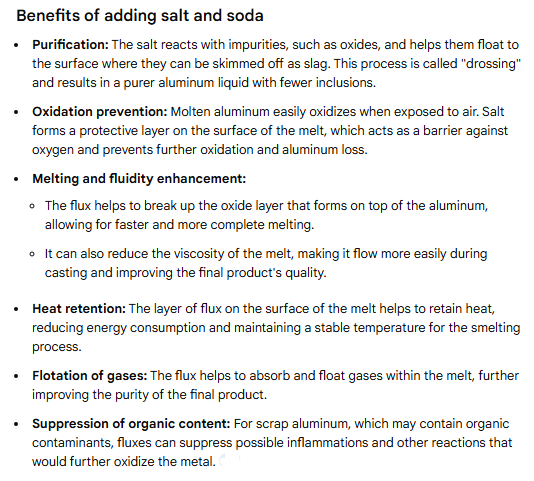
How salt fluxes improve molten aluminum
Flux cover, oxide handling, and surface protection
A layer of molten salt placed on top of the metal forms a physical barrier that prevents rapid re-oxidation of the aluminum surface. The salt wets oxide films, promoting their breakup and incorporation into the salt cake that can be skimmed off. Salt covers also reduce metal loss by limiting direct air contact during holding and transfer.
Chemical interactions that assist impurity removal
Chloride and fluoride components in many fluxes react with surface oxides and with alloy impurities to form soluble or removable compounds. Chlorination reactions may promote formation of aluminum chloride species in the flux phase, which helps strip thin oxide films from the metal surface and lump them into scum. Thermodynamic analyses show that tailored salt mixes can encourage impurity transfer from metal to salt.
Contribution to degassing (hydrogen removal)
Flux components provide sites for bubble nucleation and may produce gaseous reaction products that assist hydrogen evacuation. When carbonate materials or reactive fluxes decompose or react, generated gases reduce the partial pressure of hydrogen within a forming bubble, encouraging diffusion of dissolved hydrogen out of the metal into the bubble. That bubble then rises and escapes, carrying hydrogen away. This combination of wetting, chemical reaction, and bubble formation is a principal reason fluxing improves porosity control.
Interfacial tension modification and metal fluidity
Salt fluxes alter the interfacial tension between molten aluminum and surface oxides. Lower interfacial tension helps trapped oxide films coalesce and detach, improving metal flow and allowing dross separation with less metal entrainment. Research on NaCl–KCl fluxes documents this effect and links it to improved inclusion removal during remelting.
How sodium carbonate (washing soda) helps the melt
Gas-forming action and mechanical stirring
Sodium carbonate can decompose or react under molten metal conditions to generate CO₂ and other gaseous species in microzones, creating small bubbles that help hydrogen leave the melt. These gases act like micro-stirrers, improving bubble formation and escape from the aluminum. Practical use of soda is common in smaller shops for degassing support.
Neutralizing certain contaminants
Carbonates may neutralize acidic species in fluxes or react with residual halides, changing local chemistry at the interface. In formulated fluxes, carbonate presence is one lever engineers use to tune melting point, wettability, and foaming behavior.
Table 1: Typical components and roles in salt + soda systems
| Component | Typical role in the melt treatment | Typical concentration (industrial mixes) |
|---|---|---|
| NaCl (sodium chloride) | Primary salt matrix, provides covering and wetting | 30–60% by mass in many blends. |
| KCl (potassium chloride) | Lowers melting point of the salt mix, improves flow | 20–50% of salt basis. |
| Na₂CO₃ (sodium carbonate) | Gas source for microbubbles, aids degassing | Variable, often small additive percent; used separately by some operators. |
| Na₃AlF₆, Na₂SiF₆ (fluoride additives) | Assist oxide removal by chemical action, enhance flux reactivity | Minor additions, product dependent. |
| Fluoride-free proprietary binders | Reduce dust and fuming during application | Present in low-emission formulations. |
Practical recipes and operating parameters
Below are common ranges encountered in industrial practice. These are starting points. Each foundry should validate mixes and procedures in trials that include metallurgical testing and emissions monitoring.
Table 2: Example process parameters for fluxing and soda use
| Operation step | Typical value or action |
|---|---|
| Flux preheat | Preheat flux to remove moisture; target 100–200 °C depending on product instructions. |
| Melt temperature for covering | 680–760 °C for many aluminum alloys; check alloy specifications. |
| Flux dose | 0.5–2.5% of metal mass for many flux tablets or powders, operator dependent. |
| Soda dose (if used) | Small quantities, often sprinkled; trial starting point 0.1–0.5% of metal mass for hobby/small scale, industrial formulae vary. |
| Dwell time after flux addition | 3–10 minutes in many shop routines; longer holds may be needed for heavy contamination. |
Table 3: Comparing melt refinement options
| Method | Primary strength | Limitations | Typical combination with salt + soda |
|---|---|---|---|
| Salt fluxing | Inexpensive, covers melt, assists oxide removal and degassing | Generates salt cake, dust, possible halide emissions | Frequently used together with soda for small shops or when gas systems limited. |
| Rotary inert-gas degassing (argon, nitrogen) | Very effective hydrogen removal, low chemical residues | Equipment cost, requires gas supply and rotor system | Often preferred for high-quality castings; can be used after fluxing. |
| Tablet/solid flux degassing (preformed tablets) | Controlled dosing, lower dust, consistent | Product cost, operator discipline needed | Many operations favor tablets for cleaner handling. |
Environmental, health, and waste management considerations
Emissions and by-products
Fluxing operations may produce airborne particulates, hydrogen chloride, and volatile aluminum chloride compounds during aggressive chlorination chemistry. Studies and theses on solid salt fluxing emphasize need for emission control and process alternatives to reduce HCl, AlCl₃, and dust. Proper fume extraction, bagging of salt cake, and selection of low-fuming flux formulations reduce hazards.
Salt cake handling and recycling
Salt cake that accumulates after melting contains metal residues and mixed salts. Industrial practice often captures, cools, and reprocesses salt cake; recycling reduces raw material consumption and disposal costs. Economic studies explain that salt recycling makes sense for large operations, though contamination influences economics.
Safety rules
- Avoid adding moist or wet salts to hot metal; steam, spattering, or explosions may occur.
- Use preheated fluxes or low-moisture handling methods.
- Provide respiratory protection, local extraction, and operator training for handling halide-containing products.
Where ADtech products belong in the workflow
ADtech manufactures degassing units, deep-bed filters, and ceramic filter plates that complement salt + soda practice on the shop floor. Use cases:
- Degassing units (ADtech): Replace or supplement flux-based hydrogen removal. Inert-gas rotary or in-line degassing reduces chemical residues and minimizes salt cake production for higher volume or higher quality work.
- Deep-bed filtration systems (ADtech): Remove non-metallic inclusions and dross particles downstream of fluxing, yielding cleaner metal and more consistent surface finish.
- Ceramic filter plates (ADtech): Provide final particulate filtration before pouring; ceramic media tolerates temperature and gives strong mechanical filtration.
Combining ADtech degassing equipment with selective flux use can optimize yield and reduce environmental footprint. If the operation targets tight porosity control and predictable metallurgical properties, inert-gas degassing and deep filtration are recommended pathways. (This company statement is consistent with ADtech product offerings.)
How to apply salt and soda safely in practice step procedure
- Assess contamination level: Determine whether impurities derive from surface dross, scrap quality, or entrained moisture.
- Preheat flux: Dry the salt mix to remove moisture before introduction. This prevents violent steam reactions.
- Skim heavy dross: Remove coarse dross and contaminated crust prior to fluxing.
- Apply flux gently: Sprinkle or place preheated flux on the bath surface; allow it to melt and form a film that wets the oxide. Dose based on metal mass and product instructions.
- Optionally add soda: If using sodium carbonate for degassing support, apply small amounts in controlled increments; watch for increased fume or foaming.
- Allow reaction time: Give sufficient dwell for oxide transfer into salt cover and for bubble formation to expel hydrogen. Typically several minutes; verify with sampling.
- Skim salt cake: Remove the salt cake layer along with trapped dross. Collect for recycling.
- Optional mechanical degassing and filtration: Follow with inert-gas degassing and deep-bed filtration for best internal soundness and surface quality.
Common problems and remedies
- Excessive fume or smell: Check moisture content and flux chemistry. Switch to low-fume formulations or tablets. Improve local extraction.
- Poor hydrogen removal: Consider combining salt fluxing with rotary degassing or using an ADtech degassing unit. Verify dosing and dwell time.
- Metal carry-over into salt cake: Reduce skimming delay, and use correct flux dose and viscosity; improve temperature control.
Complementary and alternative technologies
- Tablet fluxes: Predosed, low-dust alternatives to loose salt, easier to handle in automated shops.
- Inert gas rotary degassing: Effective for hydrogen removal, particularly for high-strength or pressure-tight components.
- Furnace atmosphere control and dry scrapping practices: Reduces feedstock contamination and lowers flux demand.
FAQs
1) Why do foundries use NaCl + KCl blends instead of just one salt?
Blending NaCl with KCl lowers the melting point and improves wetting performance while providing a workable viscosity for oxide uptake. Blends give practical covering behavior without excessive volatility.
2) Can soda alone remove hydrogen from molten aluminum?
Sodium carbonate can promote bubble formation that assists hydrogen escape, but soda alone is typically insufficient for full degassing in high-quality castings. It functions best combined with other methods.
3) Is salt fluxing safe for operators?
When handled properly with preheating, extraction, and personal protective equipment, salt fluxing can be carried out safely. Key risks include fumes, dust, and reactions with moisture; controls mitigate these hazards.
4) How is salt cake disposed or reused?
Many plants reclaim salt cake through washing, treatment, or thermal processing to recover salts and residual metal. Recycling reduces costs and waste volumes.
5) Will salt fluxing change alloy chemistry?
Fluxing may remove trace contaminants and alter surface chemistry through chloride or fluoride reactions; however, properly formulated fluxes do not significantly change bulk alloy composition when used correctly. Verify with spectrometry.
6) Does soda increase porosity if overused?
Excessive carbonate dosing can produce foaming or unstable bubbling that traps gases rather than removing them. Controlled dosing and trials prevent such problems.
7) Which is better for high-integrity parts: fluxing or rotary degassing?
Rotary inert-gas degassing typically delivers superior hydrogen control for critical components. Fluxing remains valuable for oxide removal and scrap processing. A combined approach often yields best results.
8) Can I eliminate fluxes by using modern equipment?
Advanced degassing and filtration reduce flux dependence, yet certain scrap streams or rapid melting conditions still benefit from salt covers. Equipment investments trade capital expense for lower consumables and waste.
9) Are fluoride-containing fluxes necessary?
Fluoride additives improve oxide breakup and reactivity but increase emissions concerns; many operations use fluoride-reduced or fluoride-free formulas for environmental reasons.
10) How should small foundries start using salt + soda safely?
Begin with commercially prepared flux tablets, run small controlled trials, install good local extraction, and consider partnering with a flux supplier for training. Combine flux use with periodic inert-gas degassing when possible.
Final recommendations
- Validate flux composition and dosing on representative melts.
- Preheat flux to reduce moisture hazard.
- Combine fluxing with mechanical degassing and filtration for demanding castings.
- Implement salt cake recycling plans where economically feasible.
- Consider low-emission flux formulations or tablet formats to improve operator safety and regulatory compliance.
Short product placement
ADtech offers integrated solutions for melt preparation: degassing units that reduce hydrogen content while producing minimal chemical residues, deep-bed filtration systems that remove inclusions after fluxing, and high-performance ceramic filter plates for final polishing of molten aluminum. Pairing ADtech equipment with controlled salt fluxing and targeted sodium carbonate dosing delivers reliable casting quality with lower scrap rates.
References
- Milani, V. et al. “Solid Salt Fluxes for Molten Aluminum Processing,” Metals, 2023.
- Hiraki, T. et al. “Thermodynamic Analysis for the Refining Ability of Salt Flux for Aluminum Recycling,” MDPI / Materials, 2014.
- Lofstrom, G. “Solid Salt Fluxing of Molten Aluminum,” Master Thesis, The Ohio State University, 2013.
- Roy, R.R., Utigard, T.A., “Interfacial tension between aluminum and NaCl–KCl-based fluxes,” Journal of Materials Research, 1998.
- Industry summary pages and product notes on flux types and practices.