

Covering flux for melting aluminum is a chemical compound, typically a blend of chloride and fluoride salts, that gets spread across the surface of molten aluminum to form a protective barrier against oxidation, reduce metal loss through dross formation, and shield the melt from atmospheric moisture during holding and transfer. Unlike cleaning or drossing fluxes that actively pull contaminants out of the metal, covering flux works passively, sitting on top of the melt like a floating shield that stays in place from charging through pouring. We have spent considerable time around aluminum melting furnaces watching the difference a proper covering flux layer makes, and the plants that get this right consistently report lower metal loss and cleaner furnace conditions than those treating flux as an afterthought.
If your project requires the use of Covering Flux, you can contact us for a free quote.
Understanding Covering Flux and Its Core Purpose
Covering flux, sometimes called cover flux or blanket flux in different regions of the industry, exists to solve a fairly specific problem in aluminum melting: the metal surface reacts with oxygen and moisture the instant it’s exposed to open air, and this reaction never really stops as long as bare metal sits uncovered.
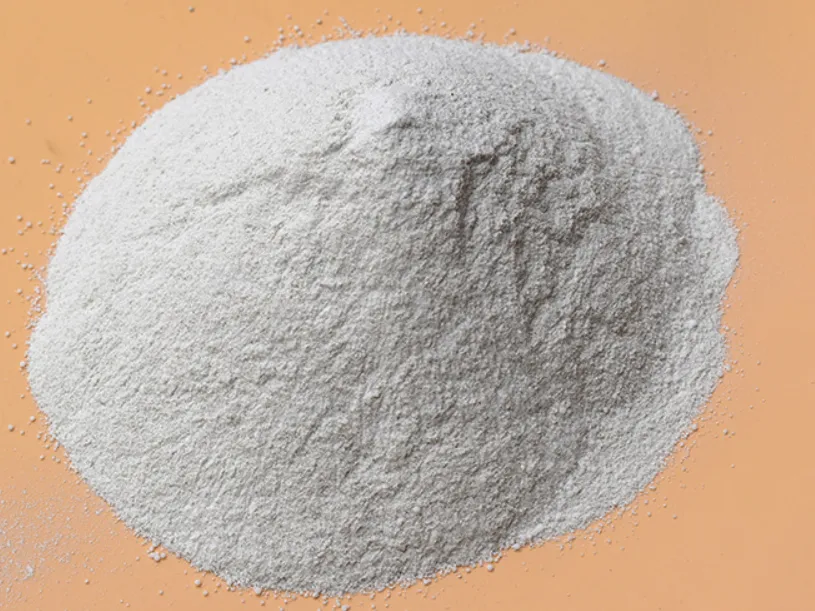
The flux forms a low-melting-point layer that floats on the aluminum surface because its density is lower than the metal itself. Once melted, it spreads into a continuous film that physically separates the aluminum from the furnace atmosphere. This isn’t a chemical cleaning action in the way a drossing flux works, it’s closer to putting a lid on a pot to stop steam from escaping, except here the goal is stopping oxygen and moisture from getting in rather than something getting out.
We think the confusion around covering flux stems from foundries lumping every flux product into one general category. Someone orders “aluminum flux” without specifying function, receives a general-purpose product, and wonders why their dross rates haven’t improved even though the same material gets marketed for oxide removal too. Understanding that covering flux has a narrower, specific job than treatment flux or cleaning flux clears up a lot of the confusion buyers run into during procurement.
Why Aluminum Needs Surface Protection During Melting
Aluminum’s chemical behavior at melting temperature makes surface protection almost mandatory rather than optional for any operation running more than occasional small batches.
At room temperature, aluminum forms a thin, stable oxide layer almost instantly on exposure to air, and this layer actually protects the metal underneath from further corrosion, which is why aluminum products don’t rust the way steel does. The problem arises specifically at melting temperature, typically between 660°C and 750°C depending on alloy and process, because the oxide layer that forms at these temperatures behaves very differently.
Molten aluminum oxidizes continuously rather than forming a single stable protective layer. Every disturbance to the surface, whether from stirring, pouring, or simple thermal convection currents within the melt, exposes fresh metal that immediately begins reacting with atmospheric oxygen again. This continuous oxidation consumes usable aluminum, converting it into oxide that ends up as dross, essentially aluminum that a foundry paid for but never gets to cast into a finished product.
Moisture compounds this problem. Water vapor reacting with molten aluminum doesn’t just create oxide, it also releases hydrogen that dissolves into the melt, setting up the porosity problems that show up later during solidification. A foundry running an uncovered melt is fighting oxidation loss and hydrogen pickup simultaneously, both of which covering flux addresses through the same protective mechanism.
| Exposure Condition | Consequence Without Covering Flux |
|---|---|
| Direct atmospheric contact during melting | Continuous oxide formation, metal loss to dross |
| Moisture contact from humid air | Hydrogen pickup, increased porosity risk |
| Surface disturbance from stirring or alloying | Fresh metal exposure, accelerated oxidation |
| Extended holding furnace time | Cumulative metal loss increases with duration |
| Transfer between furnace and ladle | Surface reoxidation during pouring operations |
We measured dross generation at one aluminum die casting facility over a comparison period, running one holding furnace with consistent covering flux application and a comparable furnace with irregular coverage due to a staffing gap. The furnace with proper coverage showed measurably lower dross generation across the tracked weeks, translating into a meaningful yield difference once scaled across their monthly production volume.
Chemical Composition of Aluminum Covering Flux
Covering flux formulations vary between suppliers, but most share a common structural approach built around chloride and fluoride salt combinations chosen for their low melting points and ability to form a stable liquid film at aluminum melting temperatures.
| Component | Function | Typical Percentage Range |
|---|---|---|
| Sodium chloride (NaCl) | Base carrier salt, lowers overall melting point | 30% to 50% |
| Potassium chloride (KCl) | Works with NaCl to further depress melting point | 25% to 45% |
| Cryolite (Na3AlF6) | Improves wetting and spreading behavior | 5% to 15% |
| Calcium fluoride (CaF2) | Enhances fluidity, assists oxide separation | 3% to 10% |
| Sodium fluoride (NaF) | Improves oxide film penetration | 2% to 8% |
| Magnesium chloride (MgCl2) | Sometimes added for alloys containing magnesium | 0% to 10% |
The sodium chloride and potassium chloride combination forms what metallurgists call a eutectic mixture, meaning the blend melts at a lower temperature than either salt would on its own. This matters practically because a covering flux needs to become fully liquid well before or right at the aluminum’s melting point to form an effective continuous film rather than sitting as unmelted granules on top of already-liquid metal.
Fluoride additions serve a secondary purpose beyond simple coverage. They help the flux wet the oxide film already present on the metal surface, allowing better contact and slightly improving the flux’s ability to assist with minor oxide coalescence even though covering flux isn’t primarily designed as a cleaning agent the way dedicated drossing flux is.
Some specialty covering flux products designed specifically for magnesium-containing aluminum alloys, common in automotive and aerospace applications, include additional fluoride compounds because magnesium oxidizes even more readily than aluminum itself and needs a more aggressive protective barrier to prevent excessive magnesium burn-off during holding.
Covering Flux Versus Other Aluminum Flux Types
This is where we see the most confusion among buyers new to aluminum processing, so a direct side-by-side comparison helps clarify the distinction.
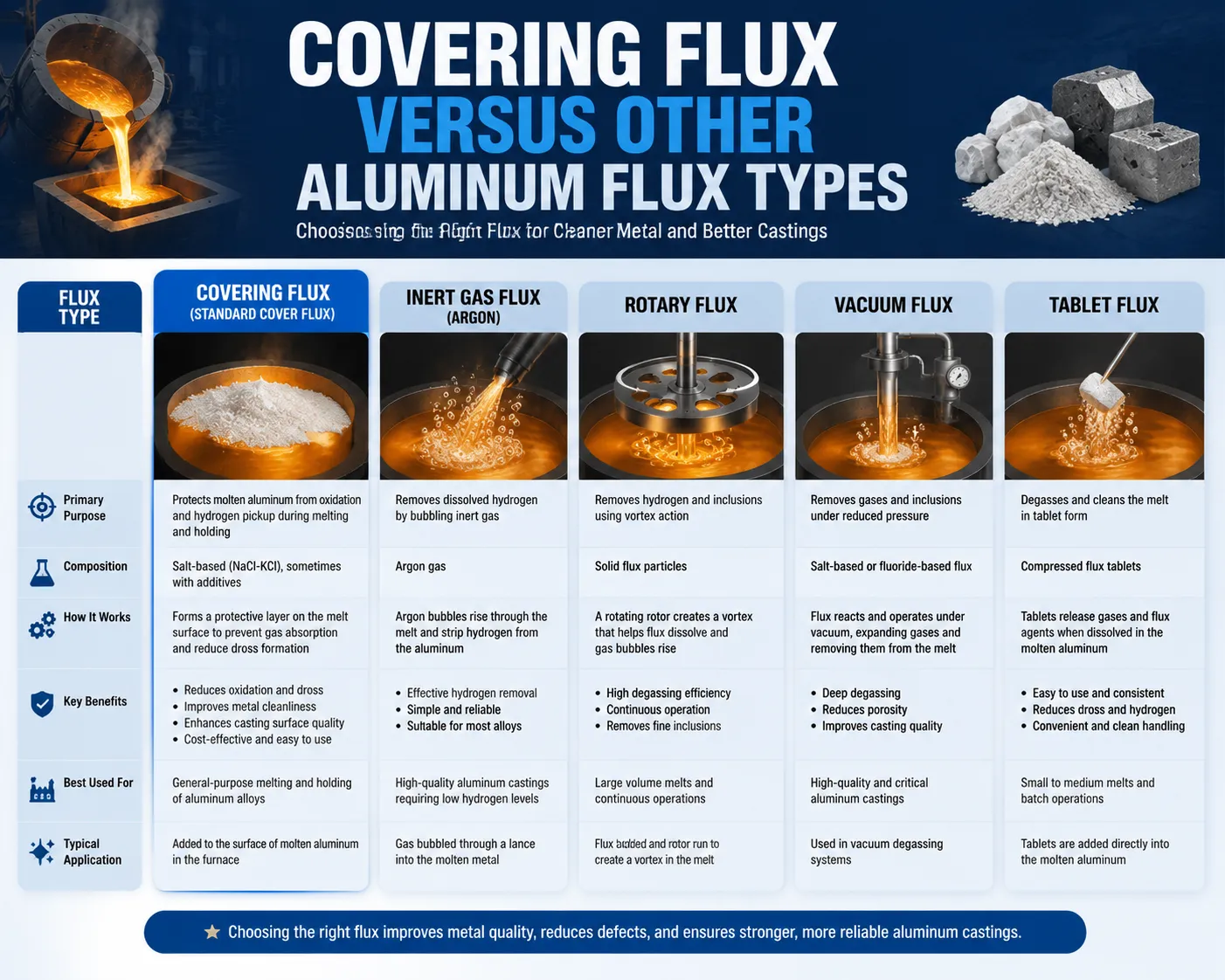
| Flux Type | Primary Function | When Applied | Chemical Action |
|---|---|---|---|
| Covering flux | Surface protection, oxidation prevention | Continuously during melting and holding | Passive physical barrier |
| Drossing flux | Separates trapped metal from dross before removal | Just before dross skimming | Active, breaks metal-oxide bond |
| Cleaning/purifying flux | Removes non-metallic inclusions from bulk melt | During refining stage | Active chemical reaction with inclusions |
| Grain refining flux | Introduces grain refining elements | Before or during pouring | Alloying/metallurgical modification |
| Degassing flux (tablet form) | Releases gas to strip hydrogen | During degassing treatment | Chemical reaction releasing gas bubbles |
Covering flux and drossing flux get confused most often because both interact with the dross layer sitting on the melt surface. The distinction matters though: covering flux prevents dross from forming excessively in the first place by blocking oxidation, while drossing flux gets added specifically when dross has already formed and needs treatment to release trapped good metal before the dross gets skimmed off and discarded.
Some products marketed as “exothermic covering flux” combine both functions to some degree, generating mild heat through their own chemical reaction to help maintain flux fluidity while also providing coverage, but these tend to cost more and aren’t necessary for every application.
How Covering Flux Physically Protects the Melt
Understanding the mechanism helps explain why application technique matters as much as product selection. Once covering flux reaches its melting point and becomes liquid, surface tension and its lower density relative to aluminum cause it to spread into a continuous, thin film across the exposed metal surface.
This film accomplishes protection through two mechanisms working together. Physical barrier action simply blocks direct contact between the atmosphere and the metal surface, similar to how oil floating on water prevents evaporation. Chemical barrier action comes from the flux’s own low reactivity with oxygen compared to aluminum, meaning oxygen molecules that do encounter the flux layer have far less tendency to react and penetrate through to the metal underneath.
The film thickness matters more than most operators realize. Too thin a layer leaves gaps where bare metal peeks through, particularly after stirring or alloying additions disturb the surface. Too thick a layer wastes material without providing proportional additional protection, and can actually make dross removal more difficult since operators end up skimming excess flux material along with genuine dross.
| Flux Layer Condition | Protective Effectiveness |
|---|---|
| Too thin (under 1mm effective coverage) | Gaps allow localized oxidation, inconsistent protection |
| Optimal (2mm to 4mm effective coverage) | Continuous barrier, minimal metal loss |
| Too thick (over 6mm) | Wastes material, complicates skimming, no added benefit |
| Patchy or uneven application | Creates oxidation hotspots at coverage gaps |
We’ve observed operators judging coverage purely by whether the surface “looks covered” without actually confirming even distribution, which tends to produce exactly the patchy coverage pattern that undermines the whole point of applying flux in the first place. A quick visual check across the entire surface area, not just the center where flux naturally tends to concentrate when poured from one location, catches this problem before it becomes an ongoing metal loss issue.
When to Apply Covering Flux During the Melting Cycle
Timing affects how well covering flux performs, and different stages of the melting cycle call for slightly different application approaches.
During initial charging: Some foundries apply a small amount of covering flux as the first solid charge material goes into the furnace, giving it time to begin melting alongside the metal charge so coverage develops as the aluminum itself starts to liquefy.
Once the melt is fully liquid: This is the most common and important application point. As soon as the charge has fully melted and the surface is exposed, applying covering flux across the entire surface area establishes the primary protective layer before extended holding begins.
After alloying additions: Adding master alloys, grain refiners, or modifiers disturbs the melt surface and often requires stirring that breaks the existing flux layer. Reapplying a light covering afterward restores full protection.
During extended holding: For furnaces holding metal for several hours before casting, periodic reapplication compensates for flux gradually getting incorporated into dross or consumed through ongoing reaction with the atmosphere.
Before transfer or pouring: Some operations apply a fresh light layer immediately before transferring metal to a ladle or launder, since the transfer process itself creates fresh surface exposure.
| Melting Stage | Covering Flux Action | Typical Reapplication Frequency |
|---|---|---|
| Initial charging | Light dusting with charge material | Once at start |
| Post-melt establishment | Full surface coverage application | Once, immediately after full melt |
| After alloying/stirring | Reapply to restore broken layer | Each time surface is disturbed |
| Extended holding furnace | Periodic topping up | Every 1 to 3 hours depending on furnace size |
| Pre-transfer/pouring | Light fresh application | Before each transfer or ladle fill |
Application Rates and Techniques
Dosage guidelines vary by supplier formulation, but general industry ranges give buyers and operators a starting reference point before fine-tuning to their specific furnace and production conditions.
| Application Context | Typical Dosage Rate |
|---|---|
| Initial full coverage application | 0.5 kg to 1.5 kg per ton of melt surface area |
| Holding furnace maintenance application | 0.2 kg to 0.5 kg per ton per reapplication |
| Small crucible furnace (under 500 kg capacity) | 0.1 kg to 0.3 kg per application |
| Large reverberatory furnace | 1 kg to 3 kg per application depending on surface area |
Application technique influences results almost as much as the quantity used. Sprinkling flux evenly by hand or through a mechanical spreader across the entire exposed surface produces more consistent coverage than dumping the full dose in one location and expecting it to spread naturally, particularly on larger furnaces where surface area exceeds what natural flow can cover before the flux begins solidifying at the edges away from the heat source.
Some larger operations use flux injection systems that blow granular or powdered flux across the surface using compressed air, achieving more even distribution than manual application, particularly valuable for furnaces with awkward geometry or limited access points for manual scattering.
We generally advise new operators to start at the lower end of a supplier’s recommended dosage range and increase gradually while monitoring dross generation and coverage consistency, since overapplication wastes material without proportional benefit while underapplication defeats the purpose of using flux at all.
Choosing the Right Covering Flux for Your Alloy
Not every aluminum alloy needs identical covering flux treatment, and buyers should factor alloy composition into their selection process rather than assuming a single general-purpose product suits every application.
Pure aluminum and low-alloy compositions generally work fine with standard chloride-fluoride covering flux blends without special additives. Alloys containing significant magnesium content, common in structural and marine-grade aluminum, benefit from covering flux formulated with additional fluoride compounds since magnesium oxidizes more aggressively than aluminum and standard flux may not provide sufficient protection against magnesium burn-off, which changes the final alloy composition if left unaddressed.
High-silicon casting alloys used in automotive components generally tolerate standard covering flux well, though some foundries running high-volume die casting operations prefer specific low-sodium formulations to avoid sodium contamination affecting silicon particle morphology in certain alloy systems.
| Alloy Category | Covering Flux Consideration |
|---|---|
| Commercially pure aluminum | Standard chloride-fluoride blend, no special additives needed |
| Aluminum-magnesium alloys (5xxx series) | Enhanced fluoride content to control magnesium oxidation |
| Aluminum-silicon casting alloys (3xx series) | Standard formulation, watch for sodium sensitivity in some grades |
| Aluminum-copper alloys (2xxx series) | Standard formulation generally adequate |
| Recycled/secondary aluminum with mixed scrap | Slightly higher dosage often needed due to contamination variability |
Benefits Foundries Gain From Proper Covering Flux Use
Based on what we’ve observed across multiple foundry engagements, the benefits of consistent covering flux application go beyond the obvious metal loss reduction.
Reduced dross generation: The most direct and measurable benefit, since less oxidation means less aluminum converted into unusable dross byproduct.
Improved metal yield: Every kilogram of aluminum that doesn’t end up as dross is a kilogram that can be cast into a sellable product, directly improving the economics of a melting operation.
Lower hydrogen pickup: By blocking moisture contact with the melt surface, covering flux indirectly reduces the hydrogen absorption that contributes to porosity defects later in the casting process.
Reduced furnace lining wear: Less aggressive interaction between exposed metal, dross, and refractory lining can extend furnace campaign life between relines, though this benefit is secondary and less consistently documented than the yield improvements.
More stable alloy composition: For alloys containing reactive elements like magnesium, proper covering reduces selective oxidation of specific alloying elements, keeping the final cast composition closer to target specification.
Cleaner working furnace surface: Operators report easier dross skimming and generally cleaner furnace conditions when covering flux maintains consistent coverage rather than allowing heavy oxide buildup between treatments.
| Benefit Category | Typical Reported Improvement |
|---|---|
| Dross generation reduction | 20% to 40% decrease compared to uncovered melting |
| Metal yield improvement | 1% to 2.5% increase in usable metal output |
| Hydrogen-related porosity reduction | Measurable decrease, varies by baseline moisture exposure |
| Furnace campaign life | 5% to 15% extension in some documented cases |
| Alloy composition consistency | Reduced magnesium/element loss in reactive alloy systems |
Common Application Mistakes and How to Avoid Them
We keep encountering the same handful of mistakes across different foundries, regardless of scale or sophistication of equipment.
Applying flux only once at the start of a long holding period and assuming it remains effective for the entire duration ignores the reality that flux gradually gets consumed, incorporated into dross, or physically displaced by surface disturbance. Periodic reapplication throughout an extended hold is not optional if consistent protection matters.
Using cleaning or drossing flux interchangeably with covering flux based on availability rather than function creates confusion about why expected results aren’t showing up. Each flux type has a distinct chemical profile suited to its intended job, and substituting one for another based on convenience rather than function usually produces suboptimal results for both purposes.
Ignoring moisture content in stored flux itself is a mistake that circles back to undermine the entire purpose of using covering flux. Flux stored in humid conditions without proper sealing absorbs atmospheric moisture, and applying damp flux to molten metal introduces exactly the moisture-related hydrogen pickup problem the flux was meant to prevent.
Overloading the surface with excessive flux thickness in an attempt to guarantee coverage wastes material and complicates subsequent operations like alloying additions or temperature measurement, since thick flux layers can interfere with probe insertion and visual monitoring of the melt surface.
| Mistake | Consequence | Correction |
|---|---|---|
| Single application for extended holding | Coverage degrades, oxidation resumes | Schedule periodic reapplication |
| Flux type substitution based on convenience | Suboptimal results for intended purpose | Match flux type to specific function needed |
| Storing flux without moisture control | Damp flux introduces hydrogen pickup | Seal storage, monitor humidity |
| Excessive application thickness | Wasted material, operational interference | Follow recommended dosage guidelines |
| Uneven manual application | Coverage gaps, localized oxidation | Use consistent spreading technique or mechanical distribution |
Storage, Handling, and Safety Practices
Covering flux needs dry, sealed storage conditions similar to other salt-based foundry chemicals, since chloride and fluoride compounds readily absorb atmospheric moisture if left exposed. Original packaging with intact moisture barriers should remain sealed until immediately before use, and opened containers should get resealed properly or used within a reasonably short timeframe rather than left open on a shop floor.
Handling precautions matter for worker safety as well as flux performance. While covering flux carries less severe fume risk than some chlorine-releasing degassing tablets, operators applying flux near an open furnace surface should still wear appropriate eye protection and heat-resistant gloves, since contact with the hot furnace surface during application carries obvious burn risk regardless of the specific chemical involved.
Fume exposure during application is generally mild for standard covering flux compared to more reactive chemical treatments, but adequate ventilation around melting furnaces remains a basic safety requirement regardless of which specific flux product a facility uses.
| Safety and Storage Practice | Recommendation |
|---|---|
| Moisture control | Seal storage below 60% relative humidity |
| Container handling | Reseal opened bags promptly, avoid prolonged open exposure |
| Personal protective equipment | Heat-resistant gloves, eye protection during application |
| Ventilation | Maintain adequate airflow near furnace application points |
| Spill cleanup | Dry cleanup methods, avoid introducing water to spilled flux |
Environmental and Regulatory Considerations
Fluoride and chloride emissions from flux use have drawn increasing regulatory attention in various regions, particularly as air quality standards around industrial fume emissions have tightened over recent years. Foundries operating in jurisdictions with strict emissions controls should verify that their chosen covering flux formulation and application volume align with local permit requirements for fluoride and chloride emissions from melting operations.
Some newer covering flux formulations marketed as “low-fume” or “environmentally optimized” reduce certain volatile components while maintaining comparable protective performance, appealing to operations facing tighter emissions permits or working in regions with dense industrial zoning near residential areas.
Waste flux and flux-contaminated dross also fall under various regional waste handling regulations depending on the specific chemical composition and local classification standards, so foundries should confirm proper disposal or recycling pathways for their spent flux material rather than assuming standard industrial waste handling applies uniformly everywhere.
Procurement Guidance for Buyers
Buyers sourcing covering flux for the first time or switching suppliers should request documentation covering chemical composition, melting point range, and recommended dosage for their specific alloy and furnace type. A generic product data sheet without alloy-specific guidance often indicates a supplier offering one-size-fits-all formulation rather than products genuinely optimized for different aluminum processing needs.
Requesting small trial quantities before committing to bulk purchasing remains sound practice, since furnace design, alloy mix, and production volume all influence how a given flux formulation performs in practice compared to its stated specifications. What performs well in one facility’s reverberatory furnace may need dosage adjustment in another facility’s induction furnace setup.
| Procurement Consideration | Why It Matters |
|---|---|
| Alloy-specific formulation guidance | Ensures appropriate fluoride/chloride balance for your metal |
| Melting point specification | Confirms flux liquefies appropriately at your furnace temperature |
| Moisture content certification | Prevents hydrogen pickup from contaminated flux |
| Trial quantity availability | Reduces risk before large-volume commitment |
| Packaging and shelf life information | Protects against degradation during storage |
| Regulatory compliance documentation | Confirms fume emissions align with local permit requirements |
Frequently Asked Questions
Does covering flux remove oxides already present in molten aluminum?
Covering flux primarily prevents new oxidation from occurring rather than actively removing existing oxide inclusions. For removing oxides already present in the melt, a dedicated cleaning or drossing flux designed for active chemical separation works more effectively.
Can covering flux be used with every type of aluminum melting furnace?
Yes, covering flux applies across reverberatory, induction, and crucible furnace types, though application technique and dosage may need adjustment based on furnace surface area and geometry.
How often should covering flux be reapplied during a production shift?
Reapplication frequency depends on furnace holding time and surface disturbance frequency, but most operations reapply every one to three hours during extended holding, and immediately after significant surface disturbance from alloying or stirring.
Is covering flux the same product as degassing flux tablets?
No, these serve different functions. Covering flux provides passive surface protection against oxidation, while degassing flux tablets actively release gas through chemical reaction to strip dissolved hydrogen from the melt itself.
What happens if covering flux gets applied too thickly?
Excessive thickness wastes material without providing additional protective benefit, and can interfere with temperature measurement, alloying addition visibility, and complicate dross skimming since operators may remove excess flux material along with genuine dross.
Does covering flux affect the final mechanical properties of cast aluminum?
When applied and skimmed correctly, covering flux itself doesn’t get incorporated into the finished casting and has no direct effect on mechanical properties. Improper skimming that leaves flux residue trapped in poured metal can create inclusion defects, so proper technique matters.
Can I make covering flux from raw chemical components rather than buying pre-blended product?
While technically possible, pre-blended commercial covering flux offers more consistent particle size, moisture control, and precisely balanced chemistry than most facilities can reliably reproduce in-house, and the cost savings rarely justify the quality control risk for production operations.
Why does my furnace still show significant dross despite using covering flux?
Common causes include insufficient application frequency, uneven coverage leaving gaps, using an incorrect flux formulation for your alloy, or dosage that’s too low for your furnace surface area and holding duration. Reviewing application technique and frequency usually identifies the gap.
Is there a difference between covering flux for die casting versus sand casting operations?
The core function remains the same across casting methods, though die casting operations running continuous high-volume production often favor formulations optimized for extended holding furnace stability, while sand casting operations with more batch-oriented melting may prioritize fast-melting formulations that establish coverage quickly.
How do I know if my covering flux has absorbed moisture during storage?
Visual clumping, caking, or an unusually damp feel to the granular product indicates moisture absorption. Applying visibly damp flux to molten aluminum can cause spattering, and any product showing these signs should be tested carefully or discarded rather than used in production.
Final Thoughts From Our Foundry Experience
Covering flux occupies a quiet but genuinely important role in aluminum melting operations, and it’s easy to underestimate its impact precisely because its job is prevention rather than correction. Nobody notices covering flux working correctly, but everyone notices the dross buildup, yield loss, and porosity complaints that show up when it isn’t. Based on what we’ve seen across various foundry operations, the facilities getting consistently good results treat covering flux application as a scheduled, monitored process rather than an occasional afterthought squeezed in when someone remembers.
If your operation is troubleshooting persistent dross generation or yield problems, reviewing covering flux application frequency, dosage accuracy, and storage moisture control often reveals gaps that cost more in lost metal than the flux itself would ever cost to apply properly. Small adjustments here tend to produce meaningful improvements in both metal yield and downstream casting quality, which makes covering flux one of the better returns on attention a melting operation can invest in.