

For safe, energy-efficient, and high-quality transfer of molten aluminum, a well-engineered trough and launder system that combines the right refractory hot-face, internal geometry to control flow, reliable seals and joints, effective insulation, and routine maintenance is essential. When designed and installed correctly, these systems preserve metal cleanliness, reduce turbulence and oxide formation, minimize heat loss, lower operating costs, and protect workers; they also make downstream degassing and filtration more effective, improving cast product yield and consistency.
1. What are troughs and launders: definitions and primary roles
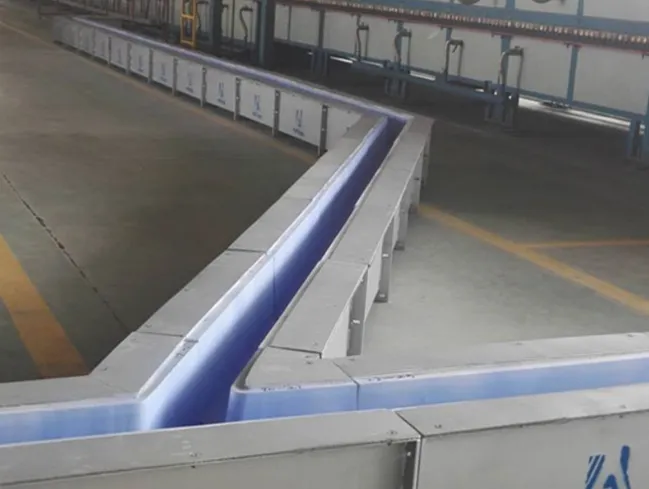
Troughs and launders are engineered channels that move molten metal, typically aluminum and its alloys, by gravity or assisted flow from furnaces to holding vessels, processing stations, or casting machines. They serve three primary purposes: safe conveyance of molten metal, thermal containment to prevent premature cooling, and preservation of melt quality by reducing turbulence and exposure to air. Properly designed systems also allow integration of flow controls, gates, thermocouples and in-line treatment devices for refining metal prior to casting.
2. Types and construction methods
Common categories
-
Prefabricated steel-shell launders with refractory lining: Steel outer shell that supports cast or precast refractory inner shapes. This is common for long runs and modular systems.
-
Precast refractory modules: Factory-made refractory sections that bolt together on site, providing consistent geometry and faster installation.
-
Cast-in-place refractory launders: Refractory cast on a steel frame on site; flexible for retrofit but requires skilled installation.
-
Fibrous or ceramic-fiber lined troughs: Lighter weight, good insulation characteristics for short runs or portable launders.
Structural components
-
Outer shell: Typically carbon steel; may include stiffening ribs and access flanges.
-
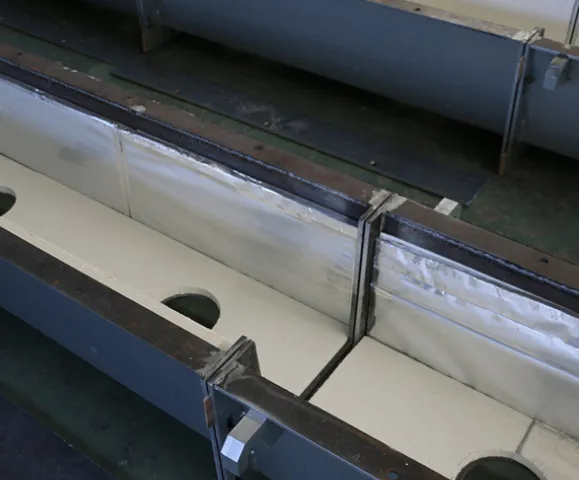
Hot-face lining: The refractory surface in contact with molten metal that must resist chemical attack and thermal shock.
-
Insulation backup: Ceramic fiber or insulating castables behind the hot face to reduce heat loss.
-
Joints and seals: Bolted flanges with gaskets or refractory fill to avoid leaks and heat bridges.
-
Accessories: Covers, inspection ports, gates, dams, thermocouple pockets, and support brackets.
3. Refractory materials and hot-face design
Selection of refractory material is the most decisive factor for launder performance. Refractories must balance non-wetting behavior, low erosion rate, thermal shock resistance, and minimal chemical reaction with molten aluminum.
Typical hot-face materials
-
High-alumina castables and ramming mixes: Good wear resistance and mechanical strength.
-
Fused silica and silicon carbide bonded goods: Low wetting behavior and good erosion resistance in some alloy systems.
-
Precast alumina-silicate shapes: Provide consistent surface finish and accurate geometry for flow control.
-
Specialty coatings or non-wetting linings: Applied to reduce metal sticking and to lengthen service life.
Design considerations
-
Surface finish: Smooth, consistent surfaces lower oxide entrapment and reduce turbulence.
-
Section thickness: Must be sufficient to withstand mechanical stresses and thermal gradients but not so thick that heat is trapped.
-
Expansion allowances: Proper jointing and offsets to accommodate thermal expansion avoid cracking and leaks.
-
Thermocouple integration: Embedding or having pockets for reliable temperature monitoring helps operators manage heat and avoid freezing inside the launder.
4. Thermal insulation, heat management and energy efficiency
A well-insulated launder reduces metal temperature drop during transfer, which helps prevent freezing and decreases energy needed from holding furnaces.
Key thermal strategies
-
Insulating backup layers: Ceramic fiber, low-density castables, or aerogel blankets reduce heat loss effectively.
-
Pre-heating practices: Controlled pre-heating prevents thermal shock to the refractory. Some modern refractories aim to eliminate lengthy pre-heat cycles, saving time.
-
Segmental thermal breaks: Design joints to minimize conductive heat loss to steel shells.
-
Optimized launder length and slope: Shorter, properly sloped runs reduce heat exposure time and flow instabilities.
Energy benefit example: Upgrading to specialized refractory systems may enable operators to reduce holding-furnace temperature setpoints, in some cases by tens of degrees Celsius, which translates to lower fuel consumption and reduced operating cost. This effect has been documented by refractory technology providers.
5. Flow control, hydrodynamics and metal quality
Metal quality depends heavily on how the launder shapes flow. Oxide formation, entrapment of inclusions, and turbulence are all linked to launder geometry and flow control devices.
Hydrodynamic principles
-
Laminar vs turbulent flow: Maintain steadier laminar-like flow where possible to reduce entrainment of air. Smooth curvature and gradual changes in cross-section support that objective.
-
Minimize splashing: Use curved transitions and properly sized outlets to avoid jets and splashing that create oxide film.
-
Gates and dams: Adjustable gates provide fine control of flow rate into downstream processes, and dams can form low-turbulence head zones for sedimentation.
-
Baffles and flow straighteners: Internal features can correct recirculation zones but must be placed to avoid accumulation of dross.
Effect on downstream treatments
A low-turbulence, controlled flow greatly improves the efficiency of degassing and filtration operations by giving inclusions time to float or be captured and by keeping the metal’s oxide content low before entering the tundish or mold.
6. Integration with degassing, filtration and tundish systems
Launder systems often form the backbone between furnaces and in-line treatment systems.
-
Positioning: Place degassing and filtration upstream of the tundish to remove hydrogen and non-metallic inclusions prior to final pouring.
-
Accessibility: Provide space and flanged connections for installing rotors, flux injectors, and ceramic foam filters.
-
Flow metering: Integrate level sensors or flow gates to synchronize downstream processes and avoid overflow or short supply.
-
Pumping options: For long or complex layouts, pump-assisted delivery can reduce launder slope and overall footprint.
Coordinated system design yields better cast surface finish and fewer internal defects, improving product yield.
7. Manufacturing and installation best practices
Factory fabrication
-
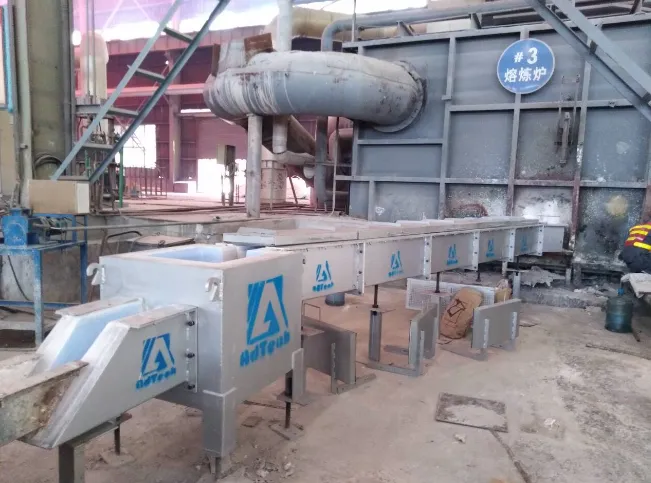
Precast, tested modules: Factory-controlled production ensures dimensional accuracy and joint compatibility.
-
Quality control: Dimensional checks, refractory curing, and kiln firing (where applicable) reduce on-site issues.
On-site assembly
-
Level and alignment: Accurate slope and alignment to specified tolerances prevents pooling or excessive velocity.
-
Joint sealing: Use bolt flanges, compression gaskets, and site-applied refractory to ensure leak-free connections.
-
Instrumentation: Install thermocouples, level indicators and accessible inspection ports during assembly.
Commissioning
-
Controlled pre-heat schedule: Gradual heat-up avoids thermal shock to refractory surfaces.
-
Test flow with sacrificial metal: Initial test with known parameters helps identify leaks, sticking zones, and thermal losses.
Companies that provide pre-engineered launder systems typically supply installation manuals and supervised commissioning to protect product life and performance.
8. Operation, safety and worker protection
Launder systems must be operated with safety front and center.
Engineering controls
-
Covers and shields: Closed or semi-closed launders reduce splatter and radiant heat exposure.
-
Automated gates: Remote-controlled gates and actuators reduce operator proximity to molten metal.
-
Thermal barriers and screens: Protect walkways and equipment from radiant heat.
Personal protective equipment and procedures
-
Mandatory PPE: Heat-resistant face shields, gloves, aprons, and footwear.
-
Hot-work permits and lockout procedures: For maintenance operations.
-
Training and drills: Operators should be trained in spill containment and emergency shut-off.
Regulatory guidance and foundry best-practice literature emphasize the risk of freeze-up blockages and the need for prompt, trained response to spillage. Documented sector guides outline standard safety measures for handling molten metal flows.
9. Maintenance, life expectancy and failure modes
Typical failure modes
-
Erosion of hot-face: Caused by high-velocity flow or chemical attack by alloying elements.
-
Thermal shock cracking: Rapid temperature swings or improper pre-heat.
-
Leakage at joints: From improper sealing or differential thermal expansion.
-
Freeze blockage: Due to excessive heat loss or interrupted flow.
Maintenance plan elements
-
Daily inspections: Quick visual checks for leaks, hot spots and insulation damage.
-
Periodic thermography: Identifies shell heat loss and insulation failures.
-
Scheduled lining repair: Replace or reline sections before critical wear depths are reached.
-
Spare parts strategy: Keep precast joint sections and common seals available to minimize downtime.
With proper materials and routine care, launders can last multiple years; heavy-duty systems in continuous high-throughput operations may need more frequent lining renewal. Manufacturer guidance gives expected lifetimes per material and operating profile.
10. Customization, accessories and value-added options
Manufacturers often offer:
-
Pre-fabricated distribution manifolds: For delivering metal to multiple casting lines.
-
Inline filter cells: Pre-mounted filter housings that reduce installation complexity.
-
Integrated degassing ports: For rotor/stationary systems.
-
Temperature control pockets and heating jackets: For long runs or low-flow scenarios.
-
Quick-release bolting systems: For faster maintenance.
AdTech’s product portfolio focuses on modular, factory-priced solutions that can be customized in length, cross-section, lining type, and accessory configuration to match customer process needs.
11. Environmental and regulatory considerations
-
Emission control: Covered launders and capture hoods reduce fumes and particulate release.
-
Waste handling: Collected dross and used refractory must be disposed of following local regulations.
-
Energy efficiency: Lower holding temperatures reduce greenhouse gas emissions per ton of metal processed.
-
Workplace ventilation: Essential to maintain safe air quality for operators.
Foundry best-practice documents and energy-implementation guides recommend measures that reduce both environmental footprint and operational cost.
12. Typical specifications, sizing and selection tables
Below are practical tables to help engineers specify and compare launder options. Values are representative; final selection requires calculation based on alloy, throughput, slope and plant layout.
Table 1. Typical launder cross-section sizing by throughput
| Throughput (kg/hr) | Typical internal width (mm) | Typical internal depth (mm) | Typical slope (%) | Typical flow velocity (m/s) |
|---|---|---|---|---|
| 500 – 2,000 | 80 – 150 | 40 – 80 | 0.5 – 2.0 | 0.2 – 0.6 |
| 2,000 – 6,000 | 150 – 300 | 80 – 150 | 0.7 – 2.5 | 0.3 – 0.8 |
| 6,000 – 15,000 | 300 – 600 | 150 – 300 | 1.0 – 3.0 | 0.4 – 1.0 |
Notes: Slopes and velocities are conservative ranges to avoid excessive erosion or turbulence. Final design must account for alloy density and pouring temperature.
Table 2. Refractory options and typical properties
| Material family | Key property strengths | Typical service life (relative) | Common applications |
|---|---|---|---|
| High-alumina castables | Wear resistance, structural strength | Medium to high | Straight runs, high flow wear areas |
| Precast alumina-silicate | Consistent surface, low porosity | High | Precision flow sections, filter housings. |
| SiC-bonded products | Low wetting, erosion resistant | High (in some alloys) | High-velocity zones |
| Ceramic fiber linings | Excellent insulation, lightweight | Low to medium | Portable launders, short runs |
Table 3. Maintenance schedule sample
| Task | Frequency | Purpose |
|---|---|---|
| Visual inspection of joints and shell | Daily | Detect leaks, warping |
| Thermocouple calibration check | Monthly | Ensure accurate temperature control |
| Refractory wear measurement | Quarterly | Plan lining repair before failure |
| Full lining overhaul | Annually or per wear | Restore flow geometry and thermal integrity |
13. Top knowledge gaps and how AdTech addresses them
-
Real-world energy savings: Many suppliers state improvements but do not quantify them. AdTech can provide measured delta in holding furnace setpoints and fuel consumption per ton after retrofit.
-
Service life expectations: Rather than generic ranges, provide wear-rate metrics under specific flow velocities and alloy chemistries.
-
Joint reliability: Offer bolted-flange designs and field-applied sealing recipes tested at operating temperatures.
-
Integration readiness: Supply turnkey options with pre-mounted filter and degassing ports to minimize on-site adaptation.
-
Rapid maintenance: Stock and supply modular replacement sections to shorten downtime.
AdTech’s factory-price model supports cost-effective custom builds and on-time delivery, addressing purchase cost concerns while offering engineering support for selection and commissioning.
14. Case study notes and performance indicators to track
When evaluating a launder system, track these KPIs:
-
Freeze incidents per year: Reduce to zero by proper heat management.
-
Dross generation rate (kg/ton): Lower rates indicate cleaner metal transfer.
-
Holding furnace temperature delta (°C): Reduction after upgrade indicates energy savings.
-
Unplanned downtime hours: Measures maintenance impact on production.
-
Replacement lining cost per year: Tracks total cost of ownership.
Manufacturers should present case data aligned to these KPIs to demonstrate real TCO improvements.
15. Comparison table — vendor feature checklist
| Feature | Baseline launder | Premium launder | AdTech 100% factory-price option |
|---|---|---|---|
| Precast modular sections | Sometimes | Yes | Yes |
| Non-wetting hot-face options | Optional | Standard | Customizable |
| Integrated filter ports | Optional | Yes | Yes |
| Pre-installation testing | Limited | Extensive | Factory-tested |
| Installation support | Extra cost | Included | Included depending on order |
| Warranty and spare parts | Basic | Extended | Competitive, factory stocked |
Launder & Trough Systems: Molten Metal Flow FAQ
1. What is the main difference between a trough and a launder?
2. How do I choose the right refractory for my alloy?
3. What causes launders to “freeze” and how can that be prevented?
4. Can launders be made portable?
5. How often should lining inspections occur?
6. Do launders need pre-heating?
7. What accessories should I expect to add to a system?
Typical integrations include:
- Flow control gates (Manual or Pneumatic).
- Thermocouple pockets for real-time temperature tracking.
- Insulated covers to reduce oxidation and heat loss.
- Inspection ports and filter housing modules.
8. How much does a launder replacement cost?
9. Can launders reduce the need for holding furnace energy?
Yes. By using advanced multi-layer insulation, you can significantly reduce the temperature drop between the furnace and the mold. This allows for lower holding furnace setpoints, directly decreasing fuel consumption.
10. What environmental measures must be considered?
Closing recommendations for engineers and purchasing teams
-
Define throughput, alloy types, plant layout and integration points before requesting quotes.
-
Ask suppliers for measured performance data: heat-loss figures, typical lining life under stated conditions, and case studies.
-
Prefer modular, factory-tested systems for predictable installation and maintenance.
-
Prioritize supplier support for commissioning and spare-part availability.
-
Include safety devices and automation suited to your operating profile to reduce exposure and improve consistency.
By focusing on material compatibility, thermal management and flow control, foundries and casthouses can substantially improve metal quality and reduce operating cost. AdTech’s launder and trough product line emphasizes modular engineering, reliable refractory choices, and transparent factory pricing to give foundries a practical route to modernization and lower total cost of ownership.