
High-purity graphite rings are a small, mission-critical consumable that determine whether an aluminum billet comes off the line with a smooth, defect-free skin or lands in the scrap pile. AdTech’s Graphite Ring combines isostatic graphite, tight CNC tolerances, and optional antioxidant impregnation to deliver consistent surface quality, longer service life, and lower total cost of ownership for Hot-Top and AirSlip billet casting systems. If you need predictable yields, less lubricant consumption, and simple retrofit compatibility with Wagstaff and other global systems, a specification audit with AdTech’s engineering team is the fastest way to lock in gains.
1. The Strategic Importance of Graphite Rings in Modern Foundries
Definition and context.
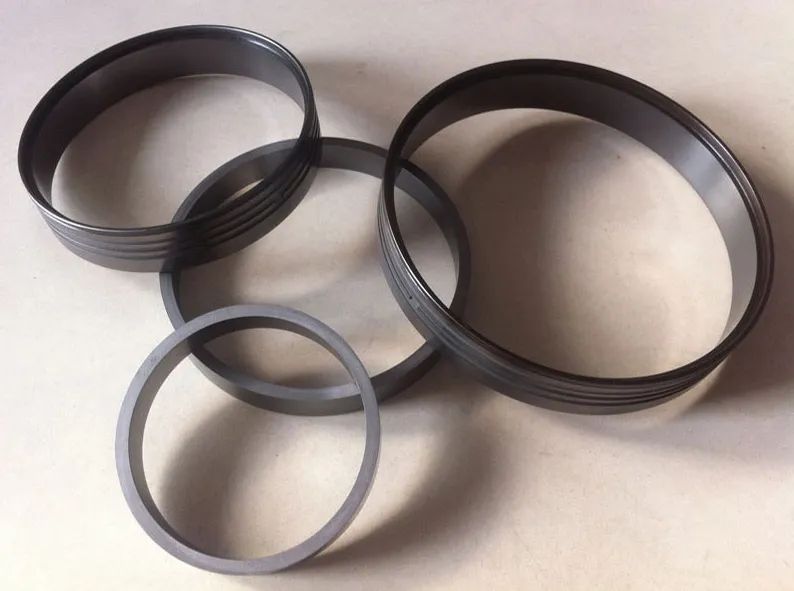
In Hot-Top and AirSlip billet casting, the graphite ring sits at the interface between the molten aluminum and the mould — it controls heat flow, manages lubricant delivery, and seals the top of the billet until solidification produces a stable skin. For production-scale furnaces the graphite ring is therefore a core consumable whose micro-performance (porosity, flatness, ash level) directly affects macro-outcomes (surface finish, shell zone size, yield).
The quality link.
A high-quality graphite ring stabilizes thermal gradients and provides controlled self-lubrication so that the billet skin forms evenly. Poor rings — with variable density, micro-cracks, or clogged porosity — cause ripples, surface cracking, greater oxide inclusion and ultimately higher scrap rates. Investment in premium rings is not cosmetic: it’s yield optimization.
Check Graphite Rings Stock Availability & Price
2. Technical Specifications & Material Science
The chemistry of high-purity graphite
AdTech uses feedstock selected for low ash and high fixed carbon content. High-purity molded/isostatic graphite typically features carbon content in the high-99% range (commercial grades frequently exceed 99.5–99.9% fixed carbon), which reduces contamination risk and improves thermal and chemical stability in contact with molten aluminum and fluxing agents.
Physical property table (optimized for featured snippets)
| Property | Typical Range / AdTech Target |
|---|---|
| Bulk Density | 1.75 – 1.90 g/cm³ |
| Compressive Strength | 60 – 85 MPa |
| Shore Hardness | 50 – 65 |
| Ash Content | < 500 ppm |
| Thermal Conductivity | Engineered for uniform cooling; grade dependent |
(These ranges align with modern isostatic/molded graphite product data and AdTech production grades)
Isostatic vs. extruded graphite — why AdTech chooses isostatic
Isostatic pressing applies equal pressure from all directions during forming, producing near-isotropic density and fewer directional weaknesses. That uniformity translates into predictable porosity (for controlled lubricant seepage), predictable thermal conductivity, and superior machinability for tight CNC tolerances. In contrast, extruded graphite can show grain directionality that affects strength and permeability. Graphitization at ultra-high temperature (~3000°C) then converts shaped carbon to crystalline graphite, greatly improving conductivity, density and resistance to chemical attack.
3. Solving 10 Major Foundry Challenges with Advanced Graphite Rings
Below are common production pain points and how a premium, engineered graphite ring addresses them.
-
Eliminating billet surface cracking.
Uniform density and tailored thermal conductivity reduce sharp thermal gradients at the solidifying skin edge. Controlled oil seepage from open, evenly distributed pores prevents local adhesive stresses that lead to tearing. -
Reducing lubricant consumption.
Precision-controlled porosity (engineered pore size and connectivity) allows the ring to act as a low-rate oil reservoir; tests show properly graded rings reduce oil use by up to ~30% versus uncontrolled porous grades. (Savings depend on process and lubricant system.) -
Preventing metal leakage.
CNC machining to tolerances within ±0.05 mm ensures the ring seats firmly in the hot-top adapter and forms a repeatable seal, preventing costly metal spills and dimensional washout. -
Minimizing oxidation.
Optional antioxidant impregnation or resin/metal impregnation reduces active surface oxidation, lengthening ring life in open-air or aggressive flux environments. -
Achieving consistent billet smoothness.
Surface finish is a function of porosity uniformity and edge integrity; rings produced from isostatic graphite with tight machining produce fewer “ripples” and smaller shell zones. -
Extending service life.
The balance between hardness and controlled friability — achieved by choice of coke, binder, graphitization schedule and any impregnation — determines wear resistance while preserving self-lubrication. -
Thermal shock resistance.
Proper grade selection and controlled grain size help rings tolerate the first-cast thermal ramp (molten aluminum at ~700–750°C) without spalling. -
Chemical erosion defense.
Low ash content and high purity reduce interaction with chlorine-based refining agents and flux residues that attack lower-grade graphite. -
Standardizing large-scale production.
Isostatic pressing and automatic QC (density mapping, ultrasonic or CT spot checks) ensure batch-to-batch consistency required for continuous, 24/7 operations. -
Compatibility issues.
AdTech designs rings to fit Wagstaff AirSlip, Air Casting systems, and a wide array of legacy hot-top adapters, simplifying retrofits and inventory management.
4. The Manufacturing Process: From Raw Carbon to Precision Ring
A consistent final ring begins with strict control over upstream steps.
Raw material selection
Premium petroleum coke + coal tar pitch (or equivalent binders) provide the base chemistry. Feedstock selection influences ash, grain size and eventual thermal and mechanical properties.
Molding and isostatic pressing
The crushed, mixed feedstock is shaped and then isostatically pressed (if adopting isostatic manufacturing) to achieve an even internal pressure environment. The result is a near-isotropic “green” block with highly predictable density and permeability.
Carbonization
Green shapes are carbonized in an oxygen-free furnace (≈1000°C) to drive off volatiles and form a stable carbon matrix. The binder forms the initial bridges between particles.
Graphitization
High-temperature graphitization (~2500–3000°C; many commercial processes target ~3000°C) reorganizes the carbon into a crystalline graphite lattice, dramatically improving electrical and thermal conductivities, reducing internal stresses, and improving machinability. This step is energy intensive but essential for premium performance.
CNC precision machining
After graphitization, blocks are CNC machined to final dimensions with micro-finish passes. Tight tolerances and concentricity controls ensure seat integrity, correct porosity channels, and consistent lubricant delivery across the ring face.
Antioxidant impregnation (optional)
For rings that operate in oxidizing atmospheres or with aggressive fluxing agents, resin or metal impregnation can fill micro-pores and stabilize the surface chemistry, improving wear and oxidation resistance.
5. Application Scenarios in Aluminum Foundries
Hot-Top billet casting (primary use)
Graphite rings are essential for Hot-Top casting of 1xxx–8xxx series alloys. They help form a controlled freeze profile at the top of the mould and feed lubricant to minimize surface defects.
Horizontal vs. vertical casting
Orientation matters: horizontal casting often benefits from slightly higher permeability to assist lubricant flow while vertical casting prioritizes seal integrity and uniform radial cooling. AdTech offers density-graded rings to match orientation and alloy.
Compatibility guide
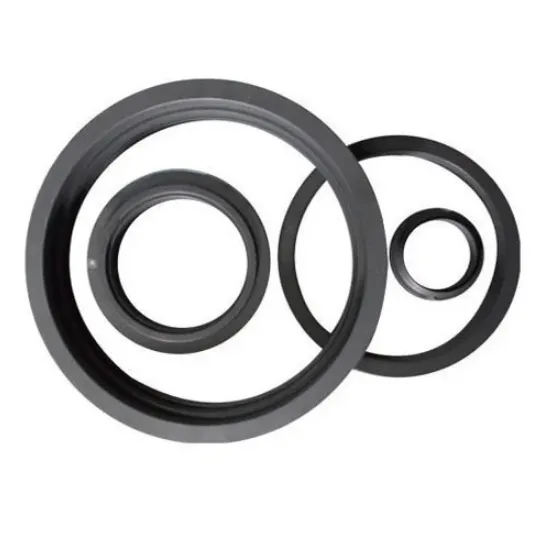
AdTech produces standard and custom diameters from small billet molds (~2.5 in / 63 mm) through large pressings (20 in+ / 500 mm+). Rings can be produced with porting, adapter flanges, or clamping features to directly mate with Wagstaff, AirSlip, and other systems without costly tooling changes.
6. Maintenance & Replacement Guide: Maximizing ROI
Pre-heating protocols
Rings must be dried/preheated to remove adsorbed moisture before first cast. Rapid exposure to molten metal with trapped moisture is the primary cause of spalling and initial cracking. A controlled preheat ramp mitigates this risk.
Cleaning best practices
Use mechanical scraping and controlled thermal cycling rather than aggressive chemical cleaners. If residual aluminum is present, warm soak and gentle mechanical removal preserves pore structure and avoids surface micro-fractures.
Signs of wear and replacement triggers
Replace the ring before severe edge erosion, a noticeable increase in billet surface defects, or when pore channels become clogged and lubricant distribution is uneven. Visual checks for micro-cracks, a simple weight-to-volume density test, and a porosity soak test are recommended. (See Buyer’s Guide below.)
7. The Buyer’s Guide: How to Identify Premium Graphite Rings
The porosity test
A simple soak test: submerge the ring face in a standard process lubricant for a fixed interval and measure oil uptake and seep rate at multiple points. Even, repeatable seepage is the sign of good pore connectivity.
Visual inspection
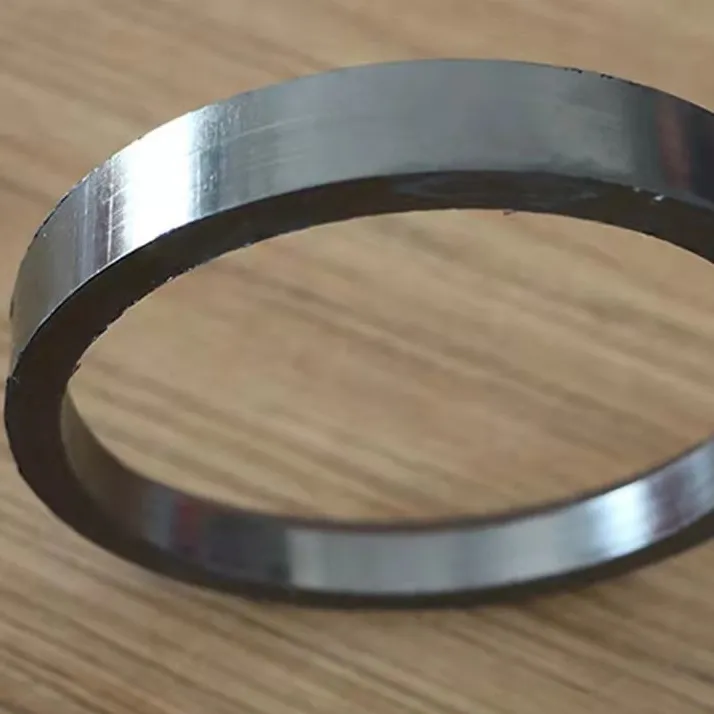
Look for uniform color and finish, absence of micro-cracks, non-chipped edges, and a smooth face finish. Microscopic crazing or visible inclusions are red flags.
The “weight-to-volume” check
Measure mass and calculate bulk density. High density (within spec for the grade) correlates to longer service life and better mechanical performance. Density that falls below the specified band generally indicates a shorter lifetime and higher friability.
Packaging standards
Rings should arrive in foam-padded, export-grade crates to prevent edge chipping. Look for anti-moisture barriers if shipping through humid zones.
8. Comparative Analysis: Graphite Rings vs. Ceramic Alternatives
Thermal conductivity advantage
Graphite’s superior thermal conductivity and ability to manage rapid heat extraction make it the preferred option for high productivity billet casting where cooling uniformity affects shell formation and skin finish. Ceramics can be useful for some high-temperature stable applications, but they lack graphite’s self-lubricating, machinable character.
Self-lubrication properties
Graphite naturally provides low friction and oil retention through engineered porosity; ceramics typically need external coatings or lubricants and do not “weep” oil to the same controlled degree.
Total Cost of Ownership (TCO)
Though premium graphite rings can command higher upfront price, their longer life, reduced lubricant consumption, and lower scrap rates commonly yield a lower TCO for continuous billet operations. When evaluating cost, include scrap reduction, downtime, and lubricant savings over an equipment life cycle.
Graphite Rings for Billet Molds: Technical FAQ
1. How long does a typical graphite ring last in a billet mold?
2. Can graphite rings be used for high-magnesium aluminum alloys?
3. What causes “clogging” in graphite rings, and how can it be prevented?
4. Do you provide custom dimensions for non-standard mold systems?
5. What is the difference between high-density and medium-density graphite for casting?
6. Is antioxidant impregnation worth the additional cost?
7. Can graphite rings be repaired on-site?
8. How do I test a new ring grade before full deployment?
9. Are AdTech rings compatible with Wagstaff AirSlip systems?
10. What environmental considerations are there for graphite rings?
Conclusion: Partnering with AdTech for Superior Casting Results
Summary of benefits.
Precision: CNC tolerances and isostatic manufacturing produce repeatable seat geometry.
Durability: High fixed carbon, low ash and optional impregnation decrease wear and chemical erosion.
Yield: Controlled porosity and thermal behavior reduce scrap and improve surface quality.
The AdTech edge.
AdTech combines metallurgical R&D, process control and foundry experience to deliver rings that integrate seamlessly with global casting platforms — from Wagstaff AirSlip to legacy hot-top molds — while offering engineering support for specification audits and in-field troubleshooting.
Request a Competitive Factory Quote
Contact our engineering team for a customized Graphite Ring specification audit. We’ll review your alloy mix, casting orientation, lubricant strategy and cycle rate, then recommend the grade, porosity profile and finishing options that will maximize yield and minimize your operational costs.
Notes on testing and procurement
-
Request density and compressive strength certificates for each batch.
-
Require ash content (ppm) and graphitization temperature information.
-
Insist on CNC run-out tolerances and a packaging standard for export crates.
-
Validate compatibility with molds/adapters (send AdTech a drawing or sample).