

A molten aluminum launder system is a heated, thermally insulated trough network that transfers liquid aluminum from a melting or holding furnace to a casting machine, continuous casting unit, or downstream processing station while maintaining precise metal temperature, minimizing oxidation, and preserving melt cleanliness. In aluminum casting foundries, the launder system is not a passive conduit — it is an active process zone where metal temperature control, inclusion management, hydrogen removal, and flow regulation all occur simultaneously. A well-engineered launder system directly determines the quality of every casting produced downstream of it.
If your project requires the use of launder system, you can contact us for a free quote.
We have evaluated launder installations across primary aluminum smelters, secondary aluminum recyclers, billet casting operations, and automotive die casting facilities, and the conclusion is the same in every context: the launder system is one of the most underspecified and under-maintained components in the aluminum production chain, yet it has outsized influence on final metal quality. Temperature losses of 5–15°C across a poorly designed launder, turbulence-induced oxide generation at joints and transitions, and inclusion carry-over from unlined or worn launder surfaces are responsible for a measurable fraction of casting scrap in facilities that have not optimized this critical transfer system. Getting the launder right is not an optional refinement — it is a foundational requirement for consistent aluminum casting quality in 2026.
What is a Molten Aluminum Launder System?
A molten aluminum launder system — sometimes called a transfer launder, casting launder, or metal transfer trough — is the engineered channel assembly that carries liquid aluminum between process stations in a foundry or casting plant. The name derives from the old English word “launder,” meaning a trough or conduit for carrying liquids, which accurately describes the fundamental function even in modern high-technology installations.
In practical foundry terms, the launder connects:
- Melting furnace to holding furnace.
- Holding furnace to casting machine (DC casting, continuous casting, gravity die).
- Holding furnace to in-line treatment units (degassing, filtration).
- Treatment units to distribution launders feeding multiple casting stations.
The distance covered by a launder system ranges from less than one meter in compact die casting cells to over 30 meters in large primary aluminum casting facilities where furnaces are separated from casting pits by significant distances.
Why Launder Systems Matter Beyond Simple Metal Transfer
The simplest mental model of a launder — an open trough that metal flows through — massively understates its engineering importance. During the time molten aluminum spends in the launder (typically 30 seconds to several minutes depending on flow rate and distance), multiple quality-critical phenomena occur:
Thermal loss: Molten aluminum at 720–780°C loses heat to the launder refractory, the atmosphere above the metal surface, and any uncovered sections exposed to convective air movement. Each degree of uncontrolled temperature loss at this stage requires additional furnace energy and reduces the casting process window.
Oxide formation: The exposed metal surface in an open launder continuously generates aluminum oxide skin. Metal turbulence at joints, transitions, and drops folds this oxide skin back into the melt as bifilm inclusions — the most damaging inclusion type in structural aluminum castings.
Hydrogen pickup: Moisture in the launder refractory (particularly after maintenance or new installation), atmospheric humidity condensing on the metal surface, and wet charge materials added upstream all contribute dissolved hydrogen to the melt during launder transit.
Inclusion accumulation: Refractory erosion products from launder walls and floor, oxide fragments from upstream processing, and particles from poorly maintained joints accumulate in the launder channel and can be swept into the casting mold.
A properly engineered launder system manages all four of these phenomena simultaneously. This is why launder design, refractory selection, heating system integration, and maintenance protocol are all engineering decisions rather than commodity procurement choices.
Launder System Components and Configuration
A complete molten aluminum launder system consists of multiple integrated components, each with specific engineering requirements.
Primary Structural Components
Launder Shells (Steel Housings):
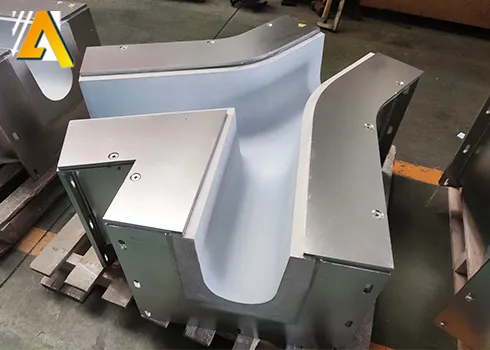
The outer structural shell of a launder section is typically fabricated from 3–6mm mild steel plate, formed into a U-channel or rectangular box section. The steel shell provides structural rigidity, defines the external dimensions of the launder section, and serves as the substrate to which refractory lining is applied. In heated launder designs, the shell also contains electrical heating elements or gas burner ports integrated into the cover assembly.
Refractory Lining:
The inner surface of the launder shell is lined with refractory material that contacts the molten aluminum. This is the most technically critical component of the launder system — the refractory must be thermally stable, chemically inert to molten aluminum, mechanically robust against thermal cycling, and dimensionally stable to prevent joint cracking that allows metal penetration.
Launder Covers:
Covers serve two functions: thermal insulation (reducing heat loss from the metal surface) and oxide reduction (limiting atmospheric oxygen contact with the melt). Covers range from simple loose-fit ceramic fiber boards placed manually over open launder sections to fully engineered hinged or sliding cover assemblies with integrated heating elements on the cover underside.
Support Structure:
The launder assembly is supported on a steel framework that must accommodate the combined weight of the launder shell, refractory lining, molten metal, and cover system — typically 150–400 kg per linear meter for insulated launders — while providing adjustment capability for precise slope alignment.
Transition Pieces and Joints:
Where launder sections connect to each other, to furnace taphole outlets, or to casting equipment inlets, transition pieces provide smooth geometric continuity. Poor joint design at these interfaces is one of the most common sources of metal leakage, turbulence, and inclusion generation.
Flow Control Components:
Ceramic stopper rods, sliding gates, and weir plates regulate metal flow within the launder system. These components allow the operator to direct metal flow, control flow rate, segregate metal streams in multi-strand operations, and shut off flow for maintenance without emptying the entire furnace.
Component Specifications Overview
| Component | Material Options | Key Specification | Replacement Frequency |
|---|---|---|---|
| Launder shell | Mild steel, stainless steel | 3–6mm wall thickness | 10–20 years |
| Primary refractory lining | Calcium silicate board, castable | Chemical purity, thermal conductivity | 3–18 months |
| Wearing surface | Precast alumina shapes, monolithic | Al₂O₃ content 85–99% | 3–12 months |
| Covers | Ceramic fiber board, rigid insulation | Thermal conductivity, mechanical strength | 6–18 months |
| Sealing rope | Ceramic fiber rope | Temperature rating, compression recovery | 3–6 months |
| Stopper rods | High-alumina ceramic | Chemical resistance, thermal shock resistance | Per campaign |
| Sliding gates | Boron nitride or graphite | Non-wetting to Al, thermal shock resistance | 50–200 operations |
| Support frame | Structural steel | Load capacity, adjustability | Structure life |
Refractory Materials Used in Aluminum Launders
The refractory lining is the heart of any aluminum launder system. Material selection determines chemical compatibility with the aluminum melt, heat loss characteristics, campaign life, and the risk of refractory-sourced contamination in the casting.
The Fundamental Challenge: Aluminum vs. Refractories
Molten aluminum is one of the most chemically aggressive metals in terms of refractory attack. It reacts with or wets many conventional refractory materials, creating two categories of problem:
Penetration and Erosion: Liquid aluminum can penetrate porous refractories through capillary action, solidify in the pores during cooling, and cause mechanical disruption of the lining when the differential thermal expansion between aluminum and refractory creates stresses that spall the refractory surface.
Chemical Attack: Aluminum reduces some refractory oxides (particularly SiO₂) through thermite-type reactions, consuming refractory material and introducing silicon or other contaminants into the metal. This reaction, while thermodynamically favorable, proceeds slowly at typical casting temperatures but accelerates at elevated temperatures or with prolonged contact.
Refractory Systems for Aluminum Launders
Calcium Silicate Board (CaSiO₃):
The most widely used insulating substrate layer in aluminum launder systems. Calcium silicate boards are manufactured from lightweight, microporous calcium silicate with excellent thermal insulation properties and low bulk density. They are not used as the metal-contact surface but as the thermal backup layer behind the wearing surface.
Key properties:
- Service temperature: up to 1000°C.
- Thermal conductivity: 0.15–0.25 W/m·K at 600°C.
- Bulk density: 250–450 kg/m³.
- Non-wetting to aluminum (does not bond to solidified metal).
- Easy to machine to fit complex geometries.
High-Alumina Precast Shapes:
Pre-fired high-alumina (85–99% Al₂O₃) refractory shapes form the metal-contact wearing surface in premium launder systems. These shapes are manufactured to precise dimensional tolerances, fired at 1500–1600°C to develop full ceramic strength, and installed with minimal joint gaps to prevent metal penetration.
| Al₂O₃ Content | Max Service Temp | Chemical Resistance | Relative Cost |
|---|---|---|---|
| 85% Al₂O₃ | 1600°C | Good | Medium |
| 90% Al₂O₃ | 1700°C | Very Good | Medium-High |
| 95% Al₂O₃ | 1750°C | Excellent | High |
| 99% Al₂O₃ (corundum) | 1800°C | Maximum | Very High |
Castable Refractory (Monolithic):
High-alumina castable refractories are poured in place, eliminating joints between precast pieces. The monolithic nature reduces metal penetration risk at joints but requires careful mixing, vibration casting, and controlled drying to achieve full performance.
Boron Nitride (BN) Coatings:
Hexagonal boron nitride is applied as a coating or spray to launder surfaces in high-cleanliness applications. BN is genuinely non-wetting to molten aluminum — aluminum beads up on BN surfaces rather than spreading — preventing metal adhesion and simplifying cleanup. BN-coated launders are standard in aerospace aluminum billet casting where any refractory contamination is unacceptable.
Graphite and Carbon-Based Linings:
Used in specialized high-purity applications. Carbon is chemically inert to aluminum but must be protected from oxidation, limiting its use to covered or inert-atmosphere launder systems.
Refractory Selection Matrix for Aluminum Launders
| Application Type | Metal Purity Requirement | Recommended Lining System | Campaign Life |
|---|---|---|---|
| Secondary Al, general casting | Standard | Calcium silicate board + castable wearing layer | 6–12 months |
| Automotive structural casting | Medium-high | Ca-silicate + 90% Al₂O₃ precast shapes | 8–15 months |
| Aerospace billet casting | High | Ca-silicate + 95–99% Al₂O₃ precast + BN coating | 10–18 months |
| Primary Al, continuous casting | Very High | Multi-layer with corundum contact surface | 12–24 months |
| Recycled Al, high inclusion load | Standard | Robust castable with sacrificial wearing layer | 3–8 months |
Thermal Management: Heating Systems and Temperature Control
Temperature management across the launder system is one of the most direct controllable factors affecting casting quality. Every degree of uncontrolled temperature loss requires either higher furnace tapping temperature (increasing energy cost and oxide formation) or acceptance of a lower casting temperature (reducing fluidity and increasing misrun risk).
Sources of Thermal Loss in Aluminum Launders
Radiation from the open metal surface:
An uncovered launder radiates heat from the exposed metal surface at a rate proportional to the fourth power of absolute temperature. At 720°C, radiation heat flux from an open surface is substantial — a 2-meter uncovered launder section can lose 3–6°C of metal temperature per minute under typical foundry conditions.
Conduction through the refractory lining:
Heat flows from the 720°C metal through the launder refractory to the cooler ambient environment. The rate of conductive loss depends on the thermal conductivity of each refractory layer, the total lining thickness, and the temperature gradient across the lining.
Convective loss from exposed surfaces:
Air movement across an open launder surface increases convective heat transfer significantly. Even moderate air flow in a foundry environment (1–2 m/s from ventilation systems) can more than double the convective heat loss compared to still air conditions.
Startup heat absorption:
At the beginning of a casting campaign, a cold launder absorbs substantial heat from the metal to reach thermal equilibrium. This startup loss can be 15–30°C for an unpreheated insulating launder of typical length. Proper preheating eliminates or minimizes this startup loss.
Heating System Types for Aluminum Launders
Electrical Resistance Heating:
The most precise and controllable heating method for aluminum launders. Resistance heating elements — typically silicon carbide (SiC) or molybdenum disilicide (MoSi₂) elements rated for 900–1100°C — are mounted on the launder cover or side walls and controlled by PID temperature controllers linked to thermocouples positioned at the metal surface.
Advantages of electrical heating:
- Precise temperature control (±2–5°C).
- Zone-by-zone independent control.
- No combustion products that could affect metal quality.
- Easy integration with automated process control systems.
- Suitable for cleanroom or enclosed foundry environments.
Gas Burner Heating:
Radiant gas burners mounted in the launder cover heat the metal surface and launder interior through radiant and convective heat transfer. Typically natural gas or LPG fueled, these systems offer lower capital cost than electrical heating but less precise temperature control.
Preheating (Startup Only):
Some foundries use portable propane burners or electric resistance pre-heaters to bring the launder to operating temperature before the first metal pass, then rely on the metal itself and cover insulation to maintain temperature during production. This approach is adequate for short launders but insufficient for long transfer distances.
Temperature Control Architecture
A well-engineered heated launder system divides the launder length into independently controlled thermal zones, each with its own heating element group and thermocouple feedback loop. This zoning approach compensates for the varying heat demand along the launder length — end sections and exposed sections may require more heating power than well-insulated mid-sections.
| Launder Length | Minimum Thermal Zones | Temperature Control Accuracy | Typical Power Density |
|---|---|---|---|
| Under 3 m | 1–2 zones | ±5°C | 3–5 kW/m |
| 3–8 m | 2–4 zones | ±3–5°C | 4–7 kW/m |
| 8–15 m | 4–8 zones | ±2–3°C | 5–8 kW/m |
| Over 15 m | 8+ zones | ±2°C | 6–10 kW/m |
Melt Treatment Integration Within the Launder
Modern aluminum casting plants integrate multiple melt treatment processes directly into the launder system, creating an in-line treatment sequence between the furnace and the casting machine.
In-Line Degassing in the Launder
Rotary impeller degassing units (also called in-line degassers or LARS — Launder-based Aluminum Refining Systems) are installed directly in the launder channel, typically in an enlarged launder box or dedicated treatment vessel positioned between the furnace and the casting station.
The rotary impeller spins at 200–600 RPM, dispersing fine bubbles of inert gas (argon or nitrogen) throughout the melt volume. These bubbles collect dissolved hydrogen through partial pressure differential and rise to the surface, carrying hydrogen out of the melt. The same bubble dispersion mechanism also flotates fine oxide inclusions to the surface, where they can be skimmed.
Degassing performance targets for aluminum launder systems:
| Initial Hydrogen Content | After Degassing Target | Degassing Efficiency | Application |
|---|---|---|---|
| 0.30–0.45 ml/100g | < 0.10 ml/100g | >75% removal | Automotive structural |
| 0.20–0.35 ml/100g | < 0.08 ml/100g | >75% removal | Aerospace billet |
| 0.15–0.25 ml/100g | < 0.12 ml/100g | >50% removal | General industrial |
In-Line Filtration in the Launder
Ceramic foam filter boxes positioned in the launder channel provide the final solid inclusion removal stage before metal enters the casting machine. The filter box is an enlarged launder section with a seat designed to hold one or more ceramic foam filters (typically 20–40 PPI alumina grade for aluminum casting).
In large-scale continuous casting operations, filter box designs include:
- Single filter stage for standard quality.
- Dual filter stage (coarser + finer PPI in series) for premium cleanliness.
- Combination filter and degassing in a single vessel for compact installations.
Flux Addition and Grain Refinement in the Launder
Wire feeding systems mounted above the launder deliver grain refinement master alloy (Al-5Ti-1B or Al-3Ti-1B wire) and alloying additions directly into the metal stream at a controlled rate. This launder-based addition method provides superior mixing compared to furnace additions because the flowing metal stream provides inherent convective mixing.
Flux tablets or powder fluxes for dross removal can also be added at designated flux addition points upstream of the skimming station in the launder.
Integrated Melt Treatment Sequence
The optimal sequence of melt treatment operations in an aluminum launder system is:
- Furnace tapping with controlled flow rate to minimize turbulence at the launder entry.
- Grain refinement wire feeding at the launder inlet (allows maximum mixing time).
- Alloying additions if required (same location or just downstream).
- In-line degassing in the primary treatment vessel.
- Dross skimming downstream of the degassing vessel.
- Ceramic foam filtration as the final treatment before the casting machine.
- Flow distribution to individual casting strands or mold positions.
Launder Design Principles for Minimizing Inclusion Formation
The geometry and surface characteristics of the launder system directly control the rate at which new inclusions are generated during metal transfer. This is a design discipline that receives far less attention than it deserves.
Controlling Metal Velocity and Turbulence
The critical parameter controlling oxide inclusion generation in a launder is the metal surface velocity. When the metal surface moves faster than approximately 0.5 m/s, the surface oxide skin cannot remain intact — it folds, breaks, and becomes entrained as bifilm inclusions. This threshold, established through experimental work by casting researchers in the 1990s and validated extensively since, defines the maximum permissible surface velocity in any launder channel carrying aluminum.
Launder cross-section sizing principle:
For a given metal flow rate (kg/s), the launder cross-section must be large enough that the resulting surface velocity stays below 0.5 m/s. Wider, shallower launder channels generally perform better than narrow, deep channels for the same flow rate, because the wider surface area accommodates higher volumetric flow at lower surface velocity.
Slope Optimization
The floor slope of a launder channel controls flow velocity — steeper slopes produce higher velocity. The ideal launder slope balances adequate velocity for reliable drainage (preventing metal freezing or buildup) against the surface velocity limit for turbulence control.
Recommended launder floor slopes for aluminum:
- Standard transfer launders: 1–3° (approximately 17–52 mm/m)
- Low-flow, low-velocity sections: 0.5–1°
- Drain sections (for maintenance): 3–5°
Slopes steeper than 3° create velocities at typical flow rates that exceed the turbulence threshold and should be avoided in quality-critical applications.
Drop Height Management
Every point where molten aluminum drops from one level to another generates turbulence proportional to the drop height. Even a 50mm drop at a launder-to-launder joint creates a splash zone that generates oxide bifilms.
Best practice drop height limits for aluminum launders:
- Maximum drop at any transition: 25mm in premium applications, 50mm maximum for general applications.
- Preferred approach: Ramp transitions rather than abrupt drops.
- When drops are unavoidable: Use ceramic dams or impact pads immediately downstream to suppress turbulence.
Channel Surface Smoothness
Rough refractory surfaces create flow turbulence through boundary layer disruption and provide sites for oxide adhesion and accumulation. Premium launder systems use smooth-finished precast refractory shapes rather than rough-textured castables in the metal-contact zone. The target surface roughness for metal-contact launder surfaces is Ra < 6.3 μm — achievable with properly formed and fired precast shapes.
Launder Geometry Design Guidelines
| Design Parameter | Standard Practice | Premium Practice | Notes |
|---|---|---|---|
| Max surface velocity | < 0.5 m/s | < 0.3 m/s | Critical for bifilm prevention |
| Floor slope | 1–3° | 1–2° | Balance drainage vs. velocity |
| Max drop at transitions | < 50 mm | < 25 mm | Use ramps where possible |
| Cover gap above metal | 50–100 mm | 50–75 mm | Minimize radiation loss |
| Joint gap between sections | < 2 mm | < 1 mm | Prevent metal penetration |
| Channel width-to-depth ratio | 1.5:1 to 3:1 | 2:1 to 3:1 | Wide-shallow preferred |
Types of Aluminum Launder Systems by Application
Different casting processes and production scales require fundamentally different launder system configurations.
Continuous Casting Launder Systems (DC Casting)
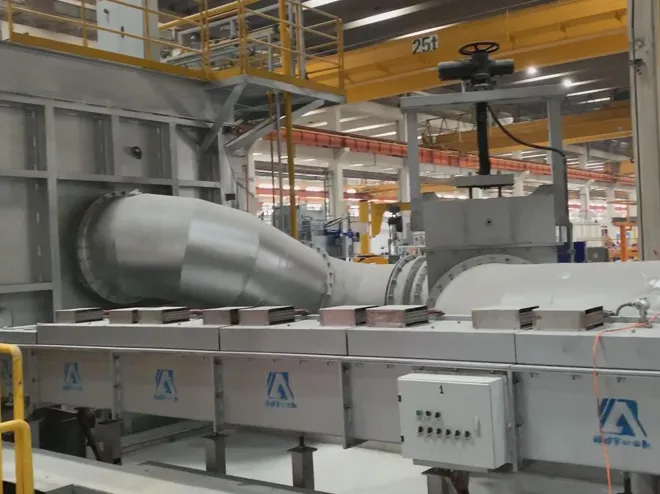
Direct chill (DC) casting of aluminum billets and slabs represents the highest-volume application for aluminum launder systems. In a typical DC casting center, the launder runs from the tilting holding furnace across the casting pit to a distribution bag (also called a distributor or metal distributor) that spreads metal evenly across multiple billet molds.
Key design features for DC casting launders:
- Full-length heating for temperature uniformity across all strands.
- In-line degassing vessel integrated into the launder channel.
- Ceramic foam filter box positioned between degassing and distribution bag.
- Grain refinement wire feeder at the launder inlet.
- Fully covered design to minimize hydrogen pickup and oxide formation.
- Precise slope control for equal metal distribution across multiple strands.
Typical DC casting launder specifications:
| Parameter | Small DC Caster | Medium DC Caster | Large DC Caster |
|---|---|---|---|
| Launder length | 3–8 m | 8–18 m | 15–35 m |
| Flow rate | 50–200 kg/min | 150–500 kg/min | 400–1500 kg/min |
| Number of strands | 1–4 | 4–16 | 12–60 |
| Heating system | Electric or gas | Electric (zoned) | Electric (multi-zone) |
| Treatment stages | Degassing + filter | Degassing + filter | Multiple degassing + dual filter |
Die Casting Launder Systems
High-pressure die casting (HPDC) and gravity die casting facilities use shorter, more compact launder systems connecting the central melting furnace or holding furnace to individual die casting cells. These launders typically operate at higher temperature (750–780°C) and must accommodate variable and intermittent flow demands as individual die casting machines cycle.
Sand Casting Foundry Launder Systems
Sand casting foundries often use simpler launder systems — sometimes just insulated precast launder sections without active heating — for transferring metal from a central melting facility to pouring areas. Flow rates are lower and metal residence times in the launder are shorter, reducing the criticality of some of the thermal and inclusion management requirements that dominate continuous casting system design.
Recycling and Secondary Aluminum Launder Systems
Secondary aluminum smelters processing scrap and recycled material deal with higher inclusion levels and more variable metal chemistry than primary operations. Launder systems in these facilities typically include additional treatment capacity (longer degassing residence time, coarser preliminary filtration to capture large inclusions before fine filter stages) to compensate for the higher incoming inclusion burden.
Installation, Commissioning, and Startup Procedures
Correct installation and commissioning of a molten aluminum launder system is as important as the design and material specification. We have witnessed numerous instances where well-specified launder systems underperformed in production because installation and startup procedures were not followed correctly.
Installation Requirements
Foundation and Structural Support:
The launder support frame must be installed on a level, stable foundation capable of supporting the full operational weight without deflection. Any sagging of the support frame after installation changes the launder slope alignment, creating low spots where metal accumulates and high spots that restrict flow.
Slope Setting and Verification:
After the refractory launder sections are installed on the support frame, the slope of each section must be verified with a precision digital level and adjusted to within ±0.1° of the design specification. Document the as-built slope for each section.
Joint Sealing:
All joints between launder sections must be sealed with ceramic fiber rope or ceramic cement to prevent metal penetration. This step is frequently rushed during installation and is the primary cause of metal leakage failures in the first weeks of operation.
Heating Element Installation and Testing:
All electrical heating elements must be installed and tested for continuity, insulation resistance, and correct power output before the refractory is preheated. Replacing a failed heating element after the launder is in service requires significant disruption.
Preheating and Drying Schedule
New or relined launders contain significant moisture — both free water from manufacturing and hygroscopic water absorbed during storage and installation. Bringing metal into contact with a wet launder causes violent steam generation, potential explosion hazard, and certain metal quality degradation.
Standard preheating schedule for alumina refractory launder systems:
| Stage | Temperature Range | Heating Rate | Hold Duration |
|---|---|---|---|
| Initial drying | Ambient to 120°C | 15–20°C/hour | 4–8 hours at 120°C |
| Bound water removal | 120°C to 350°C | 20–25°C/hour | 3–4 hours at 350°C |
| Intermediate firing | 350°C to 600°C | 25–30°C/hour | 2–3 hours at 600°C |
| Final preheating | 600°C to operating temp | 40–50°C/hour | 1–2 hours at operating temp |
| Total minimum time | 18–30 hours |
This schedule is a minimum requirement. Thicker refractory sections (precast shapes above 50mm) and high-density refractories require extended hold times at each stage.
Maintenance, Inspection, and Campaign Life Management
Proactive maintenance and systematic inspection are what separate launder systems that achieve 18-month campaign lives from those that fail after 3 months.
Routine Maintenance Activities
Daily Inspection:
- Visually check all launder joints for metal seepage or staining (early indicator of joint failure)
- Verify heating element operation on all zones (check controller setpoint vs. actual temperature)
- Check metal level and flow consistency.
- Inspect launder covers for damage or displacement.
- Skim accumulated dross from skimming positions.
Weekly Inspection:
- Check thermocouple readings against calibrated reference for drift.
- Inspect stopper rod and sliding gate condition.
- Verify all support frame components are secure and undamaged.
- Review metal temperature log for signs of developing thermal problems.
Monthly Inspection:
- Dimensional inspection of metal-contact refractory surface at accessible sections.
- Thickness measurement of refractory lining where possible (ultrasonic or endoscopic inspection).
- Thermal imaging of launder exterior to identify developing hot spots indicating refractory thinning.
- Heating element resistance measurement and comparison to baseline values.
Campaign Life Indicators and End-of-Campaign Criteria
| Indicator | Measurement Method | End-of-Campaign Threshold |
|---|---|---|
| Refractory wearing surface thickness | Ultrasonic measurement | < 20mm remaining |
| Metal temperature loss across launder | Thermocouple comparison | > 10°C above design loss |
| Joint metal seepage | Visual inspection | Any visible penetration |
| Heating element failure rate | Control system monitoring | > 20% of elements failed |
| Metal quality degradation | K-value or PoDFA testing | Consistent increase above specification |
| Dross generation rate | Weight of dross removed | > 150% of baseline rate |
Refractory Relining Procedure
When the launder system reaches end-of-campaign criteria, the relining sequence involves:
- Metal draining and cooling: Allow launder to cool to below 100°C before refractory removal.
- Old refractory removal: Mechanical removal of worn lining, avoiding damage to the steel shell.
- Shell inspection and repair: Check steel shell for corrosion, deformation, or heating element damage.
- New lining installation: Install new refractory system per the original specification and installation procedure.
- Joint sealing: Seal all joints with fresh ceramic fiber rope and ceramic cement.
- Preheating and drying: Follow the full preheating schedule before returning to service.
Launder System Performance Metrics and Quality Monitoring
Measuring launder system performance provides the data foundation for continuous improvement and early problem identification.
Key Performance Indicators for Aluminum Launder Systems
| KPI | Measurement Method | Target Value | Measurement Frequency |
|---|---|---|---|
| Metal temperature loss | Thermocouple at inlet and outlet | < 5°C for heated system | Continuous |
| Hydrogen content at launder exit | Alscan or Telegas probe | < 0.10 ml/100g (automotive) | Every cast or hourly |
| Inclusion content at launder exit | PoDFA or K-value | Per product specification | Per cast or daily |
| Dross generation rate | Weight of dross collected | < 0.3% of metal throughput | Daily |
| Metal yield through launder | Mass balance | > 99.5% | Per campaign |
| Heating energy consumption | Energy meter | Per design calculation | Monthly |
| Campaign life | Calendar from first to last metal | Per design specification | Per campaign |
Metal Quality Monitoring Tools
Reduced Pressure Test (RPT / K-value):
A quick, low-cost test performed on a metal sample taken from the launder outlet. The sample is solidified under partial vacuum, cross-sectioned, and the area fraction of porosity measured. Higher porosity indicates higher hydrogen content. Target K-values for automotive aluminum are typically K ≤ 2, for aerospace K ≤ 1.
Prefil-Footprinter (PoDFA) Analysis:
A more sophisticated analysis that filters a fixed volume of aluminum through a fine filter membrane under pressure, then examines the filter by optical microscopy to count and classify retained inclusions. Results are expressed as mm²/kg of inclusion area.
Alscan / Telegas In-Line Hydrogen Measurement:
Electrochemical or gas equilibration probes measure dissolved hydrogen content directly in the launder metal stream in real time, enabling continuous process monitoring.
Comparing Launder Designs: Open vs. Covered vs. Heated Systems
Not all aluminum casting operations require the same level of launder sophistication. Understanding the performance differences helps match system complexity to actual requirements.
Performance Comparison by Launder Type
| Parameter | Open Trough | Covered Insulated | Covered Heated |
|---|---|---|---|
| Temperature loss per meter | 3–8°C/m | 0.5–2°C/m | 0.1–0.5°C/m (controlled) |
| Oxide generation rate | High | Moderate | Low |
| Hydrogen pickup risk | High | Low-Moderate | Low |
| Initial capital cost | Very Low | Moderate | High |
| Operating energy cost | Low | Low | Moderate |
| Maintenance complexity | Low | Moderate | High |
| Suitable cast length | < 2 m | 2–10 m | 5–35 m |
| Metal quality output | Lowest | Medium | Highest |
| Suitable applications | Non-critical castings | General industrial | Automotive, aerospace |
Standards, Specifications, and Supplier Evaluation
Relevant Standards for Aluminum Launder Systems
| Standard | Organization | Scope |
|---|---|---|
| EN 993 series | European Standard | Physical testing of dense shaped refractories |
| ASTM C71 | ASTM International | Standard terminology for refractories |
| ASTM C1274 | ASTM International | Advanced ceramic reliability testing |
| GB/T 17393 | China GB | Covering flux for aluminum alloy casting |
| ISO 9001:2015 | ISO | Quality management systems (supplier qualification) |
| IATF 16949:2016 | IATF | Automotive quality management (for automotive supply chain) |
| EN 573 | European Standard | Aluminum and aluminum alloys — chemical composition |
Supplier Evaluation Criteria for Launder System Procurement
Engineering Capability:
Does the supplier provide complete engineering drawings, thermal calculations, and finite element analysis (FEA) of the proposed launder design? Can they demonstrate understanding of aluminum melt quality requirements, not just refractory installation?
Material Traceability:
Can the supplier provide material certificates for all refractory components showing Al₂O₃ content, physical properties, and batch identification?
Reference Installations:
Can the supplier provide verifiable references for similar launder system installations at comparable facilities in terms of metal throughput, alloy family, and quality requirements?
After-Sale Support:
Does the supplier offer commissioning support, training for foundry maintenance personnel, emergency supply of spare refractory components, and technical troubleshooting assistance?
Procurement Considerations and Cost Factors in 2026
Launder System Cost Components
| Cost Component | Approximate Share of Total | Notes |
|---|---|---|
| Steel shell fabrication | 15–20% | Varies with complexity and length |
| Refractory materials | 25–35% | Largest single cost component |
| Heating system (electric) | 20–30% | Significant capital investment |
| Support structure | 8–12% | Depends on installation height requirements |
| Instrumentation and controls | 10–15% | PLC, thermocouples, controllers |
| Installation labor | 10–20% | Highly variable by location |
| Commissioning and testing | 3–8% | Often underbudgeted |
Total Cost of Ownership Perspective
System capital cost is only one component of the true economic evaluation of a launder system investment. A comprehensive TCO analysis for a 10-year operating period should include:
Energy costs:
A heated launder system consuming 15–30 kW continuously represents significant energy cost over a decade. Premium insulation systems that reduce heating power requirements by 20–30% deliver meaningful long-term savings.
Refractory relining costs:
If a lower-grade refractory system requires relining every 6 months versus every 18 months for a premium system, the difference over 10 years represents 13 additional relining events — each requiring materials, labor, and production downtime.
Metal quality cost savings:
The most significant economic benefit is often the scrap rate reduction and machining yield improvement from cleaner metal. For an automotive casting facility producing 10,000 tonnes per year, reducing inclusion-related scrap from 3% to 1% saves 200 tonnes of casting production value annually.
Pricing Reference (April 2026)
| System Type | Launder Length | Approximate Capital Cost (USD) |
|---|---|---|
| Insulated, no heating | 3–5 m | $8,000–25,000 |
| Covered, electrically heated | 5–10 m | $35,000–90,000 |
| Full treatment system (degas + filter) | 8–15 m | $120,000–350,000 |
| Large DC casting launder system | 15–30 m | $400,000–1,200,000 |
| Complete automated treatment line | 20–40 m | $800,000–3,000,000+ |
Prices are indicative and reflect 2026 market conditions. Actual quotes depend on specification details, regional labor rates, and supplier selection.
Frequently Asked Questions (FAQs)
Q1: What is the purpose of a launder system in an aluminum foundry?
A launder system transfers molten aluminum from melting or holding furnaces to casting machines or downstream processing equipment while maintaining precise metal temperature, minimizing oxide formation, and providing a path for integrated melt treatment operations including degassing and filtration. It is not simply a pipe or trough — it is an active thermal and metallurgical process zone that directly influences the cleanliness, hydrogen content, and temperature of the metal delivered to the casting station.
Q2: What refractory material is best for molten aluminum launders?
High-alumina refractory materials with 85–99% Al₂O₃ content are the industry standard for metal-contact surfaces in aluminum launder systems. The specific grade depends on the quality requirements of the casting: standard automotive applications typically use 85–90% Al₂O₃, while aerospace and high-purity applications use 95–99% Al₂O₃ (corundum grade), often with a boron nitride coating to prevent aluminum adhesion. The backing insulation layer behind the wearing surface is typically calcium silicate board, chosen for its low thermal conductivity and chemical compatibility with aluminum.
Q3: How do you control metal temperature loss in an aluminum launder?
Temperature loss is controlled through a combination of: (1) thermally insulated covers that reduce radiation and convective losses from the metal surface; (2) electrically heated covers or side-wall heating elements that actively compensate for heat loss; (3) high-quality insulating refractory in the launder walls and floor to reduce conductive loss; and (4) preheating the launder system to operating temperature before metal introduction to eliminate startup heat absorption. Modern heated launder systems with proper zone control can limit temperature loss to less than 0.5°C per meter of launder length.
Q4: How long does an aluminum launder refractory lining last?
Campaign life depends strongly on the refractory grade, operating conditions, and maintenance quality. Entry-level insulating board systems in secondary aluminum operations may last 3–6 months. Premium high-alumina precast lining systems in primary aluminum continuous casting can achieve 18–24 months between relines. The average across diverse aluminum casting operations is approximately 8–12 months. Systematic monitoring of lining thickness and metal quality indicators allows campaign end to be predicted and planned rather than responding reactively to failures.
Q5: What causes dross formation in aluminum launder systems?
Dross forms when molten aluminum contacts oxygen and forms oxide skins that mix with entrained metal to create a semi-solid oxide-metal mixture. Dross generation in launders is accelerated by: high metal surface velocity causing wave action; exposed metal surface in uncovered launder sections; turbulence at transitions and joints; and high metal temperature (which increases the oxidation rate). Minimizing dross formation requires covered launders, smooth controlled flow velocities below 0.5 m/s, and careful transition design. Dross that does form should be removed at designated skimming stations rather than allowed to accumulate and fragment into the metal stream.
Q6: Can a launder system be used for aluminum alloy additions and grain refinement?
Yes, and this is a recommended practice in modern aluminum casting operations. Wire feeders positioned at the launder inlet or early in the launder channel deliver grain refinement master alloy (Al-5Ti-1B wire is the most common) directly into the flowing metal stream. The flowing metal provides natural mixing that distributes the addition more uniformly than furnace addition. Alloying element additions can similarly be made through wire feeding in the launder. The key requirement is sufficient residence time and flow distance after the addition point to achieve adequate mixing before the metal reaches the casting station.
Q7: What is the difference between a launder and a tundish in aluminum casting?
A launder is a linear transfer channel that conveys metal from one point to another, maintaining flow through slope-driven gravity. A tundish (or distribution bag in aluminum casting) is a stationary holding vessel positioned at the end of the launder, above the mold or multiple molds, that buffers metal flow and distributes it evenly across multiple casting positions. In DC casting operations, the metal flows from the furnace through the launder to the tundish or distribution bag, which then feeds multiple billet molds simultaneously. Both the launder and the tundish require high-quality refractory lining and similar design principles for minimizing oxide formation and temperature loss.
Q8: How often should aluminum launders be preheated before metal introduction?
Preheating should be performed: before initial startup of a new or recently relined launder; after any planned shutdown exceeding 24–48 hours; after any maintenance work that involved opening or disturbing the refractory; and whenever moisture contamination is suspected. The preheating schedule for a standard alumina refractory launder takes a minimum of 18–30 hours from cold to operating temperature and must not be accelerated, as rapid heating causes steam pressure damage to the refractory. For brief planned shutdowns (overnight), maintaining heating elements at low power to keep the launder at 200–300°C avoids the need for full preheating on restart.
Q9: What flow rate should an aluminum launder be designed for?
The design flow rate depends on the casting process downstream. For DC billet casting, typical flow rates range from 50–200 kg/min for small casters to 400–1500 kg/min for large multi-strand operations. For automotive gravity die casting, 30–150 kg/min is typical. The launder cross-section must then be sized so that the resulting metal surface velocity at the design flow rate does not exceed 0.5 m/s — the threshold above which turbulence-induced oxide bifilm formation increases significantly. In practice, this means that higher flow rates require wider and/or deeper launder channels rather than steeper slopes.
Q10: What are the safety requirements for working with molten aluminum launder systems?
Molten aluminum launder systems present serious safety hazards including: severe burn risk from contact with metal at 700–800°C; explosion risk from water or moisture contact with molten aluminum; fire risk from metal spillage onto combustible materials; and fume exposure risk from flux or alloying additions. Key safety requirements include: mandatory personal protective equipment (aluminized face shields, heat-resistant gloves and clothing, insulated boots); dry tools and equipment (never introduce wet tools into or near molten metal); emergency metal containment provisions (coffer dams, dry sand supply) for launder failure scenarios; regular safety training for all personnel working near the launder; and clearly marked emergency shutdown procedures for the heating system and metal supply. All launder installations should comply with local occupational health and safety regulations and relevant industry standards for molten metal handling.
Conclusion
Molten aluminum launder systems are far more than simple metal transfer channels. They are precision-engineered thermal and metallurgical process systems that determine metal temperature consistency, inclusion cleanliness, hydrogen content, and ultimately the quality and yield of every casting produced downstream. Getting the launder right — from refractory selection through heating system design, slope optimization, turbulence control, melt treatment integration, and maintenance program — is one of the highest-return investments available in aluminum casting quality improvement.
The key principles that emerge from comprehensive evaluation of launder system performance are clear: control surface velocity below 0.5 m/s to prevent bifilm generation; use the highest practical alumina purity in metal-contact refractories; cover and heat the launder to eliminate temperature variation; integrate degassing and filtration into the launder channel rather than treating them as separate operations; and maintain systematic inspection programs that allow predictive relining rather than reactive failure response.
At AdTech, we support aluminum casting foundries and continuous casting operations with launder system design consultation, refractory material supply, heated launder system engineering, and integrated melt treatment solutions. The consistent message from successful launder system projects is straightforward: investment in a properly engineered launder system pays back in metal quality, yield improvement, and reduced maintenance cost within the first 12–18 months of operation.