

For steady, repeatable handling of molten aluminium, choose pump technology that matches purity needs, flow and head demands, and maintenance capacity. Electromagnetic pumps deliver the cleanest melt for precision casting while submerged mechanical impeller pumps provide highest volume throughput; correct wetted-material selection, controlled thermal procedures before operation, inlet filtration, and a documented maintenance routine yield lower scrap, higher yield, and predictable operating cost.
What is molten aluminium pump?
A molten aluminium pump transfers liquid metal between furnaces, holds, and molds, or circulates metal inside a vessel to improve temperature uniformity and composition consistency. Pumps reduce reliance on manual pouring, cut metal losses from surface oxides, and enable controlled filling rates that lower casting defects.
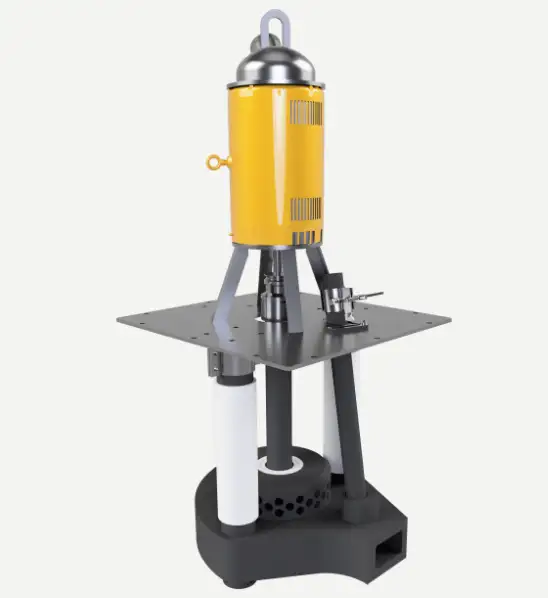
Core pump types and brief comparison
Electromagnetic pumps (EM)
Electromagnetic pumps generate flow through Lorentz forces when an electric current interacts with a magnetic field in conductive liquid metal. They contain no moving parts in contact with molten metal, which reduces wear and lowers particulate introduction into the stream. EM units suit high-purity, low-turbulence fills and precise metering tasks.
Submerged mechanical impeller pumps
These pumps use a rotor or impeller submerged within the melt to create flow. They deliver high volumetric throughput and tolerate heavier duty cycles. Wetted parts must resist abrasion and thermal cycling. Mechanical pumps require careful sealing and cooling arrangements for bearings and drive components.
Air-driven and pressure-transfer systems
Compressed gas forces metal through a chamber and into piping or ladles. These systems excel for simple transfer tasks where system complexity must remain low. They can be safe and reliable when fitted with correct venting and control valves.
Overflow and gravity-assisted transfer designs
Some furnace arrangements use controlled overflow geometry to move metal without immersing a pump rotor. These reduce moving wetted parts and can lower maintenance, but they offer limited control over flow rate and may not suit high-throughput layouts.
Why pumps improve foundry results
- Quality: Removing metal from beneath the surface helps exclude floating dross and oxides, producing cleaner pours.
- Uniformity: Forced circulation reduces thermal and compositional stratification, improving part-to-part consistency.
- Throughput and control: Pumps enable steady filling rates and shorter cycle times versus manual ladling.
- Safety: Remote operation keeps operators away from the hottest zones, with standard interlocks preventing unsafe conditions.
- Economics: Lower scrap rates and improved yield reduce cost per good casting, offsetting purchase and maintenance costs over predictable operating hours.
Wetted materials options and tradeoffs
Selecting compatible wetted materials determines service life and maintenance intervals. The table below summarizes common options.
Table 1 Wetted material properties and tradeoffs
| Material | Key strengths | Principal limits | Typical applications |
|---|---|---|---|
| Graphite | Good thermal shock resistance, machinable, wide availability | Oxidation risk above certain temperatures if exposed to oxygen | Rotors, wear rings, sacrificial elements |
| Silicon carbide ceramics | Hard wear resistance, chemical stability | Brittleness; sensitive to rapid temperature swings | Liners, inlet sleeves, EM pump jackets |
| Alumina and dense refractory ceramics | Corrosion resistance, high temp tolerance | Brittleness; specific machining challenges | Nozzles, filter housings |
| Nickel-based alloys (Inconel family) | High mechanical strength at temperature | High cost; heavy and harder to machine | Structural inserts, shafts where metal contact minimal |
| Coated steels | Economical external structure with protective coating | Coating wear, site-specific compatibility needed | Housings and non-wetted support parts |
Pump selection criteria
- Target alloy chemistry: Confirm if the process uses pure aluminium, standard foundry alloys, or specialty blends with additions. Each alloy influences corrosion, abrasion, and oxide behavior.
- Required volumetric flow: Express in liters per minute or kilograms per hour. Match pump capability to fill times and cycle requirements.
- Head requirement: Vertical lift and piping losses drive selection; include friction losses from valves, bends, and filters.
- Cleanliness target: For die casting and high-performance forgings, prioritize EM pumps and integrated filtration. For high-volume sand casting, mechanical pumps may be more cost effective.
- Duty cycle and operating hours: Continuous circulation demands different design margin than intermittent transfer duty.
- Maintenance capabilities: Evaluate on-site skills, spare parts logistics, and turnaround time for service.
- Safety features and controls: Remote start, soft-start motor drives, temperature interlocks, and emergency stop circuits should be standard.
- Total cost of ownership: Include energy, consumable parts, maintenance labor, and expected downtime costs.
Sizing method with worked example
Basic variables
- Q: Desired flow in liters per minute (L/min)
- H: Total head in meters (m) — vertical lift plus frictional head loss
- rho: Melt density in kg/m3 (typical aluminium melt density ≈ 2400 kg/m3)
- eta: System hydraulic efficiency (decimal fraction; typical range 0.55 to 0.85)
Hydraulic power estimate
Convert flow to cubic meters per second:
Q_m3_s = Q_L_min / 60000
Hydraulic power P_h in kilowatts (kW):
P_h = (rho * g * Q_m3_s * H) / (1000 * eta)
where g = 9.81 m/s^2
Worked example
- Given:
- Q = 600 L/min
- H = 6 m
- rho = 2400 kg/m3
- eta = 0.68
- Convert flow:
Q_m3_s = 600 / 60000 = 0.01 m3/s
- Compute numerator:
Numerator = rho * g * Q_m3_s * H
Numerator = 2400 * 9.81 * 0.01 * 6 = 1414.56
- Compute denominator:
Denominator = 1000 * eta = 1000 * 0.68 = 680
- Hydraulic power:
P_h = Numerator / Denominator = 1414.56 / 680 = 2.08 kW
- Recommendation:Select a motor with margin to cover starting torque and thermal limits. A typical safety margin is 1.5 to 2 times P_h. For this example:
Recommended motor ≈ 2.08 kW * 1.5 to 2 ≈ 3.0 to 4.0 kW (confirm with pump manufacturer)
Typical pump performance dimensions and selection table
Table 2 Typical performance bands for pump technologies
| Pump family | Flow range (L/min) | Usual head range (m) | Typical application |
|---|---|---|---|
| EM pump, compact | 10–800 | 1–10 | Precision metering, low turbulence fills |
| Submerged mechanical | 200–6,000 | 2–20 | High-volume transfer, furnace circulation |
| Pressure-transfer (air-driven) | 50–1,200 | 1–8 | Ladle filling, medium duty transfer |
| Overflow systems | System-dependent | Low head | Low-maintenance transfer in large furnaces |
Inlet design and filtration
A pump’s inlet is the primary control point for melt cleanliness. Good practice includes:
- Using submerged inlets located below the surface to draw cleaner metal.
- Installing coarse filtration upstream to capture large dross fragments.
- Adding a fine ceramic filter or foam ceramic pad before delivery to molds when high cleanliness required.
- Designing inlet geometry with gradual flow transitions and no sharp edges to minimize cavitation risk.
Installation recommendations that increase lifetime
- Preheat components: Bring wetted parts to near melt temperature before contact to avoid thermal shock.
- Thermal ramps: Implement controlled temperature ramps for pump heaters and refractory components during initial startup.
- Support and anchoring: Piping must be adequately supported to avoid misalignment and bending loads on the pump assembly. Flexible couplings and expansion loops prevent thermal stress transmission.
- Cooling systems: Bearings and motor enclosures require reliable cooling; route cooling circuits away from heat sources where possible.
- Instrumentation: Fit temperature probes, bearing temperature indicators, and flow sensors for early warning of abnormal operation.
Common failure modes and mitigation
- Abrasion and rotor wear: Prevent by inlet filtration and by selecting wear-resistant materials. Monitor clearance, measure wear, and keep spare wear rings.
- Thermal shock fractures in ceramics: Mitigate with preheating procedures and slow temperature ramping during commissioning.
- Bearing overheating: Ensure cooling jackets are clear, verify lubricant condition, and fit thermal cutoffs linked to control system.
- Electrical faults in EM systems: Protect power electronics from heat and dust; provide redundant cooling and routine thermal inspection.
- Seizure from slag or tramp metal: Operator training for surface skimming and routine cleaning keeps debris away from intake.
Maintenance program with tasks and frequencies
Table 3 Recommended baseline maintenance schedule
| Interval | Actions |
|---|---|
| Daily | Visual check for leaks; read and log inlet and bearing temperatures; confirm interlock readiness |
| Weekly | Clean external surfaces; remove accumulated slag near intake; verify cooling circuits |
| Monthly | Inspect rotor clearances; check inlet screen; test valve operation; inspect electrical connections |
| Quarterly | Replace sacrificial wear parts based on wear rate; calibrate sensors; run diagnostic pumping test |
| Annual | Full teardown for inspection; non-destructive testing on critical parts; update BOM and spares list |
Adjust this baseline for operating hours, alloy type, and contamination levels.
Safety protocols and operator training essentials
- Personal protection: Heat-resistant garments, face shields with appropriate shade, insulated gloves, and footwear rated for molten metal exposure.
- Control interlocks: Pumps must stop automatically if coolant flow fails, bearing temp exceeds threshold, or melt level drops below safe intake.
- Emergency procedures: Written and rehearsed steps for containment and cooling in the event of spillage. Include emergency isolation valves and quick-drain paths.
- Permit-to-work: Strict hot-work and maintenance permits prevent accidental exposure to molten metal.
- Training program: Structured operator and maintenance training covering daily checks, startup and shutdown, fault diagnosis, and safe part replacement.
Spare parts list and inventory recommendations
Maintain an on-site minimum stock that reflects lead times and criticality. Typical spares include:
- Wear rings and rotor segments
- Ceramic inlet sleeves or top sections
- Bearing sets and seals
- Control fuses and contactors for EM units
- Temperature sensors and flow meters
Inventory count should reflect single-point failures; critical wet-wetted parts should have at least one replacement per pump where lead times are uncertain.
Cost drivers and economical tradeoffs
Initial purchase price varies with technology and scale. Key cost drivers:
- Pump family: EM units often carry higher capital cost owing to power electronics and precision manufacturing. Mechanical units can cost less per unit flow.
- Materials: High-nickel alloys and advanced ceramics increase upfront cost but may reduce lifetime maintenance in harsh environments.
- Control and instrumentation: Remote operation, PLC integration, and data logging add cost while reducing operator exposure.
- Energy consumption: Evaluate drive efficiency and duty cycle. A higher-efficiency system may cost more up front but lower operating expense.
- Downtime risk: Choose design and spares strategy proportional to cost of lost production time.
Typical commissioning tests and acceptance criteria
- Cold functional checks: Verify instrumentation, interlocks, and remote control functions before exposure to melt.
- Thermal conditioning: Ramp heaters and verify thermal expansion behavior; monitor stress points.
- Performance verification: Measure flow at target head and compare with supplied pump curves.
- Cleanliness check: Run sample pours after commissioning and inspect castings for inclusions. Record melt chemical composition pre- and post-pump to confirm no contamination introduced.
- Safety tests: Simulate sensor trips and emergency stops; verify rapid isolation and controlled cool-down.
Four technical reference tables
Table 4 Typical failure indicators and immediate actions
| Symptom | Likely cause | Immediate action |
|---|---|---|
| Rising bearing temp | Cooling blockage or lubricant failure | Shut pump; inspect cooling; replace lubricant; check bearings |
| Sudden drop in flow | Blocked inlet or pump seizure | Stop pump; confirm melt level; inspect inlet screen; clear obstruction |
| Electrical fault in EM control | Overheating or short circuit | Isolate power; inspect drives and wiring; replace failed modules |
| Repeated ceramic cracking | Thermal shock or mechanical impact | Review preheat profile; replace cracked parts; slow ramps on restart |
Table 5 Material selection quick mapping
| Application need | Preferred wetted material | Notes |
|---|---|---|
| High-purity metering | Ceramic-lined EM pump | Lowest particulate generation |
| High-volume transfer | Graphite-impeller mechanical pump | Best throughput, moderate maintenance |
| Abrasive alloy service | Silicon carbide liners | Long wear life with proper thermal handling |
| Structural mounting | Nickel alloy inserts | Provide strength in high-heat zones |
Table 6 Sensor and control recommendations
| Measurement | Purpose | Typical spec |
|---|---|---|
| Melt level sensor | Protect intake from exposure | Redundant probes with fail-safe trip |
| Bearing temperature probe | Prevent bearing failure | High-temperature RTD or thermocouple |
| Flow meter | Verify delivered volume | High-temperature electromagnetic or paddleless flow |
| Cooling flow switch | Ensure bearing cooling present | Hardwired interlock to drive power |
Table 7 Example acceptance data sheet layout
| Item | Target value | Measured value | Pass/Fail |
|---|---|---|---|
| Flow at 6 m head | 600 L/min | 608 L/min | Pass |
| Bearing temp rise | < 45°C above ambient | 37°C | Pass |
| Inlet pressure | Within spec | Within spec | Pass |
| Sample inclusion count | < X per 1000 g | Measured Y | Pass/Fail |
Frequently asked questions
- Which pump family gives the cleanest molten aluminium?
Electromagnetic pumps draw metal without moving wetted parts, which reduces agitation at the surface and lowers particulate entrainment. For highest-purity needs, EM units paired with fine ceramic filtration offer the best results. - Can a mechanical pump handle continuous furnace circulation?
Yes, mechanical submerged pumps can run continuous circulation, provided cooling and bearing arrangements match duty cycles. Routine inspection of wear components must follow a disciplined schedule. - How should I place the inlet to minimize dross entry?
Locate the inlet submerged beneath the surface, below known dross layers. Avoid direct proximity to charging points and turbulent zones. Use coarse inlet screening to trap large debris. - What preheating is required before first contact with melt?
Preheat wetted parts and inlet sleeves to a temperature close to the melt temperature with slow ramps. Prevent rapid thermal gradients that cause ceramic or graphite cracking. - How often do rotor wear parts need replacement?
Replacement intervals depend on alloy cleanliness and duty. Inspect clearances monthly at moderate contamination, increase frequency if operating with high dross levels. Track wear by measurement records. - What cooling is needed for motor and bearings?
Provide continuous cooling for bearings and motor housings with circuits sized for ambient conditions. Redundant cooling monitoring that trips the drive on failure protects against thermal damage. - Is remote operation mandatory?
Remote control is strongly recommended because it reduces operator exposure to radiant heat. Remote systems must include local emergency stop capability and clear status indication. - Which filtration should be used with EM pumps?
Combine submerged intake geometry with fine ceramic foam filters at delivery to molds. This configuration prevents tooltip blockage and produces consistently clean pours. - How to validate pump performance during commissioning?
Run acceptance tests including flow verification at target head, bearing temperature rise under load, and sample casting for inclusion analysis. Document results and compare against supplier curves. - What is the best spare parts strategy?
Maintain at least one full set of critical wetted wear parts and fast-moving electrical spares. Adjust stock based on lead times and production risk tolerance.
Closing technical note
Successful implementation depends on matching technology choice to production goals, enforcing strict thermal and operational controls, and committing to a preventive maintenance program. Practical decisions include selecting inlet filtration level, setting thermal ramp profiles, and sizing spare inventories to minimize production interruption. Clear procedures and measurement during commissioning create a baseline for ongoing optimization.