

Insulation ceramic fiber refractory rope is a flexible, high-temperature sealing and thermal insulation product manufactured from refractory ceramic fibers, commonly formed into round, square, or twisted rope constructions. The practical conclusion is straightforward: ceramic fiber rope is best suited to furnace doors, boiler joints, kiln seals, expansion joints, burner assemblies, high-temperature pipe interfaces, oven doors, and other applications where flexibility, low thermal conductivity, thermal-shock resistance, and temperatures substantially above the service limits of fiberglass or many mineral-fiber seals are required. A product should never be selected from a nominal temperature rating alone. Engineers and buyers need to evaluate continuous operating temperature, fiber chemistry, rope density, construction, diameter, compression, binder or carrier content, atmosphere, abrasion, mechanical loading, chemical exposure, dimensional tolerance, health and regulatory requirements, and the manufacturer’s test data.
If your project requires the use of Insulation Ceramic Fiber Refractory Rope, you can contact us for a free quote.
What Is Insulation Ceramic Fiber Refractory Rope?
Ceramic fiber refractory rope is a compressible textile-like sealing material produced predominantly from high-temperature inorganic fibers. Depending upon the product family, these fibers may include aluminosilicate refractory ceramic fiber, alkaline earth silicate fiber, or another engineered high-temperature fiber.
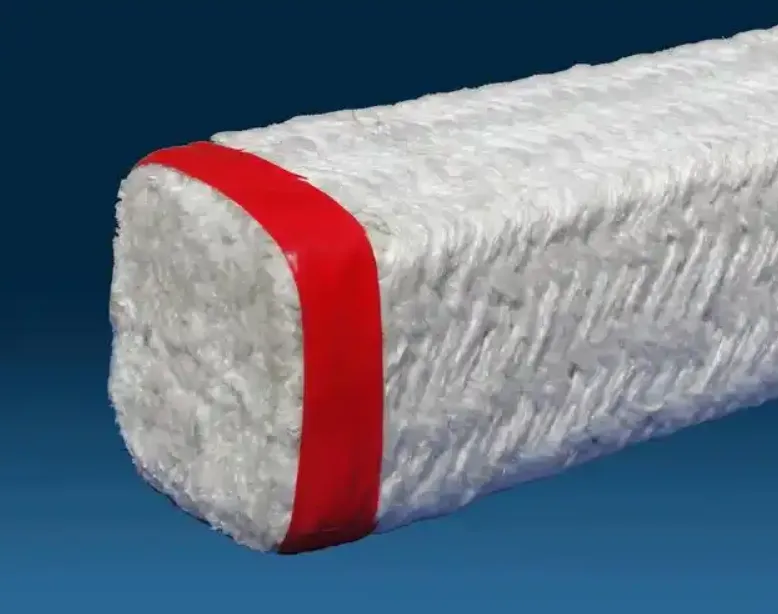
The fibers are processed into yarn-like strands and subsequently braided, twisted, knitted, or otherwise formed into flexible rope. Some constructions incorporate reinforcing filaments or wires to improve handling strength.
Unlike rigid firebrick, castable refractory, or ceramic fiber board, rope can conform to irregular gaps and moving joints. This characteristic makes it particularly useful around furnace doors and other locations requiring a resilient thermal seal.
The terms used by suppliers are not always standardized. Catalogs may describe closely related products using names such as:
- ceramic fiber rope
- refractory ceramic fiber rope
- ceramic rope insulation
- ceramic fiber braided rope
- ceramic fiber twisted rope
- ceramic fiber square rope
- high-temperature sealing rope
- kiln door rope
- furnace door gasket rope
- ceramic fiber packing
- heat-resistant refractory rope
- aluminosilicate fiber rope
- AES fiber rope
- ceramic fiber gasket rope
These descriptions can refer to products with significantly different compositions and performance. A purchasing specification should therefore state measurable requirements rather than relying entirely upon the product name.
How Does Ceramic Fiber Rope Work as Thermal Insulation and a High-Temperature Seal?
Ceramic fiber rope works through the combination of low-density refractory fibers, entrapped air, and a compressible fibrous structure.
Heat can travel through a material by solid conduction, gaseous conduction, radiation, and, where bulk gas movement exists, convection. The fibrous structure limits heat transfer while providing enough compliance to fill the gap between mating surfaces.
When used around a furnace door, the rope performs two related jobs. First, it reduces direct heat transfer across the joint. Second, suitable compression reduces the passage of hot gases through gaps around the door.
The ability to remain flexible is particularly important. A refractory brick or rigid board cannot easily accommodate repeated opening, closing, vibration, or differential thermal expansion. A properly selected rope can deform with the joint without behaving like a brittle monolithic refractory.
This does not mean the material creates a perfect pressure-tight seal. Leakage performance depends upon rope density, compression, surface geometry, braid, gas pressure, installation quality, and degradation during service. Applications involving hazardous gases or strict pressure containment require an engineered sealing assessment rather than an assumption that a refractory rope alone is adequate.
What Materials Are Used to Manufacture Ceramic Fiber Refractory Rope?
Traditional refractory ceramic fiber products commonly use aluminosilicate fibers containing aluminum oxide and silicon dioxide. Current industrial markets also include alkaline earth silicate, often abbreviated AES, products developed with different chemical and biopersistence characteristics.
Product chemistry matters because temperature capability, shrinkage, durability, regulatory status, and compatibility with the process atmosphere can differ.
A simplified comparison appears below.
| Fiber family | Typical description | Common application characteristic | Key purchasing issue |
|---|---|---|---|
| Aluminosilicate RCF | Refractory ceramic fiber based mainly on Al2O3 and SiO2 | Strong high-temperature insulation performance | Occupational and regional regulatory requirements need review |
| AES | Alkaline earth silicate fiber | High-temperature sealing with low-biopersistence grades available | Verify actual classification and maximum service conditions |
| High-alumina specialty fiber | Fiber engineered with elevated alumina content | Selected higher-temperature duties | Cost, availability, shrinkage data |
| Hybrid textile construction | Ceramic fibers with organic or inorganic reinforcement | Improved handling or installation strength | Reinforcement may have a lower temperature limit |
“Refractory ceramic fiber” is a specific material description in technical and regulatory contexts. It should not automatically be applied to every high-temperature ceramic-style insulation rope.
Organic carrier fibers are another detail frequently overlooked. A newly installed rope can contain a small proportion of organic processing material or reinforcement. During initial heating, organic constituents may decompose or burn out. Smoke or odor can consequently appear during commissioning, depending upon formulation.
We recommend obtaining a current technical data sheet and safety data sheet when composition is important to the installation.
Read more: Twisted vs. Braided Ceramic Fiber Rope: Differences & Selection Guide
How Is Ceramic Fiber Rope Manufactured?
Manufacturing varies by producer and rope geometry, but the general process begins with high-temperature fibers that are converted into workable strands or yarn structures. These are then braided, twisted, knitted, or packed into the desired cross section.
Round braided rope typically uses an external braided structure that helps maintain shape and provides a comparatively coherent surface. Square braid uses interlaced strands to create a square or rectangular sealing profile. Twisted rope has a softer, simpler configuration that can be useful where conformability is more important than surface durability.
Manufacturing control influences much more than appearance. Fiber distribution, density, strand tension, braid tightness, reinforcement, and dimensional consistency all affect installation behavior.
Two ropes carrying the same nominal diameter can therefore perform differently.
During incoming inspection, we pay particular attention to dimensional consistency and construction. A rope that varies substantially in diameter may produce alternating zones of overcompression and inadequate contact after installation. This becomes particularly noticeable on large furnace doors.
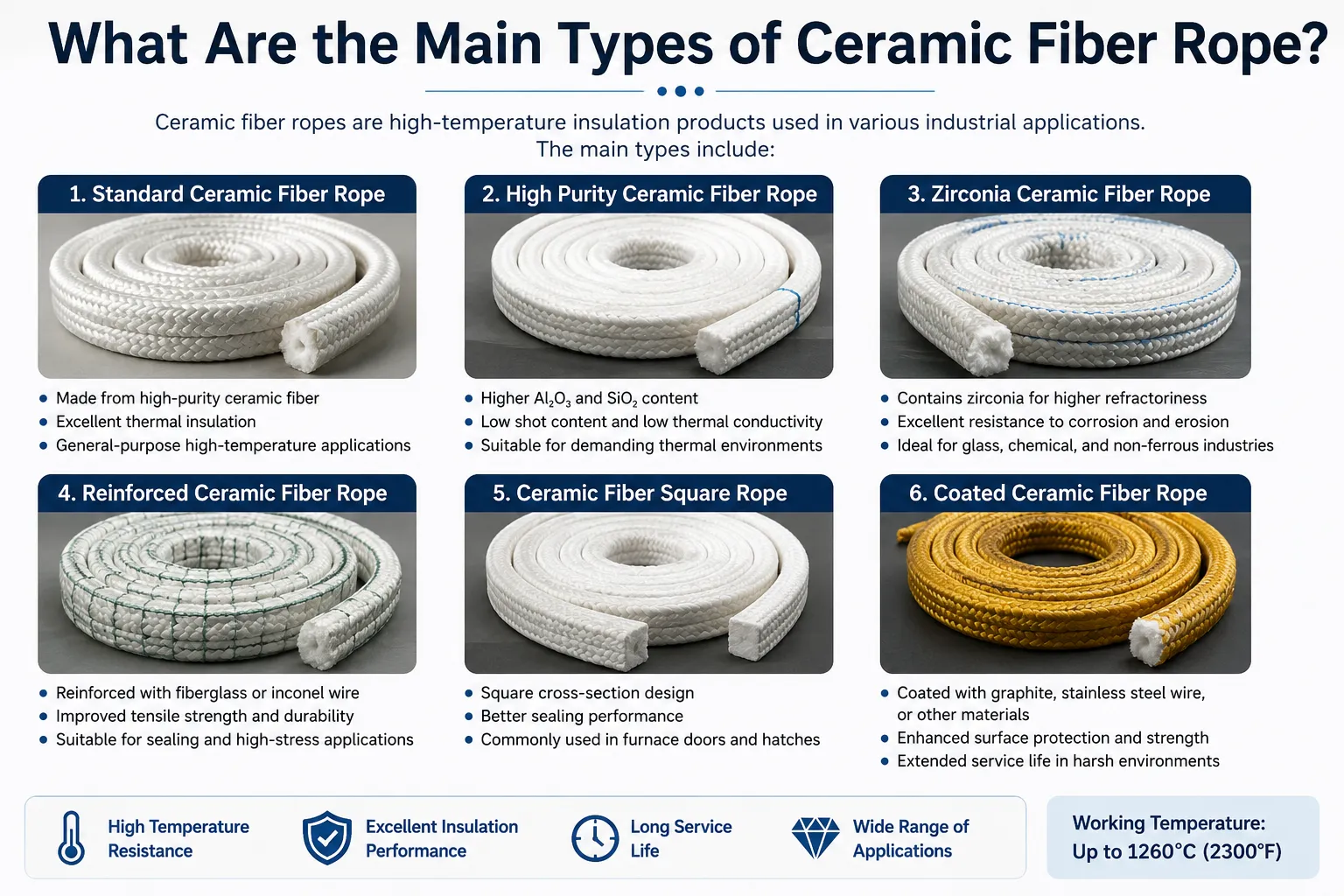
What Are the Main Types of Ceramic Fiber Rope?
Three constructions are frequently encountered: round braided, square braided, and twisted rope.
| Construction | Cross section | Relative firmness | Typical use |
|---|---|---|---|
| Round braided rope | Circular | Medium to firm | Door seals, grooves, equipment joints |
| Square braided rope | Square | Firm | Packing channels, flange-like joints, rectangular grooves |
| Twisted rope | Circular or irregular | Soft | General thermal packing, irregular gaps |
| Dense braided packing | Round or square | High | Joints needing improved dimensional stability |
| Reinforced ceramic rope | Varies | Construction dependent | Applications needing added handling strength |
Round braid is often chosen when the seal fits into a curved or machined groove. Square braid can provide broader contact against flat joint faces. Twisted products generally compress easily but can be less resistant to abrasion and repeated handling.
There is no universally superior configuration. The correct profile is the one matching groove shape, closure geometry, movement, desired compression, and mechanical conditions.
What Temperature Can Ceramic Fiber Refractory Rope Withstand?
Temperature rating is one of the most misunderstood areas of refractory insulation procurement.
A published maximum, classification, or short-duration exposure temperature is not necessarily the recommended continuous operating temperature. The temperature that a rope can tolerate over a limited period may be higher than the condition at which it retains acceptable dimensional stability over thousands of operating hours.
Representative product classes in the marketplace commonly occupy roughly the following ranges. These values are informational ranges, not specifications applying to every product.
| Product category | Representative upper temperature class | Practical qualification required |
|---|---|---|
| Standard ceramic-fiber textile | Around 1260°C / 2300°F in many product families | Confirm continuous-use limit and shrinkage |
| Higher-grade ceramic fiber product | Roughly 1300°C to 1400°C class, product dependent | Confirm chemistry and textile construction |
| AES rope | Frequently around 1100°C to 1200°C class, formulation dependent | Verify manufacturer’s stated limit |
| Reinforced rope | Fiber can tolerate high heat while reinforcement may not | Check every constituent |
Numbers in a generic table cannot substitute for a manufacturer-specific datasheet.
When we evaluate a seal near its stated upper limit, we request linear-shrinkage information at temperature and exposure time. Shrinkage can matter more than the headline temperature rating because a shrinking gasket may open a leakage path even though the fibers have not melted.
Hot-face temperature also differs from ambient furnace temperature. Engineers should determine the actual temperature where the rope sits.
What Physical and Thermal Properties Matter Most?
A professional specification goes beyond operating temperature.
Important characteristics include bulk density, thermal conductivity, loss on ignition, fiber composition, linear shrinkage, diameter or cross-sectional tolerance, tensile or handling strength, compressibility, recovery, chemical resistance, and construction.
Typical ceramic-fiber ropes share several general characteristics:
| Property | Engineering significance |
|---|---|
| Low thermal conductivity | Restricts heat flow through sealed joints |
| Low thermal mass | Absorbs relatively little stored heat |
| Flexibility | Fits curved or irregular locations |
| Compressibility | Helps maintain contact between mating surfaces |
| Thermal-shock resistance | Supports cyclic heating applications |
| Low bulk density | Reduces weight compared with dense refractory materials |
| High-temperature capability | Enables furnace, kiln, boiler, and oven use |
| Chemical stability | Useful in numerous industrial atmospheres |
| Easy cutting | Simplifies field installation, subject to safe work practices |
Thermal conductivity is temperature dependent. A single conductivity value without mean temperature has limited engineering value. Density also affects conductivity and sealing behavior.
Similarly, compressibility should not be treated as an unlimited advantage. Crushing a rope excessively can damage its structure, reduce resilience, and place unnecessary force on doors or channels.
Is Ceramic Fiber Rope a Good Heat Insulator?
Yes, ceramic fiber rope can provide useful insulation at joints and narrow geometries, but its primary value is usually combined insulation and sealing rather than large-area thermal insulation.
A furnace wall should generally use a refractory lining or an appropriately designed blanket, module, board, castable, brick, or multilayer insulation system. Filling the entire wall with rope would usually be inefficient and costly.
Rope becomes valuable where sheet or rigid products cannot make reliable contact. Typical examples include door perimeters, access panels, peep doors, observation ports, pipe penetrations, expansion gaps, and irregular equipment interfaces.
An engineer should distinguish three thermal objectives:
- reducing heat transfer,
- restricting hot-gas leakage,
- protecting adjacent hardware from direct flame or hot gases.
A rope diameter and construction optimized around one objective may not be ideal around another.
Where Is Ceramic Fiber Refractory Rope Commonly Used?
Ceramic rope appears throughout heat-processing industries because equipment often contains joints that must move while remaining thermally isolated.
Typical installations include industrial furnaces, heat-treatment equipment, ceramic kilns, foundries, boilers, forging furnaces, steel processing equipment, industrial ovens, incineration systems, fireplaces, selected chimney systems, burner openings, furnace observation doors, ladle-related equipment, petrochemical heaters, thermal-processing machinery, and laboratory furnaces.
It can also be used around expansion joints and penetrations where operating conditions match its characteristics.
The application is more important than the industry name. A rope suitable on a 700°C oven door is not automatically appropriate directly adjacent to a flame in a chemically aggressive furnace.
When AdTech evaluates a customer requirement, the first engineering information we want is the actual service environment rather than merely a requested diameter. Temperature, contact arrangement, atmosphere, movement, and required life often reveal whether the originally requested construction is suitable.
How Do You Select the Correct Ceramic Fiber Rope Diameter?
Diameter selection should start with the installed gap and groove geometry.
The rope generally needs enough interference or compression to contact both sealing surfaces throughout the full perimeter. Too small a diameter can result in leakage. Too large a rope can prevent complete door closure, create excessive mechanical stress, or permanently crush the fiber structure.
Suppose a furnace door has an 18 mm effective sealing gap. Choosing an 18 mm rope simply because the numbers match may offer little useful preload. Conversely, installing a much larger rope without checking available closure force could cause problems.
The design process should consider:
| Parameter | Question to answer |
|---|---|
| Gap | What is the minimum and maximum operating gap? |
| Groove | What are its width, depth, and corner radii? |
| Compression | What installed compression does the manufacturer recommend? |
| Tolerance | How much do rope and equipment dimensions vary? |
| Thermal expansion | Does the gap change after heating? |
| Door movement | Does the joint repeatedly open and close? |
| Closure force | Can hinges and latches provide adequate, even pressure? |
Do not apply one universal compression percentage to every ceramic fiber rope. Braided and twisted structures respond differently, while density also changes compression behavior.
The manufacturer’s compression recommendation should take priority whenever available.
Round Rope or Square Rope: Which Shape Should Engineers Choose?
Round rope is usually convenient in rounded grooves and around curved door paths. A circular section can deform into the available cavity when compressed.
Square rope provides wider initial contact against flat surfaces and fits rectangular packing channels naturally. It may also resist rolling within a channel more effectively.
A geometric match still does not guarantee sealing performance. The joint can fail if the rope is too hard, too soft, poorly anchored, or exposed to abrasion beyond its capability.
Corners deserve special attention. Leakage often develops where a rope bends sharply or where separate lengths meet. Avoid unnecessary butt joints. Where a splice is unavoidable, use the manufacturer’s recommended joining arrangement and position it away from severe mechanical wear when practical.
How Does Density Influence Ceramic Rope Performance?
Density affects thermal, mechanical, and sealing behavior.
A lower-density rope can be highly compressible and conform well to irregular surfaces. A denser structure can maintain shape better and may tolerate handling more effectively. Neither characteristic alone establishes superior performance.
A door experiencing frequent cycles may benefit from a coherent braid with enough resilience to retain contact. A static expansion gap may prioritize conformability instead.
Purchasers should not compare quotations solely by diameter and price per meter. If one supplier offers substantially lower density or a different braid, the products may not be functionally equivalent.
Useful quotation documents should therefore specify construction and density where these characteristics are critical.
What Is the Difference Between Ceramic Fiber Rope, Fiberglass Rope, and Silica Rope?
These textile insulation materials overlap in appearance but should not be treated as interchangeable.
| Material | Temperature capability | Common strength | Typical limitation |
|---|---|---|---|
| Ceramic fiber rope | Very high | Furnace and kiln sealing | Fiber handling and regulatory considerations |
| Fiberglass rope | Moderate high-temperature range | Economical sealing at lower temperatures | Lower temperature ceiling than many ceramic products |
| Silica rope | High, grade dependent | Strong high-temperature textile option | Properties and cost vary with purity/construction |
| AES rope | High | Alternative chemistry in many thermal seals | Temperature class must match application |
| Graphite packing | High under suitable atmosphere | Excellent packing properties in many systems | Oxidation can restrict temperature in air |
Fiberglass may be entirely adequate at moderate temperatures, making ceramic fiber unnecessary. At much hotter furnace conditions, ceramic or specialty silica materials can provide the required thermal capability.
Graphite illustrates why atmosphere matters. A material’s behavior in inert conditions can differ greatly from its behavior in oxidizing air.
Is Ceramic Fiber Rope the Same as Ceramic Fiber Blanket?
No. They can originate from related fiber technologies, but their forms and purposes differ.
Ceramic fiber blanket is normally supplied in rolls with broad, flat surfaces. It is used extensively in furnace linings, backup insulation, heat shields, wraps, and removable insulation systems.
Rope is a narrow textile or textile-like product intended mainly to fill joints, channels, and gaps.
Ceramic fiber paper is thinner and useful in gaskets, separators, and thin thermal barriers. Board offers rigidity. Modules create engineered furnace linings. Bulk fiber fills specialized cavities or serves as feedstock.
Choosing the product form according to geometry reduces installation labor and improves reliability.
How Should Ceramic Fiber Refractory Rope Be Installed?
Installation procedures vary with equipment and rope construction, but several principles are consistently useful.
Inspect and clean the sealing channel first. Old adhesive, degraded fibers, corrosion, metal scale, and hardened contamination can create high spots that prevent uniform compression.
Measure the groove rather than relying entirely upon nominal drawings, particularly on older furnaces. Heat distortion can cause significant dimensional variation.
Cut the rope using tools recommended by the supplier and follow the applicable occupational controls to limit airborne fibers and dust. Avoid pulling or stretching a soft rope during installation. Stretching can reduce its cross section and lead to weak sealing sections after release.
When adhesive is required to retain the rope during assembly, choose a high-temperature product compatible with both the rope and substrate. Adhesive is not automatically required in every groove.
After positioning the gasket, close the assembly gradually and inspect uniform contact. During first heat-up, follow equipment and product commissioning procedures.
We have found that recording the installed rope size, product lot, date, joint location, and observed condition during maintenance provides valuable failure-history data. That simple practice turns replacement from guesswork into preventive maintenance.
Why Does Ceramic Fiber Rope Sometimes Smoke During First Heating?
Some ceramic-fiber textiles contain organic binders, carrier fibers, lubricants, or processing additives that help manufacturing and handling. Initial heating can decompose these organic constituents.
The result can include odor, visible smoke, or temporary emissions. The magnitude varies greatly with product composition.
This behavior should not automatically be interpreted as fiber failure, but it should not be ignored either. Facilities need ventilation and commissioning procedures appropriate to the safety data sheet and equipment environment.
Applications requiring extremely low contamination, clean-room compatibility, food-related conditions, vacuum service, sensitive electronics processing, or controlled atmospheres should specify allowable organic content rather than accepting a general-purpose textile without qualification.
How Does Thermal Shrinkage Affect Refractory Rope?
Fibrous refractory materials can undergo irreversible dimensional change after prolonged high-temperature exposure. The mechanisms depend upon chemistry and temperature.
A small laboratory shrinkage value can become operationally important in a long seal. More importantly, local shrinkage can reduce contact pressure and create a leakage channel.
Temperature excursions above normal operating conditions deserve attention. A rope that survives 900°C operation reliably may experience faster dimensional change after an abnormal excursion near its upper material limit.
This is one reason why classification temperature should not be interpreted as an ideal design temperature.
A useful purchase specification requests linear shrinkage at a stated temperature and exposure duration. Without temperature and time, a shrinkage statement has little comparative value.
How Resistant Is Ceramic Fiber Rope to Chemicals, Steam, and Molten Materials?
Ceramic fibers offer good resistance to many chemicals, but “chemical resistant” must never be interpreted as resistant to every substance.
Strong acids or alkalis, phosphates, fluorine-containing compounds, molten metals, slags, salts, and reactive process vapors can attack fibers or change their behavior. Wetting can also affect a textile seal mechanically even when no immediate chemical reaction occurs.
Direct contact with molten metal deserves particular caution. Ceramic fiber insulation products used near foundry operations should not automatically be treated as suitable molten-metal containment barriers. Molten aluminum and other metals present application-specific wetting, penetration, reaction, and safety concerns.
When chemical exposure exists, provide the supplier with concentration, temperature, physical state, exposure duration, and process atmosphere.
Can Ceramic Fiber Rope Withstand Flame and Thermal Cycling?
Ceramic fiber itself is noncombustible in typical refractory applications, but a rope may contain organic materials that burn out upon heating. Reinforcement and coatings also have their own limitations.
Resistance to thermal cycling is generally a strong feature of fibrous ceramic insulation. Compared with dense refractories, low thermal mass and a flexible microstructure reduce susceptibility to conventional thermal-shock cracking.
Mechanical cycling is a separate issue. A furnace door opened hundreds of times can abrade a rope even if its thermal properties remain satisfactory.
Flame impingement can also cause local conditions much more severe than the nominal chamber temperature. Gas velocity may erode exposed fibers, while combustion chemistry can create localized attack. A protective design or different refractory form may be needed under high-velocity direct flame.
What Causes Ceramic Fiber Furnace Door Seals to Fail?
Seal failure rarely has only one cause. Visible damage should be interpreted together with service history.
Common failure modes include undersized rope, excessive compression, insufficient compression, heat shrinkage, abrasion, fiber erosion, poor splicing, groove corrosion, adhesive degradation, door misalignment, hinge wear, chemical attack, direct flame impingement, mechanical snagging, and operation beyond the recommended temperature.
A blackened or discolored rope does not alone identify the cause. Deposits from combustion, organic burnout, process contamination, and thermal history can all change appearance.
Repeated seal failure at the same location often points toward equipment geometry. Replacing the gasket every few weeks without checking door flatness or latch pressure only treats the symptom.
Maintenance staff should inspect both the removed gasket and the mating hardware.
What Information Should a Buyer Include in an RFQ?
A good ceramic fiber rope RFQ minimizes ambiguity and makes supplier quotations genuinely comparable.
At minimum, buyers should state:
| RFQ item | Example requirement |
|---|---|
| Product | High-temperature ceramic fiber refractory rope |
| Construction | Round braided |
| Nominal diameter | 25 mm |
| Fiber chemistry | Specify required grade or request proposal |
| Operating temperature | 950°C continuous |
| Peak temperature | 1100°C intermittent |
| Atmosphere | Oxidizing furnace atmosphere |
| Density | Manufacturer’s stated value or specified range |
| Reinforcement | Required / prohibited / supplier recommendation |
| Organic content | Declare |
| Dimensional tolerance | State required tolerance |
| Packaging | Coil length and identification requirements |
| Documentation | TDS, SDS, certificate, lot identification |
| Quantity | Total meters or kilograms |
| Application | Furnace door perimeter seal |
We also recommend telling the manufacturer whether the rope will experience direct flame, frequent movement, steam, aggressive chemicals, vacuum, pressure differential, or contact with molten material.
The cheapest compliant-looking line item may not have the lowest lifecycle cost. Installation labor and downtime can exceed the gasket’s purchase cost.
How Should Ceramic Fiber Rope Quality Be Inspected?
Incoming inspection can begin with product identification. Check supplier, product code, lot number, declared composition, dimensions, and packaging against purchase documents.
Measure diameter or width at multiple locations using a method that does not excessively compress the rope. Textile dimensions depend on applied measuring pressure, so consistency in inspection technique matters.
Visual checks should identify braid damage, severe loose fibers, contamination, moisture, incorrect splices, crushed packaging, and obvious dimensional variation.
Where engineering risk justifies additional validation, laboratory tests can examine density, loss on ignition, thermal shrinkage, chemical composition, and thermal conductivity. Exact tests should follow relevant standards or mutually agreed procedures.
Certificates should be interpreted carefully. A certificate of conformity is not automatically the same thing as a batch-specific laboratory test report.
What Health and Safety Requirements Apply to Ceramic Fiber Rope?
Health requirements depend upon the fiber chemistry, product classification, jurisdiction, exposure route, and work activity.
Cutting, removing, or disturbing fibrous high-temperature insulation can release airborne dust or fibers. Workers should consult the current safety data sheet and applicable workplace regulations before installation or maintenance. Engineering controls, appropriate ventilation, housekeeping methods, protective clothing, eye protection, gloves, and respiratory protection may be required following the site’s risk assessment.
Refractory ceramic fibers have specific occupational-health classifications and regulatory treatment in various jurisdictions. AES and other low-biopersistence fibers can have different classifications, but buyers should not infer regulatory exemption merely from marketing terminology.
Used insulation deserves additional care because service can alter fiber characteristics and process contaminants may be present.
Avoid compressed-air cleaning that unnecessarily disperses dust. Waste handling and disposal must follow local requirements and site procedures.
An article or product catalog cannot replace a jurisdiction-specific occupational risk assessment.
Are Ceramic Fiber Ropes Environmentally Friendly?
There is no meaningful universal yes-or-no answer.
A high-performance gasket can improve furnace energy efficiency by limiting heat loss and hot-gas leakage, which can reduce fuel consumption. Long seal life can also decrease replacement waste.
Material production, packaging, transport, workplace exposure, end-of-life handling, and fiber chemistry contribute to the broader environmental profile. Regulatory treatment also changes between countries.
Procurement teams pursuing sustainability goals should request environmental documentation where available and compare expected service life rather than evaluating chemistry in isolation.
A product replaced three times as often may have a different lifecycle footprint even when its initial material profile appears favorable.
How Should Ceramic Fiber Rope Be Stored?
Store rope dry, covered, and protected from physical damage. Avoid crushing coils beneath heavy materials because permanent deformation can complicate later installation.
Keep packaging identification with the product so maintenance teams can trace grade and lot.
Moisture exposure can introduce contamination and impair handling. Even if fibers themselves are not destroyed by brief contact with water, wet rope is not equivalent to properly stored material and may carry contaminants into thermal equipment.
A first-in, first-out inventory approach is useful, particularly where packaging or organic constituents have supplier-defined storage limitations.
How Do You Calculate the Required Rope Quantity?
For a simple rectangular furnace door, begin with the sealing perimeter:
Required length = 2 × (door width + door height)
Then account for joining, installation allowance, scrap, maintenance inventory, and any special corner configuration.
A 1.2 m by 2.0 m rectangular door has a basic perimeter of:
2 × (1.2 + 2.0) = 6.4 m
The order quantity should not automatically be exactly 6.4 m. Installation allowance and supplier coil lengths need consideration.
Multiple doors should be calculated individually when their dimensions vary. An equipment list linked to rope size also simplifies future maintenance purchasing.
How Can Engineers Improve Ceramic Rope Service Life?
Correct selection is only half the task. Joint design often determines whether a gasket lasts months or years.
Use a groove that supports the rope without exposing unnecessary surface area to gas velocity. Maintain door alignment. Apply uniform closure pressure. Protect the gasket from sharp edges. Minimize sliding abrasion where possible. Do not stretch soft rope to make it reach the end of a channel.
Track replacement intervals. If life suddenly decreases, investigate changes in furnace temperature, fuel, atmosphere, production cycle, door alignment, or supplier specification.
Thermal imaging can sometimes help identify deteriorating seals while equipment is operating. A growing hot region around a furnace door may indicate leakage or insufficient insulation, though interpretation must consider emissivity and surrounding conditions.
Preventive inspection is normally less expensive than waiting until a badly deteriorated gasket damages nearby steelwork or creates excessive heat loss.
When Should Ceramic Fiber Rope Not Be Used?
Ceramic fiber rope should not be treated as a universal gasket.
It may be unsuitable where a joint requires certified pressure containment, extreme tensile strength, substantial sliding abrasion resistance, direct structural loading, unrestricted food contact, severe chemical resistance, or service outside the fiber’s validated temperature and atmosphere.
It is also not a structural refractory. It cannot replace firebrick, castable, or engineered furnace lining merely because its fibers tolerate high temperature.
Applications involving toxic process gases, pressure vessels, fire-rated building assemblies, aerospace systems, nuclear installations, or other safety-critical equipment can require certified materials, tested joint systems, and engineering approvals beyond a general industrial rope specification.
How Does Ceramic Fiber Rope Affect Furnace Energy Efficiency?
A degraded furnace-door seal can allow hot gases to escape and cold air to infiltrate. Both mechanisms can increase energy use.
Hot leakage carries thermal energy directly out of the furnace. Air infiltration can disturb combustion and temperature uniformity. Escaping heat may also raise temperatures around doors, handles, instruments, structural steel, or operator areas.
Replacing a defective seal can consequently improve more than surface temperature.
Quantifying energy savings requires measured leakage or a validated heat-transfer model. Claims that a particular rope will automatically save a fixed percentage of fuel should be treated cautiously unless backed by site-specific calculations.
Seal condition is one element within a broader furnace-efficiency program that includes combustion control, wall insulation, exhaust management, production loading, door-opening time, and maintenance.
How Should Technical Teams Compare Ceramic Fiber Rope Suppliers?
Product equivalence should be demonstrated through specifications rather than appearance.
We normally compare fiber chemistry, classification and recommended service temperature, density, construction, dimensional tolerances, shrinkage, thermal properties, reinforcement, organic content, documentation, quality control, packaging, traceability, technical support, delivery reliability, and total cost.
A sample is useful when changing suppliers, particularly on critical production equipment. A controlled trial can reveal differences that a short datasheet does not capture, such as handling behavior, fraying, installation consistency, and recovery after cycling.
Do not assume two “1260°C ceramic ropes” are equivalent. Their fiber formulation, density, braid architecture, organic content, and recommended continuous-use conditions may differ materially.
What Documentation Should Accompany Industrial Ceramic Fiber Rope?
The required documents depend upon customer and jurisdiction, but common records include a technical data sheet, safety data sheet, product specification, certificate of conformity, batch or lot identification, packing list, and regulatory declarations where applicable.
Technical documentation should preferably identify the basis of temperature claims.
Engineers should also note the edition date of datasheets. Product formulations can change. Maintaining the document revision associated with the installed batch supports later failure analysis and auditability.
For repeat orders, use the manufacturer’s exact product code where possible rather than relying solely upon a generic material description.
Frequently Asked Questions About Insulation Ceramic Fiber Refractory Rope
1. What is ceramic fiber refractory rope used for?
It is mainly used to create flexible thermal seals around furnace doors, kiln doors, boiler access points, industrial ovens, burner assemblies, expansion gaps, pipe penetrations, and other hot equipment joints. Its combination of flexibility and high-temperature resistance makes it especially useful where rigid refractory products cannot conform to moving or irregular surfaces.
2. What is the maximum temperature of ceramic fiber rope?
The answer depends upon fiber chemistry and product construction. Many conventional ceramic-fiber textile products are marketed in classes around 1260°C, while specialty products can differ. This figure should never be assumed to be the recommended continuous service temperature. Check the manufacturer’s temperature classification, continuous-use recommendation, shrinkage data, atmosphere limitations, and reinforcement limits.
3. Is ceramic fiber rope fireproof?
The ceramic fiber component is designed around noncombustible high-temperature inorganic materials, but complete rope products can contain organic carrier fibers, binders, lubricants, or other constituents that decompose during initial heating. “Fireproof” is therefore an imprecise specification. Request tested fire or temperature performance relevant to the application.
4. Does ceramic fiber rope contain asbestos?
Modern ceramic fiber rope should not be casually confused with historical asbestos textiles. However, procurement teams should obtain an SDS and supplier declaration rather than infer composition from appearance. Older industrial equipment can contain legacy materials, so unidentified existing insulation should be handled according to appropriate site and regulatory procedures.
5. Can ceramic fiber rope be used on a wood stove or fireplace?
Potentially, but only when the stove or fireplace manufacturer specifies a compatible gasket type. Many consumer appliances use fiberglass or other purpose-designed gasket materials. Diameter, density, adhesive, temperature capability, and door geometry all affect safe operation. Equipment manufacturer requirements take priority over a generic material recommendation.
6. Does ceramic rope need high-temperature adhesive?
Not always. Some grooves mechanically retain the rope, while other designs use an adhesive mainly to hold the gasket in place during assembly. Where adhesive is needed, select a formulation compatible with the substrate, rope, temperature, atmosphere, and equipment manufacturer’s instructions. Ordinary household adhesive is generally inappropriate in high-temperature furnace joints.
7. How often should a furnace ceramic rope seal be replaced?
There is no universal replacement interval. Service life depends upon temperature, cycling frequency, abrasion, compression, chemical exposure, door alignment, rope construction, and maintenance. Replace or investigate the seal when it shows significant erosion, hardening, shrinkage, loss of contact, severe mechanical damage, or leakage outside acceptable operating limits.
8. Can ceramic fiber rope get wet?
Accidental moisture does not necessarily mean immediate destruction of the inorganic fiber, but rope should normally be stored and installed dry. Water can introduce contaminants, change handling characteristics, affect adhesives, and create commissioning issues. Follow the manufacturer’s instructions when material has become wet.
9. Is braided ceramic rope better than twisted rope?
Neither is universally better. Braided rope usually offers greater dimensional coherence and can perform well in frequently handled seals. Twisted rope is often softer and can conform readily to irregular gaps. Joint geometry, abrasion, compression, temperature, and desired resilience should determine the construction.
10. How do I order the correct ceramic fiber refractory rope?
Provide the supplier with rope shape and size, actual continuous and peak temperatures, fiber chemistry requirement, groove dimensions, operating atmosphere, compression condition, movement, direct-flame exposure, density requirement, reinforcement preference, quantity, packaging, and documentation requirements. When replacing an existing gasket, supplying equipment information and the previous material specification can significantly reduce selection errors.