

If you’re comparing industrial aluminum alloy melting furnaces right now, here’s the short answer before we get into the technical weeds: the best furnace for your operation depends on three factors that matter more than brand reputation or price tag: your production volume, the specific alloy grades you process, and your energy cost structure. At AdTech, we’ve spent years building and troubleshooting melting furnaces for foundries, extrusion plants, and die-casting operations across different climates and power grids, and the pattern is consistent. A 500 kg batch furnace optimized for A356 aluminum wheels performs terribly when someone tries to run 6061 billet stock through it. A reverberatory furnace that saves fuel in a plant with cheap natural gas becomes a liability in a facility paying industrial electricity rates. There is no single “best” furnace, only the right match between equipment design and your actual metallurgical and operational needs.
If your project requires the use of Aluminum Alloy Melting Furnace, you can contact us for a free quote.
What Is an Industrial Aluminum Alloy Melting Furnace and How Does It Work?
An industrial aluminum alloy melting furnace is a heated chamber designed to liquefy aluminum and its alloys for casting, extrusion, or alloying processes. The furnace applies controlled thermal energy, sourced from natural gas, electricity, or induction fields, to raise solid aluminum charge material past its melting point (roughly 660°C for pure aluminum, though alloys vary) while managing oxidation, dross formation, and temperature uniformity.
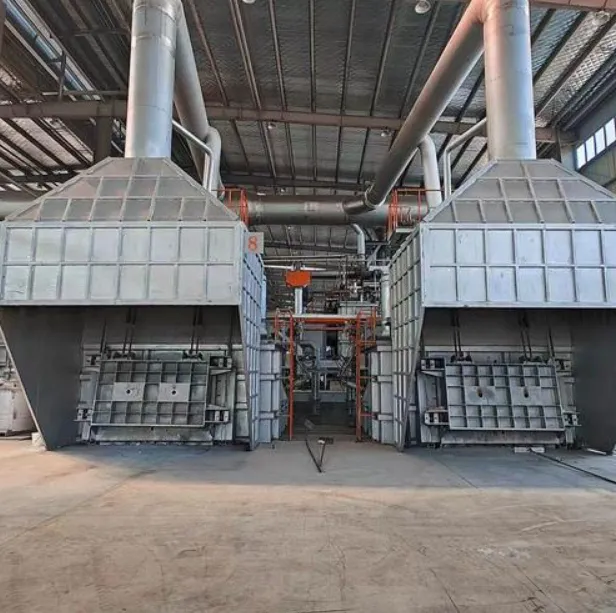
The working principle sounds simple, but the engineering underneath is not. Aluminum oxidizes rapidly when molten, forming a dross layer that traps metal and reduces yield. A well-designed furnace minimizes surface exposure to oxygen, controls flame or induction pattern to avoid hot spots, and maintains consistent temperature within a narrow band, usually plus or minus 5°C for precision casting applications.
We’ve noticed that customers new to aluminum melting often assume the furnace just needs to “get hot enough.” In practice, the thermal profile matters as much as peak temperature. A furnace that overheats one zone while underheating another causes uneven grain structure in the final cast product, something quality control catches downstream but traces back to the furnace design every time.
Core Components Found in Nearly Every Industrial Unit
| Component | Function | Common Failure Point |
|---|---|---|
| Refractory lining | Retains heat, protects shell | Cracking from thermal cycling |
| Burner or induction coil | Generates heat energy | Fuel injector clogging / coil insulation breakdown |
| Charging system | Loads solid metal into chamber | Mechanical wear on ramps or door seals |
| Tapping/pouring mechanism | Releases molten metal | Slag buildup blocking flow |
| Combustion air system | Supplies oxygen for gas-fired units | Fan bearing failure |
| Control panel/PLC | Monitors temperature and cycle timing | Sensor drift, calibration loss |
Which Types of Aluminum Melting Furnaces Are Used in Manufacturing Today?
There are five furnace categories that dominate industrial aluminum melting, and each solves a different production problem.
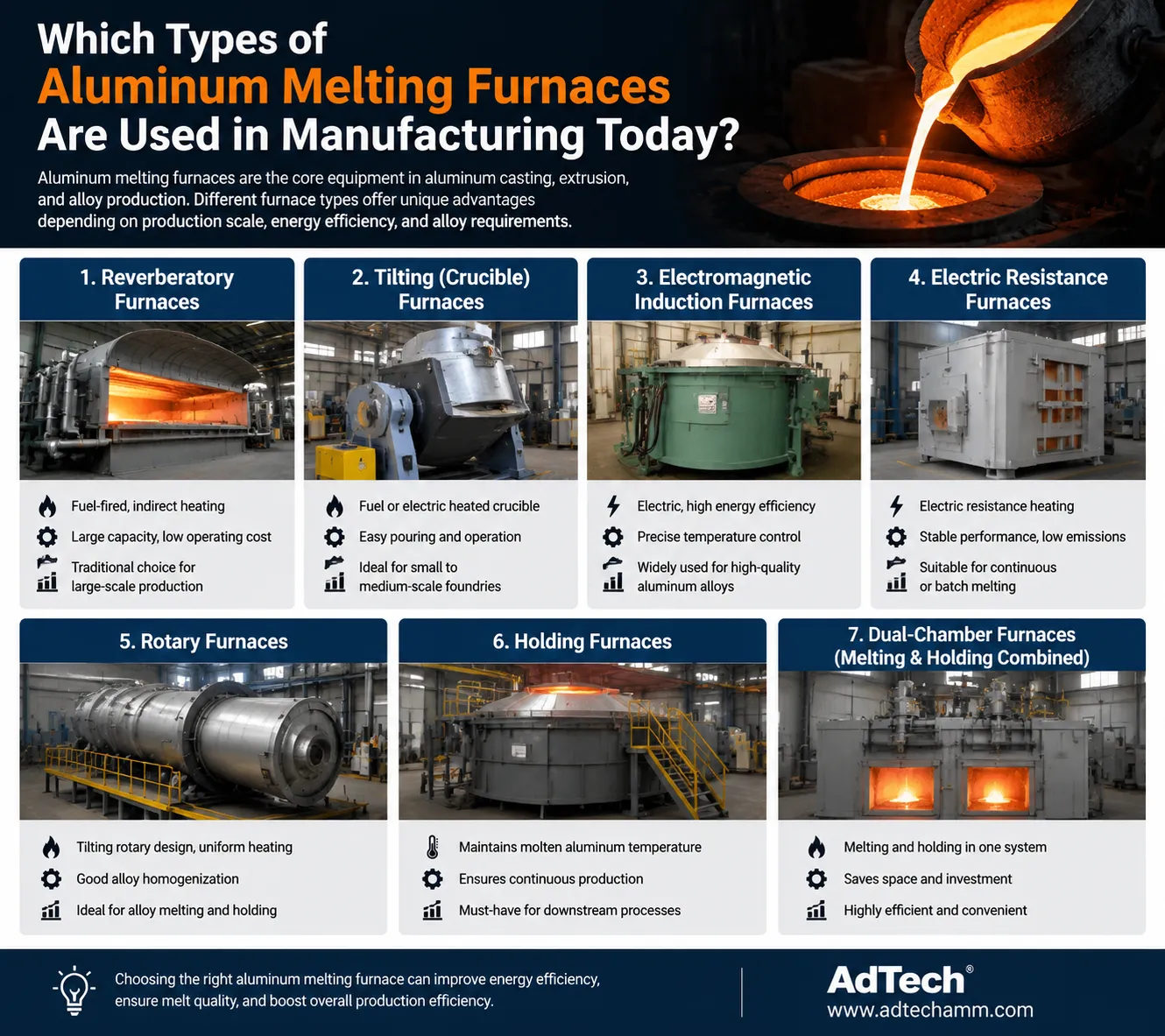
Reverberatory furnaces use radiant and convective heat from burners positioned above the metal bath. They handle large volumes efficiently, often 5 to 50 tons per batch, making them common in primary aluminum plants and large foundries. The tradeoff is metal loss through oxidation, typically 2 to 5 percent higher than induction methods.
Induction furnaces generate heat through electromagnetic fields that induce eddy currents directly in the metal. We recommend these for operations prioritizing melt purity and precise alloy control, since there’s no direct flame contact and less oxidation. They cost more upfront and consume more electricity per ton but recover value through reduced metal loss and faster cycle times for smaller batches.
Crucible furnaces rely on a container (crucible) holding the metal, heated externally by gas or electric elements. These suit smaller job shops, prototype casting, and operations melting under 500 kg per cycle. They’re the entry point for many smaller manufacturers because the capital cost is manageable.
Tower furnaces stack a melting section below a preheating chamber, using exhaust heat to warm incoming charge material before it drops into the melt. This design recovers otherwise wasted thermal energy, cutting fuel consumption by roughly 15 to 20 percent compared to standalone reverberatory units.
Stack melters are a compact variant often used in die-casting operations where floor space is limited and continuous, on-demand melting matters more than batch size.
| Furnace Type | Typical Capacity | Fuel Source | Metal Loss Rate | Best Fit |
|---|---|---|---|---|
| Reverberatory | 5-50 tons | Natural gas, oil | 2-5% | Large foundries, primary smelting |
| Induction | 100 kg-10 tons | Electricity | 0.5-1.5% | Precision alloys, small-medium batch |
| Crucible | 50-500 kg | Gas, electric, propane | 1-3% | Job shops, prototyping |
| Tower | 2-20 tons | Natural gas | 1.5-3% | High-volume with fuel savings priority |
| Stack Melter | 1-10 tons | Natural gas | 1-2.5% | Die-casting, continuous feed |
We’ve installed and serviced units across all five categories, and honestly, the tower furnace conversations are where we spend the most time educating buyers. People see the fuel savings figures and want to switch immediately, but the tower design requires more headroom (vertical space) than most existing plant layouts accommodate without structural modification.
How Much Energy Does an Aluminum Melting Furnace Actually Consume?
This question comes up in nearly every sales conversation we have, and the honest answer involves more variables than most suppliers admit. Theoretical melting energy for aluminum is about 0.75 to 0.8 kWh per kilogram, accounting for the heat needed to raise solid aluminum to melting point plus the latent heat of fusion. Real-world furnaces never hit that number because of heat losses through refractory walls, flue gas, door openings, and holding time before pouring.
Actual consumption typically runs between 1.0 and 1.8 kWh per kilogram for electric induction furnaces, and the gas-fired equivalent (measured in therms or cubic meters converted to kWh equivalent) often lands 20 to 40 percent higher in total energy input because combustion efficiency rarely exceeds 60-70 percent in reverberatory designs, versus 95-98 percent electrical-to-thermal conversion in induction systems.
| Furnace Type | Theoretical Min. Energy | Real-World Range | Efficiency Loss Sources |
|---|---|---|---|
| Induction | 0.75 kWh/kg | 0.9-1.3 kWh/kg | Coil losses, holding time |
| Reverberatory (gas) | 0.75 kWh/kg equivalent | 1.4-2.0 kWh/kg equivalent | Flue losses, door radiation |
| Crucible (gas) | 0.75 kWh/kg equivalent | 1.6-2.2 kWh/kg equivalent | Small batch inefficiency, external heating |
| Tower (gas, with preheat recovery) | 0.75 kWh/kg equivalent | 1.1-1.6 kWh/kg equivalent | Reduced flue loss via preheating |
We ran a comparison for a client last year switching from an older reverberatory unit to a tower furnace, and the fuel bill dropped nearly 18 percent within the first quarter, mostly from the preheating stage cutting the burner’s workload. That said, their electricity-heavy competitor down the road, running induction furnaces, had already achieved similar per-ton energy costs years earlier despite paying more per kWh, simply because induction wastes so little heat.
What Temperature Is Required to Melt Aluminum Alloys Properly?
Pure aluminum melts at 660.3°C, but almost nobody melts pure aluminum industrially. Alloys shift the melting range depending on their composition, and understanding this range matters because overheating degrades alloy properties and wastes energy, while underheating causes incomplete melting and poor pour quality.
| Alloy Series | Common Use | Melting Range | Typical Furnace Set Point |
|---|---|---|---|
| 1xxx (pure aluminum) | Electrical conductors | 660°C | 680-700°C |
| 3xxx (Al-Mn) | Roofing, cookware | 655-660°C | 700-720°C |
| 5xxx (Al-Mg) | Marine, automotive panels | 570-640°C | 680-710°C |
| 6xxx (Al-Mg-Si) | Extrusions, structural | 585-650°C | 700-730°C |
| 7xxx (Al-Zn) | Aerospace | 475-635°C | 680-700°C |
| A356 (casting) | Automotive wheels, castings | 555-615°C | 700-740°C |
We generally set pouring temperatures 40 to 80°C above the alloy’s liquidus point to maintain fluidity during transfer and casting, but not so high that hydrogen absorption and grain coarsening become problems. This is where furnace control quality separates good equipment from mediocre equipment. A furnace with a poorly calibrated thermocouple might read 720°C when the actual bath temperature sits at 745°C, and over months that error compounds into inconsistent casting quality that engineers often blame on the alloy supplier rather than the melting equipment.
How Do You Choose the Right Furnace Capacity for Your Production Line?
Sizing a furnace incorrectly is probably the most expensive mistake we see buyers make, more costly than choosing the wrong furnace type. Oversized furnaces run inefficiently at partial load, wasting fuel and increasing per-unit costs. Undersized furnaces create production bottlenecks and force overtime shifts or outsourced melting, both expensive workarounds.
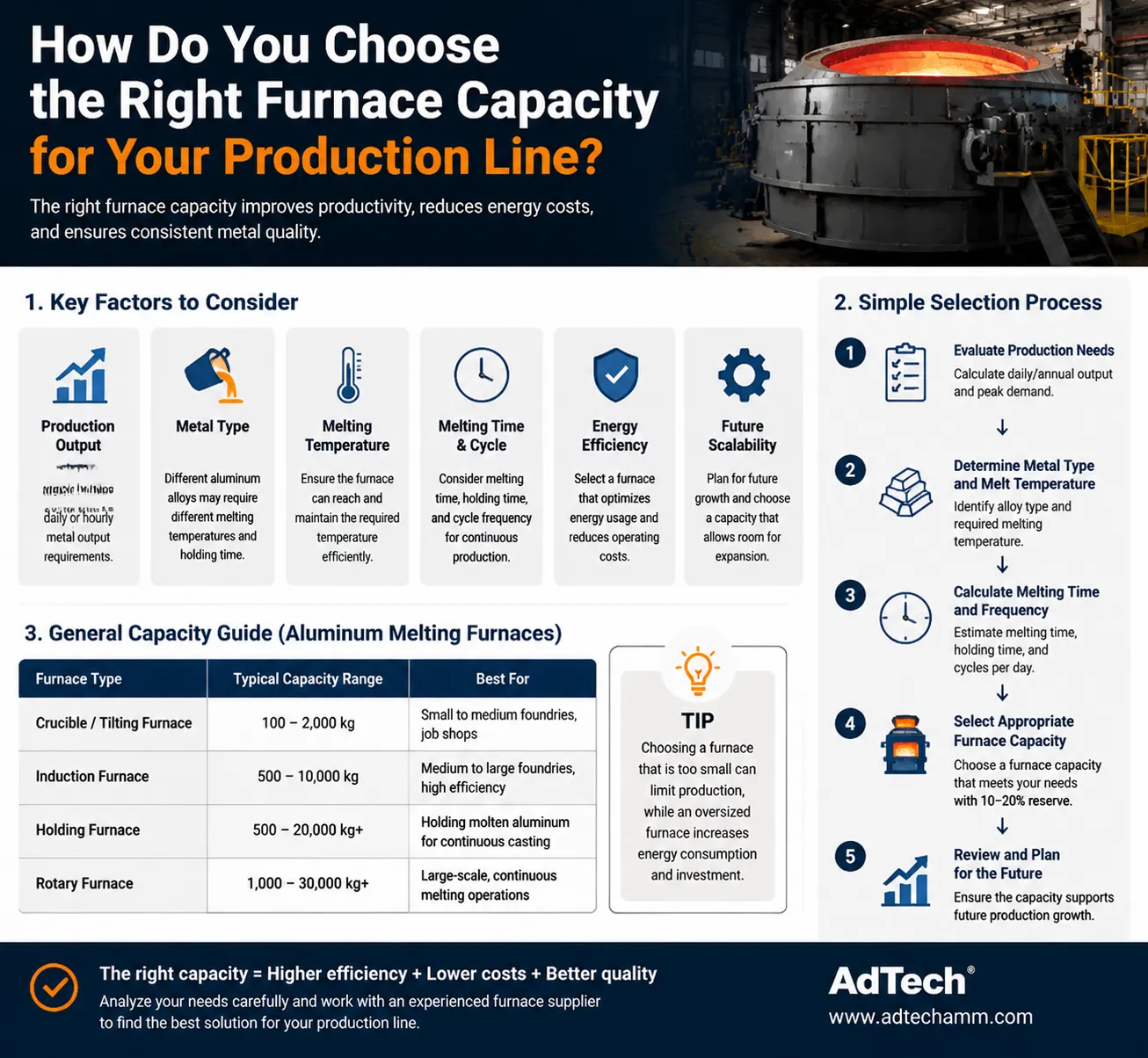
The calculation starts with your daily production target in kilograms or tons, divided by the number of melt cycles your shift schedule allows. A furnace with a 2-hour melt cycle running two 8-hour shifts can complete roughly 8 cycles per day (accounting for loading, tapping, and cleaning time between cycles).
| Daily Production Target | Recommended Furnace Capacity | Approximate Cycles/Day |
|---|---|---|
| Under 500 kg | 100-300 kg crucible or small induction | 2-4 |
| 500 kg – 2 tons | 500 kg-1 ton induction or crucible | 3-5 |
| 2-10 tons | 2-5 ton reverberatory or induction | 3-6 |
| 10-30 tons | 5-15 ton tower or reverberatory | 4-8 |
| Over 30 tons | 20+ ton reverberatory (multi-furnace setup) | Continuous/staggered |
We always tell clients to size for their 18-month production forecast, not current output. Furnaces represent a 10 to 20 year capital investment in most cases, and retrofitting capacity later costs far more than building in headroom during initial installation. That said, over-forecasting growth that never materializes is its own trap, and we’ve seen plants stuck paying to heat furnaces running at 40 percent capacity for years because someone got optimistic about a sales forecast.
What Makes a Melting Furnace “High-Efficiency” in Real-World Operations?
Efficiency claims get thrown around loosely in furnace marketing, so it’s worth breaking down what actually contributes to genuine efficiency gains versus what’s just a specification sheet number.
Refractory insulation quality matters more than most buyers realize. Ceramic fiber linings retain less heat than traditional firebrick but respond faster to temperature changes, which suits batch operations with frequent start-stop cycles. Firebrick holds heat longer, benefiting continuous operations where the furnace rarely cools down completely.
Recuperative and regenerative burner systems recapture heat from exhaust gases to preheat combustion air, a design choice that can improve gas-fired furnace efficiency by 10 to 25 percent depending on exhaust temperature and recovery system design.
Lid and door design affects heat loss more than people expect. Every time a furnace door opens for charging or skimming, heat escapes and cold air enters, disrupting temperature stability. Furnaces with faster-acting, better-sealed doors lose measurably less energy over a production shift.
Variable frequency drives on induction furnace power supplies allow operators to match power input to actual melting demand rather than running at fixed output, cutting electricity waste during the holding phase when metal is already molten and just needs temperature maintenance.
We’ve retrofitted older furnaces with improved door seals and recuperative burners for clients unwilling to invest in entirely new equipment, and the payback period on those upgrades often runs 12 to 24 months through fuel savings alone, which makes it one of the better ROI conversations we have with budget-conscious operations.
Can Aluminum Melting Furnaces Be Customized for Specific Alloys or Processes?
Yes, and this is where AdTech spends a considerable portion of our engineering time. Standard off-the-shelf furnaces work fine for common alloys and conventional casting processes, but specialized applications need modified designs.
High-magnesium alloys (5xxx series) oxidize more aggressively than standard casting alloys, requiring protective atmosphere systems or flux cover to prevent excessive burn-off. We’ve built furnaces with nitrogen purging systems specifically for clients processing marine-grade aluminum where magnesium loss directly affects alloy certification.
Recycled aluminum and scrap-heavy charge material introduces contamination risks, coatings, paint residue, and mixed alloys, that standard furnaces handle poorly. Furnaces designed for secondary aluminum (recycled material) often include enhanced dross removal systems and secondary combustion chambers to burn off organic contaminants before they affect melt quality.
Low-pressure die casting and gravity die casting operations sometimes need integrated holding furnaces attached directly to the melting unit, maintaining precise pour temperature without a separate transfer step that risks temperature loss and contamination.
| Customization Need | Design Modification | Typical Client Industry |
|---|---|---|
| High-Mg alloys | Nitrogen/argon protective atmosphere | Marine, automotive |
| Recycled/scrap feed | Secondary combustion, enhanced dross removal | Secondary smelters, recyclers |
| Precision casting | Integrated holding furnace, tighter thermocouple zones | Aerospace, automotive wheels |
| Continuous operation | Tower design with automated charging | High-volume extrusion |
| Small-batch specialty alloys | Modular crucible with rapid alloy changeover | Research, custom foundries |
What Safety Standards and Emission Controls Should Buyers Look For?
Molten aluminum handling carries serious risk, and furnace design plays a direct role in operator safety. We evaluate furnaces against several practical safety benchmarks beyond whatever regulatory minimum applies in a given country.
Explosion risk from moisture contact is a genuine hazard, molten aluminum reacting violently with water or damp scrap material. Furnaces should include dry charge verification protocols and, ideally, charge preheating zones that evaporate surface moisture before material reaches the melt.
Emission control matters both for regulatory compliance and worker health. Gas-fired furnaces produce combustion byproducts including nitrogen oxides and particulate matter, requiring baghouse filtration or scrubber systems in most jurisdictions with industrial air quality regulations. Induction furnaces produce fewer direct emissions but still generate dross and fume that need capture systems.
| Safety/Emission Element | Purpose | Common Standard Reference |
|---|---|---|
| Explosion-proof charging chute | Prevents moisture-related explosions | NFPA 484 (combustible metals) |
| Fume extraction/baghouse | Captures particulate emissions | EPA NESHAP / local air quality codes |
| Emergency tap/drain system | Allows rapid metal removal in failure scenario | OSHA general industry standards |
| Refractory integrity monitoring | Prevents shell breach and metal breakout | ASTM refractory testing standards |
| Interlocked door safety systems | Prevents operator injury during charging | ISO 13849 machinery safety |
We insist on explosion-proof design features for any furnace processing scrap or recycled feedstock, since moisture contamination risk is simply higher with secondary materials compared to clean primary ingot.
How Do Maintenance Requirements Differ Between Furnace Types?
Maintenance burden is an underappreciated cost factor that changes the real economics of furnace ownership. Refractory relining is the single largest recurring maintenance cost across nearly every furnace type, and the interval varies significantly.
| Furnace Type | Refractory Relining Interval | Annual Maintenance Cost Estimate | Downtime per Relining |
|---|---|---|---|
| Reverberatory | 2-4 years | Moderate-High | 1-3 weeks |
| Induction | 1-2 years (coil lining) | High (coil replacement costly) | 3-7 days |
| Crucible | 6 months-2 years (crucible replacement) | Low-Moderate | 1-3 days |
| Tower | 2-3 years | Moderate | 1-2 weeks |
Induction furnace coils represent a maintenance cost most buyers underestimate during purchase decisions. The refractory lining directly surrounding the induction coil degrades from thermal cycling, and when it fails, molten metal can reach the coil itself, causing catastrophic damage requiring coil replacement rather than simple relining. We tell every induction furnace client to budget for this possibility even though well-maintained units can go years without it happening.
Gas-fired furnace burners need periodic nozzle cleaning and calibration, typically quarterly, to maintain combustion efficiency. Neglected burners drift out of optimal air-fuel ratio, quietly increasing fuel consumption for months before anyone notices the utility bill creeping upward.
What Does the Total Cost of Ownership Look Like Over 10 Years?
Purchase price tells you almost nothing about the real cost of running a furnace for a decade. We built the following comparison based on actual client data from similarly sized operations (roughly 3-ton capacity) running comparable production volumes.
| Cost Category | Reverberatory (Gas) | Induction (Electric) |
|---|---|---|
| Initial equipment cost | Lower ($150,000-250,000) | Higher ($300,000-500,000) |
| Annual energy cost (est.) | $180,000-240,000 | $150,000-190,000 |
| Annual maintenance | $15,000-25,000 | $20,000-35,000 |
| Metal loss cost (dross) | Higher (2-5% loss) | Lower (0.5-1.5% loss) |
| Refractory/coil replacement (10-yr amortized) | $8,000-15,000/year | $18,000-30,000/year |
| Estimated 10-year total | $2,150,000-2,900,000 | $2,000,000-2,650,000 |
The numbers surprise people. Induction furnaces cost more to buy but often win on total cost of ownership because reduced metal loss and lower energy waste compound significantly over a decade, especially for operations processing higher-value alloys where every percentage point of metal loss represents real money. Gas-fired equipment still makes sense for operations with cheap, stable natural gas access and lower-value scrap-heavy feedstock where metal loss percentage matters less proportionally.
Frequently Asked Questions
1. What is the lifespan of an industrial aluminum melting furnace?
Most well-maintained furnaces run 15 to 25 years before major structural replacement becomes necessary, though refractory and burner or coil components need replacement multiple times during that period.
2. How long does it take to melt a full batch of aluminum?
Cycle times range from 45 minutes for small induction units to 4-6 hours for large reverberatory furnaces, depending on capacity, charge material condition, and target temperature.
3. Is induction melting better than gas melting for aluminum?
Neither is universally better. Induction offers cleaner melts and lower metal loss but higher electricity costs and equipment price. Gas-fired furnaces suit high-volume operations with access to affordable natural gas.
4. Can one furnace melt multiple aluminum alloy types?
Yes, but proper cleaning between alloy changes is essential to avoid cross-contamination, particularly when switching between high-silicon casting alloys and structural alloys with different alloying elements.
5. What causes dross formation in aluminum melting?
Dross forms when molten aluminum’s surface reacts with atmospheric oxygen, creating an oxide layer that traps metal. Minimizing surface exposure and using proper fluxing reduces dross volume.
6. How much does an industrial aluminum melting furnace cost?
Prices range from roughly $50,000 for small crucible furnaces to over $2 million for large custom reverberatory or tower installations, depending on capacity, automation level, and customization requirements.
7. What safety certifications should a furnace supplier provide?
Look for compliance documentation referencing NFPA combustible metal standards, OSHA workplace safety requirements, and applicable regional emission and pressure vessel certifications depending on your location.
8. How often should furnace refractory be inspected?
Monthly visual inspection combined with thermal imaging every quarter catches refractory degradation before it becomes a safety issue, though relining frequency depends on furnace type and usage intensity.
9. Can old furnaces be retrofitted for better efficiency instead of replaced?
Often yes. Door seal upgrades, recuperative burner installation, and control system modernization can improve efficiency 10-25 percent without full furnace replacement, typically paying back within two years.
10. What’s the difference between a melting furnace and a holding furnace?
A melting furnace converts solid metal to liquid and typically operates at higher temperatures with more aggressive heat input. A holding furnace maintains already-molten metal at pouring temperature with gentler, more stable heating designed for consistency rather than rapid thermal transfer.