

A properly specified filtration box fitted with a ceramic foam or bonded particulate filter plate yields the most reliable reduction in nonmetallic inclusions, oxide skins, and dross in molten aluminum flows, cutting scrap rates and improving downstream casting integrity while offering predictable maintenance needs and clear payback within typical foundry production cycles.
What a filtration box does and why it matters
A filtration box collects molten aluminum from a furnace or launder and forces the metal through a structured filter media inside a refractory chamber, capturing slag, oxide films, inclusions, and tramp particles before the metal reaches molds, die machines, or continuous casting equipment. This step lowers porosity, reduces hot tearing, improves surface finish, and protects downstream tooling from abrasive damage. Field studies and vendor performance summaries show measurable drops in scrap rates and downstream machining time following proper filtration implementation.
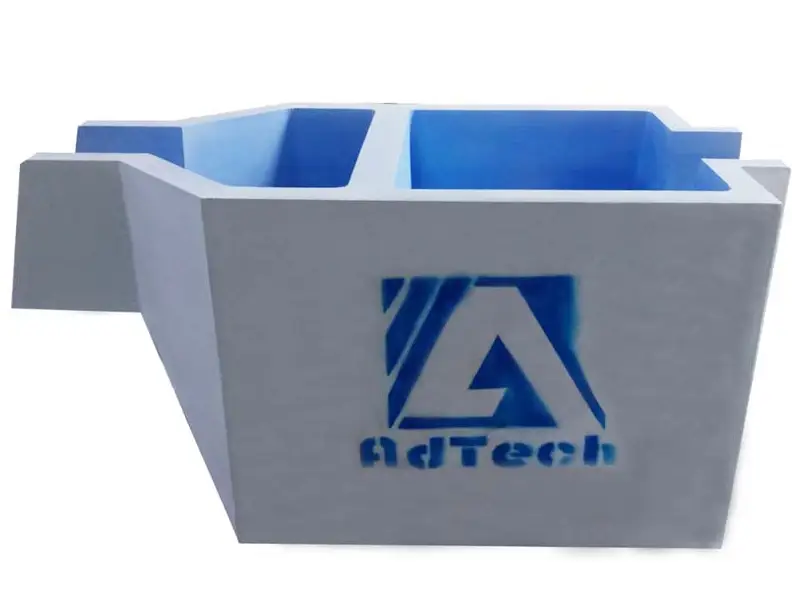
Core components and operating principle
A filtration box is a pressure neutral chamber built to hold a filter plate. Key elements include:
-
Outer shell or mounting frame that aligns with the launder or pouring spout.
-
Refractory working lining that forms the filter cavity.
-
Filter media: ceramic foam, bonded particulate, or plate-type elements.
-
Gasket or sealing system to prevent bypass leakage.
-
Inlet and outlet geometry that promotes uniform flow through the filter face.
-
Provision for draining, sampling, and emptying captured dross where required.
Operation principle: molten metal enters the box, spreads across the filter face, then migrates through open cells or porous pathways where inertial impact, surface adsorption, and mechanical interception trap nonmetallic matter. Downstream flow is thus cleaner, with reduced turbulence related defects. Vendors and technical reports describe a short residence time inside the box but emphasize the importance of correct flow velocity and even distribution across the filter area.
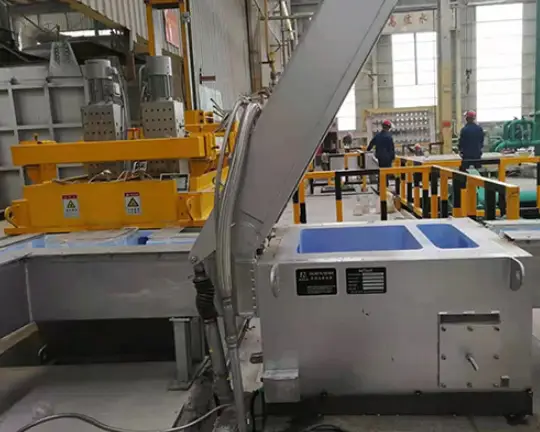
Molten Aluminum Filter System, CFF Filter Box for Foundry
Common types and filter media
Ceramic foam filter plate (CFF)
Ceramic foam plates are cellular substrates with controlled pore indices measured in pores per inch (PPI). They provide tortuous flow channels where inclusions collect on channel walls or in nodes. Typical pore grades for aluminum work range from 10 PPI through 60 PPI; 30 PPI and 40 PPI are commonly used for general foundry filtration. Ceramic foam offers high thermal shock resistance and predictable capture efficiency for particulate inclusions.
Bonded particle filters and honeycomb plates
Bonded particle filter elements are formed from a blend of refractory grains bonded into a porous matrix. These media are stronger under mechanical handling and may be used where plate rigidity or longevity is a priority. They perform well in gravity casting and certain pressure processes.
Deep bed and cartridge systems
Some systems use deep porous tube cartridges or layered beds inside a containment vessel. These systems are typically fabricated with fused alumina or specialized graded porous ceramics and tuned for very high removal of fine inclusions. They are more complex and often used where extremely low inclusion levels are needed.
Prefabricated filter boxes (aluminum silicate linings)
Prefabricated ceramic or aluminum silicate modular housings create a stable cavity for plate insertion and protect steel shells from thermal load. These are common in inline foundry installations for extrusion billet and slab casting.
Materials, thermal performance, and lining design
Design of the working lining has three primary goals: protect the metal shell from thermal and corrosive attack, provide a stable seat for the filter plate, and minimize heat loss to maintain melt temperature.
Typical lining families
-
Aluminum silicate fiber composites for high insulation and thermal shock resistance. These are widely used in prefabricated filter box modules.
-
Fused silica or fused quartz linings when very low thermal expansion and volume stability are required.
-
High alumina refractories when abrasion resistance and mechanical strength are prioritized.
Thermal matters to control
-
Heat loss through walls can increase melt viscosity and encourage oxide formation. Insulation thickness and cavity geometry determine conduction losses. Vendors provide lining designs matched to the flow rate and dwell time of the operation.
Sizing, flow rate, and pressure considerations
Correct sizing prevents either rapid bypass with incomplete filtration or excessive head loss that risks plugging or flow interruption.
Key metrics and formulas
-
Flow rate (Q): mass or volumetric flow through the box, often in t/h or L/min.
-
Face velocity (v): volumetric flow divided by effective filter face area. For ceramic foam plates, face velocities are typically kept in a range that avoids turbulence but keeps dwell time sufficient for capture. Field guidance from suppliers details acceptable ranges by PPI rating.
Pressure drop
-
A new filter plate has a design pressure drop that increases with use. Monitoring the differential pressure across the filter or measuring flow and pouring head gives an early indicator of clogging. Excessive drop signals need for plate change or maintenance.

Installation, placement, and process integration
Correctly placing a filtration box in the metal flow path secures its benefits.
Inline locations commonly used
-
Directly on the furnace or holding furnace spout.
-
Between a holding furnace and a distributing launder.
-
Upstream of a distribution manifold feeding multiple molds or dies.
Mounting and sealing
-
The box must be rigidly fixed to avoid misalignment that permits bypass.
-
Ensure gasketing or packing around the filter plate is consistent and does not permit direct flow around the media. Typical sealing uses ceramic fiber rope or compression seals tailored for molten aluminum temperature ranges.
Operation controls and monitoring metrics
Reliable filtration relies on proactive measurement rather than reactions.
Routine checks and instrumentation
-
Flow rate meter where possible, or periodic mass checks.
-
Differential pressure gauge across the filter face to detect clogging trends.
-
Temperature probes upstream and downstream to detect losses or cold spots.
-
Visual inspections of pouring spouts and sample checks in controlled safe manners.
Key performance indicators (KPIs)
-
Inclusion count per unit volume sampled.
-
Scrap percentage reduction after filtration.
-
Filter life measured in production hours or poured tonnage.
-
Maintenance interval adherence.
Routine maintenance, life expectancy, and safe cleaning
A scheduled approach lengthens service life and reduces unplanned downtime.
Typical maintenance tasks
-
Replace filter plates or cartridges when pressure drop reaches vendor threshold.
-
Remove and dispose of captured dross and slag using tools rated for high temperature.
-
Inspect lining for cracking and replace modular linings at planned intervals.
-
Verify seals and fasteners before each campaign or shift.
Expected life span
-
Ceramic foam filter plates frequently provide service measured in hundreds to thousands of tonnes poured; typical service lives are often quoted in months to a year depending on throughput and dross load. Bonded particle elements may last longer under rough handling. Exact lifetime depends on process contamination level and filtering duty.
Safe handling
-
Always follow heat-protective procedures during removal. Allow controlled cooling if recommended by vendor. Use tools that provide distance from metal and avoid sudden cooling that risks fracturing refractory.
Typical failure modes and troubleshooting checklist
-
Bypass leakage: caused by poor seating or damaged gaskets. Check seal condition and re-seat the plate.
-
Excessive pressure drop: caused by high inclusion load, too fine a pore grade, or upstream contamination surge. Consider switching PPI grade, or adding a pre-filter stage.
-
Filter fracture: thermal shock or improper handling can crack ceramic plates. Examine lining practices and handling tools.
-
Undesired temperature loss: poor insulation or excessive exposure time. Review lining thickness and pour head.
Health, safety, and environmental practices
-
Manage dross and spent filter disposal according to local hazardous waste regulation. Some captured material has recoverable metal; coordinate with reclamation vendors.
-
Provide ventilation when opening hot boxes that may release fumes.
-
Train operators in hot metal handling; provide PPE and hot metal tools.
-
Implement spill containment to prevent molten metal entering drains.
Economic model and selection decision worksheet
Filtration reduces scrap, improves yield, and lowers downstream repair costs. A simplified payback model helps compare options.
Basic parameters for cost model
-
Annual throughput in tonnes.
-
Scrap rate before filtration and expected scrap rate after filtration.
-
Cost of scrap per tonne, production margin per tonne.
-
Capital cost of filter box and installation.
-
Consumable cost: filter plates per tonne or per month.
-
Maintenance labor cost.
(Table 1 below gives a sample layout to compute payback.)
Comparative tables
Table 1. Typical filter media comparison
| Media type | Typical pore range or grade | Strength to handling | Thermal shock tolerance | Typical applications |
|---|---|---|---|---|
| Ceramic foam plate | 10 PPI to 60 PPI | Moderate | High | Gravity pour, die cast, slab casting. |
| Bonded particle filter | Graded porosity | High | Moderate | High-duty environments, continuous handling. |
| Fused alumina tube | Micron-controlled | High | High | Deep bed, very fine inclusion removal |
| Metal foam | Open cell metal foam | High | Moderate | Specific low-resistance, where conductivity matters |
Table 2. Typical specification parameters that matter to engineers
| Parameter | Importance | Typical target range |
|---|---|---|
| Filter face area | Very high | sized for desired face velocity |
| Pore index | High | 20 to 40 PPI for many foundry castings |
| Lining insulation R-value | High | vendor specified to limit temp drop |
| Inlet geometry | Medium | uniform distribution recommended |
| Sealing method | High | ceramic fiber gasket or compression seal |
Table 3. Example maintenance schedule
| Activity | Frequency | Responsible |
|---|---|---|
| Visual seal check | Daily | Operator |
| Differential pressure log | Per shift | Technician |
| Replace filter plate | When ΔP limit reached or scheduled | Maintenance |
| Inspect lining | Monthly | Shift lead |
| Full emptying and dross removal | As needed | Maintenance crew |
Table 4. Sample cost-of-ownership snapshot (illustrative numbers)
| Item | Unit cost | Annual units | Annual cost |
|---|---|---|---|
| Filter box capex | $25,000 | 1 | $25,000 |
| Ceramic plates | $150 per plate | 200 | $30,000 |
| Maintenance labor | $30/hour | 200 hours | $6,000 |
| Scrap saved (improved yield) | $200/ton | 50 tons saved | -$10,000 (benefit) |
| Net annual consumable cost | $26,000 |
Numbers vary widely; vendors provide application-specific quotes.
Aluminium Extrusion Dies & Tooling Maintenance FAQ
1. What is the standard material for aluminium extrusion dies?
2. How does Nitriding extend the life of an extrusion die?
3. What causes “die streaks” on the profile surface?
4. Why is die preheating critical before a press run?
Dies must be preheated to approximately 450 to 480 degrees Celsius. This ensures the die is at a similar temperature to the billet, preventing “thermal shock” and ensuring the metal flows evenly. Cold dies can crack under pressure or cause the profile dimensions to be out of tolerance.
5. What is the difference between bridge dies and solid dies?
- Solid Dies: Used for open shapes (like channels or angles). They are simpler and consist of a single plate.
- Bridge (Hollow) Dies: Used for hollow profiles (like tubes). They consist of a mandrel to form the internal cavity and a cap to form the external shape, with “ports” allowing the metal to flow and weld back together around the mandrel.
6. How many tons of aluminium can a die typically extrude?
7. Can an extrusion die be repaired after cracking?
8. How does nitrogen cooling affect extrusion speed and die life?
9. What is the role of die “polishing” in surface quality?
10. How should extrusion dies be stored to prevent corrosion?
After the caustic soda bath (to remove residual aluminium) and thorough cleaning, dies should be coated with a light rust-preventative oil and stored in a temperature-controlled, low-humidity environment. This prevents oxidation of the H13 steel, which could otherwise pit the bearing surfaces.