

For high-volume parts that demand tight dimensional control, fine surface finish, repeatable mechanical performance, and low unit cost at scale, die casting is generally the better choice. For prototypes, single pieces, very large components, complex cores, or parts needing ferrous alloys and low upfront tooling cost, sand casting is usually preferable. The final selection depends on required material, production volume, tolerances, surface condition, part size, and total life cycle cost.
1. Quick definitions and what sets them apart
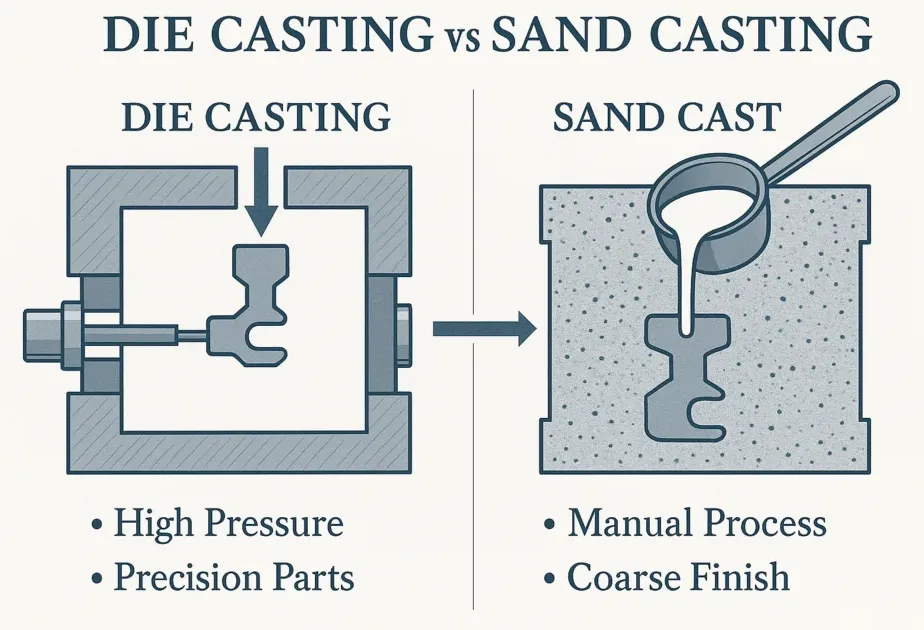
Die casting uses reusable metal molds (dies) and forces molten nonferrous metal into the cavity under pressure. It yields parts with fine detail, tight repeatability, and smooth surfaces. Sand casting forms the mold from compacted sand around a pattern; molten metal is poured into the sand cavity by gravity or with assistance. Sand casting supports a wider range of alloys and large sizes while keeping tooling cost low.
2. Short history and current industrial roles
Both methods have deep roots. Sand molding techniques date back centuries and remain the workhorse for foundries producing large, heavy parts and low to medium runs. Die casting rose to prominence with the development of modern steels and high-pressure machines, fitting industries that require thousands to millions of consistent, small to medium parts per year, such as automotive electrical housings, consumer electronics, and HVAC fittings. Modern facilities combine automation, closed-loop quality checks, and secondary machining to produce finished parts with minimal manual handling.
3. Process steps — side by side
Die casting (typical sequence)
-
Design and finalize part and die, including gating and vents.
-
Manufacture hardened steel dies with precise cavities.
-
Preheat die, apply lubricant/release agent.
-
Inject molten metal at high pressure into die.
-
Hold pressure during solidification, open die, eject part.
-
Trim excess metal, apply any finishing machining, inspection.
Sand casting (typical sequence)
-
Create pattern and gating/risering design.
-
Pack sand around pattern in a flask to form mold halves.
-
Remove pattern, assemble mold halves and core(s).
-
Pour molten metal into the sand cavity by gravity or low pressure.
-
Allow solidification, break mold to extract casting.
-
Clean off sand, chase part, perform heat treat or machining, inspect.
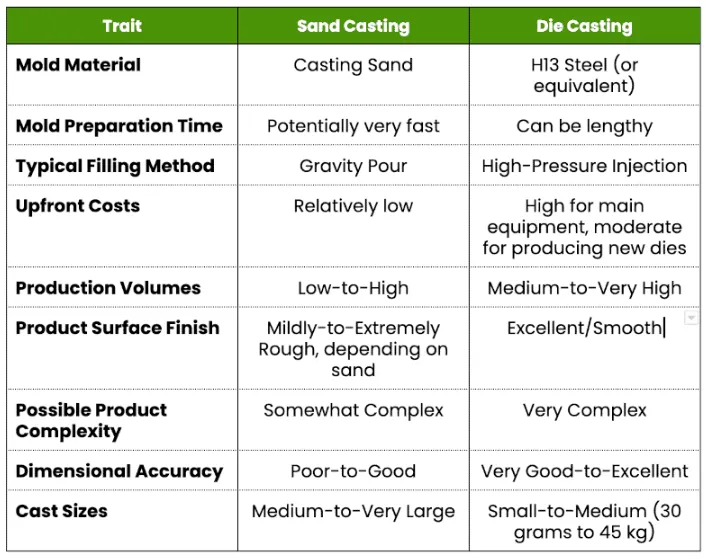
A key operational contrast: die casting uses permanent tooling and high pressure forming that supports automation; sand casting uses expendable molds and more manual stages but provides flexibility in size and alloy choice.
4. Materials and alloy compatibility
-
Die casting is most common with nonferrous alloys that have relatively low melting points and fill well under pressure, primarily zinc, aluminum, and magnesium. These alloys yield good flow, thin walls, and rapid cycle times.
-
Sand casting supports a much wider material set, including ferrous alloys such as gray and ductile iron, steels, bronzes, and copper alloys. Because each sand mold is expendable, the process tolerates higher pouring temperatures and more reactive alloys.
Practical note: If your design must use stainless steel or cast iron for strength or wear reasons, sand casting is usually the realistic route. If you need lightweight aluminum parts in large quantity with thin walls, die casting often fits better.
5. Tooling, lead time, and cost economics
Tooling influences commercial decisions heavily.
Tooling cost and life
-
Die casting dies are expensive to design and machine, often costing tens of thousands to hundreds of thousands USD for precision steel tooling. However, they last many thousands to millions of shots, spreading out the investment for high volumes.
-
Sand casting tooling is low cost because molds are formed from sand and patterns can be simple wood, plastic, or metal forms. For small runs and prototypes this reduces time to first part and lowers initial capital.
Cost per part vs production volume
A general pattern:
-
Low volumes (prototype to a few hundred): sand casting commonly has much lower total cost.
-
Medium volumes (hundreds to thousands): the break-even point depends on part complexity, finishing, and required tolerance.
-
High volumes (thousands to millions): die casting typically achieves much lower per-part cost due to high cycle rates and reusable dies.
6. Dimensional accuracy, tolerances, and repeatability
-
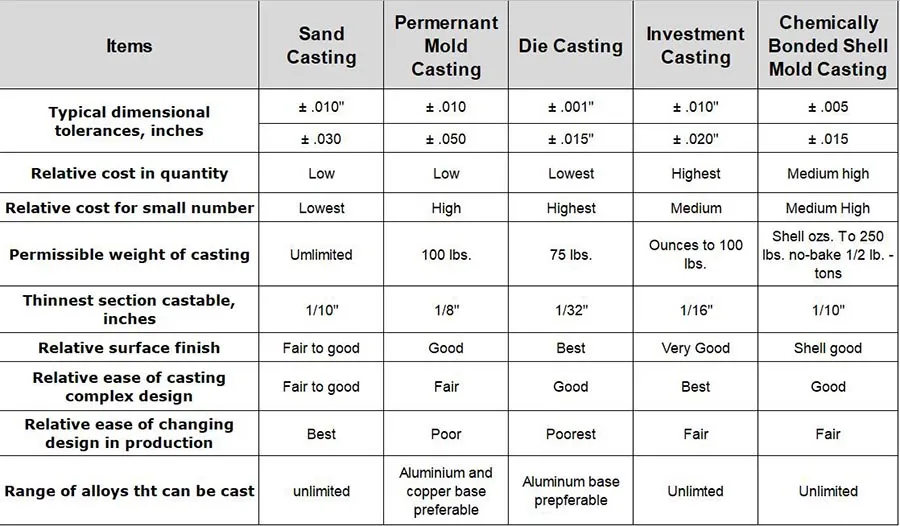
Die casting delivers tight dimensional control and repeatability suitable for press-fit assemblies and components that require consistent mating surfaces. Typical tolerances for die cast parts can be in the range of ±0.1 mm to ±0.5 mm depending on size and feature.
-
Sand castings show more dimensional scatter because of mold deformation, sand compaction inconsistencies, and shrinkage control challenges. Typical sand casting tolerances are looser and often require secondary machining for critical surfaces.
Design implication: If the part must hold tight fits without extensive machining, die casting will save secondary operations on large runs.
7. Surface finish and secondary processing
-
Die cast parts emerge with smooth surfaces and fine detail, reducing finishing time. Surface finish can be suitable for plating or painting with minimal preparation.
-
Sand cast surfaces are rougher and porous due to the granular nature of the mold; they typically need shot blasting, grinding, or machining for cosmetic or precision features. This increases labor and cycle time for finished parts.
Secondary processes to plan for: machining, heat treatment, plating, painting, leak testing, non-destructive testing. Sand cast designs often budget more for these steps.
8. Mechanical properties and microstructure differences
Casting route affects cooling rate and grain structure:
-
Die casting often produces finer microstructure and less gas porosity when properly processed because of rapid filling and controlled solidification under pressure. This tends to improve mechanical properties like tensile strength for certain aluminum and zinc alloys.
-
Sand castings can have larger grain sizes and higher porosity potential unless cores, gating, and risers are carefully designed. Heat treatment can improve properties, but consistency depends on foundry practice.
Engineering note: For load-bearing critical parts, request mechanical test data (tensile, yield, elongation) from potential suppliers and specify required acceptance criteria.
9. Design freedom, complexity, and internal features
-
Sand casting excels for complex shapes, large sections, and internal cavities created with cores. It is straightforward to create one-off or bespoke geometries without expensive tool changes.
-
Die casting handles complex external geometry and thin walls well, but internal undercuts and complicated cores increase die cost and complexity. Inserts and multi-part dies can address those needs but raise tooling expense.
Rule of thumb: Use sand casting when part size or complexity demands flexible core work or when cost and schedule cannot absorb a complex die.
10. Production volume, cycle time, and scalability
-
Die casting cycle times are short and highly repeatable, often measured in seconds to low tens of seconds per shot, supporting mass production. Automation reduces labor cost per part.
-
Sand casting cycle time is longer because molds are made and broken; the process is more batch oriented and less amenable to continuous automated cycles. It remains effective for moderate quantities and very large items where dies would be impractical.
11. Environmental, health, and workplace considerations
-
Die casting requires die maintenance and handling of lubricants and high-temperature molten metal under pressure; ventilation and fume control are critical. Mold lubricants and die coatings must be managed to limit emissions.
-
Sand casting generates used sand that may need reclamation, binders that require treatment, and dust control. Foundries often operate sand reclamation, waste heat recovery, and filtration systems.
Sustainability point: Many modern foundries reclaim and reuse sand and recover energy, and die cast shops recycle metal but must manage scrap and die wear.
12. Quality control, testing and corrective measures
Common QC steps for both:
-
Dimensional inspection (CMM, gauges).
-
Visual inspection and surface defect repair.
-
Pressure or leak testing for fluid-containing parts.
-
Non-destructive testing (X-ray, ultrasonic) for internal defects.
-
Mechanical testing of sample pieces (tension, hardness).
-
Metallurgical analysis for microstructure and inclusion content.
Die casting benefits from in-process sensors that monitor shot parameters and temperature; sand casting relies more on experienced process control and sampling.
13. Typical applications and industry examples
-
Die casting: electrical housings, connector shells, optical housing frames, automotive transmission and engine brackets (where nonferrous metal is acceptable), consumer product components.
-
Sand casting: pump housings, engine blocks and heads in iron, large valves, heavy machinery components, prototype aerospace castings that require specific alloys.
14. Practical decision matrix
The table below condenses decisions by major selection drivers.
| Selection driver | When to pick die casting | When to pick sand casting |
|---|---|---|
| Production volume | Very high runs with repeatability | Low to medium runs or one-offs |
| Required tolerance | Tight tolerances, minimal machining | Loose tolerances, expect machining |
| Surface finish | Smooth, minimal finishing | Rough, needs finishing |
| Alloy choice | Nonferrous (Al, Mg, Zn) | Wide range including ferrous |
| Part size | Small to medium | Small to very large |
| Upfront cost | High die cost | Low pattern/mold cost |
| Design complexity | External detail, thin walls | Complex cores, large cavities, inserts. |
| Lead time to first part | Long (die making) | Short (pattern or direct sand mold) |
(Sources consolidated from industry references.)
15. Cost-per-part example scenarios
Table: Example break-even estimate (numbers illustrative; get quotes for exact figures)
| Volume (pcs) | Assumed die cost USD | Sand pattern / tooling USD | Estimated per-part die cast (USD) | Estimated per-part sand cast (USD) | Recommended process |
|---|---|---|---|---|---|
| 100 | 60,000 | 1,500 | 600.00 | 120.00 | Sand casting |
| 1,000 | 60,000 | 1,500 | 60.00 | 70.00 | Sand casting or die casting depending on finish |
| 10,000 | 60,000 | 1,500 | 10.00 | 40.00 | Die casting |
| 100,000 | 60,000 | 1,500 | 1.50 | 30.00 | Die casting |
How to use: Request quotes from both types of vendors, include finishing and inspection costs, and calculate total landed cost across expected production.
16. Design checklist for choosing process (practical)
-
Confirm final material and whether ferrous alloys are required.
-
Define critical dimensions and allowable tolerances.
-
Estimate annual production volume and expected lifetime demand.
-
Check maximum and minimum wall thickness needs.
-
Assess whether thin walls, fine texturing, or integrated bosses are needed.
-
Identify any internal cavities that require cores or inserts.
-
Budget for tooling, secondary machining, and finishing.
-
Consider lead time to first parts and speed to market.
17. Tables that help engineers and procurement
Table A: Material compatibility quick glance
| Material family | Typical compatibility die casting | Typical compatibility sand casting |
|---|---|---|
| Aluminum alloys | High | High |
| Zinc alloys | Very high | Limited |
| Magnesium alloys | High | Limited |
| Copper / bronze | Limited | High |
| Iron / steel | Not suitable | Very high |
| Stainless steels | Not suitable | Very high |
Table B: Typical tolerance classes (indicative)
| Process | Typical linear tolerance per 100 mm |
|---|---|
| High quality die casting | ±0.05 to ±0.2 mm |
| Typical die casting | ±0.1 to ±0.5 mm |
| Typical sand casting | ±0.5 to ±2.0 mm |
(Consult a supplier for exact tolerances on specific geometries.)
18. Practical tips to lower cost and risk
-
For die casting, invest time in design for manufacturability: add appropriate draft angles, uniform wall thickness, and consider using ribs and bosses that suit metal flow.
-
For sand casting, plan gating and risering carefully to minimize shrink defects and reduce machining. Use simulation tools for both methods to predict filling, shrinkage, and porosity.
-
Consider hybrid approaches: use sand casting for large base shapes then machine and assemble smaller die-cast subcomponents, or use permanent mold casting for medium runs when appropriate.
19. Common pitfalls and how to avoid them
-
Choosing die casting for the wrong alloy, which forces expensive process adjustments. Solution: confirm alloy options early.
-
Underestimating secondary finishing for sand cast parts. Solution: include finishing quotes and prototype checks.
-
Ignoring tooling lead times in project schedules. Solution: build die lead time into program plan and consider rapid prototyping for early validation.
20. Final practical decision flow
-
Do you need ferrous or high-temperature alloys? If yes, pick sand casting.
-
Is expected annual volume very high and part size within die machine capacity? If yes, pick die casting.
-
Are tight tolerances and excellent surface finish required without heavy machining? If yes, pick die casting.
-
Is cost to first part more critical than per-part cost later? If yes, pick sand casting.
If still uncertain, create a short prototype run with sand casting while pursuing a die quote for volume production.
Sand Casting vs. Die Casting: Strategic Process FAQ
1. Which process gives the best dimensional accuracy?
2. Can die casting be used for very large parts?
3. Which process is cheaper for 500 pieces?
4. Are there alloy limits for die casting?
5. Do die cast parts need machining?
6. Is porosity a bigger problem in sand castings?
7. Which process is faster for high volume?
8. How should I choose if I need thin walls?
9. Can I make prototypes in die casting?
10. Which process is better for complex internal cavities?
Sand casting with the use of sand cores usually provides more freedom for deep, undercut, or complex internal cavities. For die casting, creating complex internal features requires moving slides or sacrificial cores, which drastically increases die cost and complexity.
Closing notes for procurement and engineers
Selecting between die casting and sand casting is not a single-axis decision. Evaluate material needs, scale, part geometry, lead time, and total landed cost. Use prototypes to validate function then scale up tooling after design freeze. When in doubt, ask suppliers for both sand cast prototypes and die cast quotes so you can compare technical performance and economics in your real production context.