

Degassing molten aluminum is the process of removing dissolved hydrogen gas and non-metallic inclusions from liquid aluminum before casting, and the most effective methods available today are rotary impeller degassing, inline degassing with porous plugs, and lance-fed inert gas injection using argon or nitrogen. Foundries that skip proper degassing end up with porosity defects that show up during machining, X-ray inspection, or worse, after a part has already been shipped to a customer. We have spent years around aluminum melting furnaces watching operators chase down porosity complaints, and almost every single time the root cause traces back to inadequate hydrogen removal before the metal ever reached the mold.
If your project requires the use of Degassing Molten Aluminum System, you can contact us for a free quote.
Why Molten Aluminum Absorbs Hydrogen
Aluminum has an unusual relationship with hydrogen that most other common casting metals don’t share to the same degree. In its solid state, aluminum holds almost no hydrogen at all. Once it melts, its solubility for hydrogen jumps dramatically, sometimes by a factor of nearly twenty compared to the solid phase at the same temperature. This gap is the entire reason degassing exists as an industry practice.
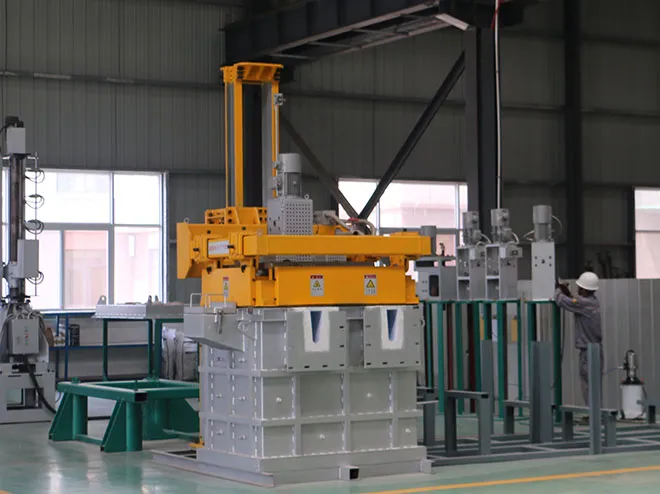
Hydrogen enters molten aluminum primarily through moisture. Water vapor in the surrounding atmosphere, moisture trapped in scrap charge material, damp refractory linings, and even humidity clinging to tools dipped into the melt all react with liquid aluminum at high temperature. The reaction breaks water molecules apart, releasing hydrogen atoms that dissolve directly into the metal while oxygen combines with aluminum to form oxide.
The dissolved hydrogen stays invisible while the metal remains liquid. The trouble starts during solidification. As aluminum cools and transitions from liquid to solid, its hydrogen solubility drops sharply again, and the gas that was previously dissolved has nowhere to go. It comes out of solution and forms bubbles, and if those bubbles get trapped inside the solidifying structure, you end up with porosity, tiny voids scattered through the casting that weaken mechanical properties and ruin pressure-tightness in parts like engine blocks or hydraulic housings.
| Factor Contributing to Hydrogen Pickup | Typical Source |
|---|---|
| Furnace atmosphere humidity | Ambient air moisture, especially in humid climates |
| Scrap charge moisture | Wet or oily recycled aluminum, uncleaned turnings |
| Refractory lining moisture | New or improperly dried furnace linings |
| Tool and ladle contamination | Damp skimming tools, unpreheated transfer ladles |
| Alloying addition contamination | Moisture on master alloy ingots or additives |
| Holding time at temperature | Extended holding increases exposure to atmospheric moisture |
We noticed something interesting working with a die casting operation in a coastal region a while back. Their porosity complaints spiked noticeably during the rainy season every year, almost like clockwork, and it took months before anyone connected it to ambient humidity affecting their charge material storage. Once they moved scrap storage indoors and added a dry-out step for reclaimed material, defect rates dropped within two production cycles.
What Happens When Aluminum Isn’t Properly Degassed
Skipping or poorly executing degassing shows up in several measurable ways, and buyers evaluating aluminum castings should know exactly what to look for.
Gas porosity appears as small, generally round voids distributed somewhat evenly through the casting cross-section, visible under X-ray inspection or after machining cuts into the surface. This differs from shrinkage porosity, which tends to look more irregular and concentrated near thick sections, so distinguishing between the two matters when diagnosing a defect’s root cause.
Reduced mechanical strength follows directly from porosity, since voids act as stress concentration points where cracks initiate under load. Fatigue life in particular suffers disproportionately, meaning a part might pass an initial static strength test but fail prematurely under cyclic loading conditions common in automotive and aerospace applications.
Pressure leakage becomes a critical failure mode for parts required to hold fluid or gas, such as transmission housings, cylinder heads, or hydraulic components. Even microscopic interconnected porosity can create leak paths that cause outright rejection during pressure testing.
Surface finish problems also trace back to poor degassing, since gas bubbles rising to the surface during solidification can leave pinholes or blistering that ruins the cosmetic appearance of decorative or visible cast parts.
| Defect Type | Visual Characteristic | Typical Root Cause |
|---|---|---|
| Gas porosity | Small, round, evenly distributed voids | Dissolved hydrogen releasing during solidification |
| Shrinkage porosity | Irregular shape, concentrated in thick sections | Inadequate feeding during solidification, not gas related |
| Pinholing | Fine surface pits, often clustered | Hydrogen escaping near the casting surface |
| Blistering | Surface bulges appearing after heat treatment | Subsurface gas expanding during solution treatment |
Main Degassing Methods Used in Aluminum Foundries
Several distinct approaches exist for removing hydrogen from molten aluminum, and most foundries end up choosing based on production volume, budget, and the level of gas removal precision their end product demands.
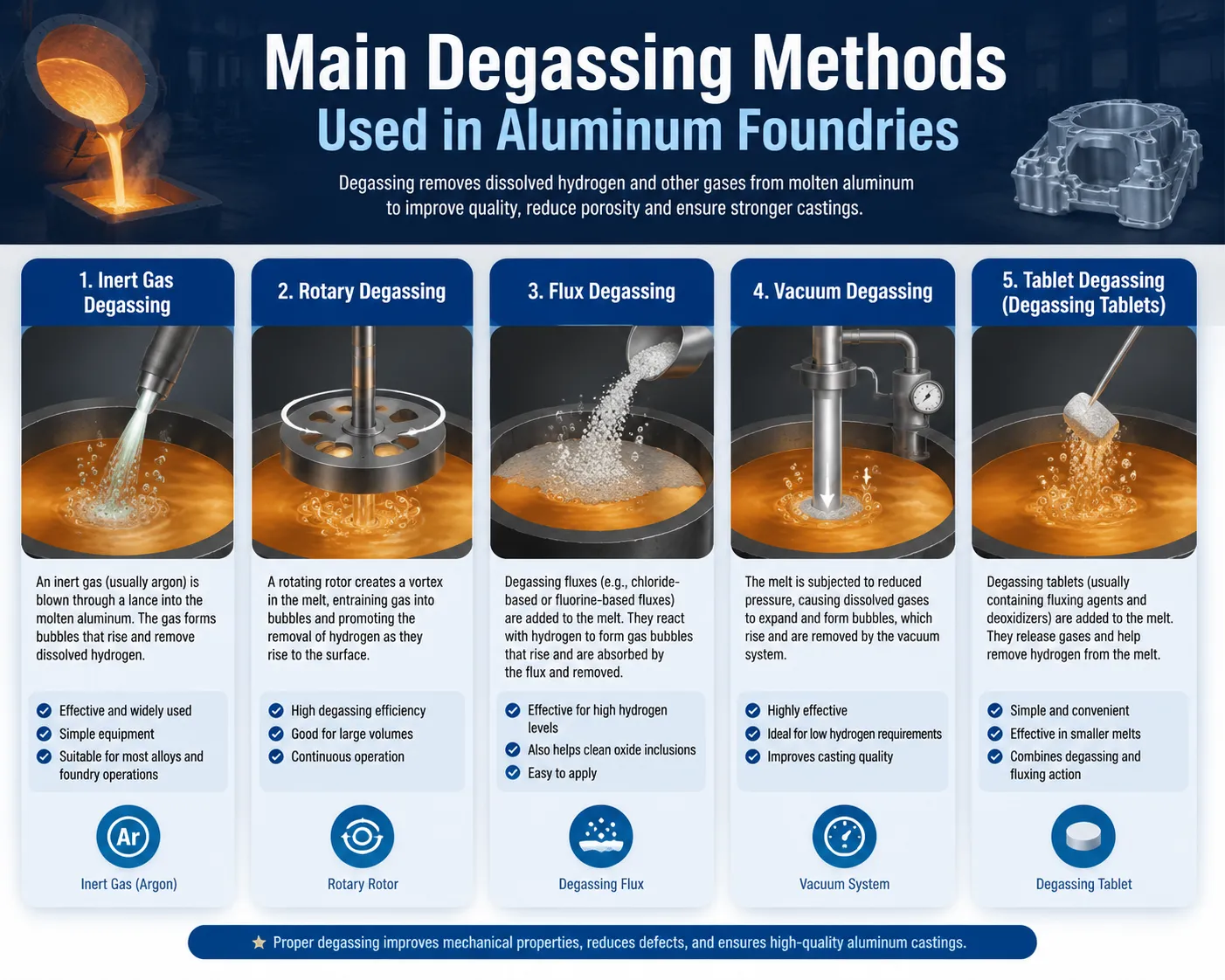
| Degassing Method | Typical Efficiency | Best Suited Production Scale |
|---|---|---|
| Rotary impeller degassing | High (removes 60% to 85% of dissolved hydrogen) | Medium to large foundries, continuous operations |
| Inline degassing with porous plugs | Very high (up to 90%) | High-volume casting lines, automotive suppliers |
| Lance injection | Moderate (40% to 60%) | Small foundries, batch operations, low budget |
| Flux tablets | Low to moderate (30% to 50%) | Small shops, supplementary treatment |
| Vacuum degassing | Very high (90%+) | Specialty aerospace, high-integrity castings |
Each method works on the same underlying physical principle: introducing fine bubbles of an inert or reactive gas into the melt, which creates a lower partial pressure of hydrogen inside each bubble compared to the surrounding metal. Dissolved hydrogen diffuses into these bubbles as they rise through the melt, and the hydrogen escapes with the bubble when it reaches the surface. The differences between methods come down to bubble size, distribution, and contact time, all of which determine how efficiently hydrogen actually transfers out.
Rotary Impeller Degassing Explained
Rotary impeller degassing has become the workhorse method across mid-size and large aluminum foundries, and for good reason. A rotating shaft with a specially designed impeller head sits submerged in the melt, spinning at controlled speed while inert gas flows down through the shaft and exits through small ports on the impeller. The rotation shears the gas into extremely fine bubbles and disperses them throughout the melt volume rather than letting them rise in one concentrated column.
This fine, even bubble distribution is what makes rotary impeller systems more efficient than simple lance injection. Smaller bubbles mean more total surface area for hydrogen diffusion, and better distribution means the entire melt volume gets treated rather than just the area directly around the injection point.
Impeller design has evolved considerably over the past couple decades. Early designs used simple paddle shapes, while modern impellers feature complex geometries with multiple gas exit ports optimized through computational fluid dynamics modeling. Materials matter too, most impeller shafts and heads are made from graphite or ceramic-coated composites that resist erosion from prolonged contact with molten aluminum at temperatures typically between 680°C and 750°C.
| Rotary Impeller Component | Function | Common Material |
|---|---|---|
| Drive motor | Controls rotation speed, typically 200-600 RPM | Electric motor with variable frequency drive |
| Shaft | Delivers gas from source to impeller head | Graphite, ceramic-coated steel |
| Impeller head | Disperses gas into fine bubbles | Graphite, silicon carbide composite |
| Gas flow controller | Regulates inert gas volume and pressure | Rotameter or mass flow controller |
| Refractory sleeve | Protects shaft from thermal and chemical wear | High-alumina refractory |
We worked alongside a foundry technician who described rotary degassing units as “the difference between stirring sugar into cold water versus hot water”, the mechanical action combined with fine dispersion just moves things along far faster than passive gas injection ever could. Treatment times with a rotary unit typically run between 5 and 15 minutes for a standard holding furnace batch, compared to 15 to 30 minutes with a simple lance for similar hydrogen reduction.
Also Read: Rotary Degassing Aluminum: High-Efficiency Unit, Graphite Rotor Specs
Inline Degassing Systems and Porous Plug Technology
For continuous casting operations, particularly automotive component producers running high-volume die casting or continuous strip casting lines, inline degassing units integrated directly into the metal transfer trough offer the highest throughput efficiency.
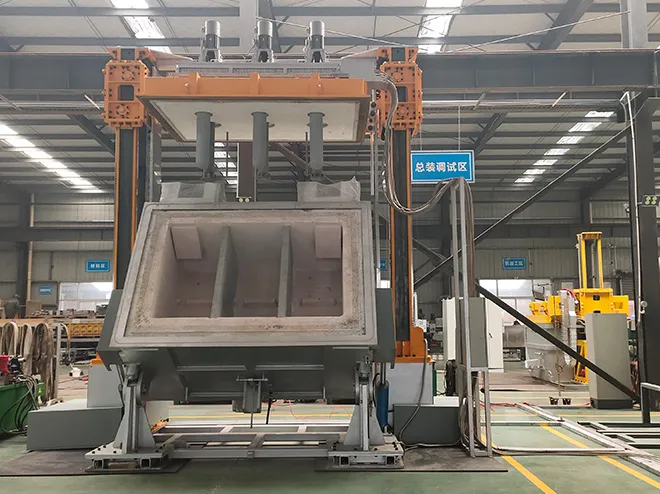
Porous plug technology works by embedding a ceramic plug with microscopic interconnected channels into the base or side wall of a treatment chamber the metal flows through on its way to the casting machine. Inert gas pumped through the plug emerges as an extremely fine, uniform curtain of bubbles that the flowing metal passes through continuously. Because the metal is moving rather than sitting static, this method treats large volumes without requiring a dedicated batch treatment cycle, which is exactly why high-volume producers favor it.
The key advantage here is consistency. Every unit of metal passing through the treatment chamber gets essentially identical exposure to the degassing bubbles, removing the batch-to-batch variability that can creep into manual lance or even rotary impeller treatment if operator technique varies.
| Inline System Feature | Benefit |
|---|---|
| Continuous flow treatment | No production stoppage for batch degassing |
| Uniform bubble distribution via porous plug | Consistent hydrogen removal across every batch |
| Integrated filtration combination | Often paired with ceramic foam filters for inclusion removal |
| Automated gas flow control | Reduces reliance on manual operator adjustment |
| Smaller footprint than rotary units | Fits into tight production line layouts |
The tradeoff is upfront capital cost and the complexity of integrating this equipment into an existing production line. Retrofitting inline degassing into a plant not originally designed for it often costs more than the equipment itself once you factor in trough redesign and installation downtime.
Lance Degassing and Its Limitations
Lance degassing represents the simplest and oldest method still in active use, particularly among smaller foundries and job shops that can’t justify the capital cost of rotary or inline systems. A metal or ceramic lance with holes drilled along its length gets submerged into the melt, and inert gas flows through under pressure, bubbling up through the metal.
The obvious limitation is bubble size. Without mechanical shearing action like a rotary impeller provides, lance-generated bubbles tend to be significantly larger, which means less total surface area for hydrogen diffusion and faster bubble rise time through the melt, giving hydrogen less opportunity to transfer before the bubble escapes at the surface. This translates to lower overall efficiency and longer treatment times to achieve comparable hydrogen removal.
Lance degassing still has legitimate use cases though. For smaller batch sizes, occasional touch-up treatment, or operations where capital budget genuinely doesn’t support more sophisticated equipment, a well-operated lance system combined with good furnace hygiene practices can produce acceptable results for less demanding casting applications.
| Lance Degassing Consideration | Detail |
|---|---|
| Typical bubble diameter | 5mm to 15mm (versus under 1mm for rotary systems) |
| Treatment time for standard batch | 15 to 30 minutes |
| Capital cost relative to rotary system | Roughly 20% to 30% of equivalent rotary equipment |
| Best application | Small batch, low-volume, budget-constrained operations |
| Common failure point | Lance clogging, uneven gas distribution near tip |
Flux Tablet and Fluxing Agent Degassing
Some foundries use solid flux tablets or granular fluxing compounds that release gas through a chemical reaction when submerged into molten aluminum, typically hexachloroethane-based tablets in older operations, though environmental regulations have pushed the industry heavily toward inert gas methods instead.
The chemical reaction releases chlorine or other reactive gases that bubble through the melt similarly to injected inert gas, carrying dissolved hydrogen to the surface. While this method requires no specialized equipment beyond a plunging tool, it comes with meaningful downsides. Chlorine-releasing tablets create fume emissions that most modern environmental regulations restrict heavily, and the reaction is harder to control precisely compared to metered gas flow through a rotary or lance system.
We rarely recommend chlorine-based flux tablets to clients anymore, not just for regulatory reasons but because the efficiency simply doesn’t compete with modern inert gas methods, and the fume handling requirements often cost more in ventilation infrastructure than switching to a proper rotary degassing unit would in the first place.
Vacuum Degassing for High-Purity Applications
Aerospace and other high-integrity casting applications sometimes require degassing performance beyond what atmospheric pressure methods can achieve. Vacuum degassing places the molten aluminum in a sealed chamber where pressure is reduced significantly below atmospheric level, which lowers hydrogen’s solubility limit dramatically and drives dissolved gas out of solution even without bubble injection, though many vacuum systems combine reduced pressure with simultaneous inert gas purging for maximum effect.
This method achieves the highest hydrogen removal percentages of any technique but comes with substantial equipment cost, slower processing time, and batch size limitations based on chamber capacity. Most standard foundries producing general automotive or industrial castings don’t need vacuum degassing, but producers supplying aerospace structural components or medical device castings often have specifications that essentially require it.
| Vacuum Degassing Characteristic | Detail |
|---|---|
| Typical hydrogen reduction | 90% to 95%+ |
| Processing time per batch | 20 to 45 minutes depending on chamber size |
| Capital investment level | High, often 3-5x rotary impeller system cost |
| Common industry application | Aerospace, defense, medical device castings |
| Batch size limitation | Constrained by chamber volume, less flexible than inline systems |
Choosing the Right Gas for Degassing
Gas selection matters as much as equipment choice, and this is a detail we find gets glossed over in a lot of introductory material on this topic.
Nitrogen has traditionally been the most common choice due to low cost and wide availability, and it performs adequately for many general-purpose aluminum casting applications. However, nitrogen has a notable limitation: it has some solubility in molten aluminum, meaning at very low hydrogen concentrations, nitrogen itself can start contributing marginally to porosity rather than purely removing hydrogen, which sets a practical floor on how low nitrogen-based degassing can push hydrogen content.
Argon, being fully inert with essentially zero solubility in aluminum, provides more consistent and often superior degassing results, particularly when very low final hydrogen levels are the target. Argon costs more than nitrogen, which is the main reason it isn’t universally used, but for high-specification castings the performance difference justifies the added expense.
Also Read: How to Reduce Porosity in Aluminium Casting?
Some operations use blended gas mixtures, combining small percentages of chlorine or other reactive gases with the primary inert carrier gas to enhance oxide film removal alongside hydrogen extraction, though this circles back into the environmental and fume handling considerations mentioned with flux tablets.
| Gas Type | Relative Cost | Hydrogen Removal Effectiveness | Notes |
|---|---|---|---|
| Nitrogen | Low | Good | Slight solubility limits ultra-low hydrogen targets |
| Argon | Moderate to high | Excellent | Fully inert, preferred for high-spec castings |
| Nitrogen-chlorine blend | Moderate | Very good | Enhanced oxide removal, requires fume control |
| Argon-chlorine blend | High | Excellent | Best overall performance, highest cost and regulatory burden |
Measuring Hydrogen Content Before and After Degassing
None of this matters without a reliable way to confirm degassing actually worked, and this is where a surprising number of smaller foundries fall short. Visual inspection of a fracture surface tells you almost nothing reliable about dissolved hydrogen content, yet we still encounter shops relying purely on experience and “it looks fine” judgments.
The reduced pressure test remains the most widely used practical shop-floor method. A small metal sample solidifies under vacuum conditions, exaggerating any porosity that dissolved hydrogen would create, and the resulting sample gets compared visually or by density measurement against reference standards. It’s inexpensive and fast, though somewhat subjective depending on operator experience interpreting the results.
More precise instrumental methods have become standard in larger operations. First bubble tests, thermal conductivity-based hydrogen analyzers, and dedicated hydrogen measurement probes that give a direct reading in milliliters of hydrogen per hundred grams of aluminum provide quantifiable, repeatable data that a reduced pressure test simply can’t match.
| Measurement Method | Speed | Precision | Typical Cost |
|---|---|---|---|
| Reduced pressure test | Fast (10-15 min including solidification) | Moderate, somewhat subjective | Low |
| Density index calculation | Fast | Moderate | Low |
| First bubble test | Moderate | Good | Moderate |
| Thermal conductivity hydrogen analyzer | Fast (2-5 min) | High, quantitative | High |
| Telegas or similar in-situ probe | Very fast (real-time) | Very high | Very high |
We tell every client the same thing: whatever method you choose, the value comes from consistency and trend tracking over time, not from a single reading. A foundry checking hydrogen content once a shift and logging it against production data builds a dataset that catches drift in furnace conditions, gas supply problems, or equipment wear long before it turns into a batch of scrapped castings.
Equipment Comparison for Buyers
Buyers evaluating degassing equipment purchases need to weigh several factors beyond the headline efficiency numbers.
| Equipment Type | Approximate Capital Cost Range | Maintenance Complexity | Consumable Costs |
|---|---|---|---|
| Lance system | Low ($2,000-$8,000) | Low | Gas, occasional lance replacement |
| Rotary impeller unit | Moderate ($15,000-$60,000) | Moderate, shaft/impeller wear parts | Gas, graphite impeller replacement |
| Inline porous plug system | High ($50,000-$200,000+) | Moderate, plug replacement scheduling | Gas, periodic plug replacement |
| Vacuum degassing chamber | Very high ($150,000-$500,000+) | High, seals and pumps | Gas, vacuum pump maintenance |
Beyond sticker price, buyers should ask suppliers about impeller or plug replacement frequency under their specific production volume, since consumable wear parts can add meaningfully to total cost of ownership over a few years of operation. Shaft and impeller life in a rotary system typically ranges from a few weeks to a few months depending on melt temperature, alloy composition, and rotation speed, and budgeting for this replacement cycle upfront prevents unpleasant surprises after purchase.
Common Mistakes That Reduce Degassing Efficiency
We’ve walked into more than a few foundries where expensive degassing equipment sat underperforming simply due to operational habits rather than equipment failure.
Running gas flow rate too high seems intuitive as a way to speed up treatment, but excessive flow actually creates larger bubbles through coalescence, reducing total surface area and cutting efficiency rather than improving it. There’s a sweet spot for flow rate specific to each equipment design that operators need to dial in rather than assuming more gas equals better results.
Insufficient treatment time driven by production pressure to move faster is probably the most common shortfall we encounter. Operators under pressure to hit throughput targets sometimes cut treatment cycles short, and the hydrogen reduction curve isn’t linear, the last portion of gas removal often takes disproportionately longer than the initial reduction, meaning a rushed cycle can leave significant residual hydrogen despite looking similar to a properly completed one on the surface.
Worn or damaged impellers lose their fine bubble dispersion capability as graphite erodes and gas exit ports enlarge over time, yet operators sometimes keep running degraded impellers well past their effective service life to avoid replacement cost and downtime.
Poor furnace hygiene upstream of degassing, meaning wet scrap, damp tools, or contaminated charge material, can introduce hydrogen faster than even a well-functioning degassing unit can remove it, essentially fighting a losing battle against continuous contamination.
| Mistake | Consequence | Correction |
|---|---|---|
| Excessive gas flow rate | Larger bubbles, reduced efficiency | Follow manufacturer-specified flow range |
| Shortened treatment cycles | Incomplete hydrogen removal | Match cycle time to actual measured hydrogen reduction curve |
| Worn impeller components | Poor bubble dispersion | Establish and follow replacement schedule |
| Wet or contaminated charge material | Continuous hydrogen reintroduction | Improve scrap storage and preheating practices |
| Inconsistent measurement practice | Undetected process drift | Implement regular hydrogen testing schedule |
Cost Considerations and Return on Investment
Foundry managers evaluating whether to upgrade degassing equipment often focus purely on purchase price without calculating the defect cost savings that justify the investment. We’ve found it useful to walk through a simplified comparison when advising clients on this decision.
Consider a foundry currently running lance degassing with a 12% scrap rate attributable to porosity-related rejections. Upgrading to a rotary impeller system might realistically cut that porosity-driven scrap rate to 3% or 4%, and depending on production volume and part value, the material and labor savings from that scrap reduction alone often pays back the equipment cost within twelve to eighteen months, sometimes faster for high-value castings.
| Cost Factor | Lance System | Rotary Impeller System |
|---|---|---|
| Initial equipment investment | Lower | Moderate to high |
| Typical porosity-related scrap rate | 8% to 15% | 2% to 5% |
| Labor time per batch treatment | Higher (longer cycles) | Lower (faster, more consistent) |
| Gas consumption efficiency | Lower per unit hydrogen removed | Higher |
| Long-term cost per good casting produced | Often higher due to scrap | Often lower despite higher upfront cost |
This kind of calculation is exactly what we walk procurement teams through before they sign off on capital equipment requests, because the conversation shifts entirely once scrap cost, labor time, and customer rejection penalties enter the picture rather than looking at equipment price in isolation.
Frequently Asked Questions
How long does aluminum degassing typically take?
Treatment time depends heavily on method and batch size. Lance degassing generally takes 15 to 30 minutes for a standard batch, while rotary impeller systems achieve comparable or better hydrogen reduction in 5 to 15 minutes due to more efficient bubble dispersion.
What is the acceptable hydrogen level in molten aluminum before casting?
Acceptable levels vary by application, but general industry targets fall between 0.1 and 0.2 milliliters of hydrogen per hundred grams of aluminum for most commercial castings, with high-integrity aerospace applications often requiring levels below 0.1.
Can nitrogen fully replace argon for degassing purposes?
Nitrogen works adequately for most general casting applications and costs significantly less than argon. For applications requiring very low final hydrogen content, argon typically outperforms nitrogen due to its complete inertness and zero solubility in molten aluminum.
Does degassing remove oxide inclusions as well as hydrogen?
Degassing primarily targets dissolved hydrogen, though the bubbling action does help float some oxide inclusions to the surface. Most foundries pair degassing with separate filtration, typically ceramic foam filters, to address inclusion removal more thoroughly.
How often should impeller components be replaced in a rotary degassing unit?
Replacement frequency depends on melt temperature, rotation speed, and production volume, but graphite impellers commonly need replacement every few weeks to a few months of continuous operation. Regular visual inspection catches erosion before performance drops significantly.
Is vacuum degassing necessary for automotive aluminum castings?
Most automotive applications don’t require vacuum degassing, since rotary impeller or inline systems provide sufficient hydrogen reduction for standard structural and engine components. Vacuum degassing is generally reserved for aerospace or specialty high-integrity applications with stricter porosity tolerances.
What causes inconsistent degassing results between batches?
Common causes include variable gas flow rates, inconsistent treatment time, worn equipment components, and fluctuating moisture content in charge material. Establishing standardized procedures and regular hydrogen measurement helps identify and correct sources of variability.
Can flux tablets alone provide adequate degassing without gas injection equipment?
Flux tablets can provide modest hydrogen reduction, typically 30% to 50%, but generally underperform compared to inert gas injection methods. Regulatory restrictions on chlorine-releasing tablets have also pushed most modern foundries toward gas-based methods.
How do I know if my current degassing process needs improvement?
Tracking porosity-related scrap rates over time is the most direct indicator. If rejection rates for gas porosity remain persistently high despite regular degassing, measuring actual hydrogen content before and after treatment will reveal whether the process is achieving adequate reduction.
Does ambient humidity really affect how much degassing a foundry needs?
Yes, foundries operating in humid climates or during rainy seasons often see increased hydrogen pickup from atmospheric moisture and damp charge material, which can require adjusted treatment times or more frequent monitoring compared to drier operating environments.
Closing Thoughts From Our Experience
Degassing molten aluminum sits at an odd intersection in foundry operations. Everyone acknowledges it matters, yet the actual execution quality varies enormously from one plant floor to another, often more due to operational discipline than equipment capability. We’ve watched foundries with modest lance systems outperform others running expensive rotary units, purely because the team with simpler equipment measured consistently, replaced consumables on schedule, and maintained good furnace hygiene practices upstream.
If there’s one takeaway worth carrying forward from everything covered here, it’s that equipment choice matters less than most buyers initially assume, and process discipline matters more. Choose degassing equipment appropriate to your production volume and quality requirements, but invest equally in measurement practices and operator training, because even the best rotary impeller system will underperform in the hands of an operator rushing treatment cycles to hit a production number.