

AdTech is an ISO 9001 certified ceramic foam filter manufacturer producing alumina (Al₂O₃), silicon carbide (SiC), and zirconia (ZrO₂) filters in standard pore sizes from 10 PPI to 60 PPI, covering filtration applications for aluminum alloy casting, cast iron, steel, and copper alloy foundries — with filter dimensions ranging from 40×40mm to 600×600mm and custom sizes available, offering wholesale pricing from USD 0.80 to USD 45 per piece depending on material type, size, and pore density, backed by full ISO 9001:2015 quality management certification and third-party tested performance documentation that satisfies the sourcing requirements of foundry engineers, metallurgists, and casting procurement teams worldwide.
If your project requires the use of Ceramic Foam Filter, you can contact us for a free quote.
At AdTech, we manufacture ceramic foam filters daily and ship them to foundries across six continents. The questions we receive most consistently from engineers and procurement managers fall into predictable categories: which filter material is right for a specific metal, what pore size achieves the cleanliness target without causing premature blockage, how dimensional tolerances affect filter seating in existing filter boxes, and what ISO 9001 certification actually means in practice for a ceramic foam filter supplier.
What Is a Ceramic Foam Filter and How Does It Remove Inclusions from Molten Metal
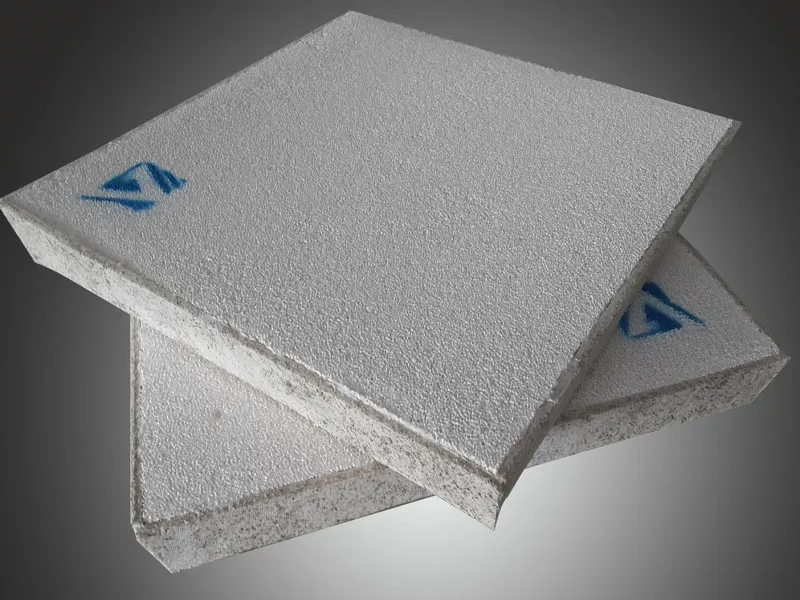
A ceramic foam filter is a three-dimensional, open-cell porous ceramic structure through which molten metal flows during casting. The filter captures non-metallic inclusions — oxide films, slag particles, refractory fragments, and other solid contaminants — that would otherwise become embedded in the solidified casting, causing surface defects, internal porosity, reduced mechanical strength, and machining problems.
The filtration mechanism is not simple mechanical sieving. Molten metal inclusions range from particles larger than the filter pore opening (captured by direct interception) down to sub-micron particles far smaller than any practical pore size (captured by inertial impaction and adhesion to filter strut surfaces). This multi-mechanism filtration makes ceramic foam filters significantly more effective than metal mesh screens or ceramic particle bed filters that rely purely on size exclusion.
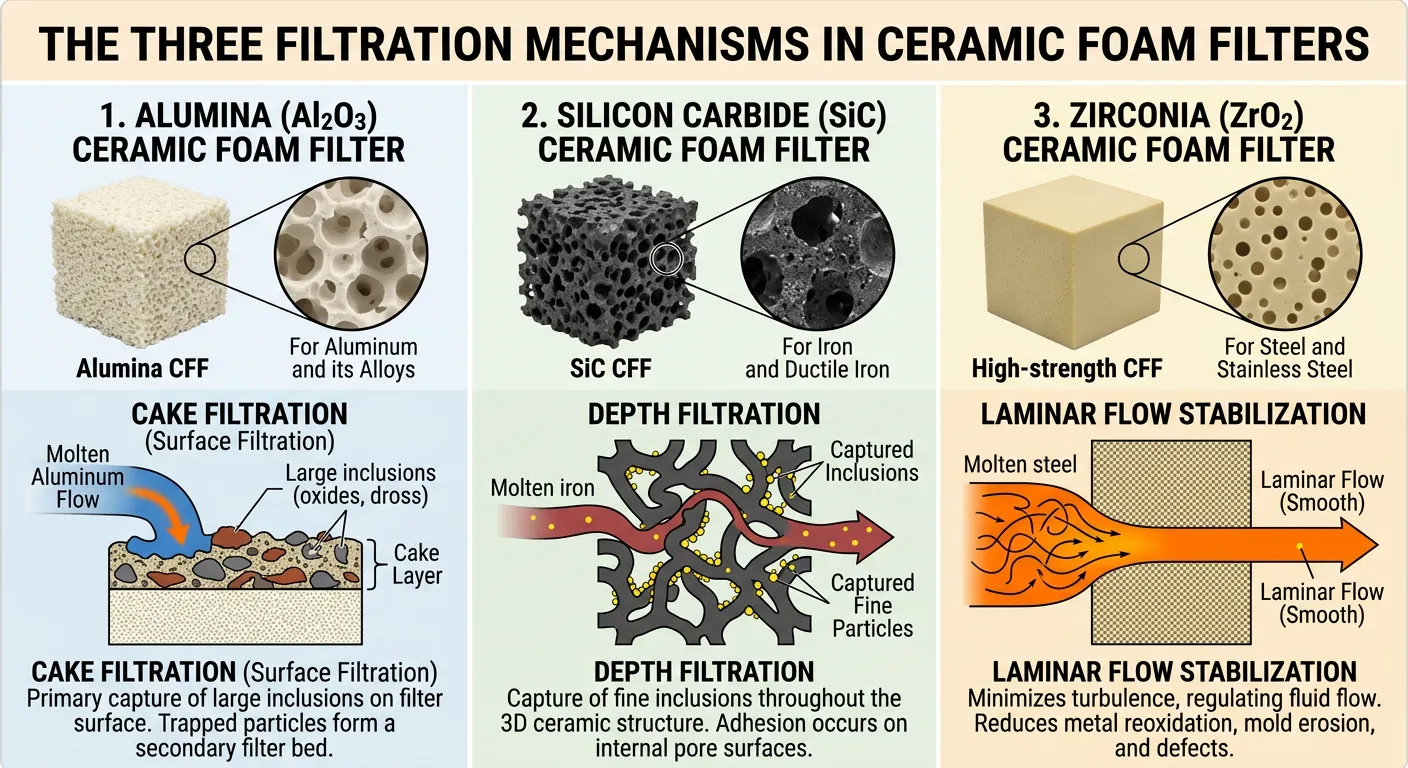
The Three Filtration Mechanisms in Ceramic Foam Filters
Direct interception (sieving): Inclusions larger than the constriction diameter at pore windows are physically blocked. For a 30 PPI filter (approximately 0.5–0.6mm mean pore diameter), particles larger than ~0.4mm are captured by direct interception.
Inertial impaction: As molten metal follows tortuous flow paths through the foam structure, heavier inclusion particles cannot change direction as rapidly as the liquid metal. They continue in a straight line and impact the ceramic strut surfaces, where they are captured by adhesion.
Surface adhesion (ceramic-to-inclusion bonding): This is the mechanism responsible for capturing the finest inclusions. Oxide films and fine particles adhere to the wetted ceramic strut surfaces through surface energy interactions. The large specific surface area of ceramic foam (typically 200–600 m²/m³ depending on PPI rating) provides extensive adhesion sites.
The combined effect of these three mechanisms explains why a well-selected ceramic foam filter removes 70–95% of inclusions by count from aluminum alloy melts — a performance level that no mechanical screen or alternative filtration approach achieves in practical foundry conditions.
Why Inclusion Removal Matters in Metal Casting
The commercial justification for ceramic foam filter investment is straightforward:
- Reduced scrap rate: Inclusions are among the top three causes of casting rejection in aluminum and iron foundries. Consistent filtration directly reduces scrap.
- Improved machined surface quality: Inclusions at or near the casting surface cause tool marks, pitting, and surface finish failures during machining.
- Enhanced mechanical properties: Oxide bifilms in aluminum castings reduce elongation and fatigue life by providing internal crack initiation sites.
- Consistent mold filling: Turbulence-damping effect of ceramic foam filters produces calmer metal flow, reducing secondary oxide formation during filling.
- Extended tooling life: Cleaner metal reduces abrasive wear on die casting tooling and permanent molds.
Three Core Materials: Alumina, Silicon Carbide, and Zirconia Ceramic Foam Filters
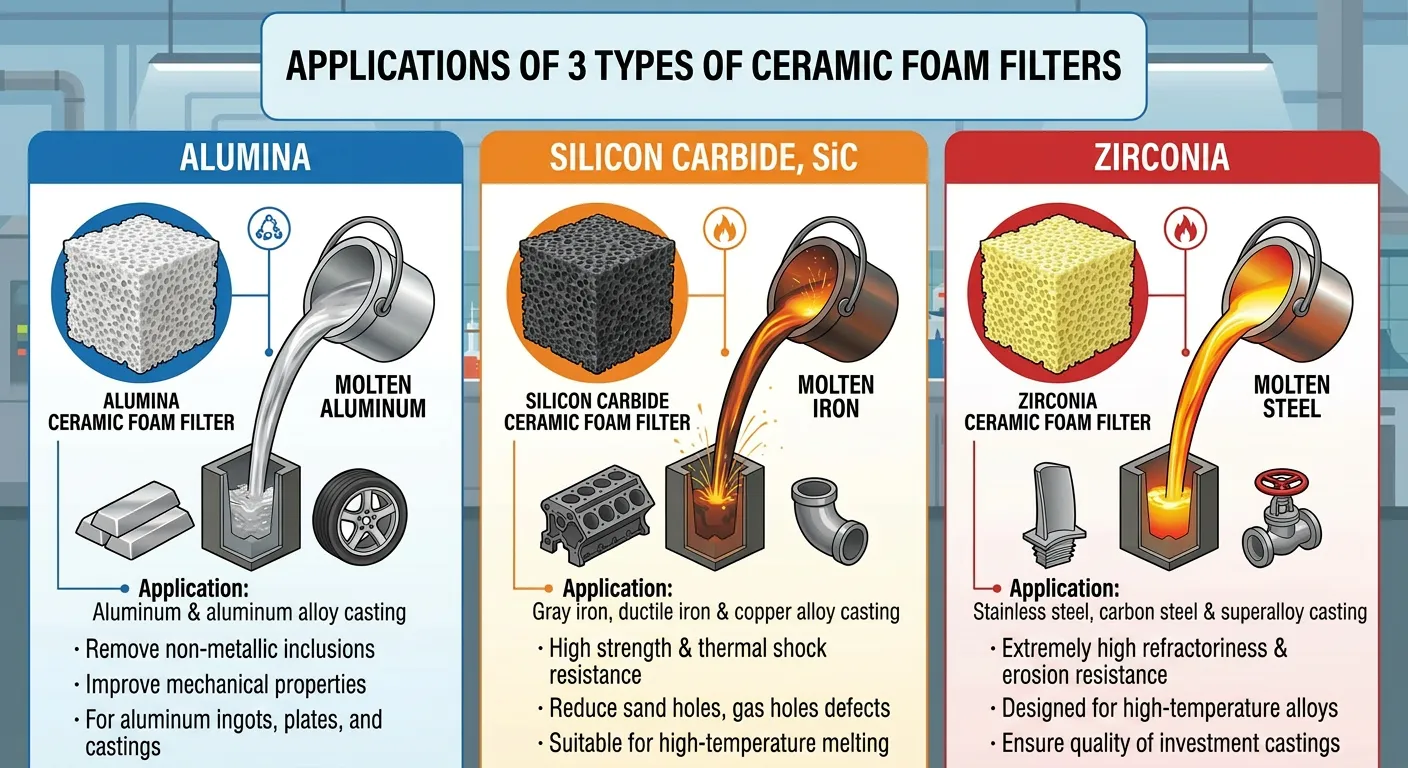
The choice of ceramic material determines the filter’s maximum service temperature, chemical compatibility with the molten metal being filtered, thermal shock resistance, and cost. At AdTech, we produce all three material types in our manufacturing facility, and we see consistent patterns in which material foundry engineers select for specific applications.
Material Selection Overview Table
| Property | Alumina (Al₂O₃) | Silicon Carbide (SiC) | Zirconia (ZrO₂) |
|---|---|---|---|
| Maximum Service Temperature | 1200°C (2192°F) | 1500°C (2732°F) | 1700°C (3092°F) |
| Primary Applications | Aluminum alloys | Cast iron, copper alloys | Steel, high-temp alloys |
| Chemical Compatibility | Neutral to Al melts | Good with Fe, Cu, Mg | Excellent with steel |
| Thermal Shock Resistance | Good | Excellent | Moderate |
| Compressive Strength | Medium | High | High |
| Porosity Range | 80–90% | 75–85% | 75–85% |
| Relative Cost | Lowest | Medium | Highest |
| Pore Size Range (PPI) | 10–60 PPI | 10–30 PPI | 10–30 PPI |
| Color (standard) | White / off-white | Gray / dark gray | White / cream |
| ISO 9001 Production | Yes (AdTech) | Yes (AdTech) | Yes (AdTech) |
Alumina Ceramic Foam Filters (Al₂O₃)
Alumina ceramic foam filters are manufactured from high-purity aluminum oxide (Al₂O₃ content typically 95–99%), making them chemically inert to aluminum alloy melts. This chemical compatibility is the defining advantage — alumina does not react with molten aluminum, does not introduce metallic contamination, and maintains structural integrity throughout the casting cycle.
The alumina filter’s open-cell foam structure is created through a reticulated polymer foam impregnation process: a polyurethane foam template is coated with alumina ceramic slurry, dried, and fired at 1400–1600°C. During firing, the organic foam burns out, leaving behind the rigid ceramic strut network that defines the filter’s three-dimensional pore structure.
Alumina filter chemistry: Al₂O₃ > 95%, with small additions of silica (SiO₂), magnesia (MgO), and sintering aids to optimize strength and densification. High-purity grades (Al₂O₃ > 99%) are available for applications where even trace silica contamination is unacceptable.
Silicon Carbide Ceramic Foam Filters (SiC)
Silicon carbide ceramic foam filters are manufactured from SiC powder with oxide binders (typically alumina or silica). The SiC matrix provides exceptional thermal shock resistance — the defining advantage of this material type. Molten iron at 1350–1480°C creates a significantly more severe thermal shock environment than aluminum casting, and the SiC filter’s low thermal expansion coefficient (approximately 4.5 × 10⁻⁶/°C versus alumina’s 8 × 10⁻⁶/°C) provides superior resistance to cracking during rapid heating.
SiC filters are gray to dark gray in color, which sometimes leads foundry personnel to confuse them with carbon-based materials. The color comes from the SiC itself — there is no carbon addition in standard SiC ceramic foam filters.
SiC filter chemistry: SiC content typically 70–80%, with Al₂O₃ or SiO₂ binder at 15–25%, plus processing additives. Some high-strength grades incorporate mullite (3Al₂O₃·2SiO₂) formation during firing to improve structural integrity.
Zirconia Ceramic Foam Filters (ZrO₂)
Zirconia ceramic foam filters represent the highest performance tier in the ceramic foam filter range. Zirconia (ZrO₂) has a melting point of 2715°C — far above any practical casting temperature — making ZrO₂ filters suitable for steel casting at 1550–1650°C and other ultra-high temperature applications where alumina and SiC filters cannot survive.
Zirconia undergoes a phase transformation between monoclinic and tetragonal crystal structures at approximately 1170°C, accompanied by a volume change that would cause catastrophic cracking in pure ZrO₂. Commercial zirconia filters use stabilized zirconia — typically partially stabilized with yttria (Y₂O₃) or magnesia (MgO) — to suppress this transformation and maintain dimensional stability through multiple thermal cycles.
ZrO₂ filter chemistry: ZrO₂ content typically 85–92%, with 5–8% Y₂O₃ or MgO stabilizer, plus small amounts of Al₂O₃ and processing additives.
Pore Size Selection: PPI Rating System and Filtration Efficiency Data
Understanding the PPI (Pores Per Inch) Rating System
Ceramic foam filter pore density is expressed in PPI — pores per linear inch measured across the filter face. This rating system was established by the polyurethane foam template industry and has been adopted universally for ceramic foam filters. The PPI rating corresponds inversely to pore size: lower PPI means larger pores, less flow resistance, and coarser filtration; higher PPI means smaller pores, greater flow resistance, and finer filtration.
PPI Rating to Pore Dimension Conversion
| PPI Rating | Mean Pore Diameter | Flow Resistance | Filtration Capability | Typical Application |
|---|---|---|---|---|
| 10 PPI | 2.5–3.0 mm | Very Low | Coarse inclusions only | Heavy section iron castings; high flow rate |
| 20 PPI | 1.2–1.5 mm | Low | Medium inclusions | Standard iron castings; aluminum large sections |
| 25 PPI | 0.9–1.2 mm | Low-Medium | Medium-fine inclusions | General aluminum casting |
| 30 PPI | 0.65–0.9 mm | Medium | Fine inclusions | Precision aluminum; standard copper alloy |
| 40 PPI | 0.45–0.65 mm | Medium-High | Very fine inclusions | High-quality aluminum alloy; automotive parts |
| 50 PPI | 0.30–0.45 mm | High | Ultra-fine inclusions | Aerospace aluminum; critical iron castings |
| 60 PPI | 0.20–0.30 mm | Very High | Finest filtration | Medical, aerospace, ultra-critical applications |
Filtration Efficiency by PPI Rating
The following data represents typical inclusion removal efficiency measured by K-mold or Prefil-Footprinter analysis on aluminum alloy A356 at standard casting temperature:
| PPI Rating | Inclusion Removal Efficiency (by count) | Effect on Metal Velocity | Risk of Premature Blockage |
|---|---|---|---|
| 10 PPI | 40–55% | Minimal velocity reduction | Very Low |
| 20 PPI | 55–70% | ~5–10% velocity reduction | Low |
| 30 PPI | 70–82% | ~10–20% velocity reduction | Low-Medium |
| 40 PPI | 82–91% | ~20–35% velocity reduction | Medium |
| 50 PPI | 88–95% | ~35–55% velocity reduction | Medium-High |
| 60 PPI | 92–97% | ~55–75% velocity reduction | High |
PPI Selection Logic: The Flow Rate vs. Cleanliness Trade-off
The fundamental trade-off in PPI selection is between filtration efficiency and flow resistance. Every foundry engineer has seen what happens when this balance is wrong:
Too fine (over-specified PPI): The filter blocks prematurely before the mold cavity fills. The result is a misrun — a partially filled casting that is 100% scrap. No cleanliness benefit is achieved if the casting never fills completely.
Too coarse (under-specified PPI): The filter passes inclusions that cause downstream quality failures. The casting fills completely but is rejected for inclusions during inspection or machining — wasted casting cost plus scrap.
The correct approach to PPI selection requires knowing: (1) the metal cleanliness level entering the filter (dirty melts with high inclusion loads require coarser PPI to avoid premature blockage), (2) the casting section thickness and total volume (which determine flow rate requirements), and (3) the quality specification for the finished casting (aerospace tolerates less inclusion loading than agricultural equipment).
Our standard PPI recommendations by application:
| Casting Application | Recommended PPI (Alumina) | Recommended PPI (SiC) |
|---|---|---|
| Automotive aluminum wheels | 30–40 PPI | N/A |
| Aerospace aluminum structural | 40–50 PPI | N/A |
| Aluminum cylinder heads | 30–40 PPI | N/A |
| General gray iron castings | N/A | 10–20 PPI |
| Ductile iron automotive | N/A | 20–30 PPI |
| Bronze/brass valve bodies | N/A | 20–30 PPI |
| Steel investment casting | N/A | N/A (ZrO₂: 10–20 PPI) |
| Copper electrical components | N/A | 30 PPI |
Technical Specifications: Dimensions, Tolerances, Porosity, and Physical Properties
Standard Dimensional Ranges for Ceramic Foam Filters
AdTech manufactures ceramic foam filters in the following standard size ranges. Custom dimensions beyond these ranges are available with minimum order quantities.
Square filters (most common format):
| Size (mm) | Thickness Options | Weight (30 PPI, g) | Applications |
|---|---|---|---|
| 40 × 40 | 15mm, 22mm | 25–45 | Small non-ferrous castings |
| 50 × 50 | 15mm, 22mm | 38–65 | Small aluminum castings |
| 75 × 75 | 22mm, 30mm | 85–145 | Medium aluminum castings |
| 100 × 100 | 22mm, 30mm | 150–260 | Standard aluminum, iron |
| 150 × 150 | 22mm, 30mm, 40mm | 340–580 | Large aluminum, iron castings |
| 200 × 200 | 30mm, 40mm, 50mm | 600–1,050 | Heavy section castings |
| 250 × 250 | 40mm, 50mm | 950–1,650 | Large iron, automotive block |
| 300 × 300 | 40mm, 50mm | 1,400–2,400 | Very large castings |
| 380 × 380 | 50mm | 2,250–3,900 | Large industrial castings |
| 430 × 430 | 50mm | 2,900–4,900 | Extra-large applications |
| 584 × 584 | 50mm | 5,300–8,900 | Maximum standard size |
Round filters (less common but stocked):
| Diameter (mm) | Thickness | Common Application |
|---|---|---|
| 40mm diameter | 15mm | Small die casting gates |
| 60mm diameter | 22mm | Medium non-ferrous |
| 80mm diameter | 22mm | Standard non-ferrous |
| 100mm diameter | 22mm, 30mm | Aluminum casting gates |
| 150mm diameter | 30mm | Medium iron castings |
| 200mm diameter | 40mm | Large castings |
Dimensional Tolerances (Standard Production)
| Dimension | Standard Tolerance | Tight Tolerance (available on request) |
|---|---|---|
| Length / Width | ±2mm | ±1mm |
| Thickness | ±1.5mm | ±1mm |
| Squareness (diagonal difference) | ≤2mm | ≤1mm |
| Flatness (bow/warp) | ≤1.5mm | ≤0.8mm |
| Porosity (measured) | ±3 PPI from nominal | ±2 PPI from nominal |
Physical Property Specifications
| Property | Alumina (Al₂O₃) | Silicon Carbide (SiC) | Zirconia (ZrO₂) | Test Method |
|---|---|---|---|---|
| Al₂O₃ / SiC / ZrO₂ content | >95% | >70% SiC | >85% ZrO₂ | XRF analysis |
| Open porosity | 80–90% | 75–85% | 75–85% | Archimedes method |
| Bulk density | 0.30–0.50 g/cm³ | 0.45–0.65 g/cm³ | 0.55–0.75 g/cm³ | ASTM C134 |
| Compressive strength | 0.4–0.9 MPa | 0.6–1.2 MPa | 0.8–1.4 MPa | ASTM C773 |
| Flexural strength | 0.3–0.7 MPa | 0.5–1.0 MPa | 0.6–1.1 MPa | ASTM C674 |
| Max service temperature | 1200°C | 1500°C | 1700°C | Manufacturer test |
| Thermal shock resistance | ≥5 cycles (900°C→water) | ≥8 cycles | ≥5 cycles | Internal test |
| Specific surface area | 200–600 m²/m³ | 180–500 m²/m³ | 180–500 m²/m³ | BET method |
| Mean pore diameter (30 PPI) | 0.65–0.9 mm | 0.65–0.9 mm | 0.65–0.9 mm | Image analysis |
ISO 9001 Certification: What It Means for Ceramic Foam Filter Quality Assurance
Why ISO 9001 Matters Specifically for Ceramic Foam Filter Manufacturing
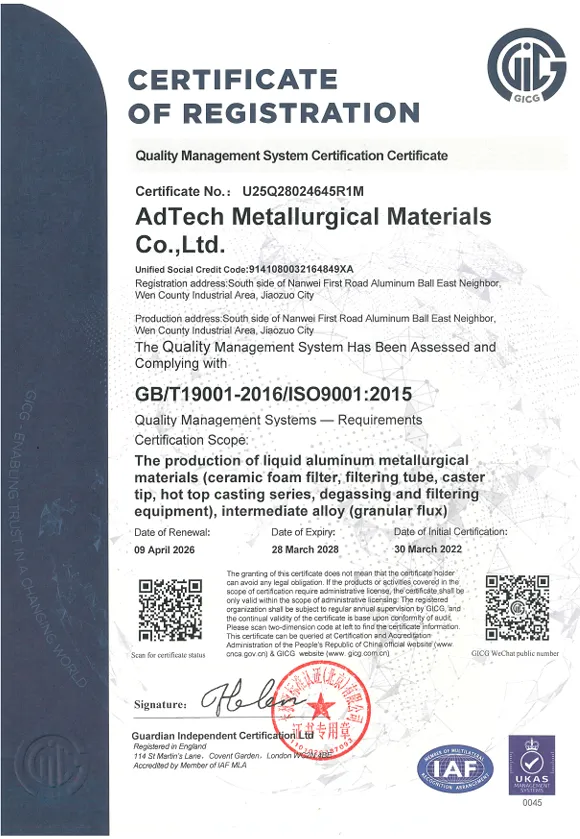
AdTech holds ISO 9001:2015 certification for its ceramic foam filter manufacturing operations. We are frequently asked by procurement teams what this means in practical terms — and this is a fair question, because ISO 9001 certification alone does not guarantee product performance. What it does guarantee, when properly implemented, is a systematic quality management framework that reduces variability and ensures documented control over every production variable.
For ceramic foam filter manufacturing specifically, the variables that ISO 9001 disciplines into controlled processes include:
Raw material qualification: ISO 9001 requires documented incoming material inspection. For alumina filters, this means verifying Al₂O₃ purity, particle size distribution, and specific surface area of the alumina powder before it enters production. For SiC filters, it means verifying SiC content and oxide binder chemistry. Without this control, a single batch of off-specification raw material can produce an entire production lot of undersized filters that fail prematurely in the foundry.
Slurry preparation control: The ceramic slurry used to impregnate the polyurethane foam template must be prepared to tight viscosity, solid content, and pH specifications. ISO 9001 requires documented slurry preparation procedures with process controls at each step, including viscosity measurement and correction before foam impregnation begins.
Firing curve control: The sintering furnace firing profile (heating rate, peak temperature, hold time, cooling rate) critically determines final filter strength, porosity, and dimensional stability. ISO 9001 requires documented firing curves, calibrated furnace temperature recording, and systematic review of firing data against product specifications.
Finished product inspection: ISO 9001 mandates documented inspection plans with defined acceptance criteria, sampling frequencies, and traceability of inspection results to specific production lots. Our finished product inspection includes dimensional measurement, visual inspection, compressive strength testing by lot sampling, and porosity verification.
ISO 9001 vs. Non-Certified Suppliers: What Buyers Should Know
The ceramic foam filter market, particularly Chinese-origin product, includes many manufacturers who claim quality management systems without holding genuine third-party certification. The practical difference between a certified and uncertified supplier:
| Quality Aspect | ISO 9001 Certified Manufacturer | Non-Certified Manufacturer |
|---|---|---|
| Raw material traceability | Documented to batch level | Variable; often undocumented |
| Process control records | Maintained per ISO requirements | Inconsistent or absent |
| Non-conformance management | Formal NCR system; root cause analysis | Ad-hoc or reactive |
| Customer complaint process | Documented response procedure | Variable response |
| Calibration records | All measuring equipment calibrated | Often uncalibrated |
| Audit trail | Internal + third-party audits | None |
| Product consistency batch-to-batch | High (controlled processes) | Variable |
| Corrective action system | Systematic CAPA process | Informal |
Our ISO 9001 Certification Scope and Renewal
AdTech’s ISO 9001:2015 certificate covers the design, manufacture, and supply of ceramic foam filters including alumina, silicon carbide, and zirconia grades. The certification is maintained through annual surveillance audits by an accredited third-party certification body and full recertification audits every three years. Certificate copies with accreditation body details are available upon request for procurement qualification purposes.
Alumina Ceramic Foam Filters: Aluminum Alloy Casting Applications
Why Alumina Is the Universal Choice for Aluminum Filtration
The pairing of alumina filters with aluminum alloy casting is not coincidental — it is chemically logical. Molten aluminum readily reduces many oxide materials, attacking filter materials that contain reducible oxides. Alumina (Al₂O₃) is already fully oxidized aluminum; there is no thermodynamic driving force for molten aluminum to attack an alumina filter surface. This chemical stability is why alumina foam filters maintain structural integrity through the entire aluminum casting cycle.
Aluminum Alloy Applications and Filter Specifications
Automotive aluminum wheels (A356, A357 alloys):
These safety-critical castings require consistent mechanical properties, particularly elongation and fatigue life, which are dramatically affected by oxide bifilm inclusions. Standard specification: 30 PPI alumina filter, 150×150×22mm or 200×200×30mm for typical wheel casting gating systems. Many automotive foundries have upgraded to 40 PPI following OEM customer pressure for improved fatigue life data.
Aluminum cylinder heads and engine blocks:
Complex geometry, multiple thin-section flow paths, and demanding pressure tightness requirements make these castings highly sensitive to inclusion-driven porosity. 30–40 PPI alumina filters in 100×100×22mm or 150×150×22mm sizes are standard. Some European foundries supplying turbocharged engine applications specify 50 PPI.
Aerospace aluminum structural components:
Aerospace casting specifications (ASTM B26 for sand castings, AMS standards for investment castings) impose the most demanding cleanliness requirements. 40–50 PPI alumina filters, combined with degassed and grain-refined metal, are the standard filtration approach. Some aerospace applications specify K-mold or Prefil-Footprinter cleanliness testing on each melt as a production record requirement.
Aluminum heat exchangers and pressure die castings:
Die casting applications typically use alumina filters in runner system designs rather than in-cavity filtration. 20–30 PPI filters in small formats (50×50mm, 75×75mm) are placed in runner systems to intercept shot sleeve oxide before it enters the die cavity.
Alumina Filter Performance in Aluminum Recycling Foundries
Secondary aluminum (recycled) foundries present the most challenging filtration environment for alumina filters. Recycled aluminum melts contain higher inclusion loads than primary aluminum — oxide buildup from scrap surface contamination, refractory fragments from melting equipment, and intermetallic particles from alloying. In these conditions:
- Use one PPI grade finer than primary metal foundries for equivalent cleanliness output.
- Consider dual-filter systems (coarse filter trapping heavy inclusions, fine filter catching fine oxides).
- Monitor filter usage carefully — secondary metal filters block faster and may need flow rate allowances in gating system design.
Silicon Carbide Ceramic Foam Filters: Cast Iron and Copper Alloy Applications
Thermal Shock Performance: The Critical SiC Advantage
Cast iron is poured at 1350–1480°C — temperatures that would crack most alumina foam filters due to thermal shock during metal contact. Silicon carbide’s combination of high thermal conductivity (which reduces temperature gradients within the filter during metal contact) and low thermal expansion coefficient (which reduces the strain associated with those gradients) produces a filter that reliably survives the violent thermal shock of iron melt contact.
We have tested alumina filters in gray iron applications — they fail catastrophically, releasing ceramic fragments into the casting. SiC filters in the same conditions survive intact. This is not a marginal performance difference; it is the reason SiC is the only appropriate ceramic foam filter material for cast iron.
Gray Iron and Ductile Iron Applications
Gray iron (flake graphite iron, GJL grades):
The graphite flakes in gray iron act as stress concentrators, making the base iron matrix less sensitive to small inclusions than steel or ductile iron. However, slag inclusions and refractory fragments cause surface defects and machining problems. 10–20 PPI SiC filters in 150×150×22mm to 300×300×40mm sizes handle the high flow rates of large gray iron castings while providing meaningful inclusion removal.
Ductile iron (spheroidal graphite iron, GJS grades):
Ductile iron requires magnesium treatment (for graphite spheroidization) that generates significant dross and reaction products. These inclusions are more numerous and finer than in gray iron. 20–30 PPI SiC filters are standard for ductile iron, with 30 PPI gaining adoption in automotive ductile iron applications where mechanical property consistency is critical.
Compacted graphite iron (CGI):
CGI, increasingly used for diesel engine cylinder blocks, presents similar filtration challenges to ductile iron. 20–25 PPI SiC filters are the current standard specification.
Copper Alloy Applications
SiC ceramic foam filters are compatible with most copper alloys (bronze, brass, gunmetal, nickel silver) at their typical pouring temperatures (1000–1200°C). The primary inclusions in copper alloy castings are Cu₂O and SnO₂ (in tin bronze), and slag from flux additions. 20–30 PPI SiC filters in medium sizes (100×100mm to 200×200mm) are standard for copper alloy valve bodies, pump components, and marine hardware castings.
SiC Filter Compatibility Limitations
SiC filters are NOT suitable for:
- Aluminum alloy casting: SiC can react with molten aluminum at elevated temperatures, introducing silicon and potentially carbon contamination into the aluminum.
- Magnesium alloy casting: Chemical compatibility concerns with Mg melt.
- Steel casting: Insufficient temperature capability (max 1500°C vs. steel pouring temperatures of 1550–1650°C).
Zirconia Ceramic Foam Filters: Steel Casting and Ultra-High Temperature Applications
The Steel Casting Challenge
Steel is cast at 1550–1650°C — well above the maximum service temperature of alumina (1200°C) and SiC (1500°C) filters. Only zirconia ceramic foam filters can survive these temperatures while maintaining structural integrity throughout the casting cycle.
The inclusions in steel castings that ceramic foam filtration targets include: alumina clusters (from aluminum deoxidation), silica particles (from silica-based deoxidation), calcium aluminate and other complex oxide inclusions, and slag carry-over from ladle operations. These inclusions reduce fatigue life, cause welding defects in steel components, and create machining problems.
Steel Foundry Application Specifications
| Steel Grade / Application | ZrO₂ Filter Size | PPI | Pouring Temperature | Notes |
|---|---|---|---|---|
| Carbon steel valves and fittings | 100×100 to 200×200mm | 10–20 PPI | 1580–1620°C | Standard investment or sand casting |
| Low-alloy steel automotive | 150×150 to 250×250mm | 15–20 PPI | 1570–1610°C | Ductile iron substitute applications |
| Stainless steel pump bodies | 100×100 to 200×200mm | 10–20 PPI | 1620–1660°C | CF8, CF8M grades |
| Tool steel casting | 75×75 to 150×150mm | 10 PPI | 1600–1650°C | Low flow rate; high inclusion capture |
| Manganese steel (Hadfield) | 200×200 to 300×300mm | 10–15 PPI | 1450–1520°C | Lower pour temp than carbon steel |
Yttria-Stabilized vs. Magnesia-Stabilized ZrO₂ Filters
AdTech produces zirconia filters in both yttria-stabilized (Y-PSZ) and magnesia-stabilized (Mg-PSZ) formulations:
Y-PSZ (Yttria Partially Stabilized Zirconia): Superior thermal shock resistance and higher strength. Higher cost due to yttria raw material price. Preferred for investment casting applications where the filter is integrated into the ceramic shell system.
Mg-PSZ (Magnesia Partially Stabilized Zirconia): Lower cost, slightly lower thermal shock resistance than Y-PSZ. Suitable for most steel sand casting applications where the filter is seated in a filter box rather than embedded in a ceramic shell.
Wholesale Pricing Structure and 2025–2026 Market Rate Benchmarks
Pricing by Material Type and Size (USD per piece, 30 PPI, standard tolerance)
| Size (mm) | Alumina (Al₂O₃) | Silicon Carbide (SiC) | Zirconia (ZrO₂) |
|---|---|---|---|
| 40×40×15mm | USD 0.80–1.20 | USD 1.00–1.50 | USD 2.50–3.80 |
| 75×75×22mm | USD 1.80–2.80 | USD 2.30–3.50 | USD 5.50–8.00 |
| 100×100×22mm | USD 3.00–4.50 | USD 3.80–5.80 | USD 9.00–14.00 |
| 150×150×22mm | USD 5.50–8.50 | USD 7.00–11.00 | USD 16.00–25.00 |
| 200×200×30mm | USD 9.00–14.00 | USD 11.50–18.00 | USD 27.00–42.00 |
| 250×250×40mm | USD 14.00–22.00 | USD 18.00–28.00 | USD 42.00–65.00 |
| 300×300×40mm | USD 20.00–32.00 | USD 26.00–40.00 | USD 60.00–92.00 |
Volume Pricing Tiers (Alumina 150×150×22mm, 30 PPI, reference)
| Order Volume | USD per Piece | Discount vs. Small Order |
|---|---|---|
| Sample order (10–49 pcs) | USD 8.00–8.50 | Baseline |
| Small wholesale (50–499 pcs) | USD 6.50–7.50 | 10–20% |
| Standard wholesale (500–4,999 pcs) | USD 5.50–6.50 | 20–32% |
| Volume (5,000–19,999 pcs) | USD 4.50–5.50 | 35–45% |
| High volume (20,000+ pcs) | USD 3.80–4.80 | 43–53% |
PPI Pricing Premium (Alumina 150×150×22mm, volume pricing)
| PPI Rating | Relative Price vs. 30 PPI | Reason |
|---|---|---|
| 10 PPI | -10% to -15% | Less dense foam template; lower material cost |
| 20 PPI | -5% to -8% | Slightly less dense than 30 PPI |
| 30 PPI | Baseline | Standard production specification |
| 40 PPI | +8% to +15% | Higher foam density; more processing complexity |
| 50 PPI | +18% to +28% | Significantly higher complexity; higher rejection rate |
| 60 PPI | +35% to +55% | Highest complexity; lowest production yield |
Pricing Drivers for 2025–2026
Alumina raw material costs: High-purity alumina (Al₂O₃ > 99%) for ceramic filter production is sourced primarily from Australian bauxite-alumina operations and Chinese alumina refineries. Pricing has remained relatively stable through 2024–2025 following earlier volatility.
Energy costs in manufacturing: Ceramic filter sintering requires kiln temperatures above 1400°C sustained for 4–8 hours per batch. Natural gas and electricity costs directly affect production economics. Facilities in regions with higher industrial energy prices (Europe, Japan) carry higher production costs than Chinese or Southeast Asian manufacturers.
Freight and packaging: Ceramic foam filters are fragile and require careful packaging (typically individual foam wrapping plus rigid box packaging). Airfreight for urgent small orders can equal or exceed the product value for small-size filters. Sea freight is economical for container volumes but adds 20–40 days to lead time.
Custom Manufacturing: Non-Standard Sizes, Special Coatings, and OEM Supply
Non-Standard Dimension Manufacturing
AdTech’s manufacturing capability extends beyond standard catalog sizes. We regularly produce non-standard filter dimensions for foundry clients with existing filter box designs that do not match standard sizes:
- Any square or rectangular size within manufacturing press capacity.
- Round, oval, and irregular profile shapes through custom tooling.
- Non-standard thickness (minimum 12mm, maximum 80mm in single piece).
- Radius corners for specific filter box designs that would cause stress concentration at sharp corners.
- Combined size families (multiple related sizes sharing a common pressing tool setup).
Minimum order quantities for non-standard sizes: typically 500 pieces per size for standard material grades. Setup fees for new tooling depend on complexity.
Special Coatings and Surface Treatments
Boric acid coating (alumina filters for aluminum): A thin boric acid wash applied to alumina filter surfaces improves wettability by molten aluminum, reducing the initial metal pressure required to prime the filter. This coating is particularly valuable in low-pressure casting where available metal head is limited.
Zirconia wash coating (SiC filters for iron): A zirconia wash applied to SiC filter surfaces improves chemical resistance to slag attack in aggressive iron melts containing high manganese or chromium content.
Alumina rigidizer coating: Applied to filter faces to seal surface pores and improve filter handling robustness during installation in hot filter boxes. Reduces surface fiber fallout during metal pouring.
Custom density gradients: Some advanced applications benefit from filters with finer pore structure on the downstream face than the upstream face (gradient structure). These are produced by controlled slurry application variations during manufacturing.
OEM and Private Label Supply
AdTech provides OEM manufacturing services for refractory distributors, foundry consumable suppliers, and equipment manufacturers who require ceramic foam filters under their own brand identity. OEM services include:
- Custom packaging with client branding.
- Specific product labeling requirements.
- Modified product specifications to match existing client product lines.
- Consolidated container shipments combining multiple product types.
- Technical documentation support (product data sheets, test certificates) with client branding.
Filter Box Design and Installation Best Practices
Filter Box Geometry Principles
The filter box (or filter seat) is the gating system component that holds the ceramic foam filter in position during casting. Poor filter box design causes filter bypass (metal flowing around the filter rather than through it), filter breakage from improper support, or premature blockage from incorrect metal approach geometry.
Critical design parameters:
| Design Element | Recommended Practice | Common Error |
|---|---|---|
| Filter seat contact area | Full perimeter support, minimum 5mm contact width | Point contact or insufficient support area |
| Filter-to-seat gap | 0–0.5mm (compression fit preferred) | >1mm gap allows bypass flow |
| Metal approach angle | 90° perpendicular to filter face | Angled approach creates uneven loading |
| Filter area sizing | Metal flow rate ÷ 25–40 mm/s target velocity | Undersized filter area (too high velocity) |
| Filter position in gating | Horizontal preferred; vertical acceptable | Inverted position (metal flows down through filter) |
| Downstream runner | Full filter face area maintained downstream | Narrowing downstream of filter (backpressure) |
Sizing the Filter for Flow Rate
The correct filter size selection requires calculating the metal flow rate through the gating system and matching it to a filter face area that produces acceptable metal velocity through the filter:
Target velocity through 30 PPI alumina filter in aluminum: 25–40 mm/s.
Target velocity through 20 PPI SiC filter in iron: 30–50 mm/s.
If a 200×200mm filter is specified (40,000 mm² face area) for an aluminum casting filling at 3 kg/s:
Metal volume flow = 3 kg/s ÷ 2.7 g/cm³ = 1,111 cm³/s = 1,111,000 mm³/s.
Required face area = 1,111,000 mm³/s ÷ 35 mm/s (target velocity) = 31,743 mm².
This confirms the 200×200mm filter (40,000 mm² face area) is adequate — the 40,000 mm² provides comfortable margin above the 31,743 mm² minimum.
Preheating Requirements
Cold ceramic foam filters placed in contact with molten metal experience severe thermal shock. While SiC filters generally handle this without preheating, alumina filters in aluminum casting benefit from preheating:
- Alumina filters in aluminum: Preheat to 200–400°C before metal contact where possible. This reduces thermal shock severity and improves wettability.
- SiC filters in iron: Typically no preheating required due to excellent thermal shock resistance; however, damp or cold filters in iron casting can cause hydrogen pickup in the metal from moisture.
- ZrO₂ filters in steel: Preheat to 600–800°C before metal contact is strongly recommended; cold ZrO₂ contact with 1600°C steel creates extreme thermal gradient.
Quality Testing Methods and Performance Verification
Production Quality Tests Performed by AdTech
| Test | Method | Acceptance Criteria | Frequency |
|---|---|---|---|
| Dimensional inspection | Caliper measurement | Per tolerance table | 100% |
| Visual inspection | Visual + tactile | No cracks, chips, or delamination | 100% |
| Weight measurement | Precision balance | Within ±8% of target weight | Sampling |
| Compressive strength | ASTM C773 | Per grade specification | Lot sampling |
| Porosity (open) | Archimedes / water displacement | 80–90% (Al₂O₃); 75–85% (SiC, ZrO₂) | Lot sampling |
| Chemical composition | XRF analysis | Per material specification | Per raw material batch |
| Thermal shock | 900°C to cold water, 5+ cycles | No cracking | New product / periodic |
| Filter flow test | Water flow measurement | Within 15% of specification | Sampling |
Third-Party Testing and Certification
AdTech supports customer-requested third-party testing through accredited laboratories. Commonly requested third-party tests include:
- SGS or Bureau Veritas material testing: Chemical composition and physical property verification.
- Foundry-site filtration efficiency testing: K-mold or Prefil-Footprinter cleanliness assessment before and after filtration.
- Scanning electron microscopy (SEM): Microstructure verification, pore size distribution analysis, inclusion capture documentation.
- Computed tomography (CT) scanning: Internal pore structure verification for premium-grade filters.
Certificate of Conformance and Traceability
Every AdTech shipment includes a Certificate of Conformance referencing the specific production lot, test results, and applicable standard compliance. Lot traceability is maintained from raw material batch through production records to finished product shipping documentation, enabling root cause investigation if field performance issues arise.
Frequently Asked Questions (FAQs)
Q1: What is the difference between alumina, SiC, and zirconia ceramic foam filters, and how do I choose?
The choice is determined primarily by the metal being cast and its pouring temperature. Alumina (Al₂O₃) filters are chemically compatible with aluminum alloys and are the correct choice for all aluminum casting applications — they are not suitable for iron or steel due to insufficient temperature capability. Silicon carbide (SiC) filters withstand the thermal shock of cast iron and copper alloy pouring temperatures (1350–1480°C) and are the standard choice for gray iron, ductile iron, and bronze/brass casting. Zirconia (ZrO₂) filters are required for steel casting at 1550–1650°C, where both alumina and SiC filters would fail. Match the filter material to the metal: alumina for aluminum, SiC for iron and copper alloys, zirconia for steel.
Q2: What PPI rating should I use for automotive aluminum wheel casting?
Automotive aluminum wheel casting (typically A356 or A357 alloy) requires good inclusion removal for consistent fatigue life and elongation properties. The industry standard specification is 30 PPI for most production wheel foundries, with a trend toward 40 PPI among foundries supplying OEMs with tightening quality specifications. The appropriate filter size depends on your casting weight and filling time — a rough starting point is one 200×200×30mm, 30 PPI alumina filter per wheel for wheels in the 8–12 kg range. Your casting simulation software (Magmasoft, ProCAST) can optimize the filter size and position if flow rate data is available.
Q3: Does AdTech hold ISO 9001 certification, and can I get a copy of the certificate?
Yes — AdTech holds ISO 9001:2015 certification covering the design, manufacture, and supply of ceramic foam filters including alumina, silicon carbide, and zirconia grades. The certificate is issued by an accredited third-party certification body and is renewed through annual surveillance audits plus triennial full recertification audits. A copy of our current ISO 9001 certificate is available upon request for supplier qualification purposes. We can also provide our quality manual outline and specific quality procedure references relevant to your procurement requirements.
Q4: What is the maximum temperature that ceramic foam filters can withstand?
This depends entirely on the filter material. Alumina (Al₂O₃) ceramic foam filters have a maximum continuous service temperature of approximately 1200°C (2192°F) — suitable for aluminum alloy casting but not for iron or steel. Silicon carbide (SiC) filters withstand up to 1500°C (2732°F), covering gray iron, ductile iron, and copper alloy applications. Zirconia (ZrO₂) filters handle temperatures up to 1700°C (3092°F), making them the appropriate choice for steel casting at 1550–1650°C. Exceeding the rated temperature causes filter softening, deformation, or cracking, releasing ceramic fragments into the casting — which is worse than using no filter at all.
Q5: Can ceramic foam filters be reused, or are they single-use products?
Ceramic foam filters are single-use products and should never be reused. After one casting cycle, the filter struts carry embedded inclusions from the first pour. Reusing the filter risks releasing these captured inclusions into the next casting, completely negating the filtration purpose. Additionally, thermal cycling causes progressive microcracking in the ceramic structure, and a filter that survived one pour intact may fail structurally during a subsequent pour, releasing ceramic fragments into the casting. The cost of ceramic foam filter replacement is a small fraction of the value of a single casting rejection — always use fresh filters.
Q6: How do I verify the quality of ceramic foam filters from a new supplier?
Request the following documentation before accepting a new supplier: (1) ISO 9001 certificate with accreditation body name and certificate scope, (2) product data sheet with chemical composition, physical property specifications, and test methods, (3) mill test certificate for the specific production batch you are ordering, (4) sample filters for independent testing at your foundry laboratory or an accredited testing facility. Practical incoming inspection: measure dimensions against stated tolerances, weigh filters against specified weight range (significant underweight indicates insufficient ceramic content and low strength), and perform a simple compressive strength check by hand-loading — quality filters should resist moderate hand pressure without crumbling. For critical applications, K-mold or Prefil-Footprinter testing compares metal cleanliness with and without the filter to directly measure filtration efficiency.
Q7: What sizes and PPI ratings does AdTech stock for immediate shipment?
AdTech maintains warehouse stock of the most commonly ordered combinations for rapid fulfillment. Standard stocked items include: alumina filters in 10, 20, 30, and 40 PPI at sizes 40×40mm through 300×300mm in 22mm and 30mm thickness; SiC filters in 10, 20, and 30 PPI at 100×100mm through 300×300mm; zirconia filters in 10 and 20 PPI at 75×75mm through 200×200mm. Non-standard sizes, 50 and 60 PPI grades, and custom specifications are manufactured to order with typical lead times of 15–25 business days depending on order volume.
Q8: What causes a ceramic foam filter to block prematurely during casting?
Premature filter blockage before the mold cavity fills is caused by one of three conditions: (1) The PPI rating is too fine for the inclusion load in the metal — high-inclusion secondary aluminum melts paired with 50 PPI filters block almost immediately; reduce PPI or improve melt quality, (2) The filter face area is too small for the required flow rate, creating excessive velocity and pressure drop that causes rapid inclusion buildup at the filter face, (3) The filter is being used in a system where cold metal primes the filter slowly, causing partial solidification of metal in the filter pores before the mold is filled. Solutions: match PPI to melt cleanliness, increase filter size to reduce velocity, and ensure adequate metal head above the filter for rapid initial priming.
Q9: Are there ceramic foam filters specifically designed for magnesium alloy casting?
Magnesium alloy casting presents unique challenges for ceramic foam filtration: magnesium is highly reactive and requires protective atmospheres (SF₆/CO₂ or SO₂) during casting, and the same reactivity that makes magnesium difficult to cast makes material selection for filter contact critical. Alumina filters are generally not recommended for magnesium casting due to potential thermite-type reaction risk. Purpose-designed magnesium casting filters typically use low-reactivity compositions. This is a specialized application area — contact AdTech’s technical team directly to discuss your specific magnesium alloy grade, pouring temperature, and casting configuration before selecting a filter specification.
Q10: What is the typical lead time and minimum order quantity for ceramic foam filters from AdTech?
For standard stocked items (most common sizes and PPI ratings in alumina and SiC grades), lead time is 3–7 business days for order preparation and shipping. For non-stocked standard items (less common sizes, 50–60 PPI grades, standard zirconia sizes), production lead time is 15–25 business days. Custom and non-standard items require 25–40 business days from order confirmation. Minimum order quantities: sample orders start at 10 pieces per size/specification for evaluation purposes; standard wholesale orders typically start at 100 pieces per item; OEM and high-volume orders are negotiated on project specifics. Freight options include express courier (DHL, FedEx) for small orders, air freight for urgent medium orders, and sea freight (LCL or FCL) for large-volume shipments where 30–45 day transit time is acceptable.
Summary: Selecting the Right Ceramic Foam Filter Manufacturer
Ceramic foam filter performance is determined by the combined effect of material selection, pore density specification, dimensional precision, and manufacturing quality control. Each of these variables requires deliberate engineering decisions backed by documented production controls.
At AdTech, our ISO 9001:2015 certified manufacturing process covers all three primary filter materials — alumina for aluminum casting, SiC for iron and copper alloys, and zirconia for steel — across the full PPI range from 10 to 60 and a dimensional range from 40×40mm through 584×584mm. Our quality management system ensures batch-to-batch consistency that foundry production teams can rely on across high-volume production environments.
The key decision points for procurement teams evaluating ceramic foam filter suppliers:
Verify ISO 9001 certification authenticity: Request the certificate number, certifying body name, and certificate scope. Confirm validity through the certifying body’s public registry.
Match material to metal: Alumina for aluminum. SiC for iron and copper. Zirconia for steel. No exceptions based on cost.
Right-size the filter: Calculate required face area from flow rate requirements before specifying filter dimensions. An undersized filter blocks prematurely; an oversized filter increases cost without proportional benefit.
Select PPI based on melt cleanliness and quality target: Cleaner melts can use finer PPI for higher inclusion removal; dirty secondary melts require coarser PPI to avoid premature blockage.
Request batch-specific test certificates: Not just generic data sheets. Certified material test reports for the specific production batch you receive confirm that what you ordered is what was manufactured and shipped.