

After installing and servicing rotary degassing units across dozens of aluminum casting facilities over the past several years, we can state the conclusion plainly before going into detail: an aluminum liquid degassing machine is the single most cost-effective piece of equipment a foundry can add to reduce porosity-related scrap, and a properly selected unit typically pays for itself within six to fourteen months through reduced rejection rates and lower remelt costs. The equipment removes dissolved hydrogen gas and non-metallic inclusions from molten aluminum before it reaches the mold, using rotating graphite rotors that disperse inert gas bubbles throughout the melt. Plants that skip this step or run outdated equipment consistently report porosity defect rates two to four times higher than those using calibrated rotary units with proper rotor speed and gas flow control. What follows is a full technical breakdown built from our own commissioning records, plus the engineering standards our team references daily when specifying equipment for automotive wheel casters, extrusion billet producers, and die casting operations.
If your project requires the use of Aluminum Liquid Degassing Machine, you can contact us for a free quote.
What Is an Aluminum Liquid Degassing Machine and How Does It Work?
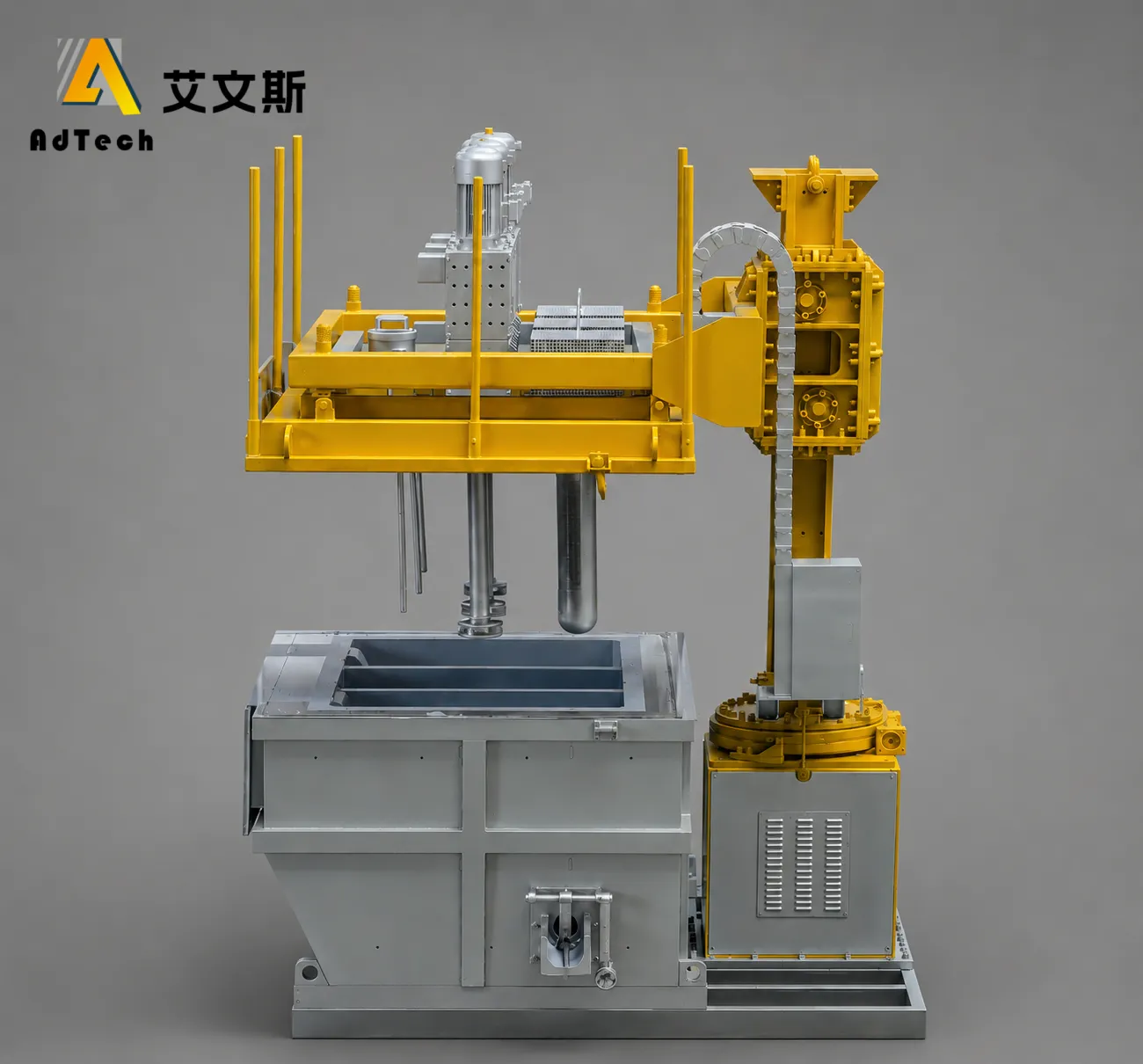
An aluminum liquid degassing machine is a metallurgical treatment unit that injects inert or reactive gas into molten aluminum through a submerged, rotating rotor. The spinning action shears the incoming gas stream into thousands of fine bubbles that rise through the metal bath. As these bubbles travel upward, dissolved hydrogen atoms diffuse into them because the partial pressure of hydrogen inside the bubble starts near zero. Non-metallic inclusions, mainly aluminum oxide particles, get physically trapped on the bubble surfaces and float to the top with the resulting dross.
The basic working sequence looks like this in our commissioning checklist:
- Molten metal reaches a target temperature, usually 700-740°C for most casting alloys.
- The rotor assembly lowers into the melt through a graphite or ceramic shaft.
- Nitrogen or argon flows through the hollow shaft at a controlled rate, often 8-25 L/min depending on melt volume.
- The rotor spins at 300-600 RPM, breaking gas into micro-bubbles.
- Treatment continues for 8-20 minutes depending on melt tonnage and initial hydrogen content.
- Operators pull a sample using a Reduced Pressure Test (RPT) mold to verify porosity reduction.
We have watched operators try to shortcut this process by increasing rotor speed without adjusting gas flow, and the result is almost always poor bubble distribution rather than faster degassing. The physics does not reward brute force; it rewards balance between rotation speed, gas volume, and rotor geometry.
Why Does Molten Aluminum Need Degassing Before Casting?
Liquid aluminum absorbs hydrogen readily because hydrogen solubility in molten aluminum is roughly twenty times higher than in solid aluminum. When the metal solidifies, this excess hydrogen has nowhere to go and forms gas porosity throughout the casting. These pores weaken mechanical properties, ruin machined surface finishes, and cause pressure leaks in components like engine blocks, transmission housings, and hydraulic fittings.
Sources of hydrogen contamination our clients frequently encounter include:
- Moisture on charge materials, ingots, and returns.
- Humid atmospheric conditions during holding and transfer.
- Contaminated fluxes or poorly dried refractory linings.
- Hydrocarbon residue on scrap aluminum being remelted.
We have tested plants where switching from wet scrap storage to a covered, dehumidified staging area alone dropped hydrogen readings by 0.15-0.20 ml/100g before any degassing treatment even began. That said, environmental controls only reduce the problem; they do not eliminate it. A degassing machine remains necessary because hydrogen pickup happens continuously from the moment metal melts until it fills a mold cavity.
Read more: Molten Aluminum Degassing System
What Types of Aluminum Degassing Machines Are Available in the Market?
Buyers researching this equipment typically encounter four main categories, each suited to different production scales and layouts.
| Machine Type | Best Suited For | Typical Capacity | Relative Cost |
|---|---|---|---|
| Portable ladle degassing unit | Small foundries, job shops, batch casting | 200-1,500 kg per batch | Low |
| Fixed rotary degassing station | Medium foundries with dedicated furnaces | 1-5 tons per hour | Moderate |
| In-line (online) degassing unit | Continuous casting lines, wheel plants | 3-15 tons per hour | High |
| Multi-rotor degassing box | Large aluminum billet or slab casters | 10-40 tons per hour | Very High |
Portable units mount on a mobile stand and lower into a transfer ladle or holding pot. Foundries running mixed alloy batches favor these because they can move between furnaces quickly. Fixed rotary stations sit permanently over a launder or holding furnace and process metal as it flows toward the casting machine, which suits automotive component producers running consistent alloy programs.
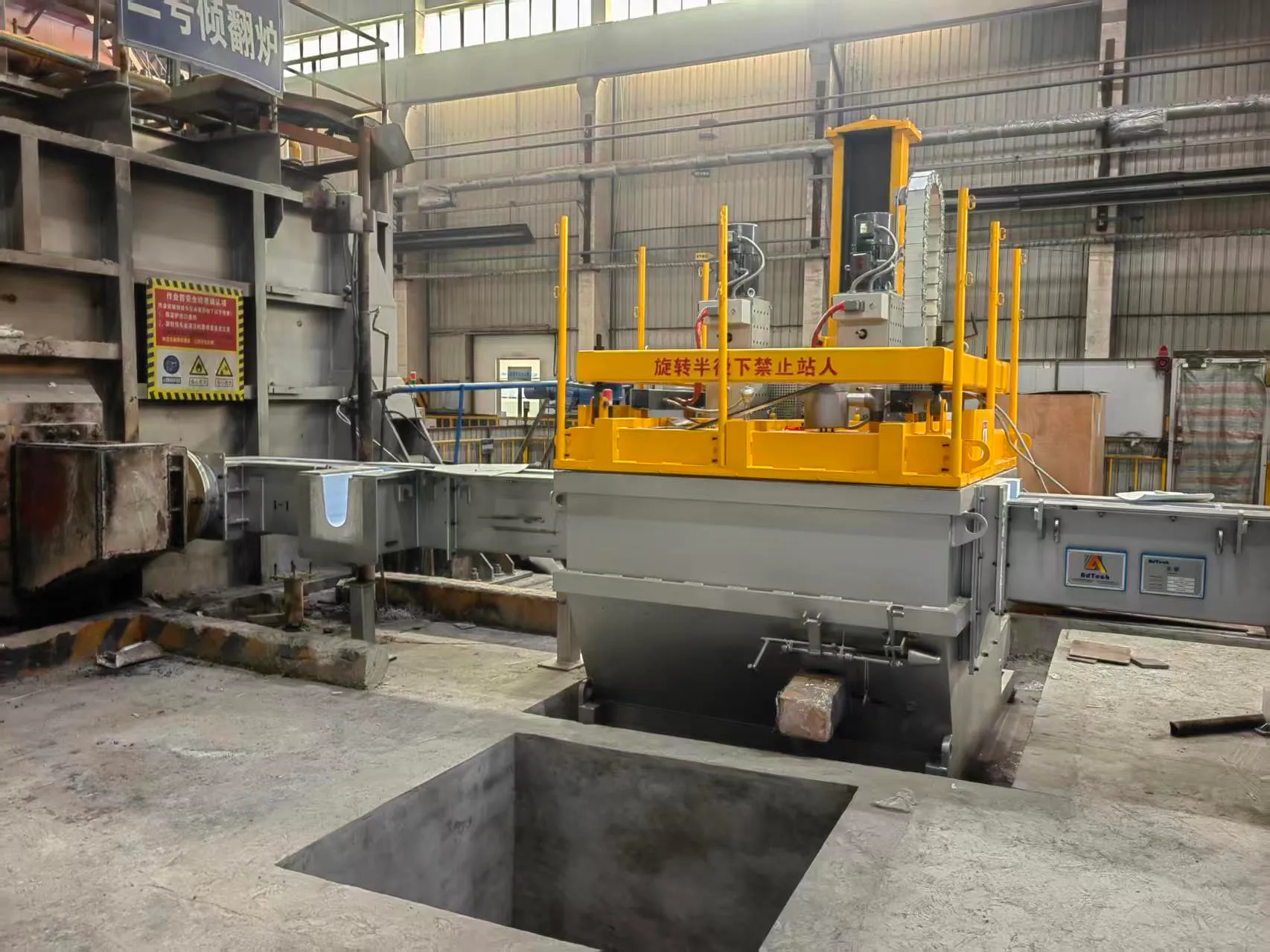
In-line degassing boxes represent what we install most often for wheel and cylinder head plants. Metal flows continuously through a refractory-lined box divided into two to four chambers, each fitted with its own rotor. This staged approach gives the melt more residence time and multiple treatment passes without slowing production speed. Large extrusion billet casters and rolling slab operations tend to specify multi-rotor systems because the sheer tonnage passing through demands parallel processing chambers rather than a single rotor trying to treat everything.
How Does Rotary Degassing Compare to Other Degassing Methods?
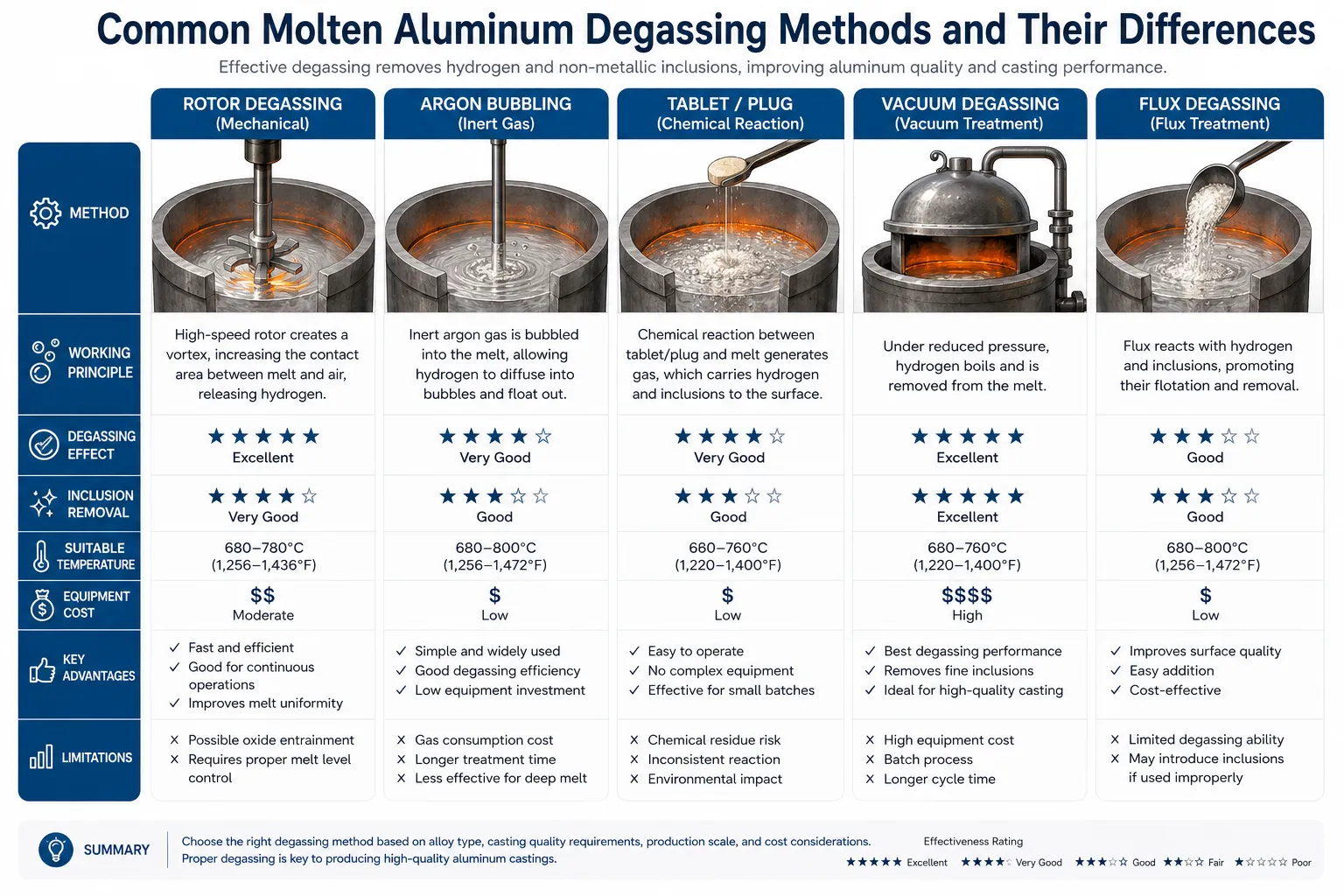
Before rotary technology became standard, foundries relied on lance degassing (a stationary pipe pushing gas bubbles straight up) and tablet flux degassing (solid hexachloroethane tablets plunged into the melt). Both methods still appear in smaller operations, so a fair comparison matters for buyers weighing upgrade decisions.
| Method | Hydrogen Removal Efficiency | Treatment Time | Environmental Concerns | Labor Requirement |
|---|---|---|---|---|
| Lance/pipe degassing | 30-45% reduction | 20-40 minutes | Low | Moderate |
| Tablet flux (chlorine-releasing) | 40-55% reduction | 10-15 minutes | High (chlorine fumes) | High |
| Rotary graphite degassing | 65-90% reduction | 8-20 minutes | Low with nitrogen/argon | Low (automated) |
| Vacuum degassing | 80-95% reduction | 15-30 minutes | Low | High (specialized) |
Rotary degassing wins on the balance of speed, effectiveness, and worker safety. Vacuum degassing achieves marginally better hydrogen removal in controlled lab conditions, but the equipment cost and cycle time make it impractical for most production foundries outside specialty aerospace casting houses. We generally advise clients moving away from chlorine tablet systems that the switch to nitrogen-based rotary degassing eliminates the chlorine gas exposure issues that occupational safety inspectors flag repeatedly during plant audits.
What Are the Key Components of a Rotary Degassing Unit?
Understanding the physical build helps buyers evaluate quotes from different manufacturers, since pricing often hides differences in component quality that affect service life.
Rotor and Shaft Assembly
The rotor sits at the bottom of the shaft and does the actual gas dispersion work. Most rotors today use a graphite composite or CFC (carbon fiber reinforced carbon) material because these withstand molten aluminum’s corrosive attack far longer than plain graphite. Shaft length varies by furnace or ladle depth, commonly ranging from 800mm to 2,200mm.
Drive Motor and Speed Controller
A variable frequency drive motor controls rotor RPM. Precision here matters more than most buyers realize; a motor that drifts even 50 RPM under load can change bubble size distribution enough to noticeably affect degassing outcomes.
Gas Delivery System
This includes the gas cylinder or plant nitrogen line, a flow meter, pressure regulator, and often a mass flow controller for facilities wanting repeatable, documented gas consumption per batch.
Lifting Mechanism
Pneumatic or hydraulic cylinders raise and lower the rotor assembly into the melt. Fixed and in-line units need reliable lifting systems because rotor immersion depth directly affects bubble residence time in the melt.
Refractory Housing (for in-line units)
Multi-chamber boxes require castable refractory linings rated for continuous contact with 700-750°C aluminum, typically lasting 6-18 months before relining depending on throughput.
| Component | Typical Material | Expected Service Life |
|---|---|---|
| Rotor | Graphite/CFC composite | 60-150 treatment cycles |
| Shaft | Graphite or CFC | 3-6 months continuous use |
| Refractory lining (in-line box) | High-alumina castable | 6-18 months |
| Drive motor | Industrial VFD motor | 5-8 years |
| Flow meter/regulator | Brass or stainless steel | 3-5 years |
Which Rotor Design Delivers the Best Degassing Efficiency?
Rotor geometry is where a lot of the real engineering differentiation between manufacturers happens, yet buyers rarely ask about it during procurement. We have run side-by-side trials with four rotor blade configurations on identical furnace setups, and the differences in RPT results were significant enough to change our procurement recommendations.
Standard flat-blade rotors work adequately for basic degassing but generate uneven bubble sizes, with larger bubbles rising too quickly to fully saturate with hydrogen. Curved-blade or “turbine style” rotors create more turbulent shear at the blade tips, producing finer, more uniform bubbles that stay suspended longer. Multi-hole diffusion rotors, which release gas through several small ports rather than a single central outlet, tend to perform best in our testing for melt volumes above three tons because they distribute treatment more evenly across the bath cross-section rather than concentrating bubbles in one rising column.
| Rotor Design | Bubble Size Range | Best Melt Volume | Relative Efficiency Gain |
|---|---|---|---|
| Flat blade | 3-6mm | Under 1 ton | Baseline |
| Curved turbine blade | 1.5-3mm | 1-4 tons | +20-30% |
| Multi-hole diffusion | 1-2mm | 3-15 tons | +35-45% |
| Dual-rotor counter-flow | 0.8-1.5mm | 10+ tons | +45-55% |
Our practical recommendation for most mid-size foundries running 2-6 ton batches lands on curved turbine or multi-hole diffusion rotors, since the added cost over basic flat blades is modest while the porosity reduction gains are substantial enough to show up clearly in customer quality audits.
Read more: Rotary Degassing Unit: Design, Efficiency for Molten Aluminum Refining
What Gases Are Used in Aluminum Degassing and Why?
Gas selection affects both degassing effectiveness and operating cost, and this is a question we get from nearly every procurement manager during initial consultations.
Nitrogen remains the most widely used gas because it is inexpensive, widely available, and effective for hydrogen removal in most standard aluminum alloys. Nitrogen has a slight limitation in that it can react with certain alkali or alkaline earth elements in specialty alloys, so it is not universally recommended.
Argon costs more than nitrogen but is fully inert with no reaction risk, making it the preferred choice for high-magnesium alloys (like 5xxx series) and premium aerospace-grade castings where any chemical interaction is unacceptable.
Nitrogen-chlorine mixtures (typically 90-95% nitrogen with a small chlorine percentage) offer superior inclusion removal because chlorine reacts with alkali metals and helps break down oxide films more aggressively than inert gas alone. The tradeoff is fume handling and the need for proper ventilation systems, plus stricter environmental compliance in many regions.
| Gas Type | Cost per Cubic Meter (relative) | Hydrogen Removal | Inclusion Removal | Alloy Compatibility |
|---|---|---|---|---|
| Nitrogen | Low | Good | Moderate | Most standard alloys |
| Argon | Moderate-High | Good | Moderate | All alloys, required for high-Mg |
| N2/Cl2 mixture | Moderate | Excellent | Excellent | Standard alloys, not recommended for Mg-rich |
We generally steer clients toward nitrogen for standard 3xx and 6xx series casting alloys since it delivers 85-90% of the performance of chlorine mixtures without the fume handling headache, then reserve argon specifically for magnesium-bearing alloys where reaction risk genuinely matters.
How Do You Choose the Right Degassing Machine for Your Foundry?
This decision comes down to matching equipment capacity and configuration to actual production patterns rather than buying based on catalog specifications alone. We walk clients through several practical questions before recommending a specific model:
What is your hourly or daily melt throughput? A foundry pouring 800kg batches twice daily needs entirely different equipment than one running continuous 8-ton-per-hour billet casting.
What alloy families do you cast? Facilities switching between many alloy types benefit from portable units that move easily between furnaces, while single-alloy continuous casters benefit from permanently installed in-line systems.
What is your current hydrogen level baseline? Foundries with poor melt handling practices (high starting hydrogen) need machines with longer treatment capability or dual-rotor configurations rather than basic single-rotor units.
How much floor space and furnace access do you have? In-line boxes require dedicated space in the metal flow path, which sometimes means redesigning launder layouts, whereas portable units need only ladle or furnace access.
What quality certifications does your customer base demand? Automotive Tier 1 suppliers and aerospace casters often need documented, repeatable treatment parameters, which points toward machines with programmable logic controllers and data logging rather than manually operated units.
We typically tell smaller operations pouring under two tons daily that a quality portable unit with a multi-hole rotor handles their needs without the capital expense of a fixed installation. Once daily throughput crosses roughly five tons, the labor savings and consistency of an automated in-line or fixed rotary station start justifying the higher upfront cost within a reasonable payback window.
What Are the Typical Technical Specifications Buyers Should Check?
Procurement teams comparing quotes from multiple suppliers should request specific numbers rather than accepting general marketing claims. Here is the specification checklist we use internally when evaluating new equipment for client installations.
| Specification | What to Verify | Why It Matters |
|---|---|---|
| Rotor RPM range | Should offer at least 100-600 RPM adjustability | Different alloys and melt volumes need different speeds |
| Gas flow rate range | 5-30 L/min minimum adjustability | Controls bubble density and treatment aggressiveness |
| Shaft immersion depth | Match to your furnace/ladle depth plus 10-15% margin | Insufficient depth reduces bubble residence time |
| Motor power rating | 1.5-5.5 kW depending on rotor size | Underpowered motors stall under melt resistance |
| Treatment chamber volume (in-line) | Match to your line speed and required residence time | Undersized chambers rush metal through too quickly |
| Control system | PLC with data logging preferred for quality documentation | Needed for ISO/IATF audit trails |
| Refractory lining thickness | 150-250mm typical for in-line boxes | Thinner linings fail faster under thermal cycling |
We always ask suppliers for actual RPT test data from a reference installation running similar alloy and tonnage before finalizing a purchase decision. Marketing brochures rarely tell the full story, but a foundry manager willing to share their before-and-after density index numbers usually gives an honest picture of real-world performance.
How Does Degassing Machine Cost Compare Across Capacity Ranges?
Pricing varies considerably based on capacity, automation level, and rotor configuration. These figures reflect ranges we have seen across multiple supplier quotes over recent years, though currency fluctuations and regional manufacturing costs shift numbers somewhat.
| Capacity Class | Approximate Price Range (USD) | Typical Buyer Profile |
|---|---|---|
| Portable, single rotor (under 1.5 tons) | $8,000-$18,000 | Small job foundries, sand casting shops |
| Fixed rotary, single rotor (1-5 tons/hr) | $20,000-$45,000 | Mid-size gravity/low-pressure die casters |
| In-line dual-chamber (3-8 tons/hr) | $50,000-$120,000 | Automotive wheel and component plants |
| Multi-rotor box (10+ tons/hr) | $150,000-$400,000+ | Billet casters, rolling slab producers |
Operating costs beyond the initial purchase deserve equal attention. Gas consumption, rotor replacement, and refractory relining add up over a year of continuous use. A mid-size fixed rotary unit running two shifts typically consumes $3,000-$6,000 annually in nitrogen and replacement rotors, figures worth building into any total cost of ownership comparison rather than focusing purchase decisions on sticker price alone.
What Maintenance Practices Extend the Life of a Degassing Unit?
Poor maintenance is the single most common reason we get called for emergency repairs on equipment that should still have years of service life remaining. Foundries that follow a disciplined maintenance schedule report rotor and shaft life extending 30-40% beyond facilities that run equipment until failure.
| Maintenance Task | Recommended Frequency | Consequence of Neglect |
|---|---|---|
| Rotor visual inspection for erosion | Every shift | Uneven bubble distribution, reduced efficiency |
| Shaft alignment check | Weekly | Vibration damage, premature bearing wear |
| Gas flow meter calibration | Monthly | Inaccurate treatment dosing |
| Motor bearing lubrication | Per manufacturer schedule, typically monthly | Motor seizure, unplanned downtime |
| Refractory lining inspection (in-line units) | Monthly visual, quarterly thickness check | Metal breakthrough, safety hazard |
| Rotor replacement | Every 60-150 cycles depending on alloy | Declining degassing performance |
| Full system inspection by technician | Semi-annually | Missed early-stage component failures |
One habit we push hard with every client is preheating new rotors and shafts before first immersion. Cold graphite dropped directly into 720°C molten aluminum experiences thermal shock that can crack the material within its first few uses. A 15-20 minute gradual preheat cycle above the melt surface before full immersion adds almost no time to daily operations but meaningfully extends component life.
What Problems Occur When Degassing Is Skipped or Done Poorly?
The downstream consequences of inadequate degassing show up throughout the entire production chain, not just at the casting stage. We have traced customer complaints back to degassing shortfalls in situations the original foundry never suspected.
Gas Porosity in Castings
The most direct result, appearing as rounded voids visible on X-ray inspection or machined surfaces. Automotive pressure-tight components like brake calipers and transmission cases fail leak testing when porosity exceeds acceptable thresholds.
Reduced Mechanical Properties
Porosity acts as stress concentration points, lowering tensile strength and fatigue life. A casting that looks visually acceptable can still fail prematurely under cyclic loading if internal porosity weakens its effective load-bearing cross-section.
Poor Machinability and Surface Finish
Pores that intersect a machined surface create pits and rough patches, causing higher scrap rates during finishing operations and complaints from downstream customers about cosmetic quality.
Increased Scrap and Remelt Costs
Every rejected casting means remelting metal, consuming additional energy, and losing production time. Foundries we have audited after installing proper degassing typically see scrap rate reductions of 3-8 percentage points, which translates directly into material and energy savings.
Inclusion-Related Defects
Beyond gas porosity, inadequate degassing leaves oxide films and inclusions in the melt that cause leak paths, reduced ductility, and inconsistent mechanical test results between castings from the same batch.
| Defect Type | Root Cause | Typical Detection Method |
|---|---|---|
| Gas porosity | Excess dissolved hydrogen | X-ray, RPT, density index test |
| Oxide inclusions | Insufficient bubble contact time | LAIS/PoDFA inclusion analysis |
| Pressure leak failure | Interconnected porosity network | Helium/air leak testing |
| Surface pitting after machining | Subsurface porosity intersecting cut plane | Visual inspection, dye penetrant |
| Inconsistent tensile results | Uneven inclusion distribution | Tensile test scatter analysis |
How Do We Measure Degassing Quality and Effectiveness?
Verifying that a degassing machine actually works requires objective testing rather than visual judgment of the melt surface. The methods below represent the standard toolkit foundry metallurgists rely on.
Reduced Pressure Test (RPT)
A small metal sample solidifies under vacuum, exaggerating any porosity present. Operators compare the sample’s density and appearance against reference standards to estimate hydrogen content. This remains the fastest, most accessible shop-floor test.
Density Index Calculation
Comparing the density of a sample solidified under atmospheric pressure against one solidified under vacuum gives a percentage figure representing gas content. Values below 3% density index generally indicate well-degassed melt suitable for critical castings, while values above 5-6% signal inadequate treatment.
Telegas or Hydrogen Analyzer Probes
Real-time electronic probes measure hydrogen content directly in the melt, giving immediate parts-per-million readings without waiting for sample solidification. These cost more than basic RPT equipment but suit high-volume operations needing continuous quality documentation.
PoDFA/LAIS Inclusion Analysis
For inclusion content specifically rather than gas porosity, filtering a metal sample through a fine ceramic filter and examining the residue under microscope reveals inclusion type and density, helping distinguish between hydrogen porosity and oxide-related defects that look similar on casual inspection.
| Test Method | Measures | Result Turnaround | Equipment Cost |
|---|---|---|---|
| RPT | Relative gas content | 10-15 minutes | Low |
| Density Index | Percentage gas content | 15-20 minutes | Low-Moderate |
| Telegas/hydrogen probe | Direct hydrogen ppm | Immediate (real-time) | High |
| PoDFA/LAIS | Inclusion type and quantity | 1-2 hours (lab analysis) | Moderate-High |
We recommend every foundry running degassing equipment perform at least one RPT test per treatment batch minimum, with periodic density index testing for quality documentation purposes when supplying automotive or aerospace customers requiring traceable quality records.
What Industry Standards and Certifications Matter for This Equipment?
Buyers supplying regulated industries need equipment and processes that satisfy specific documentation requirements. IATF 16949 (automotive quality management) auditors frequently ask to see degassing process parameters, maintenance logs, and RPT test records as part of process capability verification. Aerospace suppliers working under AS9100 face similarly strict documentation demands, often requiring statistical process control charts tracking hydrogen levels batch to batch.
CE marking applies to degassing equipment sold into European markets, covering electrical safety and mechanical guarding requirements around the rotating shaft and lifting mechanism. Facilities in North America should confirm equipment meets relevant OSHA machine guarding standards, particularly around pinch points on the lifting mechanism and gas cylinder safety provisions.
While no single international standard governs degassing machine design specifically, purchasing decisions benefit from equipment built to recognized pressure vessel and electrical component standards for the gas delivery and control systems, since these subsystems do carry independent certification requirements in most jurisdictions.
Frequently Asked Questions
How long does a typical degassing treatment cycle take?
Most batches require 8-20 minutes depending on melt volume, starting hydrogen content, and rotor configuration. Smaller ladle batches under 500kg often finish in 5-8 minutes, while larger multi-ton furnace treatments can take up to 25 minutes for thorough hydrogen reduction.
Can one degassing machine handle multiple aluminum alloy types?
Yes, provided the rotor and shaft materials tolerate the alloy chemistry involved. Standard graphite/CFC rotors work across most common casting alloys, though facilities running high-magnesium alloys should switch to argon gas rather than nitrogen to avoid reaction concerns.
What is the typical lifespan of a graphite rotor?
Most rotors last 60-150 treatment cycles before erosion reduces performance enough to warrant replacement. Actual lifespan depends on melt temperature, alloy aggressiveness, and how consistently operators follow preheat procedures before immersion.
Does higher rotor speed always mean better degassing?
No. Excessive RPM without matching gas flow adjustment can create surface vortexing that pulls oxygen back into the melt, actually increasing oxide inclusion formation rather than improving results. Optimal speed balances with gas flow rate for the specific melt volume being treated.
How much does nitrogen gas consumption typically cost per year?
A mid-size fixed rotary unit running two production shifts generally consumes $2,000-$4,000 annually in nitrogen, though this varies with local gas pricing and treatment frequency.
Is vacuum degassing better than rotary degassing for aluminum?
Vacuum systems achieve marginally higher hydrogen removal rates in controlled conditions but cost significantly more and require longer cycle times, making them impractical for most standard production foundries outside specialized aerospace or premium casting applications.
What causes uneven bubble distribution during treatment?
Worn rotor blades, incorrect immersion depth, misaligned shaft, or gas flow rates mismatched to melt volume all contribute to uneven bubbling, which reduces overall degassing effectiveness even when treatment time appears adequate.
Can degassing machines remove all porosity from aluminum castings?
No single treatment eliminates porosity completely. Well-executed degassing reduces hydrogen-related porosity substantially, often by 70-90%, but shrinkage porosity from solidification patterns requires separate mold design and gating solutions rather than melt treatment.
How do we know if our current degassing process needs improvement?
Rising scrap rates, failed leak tests, inconsistent density index readings above 4-5%, or customer complaints about porosity-related rejections all signal that current treatment parameters or equipment condition need review.
What is the difference between in-line and batch degassing units?
Batch units treat a fixed volume of metal in a ladle or furnace before pouring, while in-line units treat metal continuously as it flows through a refractory box toward the casting machine, suiting high-volume continuous production rather than discrete batch pours.
Final Assessment
Choosing and operating an aluminum liquid degassing machine involves more engineering judgment than most procurement checklists suggest. Rotor geometry, gas selection, treatment timing, and maintenance discipline all interact to determine whether a foundry actually achieves the porosity reduction the equipment promises on paper. Our recommendation for any facility evaluating new equipment or troubleshooting an underperforming existing unit remains consistent: verify actual RPT and density index performance data rather than relying on rotor speed or gas flow specifications alone, since real-world melt behavior often diverges from catalog claims in ways that only hands-on testing reveals.