

Achieving zero-defect aluminum castings relies entirely on three critical variables: precise temperature stability, effective hydrogen removal, and rigorous inclusion filtration. For foundry engineers and plant managers, the selection of equipment is not merely about melting metal. It is about controlling the metallurgical purity from the furnace to the mold. High-performance aluminum foundry equipment reduces scrap rates, eliminates porosity, and ensures mechanical properties meet automotive and aerospace standards. This resource breaks down the essential machinery, specifically focusing on melt treatment technologies where ADtech specializes, to help facilities optimize their casting lines for maximum yield.
The Core Ecosystem of Aluminum Casting
Modern cast houses operate as complex integrated systems. The equipment landscape divides into melting, holding, transfer, and treatment sectors. Success in this industry demands syncing these stages to prevent oxide formation and temperature loss.
Foundries aiming for high-grade output must prioritize the following machinery categories:
-
Melting Furnaces: Reverberatory, induction, or crucible furnaces that convert solid charge to liquid.
-
Melt Treatment Stations: The heart of quality control, involving degassing and filtration.
-
Transfer Systems: Launder systems and ladles designed to move metal without turbulence.
-
Casting Machines: Direct Chill (DC), die casting, or continuous casting units.
We will examine the specific engineering requirements for each, focusing heavily on purification technologies that drive profitability.

Molten Metal Filtration Systems
Filtration remains the primary defense against non-metallic inclusions. Inclusions act as stress concentration points in the final product, leading to catastrophic fatigue failure.
Ceramic Foam Filters (CFF)
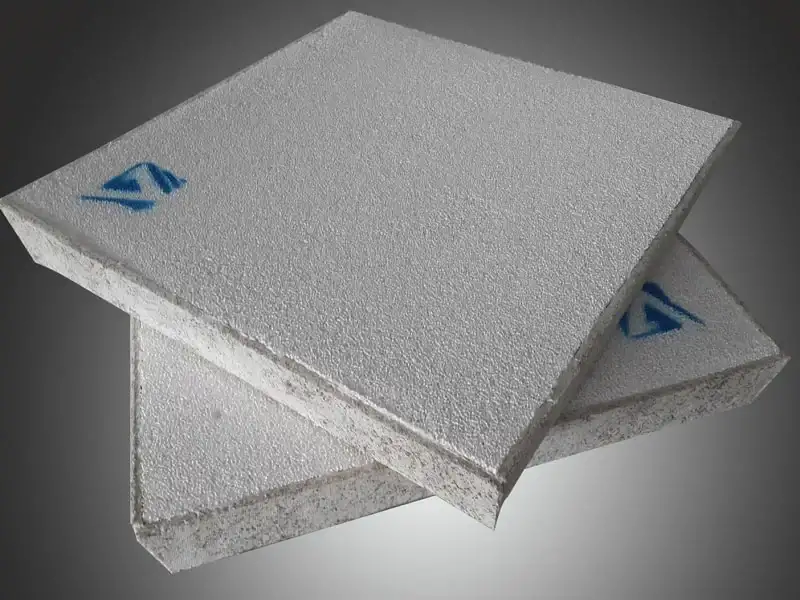
Ceramic Foam Filters are the industry standard for removing micron-sized impurities. These filters utilize a tortuous path mechanism. As molten aluminum flows through the open-pore ceramic structure, inclusions become trapped via deep bed filtration and cake filtration mechanisms.
ADtech manufactures advanced CFF solutions that utilize distinct ceramic slurries to withstand high thermal shock. The selection of Pore Per Inch (PPI) depends on the final application:
-
10-20 PPI: General commercial casting.
-
30-40 PPI: Automotive wheels and engine blocks.
-
50-60 PPI: Aerospace and thin-foil applications.
Deep Bed Filtration
For operations requiring ultra-high purity, such as can-body stock, deep bed filtration units are necessary. These utilize layers of alumina balls or grit. The metal flows through these layers, and the large surface area captures significantly more inclusions than a standard plate filter.
Table 1: Filtration Efficiency Comparison
| Filtration Method | Particle Removal Range | Flow Rate Capability | Primary Application | Maintenance Requirement |
| Fiberglass Mesh | > 1000 microns | High | Low-grade gravity casting | Low (Single use) |
| Ceramic Foam Filter (CFF) | 10 – 50 microns | Medium | Automotive, Extrusion Billets | Medium (Replace per cast) |
| Deep Bed Filter | < 5 microns | Low to Medium | Aerospace, Lithographic Sheet | High (Bed replacement) |
| Tubular Filter | 2 – 10 microns | Low | Specialized Alloy Production | Very High |
Degassing Units and Hydrogen Removal
Hydrogen is the only gas with significant solubility in liquid aluminum. Upon solidification, this solubility drops drastically, causing the gas to precipitate and form porosity. Porosity kills mechanical strength and ruins machined surfaces.
Rotary Degassing Technology
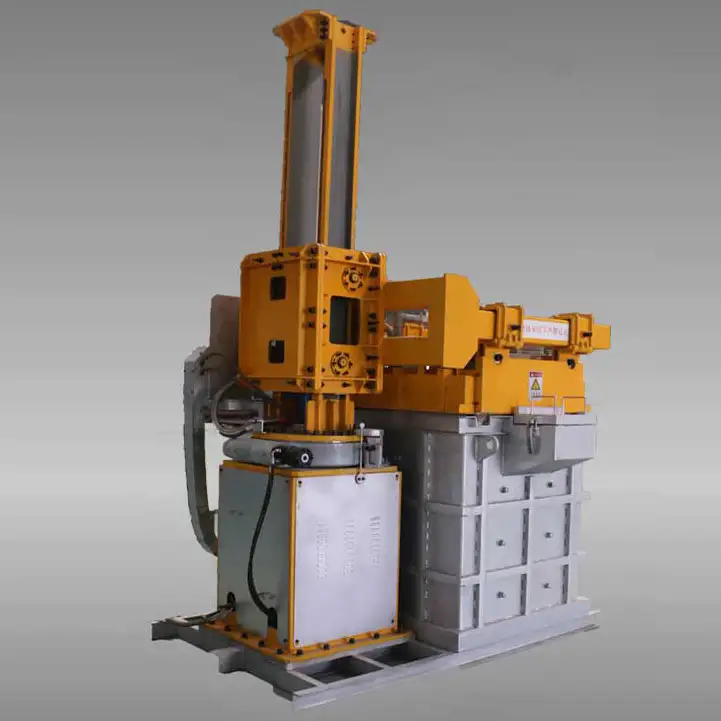
The most effective method to remove hydrogen is rotary degassing. This equipment introduces an inert gas (usually nitrogen or argon) through a rotating graphite shaft and rotor.
ADtech degassing units focus on bubble fragmentation. The spinning rotor shears the inert gas into tiny bubbles. These bubbles disperse throughout the melt. Hydrogen atoms diffuse into these inert gas bubbles and rise to the surface. Additionally, the flotation effect helps lift solid oxides to the surface dross layer for removal.
Key Performance Indicators for Degassing:
-
Rotor Speed (RPM): Must be adjustable to prevent vortexing which can re-introduce oxides.
-
Gas Flow Rate: Needs precise metering.
-
Treatment Time: Typically 5 to 15 minutes depending on melt volume.
Launder Systems and Molten Metal Transfer
Moving metal from the holding furnace to the casting station is where many defects originate. Turbulence creates fresh oxides.
Hot Top Casting Parts
Hot top systems are crucial for DC (Direct Chill) casting. They utilize a refractory reservoir to feed the mold. The insulation properties of the hot top header ensure the metal remains liquid long enough to feed the shrinkage of the ingot, increasing recovery rates.
Integration of Launder Systems
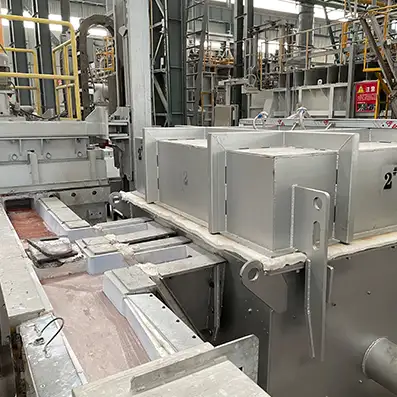
A well-designed launder system maintains metal temperature and prevents splashing. ADtech supplies pre-cast refractory launder segments that offer high insulation and non-wetting properties. These systems often integrate in-line degassing and filtration boxes, allowing for continuous treatment during transfer.
Benefits of Insulated Launders:
-
Temperature Conservation: Reduces the need for superheating in the furnace.
-
Oxide Reduction: A quiet, steady flow minimizes surface area exposure to air.
-
Safety: Enclosed transfer paths protect workers from radiant heat and splashes.
Fluxing Agents and Chemical Refining
Machinery alone cannot handle every impurity. Chemical fluxes are necessary additives used in conjunction with mechanical equipment.
Types of Fluxes
-
Covering Flux: Melts on the surface to form a barrier against oxidation.
-
Drossing Flux: Promotes the separation of aluminum from dross, reducing metal loss during skimming.
-
Refining Flux: Reacts with specific impurities (like Calcium or Sodium) to remove them from the alloy.
Table 2: Flux Selection Matrix
| Flux Type | Chemical Basis | Function | Recommended Temperature |
| Exothermic Flux | Nitrates/Fluorides | heats dross to separate metal | 700°C – 750°C |
| Grain Refining Flux | Ti/B Salts | Reduces grain size for strength | 720°C – 740°C |
| Modifying Flux | Strontium/Sodium | Modifies Silicon structure (Al-Si) | 730°C – 760°C |
| Cleaning Flux | Chlorides/Fluorides | Removes oxides and non-metallics | 700°C – 740°C |
Temperature Control and Measurement
Accurate temperature reading is non-negotiable. Thermocouples and protection tubes must withstand the corrosive nature of molten aluminum.
Silicon Nitride Protection Tubes:
ADtech recommends Silicon Nitride (Si3N4) for thermocouple protection tubes. Unlike cast iron or graphite, Si3N4 does not contaminate the melt and possesses superior thermal shock resistance. It ensures fast response times for furnace controllers, preventing overshoot and energy waste.
Case Study: Quality Turnaround in Michigan
Project Overview:
-
Client: Tier-1 Automotive Supplier (Engine Block Production)
-
Location: Michigan, USA
-
Timeline: March 2023 – October 2023
-
Challenge: The facility faced a 12% rejection rate on V6 engine blocks due to microporosity and oxide streaks.
The Intervention:
The plant managers audited their process and identified that their transfer ladles were introducing turbulence and their static fluxing method was insufficient for hydrogen removal.
Implementation of ADtech Solutions:
-
Installation of In-Line Degassing: They replaced static ladle fluxing with an ADtech compact in-line degassing unit positioned between the holding furnace and the casting station.
-
Filter Upgrade: Switched from a standard 20 PPI filter to a 40 PPI ADtech Ceramic Foam Filter to capture finer inclusions.
-
Launder Redesign: Installed a 15-meter heated launder system to replace forklift ladle transfer.
Results:
By October 2023, the data showed significant improvements:
-
Scrap Reduction: Rejection rate dropped from 12% to 1.8%.
-
Hydrogen Levels: Consistently measured below 0.10 ml/100g (down from 0.25 ml/100g).
-
ROI: The reduction in remelting costs paid for the new equipment within 5 months.
Maintenance and Operational Safety
Foundry equipment involves extreme hazards. Maintenance protocols are vital for both longevity and personnel safety.
Routine Maintenance Schedule
Degassing rotors, heater protection tubes, and filter boxes are consumables or wear parts. A rigid schedule prevents unexpected downtime.
Table 3: Preventive Maintenance Checklist
| Equipment Component | Inspection Frequency | Action Item |
| Degassing Rotor | Daily | Check for erosion or oxidation; coat with boron nitride if needed. |
| Thermocouples | Daily | Verify calibration against a master probe. |
| Launder Lining | Weekly | Inspect for cracks or metal penetration; patch immediately. |
| Furnace Refractory | Monthly | Infrared scan for hot spots indicating lining failure. |
| Filter Box Seals | Per Cast | Ensure fiber gaskets are intact to prevent metal bypass. |
Advanced Grain Refinement
Grain refinement is the process of reducing the size of the crystal grains in the solidifying aluminum. Smaller grains result in better feeding characteristics, reduced hot tearing, and improved mechanical properties.
While Al-Ti-B (Aluminum-Titanium-Boron) rod is the common method, specialized equipment can feed this rod precisely into the launder stream. Automated rod feeders ensure that the grain refiner is added at the exact rate required for the metal flow speed, preventing waste and ensuring consistency.
The Economics of Foundry Equipment
Investing in high-end purification equipment like that offered by ADtech is an operational expenditure that lowers Cost Per Ton.
Calculating the Cost of Quality:
-
Metal Loss: Poor dross treatment can throw away 5-10% of usable aluminum.
-
Energy: Keeping a furnace running longer to fix bad chemistry burns gas/electricity.
-
Reputation: One bad shipment can lose an automotive contract.
Foundries that integrate automated degassing and filtration see an immediate reduction in these “hidden” costs.
FAQs
1. What is the primary purpose of a degassing unit in an aluminum foundry?
The primary function is to remove dissolved hydrogen gas from the molten aluminum to prevent porosity in the final casting. It also helps float solid inclusions to the surface.
2. How often should ceramic foam filters be changed?
Filters are typically single-use items. They must be replaced after every cast or when the metal flow is interrupted, as the metal inside the filter will solidify.
3. Why is silicon nitride preferred for protection tubes?
Silicon nitride offers superior resistance to thermal shock, does not wet with aluminum (meaning metal doesn’t stick), and has a long service life compared to cast iron or silicon carbide.
4. What causes oxide inclusions in aluminum casting?
Oxides form whenever molten aluminum contacts oxygen. Turbulence during pouring, stirring, or transfer greatly increases oxide generation.
5. What is the difference between fluxing and degassing?
Degassing specifically targets the removal of hydrogen gas. Fluxing is a chemical treatment used to clean the metal, remove oxides, modify the alloy structure, or separate metal from dross.
6. How does rotor speed affect degassing efficiency?
Higher speeds create smaller bubbles, which improves surface area for hydrogen removal. However, excessive speed creates a vortex that sucks air (and oxides) back into the melt.
7. Can ADtech equipment be retrofitted into existing lines?
Yes, most filtration boxes and portable degassing units are designed to be integrated into existing furnace and launder layouts with minimal disruption.
8. What is the ideal temperature for aluminum degassing?
It typically occurs between 700°C and 750°C. If the temperature is too low, the viscosity prevents bubble dispersion. If too high, hydrogen solubility increases, making removal harder.
9. What are “hard spots” in aluminum machining?
Hard spots are usually inclusions—clumps of corundum (aluminum oxide) or spinel that were not filtered out. They damage CNC tools and ruin surface finish.
10. How do I choose the right PPI for my filter?
Select based on your quality requirements. Use 10-20 PPI for standard parts, 30-50 PPI for safety-critical automotive parts, and 60+ PPI for high-stress aerospace components or foil.
Conclusion
The difference between a mediocre foundry and a world-class facility lies in the control of the molten state. Aluminum foundry equipment is not just about heavy machinery; it is about precision engineering applied to liquid metal. By implementing robust filtration via Ceramic Foam Filters, mastering hydrogen removal with Rotary Degassing, and ensuring stable transfer through insulated launders, foundries secure their position in the supply chain.
ADtech stands ready to support this transition. Our expertise in melt treatment technology ensures that your facility produces metal that meets the most stringent global standards.