

For most aluminum casting operations, there is no single filtration system that is universally superior. Electric-heated filtration units usually provide the strongest temperature control, clean operating environment, and automation compatibility, making them well suited to quality-sensitive aluminum sheet, foil, can stock, aerospace alloys, and modern casthouses. Gas-heated systems can offer lower heating cost where natural gas is inexpensive and are practical when electrical capacity is constrained, but combustion control, temperature uniformity, refractory exposure, emissions, and maintenance require closer attention. Deep bed filtration, meanwhile, should not be viewed simply as an alternative heating method. It is a filtration architecture designed around a substantial media bed and is particularly valuable when high inclusion-removal efficiency, high throughput, and stable continuous operation justify its larger metal inventory and maintenance commitment. In our experience working with molten aluminum treatment equipment, the correct choice comes from balancing melt cleanliness targets, alloy family, flow rate, inclusion size distribution, operating schedule, energy infrastructure, temperature-loss allowance, refractory practice, maintenance capability, and total cost per tonne of acceptable metal rather than comparing equipment purchase prices alone.
This distinction matters because buyers frequently compare “gas-heated vs electric-heated vs deep bed” as though all three terms describe the same engineering variable. They do not. Gas and electricity describe thermal energy input, while a deep bed describes the filtration mechanism and media configuration. A filter vessel may incorporate different heating technologies depending on its design. Separating these decisions is the first step toward specifying a molten aluminum filtration system that performs predictably in production.
At AdTech, we therefore evaluate filtration from the metal outward: what contaminants must be removed, what cleanliness the downstream casting process demands, how the molten metal moves through the filter, what temperature window must be maintained, and only then how the vessel should be heated.
What Does a Molten Aluminum Filtration System Actually Remove?
Molten aluminum can contain suspended non-metallic inclusions originating at several points between melting and solidification. Typical contaminants include aluminum oxide films, oxide clusters, spinel, magnesium oxide, refractory fragments, furnace debris, flux residues and other exogenous particles introduced through handling.
These inclusions matter even when their total mass appears small. A thin folded oxide film can become a mechanically significant discontinuity after casting and deformation. In demanding products, metal cleanliness therefore cannot be reduced to the question “does the melt look clean?”
Read more: What is a Deep Bed Filter? Principles, Media, Working Mechanism, Applications
Filtration works primarily on suspended solid inclusions. Dissolved hydrogen is a different problem. A filter is not a substitute for an inline degasser.
Hydrogen has appreciable solubility in liquid aluminum and much lower solubility after solidification. Excess hydrogen may consequently contribute to porosity. Rotor-based degassing or another suitable melt-treatment process is normally used to reduce dissolved hydrogen. Filtration is then positioned to capture inclusions already present in the melt plus particles generated or transported during upstream treatment.
A typical process chain may therefore include a melting or holding furnace, flux treatment when required, inline degassing, molten aluminum filtration, launders, and finally a casting machine. Exact sequencing varies with plant design and product requirements.
The three filtration mechanisms usually discussed in engineering terms are interception, cake filtration and depth filtration. Their relative contributions change with filter medium, pore geometry, flow velocity, inclusion characteristics and operating history.
Gas-Heated vs Electric-Heated vs Deep Bed: What Is the Fundamental Difference?
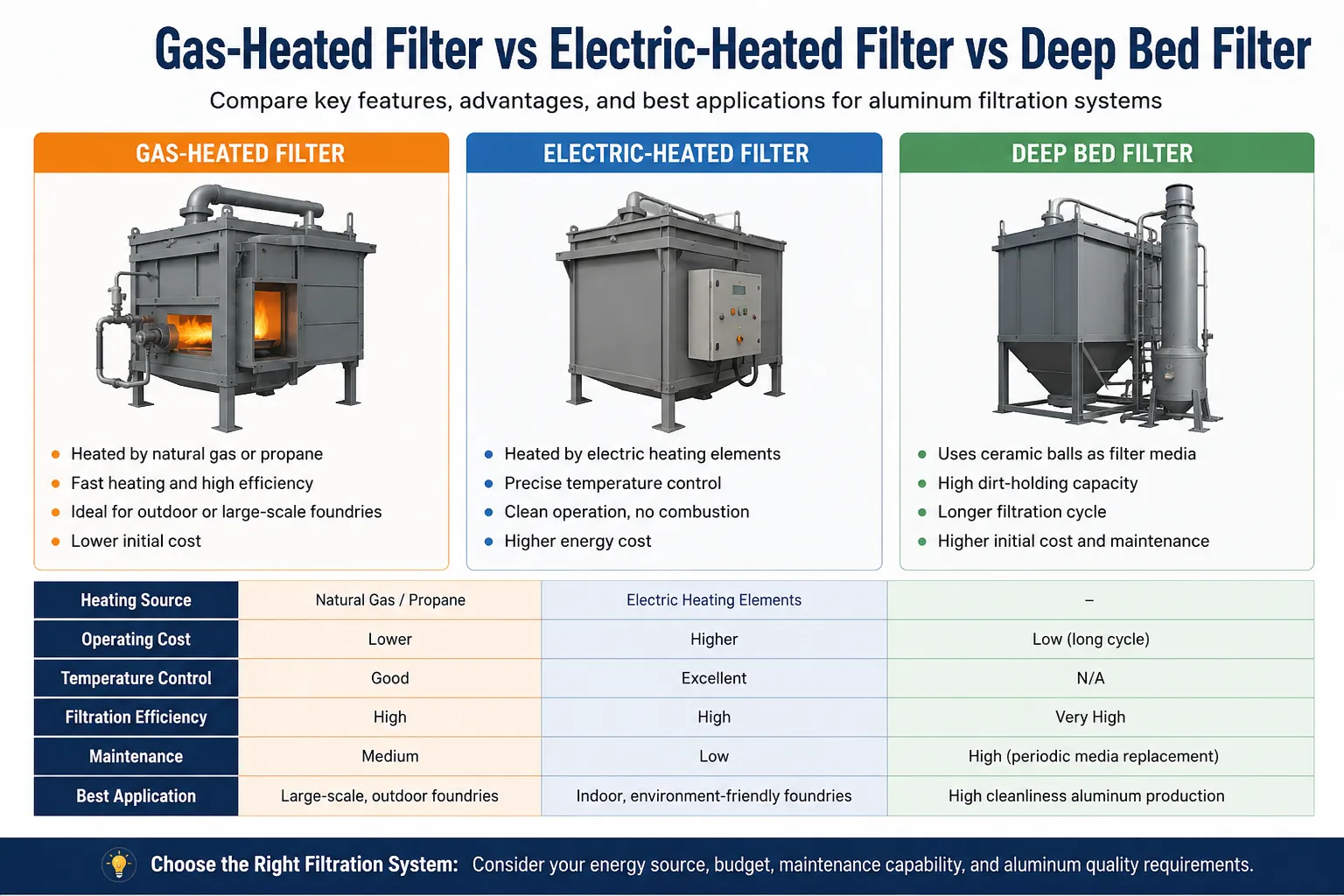
The comparison becomes much clearer when thermal design and filtration design are separated.
| System or feature | Gas-heated filter | Electric-heated filter | Deep bed filter |
|---|---|---|---|
| Primary definition | Heating method | Heating method | Filtration architecture |
| Heat source | Natural gas or other gaseous fuel | Electrical resistance or related electric heating | Depends on equipment design |
| Main reason to select | Fuel economics, available gas infrastructure | Precise thermal management, clean operation, automation | High filtration capability and continuous processing |
| Direct combustion products | Present with combustion heating | None at equipment point of use | Depends on heater |
| Temperature control | Good with a well-designed burner and control system | Typically precise and responsive | Design dependent |
| Filtration medium | Often ceramic foam or another filter arrangement | Often ceramic foam or another filter arrangement | Granular or packed refractory media bed |
| Molten metal inventory | Design dependent | Design dependent | Commonly higher |
| Start-up complexity | Moderate | Often relatively straightforward | Typically higher |
| Media replacement | Depends on filter format | Depends on filter format | More involved |
| Best fit | Continuous plants with favorable gas economics | High-quality production and plants prioritizing control | High-throughput operations demanding strong inclusion removal |
| Main limitation | Combustion management and emissions | Electrical load and power cost | Inventory, footprint, start-up and maintenance |
A procurement specification that merely asks suppliers to quote “one filtration unit” is consequently incomplete. At minimum, a purchaser should define throughput, alloy range, inlet temperature, required outlet temperature, filtration target, upstream treatment, campaign length, acceptable pressure head, operating pattern, existing utilities and downstream casting process.
How Does Molten Aluminum Filtration Work?
A molten metal filter does more than behave like a household sieve. Some particles certainly can be excluded because they are too large to pass a pore or constriction, but high-performance filtration also depends on particle trajectories and interactions with internal surfaces.
When metal enters porous ceramic or packed filtration media, the flow divides through many tortuous passages. Inclusion particles can contact and adhere to media surfaces. Larger inclusion clusters may be intercepted relatively quickly. Smaller particles can be captured deeper in the medium through depth-filtration effects.
The performance of an actual system is influenced by several interacting variables:
Inclusion type, morphology and size distribution; filter-medium chemistry and wettability behavior; pore size or bed grading; effective filter area and bed depth; molten metal velocity; residence time; metal temperature and viscosity; metallostatic head; oxide formation upstream of the filter; priming conditions; filter loading during a campaign; alloy chemistry; thermal stability; and flow disturbances generated by launders, transitions or level changes.
This explains why a “finer” filter is not automatically the better filter. Increasing resistance without accounting for flow and head can create operational instability. A technically successful design needs sufficient particle capture while maintaining stable delivery of metal to the caster.
Filtration performance also changes during service. Captured material accumulates, altering hydraulic resistance and sometimes improving capture of certain particles until pressure loss becomes excessive. Selecting equipment from a nominal pore number alone overlooks this dynamic behavior.
When Is a Gas-Heated Molten Aluminum Filter the Better Choice?
Gas heating remains technically relevant in casthouses with established natural-gas infrastructure, high electrical tariffs or limited available electrical capacity. Large equipment operating continuously may benefit economically when gas provides a meaningful delivered-energy advantage.
A gas-heated filtration vessel normally uses controlled combustion to compensate for heat lost through refractory walls, covers and exposed components. Burner arrangement is critical. Good thermal engineering seeks to heat the system without producing damaging local hot spots or undesirable interaction between the combustion environment, refractory and molten-metal process.
The strongest arguments supporting gas heating include high heating power, familiar plant infrastructure and potentially favorable operating cost. A plant already maintaining combustion systems may also possess the necessary technician skills, gas trains, detection equipment and maintenance procedures.
Yet fuel price should never be the sole selection criterion.
Combustion introduces flue gas, requires air-to-fuel management, creates exhaust requirements and normally adds components such as burners, igniters, valves, pressure regulators, flame safeguards and associated instrumentation. Local environmental requirements may also make on-site combustion increasingly important in capital planning.
Temperature uniformity deserves particular attention. The measured control temperature at one thermocouple does not prove that every refractory surface and every region of the molten-metal volume is at the same temperature. Burner positioning and refractory geometry influence heat distribution substantially.
We recommend examining cold-start behavior separately from steady-state efficiency. A system that looks economical during a long casting campaign may consume considerable energy while heating a large refractory mass from ambient temperature.
What Should Engineers Check in a Gas-Heated Filter Design?
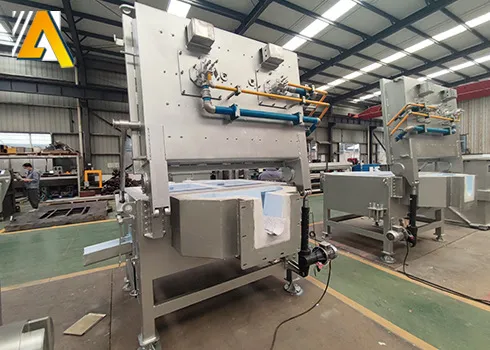
Critical items include burner turndown, flame supervision, combustion control philosophy, exhaust routing, refractory maximum service temperature, thermocouple position, over-temperature protection, gas pressure requirements, purge logic, emergency shutdown behavior and access to burner components.
Buyers should also ask suppliers how the heater prevents localized refractory overheating. A high nominal burner capacity is not itself evidence of better thermal performance.
Another consideration is oxidation. Molten aluminum should be handled with minimum unnecessary turbulence and air entrainment throughout the process. Burner architecture needs to be considered within that broader melt-handling objective.
Why Are Electric-Heated Molten Aluminum Filtration Systems Increasingly Attractive?
Electrical heating replaces combustion hardware near the filtration station with controlled electric energy. Depending on equipment architecture, heating elements transfer heat through refractory structures or heat the chamber using another engineered arrangement.
Its major advantage is controllability. Modern electrical systems can integrate multiple thermocouples, PID control, programmable start-up sequences, solid-state power control, alarms and plant-level data collection. That makes the technology attractive where repeatability and traceability matter.
Electric heating also produces no point-of-use combustion exhaust. This does not mean electricity is automatically carbon-free because lifecycle emissions depend on the generating mix. It does simplify the immediate workplace environment and can support plant electrification strategies.
Maintenance changes rather than disappears. Electric equipment still has consumable or service-sensitive components, including heating elements, electrical connections, insulation, contactors or semiconductor power controls and thermocouples. Element life depends strongly on temperature, installation quality, thermal cycling and protection from metal attack.
The electrical supply deserves early evaluation. A new filter station with significant connected load may require transformer, switchgear or distribution upgrades. A technically attractive electric heater can therefore become expensive when plant infrastructure is near its limit.
Electricity demand charges can also alter the business case. Procurement teams should calculate annual costs using actual tariff structure instead of multiplying rated kilowatts by a simple energy price.
Does Electric Heating Give Better Aluminum Temperature Control?
It often can, although heater type alone does not guarantee it.
Temperature precision results from the complete thermal system: element arrangement, refractory conductivity, insulation, control tuning, sensor location, vessel geometry, molten-metal level and process flow. A poorly designed electrically heated vessel can still have gradients.
Where good equipment design is combined with suitable controls, electric heating provides an excellent platform for repeatable temperature regulation. This is useful when downstream casting requires a narrow temperature window.
Temperature management affects more than energy consumption. Excessive temperature can accelerate oxidation and refractory degradation, while insufficient temperature can impair flow, create freeze risk and disrupt casting stability. The engineering objective is not simply to keep the filter “hot.” It is to maintain the required metal temperature with minimum practical thermal variation.
What Makes a Deep Bed Filter Different From Ceramic Foam Filtration?
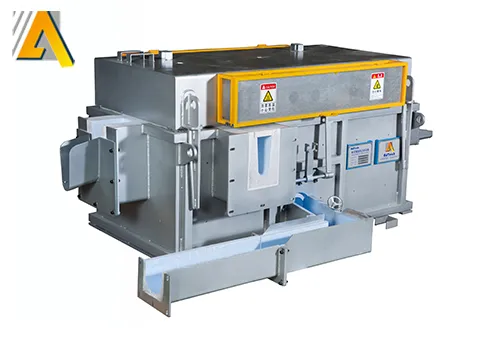
Deep bed filtration uses a substantial volume of refractory filtration media rather than relying predominantly on a relatively thin porous element. Molten metal travels through the spaces between media particles or shapes, creating a long, tortuous flow path with extensive internal contact area.
This architecture can achieve high inclusion capture performance, especially when the process is engineered around stable long-duration production. It has historically been important in aluminum operations producing quality-sensitive wrought products.
Depth is central to its behavior. Instead of concentrating capture near a single planar filter surface, inclusions can be retained throughout portions of the media bed. Bed material, particle grading, bed height, metal velocity and flow distribution all contribute to performance.
Ceramic foam filtration, commonly abbreviated CFF, uses a rigid porous ceramic structure with interconnected cells. Such filters can be compact, comparatively easy to replace and available in different nominal pore structures. They are widely used in aluminum casting because they combine practical operation with useful inclusion removal.
Neither architecture should be declared universally superior without context.
| Engineering criterion | Ceramic foam filter | Deep bed filter |
|---|---|---|
| Filtration path | Relatively compact porous body | Extended path through packed media |
| Installation footprint | Usually smaller | Usually larger |
| Metal inventory | Generally lower | Generally higher |
| Media handling | Relatively convenient | More labor and procedure intensive |
| Start-up | Often faster | Usually requires more thermal preparation |
| Inclusion capture | Strong when correctly specified | Very high capability in suitable continuous processes |
| Pressure behavior | Depends on pore structure and loading | Depends on bed depth, grading and contamination |
| Campaign suitability | Flexible | Particularly suited to long campaigns |
| Process changeovers | Usually easier | Can be less convenient |
| Capital complexity | Often lower | Usually higher |
| Typical use | Broad aluminum casting applications | Demanding, high-volume melt-cleanliness duties |
In our equipment evaluations, this difference changes the conversation with plant management. A deep bed may deliver excellent metallurgical performance but still be economically inappropriate where alloys change frequently, production is intermittent or residual metal inventory imposes an unacceptable yield cost.
Conversely, selecting a compact filter solely because replacement is simple may not meet a demanding cleanliness specification at very high throughput.
How Do Ceramic Foam Filters Capture Inclusions?
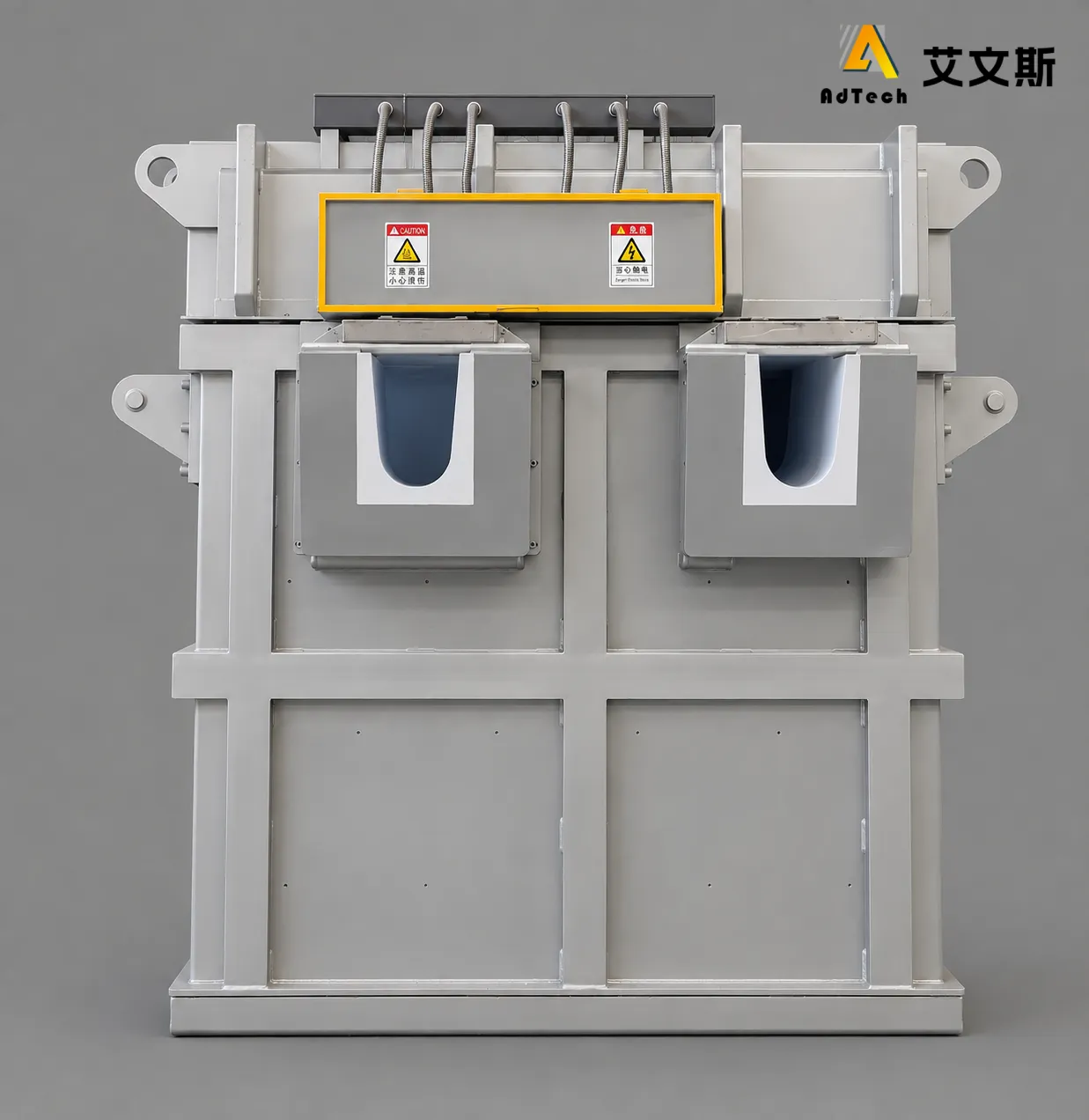
Ceramic foam filtration is often described through pores per inch, usually written PPI. Numbers such as 10, 20, 30, 40, 50 or higher may appear in commercial specifications, though available grades and true structural properties depend on manufacturer and material.
PPI is useful, but it is not a complete performance metric. Two nominally similar ceramic filters can differ in pore uniformity, open porosity, mechanical strength, dimensional accuracy, ceramic composition, surface characteristics and internal architecture.
Higher PPI commonly corresponds to a finer porous structure and increased hydraulic resistance. Engineers consequently need to balance cleanliness against required throughput and available head.
Filter area matters at least as much as many purchasing teams initially expect. If a specified flow is forced through insufficient area, superficial velocity rises. That can increase pressure loss and influence capture mechanisms. Increasing area can provide a more favorable operating window without necessarily changing the nominal filtration grade.
Preheating is another decisive issue. Molten aluminum contacting an inadequately heated filter can lose heat rapidly and may not prime correctly. Each filter and filtration box should be brought to its required operating state according to its material and equipment specifications rather than following an arbitrary universal preheat temperature.
How Do Deep Bed Filters Achieve High Melt Cleanliness?
Deep bed media create numerous changes in direction and a very large collective contact surface. Inclusion particles moving with molten aluminum have repeated opportunities to leave their fluid trajectories and interact with media surfaces.
This makes bed geometry important. If flow channels preferentially through one part of the bed, effective filtration volume decreases. Good vessel design seeks even distribution and avoids bypassing.
Bed preparation matters too. Refractory media must be compatible with molten aluminum and properly conditioned. Moisture is an acute safety concern wherever material will encounter molten metal. Plant procedures need to control storage, drying, preheating and handling carefully.
An experienced operator also treats changeout as a metallurgical operation, not merely routine housekeeping. Disturbing an old bed, introducing new material, cleaning the chamber and returning the vessel to temperature can affect both safety and subsequent metal quality.
Deep bed systems therefore make most economic sense when their performance can be utilized over suitable campaigns.
Which System Produces the Lowest Temperature Loss?
There is no credible universal number because heat loss depends on equipment size, throughput, insulation, refractory condition, ambient conditions, inlet temperature, cover design, residence time and heater power.
The relevant thermal relationship can be expressed conceptually through sensible heat:
Q = m × Cp × ΔT
where Q represents thermal energy, m is metal mass, Cp is specific heat capacity and ΔT represents temperature change.
In a continuously heated filter, however, engineers must account not only for the flowing metal but also for wall losses, cover losses, openings, launder interfaces, refractory storage, radiation and start-up energy.
A filter with excellent insulation may require relatively little steady-state heater input but significant energy during initial warm-up due to refractory mass. A lower-mass system can heat quickly yet experience a different rate of thermal response when flow stops.
This is why energy consumption should be specified per operating condition rather than from heater nameplate rating. A 100 kW installed heating system does not continuously consume 100 kWh each hour if controlled demand is lower.
For procurement comparison, request measured or calculated consumption during cold start, hot holding, normal production and standby.
How Should Filtration Efficiency Be Measured?
Filtration efficiency is often represented using upstream and downstream inclusion concentrations:
Efficiency (%) = (Cin − Cout) / Cin × 100
Cin is the inclusion concentration before filtration and Cout represents concentration after filtration, provided both values use a consistent validated measurement method.
This simple equation hides a difficult practical question: how are inclusions being measured?
Several methods can characterize molten aluminum cleanliness. Depending on the plant and quality system, engineers may use reduced-pressure testing, metallographic methods, PoDFA-type analysis, LiMCA-type measurements, pressure filtration techniques or other laboratory and online techniques.
These tools do not all measure the same phenomenon.
Reduced-pressure testing is commonly associated with melt quality and hydrogen-related porosity behavior, but it should not be treated as a direct universal measurement of individual inclusion populations. Metallographic examination can provide valuable particle identification but samples only a finite metal volume. Online inclusion analyzers can reveal concentration and size-distribution information yet demand appropriate equipment, calibration and interpretation.
The right test method therefore needs to match the defect mechanism and product requirement.
A supplier claiming “99 percent efficiency” without naming inlet contamination, particle-size range, alloy, flow rate, test method and sampling protocol has provided insufficient engineering information.
Gas-Heated vs Electric-Heated Filtration: Which Has the Lower Operating Cost?
The result is site-specific. A useful total-cost calculation should include more than nominal energy prices.
| Cost category | Gas heating | Electric heating | Deep bed considerations |
|---|---|---|---|
| Energy | Fuel consumption | kWh plus possible demand charges | Depends on heating method and thermal mass |
| Utility infrastructure | Gas train, exhaust, safety hardware | Transformer and distribution capacity | Both may apply according to design |
| Routine maintenance | Burner and combustion components | Elements, controls and electrical components | Media management adds maintenance |
| Emissions infrastructure | Potentially significant | No local combustion flue gas | Depends on installed heater |
| Start-up energy | Refractory and equipment dependent | Refractory and equipment dependent | Can be substantial because of system mass |
| Metal inventory | Vessel dependent | Vessel dependent | Commonly higher |
| Media cost | Filter-design dependent | Filter-design dependent | Bed-media replacement cost |
| Labor | Operating practice dependent | Often automation friendly | Changeout may require more labor |
| Downtime | Maintenance and warm-up dependent | Maintenance and warm-up dependent | Campaign planning is important |
| Yield impact | Process dependent | Process dependent | Trapped or residual metal needs evaluation |
A more useful purchasing metric is total annual cost divided by tonnes of acceptable cast product rather than raw tonnes flowing through the system.
Suppose one unit saves energy but allows enough inclusion-related scrap to increase rejection by even a small fraction. In high-volume production, the lost metal value and remelting expense can dwarf the heater savings. Conversely, an extremely sophisticated filtration system adds little business value if downstream product specifications do not require its additional capability.
Total cost of ownership should therefore include energy, filter media, refractory, maintenance labor, production downtime, metal retained during shutdown, scrap, recovery, environmental costs and capital amortization.
Which Filtration System Fits Each Aluminum Casting Application?
Selection changes considerably with final product.
Rolling slab destined for demanding sheet can place substantial importance on inclusion population because defects may appear after extensive rolling. Aluminum foil is even less tolerant of certain non-metallic inclusions because final gauge is extremely thin. Can stock, lithographic sheet and high-surface-quality products likewise require controlled melt cleanliness.
Billet production also benefits from effective filtration. Downstream extrusion quality can be affected by inclusions and oxide-related defects, though exact cleanliness requirements depend on alloy and application.
Foundry casting may use ceramic foam filters within gating systems rather than large continuously heated inline filtration boxes. This is a different application even though the underlying objective, reducing harmful inclusions, remains related.
High-integrity aerospace production demands stringent process control and traceability, but equipment selection should always follow the alloy, customer standard and qualified production route. A filter should never be promoted as independently converting ordinary metal into aerospace-qualified material.
Continuous, high-throughput casthouses are the setting where deep bed filtration can make particularly strong technical sense. Smaller or frequently changing production campaigns often favor compact filter-box arrangements.
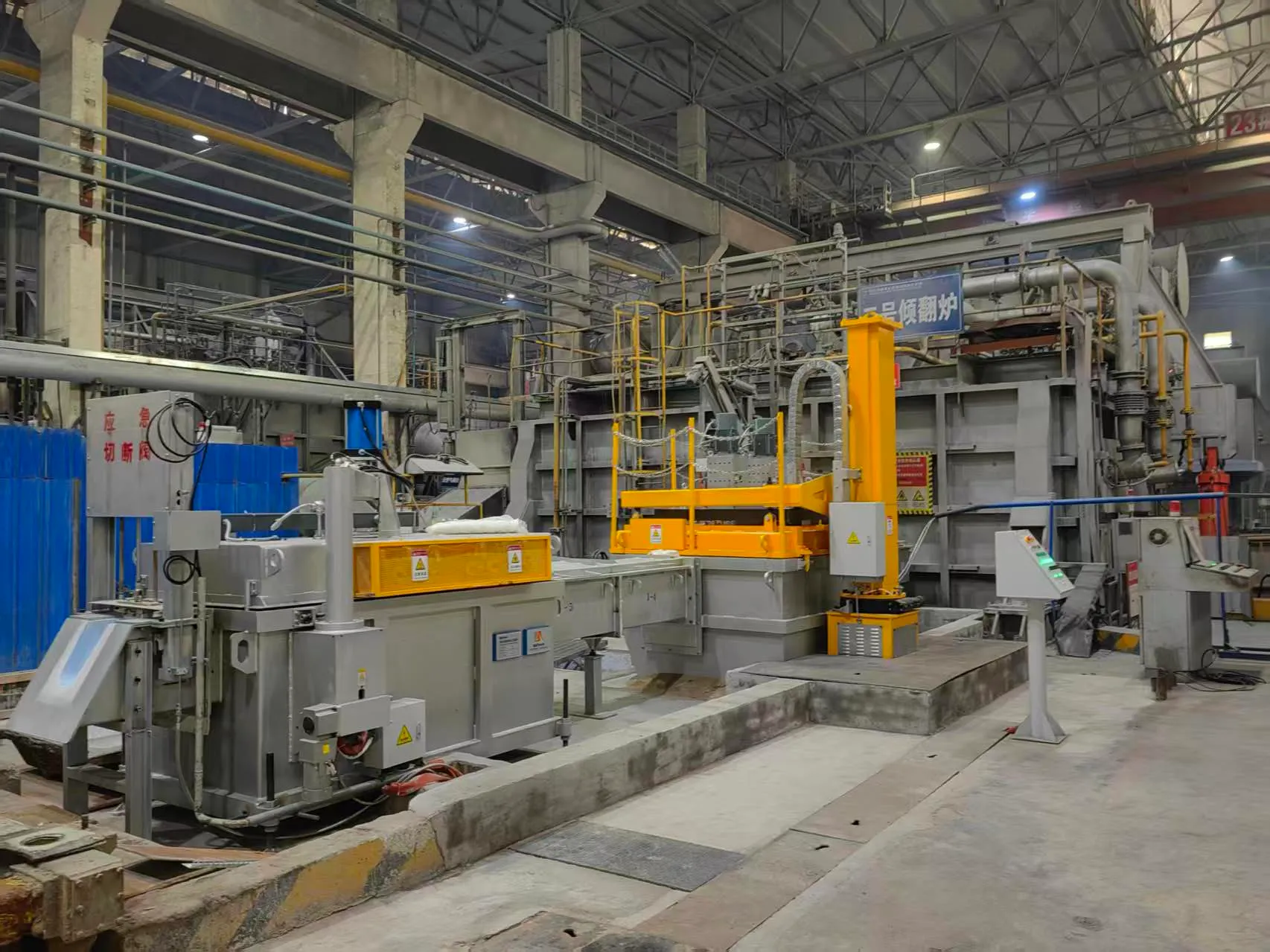
How Do Flow Rate, Pressure Drop and Filter Size Affect Performance?
Throughput is one of the first numbers AdTech engineers request because it affects nearly everything downstream in equipment sizing.
Superficial velocity can be expressed conceptually as flow divided by effective cross-sectional area. Raising throughput through a fixed filter area increases velocity. Pressure loss generally rises with flow resistance, though the precise relationship depends on medium architecture, metal properties and loading state.
A filter must be large enough to maintain its required rate even after capturing inclusions during its planned service campaign. Designing only for a clean, new filter creates little operating margin.
Pressure head also needs consideration. The upstream metal level supplies hydraulic driving force. Excessive resistance can increase metal level, disrupt launder control or starve a downstream caster. In extreme situations, poor priming or partial blockage can compromise the entire casting operation.
More area is often an effective engineering response, but oversized equipment has costs. It increases footprint, refractory mass, warm-up energy and sometimes molten metal inventory.
Optimization therefore means enough filtration capacity without unnecessary vessel size.
What Role Do Refractories Play in Filtration Reliability?
Refractory engineering is sometimes overshadowed by discussions of ceramic filters and heaters, even though the refractory is continuously exposed to severe thermal and chemical conditions.
A filter box lining needs suitable resistance to molten aluminum penetration, thermal cycling, erosion and chemical attack from the alloys and treatment practices in use. Insulating layers must reduce thermal loss while maintaining sufficient mechanical and structural stability.
Molten aluminum can interact aggressively with inappropriate materials. Alloying elements, especially magnesium in certain compositions, may change refractory-corrosion behavior. Supplier recommendations should consequently reflect actual alloy families rather than a generic “aluminum” specification.
Cracks deserve attention because they may become metal penetration paths. Metal infiltration can damage insulation, compromise heater components and make later repair much more difficult.
We pay particular attention to joints, corners, drain details and heater interfaces during equipment evaluation. These apparently minor construction features often determine real maintenance burden after repeated production cycles.
Refractory dry-out is equally important. New or repaired linings can retain moisture. Controlled curing and dry-out should follow refractory manufacturer’s procedures before molten metal introduction.
Can Filtration Remove Hydrogen From Molten Aluminum?
No. A conventional ceramic or deep bed filter is not fundamentally a dissolved-hydrogen removal device.
This question appears often because porosity and inclusions are both described loosely as “melt quality problems.” They require different treatment mechanisms.
Hydrogen removal usually relies on gas-liquid mass transfer. Inline rotary degassing creates small inert-gas bubbles, often using argon or nitrogen depending on the process. Dissolved hydrogen diffuses toward those bubbles and is transported from the melt. Process design can also help flotation of some inclusions toward the surface.
Filtration then captures suspended particles that remain in the flowing metal.
The interface between degasser and filter matters. Excess turbulence after treatment can regenerate oxide films. A beautifully specified filter cannot fully compensate for poor launders that repeatedly expose turbulent molten aluminum to air.
Maintaining metal cleanliness is therefore a system problem. Every transfer, drop, bend, level-control device and open surface between furnace and mold should be considered.
What Safety Risks Must Be Addressed Around Molten Aluminum Filters?
Molten aluminum work involves severe burn, fire and explosion hazards. The most critical rule is rigorous exclusion of uncontrolled moisture from anything that can contact the melt.
Water can rapidly vaporize when introduced beneath or into molten metal, producing violent expansion and metal ejection. Filter media, tools, refractory repairs and vessel interiors require approved drying and preheating procedures.
Heated filtration equipment also creates electrical or combustion hazards depending on configuration. Gas installations need properly engineered fuel trains, ventilation, leak management, flame safeguards and shutdown systems. Electric units need appropriate isolation, grounding, overcurrent protection, temperature protection and lockout procedures.
Operator procedures should cover personal protective equipment, emergency drainage where provided, molten-metal level limits, heater failures, thermocouple faults, blocked filters and unexpected loss of flow.
A safe system should not depend on a single temperature sensor. Critical heating applications commonly benefit from independent over-temperature protection and alarm logic appropriate to the machine risk assessment.
Safety design must ultimately follow equipment manufacturer instructions and applicable national and local codes. Production pressure is never a reason to shorten preheating or refractory-drying procedures.
How Should a Buyer Specify a Molten Aluminum Filtration System?
A productive request for quotation begins with process data rather than a preferred machine model. We normally want the supplier and buyer to agree on the operating envelope before discussing heater capacity.
Important specification fields include annual tonnage, normal and maximum instantaneous flow, alloy families, inlet metal temperature, required delivery temperature, available metallostatic head, existing launder elevation, upstream degassing process, desired filter grade or cleanliness requirement, casting-machine type, normal campaign length, alloy-change frequency, available electrical voltage and power, gas characteristics, environmental restrictions, footprint, automation platform and maintenance constraints.
Acceptance criteria need equal care.
Rather than stating “high filtration efficiency,” identify how performance will be demonstrated. When possible, agree on an upstream/downstream sampling method, stable operating condition, measurement technique and acceptance threshold before purchase.
The buyer should request documented assumptions regarding throughput. Is maximum capacity quoted using a clean filter or near the end of its campaign? At what metal temperature? With which alloy? What metal-head requirement accompanies that rate?
Those questions frequently reveal more about a filtration system than a brochure’s maximum-throughput figure.
How Can Plants Compare Suppliers Without Relying on Marketing Claims?
A technically useful comparison normalizes each proposal around the same duty point. Otherwise, one supplier may quote maximum burner power while another reports average consumption, or one may specify filter capacity at nominal flow while another gives an absolute peak.
We use a decision matrix similar to the following:
| Evaluation item | What should be verified |
|---|---|
| Maximum throughput | Conditions under which the value was established |
| Normal operating flow | Pressure/head margin over a complete campaign |
| Cleanliness | Measurement method and defined particle criteria |
| Temperature stability | Sensor locations and operating conditions |
| Energy use | Start-up, production and holding separated |
| Filter medium | Chemistry, grade, dimensions and quality controls |
| Refractory | Material specification and expected maintenance practice |
| Heater | Installed rating, controlled output and replacement procedure |
| Control system | PLC, alarms, interlocks, data logging and remote interface |
| Safety | Over-temperature, loss-of-flow and utility-failure behavior |
| Maintenance | Replacement intervals and physical access |
| Spare parts | Lead time and regional availability |
| Warranty | Clearly defined exclusions and operating conditions |
| References | Similar alloy, throughput and casting duty |
| Lifecycle cost | Energy, media, labor, downtime and metal loss |
Reference installations are particularly valuable when they genuinely resemble the proposed application. A filter performing well at low flow in one alloy is weak evidence that it will perform identically in high-magnesium production at several times the throughput.
Factory acceptance testing can verify control logic, heaters and instrumentation, but meaningful metallurgical filtration testing normally requires molten-metal production conditions. Site acceptance criteria should reflect that distinction.
What Maintenance Extends Filter-System Service Life?
The most effective maintenance program is condition-based where possible and preventive where necessary.
Operators should record temperature stability, heater output, metal level, filter campaign duration and abnormal pressure or flow behavior. Trend data can reveal gradual deterioration earlier than an emergency shutdown.
Gas burners need inspection and combustion-system maintenance consistent with manufacturer requirements. Electric heaters benefit from checking electrical connections, element resistance or condition where applicable, insulation integrity and power-control behavior.
Thermocouples should not be assumed accurate indefinitely. Sensor drift produces misleading controls even while the displayed temperature appears stable.
Refractory surfaces should be inspected between appropriate campaigns. Small cracks, erosion zones and metal penetration are easier to repair before they develop into structural problems.
Cleaning itself demands discipline. Aggressive mechanical cleaning can remove adhered aluminum but damage refractory underneath. Tools and procedures should match the lining.
Deep bed equipment adds media management. Plants need defined procedures governing removal, replacement, bed preparation and preheat. Ceramic foam systems need controls around filter storage and handling because cracked or moisture-contaminated filters should never be placed into service casually.
How Should Energy Efficiency and Carbon Emissions Influence the Decision?
Energy efficiency and greenhouse-gas emissions overlap but are not synonymous.
An efficient natural-gas heater can still create direct combustion emissions. An electrically heated filter creates no direct combustion emissions at the unit, yet its indirect carbon footprint depends on grid electricity or plant generation.
Facilities moving toward renewable electricity may find electric filtration increasingly favorable over equipment life. Plants supplied by carbon-intensive grids could reach a different lifecycle result.
The calculation should include expected future energy prices rather than relying entirely on today’s tariff. Filtration equipment can remain in service for years, while industrial energy policy and carbon costs can change significantly over the same period.
Heat conservation is beneficial regardless of energy source. Better insulation, effective covers, minimized open exposure, correctly sized heating systems and sensible standby strategies can all reduce consumption.
Oversized heaters are not automatically efficient heaters. Installed capacity needs enough reserve for start-up and disturbances, but steady-state control quality and heat containment usually determine actual operating consumption.
What Common Filtration Mistakes Cause Poor Casting Results?
The first recurring error is trying to solve every melt-quality problem by using a finer filter. If defects come mainly from hydrogen, downstream oxide generation, refractory erosion or poor casting practice, changing PPI alone will not cure them.
Another problem is treating nominal filter grade as the entire cleanliness specification. Media structure, area, velocity, installation, preheat and incoming inclusion loading can all alter results.
Uncontrolled turbulence after filtration is especially damaging. Once metal has been cleaned, a turbulent fall into an open launder can generate new oxide films downstream of the filter. The process must preserve the cleanliness that filtration achieved.
Excessive temperature is also a poor substitute for competent thermal design. Operators sometimes raise melt temperature to create extra margin against freezing. Higher temperature increases energy use and can accelerate oxidation or refractory wear. Fixing insulation, flow interruptions or heater control is preferable to routinely overheating the metal.
Finally, maintenance should not be postponed until flow becomes visibly impaired. Planned media replacement based on validated campaign performance is much easier to manage than a restriction developing during a critical cast.
Which Option Should You Choose: Gas, Electric or Deep Bed?
The answer should be framed in two stages.
First choose filtration architecture. Determine whether ceramic foam, deep bed or another suitable technology meets inclusion-removal requirements at the required flow and campaign length. Then select the heating architecture that maintains that system inside the correct thermal window.
An electric-heated ceramic foam filtration box is frequently a strong choice where plants want compact construction, controlled temperature, straightforward filter replacement, cleaner local operation and close integration with modern process controls.
Gas heating remains sensible where high heating duty combines with established gas infrastructure and favorable fuel economics, especially when combustion equipment is already familiar to the maintenance organization.
Deep bed filtration becomes compelling when cleanliness performance, throughput and long campaigns justify its larger footprint, higher molten-metal inventory and more involved media handling.
For high-value products, we would not choose solely from energy cost. A few dollars saved in heating can be insignificant compared with the cost of rejected slab, coil or billet. The metric that matters is stable production of acceptable metal at the lowest sustainable lifecycle cost.
Frequently Asked Questions About Molten Aluminum Filtration Systems
1. Is electric heating better than gas heating for molten aluminum filtration?
Electric heating usually provides excellent controllability, eliminates combustion exhaust at the equipment and integrates readily with automated temperature control. Gas heating may have lower operating cost at sites with inexpensive natural gas. Vessel design, insulation and process conditions remain at least as important as energy source.
2. Is a deep bed filter always more efficient than a ceramic foam filter?
Not under every operating condition. Deep bed filters offer substantial filtration depth and can deliver very high cleanliness in suitable continuous operations. Ceramic foam filters provide strong performance with lower metal inventory and easier media replacement. Meaningful comparisons need specified particle sizes, flow rate, alloy and measurement method.
3. What PPI ceramic foam filter should be used with molten aluminum?
There is no universal PPI. The appropriate grade depends on incoming inclusion loading, target cleanliness, flow, filter area, available head and downstream product. Finer structures usually increase resistance, making a staged or application-specific selection preferable to simply choosing the highest available PPI.
4. Does an aluminum filter remove dissolved hydrogen?
No. Filtration primarily captures non-metallic inclusions. Dissolved hydrogen normally requires a degassing process. Plants seeking high melt quality commonly combine effective degassing with filtration and controlled low-turbulence metal transfer.
5. What inclusions can aluminum filtration remove?
Common targets include aluminum oxide films and clusters, magnesium oxide, spinel, refractory fragments and other suspended non-metallic material. Capture depends on inclusion size, morphology, filter medium, flow and operating conditions.
6. Why must a ceramic foam filter be preheated?
Preheating reduces thermal shock, helps avoid premature metal freezing and supports reliable priming. It also forms part of safe moisture-control practice. Correct procedure and temperature must follow the specific filter and filtration-equipment manufacturer requirements.
7. How often should a molten aluminum filter be replaced?
Replacement intervals depend on metal throughput, incoming contamination, filter grade, alloy, campaign conditions and acceptable pressure increase. Tonnage alone should not be treated as a universal interval. Plants should establish validated campaign limits through operating and cleanliness data.
8. What is the principal disadvantage of a deep bed filter?
Its strengths come with larger equipment and operational commitment. Higher metal inventory, longer thermal preparation, media handling, footprint and changeout requirements can make deep beds less attractive in short or frequently changing campaigns.
9. Can a filtration system improve aluminum casting yield?
It can contribute indirectly by reducing inclusion-related defects and associated scrap, provided inclusions are genuinely responsible for those losses. Yield also depends on furnace practice, degassing, transfer, casting control, alloy management and downstream operations.
10. What information should be sent to a filtration-equipment manufacturer before requesting a quotation?
Provide alloy grades, nominal and maximum flow, casting process, current melt-treatment arrangement, inlet and required outlet temperatures, cleanliness objectives, campaign pattern, launder dimensions and elevation, available head, utility details, installation environment and existing quality data. Better input data results in a more defensible filter and heater selection.
Final Engineering Perspective
A useful comparison of molten aluminum filtration systems cannot stop at “gas-heated vs electric-heated vs deep bed.” The first two describe how thermal energy is supplied; the third describes how inclusions are captured through an extended filtration medium. Once that distinction is understood, equipment selection becomes considerably more systematic.
Electric heating is particularly attractive where precise temperature regulation, automation, local emissions reduction and simplified thermal control carry high value. Gas remains commercially and technically credible in plants with strong fuel infrastructure and favorable operating economics. Deep bed filtration is best evaluated on metallurgical performance, throughput and campaign economics rather than being treated merely as a third heater option.
At AdTech, we consider the complete molten-metal path when assessing a filtration project. Furnace cleanliness, degassing, launder geometry, metal velocity, refractory condition, filtration medium, heating, temperature regulation and casting stability interact with one another. Improving only one component while neglecting the rest can shift a defect instead of eliminating it.
The strongest procurement decision is therefore based on measurable conditions: inclusion population before and after treatment, target flow, allowable hydraulic resistance, metal temperature, campaign length, energy consumption under defined operating modes, maintenance intervals, filter or bed cost, molten-metal inventory, scrap performance and lifecycle expense. Those data create a technical basis on which gas-heated, electric-heated and deep bed solutions can be compared fairly.