

The AdTech Ceramic Tap Out Cone is a vacuum-formed, high-alumina refractory component engineered to improve molten aluminum handling by reducing turbulence, minimizing dross formation, and extending service life — delivering measurable reductions in material loss, fewer downtime events, and consistent metal quality across tilting and holding furnace lines.
1. Product In-Depth
What is a Ceramic Tap Out Cone?
A Ceramic Tap Out Cone is a precision-shaped refractory insert used at the metal outlet of furnaces, launders, and filter boxes to control the flow of molten metal during tapping, ladle filling, and transfer operations. Typically installed in the spout or launder throat, the tap out cone channels molten aluminum smoothly, stabilizes flow, and protects surrounding refractory from direct impingement and erosion.
Core purpose — the problem it solves
In melting and casting operations, improper flow geometry and thermal shock can cause turbulence, oxide inclusion, dross generation, and accelerated wear of downstream tooling. AdTech’s Ceramic Tap Out Cone addresses these issues by controlling flow velocity and stream shape, lowering surface exposure to air (reducing reoxidation), and improving compatibility with downstream filtration systems like filter boxes and ceramic filters. The result is higher cast metal yield, fewer non-conforming pours, and longer intervals between refractory replacements.
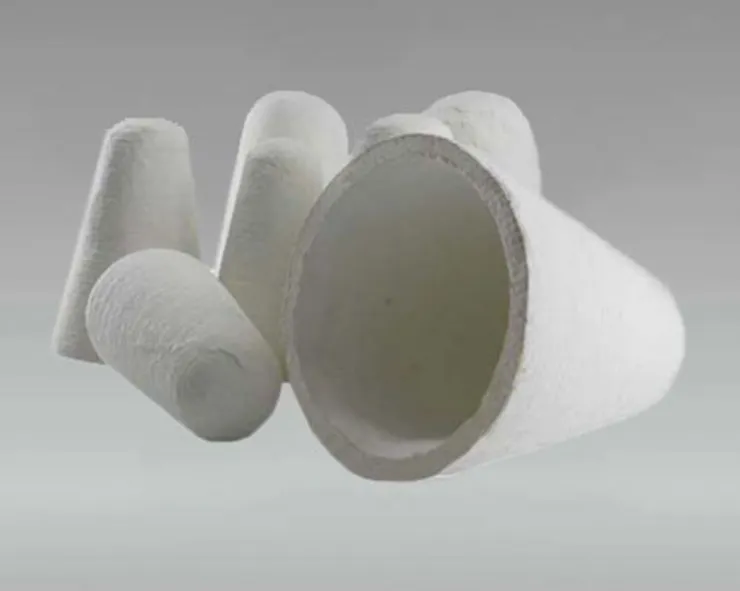
Unique Selling Points (USP)
-
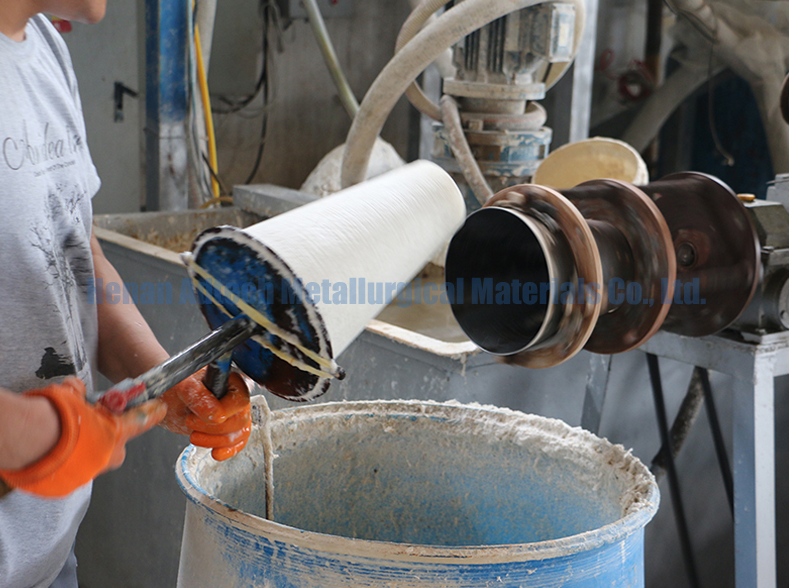
Vacuum-formed, high-density manufacture: Our cones are manufactured using an advanced vacuum forming process that yields a uniform microstructure with low open porosity — improving mechanical strength and thermal stability compared with conventionally pressed shapes.
-
High Al₂O₃ content for corrosion resistance: Formulated with high-alumina raw materials to resist molten aluminum corrosion and erosion; typical Al₂O₃ content is in the high-range (see Technical Specifications).
-
Thermal shock resistance boost: Optimized formulation and controlled sintering deliver improved thermal shock resistance — field-verified increases (typical improvements versus standard castables) reduce crack initiation during rapid temperature swings.
-
Dimensional precision for consistent flow: Tight tolerances ensure predictable metal stream geometry and compatibility with launders, ladles, and filter boxes — minimizing operator adjustments and improving automation repeatability.
-
B2B-ready customization: “Support Custom Drawings” as a standard offering to meet OEM and plant-specific interface requirements (hole patterns, flange sizes, integrated seals).
2. Technical Specifications
Below is a concise specification table commonly used on product pages and technical catalogs. This table is easily crawlable by search engines and contains the technical anchor phrases important to industrial buyers.
| Parameter | Typical Value / Range | Notes |
|---|---|---|
| Material | High-alumina ceramic (Al₂O₃-based) | Vacuum-formed alumina mix with proprietary binders |
| Al₂O₃ Content | ≥ 85% (standard) — optional 90%+ | Higher Al₂O₃ variants available for aggressive environments |
| Bulk Density | 2.8 – 3.4 g/cm³ | Depends on grade (high density for improved erosion resistance) |
| Open Porosity | < 10% (typical) | Low porosity for reduced metal penetration and corrosion |
| Cold Crushing Strength | > 60 MPa (typical) | Quality grades vary; HT grades available |
| Maximum Service Temperature | Up to 1650°C (3002°F) | Depends on grade and application; typical molten aluminum service below 800–950°C. |
| Chemical Resistance | Excellent vs. molten Al & Al-Si alloys | Resists penetration & chemical attack from common fluxes |
| Thermal Shock Resistance | Improved vs. standard castable (process dependent) | Optimized microstructure and sintering profile |
| Standard Sizes | Ø50–Ø300 mm diameters; lengths 80–300 mm | Custom diameters and lengths available — Support Custom Drawings |
| Finish | Machined / as-sintered | Machined finish for tight interface tolerances |
| Certifications | ISO 9001; material test reports (SGS / third-party on request) | Traceable batch documentation provided |
Note: “Support Custom Drawings” is explicitly provided for all B2B orders; AdTech works with customer CAD files and OEM specifications to produce precise interface geometries.
3. Customization & Ordering Guidance
-
Support Custom Drawings: AdTech accepts CAD files (STEP/IGES), dimensioned PDF drawings, and sample pieces for reverse engineering. Typical customization includes bore diameters, integrated flanges, locating tabs, cutouts for thermocouples, and bespoke taper angles for unique launder geometries.
-
Lead time: Typical production lead time for standard sizes is quoted at order; expedited manufacturing options are available for urgent plant turnarounds.
-
Spare & retrofit kits: We offer retrofit kits that include multiple tap out cones, gaskets, and alignment tools for rapid replacement during planned outages.
-
Packaging & shipping: Industrial packaging to protect precision surfaces; export crating and customs documentation available.
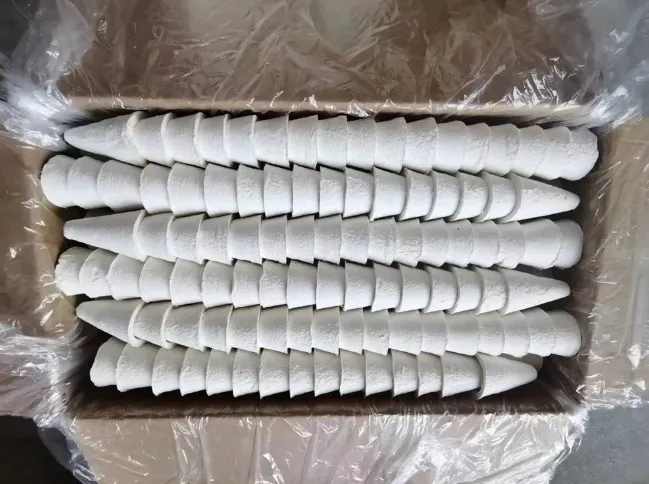
4. Applications & Compatibility
Suitable Equipment
-
Tilting furnaces (tilt-pour furnaces): Stabilizes the pour stream during tilt operations, reduces turbulence at low pour rates.
-
Holding furnaces: Protects the holding furnace spout from localized thermal erosion during extended holding cycles.
-
Filter boxes / Filter housings: Direct integration upstream of ceramic filter plates and foam filters to promote even filtration and avoid channeling.
-
Launders & launders’ outlets: Interfaces with launders to minimize splashing and dross formation when filling downstream ladles.
-
Casting cells and ladle filling stations: Ensures repeatable stream geometry for automated ladle filling and robotic handling.
Industries
-
Aluminum foundries & die casting plants
-
Aluminum alloy extrusion & rolling mills (feedstock handling).
-
Automotive component casting.
-
Aerospace alloy casting.
-
High-precision sand & permanent mold foundries.
5. Quality Assurance & Manufacturing Process
Manufacturing Overview
AdTech’s production flow emphasizes material science and process control:
-
Raw material selection: High-purity alumina powders and engineered binders are selected for low impurity content and predictable sintering behavior.
-
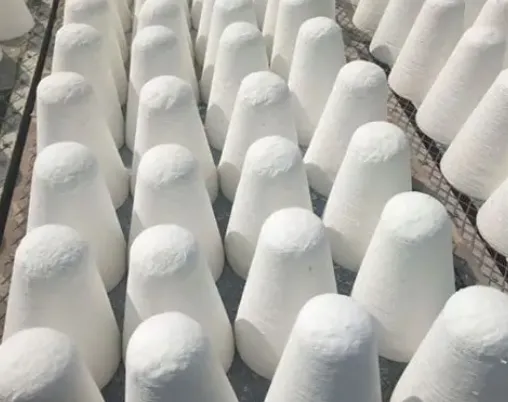
Forming: Vacuum forming (or cold pressing where specified) creates dense preforms with controlled geometry and minimal macro-defects.
-
Drying & binder burnout: Controlled thermal ramps remove binders without inducing cracks.
-
High-temperature sintering: Precision sintering cycles yield optimal density, mechanical strength, and phase stability.
-
Machining & finishing: Critical mating surfaces are machined to tolerance; optional coatings or sealants applied as requested.
-
Inspection & packing: Every unit undergoes dimensional and visual checks prior to packaging.
Inspection & Testing
-
100% Visual Inspection: Every cone is visually inspected for cracks, deformation, and surface defects.
-
Thermal Shock Testing: Representative samples are subjected to thermal cycling protocols simulating real-world plant transients to validate resistance to cracking.
-
Batch Material Certificates: Chemical composition and physical test reports accompany each shipment; third-party verification (SGS) available on request.
-
ISO 9001 Quality System: Manufacturing is executed under a documented quality management system to ensure traceability and repeatability.
Certifications & Compliance
-
ISO 9001 (quality management) — demonstrates manufacturing governance.
-
Material Test Reports — Al₂O₃ content, density, and porosity values traceable to batch.
-
Third-party testing (SGS/independent labs) available upon request to validate claims for critical aerospace or automotive applications.
6. Performance Benefits & Cost Justification
Operational Benefits
-
Reduced dross & inclusion rate: Improved flow control lowers air entrainment and oxide formation, leading to fewer defective pours.
-
Higher melting/casting yield: Less metal loss to dross and scrap increases volume of usable cast metal per melt charge.
-
Lower refractory replacement frequency: Robust material and reduced impingement extend service life, reducing unplanned downtime and maintenance costs.
-
Improved filtration performance: By presenting a stable stream to filter boxes and filter plates, filtration life and efficiency improve, reducing consumable costs.
-
Enhanced worker safety & cleaner pours: Controlled stream reduces splashing and spatter during ladle filling.
Return on Investment (ROI)
Plant managers often realize ROI through:
-
Lower consumable spend (replacement refractories & filters).
-
Fewer stoppages for emergency repairs.
-
Improved first-pass yield for cast parts.
-
Reduced aluminum loss to dross (a measurable cost item).
7. Social Proof — Representative Case Examples
Case 1: Oman Primary Aluminum Producer (2024)
In 2024, an AdTech Ceramic Tap Out Cone retrofit program at a large Oman aluminum plant reduced daily dross generation during tapping by an estimated 18% and extended launder lining life by approximately 22%, translating to a measurable decrease in scrap handling and refractory replacement costs. (Data provided by plant engineering reports during the retrofit evaluation.)
Case 2: Automotive Alloy Foundry (Europe)
A European automotive foundry integrated custom-drawn tap out cones with its filter box system. The result: more consistent metal cleanliness, fewer inclusion-related rejects on high-precision structural components, and improved uptime during high-volume production runs.
Note: AdTech provides references and more detailed case studies on request; anonymized performance data available for prospective B2B partners.
8. Installation & Maintenance Guidelines
Installation Tips
-
Ensure the cone seat and flange are clean and dimensionally correct; small misalignments can cause local hot spots.
-
Use recommended high-temperature gaskets or ceramic cement where a hermetic seal is required.
-
Allow for thermal expansion: verify clearance with neighboring launders and filter housings.
-
Where possible, pre-heat the cone gradually to operating temperature following furnace manufacturer guidance.
Routine Maintenance
-
Regular visual inspection for hairline cracks or erosion at the outlet.
-
Monitor pour quality and dross formation as indirect indicators of cone health.
-
Replace cones at the first sign of through-cracking to avoid catastrophic failure during a pour.
-
Keep spare cones on hand as part of a preventive maintenance kit.
Ceramic Tap Out Cones: Engineering & Selection FAQ
1. What is the typical service life of a Ceramic Tap Out Cone?
2. How do I choose the right size for my tap out cone?
Selection should be based on your launder diameter, required flow rate (kg/s or L/min), and ladle inlet geometry.AdTech supports Custom CAD Drawings to ensure a precise hydraulic match for your specific casting line setup.
3. Can the cone handle thermal shock from rapid temperature changes?
4. Is the cone compatible with aluminum-silicon (Al-Si) alloys?
5. Do you provide certification and material test reports?
6. Can I get a machined finish on the mating surfaces?
7. What turnaround time should I expect for custom cones?
8. How does the cone interact with a filter box?
9. Are spare parts and retrofit kits available?
10. What maintenance steps extend cone life?
Key maintenance practices include:
- Avoiding rapid, unplanned thermal shocks (preheating is recommended).
- Visual inspection for hairline cracks after each casting cycle.
- Periodic realignment of the launder interface to prevent localized erosion caused by turbulent flow.
Closing — Why AdTech Ceramic Tap Out Cone
AdTech combines material science, vacuum-forming fabrication, and field-oriented engineering to deliver Ceramic Tap Out Cones that reduce dross, improve metal cleanliness, and lower lifecycle costs. With robust manufacturing controls, traceable quality documentation, and standardized support for custom drawings, our products are designed for heavy industrial use in aluminum meltshops and casting facilities that demand predictable performance and minimal process disruption.