

Refractory ceramic fiber (RCF) insulation is a lightweight, high-temperature thermal insulation material engineered for temperatures up to 1430°C (2600°F). It features low thermal conductivity, excellent thermal shock resistance, and is widely used in industrial furnace linings, kilns, and boilers. Refractory ceramic fiber (RCF) insulation remains the most weight-efficient thermal barrier available for continuous service temperatures between 1000°C and 1600°C, and after supplying furnace builders, kiln fabricators, and industrial contractors for well over a decade, we can say without hesitation that no other insulation family matches its combination of low thermal mass, chemical stability, and installation flexibility. Whether you’re specifying a ceramic fiber blanket for a rotary kiln lining, sourcing high-purity paper for a laboratory furnace gasket, or comparing rope gasket options for a boiler door seal, this article breaks down what actually matters when selecting RCF products, drawing on real project data and the questions our engineering desk fields every week from procurement teams and plant engineers alike.
If your project requires the use of Refractory Ceramic Fiber Insulation, you can contact us for a free quote.
What Is Refractory Ceramic Fiber Insulation?
Refractory ceramic fiber is a spun or blown mineral fiber made primarily from alumina (Al₂O₃) and silica (SiO₂), sometimes with added zirconia (ZrO₂) to push the service temperature ceiling higher. The raw materials are melted in an electric arc furnace at temperatures exceeding 1800°C, then either blown with high-pressure air or spun using rotating wheels to form fine fibers, typically between 2 and 4 microns in diameter. These fibers are collected, needled, or bonded into finished shapes: blankets, boards, ropes, papers, modules, and vacuum-formed shapes.
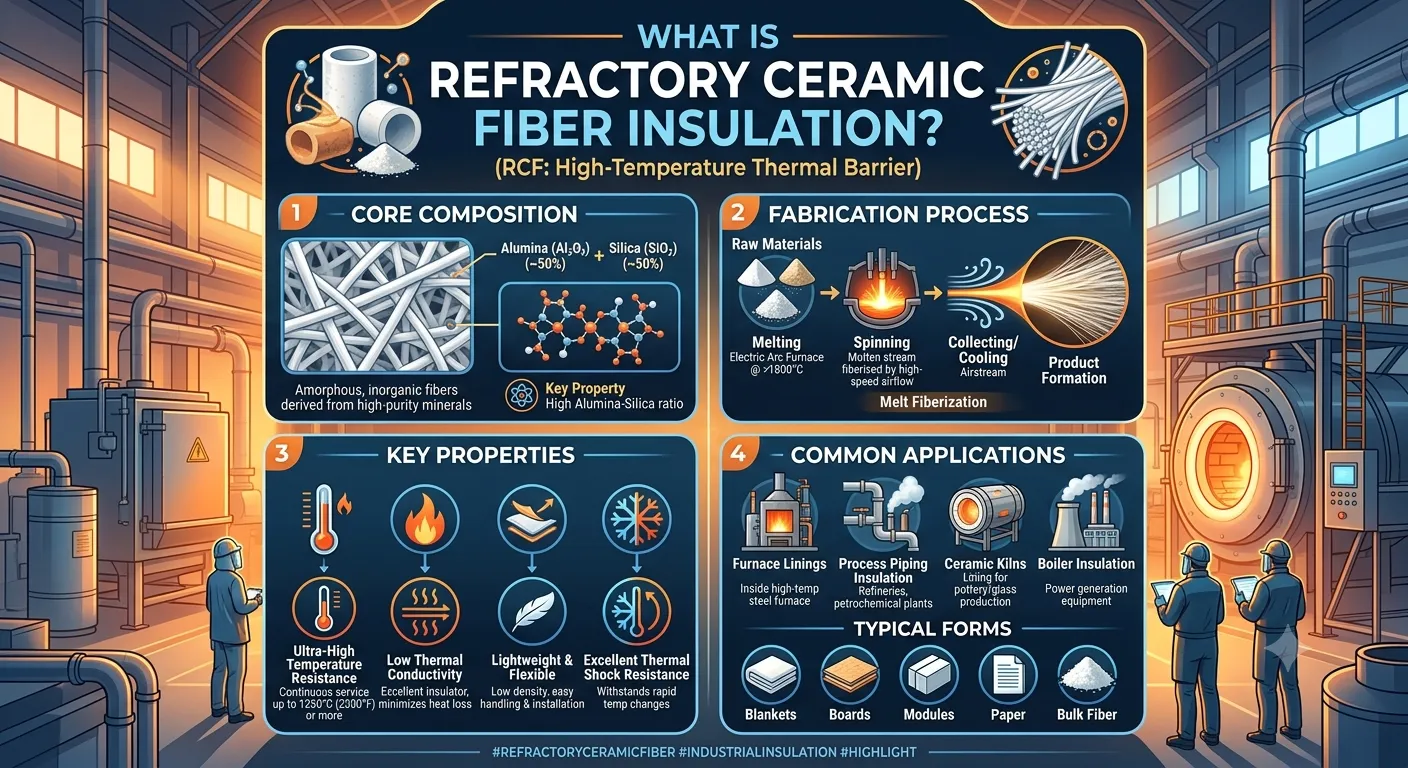
What makes RCF different from mineral wool or fiberglass is the crystalline structure that forms during cooling. Rather than a purely amorphous glass fiber, RCF develops a partially vitrified structure that tolerates repeated thermal cycling without significant degradation, at least up to its rated classification temperature. Above that threshold, the fiber begins to devitrify, forming cristobalite crystals that make the material brittle and reduce its insulating performance. This is why understanding classification temperature versus continuous use temperature matters so much when you’re specifying material for a real application rather than just reading a datasheet number.
In our shop, we’ve cut open failed linings from client furnaces more times than I can count, and the pattern is almost always the same: someone specified a 1260°C blanket for a process that actually saw hot-face spikes to 1350°C during upset conditions. The fiber survived the average operating temperature just fine but shrank and powdered during the excursions. That’s a procurement lesson as much as an engineering one.
What Are the Main Forms of RCF Products and When Do You Use Each?
Refractory ceramic fiber isn’t a single product. It’s a family, and each form exists because of a specific installation constraint or thermal design requirement.
| Product Form | Typical Density (kg/m³) | Common Thickness | Primary Use Case |
|---|---|---|---|
| Ceramic Fiber Blanket | 64, 96, 128, 160 | 13mm to 50mm | Furnace linings, kiln car tops, expansion joints |
| Ceramic Fiber Board | 200, 240, 300 | 12mm to 100mm | Backup insulation, structural panels, door linings |
| Ceramic Fiber Paper | 170 to 220 | 0.5mm to 6mm | Gasketing, laboratory furnace insulation, filtration backing |
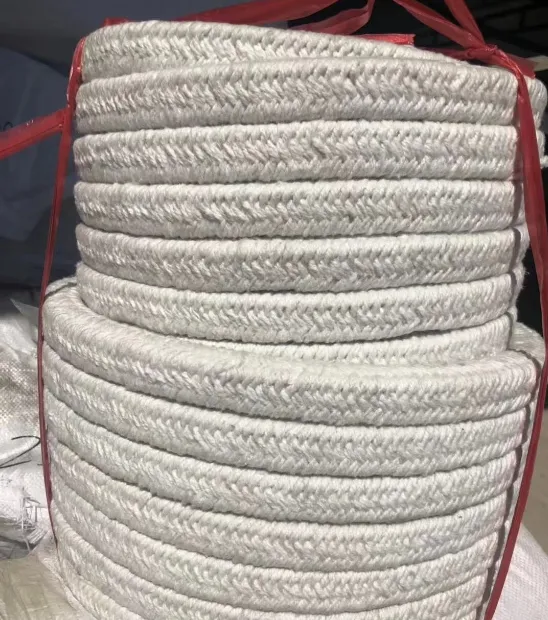
| Ceramic Fiber Rope | Braided or twisted, varies | 3mm to 50mm diameter | Door seals, expansion joint packing, pipe insulation |
| Ceramic Fiber Vacuum-Formed Shapes | 250 to 400 | Custom | Burner blocks, crucible liners, complex geometries |
| Ceramic Fiber Textiles (cloth, tape, sleeving) | Woven, coated with vermiculite or foil | Various | Welding blankets, expansion joint covers, cable insulation |
Blanket is what most people picture when they think of ceramic fiber. It’s needled to hold the fibers together, resilient enough to compress into gaps, and it recovers a good portion of its thickness after compression, which matters for furnace door seals and expansion joints that see repeated movement.
Board is a rigid alternative made by wet-forming the fibers with an organic or inorganic binder, then pressing and drying. We recommend board over blanket whenever a project needs a self-supporting panel, such as a furnace door insert or a section of duct insulation that can’t rely on pins or anchors for structural support.
Paper is the thinnest and most consistent product in the lineup, made using a papermaking process similar to conventional cellulose paper but with ceramic fibers instead. It’s the go-to choice for gasketing applications, particularly in industries like glass manufacturing and heat treatment where a thin, conformable seal is required between metal flanges exposed to high heat.
Rope comes braided, twisted, or knitted, sometimes reinforced with a fiberglass or Inconel wire core for added tensile strength. Anyone who has repacked a wood stove door gasket has probably handled a low-temperature cousin of industrial ceramic fiber rope.
How Hot Can Ceramic Fiber Insulation Actually Go?
This is probably the single most common question we get from buyers, and it deserves a nuanced answer rather than a single number pulled off a spec sheet.
| Fiber Classification | Classification Temperature | Recommended Continuous Use Temp | Typical Composition |
|---|---|---|---|
| Standard (STD) | 1260°C (2300°F) | Up to 1100°C | Al₂O₃-SiO₂, no Zr |
| High Purity / HP | 1350°C (2460°F) | Up to 1200°C | Al₂O₃-SiO₂, higher purity |
| Zirconia-Grade | 1430°C (2600°F) | Up to 1300°C | Al₂O₃-SiO₂-ZrO₂ |
| Polycrystalline (PCW) | 1600°C+ (2900°F+) | Up to 1500°C | Pure Al₂O₃ or Al₂O₃-Cr₂O₃ |
Notice that the classification temperature and the recommended continuous use temperature are never the same number. Classification temperature is determined in a lab under controlled conditions using linear shrinkage testing, typically holding the sample at temperature for a fixed duration and measuring how much it shrinks. Industry standard acceptable shrinkage is usually under 3% or 4%, but that lab test doesn’t account for thermal cycling, mechanical stress, chemical attack from process gases, or erosion from high-velocity flue gas.
We generally tell clients to leave a buffer of at least 100°C to 150°C between their expected maximum process temperature and the blanket’s classification rating, especially in applications with cyclic heating and cooling, which is harder on fiber structure than steady-state operation.
How Does RCF Compare With Other High-Temperature Insulation Materials?
Buyers often come to us already comparing RCF against calcium silicate board, mineral wool, firebrick, or microporous insulation, and it’s worth laying out the tradeoffs honestly rather than pretending RCF wins in every scenario.
| Property | Ceramic Fiber | Mineral Wool | Calcium Silicate | Firebrick | Microporous Board |
|---|---|---|---|---|---|
| Max Continuous Temp | 1300°C | 750°C | 1000°C | 1600°C+ | 1000-1200°C |
| Thermal Conductivity (mid-range) | 0.10-0.20 W/mK | 0.04-0.06 W/mK | 0.06-0.09 W/mK | 0.8-1.5 W/mK | 0.02-0.04 W/mK |
| Weight | Very light | Light | Moderate | Very heavy | Light |
| Thermal Shock Resistance | Excellent | Fair | Good | Poor to fair | Good |
| Installation Speed | Fast | Fast | Moderate | Slow | Moderate |
| Cost per m³ | Moderate | Low | Moderate | High | Very high |
| Typical Lifespan in Cyclic Service | 2-5 years | Not suitable above 750°C | 3-6 years | 10+ years | 5-8 years |
Firebrick still wins on raw longevity and mechanical durability, which is why we still spec it as a hot-face wear layer in high-abrasion zones like rotary kiln inlets, backed up with ceramic fiber as the insulating layer behind it. Microporous board delivers the lowest thermal conductivity of anything on this list, which makes it valuable in space-constrained designs, but the price per cubic meter is often three to five times that of standard ceramic fiber blanket, so it only gets specified where wall thickness is genuinely the limiting constraint.
Where ceramic fiber consistently wins is in low thermal mass applications. A furnace lined with ceramic fiber module heats up and cools down far faster than one lined with brick, which translates directly into energy savings for batch processes with frequent thermal cycling, like heat treatment furnaces running multiple loads per shift.
What Industries Actually Use This Material and Why?
RCF insulation shows up across a wider range of industries than most people expect. Based on the orders we process year over year, these are the sectors driving the bulk of demand.
Steel and metal processing accounts for a large share of consumption, primarily for reheat furnace linings, ladle preheaters, and tundish covers. The rapid thermal cycling in these applications plays directly to ceramic fiber’s strength.
Petrochemical and refining operations use RCF extensively for pipe insulation, expansion joint filler, and heater linings, often in zirconia-grade material because process temperatures in cracking units and reformers regularly exceed 1000°C.
Glass manufacturing relies heavily on ceramic fiber paper and blanket for furnace crown insulation and forehearth lining, where the low iron content of high-purity grades matters because contamination can show up as defects in the finished glass product.
Ceramics and refractory manufacturing (yes, the industry uses its own product) applies RCF in kiln car construction, shuttle kiln linings, and tunnel kiln insulation.
Power generation uses ceramic fiber rope and blanket for boiler expansion joints, turbine insulation, and flue gas duct linings.
Aerospace and foundry applications include investment casting shell insulation and crucible liners, typically specifying the higher-purity, lower-shot-content grades because shot content (unfibrized glassy beads left over from manufacturing) can compromise performance in precision applications.
How Do You Actually Choose the Right Product and Grade?
We’ve built a rough decision framework over the years that we walk clients through before quoting, because getting this wrong is expensive twice over: once when the wrong material fails prematurely, and again when the furnace has to come down for an unplanned reline.
Step one is nailing down actual peak temperature, not average temperature. Ask your process engineer for the highest recorded hot-face temperature over the last twelve months, including startup spikes and upset conditions, not the target setpoint.
Step two is considering the atmosphere. Reducing atmospheres, high-moisture environments, and exposure to alkali vapors, molten metal splash, or acidic gases all degrade standard ceramic fiber faster than a clean oxidizing atmosphere would. In some chemical exposure cases we’ve actually steered clients toward calcium silicate or a coated fiber product instead.
Step three is mechanical requirements. Does the application need something that holds its shape under its own weight (board), something flexible enough to wrap curved surfaces (blanket), or something that needs to compress and recover repeatedly (rope, for door seals)?
Step four is density selection. Higher density blanket (128 or 160 kg/m³) offers better insulating value per unit thickness and better resistance to erosion from gas flow, but it costs more and is heavier to install. Lower density blanket (64 or 96 kg/m³) is easier to handle and cut but performs worse under high-velocity gas flow conditions where erosion is a concern.
| Application Scenario | Recommended Form | Recommended Density | Recommended Grade |
|---|---|---|---|
| Furnace door seal, frequent opening | Rope or folded blanket | N/A / 96-128 kg/m³ | Standard to HP |
| Rotary kiln backup insulation | Blanket or module | 128 kg/m³ | Zirconia-grade if hot face exceeds 1300°C |
| Laboratory furnace gasket | Paper | 170-220 kg/m³ | High purity, low shot |
| Ladle cover insulation | Board | 240-300 kg/m³ | HP or Zirconia |
| Expansion joint in flue duct | Blanket, folded | 96-128 kg/m³ | Standard |
| High-erosion flue gas path | Blanket, high density | 160 kg/m³ | HP or Zirconia |
What Do Installers Need to Know Before Working With This Material?
Installation quality determines lining life almost as much as material selection does, and this is an area where we’ve seen good products fail simply because of poor installation technique.
For blanket lining, the fiber should be installed under slight compression, typically 10% to 20%, using stainless steel or ceramic anchors depending on the service temperature of the metal components. Under-compression leaves gaps that create hot spots and convective heat loss; over-compression reduces the insulating air pockets within the fiber structure and can accelerate shrinkage-related gapping over time.
Layer joints matter more than people realize. A single-layer lining with butt joints running straight through the wall thickness gives hot gas a direct path to the shell. We always recommend staggering joints between layers in multi-layer constructions, and for single-layer applications, overlapping folded joints (rather than simple butt joints) significantly reduce heat leakage at seams.
For module systems, pre-compressed blanket modules are pinned or welded to the shell using a stud and washer arrangement, and the spacing of these anchors needs to account for thermal expansion of the shell itself, not just the insulation.
Cutting ceramic fiber generates airborne fiber dust, so proper ventilation, N95 or better respiratory protection, and long sleeves are non-negotiable on any job site. We equip our own installation crews with disposable coveralls for anything beyond small patch repairs.
Is Ceramic Fiber Insulation Actually Safe to Work With?
This question deserves a straight answer because there’s a lot of outdated fear floating around alongside some legitimate caution.
Refractory ceramic fiber (the amorphous, unfired form) is classified in various jurisdictions as a possible carcinogen based on animal studies, largely because of respirable fiber size and biopersistence concerns similar to those associated with asbestos, though RCF is chemically and structurally distinct from asbestos minerals. The bigger concern in practice comes after use, not before: once RCF has been exposed to temperatures above roughly 900°C to 1000°C for extended periods, a portion of it converts to cristobalite, a crystalline form of silica that carries its own recognized respiratory hazard (silicosis risk) upon inhalation of dust during removal or demolition.
Because of this, we always tell clients handling teardown of old furnace linings to treat spent RCF as a higher-hazard material than new, unused RCF, and to follow local regulations regarding respiratory protection, wetting down material before removal to suppress dust, and proper disposal procedures. Many regions classify spent RCF differently from virgin material for disposal purposes, so it’s worth checking local waste regulations before a reline project rather than after.
Manufacturers have also developed low-bio-persistent (LBP) fiber alternatives, sometimes marketed as alkaline earth silicate (AES) wool, which is engineered to dissolve more readily in lung fluid if inhaled, reducing long-term retention. AES products typically top out around 1000°C to 1100°C continuous use, lower than traditional RCF, so they’re not a drop-in replacement for high-temperature zirconia-grade applications, but for mid-range temperature work they’re becoming the preferred choice in markets with strict occupational exposure regulations.
How Is Refractory Ceramic Fiber Actually Manufactured?
Understanding the manufacturing process helps explain why quality varies so much between suppliers, something buyers rarely think about until they’ve been burned by an inconsistent batch.
The process starts with raw material selection, typically calcined alumina and high-purity silica sand, melted together in an electric furnace at temperatures around 1800°C to 2000°C. The molten stream is then fiberized using one of two methods: the blowing process, where high-velocity air or steam streams strike the molten material and draw it into fibers, or the spinning process, where the melt is poured onto rapidly rotating wheels that fling it into fine filaments.
Spun fiber tends to be finer and produces less shot content (those unwanted glassy beads mentioned earlier), which generally means better insulating performance and less skin irritation during handling, but it’s a slower and more expensive process. Blown fiber is more economical and remains the dominant method for standard commercial-grade blanket.
After fiberizing, the loose fiber (sometimes called “wool”) gets collected on a moving belt, then either needled mechanically to interlock the fibers into a coherent blanket, or mixed with a binder and formed into board or vacuum-formed shapes, or processed on papermaking equipment for paper products.
Quality control at a reputable facility includes checking fiber diameter distribution, shot content percentage, density uniformity across the roll, and shrinkage testing on sample batches pulled from actual production runs, not just periodic spot checks. We’ve toured facilities where shrinkage testing happened once per week regardless of production volume, and we’ve toured others that test every batch. The difference shows up years later in the field, which is exactly why it matters at the sourcing stage.
What Should Buyers Check Before Placing a Bulk Order?
For procurement teams sourcing RCF products, price per kilogram tells you almost nothing useful on its own. Here’s what we recommend checking before committing to a supplier, especially for first-time or high-volume orders.
| Checkpoint | Why It Matters |
|---|---|
| Shot content percentage | Higher shot content lowers insulating efficiency and increases weight without adding thermal benefit |
| Fiber diameter | Finer fibers generally insulate better but may be more prone to airborne dust generation |
| Certified shrinkage test data | Confirms the product actually meets its stated classification temperature |
| Density consistency across the roll | Inconsistent density leads to uneven thermal performance across the lining |
| Country of origin and mill certification | Affects both quality consistency and compliance with import regulations |
| Packaging and moisture protection | Moisture absorption during shipping can affect handling and, in rare cases, performance |
| Chemical composition report (Al₂O₃/SiO₂/ZrO₂ ratio) | Confirms the grade matches what’s needed for your specific temperature and atmosphere |
| Sample testing before bulk order | A small test batch run through your own QC avoids costly surprises on a full container order |
We always encourage new clients to request a certificate of analysis with every shipment, not just the first one. Fiber composition can drift slightly between production batches even at reputable mills, and for critical high-temperature applications, that drift matters.
Frequently Asked Questions
1. What is the difference between ceramic fiber blanket and ceramic fiber board?
Blanket is flexible, needled fiber that can be wrapped around curved surfaces and compressed into gaps, while board is rigid, pressed with a binder, and used where self-supporting structure is needed, such as furnace door panels or backup insulation behind a hot-face brick layer.
2. Can ceramic fiber insulation be reused after removal from a furnace?
Generally no for hot-face material, since fiber exposed to high temperature undergoes shrinkage and partial devitrification that permanently reduces its insulating performance and increases brittleness. Backup insulation that never saw high temperature may sometimes be salvageable, but we recommend replacement in most cases for reliability.
3. How long does refractory ceramic fiber blanket typically last?
Service life varies enormously by application, but in cyclic industrial service, expect somewhere between 2 and 5 years for standard grades, with high-purity and zirconia grades sometimes lasting longer in the same conditions due to better resistance to shrinkage and devitrification.
4. Is ceramic fiber insulation waterproof?
No, standard RCF absorbs water and loses some structural integrity when saturated, though it dries out and typically regains most of its properties once fully dried, provided it wasn’t stored wet for an extended period that allowed binder degradation in bonded products.
5. What thickness of ceramic fiber blanket do I need for my furnace?
Thickness depends on target hot-face temperature, desired cold-face temperature, and ambient conditions, and is typically calculated using thermal conductivity data at mean temperature. As a rough field reference, a 50mm layer of 128 kg/m³ blanket might drop temperature by 300°C to 500°C depending on hot-face conditions, but a proper heat transfer calculation is always recommended for critical applications.
6. Does ceramic fiber insulation contain asbestos?
No, refractory ceramic fiber is a man-made vitreous fiber composed of alumina and silica, chemically and mineralogically distinct from asbestos, which is a naturally occurring mineral fiber.
7. What’s the difference between standard RCF and AES (alkaline earth silicate) wool?
AES wool is engineered to be less biopersistent, meaning it dissolves more readily in lung fluid if inhaled, and generally tops out around 1000°C to 1100°C continuous use, while standard RCF can handle higher temperatures but carries different long-term exposure considerations.
8. Can ceramic fiber paper be used for gasket applications in food or pharmaceutical equipment?
It’s used in some industrial heat processing equipment, but for direct food contact applications, buyers should confirm compliance with relevant food safety and material contact regulations with the specific supplier, as not all grades are certified for that use.
9. Why does my ceramic fiber blanket shrink after only a few months of use?
Shrinkage beyond the expected rate usually indicates the material was operated above its rated classification temperature, exposed to chemical attack from process gases, or that a lower-grade product was substituted for what the application actually required.
10. How do I calculate how many rolls of ceramic fiber blanket I need for a project?
Measure the total surface area to be lined, factor in roll width (commonly 610mm or 1220mm) and length (commonly 7.2m or 14.6m depending on thickness and density), then add 10% to 15% waste allowance for cutting, overlaps, and irregular geometries like corners and penetrations.
Final Thoughts From Our Experience Supplying This Material
After years of fielding calls from engineers who inherited a furnace design from someone else and buyers who just need a reliable supplier who won’t send them an inconsistent batch, our biggest piece of advice is this: match the product grade to your actual peak operating conditions, not your average conditions, and don’t treat ceramic fiber as a commodity where the cheapest option per kilogram automatically wins. A blanket that lasts eighteen months longer than a cheaper alternative usually pays for the price difference many times over once you account for downtime, labor, and production losses during an unplanned reline. That calculation, more than any single technical spec, is what separates a good insulation decision from an expensive mistake.