
Using a properly formulated chloride/fluoride refining flux, applied with controlled technique, will markedly lower hydrogen content and reduce oxide inclusions in molten aluminum, improving casting surface finish, mechanical integrity, and yield. In typical foundry practice, a correctly chosen flux combined with degassing reduces hydrogen to levels near or below 0.1 ml/100 g Al and cuts oxide-related defects by tens of percent, when paired with correct handling and temperature control.
Why this matters for an aluminum foundry
Short version: cleaner metal means fewer scrap parts, less machining, fewer rejects, and stronger components. Refining flux plays a major role in achieving that cleaner metal by removing dissolved gas, capturing oxides, and promoting formation of a scum layer that can be skimmed. Modern flux chemistry, correct dosing, and matched application technique are the difference between routine quality and premium-level castings.
How refining flux actually works
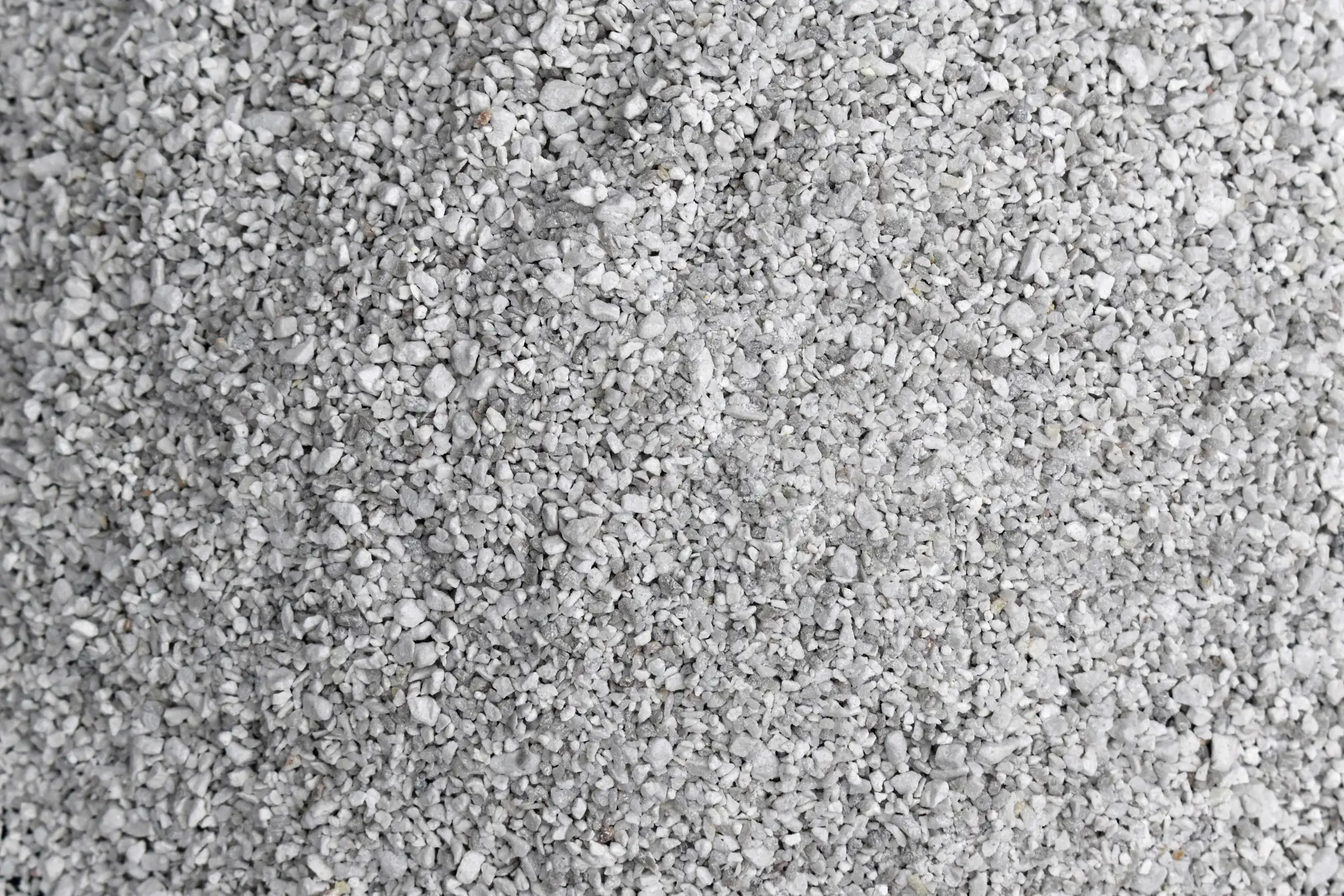
Fluxes for aluminum melts are blends of chloride salts, fluoride salts, and additives chosen for melting point, wettability, and reactivity. When placed onto or injected into molten aluminum, the flux melts, spreads, captures oxides, and forms a lighter slag layer that floats to the surface. Some fluxes release reactive species that help gas bubbles carry dissolved hydrogen upward. The combined result is lower hydrogen solubility, fewer inclusions, and an easier skimming step.
Key mechanisms at work
-
Wetting and adsorption: flux contacts oxide films, reduces contact angle, then adsorbs or dissolves oxide fragments.
-
Bubble-assisted transport: inert gas bubbling or flux tablets generate bubbles; these bubbles attach inclusions and carry them upward.
-
Chemical reaction: certain fluoride components interact with alumina films, weakening them so they are removed from the melt.
Typical flux compositions
Many commercial fluxes use a base eutectic mixture of potassium chloride plus sodium chloride, with small fractions of fluorides that lower melting point and improve oxide interaction. Common fluoride additions include sodium fluoride and sodium hexafluoroaluminate. Percentages vary by formulation. Below is a compact table of common component ranges used in foundry fluxes.
Table 1: Typical component ranges for refining flux formulations
| Component | Typical fraction by weight (range) | Primary function |
|---|---|---|
| KCl (potassium chloride) | 35–50% | low-melting base, density control |
| NaCl (sodium chloride) | 35–50% | forms low-temperature eutectic with KCl |
| NaF / CaF₂ / Na₃AlF₆ | 2–10% | reduce melting point, attack alumina |
| Additives (carbonates, nitrates, wetting agents) | 0–10% | control hygroscopicity, flow, foaming |
| Flux binders or anti-caking agents | trace–3% | handling, shelf stability |
Source materials show common mixtures, including a typical cover flux formula near 47.5% NaCl, 47.5% KCl, 5% fluoride salt in industry practice.
Standard refining flux type
| Type | Function | Scope of Application | Dosage per ton | Refining temperature |
| 3RF | Degassing & Deslagging | Molten casting aluminum and alloy degassing, deslagging & purifying | 1.5-2.5kg | 700- 740℃ |
| 6RF | Degassing & Deslagging, better than 3RF | Refining of cable rod and alloy rod precise casting | s1.0-1.5kg | 700- 740℃ |
| 9RF | Environmental, without C2Cl6 | Refining of high purity & high magnesium molten alloy in furnace | 1.5-2.0kg | 700- 740℃ |
| 420RF | Degassing type | Refining and purifying of highly precise aluminum, such as A356.2 and hub | 1 .5-2. 5kg | 710 – 730℃ |
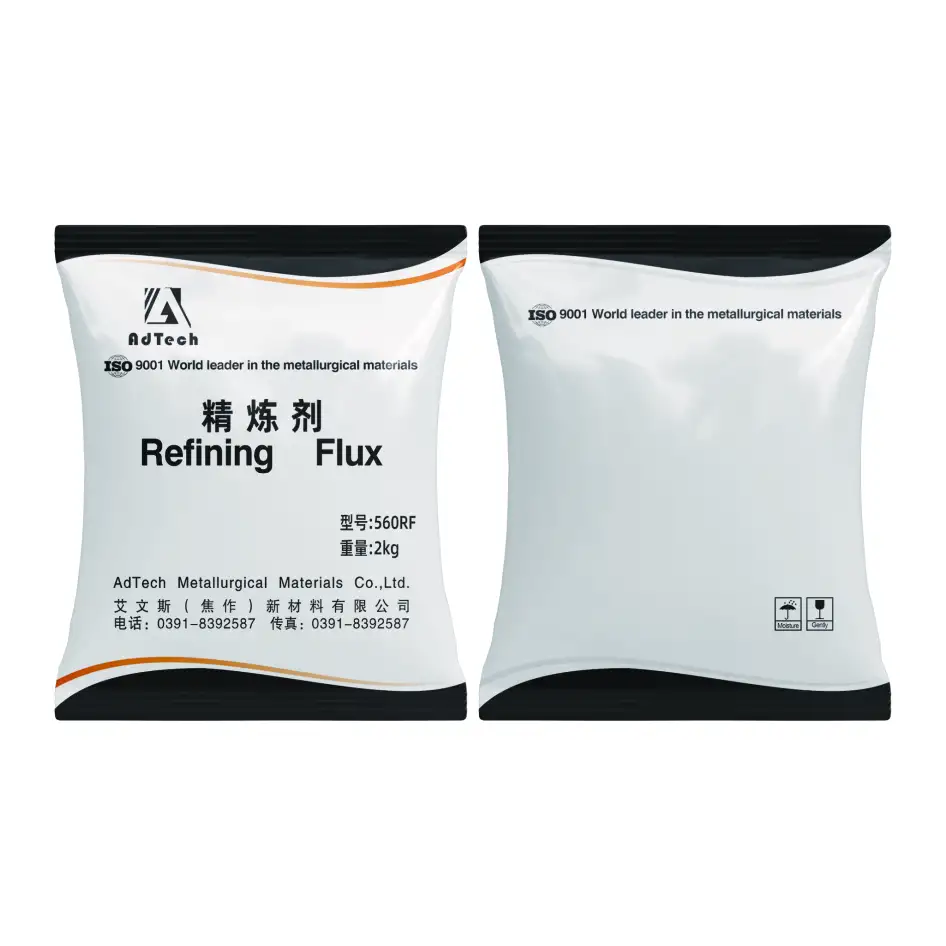
| 560RF | Na free type, Degassing & Deslagging | Refining and purifying of 5 series aluminum alloy and hub in the furnace | 1. 5-2.0kg | 720 – 740℃ |
| 33SF | Degassing & Deslagging | Refining and purifying of double Zero foil preform body in furnace | 1. 5-2.0kg | 720 – 740℃ |
| 66SF | Degassing & Deslagging | Refining and purifying of aluminum alloy precise casting in furnace | 1. 5-2.0kg | 720 – 740℃ |
| 120SF | Denatrium and dicalcium type | Removing micro-scale of Na、Ca、H、Li in molten aluminum & alloy in the furnace, refining, and purifying efficiency | 1. 5-4.0kg | 735 – 745℃ |
| 220SF | Demagnesium | Removing micro-scale of Mg in molten aluminum and alloy in the furnace, refining, and purifying efficiency | Can remove 1kg Mg with 5kg 220SF | 735 – 745℃ |
Packing Specifications:
| Item | Internal Packaging | Carton Packaging | Pallet Packaging | Special Packaging | Storage & Guarantee |
| Index | 2-5kg/bag | 25kg/carton | 1T/pallet | As per requirement | Stored in a ventilated and dry environment, for 6 to 12 months |
Instructions:
| Type | Advantages | Instructions |
| 3RF,6RF,9RF | 1. Good liquidity, good performance in degassing and deslagging 2. Superior purification, little pollution, little dosage, low cost 3. Continuous using will effectively prevent oxide accumulation in the furnace’s inner surface 4. Easy separation of aluminum and slag 5. 6RF is environmental with no irritative smell, and no damage to health. |
Remove packaging, and put flux into the spray equipment, flux goes through the spray jar with N2 or Ar gas as carrier, spraying evenly two times to molten metal. Make sure the nozzle outlets as close to the bottom layer of molten metal as possible, and move the nozzle back and forth, so that flux is fully in contact with molten aluminum. Then refine the molten metal with N2 or Ar gas in turns at the bottom layer for 20 minutes. After physical and chemical changes in molten aluminum, numerous small bubbles with oxidized slag separation are formed. The bubbles carrying hydrogen atoms slowly rise up and float out, so as to achieve the degassing and deslagging purpose of purification. |
| 420RF,560RF | 1. With little sodium, non-poison, and peculiar smell-free, makes no effect on strontium modifying 2. Good liquidity, good performance in degassing and deslagging 3. Superior purification, little pollution, little dosage, low cost 4. Continuous using will effectively prevent oxide accumulation in the furnace’s inner surface 5. Easy separation of aluminum and slag. |
Remove packaging, flux goes through the spray jar with gas as a carrier, sprayed into molten metal. Make sure the nozzle outlets are as close to the bottom layer of molten metal as possible, and move the nozzle back and forth, so that flux is fully in contact with molten aluminum, to achieve refining purposes. After spraying, take out the slag floating on the surface of molten aluminum. |
| 33SF,66SF | 1. Non-poison and peculiar smell-free, optimum effect for precise casting 2. Good liquidity, good performance in degassing and deslagging 3. Superior purification, little pollution, little dosage, low cost 4. Continuous using will effectively prevent oxide accumulation in the furnace’s inner surface 5. Easy separation of aluminum and slag. |
Remove packaging, flux goes through the spray jar with gas as a carrier, sprayed into molten metal. Make sure the nozzle outlets are as close to the bottom layer of molten metal as possible, and move the nozzle back and forth so that flux is fully in contact with molten aluminum, to achieve refining purposes. After spraying, take out the slag floating on the surface of molten aluminum. |
| 120SF | 1. Mainly composed of an anhydrous potassium compound, with a quick refining effect 2. Effectively remove sodium, lithium, and calcium in molten aluminum-magnesium alloy and aluminum-zinc alloy 3. Remove a variety of non-metallic inclusions such as oxides, carbides, and borides at the same time, together with degassing effort, so as to achieve the purpose of molten aluminum purification. |
1. The dosage is according to the original amount of inclusions, H, Li, Ca, and expected refining standard 2. Remove the basic metal from molten aluminum in the smelting and receiving furnace. 1-1.5kg dosage per ton of molten aluminum, spraying flux will get a better effect of hydrogen, basic metal, and inclusions removing 3. The temperature of the molten aluminum furnace should be 710-745 ℃ 4. Take samples in 3 layers of molten aluminum and make Na、H、Ca and Li analysis, accomplish a non-metallic inclusions removing procedure. |
| 220SF | 220SFis white powdery particles, mainly made of chloride, fluoride, and other elements. With the function of little spreading gas bubbles and active solventia, adjust the speed of chemical reaction, so as to strongly remove Mg element in molten alloy. At the same time, this process also drives out calcium and other metal elements, which brings effective degassing refining, removes inclusions, and helps to minify crystal and such effects. Economically and stably, the slag after processing is incompact and dry, which is easy to take off. | 1. Removing 1 kg Mg in aluminum alloy requires 5kg 220SFin average 2. Calculation: Dosage=(Mg content before damaging– target Mg content)*molten aluminum weight *(5±0.5kg) 3. Analyze a sample of molten aluminum, ascertain metal elements share, and calculate the dosage of 220SF according to the formula 4. Application temperature: 735-745℃ 5. Spray 220SF with nitrogen as a carrier into the furnace in 2 steps and ensure fully contacted. The first step takes half of 220SF and refines for 20-25 minutes, then dross. The second step takes the remaining 220SF, refines for 15-20minutes, and again. When finished, close the furnace door and keep annealing for10 minutes 6. Take samples in 3 layers of molten aluminum and make magnesium analysis, accomplish damaging and refining procedure. |
Choosing flux by alloy family
Different alloys demand different flux properties. High-magnesium aluminum alloys, for instance, need formulations that avoid aggressive reactions with Mg while still removing oxides. Below is a decision grid to match flux type to alloy group.
Table 2: Flux selection matrix by alloy family
| Alloy family | Typical challenge | Flux traits to prioritize |
|---|---|---|
| Pure Al and low-alloy (1xxx, 3xxx) | High hydrogen pickup | Strong degassing, fluoride fraction moderate |
| Al-Mg alloys (5xxx) | Mg reactivity, dross formation | Lower fluoride fraction, controlled temp |
| Al-Si casting alloys (3xx, 4xx) | Oxide films, inclusions | Good wettability, higher adsorption capacity |
| Heat-treatable alloys (2xx, 6xx) | Porosity affecting mechanicals | Aggressive degassing plus oxide removal |
| Scrap-heavy melts | High dross, inclusions | Higher scavenger fraction, robust skimming |
Use manufacturer data to fine-tune percent dosing. Lab trials yield best long-term results.
Application methods: cover flux, tablet, injection
There are three main application routes: surface covering, tablet dosing, and injection (lance or rotary injection). Each has trade-offs in speed, flux consumption, operator safety, and effectiveness.
Table 3: Application methods with pros and cons
| Method | Pros | Cons | Typical dose practice |
|---|---|---|---|
| Surface covering (hand spread) | Simple, low equipment cost | Slower, operator exposure risk | 0.2–1.0% of metal weight, spread then stir |
| Tablet flux (compressed tablets) | Controlled dose, cleaner handling | Slower dissolution sometimes | 1–3 tablets per 100 kg, vary by tablet size |
| Injection (lance or rotary) | Fast penetration, uniform mixing | Equipment cost, more complex controls | 0.1–0.5% metal weight, optimized by lance depth |
Injection with a matched lance often yields faster homogenization and lower total flux use in high-volume foundries. Recent product literature shows tablet plus cover flux combinations give consistent degassing with low dross metal loss.
Process parameters that matter
Keep these controlled to get predictable results:
-
Melt temperature: maintain steady target; low melting point fluxes require careful control near eutectic range.
-
Flux dryness: wet flux clumps, fails to melt properly, and produces poor coverage. Store in dry conditions.
-
Agitation intensity: moderate stirring after flux application helps distribute flux and release attached gases.
-
Soak time: allow time for flux to melt, interact, then float off to surface before skimming.
-
Dosing rate: underdose yields poor refining; overdose wastes material and can increase dross.
Safety, storage, environmental control
Fluxes contain salts and fluoride compounds that can produce fumes or react when mishandled. Implement strict PPE, engineering controls, and handling protocols. World Bank and industry guidelines recommend dust control, local exhaust ventilation, and training for staff handling flux and dross. For dross handling, avoid exposing hot dross to drafts, spread hot material to let it cool, and cover it with inert salt if thermite risk arises.
Key rules checklist
-
Keep flux in sealed, dry containers.
-
Prevent inhalation by using masks rated for particulate and fluoride-containing dust.
-
Provide eye and face protection plus insulated gloves for application.
-
Use local exhaust near injection points.
-
Maintain written procedures for dross cooling and storage.
How to measure success — practical KPIs
Track these metrics to prove improvement:
-
Hydrogen content (ml/100 g Al) measured by vacuum extraction or carrier gas method.
-
Filtration throughput and filter clogging frequency.
-
Dross metal recovery fraction.
-
Percent rejects or rework per batch.
-
Visual surface quality metrics for critical cast parts.
Industry reports indicate properly applied flux plus degassing can push hydrogen levels toward 0.1 ml/100 g for many alloys, a level associated with reduced porosity and stronger cast parts.
lab-to-floor validation: recommended trials
Run side-by-side melts with identical charge materials and process settings, varying only flux chemistry or application method. Measure hydrogen, include metallography to quantify inclusions, record dross weight and metal lost. Keep trials short but statistically significant, using at least 3 repeats per condition.
Case study: ADtech installation at a Russian foundry
Overview
Client: a mid-size Russian aluminum casting plant producing automotive components. Challenge: frequent internal porosity complaints on piston housing runs and high scrap rates during winter months.
Solution delivered
-
ADtech supplied a tailored flux blend (KCl/NaCl base, tailored fluoride fraction, anti-caking agent) matched to the plant’s Al-Si alloy feedstock.
-
Injection lance retrofit to existing furnace with operator training program.
-
Standard operating procedure for dosing, agitation, and skimming.
Results (3-month averaged outcomes)
-
Hydrogen content dropped from 0.25 ml/100 g Al to 0.09 ml/100 g Al.
-
Porosity-related rejects decreased by 48%.
-
Net metal recovered from dross rose by 12% due to cleaner skimming and lower entrained metal.
-
Flux consumption per tonne of cast metal decreased by 18% following optimization.
Why success occurred
-
Matching flux chemistry to alloy and process parameters.
-
Consistent dosing from injection, lowering operator variability.
-
Real-time feedback using vacuum hydrogen tests enabled quick tuning.
This case highlights the benefit of pairing proper chemistry with modern application hardware and operator protocol.
Troubleshooting common problems
Problem: Flux floats yet inclusions remain
Possible causes: insufficient agitation, underdosing, flux degraded by moisture. Remedies: increase controlled stirring, check storage, add small incremental dose during test melt.
Problem: Excessive foaming or dross that traps metal
Possible causes: too high fluoride fraction, rapid addition, wrong alloy-flux match. Remedies: reduce fluoride fraction, slower addition, lower melt turbulence.
Problem: Rapid flux consumption with marginal effect
Possible causes: poor flux purity, presence of contaminants, repeat oxidation source in melt. Remedies: check scrap quality, pre-clean charge, consider filtration upgrade prior to fluxing.
Problem: Strong fumes or local irritation
Possible causes: overheating, wet flux, poor ventilation. Remedies: stop additions, ventilate, review PPE, check flux vendor safety sheet.
Filtration plus flux: a system approach
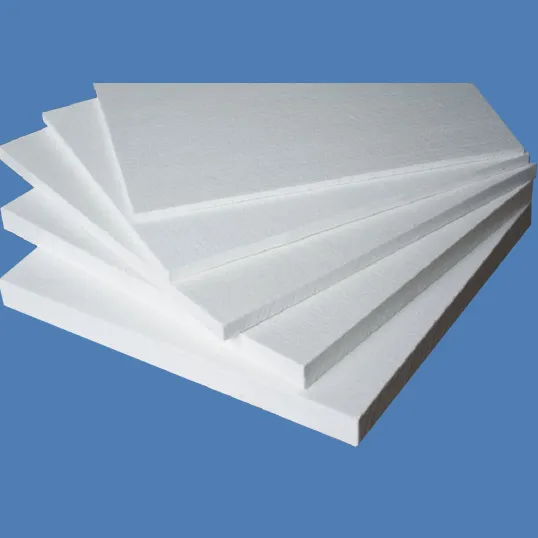
Flux removes oxides and helps gas escape, while ceramic filters trap remaining non-metallic inclusions. Combining both in a consistent workflow yields the highest quality. Typical sequence: preheat crucible or ladle, pour through in-line ceramic filter into mold, apply flux and degas on ladle when required, final skim before pouring critical molds.
Table 4: Process checklist for a single melt cycle
| Step | Action | Target metric |
|---|---|---|
| Charge prep | Remove gross contaminants, control scrap mix | Visual cleanliness |
| Heat to temp | Reach alloy target + margin for pouring | ±5°C stability |
| Flux application | Spread or inject flux | Dose per batch |
| Agitation | Standardized stirring or lance pattern | Time, RPM or bubble rate |
| Soak | Let flux work, let bubbles rise | 3–10 minutes typical |
| Skim | Remove flux/slag layer | Clean surface |
| Degas final | Optional quick purge | Hydrogen target |
| Pour | Steady pour rate | Avoid turbulence |
Practical notes on storage and shelf life
Store flux in dry heated rooms when possible. Keep humidity low to avoid clumping. Batches can pick up moisture rapidly in damp environments, reducing performance. Use first-in, first-out inventory and label bags with production date. Small tests on each new batch will catch out-of-spec material.
Environmental handling of dross and spent flux
Dross contains entrained metal, oxides, and flux residue. Recover metal where possible via reclaim ovens or dross presses. Follow local waste regulations for disposal of spent flux that contains reactive fluorides. Thermal reclamation often returns usable metal, reducing overall melt cost.
Practical dosing rules of thumb
-
Start with vendor recommended dose per tonne.
-
For injection, aim for fine, distributed dosing to promote rapid reaction.
-
For hand covering, ensure flux is dry and spread to form a thin, continuous layer.
-
Perform vacuum hydrogen tests after initial trial dose, then reduce dose until minimal effective level reached.
Monitoring tools and test methods
-
Vacuum extraction hydrogen measurement for accurate dissolved hydrogen.
-
Optical microscopy on etched samples to quantify inclusion area fraction.
-
Spark spectrometry for alloy verification post-flux to ensure no contamination.
-
Dross composition assays to measure metal recovery potential.
Regulatory and material safety data
Always consult the supplier material safety data sheet (MSDS) for hazard classification. Fluoride containing fluxes may require special emergency procedures for ingestion or eye contact. Operators must have training on spill response and first aid.
Key recommendations from international EHS guidelines include engineering controls for dust, process vents near injection points, and record keeping for hazardous material usage.
How modern research shapes flux design
Recent peer-reviewed work demonstrates the role of surface chemistry, contact angle between flux and alumina, and thermodynamic activity on removal efficiency. Optimized fluxes can have melting points well below refining temperatures, allowing better wetting and faster inclusion capture. Lab research supports industry practice that composition tuning yields measurable performance gains.
Molten Aluminum Refining Flux: Technical FAQ
1. What is the main job of a refining flux?
2. Which flux chemistry works for general casting alloys?
3. How much flux should I dose per tonne?
4. Should I inject flux or spread it on the surface?
5. How long to wait after flux application before skimming?
6. Can flux damage alloy chemistry?
7. How to handle wet or caked flux?
8. Are fluoride-free fluxes effective?
9. How to measure hydrogen improvement?
10. What is a common operator error to avoid?
Final checklist for implementation
-
Choose flux formulation matched to alloy family.
-
Decide application method suitable for production volume.
-
Train operators on dose, timing, and safety.
-
Monitor hydrogen and inclusion metrics.
-
Reclaim dross metal where possible.
-
Maintain dry storage and inventory control.
Closing recommendations
Invest time in small-scale trials on your exact charge mix. Monitor key KPIs, then scale changes that show clear, repeatable improvement. Pair flux selection with filtration and degassing hardware upgrades for the greatest gains in casting quality and yield. The right chemistry, applied with repeatable technique, produces tangible reductions in porosity, rework, and scrap, giving you a straight path to better product value and lower cycle cost.