
Ceramic fiber rope provides a compact, cost effective sealing and thermal-insulation solution for high temperature installations in aluminum foundries. When chosen correctly, installed with proper backing and supported by compatible hardware, ceramic fiber rope reduces heat loss, improves furnace efficiency, lowers flux and metal contamination risks, and extends the life of door seals and hot-top assemblies. For foundry teams seeking higher uptime and cleaner castings, combining ceramic fiber rope with AdTech’s degassing and filtration products delivers measurable gains in yield and product quality.
1. What ceramic fiber rope is and why it matters in foundries
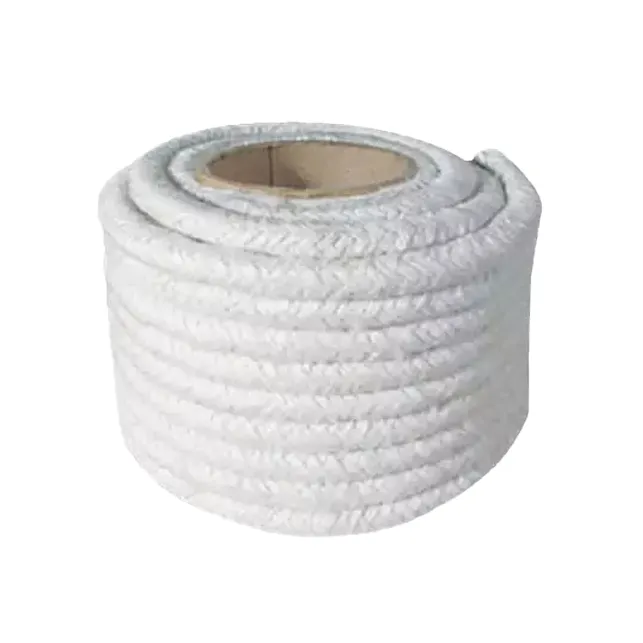
Ceramic fiber rope is a flexible packing material created from spun or carded ceramic fibers that are twisted or braided into a cord. The final product is lightweight, mechanically pliable, and engineered to resist continuous high temperatures while providing thermal insulation and a sealing function for furnace doors, kiln closures, baffles, and other hot junctions. In aluminum foundries, reliable sealing prevents heat loss, reduces oxidation of molten metal, lowers flux consumption, and limits contamination pathways that degrade alloy quality. Modern production lines that pair good thermal sealing with effective degassing and filtration see improved melt quality and reduced rework.
Key technical features include low thermal conductivity, strong thermal shock resistance, low heat storage, and chemical stability in a broad pH range. Many ceramic fiber ropes are available with reinforcement carriers, such as fiberglass or stainless wire, to raise mechanical strength for handling and to support installation tension.
2. Core chemistry and base fiber grades
Ceramic fiber rope is typically produced from alumino-silicate fibers. The two common classes used in industrial rope products are:
-
Alumina-silicate (high purity): Higher alumina content increases strength at extreme temperatures and provides improved chemical resistance. These ropes are common in furnace seals and gasketing for metallurgical uses.
-
Low-alkali alumino-silicate: Economical, with good general thermal properties suitable for many kilns and ovens.
Manufacturers may tag product grades by operating temperature, fiber density, or brand-specific trade names. Some ropes include a small organic carrier to assist manufacturing; these organics burn out at low temperatures leaving the ceramic matrix intact. Performance differences stem from fiber chemistry and fiber diameter, not from the rope geometry alone.
3. Construction types and reinforcements
Rope construction affects flexibility, sealing behavior, and mechanical robustness. Common constructions include:
-
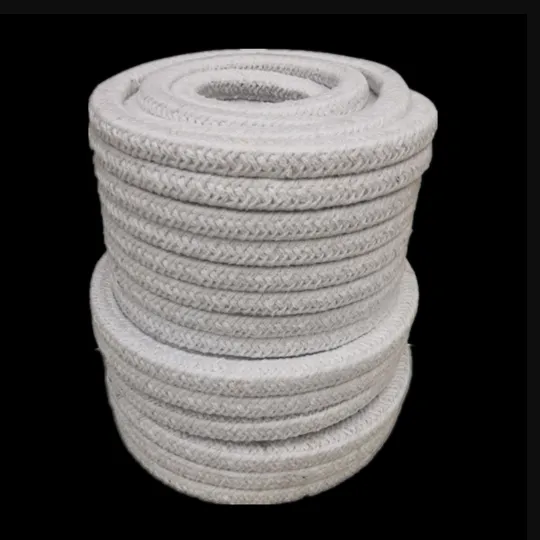
Twisted rope: Multiple plied yarns twisted together. Offers compressible sealing and easier on-site trimming. Typical for door seals.
-
Braided rope: Interlaced fiber yarns produce a smooth surface, better abrasion resistance, and lower friability. Preferred where friction or rubbing occurs.
-
Square braid and flat rope: Designed for flange-style gaskets and slot seals where a flatter profile increases contact area.
-
Wicking/braided rope with core: Some variants include a soft core or a metallic carrier for dimensional stability and pull strength.
Reinforcements:
-
Glass-fiber filament carrier: Improves tensile strength for handling and permits higher installation tension.
-
Stainless-steel wire braid: For aggressive mechanical environments where abrasion or crushing could occur.
-
Inconel or nickel-based carriers: Used when continuous exposure above the stainless limit is expected or when long life at high temperature is needed.
4. Temperature ratings, thermal performance, and limits
Ceramic fiber ropes commonly claim continuous use temperature ranges between about 1000°C and 1260°C (1832°F to 2300°F), depending on grade and reinforcement. Maximum short-term or peak operating temperatures can exceed these values, but creep, shrinkage, and mechanical weakening accelerate if the product is exposed to peak temperatures repeatedly. Material datasheets specify continuous use and short-term temperature limits along with thermal expansion and specific heat data.
Quick technical note
-
Typical continuous rating: up to roughly 1260°C.
-
Typical short-term peak: higher, often quoted near 1300°C to 1400°C, but rely on manufacturer datasheets for specific products.
5. Typical foundry applications with emphasis on aluminum melt processes
Ceramic fiber rope serves in several key roles inside an aluminum foundry:
-
Furnace and kiln door seals: Prevents convective heat loss and limits oxygen ingress that would oxidize molten aluminum.
-
Hot-top and mold interfaces: Seals around hot-top lids and plug points, preventing metal spray and ingress of contaminants.
-
Degassing installation packing: Around feed-throughs for rotating impellers, lance ports, and vacuum seals in degassing setups. Effective packing reduces gas leaks and maintains required process pressures.
-
Trough and launder covers: Insulating seals at removable covers that undergo repeated opening cycles.
-
Expansion joint packing and flange gaskets: Where equipment thermal cycling produces dimensional changes.
In the aluminum workflow, two improvements from correct rope use are lower hydrogen pickup in the melt and reduced flux carryover to downstream filtration steps. That combination improves casting integrity and lowers scrap rates.
6. Installation best practices for furnace doors, hot-top interfaces, and degassing equipment
Correct installation has more impact on performance than minor differences in rope grade. Key steps:
-
Clean mating surfaces thoroughly to remove ash, loose refractory, and scale.
-
Select the correct cross-section: round ropes compress differently than square braided ropes. Match profile to slot geometry.
-
Allow for compression set: design the slot depth and rope diameter to provide 20 to 40 percent compression once installed and heated. That range yields a tight seal without overstressing the rope.
-
Use backing or retainer channels that distribute mechanical loads and prevent extrusion into gaps. Stainless clips or ceramic retainers are common.
-
Fasten gently when using mechanical clips. Over-tightening causes fiber damage and localized overheating.
-
Avoid direct metal contact between the rope and live molten metal; use a thin refractory barrier, metal spacer, or gasket plate where necessary.
-
Trim cleanly with a sharp blade; avoid tearing which increases fiber release.
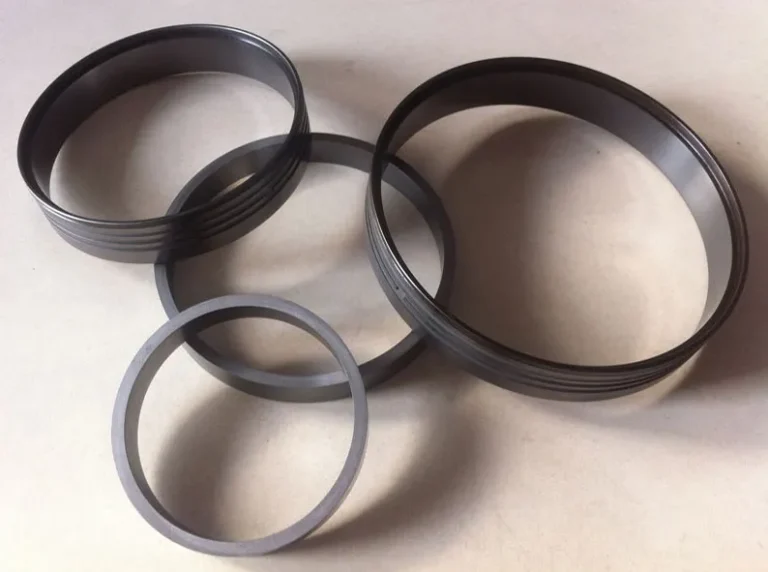
AdTech recommends pairing rope seals with our ceramic gasket products where direct splashing risk exists. Our technical team can provide cut-to-length gasket rings for hot-top lids that match common OEM dimensions.
7. Mechanical and chemical compatibility with flux, molten aluminum, and refractory systems
Ceramic fiber rope resists common foundry chemicals and flux formulations used in aluminum processing. Nevertheless, some fluxes with aggressive halide content or strong reducers may attack binder residues or generate corrosive fumes that affect metallic reinforcements. Points to review:
-
Metallic carriers such as stainless braid can corrode slowly when exposed to chlorine-containing flux fumes and high humidity. Consider Inconel reinforcement for very aggressive chemistries.
-
Direct molten metal contact: While the fiber itself is refractory, prolonged direct contact with molten aluminum will erode or fuse fibrous packing. Design interfaces to avoid exposed fibers facing free metal surfaces.
-
Flux dust and residues: Accumulated flux scale may abrade rope surfaces during opening cycles; routine cleaning improves life.
-
pH range: Many ceramic fibers tolerate pH 2 to 12 chemically, but coatings or carriers may reduce that tolerance.
8. Inspection, maintenance, and expected lifespan
Lifespan depends on temperature history, mechanical cycling, and exposure to aggressive chemicals. Typical maintenance items:
-
Visual checks every shift in high-duty installations. Look for fraying, blistering, or metallic carrier corrosion.
-
Compression test after heating cycles. Excessive loss of compression often indicates needed replacement.
-
Record temperature cycles and compare to design assumptions. Short-term spikes shorten service life dramatically.
-
Replace proactively before critical paintwork or gasket failure. A pre-planned replacement interval reduces emergency downtime.
Under moderate duty, ropes can last months to years; in heavy-duty repeated opening work, expect months. Follow manufacturer guidance for scheduled replacement intervals.
9. Safety, handling, and storage guidance
Although ceramic fibers are less hazardous than older refractory ceramic fibers (RCFs), safe handling matters:
-
Personal protective equipment: gloves, eye protection, and respiratory protection during cutting or machining. Local regulations will define exposure limits.
-
Dust control: Use wet cutting or HEPA extraction on tools to limit airborne fibers.
-
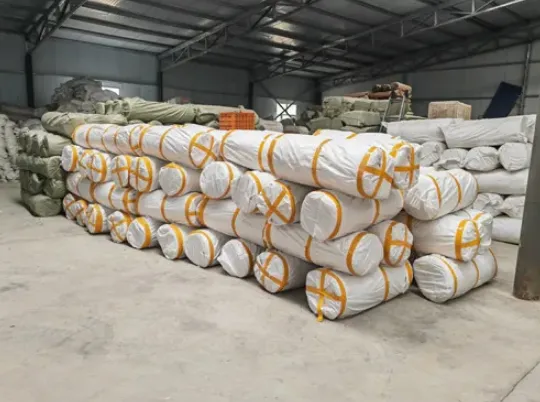
Storage: Keep in dry, cool conditions in sealed packaging. Moisture can reduce some mechanical properties and encourage organic residue breakdown.
-
Waste handling: Collect trimmed material in sealed containers and consult local waste rules for ceramic fiber disposal. Many wastes are non-hazardous but classification varies.
10. Standards, test methods, and procurement checklist
When specifying rope for foundry duty, request these data from suppliers:
-
Continuous operating temperature rating and short-term peak rating.
-
Shrinkage at high temperature and linear thermal expansion.
-
Tensile strength and recommended installation compression.
-
Reinforcement type and corrosion resistance details.
-
Available diameters and tolerances.
-
Certifications or test reports for formal standards used in your region.
A procurement checklist helps engineers compare offers quickly. See the Appendix tables for a compact spec sheet to copy into RFQs.
11. Comparison tables
Table 1: Typical technical specs (representative values — confirm with manufacturer datasheet)
| Parameter | Typical ceramic fiber rope range | Note / Recommendation |
|---|---|---|
| Continuous operating temperature | 1000°C to 1260°C (1832°F to 2300°F) | Check grade for exact rating. |
| Short-term peak temperature | Up to ~1300°C+ | Manufacturer-specific. |
| Typical density | 200 to 400 kg/m3 equivalent for yarns | Impacts compressibility. |
| Reinforcement types | Glass filament, stainless braid, Inconel | Choose based on corrosion and mechanical needs. |
| Chemical pH tolerance | ~2 to 12 | Fiber chemistry tolerant; carriers might not be. |
| Common diameters available | 4 mm to 60 mm or larger | Many suppliers offer custom lengths. |
| Typical compression set goal | 20% to 40% installed compression | Ensures sealing without crushing. |
(Always request up-to-date datasheets from your supplier before final selection.)
Table 2: Material comparison — ceramic fiber rope versus alternatives
| Property | Ceramic fiber rope | Mineral wool rope | Graphite packing | Ceramic block/gasket |
|---|---|---|---|---|
| Max continuous temp | Up to ~1260°C | Lower, often up to 700°C to 1000°C | High temp resistant but conductive | High temp, rigid, less flexible |
| Flexibility for irregular slots | Excellent | Moderate | Poor | Poor |
| Abrasion resistance | Moderate | Lower | Higher | High |
| Chemical resistance to flux fumes | Good | Variable | Excellent to some chemistries | Good |
| Cost | Mid-range | Low | Mid-high | High |
| Best use | Door seals, dynamic openings | Bulk insulation | Shaft packing, anti-oxidizer seals | Static flange gaskets |
Table 3: AdTech solution matrix for aluminum foundries
| Foundry problem | Product(s) from AdTech | Expected benefit |
|---|---|---|
| Excessive door heat loss | Ceramic fiber rope + ceramic fiber gasket rings | Lower energy use, quicker heat recovery |
| Flux carryover into filters | Hot-top seals with AdTech gasket + degassing coupling seals | Less flux in launder, improved filtration efficiency |
| Short seal life from mechanical wear | Braided rope with stainless carrier + protective retainer | Longer runtime between replacements |
| Hydrogen pick-up due to leaks | Precision-installed rope packing + degassing equipment alignment | Lower hydrogen, fewer porosity defects |
| Emergency gasket failure | Pre-cut spare rings and on-site AdTech support | Quicker recovery, less lost production |
(AdTech can supply installation kits, cut-to-length rings, and technical field support.)
12. Five common customer pain points and AdTech responses
Below are five frequent pain points foundry teams report, paired with AdTech practical solutions and expected outcomes.
-
Pain point: Frequent door gasket failures causing unplanned stops
AdTech response: Supply braided ceramic rope with stainless carrier plus a stainless retainer clamp. Provide installation training and a replacement schedule.
Outcome: Fewer emergency shutdowns, predictable maintenance windows. -
Pain point: High flux consumption and excessive flux residue downstream
AdTech response: Offer hot-top seal kits that mate to existing lids plus an optimized gasket that reduces flux escape. Integrate with AdTech degassing hardware to reduce flux reliance.
Outcome: Lower flux kilograms per ton of melt, cleaner filters, longer filter life. -
Pain point: Metal contamination from poor sealing at feed-throughs
AdTech response: Custom-fabricated rope gaskets with ceramic backing plates for critical penetration points; stainless carrier on rope to resist abrasion.
Outcome: Reduced inclusions, improved surface finish of cast billets. -
Pain point: Short life when exposed to halide-rich flux fumes
AdTech response: Recommend Inconel-reinforced rope or non-metallic braided options plus a protective outer braid and scheduled cleaning.
Outcome: Extended service life in corrosive atmospheres. -
Pain point: Insufficient technical support during installation
AdTech response: On-site commissioning, installation checklists, and cut-to-length spare parts packages. Remote troubleshooting for process teams.
Outcome: Faster ramp-up, reduced installation errors, better sealing performance.
(AdTech can pilot solutions in trial furnaces and provide measured before-and-after energy and defect metrics.)
13. Procurement checklist and specification template
Use this template when requesting quotes:
-
Product name and trade code
-
Chemistry: alumina-silicate composition or grade name
-
Continuous operating temperature rating and short-term limit
-
Construction: twisted, braided, square braid, or wicking
-
Reinforcement: fiberglass filament, stainless braid, Inconel, none
-
Diameters and tolerances required (list all sizes)
-
Length per coil and packaging requirements
-
Certificates: MSDS, product test reports for shrinkage and tensile strength
-
Warranty terms and replacement lead time
-
Cut-to-length or pre-formed gasket options required
Include a site contact for installation questions. AdTech offers a checklist and will provide sample sections for trial.
14. Ceramic Fiber Rope & Seals: Technical FAQ
1. What is the maximum continuous temperature for ceramic fiber rope?
2. Can ceramic fiber rope contact molten aluminum directly?
3. Which reinforcement is best when flux fumes contain halides?
4. How much compression should I design for in my seal slot?
5. How often should ceramic rope seals be inspected?
6. Are there low-dust or coated versions for cleaner workshops?
7. Can I braid multiple rope sizes together to fill an oversized slot?
8. Is ceramic fiber rope recyclable?
9. What PPE is required during installation?
[Safety Icons: Gloves, Mask, Glasses required]
10. How do I match rope choice to hot-top lids or degassing ports?
15. Appendix: specification quick-reference tables
Table 4: Common rope diameters and suggested applications
| Diameter | Typical use |
|---|---|
| 4 mm to 8 mm | Small access seals, thermocouple feed-throughs |
| 10 mm to 20 mm | Furnace door seals, small hot-top interfaces |
| 25 mm to 40 mm | Large kiln joints, hot-top lids with shallow grooves |
| 50 mm+ | Specialty gaskets and high-compression flange seals |
Table 5: Cut-to-length ring ordering example (AdTech sample)
| Part code | Inner diameter | Cross-section | Reinforcement | Length (m) | Notes |
|---|---|---|---|---|---|
| AT-CFR-50-200 | 200 mm | 10 mm round | Glass filament | 2.0 | For small hot-top lid |
Contact AdTech for custom part coding and on-site templating.
16. Practical selection workflow for foundry engineers
-
Map the joint: measure depth, width, and expected compression range.
-
Pick material grade: base on continuous temperature and chemical exposures.
-
Choose construction: twisted for compressible seals, braided for abrasion resistance.
-
Decide reinforcement: glass filament for general duty, stainless for mechanical, Inconel for corrosive atmospheres.
-
Specify retainers or backing plates: avoid extrusion and metal contact.
-
Plan maintenance: schedule inspections and spares stocking.
-
Pilot: install in a single furnace, track energy, flux usage, and seal life for 60 to 90 days before wider rollout.
AdTech can support each step with shop drawings, sample kits, and field commissioning.
Closing recommendations
For aluminum foundries focused on consistent quality, reduced flux usage, and lower hydrogen-related defects, ceramic fiber rope offers a practical balance of thermal performance and installation flexibility. Careful matching of rope grade, construction, and reinforcement to the specific application is essential. AdTech provides a portfolio of ceramic rope, pre-cut gaskets, and integrated degassing and filtration solutions that work in combination to reduce defects and improve furnace economics. For tailored recommendations, send AdTech your joint dimensions, operating temperature profile, and flux chemistry; we will propose the optimal rope type, reinforcement, and an installation kit.