
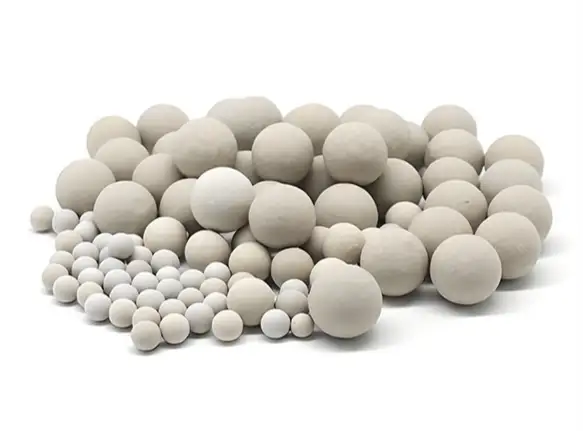
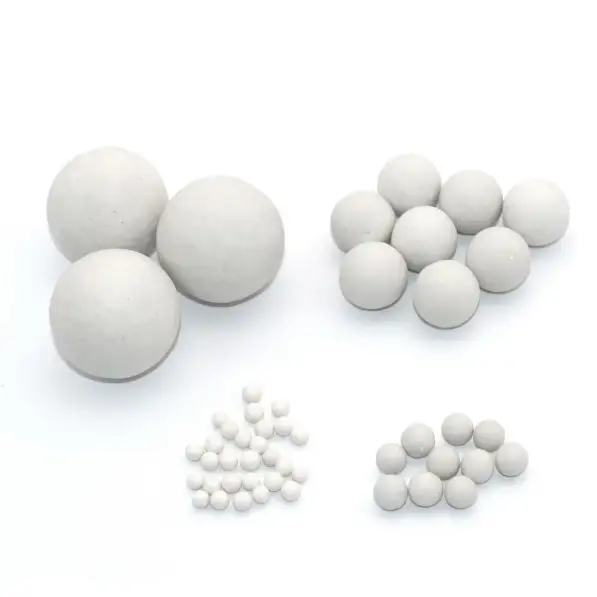
Alumina porous ceramic balls combine high thermal stability, tailored pore networks, chemical resilience, and mechanical reliability, making them an excellent choice for carrier media, mass transfer packing, desiccant beds, and filtration components in demanding industrial systems; when selected with attention to porosity, purity, and surface area, they deliver long service life and predictable performance in petrochemical, environmental, water treatment, and catalyst-support roles.
1. What is Alumina porous ceramic ball?
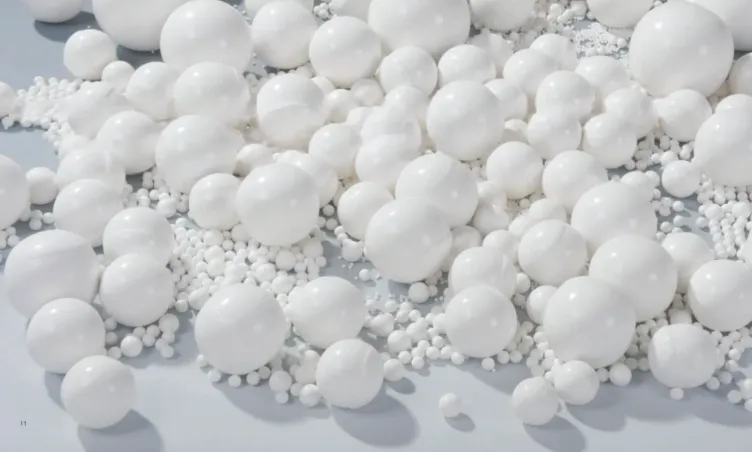
Alumina porous ceramic balls are spherical bodies made mainly from aluminum oxide (Al2O3) engineered to contain an open pore network. That network can be tuned from micropores to macropores to meet mass transfer, adsorption, or filtration demands. Key advantages include high temperature resistance, chemical inertness in most process streams, configurable mechanical strength, and predictable hydraulic behavior. Their common uses include catalyst support, packing for towers and reactors, moisture removal media, and fine filtration support. When purity and pore architecture are controlled, these spheres perform reliably in continuous operations under high temperature and corrosive conditions.
2. What are porous alumina ceramic balls?
Definition
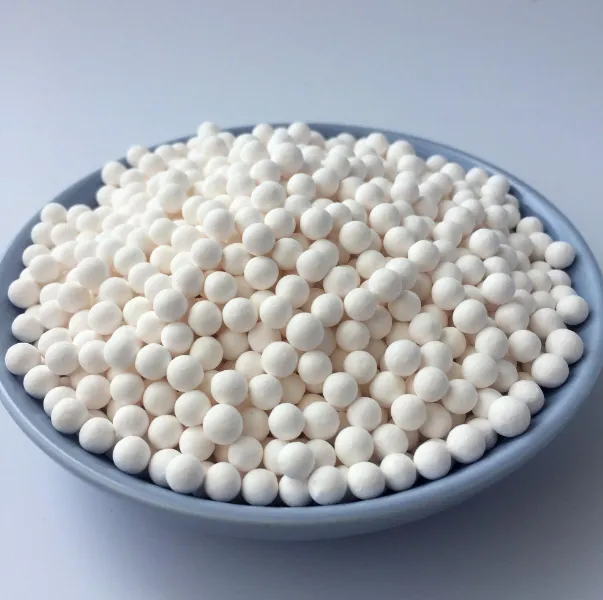
Porous alumina ceramic balls are precision-formed spherical ceramic elements composed primarily of alumina (Al2O3) that contain an interconnected network of pores. The pore structure provides surface area for adsorption and contact, while the ceramic matrix supplies mechanical strength and thermal stability.
Common forms and variants
-
Activated or high-surface-area alumina spheres meant for adsorption duties.
-
Inert high-alumina balls with low water uptake for catalyst support and tower packing.
-
Engineered porous alumina with controlled pore size distributions for precision filtration and gas diffusion duties.
3. How they are made: core production routes
Manufacturing strategies differ by target pore size, purity, and mechanical target. Major techniques include:
3.1 Forming method
-
Slip casting or extrusion and spherodization where alumina slurry is shaped into spheres, then dried.
-
Binder-assisted granulation where ceramic powder is pelletized then formed into near-spherical shapes.
-
Isostatic pressing for precision, lower-porosity balls.
3.2 Pore creation and control
-
Pore former burnout uses fugitive organic particles that burn out during firing, leaving controlled voids.
-
Foaming agents produce interconnected macropores through gaseous phase evolution during forming.
-
Sintering control at lowered temperature or short soak times retains micro-porosity by limiting grain growth.
3.3 Additives and activation
-
Impregnation with metal oxides or surface treatments create high-surface-area activated alumina suitable for adsorption.
-
Calcination profiles adjust mechanical strength and surface chemistry.
Manufacturers can deliver pore sizes from submicron (0.1 micron) up to 50 microns depending on process choices. Custom pore distributions are possible for specialist demands.
4. Key material properties that matter for performance
4.1 Chemical composition and purity
-
Typical commercial grades range from technical alumina (80 to 95 percent Al2O3) to high-purity alumina with >99.9 percent. Ultra-high-purity porous alumina products are available for critical applications. Purity impacts chemical leaching, catalytic compatibility, and high-temperature stability.
4.2 Porosity and pore-size distribution
-
Porosity expressed in percent void volume controls permeability and specific surface area. Micropores increase surface area, macropores improve hydraulic flow. Tailor porosity to balance pressure drop with contact efficiency.
4.3 Specific surface area
-
Measured in square meters per gram (m2/g), surface area determines adsorption capacity and catalyst dispersion. Activated forms can reach high surface areas by chemical activation or controlled micro-porosity creation.
4.4 Mechanical strength and crush resistance
-
Compressive strength and modulus determine bed life under load. Strength tends to drop with increasing open porosity, so engineers choose the minimum porosity that meets mass transfer requirements.
4.5 Thermal stability
-
Alumina has exceptional high-temperature capability and maintains dimensional stability across wide temperature ranges, making it compatible with calcination, regeneration, and elevated-temperature process streams.
5. Typical industrial uses by sector
5.1 Petrochemical and refining
Used as inert packing, catalyst support, and gas distributor media in reactors and sulfur recovery units. Their inertness helps avoid contamination of catalysts downstream.
5.2 Environmental control and gas treatment
Activated porous alumina spheres serve in desiccant beds and sulfur compound capture. Their adsorption selectivity can be tuned for moisture removal and contaminant trapping.
5.3 Water treatment and filtration
Porous balls can support filter media, act as pre-filters for fine particulates, or be used in specialty applications such as fluoride removal when combined with chemically active phases.
5.4 Ceramic catalyst carriers and fixed-bed reactors
Spheres provide uniform packing, low channeling tendency, and a stable platform for catalyst coatings or for distributing catalyst pellets in fixed-bed reactors.
5.5 Thermal insulation and heat-management components
In specific engineered porous grades, the low thermal conductivity and dimensional stability offer thermal buffering in high-temperature installations.
6. Size, porosity, and surface area: matching media to duty
Key selection variables
-
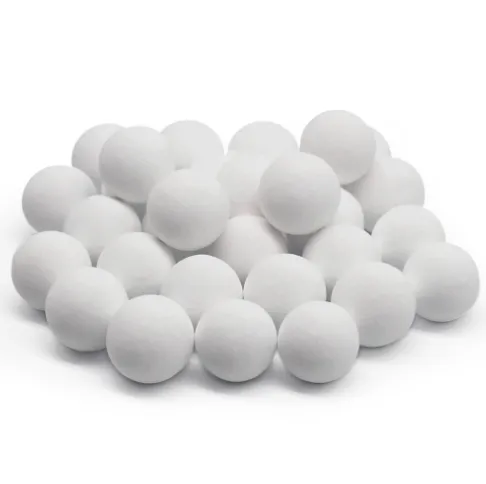
Diameter: from a few millimeters up to 30 to 90 mm depending on packing needs and hydraulic regime. Typical packing balls are 3 mm to 25 mm.
-
Open porosity: low (<10 percent) for mechanical duty, moderate (10 to 40 percent) for mixed duties, high (>40 percent) for adsorption.
-
Pore size: select micropores for adsorption, mesopores for catalyst dispersion, macropores for bulk flow and lower pressure drop.
Table 1. Typical property ranges and common uses
| Property | Typical range | Design implication | Common use examples |
|---|---|---|---|
| Diameter | 3 mm to 90 mm | Smaller spheres give higher surface area per packed volume and more contact points | Catalysts, fine packing |
| Open porosity | 5 to 60 percent | Higher porosity increases adsorption but lowers mechanical strength | Desiccant beds, adsorption columns |
| Pore size | 0.1 μm to 50 μm | Submicron pores for adsorption, larger pores for flow | Filtration support, catalyst carriers |
| Surface area | 1 to 300 m2/g | Higher area increases adsorption/catalytic capacity | Activated alumina uses |
| Al2O3 content | 85 to >99.9 percent | Higher purity improves corrosion resistance and reduces leaching | High-temp reactors, semiconductor processes |
Sources for ranges and use examples include manufacturer specifications and technical reviews.
7. Installation, loading, and bed design considerations
7.1 Packing method
-
For packed towers: load evenly, avoid irregular compaction, and provide distribution trays or meshes to prevent movement. Use multiple small pulses during loading to settle the bed gently.
7.2 Hydraulic design
-
Pressure drop correlates to diameter and porosity. Use Ergun-type correlations modified for porous media. Check that superficial velocity stays within recommended limits by manufacturer.
7.3 Thermal and mechanical allowance
-
Allow for thermal expansion gaps and for support plates that do not abrade the spheres. Provide containment that prevents attrition from mechanical vibration.
7.4 Back-up and screens
-
Use graded particle layers and support screens to prevent migration of fines. A graded bed reduces localized channeling near the inlet.
8. Performance tradeoffs and failure modes
8.1 Tradeoffs
-
Higher porosity boosts contact area but reduces crush strength. Higher purity improves chemical stability but increases cost. Smaller diameter increases head loss.
8.2 Common failure modes
-
Crushing and fragmentation under excessive load or shock.
-
Fouling and pore blockage from suspended solids or precipitates.
-
Surface chemical alteration with aggressive chemistries leading to loss of activity.
-
Attrition caused by vibration or poorly supported loading.
Mitigation involves lifecycle planning, prefiltration, and selecting mechanical grade appropriate for expected loads.
9. Maintenance, regeneration, and end of life
9.1 Maintenance strategy
-
Inspect for pressure loss trends, monitor fines in downstream filters, and sample spheres for mechanical degradation. Routine visual checks for channeling and surface deposits help extend life.
9.2 Regeneration routes
-
Thermal regeneration: commonly used to remove adsorbed moisture and organics. Temperature limits depend on alumina purity and any impregnated phases.
-
Chemical regeneration: mild solvents or pH swings can remove specific deposits, but check chemical compatibility.
9.3 Disposal and recycling
-
Spent ceramic balls are inert and often classified as non-hazardous if they carried no hazardous species. Recycling includes crushing and reuse as filler in refractory or ceramic composites where contamination is acceptable.
10. Quality specifications, testing, and certification checkpoints
When evaluating suppliers, request and verify the following:
10.1 Standard test data
-
Composition by XRF or ICP for Al2O3 and impurity content.
-
Open porosity measured by mercury intrusion or water uptake.
-
Pore size distribution by mercury porosimetry or gas adsorption.
-
Surface area via BET method.
-
Crush strength and bulk density.
-
Thermal stability by TGA and heat-cycling.
10.2 Certificates and process controls
-
ISO quality certificates, batch traceability, production sintering curves, and material safety data sheets. For critical applications, request sample lots for pilot testing.
11. Comparison tables: grades, properties, applications
Table 2: Quick comparison of commercial grades
| Grade name | Al2O3 % | Porosity range | Typical surface area | Suited for |
|---|---|---|---|---|
| Inert high-alumina | 95 to 99% | 5–20% | 1–10 m2/g | Catalyst support, tower packing. |
| Activated alumina | 90–99% | 20–60% | 50–300 m2/g | Desiccant, fluoride removal, adsorption. |
| High-purity porous | >99.9% | 5–40% | 1–100 m2/g | Semiconductor, pharmaceutical, clean gas systems. |
| Engineered macro-porous | 85–95% | 30–60% | 5–50 m2/g | Filtration support, low-pressure-drop packing. |
Table 3. Typical test and acceptance criteria for packing media
| Test | Typical acceptance threshold | Notes |
|---|---|---|
| Bulk density | Within supplier spec ±5% | Affects bed mass and support design |
| Crush strength | Manufacturer-rated minimum | Specify test method and sample size |
| Water absorption | Match porosity spec | Indicates open porosity |
| BET surface area | Within specified tolerance | Critical for adsorption duties |
| Impurity levels | Trace metals below target | Important in catalyst and semiconductor uses |
12. Purchasing checklist for engineers and buyers
-
Specify duty conditions: temp, pressure, chemical exposures.
-
Define hydraulic targets: velocity, allowable pressure drop.
-
Choose diameter and porosity to match contact and flow needs.
-
Request lot certificates for composition and mechanical testing.
-
Insist on sample trial under real conditions.
-
Plan for regeneration, replacement frequency, and spare inventory.
-
Verify packaging to avoid contamination and moisture pickup.
-
Clarify return and warranty terms.
13. Porous & Activated Alumina Spheres: Technical FAQ
1. What is the difference between activated alumina and inert porous alumina balls?
2. How do I choose a pore size for my application?
3. Will porous alumina leach impurities into my process?
4. Can these balls withstand thermal regeneration cycles?
5. What is the typical service life of porous alumina media?
6. How do porous alumina balls compare to silica gel or activated carbon?
7. Can I coat these spheres with catalysts?
8. Are porous alumina balls suitable for potable water systems?
9. What quality tests should I demand before purchase?
10. Can pores clog and how is fouling managed?
14. Final recommendations and quick selection flowchart
Quick selection steps
-
Document operating temperature, pressure, and chemistry.
-
Define the hydraulic target for pressure drop and velocity.
-
Decide on primary function: adsorption, packing, filtration, or catalyst support.
-
Choose diameter and porosity that satisfy hydraulic and surface area needs.
-
Obtain vendor specs and test reports for composition, porosity, BET, and crush strength.
-
Run a pilot or lab-scale test. Monitor head loss and mechanical integrity.
-
Implement a maintenance plan including inspection, regeneration schedule, and spares.
Practical tip
For critical process streams, invest in a small pilot bed with the supplier’s material. Real duty conditions quickly reveal whether pore distribution and mechanical grade are correct.