

The majority of aluminum melt degassing inefficiencies trace back to four controllable variables — rotor rotational speed, argon (or nitrogen) gas flow rate, treatment duration, and melt temperature management. When any one of these parameters drifts outside its optimal window, hydrogen content in the finished melt can easily exceed 0.2 mL/100g Al, leading to porosity defects, scrap rates above 8%, and costly downstream rework.
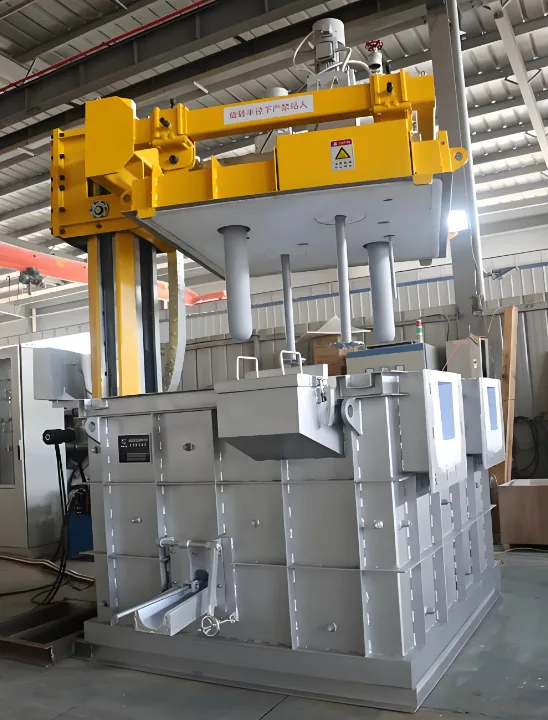
If your project requires the use of Aluminum degassing system, you can contact us for a free quote.
How Hydrogen Enters Aluminum Melts and Why It Matters
Hydrogen is the only gas with meaningful solubility in liquid aluminum under standard atmospheric conditions. Its presence in the melt originates from multiple sources: moisture on scrap surfaces, contaminated fluxing agents, atmospheric humidity absorbed during melting, and chemical reactions between molten aluminum and water vapor:
2Al + 3H₂O → Al₂O₃ + 6[H]
The dissolved atomic hydrogen remains in supersaturated solution during solidification and nucleates as molecular H₂ gas within the solidifying microstructure, forming spherical porosity voids. These pores reduce tensile strength, elongation, fatigue resistance, and pressure tightness — properties critical to automotive components, aerospace extrusions, and thin-wall die castings.
The solubility of hydrogen in aluminum follows Sievert’s Law:
[H] = K × √(P_H₂)
Where K is a temperature-dependent constant. At 750°C, liquid aluminum can dissolve approximately 0.69 mL H₂/100g Al, while solid aluminum at 660°C dissolves only about 0.036 mL H₂/100g Al. This dramatic drop in solubility during solidification is precisely what drives porosity formation.
Industry-accepted hydrogen content targets by application:
| Application | Target H₂ Content (mL/100g Al) | Acceptable Porosity Level |
|---|---|---|
| Aerospace structural parts | < 0.10 | P1 (ASTM E505) |
| Automotive safety components | < 0.12 | P2 |
| General die castings | < 0.15 | P3 |
| Non-critical sand castings | < 0.20 | P4 |
| Standard extrusion billets | < 0.18 | P3 |
We have measured incoming melt hydrogen levels as high as 0.45 mL/100g Al in high-humidity foundry environments during monsoon season — more than four times the aerospace threshold. Getting that down to spec within a reasonable cycle time requires a degassing system operating at peak efficiency across all four major parameters.
The Fundamental Mechanism of Rotary Degassing
Before dissecting each individual factor, it is worth establishing exactly what rotary degassing does at the physical chemistry level. A rotary degassing unit (RDU) consists of a rotating graphite shaft and rotor submerged in the melt. Inert gas — most commonly argon, sometimes nitrogen — is pumped down through the hollow shaft and expelled through the spinning rotor.
The rotor performs two simultaneous functions:
First, it breaks the inert gas stream into very fine bubbles. Bubble diameter matters enormously because the interfacial surface area available for hydrogen transfer scales inversely with bubble size. A 1mm bubble has roughly ten times the surface-area-to-volume ratio of a 10mm bubble. More surface area means faster hydrogen mass transfer.
Second, the rotating action disperses these fine bubbles throughout the melt volume rather than allowing them to rise immediately in a single column near the lance. This horizontal distribution dramatically increases the effective contact volume between the inert gas phase and the hydrogen-saturated liquid aluminum.
The driving force for hydrogen transfer from melt to bubble is the partial pressure gradient. Inside a fresh argon bubble, the partial pressure of hydrogen is essentially zero. In the surrounding melt, dissolved hydrogen exerts a partial pressure proportional to its concentration. This gradient pushes hydrogen atoms from the melt into the bubble. As the bubble rises and eventually exits the melt surface, it carries the captured hydrogen away permanently.
The rate of degassing follows a first-order kinetic relationship:
dC/dt = -k × C
Where C is the hydrogen concentration in the melt and k is the mass transfer coefficient, which is influenced by — you guessed it — rotor speed, gas flow rate, treatment time, and temperature.
Factor 1: Rotor Rotational Speed: Finding the Optimal RPM Range
Why RPM Is the Most Misunderstood Variable in Degassing Operations
Rotor speed is the parameter we see most frequently set incorrectly in foundry audits. The intuitive assumption is straightforward: faster rotation equals better mixing equals more efficient degassing. In practice, this assumption holds only up to a specific threshold before it becomes actively counterproductive.
The Three RPM Regimes
Low RPM (below 150 rpm): At insufficient rotor speeds, the gas-shearing action is weak. Bubbles emerging from the rotor remain large — often 5 to 15mm in diameter — because the centrifugal force and shear stress are not sufficient to break the gas stream into fine dispersion. These large bubbles rise quickly through the melt with limited residence time, and their small surface-area-to-volume ratio limits the hydrogen absorption rate. The melt also receives inadequate circulation, creating concentration gradients where hydrogen near the bottom of the ladle or holding furnace is never adequately brought into contact with rising bubbles.
Optimal RPM (300-600 rpm, application-dependent): Within this window, the rotor generates sufficient shear to produce bubble diameters in the range of 1-3mm. The turbulent wake behind each rotor blade disperses these bubbles radially outward and then allows them to rise through a much larger melt cross-section. Hydrogen removal efficiency is maximized. We have measured degassing efficiency improvements of 35-55% simply by correcting rotor speed from 200 rpm to 400 rpm on otherwise identical systems.
Excessive RPM (above 700-800 rpm, depending on rotor diameter): When rotation speed climbs too high, the melt surface directly above the rotor begins to vortex. This is the critical failure mode. A vortex draws atmospheric air — specifically moisture-laden air — down into the melt. The incoming moisture immediately reacts with the aluminum melt, generating fresh hydrogen at a rate that can actually exceed the hydrogen removal rate from degassing. The net result is that hydrogen content in the melt increases rather than decreases. Additionally, excessive surface turbulence causes oxide film entrainment, introducing inclusions that further degrade melt quality.
Rotor Speed vs. Rotor Diameter Relationship
The optimal RPM range is not universal — it scales with rotor diameter. A larger diameter rotor covers more cross-sectional area at lower RPM and generates more peripheral velocity (tip speed) for the same angular velocity. The relevant comparison metric is tip speed (peripheral velocity), not raw RPM:
Tip Speed (m/s) = π × D × N / 60
Where D is rotor diameter in meters and N is rotational speed in rpm.
Optimal tip speed range for most aluminum degassing rotors: 3.5 to 6.5 m/s
| Rotor Diameter (mm) | Optimal RPM Range | Corresponding Tip Speed (m/s) |
|---|---|---|
| 100 | 450 – 700 | 2.4 – 3.7 |
| 150 | 350 – 550 | 2.7 – 4.3 |
| 200 | 280 – 450 | 2.9 – 4.7 |
| 250 | 250 – 400 | 3.3 – 5.2 |
| 300 | 200 – 350 | 3.1 – 5.5 |
We recommend using tip speed as the primary specification when comparing degassing units across different manufacturers, since rotor diameter varies considerably between suppliers.
Practical RPM Optimization Protocol
Rather than relying on published specifications alone, we advocate for a field calibration approach:
- Start treatment at a conservative 300 rpm.
- Measure hydrogen content using a Telegas or Notched Bar test every 2 minutes.
- Incrementally increase RPM by 50 rpm increments while monitoring the melt surface for vortex formation.
- Identify the maximum RPM where the surface remains calm (no visible vortex).
- Set operating RPM at 90% of that threshold value for a safety margin.
This approach accounts for site-specific variables including ladle geometry, melt depth, and alloy viscosity.
Factor 2: Inert Gas Flow Rate: Balancing Bubble Size and Melt Turbulence
Argon vs. Nitrogen: Which Inert Gas Performs Better?
This question comes up frequently in procurement discussions. Argon is the preferred choice for degassing aluminum, and here is why:
Nitrogen is slightly cheaper per unit volume, but it reacts with aluminum at elevated temperatures to form aluminum nitride (AlN) inclusions:
2Al + N₂ → 2AlN
While this reaction is relatively slow at typical aluminum processing temperatures (700-760°C), it introduces non-metallic inclusions that compromise melt cleanliness, particularly in alloys with higher magnesium content where the reaction rate increases. For high-purity aerospace or automotive applications, argon is the only acceptable choice. For less demanding applications, nitrogen can be economically justified if melt cleanliness requirements are not stringent.
Argon is completely inert toward aluminum at all processing temperatures and provides a slightly higher density (1.78 kg/m³ vs. 1.25 kg/m³ for nitrogen), which affects bubble buoyancy and residence time to a minor degree.
Understanding the Flow Rate Optimization Problem
Gas flow rate determines two competing variables simultaneously:
- Total number of bubbles introduced per unit time (more bubbles = more surface area = better degassing).
- Surface turbulence level (excessive flow rate creates surface agitation that re-introduces atmospheric moisture).
This creates a non-linear relationship between flow rate and degassing efficiency with a clear optimal operating zone.
The relationship between flow rate and bubble dynamics:
At low flow rates (below 1 L/min for a 150mm rotor), the gas exits the rotor in intermittent puffs rather than a continuous stream. The resulting large, irregular bubbles provide inadequate surface area. Hydrogen removal is slow and uneven.
At moderate flow rates (1-5 L/min typically, scaled to melt volume), the rotor effectively shears the gas into fine, uniform bubbles. The melt receives a consistent dispersion of small bubbles throughout its volume. This is the optimal operating zone.
At excessive flow rates (above 8-10 L/min for most rotor sizes), several problems emerge:
- The melt surface becomes visibly agitated and may splash.
- Surface oxide films are disrupted and entrained into the bulk melt.
- The high gas volume creates buoyancy that overwhelms the rotor’s shearing capability, producing large coalesced bubbles.
- Atmospheric air is drawn into the melt along with the oxide films.
Gas Flow Rate Scaling Guidelines
The appropriate gas flow rate scales with melt volume and target degassing time. Industry practice typically references specific gas flow rate — liters of inert gas per minute per ton of melt (L/min/ton):
Recommended specific gas flow rate: 0.5 to 2.0 L/min/ton
| Melt Volume (tons) | Recommended Flow Rate (L/min) | Treatment Time for 0.12 mL/100g target |
|---|---|---|
| 0.5 | 0.5 – 1.5 | 8 – 12 min |
| 1.0 | 1.0 – 2.5 | 10 – 15 min |
| 2.0 | 2.0 – 4.5 | 12 – 18 min |
| 5.0 | 4.0 – 9.0 | 15 – 25 min |
| 10.0 | 8.0 – 18.0 | 20 – 35 min |
Note: These values assume argon as the purging gas, rotor at optimal RPM, and melt temperature between 720-760°C.
The Impact of Gas Pressure on Bubble Formation
An often-overlooked variable is the back pressure in the gas delivery system. If the supply pressure is insufficient, the flow rate drops below target when the rotor submerges into the melt. We recommend maintaining a minimum supply pressure of 0.3 MPa at the inlet and using a calibrated rotameter (flow meter) rather than relying on supply pressure alone as a proxy for flow rate.
Factor 3: Treatment Time and Degassing Efficiency Curves
The Diminishing Returns Problem in Extended Degassing
Treatment duration is perhaps the most straightforward of the four factors conceptually, but it involves important non-linearities that affect both quality and process economics.
Because degassing follows first-order kinetics (the removal rate is proportional to the current hydrogen concentration), the efficiency of each additional minute of treatment decreases as hydrogen content approaches equilibrium. The curve is exponential in character:
C(t) = C₀ × e^(-kt)
This means:
- The first 5 minutes of treatment typically removes 40-60% of the total dissolved hydrogen
- Minutes 5-15 account for an additional 25-35%
- Beyond 15-20 minutes, marginal improvement per unit time falls below 1% per minute under most conditions
Degassing efficiency as a function of treatment time (typical conditions):
| Treatment Time (min) | Hydrogen Content (mL/100g Al) | Efficiency Achieved (%) |
|---|---|---|
| 0 | 0.45 (initial) | 0% |
| 3 | 0.30 | 33% |
| 6 | 0.22 | 51% |
| 9 | 0.17 | 62% |
| 12 | 0.14 | 69% |
| 15 | 0.12 | 73% |
| 20 | 0.10 | 78% |
| 30 | 0.09 | 80% |
| 45 | 0.085 | 81% |
The data above illustrates why extending treatment beyond 20-25 minutes yields rapidly diminishing returns. In our experience auditing foundry operations, treatment times beyond 30 minutes are rarely justified economically unless the initial hydrogen content is exceptionally high (above 0.5 mL/100g Al).
Practical Treatment Time Determination
The required treatment time depends on:
- Initial hydrogen content — Higher starting H₂ requires longer treatment (this should be measured, not assumed)
- Target hydrogen specification — Tighter specs require longer treatment times.
- Melt volume — Larger volumes need proportionally longer treatment.
- Rotor efficiency — A well-maintained, properly sized rotor at optimal RPM achieves the same hydrogen reduction faster.
- Gas flow rate — Within the optimal range, higher flow rates allow shorter treatment times.
A common mistake we encounter is setting a fixed treatment time regardless of initial conditions. A melt from clean, dry ingot charges might start at 0.15 mL/100g Al and reach spec in 8 minutes. A melt from wet, corroded scrap might start at 0.50 mL/100g Al and require 25 minutes. Using the same 12-minute cycle for both leads either to under-treatment (scrap defects) or over-treatment (wasted time, energy, and argon costs).
Re-Gassing Risk During and After Treatment
An important practical concern is hydrogen re-absorption after degassing is complete. If the treated melt is held in an open ladle or transferred to a holding furnace with a damp refractory lining, hydrogen content will begin to climb again immediately. The rate of re-absorption depends on:
- Atmospheric humidity levels
- Melt surface area exposed to atmosphere.
- Melt temperature
- Ladle refractory moisture content.
In high-humidity environments, we have measured hydrogen content increases of 0.03-0.06 mL/100g Al per hour in open ladles. This underscores the importance of minimizing the time between degassing completion and casting, and of maintaining properly dried refractory linings.
Factor 4: Melt Temperature and Its Interaction with Hydrogen Solubility
Why Temperature Control Is Not Optional in Degassing Operations
Melt temperature affects degassing efficiency through multiple simultaneous mechanisms, making it the most complex of the four factors.
Effect on hydrogen solubility: Per Sievert’s Law, higher temperatures increase hydrogen solubility. If you are degassing at 800°C instead of 720°C, the equilibrium hydrogen content you can achieve at any given partial pressure is higher. You are working against a larger thermodynamic driving force. At the same time, higher temperatures increase atomic diffusivity, which accelerates mass transfer from the melt bulk to the bubble surface.
Effect on melt viscosity: Liquid aluminum viscosity decreases significantly with increasing temperature. Lower viscosity means faster bubble rise velocity (Stokes’ Law) but also better mass transfer coefficients. The net effect on degassing efficiency is complex.
Practical temperature window for aluminum degassing:
| Temperature (°C) | Hydrogen Solubility (mL/100g Al) | Viscosity (mPa·s) | Recommended Operation |
|---|---|---|---|
| 680 | 0.48 | 2.85 | Too cold — risk of premature solidification |
| 700 | 0.55 | 2.45 | Marginal — rotor tip may contact solidified skin |
| 720 | 0.62 | 2.15 | Acceptable lower bound |
| 740 | 0.68 | 1.90 | Optimal range |
| 760 | 0.75 | 1.70 | Optimal range |
| 780 | 0.83 | 1.55 | Acceptable upper bound |
| 800 | 0.92 | 1.40 | Too hot — excessive oxidation, energy waste |
Optimal degassing temperature range: 720-760°C for most aluminum alloys
Temperature Gradients Within the Melt
A common issue in large holding furnaces or deep ladles is thermal stratification — the melt near the furnace walls or bottom heating elements is significantly hotter than the bulk, while the upper surface cools more rapidly. These temperature gradients create hydrogen concentration gradients because hydrogen solubility is temperature-dependent.
The degassing rotor’s mixing action helps reduce thermal stratification, which is another reason why proper RPM settings matter — the rotor is simultaneously degassing and homogenizing the melt temperature.
We recommend checking melt temperature at multiple depths before initiating degassing treatment, particularly for ladles deeper than 400mm. A temperature variation exceeding 25°C between measurement points indicates stratification that may require additional mixing time before or during degassing.
Alloy-Specific Temperature Considerations
Different aluminum alloys have different optimal processing temperatures due to their composition-dependent liquidus temperatures and viscosity profiles:
| Alloy Series | Typical Casting Temperature (°C) | Optimal Degassing Temperature (°C) |
|---|---|---|
| 1xxx (pure Al) | 720 – 750 | 720 – 750 |
| 2xxx (Al-Cu) | 730 – 760 | 730 – 760 |
| 3xxx (Al-Mn) | 720 – 750 | 720 – 750 |
| 4xxx (Al-Si) | 680 – 720 | 700 – 730 |
| 5xxx (Al-Mg) | 710 – 750 | 720 – 750 |
| 6xxx (Al-Mg-Si) | 720 – 760 | 730 – 760 |
| 7xxx (Al-Zn) | 720 – 760 | 740 – 770 |
For 4xxx alloys (high silicon content), lower degassing temperatures are acceptable because the higher silicon content depresses the liquidus temperature and reduces viscosity at lower temperatures.
How These Four Factors Interact: A Systems-Level View
The Interdependency Matrix
None of the four factors operates in isolation. Changing one parameter shifts the optimal range for the others. This interdependency is why simple rule-of-thumb settings frequently fail, and why systematic process optimization is necessary.
Key interactions to understand:
RPM and Flow Rate interaction: Higher gas flow rates require slightly higher RPM to effectively shear the increased gas volume into fine bubbles. If you increase flow rate without adjusting RPM, bubble size increases and efficiency drops. Our recommendation is to increase RPM proportionally when increasing flow rate, maintaining the relationship: RPM increase (%) ≈ 0.5 × Flow Rate increase (%).
Temperature and Treatment Time interaction: At lower melt temperatures (720°C), hydrogen diffusivity is lower, slowing the mass transfer step. This means a longer treatment time is needed to achieve the same result compared to operation at 760°C. The compensation factor is approximately 10-15% additional treatment time per 20°C temperature reduction.
Flow Rate and Treatment Time interaction: Within the optimal flow rate range, doubling the flow rate reduces the required treatment time by approximately 30-40% for a given hydrogen reduction target. However, this relationship is not linear at extremes — doubling a flow rate that is already at the upper optimal limit may actually worsen efficiency due to surface turbulence.
RPM and Temperature interaction: At higher melt temperatures, lower viscosity allows the same degree of melt circulation at lower RPM. In practice, a slight downward RPM adjustment (5-10%) at temperatures above 760°C helps avoid surface vortexing because the lower-viscosity melt is more susceptible to surface disturbance.
Process Optimization Case Study
To illustrate these interactions concretely, consider a real-world scenario we encountered: a foundry producing automotive knuckle components from A356 alloy was experiencing scrap rates of 12% from shrinkage porosity. Initial melt hydrogen content was consistently 0.28-0.35 mL/100g Al after a 12-minute degassing cycle. Target was 0.12 mL/100g Al.
Initial settings:
- Rotor RPM: 250 (too low for the 200mm rotor — tip speed only 2.6 m/s)
- Argon flow rate: 5 L/min (within acceptable range)
- Treatment time: 12 minutes (fixed)
- Melt temperature: 780°C (above optimal upper bound)
After systematic optimization:
- Rotor RPM: 380 (tip speed now 4.0 m/s — within optimal zone).
- Argon flow rate: 4 L/min (slightly reduced to maintain bubble quality at higher RPM).
- Treatment time: 16 minutes (extended to compensate for high initial H₂).
- Melt temperature: 745°C (lowered by adjusting furnace settings).
Results after two weeks of optimized operation:
- Average post-degassing H₂: 0.09 mL/100g Al.
- Scrap rate: 3.2% (reduction from 12%).
- Argon consumption: reduced by 18% due to lower flow rate.
- Cycle time: increased by 4 minutes, but eliminated a downstream x-ray rejection step.
Equipment Selection Criteria for Online Degassing Units
Inline vs. Batch Degassing: Choosing the Right System Architecture
Batch degassing (treating individual ladles or crucibles) is suitable for lower-volume operations, alloy flexibility, and situations where continuous casting is not used. The advantages include lower capital cost and greater flexibility. The disadvantages include treatment time adding to overall cycle time and potential re-gassing during ladle transfers.
Inline degassing (continuous treatment in a dedicated degassing box installed in the metal transfer system) suits high-volume continuous casting operations. The metal flows continuously through the degassing chamber, receiving treatment in transit. This approach maintains a consistent, low hydrogen level at the casting point and eliminates the re-gassing risk associated with ladle holding time.
System comparison table:
| Feature | Batch Rotary Degassing | Inline Continuous Degassing |
|---|---|---|
| Capital cost | Lower | Higher |
| Operating flexibility | High | Low (fixed in transfer system) |
| Treatment consistency | Variable (operator-dependent) | High |
| Re-gassing risk | Moderate to high | Low |
| Suitable melt volume | 0.1 – 10 tons/batch | 0.5 – 20 tons/hour |
| Best application | Job shop, small foundry | Continuous casting, large operations |
| Argon efficiency | Moderate | High |
| Maintenance accessibility | Easy | Moderate to difficult |
Rotor Material Selection
Graphite rotor materials vary considerably in quality, and material selection directly affects:
- Resistance to thermal shock (critical during insertion into the melt)
- Oxidation rate (determines rotor service life)
- Machining precision (affects bubble generation quality)
- Cost per hour of operation
Fine-grain isostatic graphite (ISO graphite) rotors offer superior performance compared to standard extruded graphite:
| Property | Extruded Graphite | Isostatic Graphite |
|---|---|---|
| Bulk density (g/cm³) | 1.60 – 1.70 | 1.75 – 1.85 |
| Flexural strength (MPa) | 25 – 35 | 45 – 65 |
| Thermal shock resistance | Moderate | High |
| Typical service life (hours) | 40 – 80 | 100 – 200 |
| Oxidation resistance | Moderate | Moderate to High (with coating) |
| Cost premium vs. extruded | – | 2x – 3x |
For most industrial applications, the higher cost of isostatic graphite rotors is justified by their longer service life and more consistent performance.
Common Operational Mistakes That Destroy Degassing Performance
Based on our field audit experience across dozens of aluminum facilities, we consistently observe the following avoidable errors:
Mistake 1: Not measuring initial hydrogen content. Many operations run fixed degassing cycles without measuring incoming hydrogen. This either wastes time treating low-H₂ melts or under-treats high-H₂ melts. Measuring initial H₂ with a portable instrument takes less than 3 minutes and allows appropriate treatment time selection.
Mistake 2: Using wet or damp graphite rotors. A rotor that has been stored in a humid environment or not properly pre-heated before insertion will release moisture into the melt. This hydrogen source can completely offset the degassing effect. Rotor pre-heating protocol: heat gradually to 200°C over 30 minutes minimum before immersion.
Mistake 3: Ignoring ladle refractory dryness. A freshly patched or improperly dried ladle lining contains significant moisture. Pouring aluminum melt into such a ladle before the refractory is fully cured generates hydrogen throughout the treatment. Proper dry-out cycles for ladle refractory are non-negotiable.
Mistake 4: Setting gas flow too high to compensate for short treatment time. This is counterproductive. The surface turbulence created by excessive flow rate re-introduces atmospheric moisture faster than the excess gas removes hydrogen.
Mistake 5: Ignoring rotor wear. As graphite rotors erode in service, the gas distribution channels become irregular and the rotor diameter decreases. Both changes shift the optimal RPM and reduce efficiency. Inspect rotors visually before each shift and replace when diameter loss exceeds 10% of original specification.
Mistake 6: Treating aluminum melt that is too cool. At temperatures approaching 700°C, melt viscosity is high enough that circulation and bubble rise are significantly impaired. The rotor also risks contacting solidified aluminum skin at the melt surface. Always confirm melt temperature before initiating degassing treatment.
Measurement and Quality Control: Reduced Pressure Test vs. Telegas Methods
Reduced Pressure Test (RPT) — The Shop Floor Standard
The Reduced Pressure Test is the most widely used shop-floor quality check for hydrogen content in aluminum. A small melt sample is poured into a steel cup and solidified under a controlled vacuum (typically 80 mbar or 60 mmHg). Under reduced pressure, the hydrogen precipitation is amplified, producing visible porosity that can be evaluated qualitatively (visual comparison to reference samples) or quantitatively (density measurement by Archimedes method).
RPT procedure summary:
- Collect approximately 200g melt sample in a pre-heated steel cup.
- Place in vacuum chamber and apply 80 mbar vacuum within 30 seconds.
- Allow to solidify completely (approximately 3-5 minutes).
- Compare cross-section to reference porosity charts OR measure density.
RPT density interpretation:
| Sample Density (g/cm³) | Hydrogen Estimate (mL/100g Al) | Quality Assessment |
|---|---|---|
| > 2.62 | < 0.10 | Excellent |
| 2.58 – 2.62 | 0.10 – 0.15 | Acceptable (most applications) |
| 2.52 – 2.58 | 0.15 – 0.20 | Marginal |
| < 2.52 | > 0.20 | Reject / Re-treat |
Telegas and FOSECO NOTCHED BAR Test
For continuous production or when a quantitative measurement is needed quickly, the Telegas system (or equivalent Alspek-H or ABB Hydris instruments) provides a direct, real-time hydrogen measurement in liquid aluminum within 4-6 minutes. A permeable probe immersed in the melt equilibrates with the dissolved hydrogen, and the resulting measurement is displayed directly in mL/100g Al.
The accuracy of in-line hydrogen measurement instruments is typically ±0.02-0.03 mL/100g Al, which is adequate for process control purposes.
Comparison of hydrogen measurement methods:
| Method | Measurement Range | Accuracy | Time Required | Cost per Test | Best Use |
|---|---|---|---|---|---|
| Reduced Pressure Test (qualitative) | Relative only | Low (operator-dependent) | 5 – 8 min | Very low | Routine shop check |
| RPT with density measurement | 0.05 – 0.5 mL/100g | ±0.03 – 0.05 | 8 – 12 min | Low | Regular quality check |
| Telegas / Hydris | 0.02 – 0.5 mL/100g | ±0.02 – 0.03 | 4 – 6 min | Moderate | Process optimization |
| Vacuum fusion analysis | 0.01 – 1.0 mL/100g | ±0.005 | 30 – 60 min | High | Laboratory reference |
Comparative Performance Table: Different Degassing Configurations
| Configuration | RPM | Ar Flow (L/min) | Time (min) | Temp (°C) | Final H₂ (mL/100g Al) | Overall Efficiency |
|---|---|---|---|---|---|---|
| Under-optimized | 200 | 2.0 | 10 | 780 | 0.24 | Poor |
| Flow rate too high | 400 | 12.0 | 15 | 750 | 0.19 | Poor (surface turbulence) |
| RPM too high (vortex) | 750 | 4.0 | 15 | 750 | 0.22 | Poor (re-absorption) |
| Short treatment only | 400 | 4.0 | 5 | 750 | 0.23 | Poor (insufficient time) |
| Optimized baseline | 400 | 4.0 | 15 | 745 | 0.10 | Excellent |
| High volume optimized | 380 | 6.5 | 20 | 750 | 0.09 | Excellent |
| Inline continuous | N/A | 8.0 | Continuous | 745 | 0.07 | Outstanding |
Initial hydrogen content for all configurations: 0.40 mL/100g Al; melt volume: 2 tons
FAQs: Aluminum Melt Degassing
Q1: What is the ideal hydrogen content in aluminum before casting?
The acceptable hydrogen content depends on the end application. For aerospace structural components, the target is typically below 0.10 mL/100g Al. Automotive safety parts generally require below 0.12 mL/100g Al. General die castings can tolerate up to 0.15 mL/100g Al. Non-critical sand castings may accept 0.20 mL/100g Al. Always check the material specification for your specific component before setting targets.
Q2: What happens if rotor RPM is set too high during degassing?
Excessive rotor speed causes a vortex at the melt surface above the rotor. This vortex draws atmospheric air — containing humidity — down into the melt. The moisture reacts with aluminum to generate hydrogen, potentially increasing the melt’s hydrogen content rather than reducing it. Additionally, oxide films from the surface are entrained into the melt bulk, degrading cleanliness. The practical solution is to identify the maximum RPM at which the surface remains calm and operate at 90% of that threshold.
Q3: Can nitrogen replace argon in aluminum degassing?
Nitrogen can replace argon for less demanding applications where melt cleanliness specifications are not strict. However, nitrogen reacts with aluminum at typical processing temperatures to form aluminum nitride inclusions. For high-purity applications — aerospace, automotive safety parts, and pressure-tight castings — argon is the only appropriate choice. The cost saving from using nitrogen rarely justifies the quality risk in precision applications.
Q4: How do I know if my degassing treatment is actually working?
The most reliable shop-floor check is the Reduced Pressure Test (RPT) with density measurement, taken before and after degassing. A properly functioning degassing system should achieve at least a 50-70% reduction in hydrogen content within 15-20 minutes. If your post-treatment RPT density consistently falls below 2.58 g/cm³, your system has a problem that requires investigation across the four main parameters.
Q5: How often should graphite degassing rotors be replaced?
Replacement frequency depends on rotor material quality, operating RPM, melt temperature, and alloy chemistry. Extruded graphite rotors typically last 40-80 operating hours. Isostatic graphite rotors last 100-200 hours. Inspect the rotor before each shift for cracks, dimensional loss, and channel blockage. Replace when outer diameter has decreased by 10% or more from the original specification, or when visible cracking is observed.
Q6: Why does hydrogen content increase again after degassing is complete?
Re-gassing (hydrogen re-absorption) occurs because the treated melt is in contact with a moisture-containing atmosphere. Sources of re-gassing include atmospheric humidity, damp refractory linings, moisture on transfer tools, and incompletely dry flux additions. The rate of re-absorption is proportional to atmospheric humidity and melt surface area exposure. Minimize time between degassing completion and casting, and ensure all ladle linings are properly dried and maintained.
Q7: What is the difference between inline degassing and batch degassing?
Batch degassing treats individual ladle charges sequentially, making it suitable for flexible, lower-volume operations. Inline degassing installs a dedicated degassing unit permanently in the metal transfer stream, so all metal passing to the casting machine receives continuous treatment. Inline systems provide more consistent hydrogen control and eliminate re-gassing risk from ladle holding time, but require higher capital investment and are less flexible when processing multiple alloys.
Q8: Does melt temperature significantly affect degassing speed?
Yes, temperature influences degassing speed through two competing mechanisms. Higher temperatures increase hydrogen solubility (working against degassing efficiency) but also reduce melt viscosity and increase diffusion rates (working in favor of efficiency). The practical optimal window of 720-760°C balances these effects for most aluminum alloys. Below 720°C, sluggish melt circulation and higher viscosity slow the process significantly. Above 780°C, excessive oxidation and increased hydrogen solubility reduce the achievable minimum hydrogen level.
Q9: What causes large bubbles instead of fine bubbles during argon degassing?
Large bubbles typically result from one or more of these causes: insufficient rotor speed (inadequate shear force), excessive gas flow rate (rotor cannot break up the gas volume fast enough), worn or damaged rotor (channels eroded or blocked), or incorrect rotor-to-shaft alignment. Large bubbles indicate poor degassing efficiency because they have low surface-area-to-volume ratios and short melt residence times. Correcting the root cause — usually rotor speed or rotor condition — is the priority.
Q10: How does alloy composition affect degassing efficiency?
Alloy composition affects degassing through viscosity, surface tension, and hydrogen affinity. Alloys with high magnesium content (5xxx, 7xxx series) have higher surface tension and are more reactive with nitrogen. They also show a stronger tendency to form oxide films during treatment. High-silicon alloys (4xxx series) have lower viscosity at equivalent temperatures, which can slightly improve bubble dispersion. In general, the four core parameters (RPM, flow rate, time, temperature) need to be adjusted within their respective optimal ranges for each alloy family, but the optimization principles remain the same.
Conclusion and Recommended Parameter Ranges
Aluminum melt degassing efficiency is not a mystery — it is the predictable result of four controllable process parameters operating within their respective optimal ranges. After working through the metallurgical principles, real-world case studies, and operational data presented in this article, the key takeaways are clear:
Rotor speed must be matched to rotor diameter to achieve tip speeds of 3.5-6.5 m/s. Both insufficient and excessive RPM damage efficiency in distinct but equally harmful ways.
Argon flow rate must be sized to melt volume, targeting 0.5-2.0 L/min per ton of melt. More gas is not better beyond the optimal range, and surface turbulence from excessive flow rate is one of the most common — and most fixable — sources of poor degassing performance.
Treatment time follows first-order kinetics with diminishing returns. Measure initial hydrogen content, set treatment time accordingly, and avoid the false economy of either shortened cycles or unnecessarily extended treatment beyond 25-30 minutes.
Melt temperature should be maintained between 720-760°C during treatment for most aluminum alloys. Proper temperature control is inseparable from degassing performance and must be verified before treatment begins, not assumed.
Summary of optimal operating parameters:
| Parameter | Optimal Range | Common Error |
|---|---|---|
| Rotor tip speed | 3.5 – 6.5 m/s | Too low (inadequate shear) or too high (vortex) |
| Argon flow rate | 0.5 – 2.0 L/min/ton | Too high (surface turbulence) |
| Treatment temperature | 720 – 760°C | Too hot (excess oxidation) or too cold (high viscosity) |
| Treatment time | Based on initial H₂ measurement | Fixed schedule regardless of incoming quality |
| Target H₂ (aerospace) | < 0.10 mL/100g Al | Assuming fixed cycle achieves spec |
| Target H₂ (automotive) | < 0.12 mL/100g Al | No post-treatment verification |
| Rotor inspection interval | Every shift | Waiting for visible failure |
At AdTech, we design and supply degassing systems, ceramic foam filters, flux products, and online melt treatment solutions for aluminum foundries and casting operations worldwide. Our engineering team is available to review your specific process parameters and provide optimization recommendations based on your alloy, casting method, and quality requirements.