

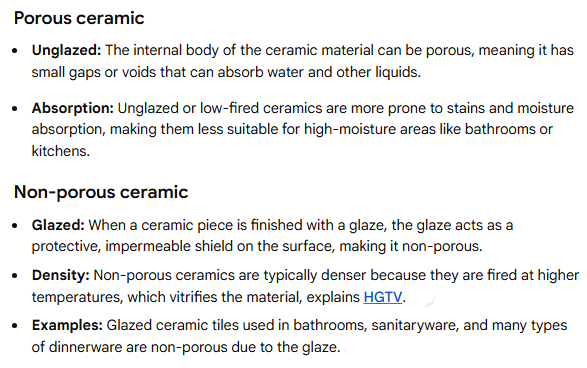
Ceramic materials can be both porous and nonporous; the classification depends entirely on the type of clay used, the firing temperature, and the presence of a glaze. Generally, Earthenware (terracotta) is highly porous and will absorb water if unglazed. Stoneware is semi-porous to nonporous. Porcelain is almost completely nonporous and impervious to moisture even without a glaze. However, adding a glass-like glaze to any ceramic surface effectively renders it nonporous for practical daily use.
When selecting materials for flooring, planters, or kitchenware, knowing the water absorption rate is critical. This rating determines if the material can withstand frost, resist stains, or hold liquid safely.
The Science of Ceramic Porosity
Porosity refers to the ratio of empty spaces (pores) within a solid material. In ceramics, these pores are microscopic air pockets left between clay particles after the firing process.
The primary factor reducing porosity is a process called vitrification. When clay goes into a kiln at high temperatures, the silica within the clay melts and turns into glass. This liquid glass fills the spaces between the clay particles. When it cools, it hardens and binds the material together, closing off the pores.
-
Low Firing Temperature: Less glass forms. The material remains porous.
-
High Firing Temperature: More glass forms. The material becomes dense and nonporous.
ADtech experts emphasize that understanding this structural difference is vital for construction and manufacturing projects.
3 Main Categories of Ceramic Porosity
To determine if a specific ceramic item is porous, you must identify its category. We classify ceramics into three distinct groups based on firing temperatures and physical properties.
1. Earthenware (High Porosity)
Earthenware is fired at the lowest temperatures, typically between 1,828°F and 2,075°F (1,000°C – 1,135°C). Because the kiln heat is not high enough to fully vitrify the clay, the particles remain somewhat loose.
-
Characteristics: It feels lighter and softer than other ceramics. It can be scratched easily with a knife.
-
Water Absorption: High (usually 5% to 15%).
-
Common Uses: Terracotta plant pots, decorative bricks, rustic dinnerware.
-
Verdict: Earthenware is porous. If you pour water into an unglazed terracotta pot, the exterior will eventually become damp.
2. Stoneware (Low Porosity)
Stoneware is fired at much higher temperatures, ranging from 2,185°F to 2,380°F (1,196°C – 1,304°C). The heat is sufficient to melt the silica, resulting in a hard, durable stone-like material.
-
Characteristics: Dense, opaque, and durable.
-
Water Absorption: Low (usually 0.5% to 3%).
-
Common Uses: Everyday dinner plates, baking dishes, coffee mugs, quality floor tiles.
-
Verdict: Stoneware is nonporous to semi-porous. While it resists water well, manufacturers usually glaze it to ensure total hygiene.
3. Porcelain (Nonporous)
Porcelain represents the peak of density. Fired above 2,300°F (1,260°C) using refined kaolin clay, it undergoes near-complete vitrification.
-
Characteristics: Extremely hard, white, and often translucent when held up to light.
-
Water Absorption: Negligible (less than 0.5%).
-
Common Uses: Bathroom sinks, high-end flooring, fine china, electrical insulators.
-
Verdict: Porcelain is nonporous. It is officially classified as “impervious” by industry standards.
Water Absorption Ratings for Tiles
In the construction and flooring industry, “porous” is not a vague term. It is a precise measurement defined by the American National Standards Institute (ANSI) and other global bodies. The rating comes from how much water the tile absorbs relative to its weight.
The following table breaks down these classifications. This data is crucial when ADtech advises clients on bathroom or outdoor installations.
Table 1: Ceramic Tile Absorption Classifications
| Classification | Water Absorption Rate | Description | Best Application |
| Non-Vitreous | More than 7.0% | Highly Porous | Indoor walls only (Dry areas). Never outdoors. |
| Semi-Vitreous | 3.0% to 7.0% | Moderately Porous | Indoor usage. Splashbacks or low-moisture rooms. |
| Vitreous | 0.5% to 3.0% | Low Porosity | Standard indoor flooring. Frost resistant but not frost proof. |
| Impervious | Less than 0.5% | Nonporous | Heavy traffic, outdoor patios, swimming pools, showers. |
Note: Porcelain tile always falls into the “Impervious” category.
The Role of Glazing: The Surface Shield
You might own a ceramic mug made of earthenware that holds coffee without leaking. This is possible because of glazing.
A glaze is a coating of liquid glass applied to the surface of the ceramic before the final firing. When the kiln heats up, this coating fuses to the clay body.
-
Unglazed Ceramic: The natural pores are open. Liquids, bacteria, and stains can penetrate the surface.
-
Glazed Ceramic: A protective layer seals the surface. Even if the clay underneath is porous, the surface becomes nonporous.
Why does this matter?
If a glazed tile chips or cracks, the protective seal breaks. If the body underneath is porous earthenware, water can seep in under the glaze, causing the tile to lift or the glaze to flake off later.
Case Study: Outdoor Patio Failure in Chicago
Time: March 2023
Location: Chicago, Illinois, USA
Client Profile: Residential Property Developer
The Situation:
A developer installed “Ceramic Slate” tiles on an outdoor luxury patio in late 2022. The tiles looked beautiful and robust. However, after the harsh Chicago winter, residents reported cracking, flaking, and “popping” tiles in March 2023.
Investigation:
They analyzed the fractured samples. The developer had purchased Semi-Vitreous ceramic tiles (4% absorption rate) instead of Impervious porcelain.
The Failure Mechanism:
-
Rain and melting snow seeped into the microscopic pores of the tile.
-
Temperatures dropped below freezing.
-
The water inside the tile expanded when it turned to ice.
-
The internal pressure shattered the clay body structure.
The Solution:
We recommended a complete replacement using ANSI-certified Impervious Porcelain with an absorption rate of 0.05%. The new installation survived the 2024 winter with zero defects.
How to Test if Your Ceramic is Porous (DIY Method)
You do not need a laboratory to check porosity. ADtech recommends this simple “Water Drop Test” for identifying unglazed surfaces or checking if your sealer has worn off.
-
Clean the surface: Wipe the ceramic with a damp cloth and let it dry completely.
-
Pour water: Place a tablespoon of water on the surface.
-
Wait: Let the water sit for 15 minutes.
-
Observe:
-
Darkening: If the ceramic under the water turns darker, it is absorbing the liquid. It is porous.
-
Beading: If the water remains in a perfect bead and the surface color does not change, it is nonporous (or well-sealed).
-
Applications: When to Choose Porous vs. Nonporous
Choosing the wrong type leads to structural failure or hygiene issues. Here is how experts categorize utility based on porosity.

1. Flooring and Wet Areas
Bathrooms, kitchens, and pool decks require nonporous materials.
-
Requirement: Impervious (Porcelain).
-
Reason: Prevents mold growth, resists urine or chemical stains, and withstands humidity. Porous tiles in a shower will absorb water, eventually causing the adhesive to rot.
2. Gardening and Plant Health
Plants often prefer porous containers.
-
Requirement: Porous (Terracotta/Earthenware).
-
Reason: Roots need oxygen. Porous walls allow air to reach the soil and wick away excess moisture, preventing root rot. A nonporous plastic or glazed pot holds water too well, which can drown sensitive plants.
3. Food and Dining
Hygiene is the priority here.
-
Requirement: Glazed Stoneware or Porcelain.
-
Reason: You cannot effectively sanitize porous material. Meat juices or milk soaking into unglazed earthenware creates a breeding ground for bacteria like Salmonella. FDA regulations strictly monitor the glazing of food-contact surfaces to ensure they are nonporous.
Table 2: Application Recommendations
| Application | Recommended Material | Porosity Level |
| Shower Floor | Porcelain Mosaic | Nonporous |
| Orchid Pot | Unglazed Terracotta | Highly Porous |
| Kitchen Counter | Glazed Stoneware/Porcelain | Nonporous |
| Bedroom Floor | Glazed Ceramic (Vitreous) | Low Porosity |
| Driveway | Porcelain Pavers | Nonporous |
Maintenance and Sealing Porous Ceramics
If you love the look of unglazed terracotta or natural stone but need stain resistance, you must use a sealer. Sealing fills the top pores with a chemical barrier.
There are two main types of sealers to consider:
-
Penetrating (Impregnating) Sealers: These soak into the pores. They repel water and oil but keep the natural look of the clay.
-
Topical Sealers: These sit on top, creating a glossy film. They offer high protection but can look like plastic and may peel over time.
Table 3: Sealing Schedule for Porous Ceramics
| Material | Sealer Type | Re-application Frequency |
| Terracotta Floors | Penetrating Oil/Wax | Every 1-2 years |
| Unglazed Backsplash | Impregnating | Every 3-5 years |
| Outdoor Pavers | Solvent-based Acrylic | Every 2-3 years |
ADtech Tip: Always perform the Water Drop Test before applying a new coat of sealer.
Detailed Comparison: Ceramic vs. Other Materials
To fully grasp the nature of ceramic, we should compare it to other common household materials.
Ceramic vs. Natural Stone
Natural stone (Marble, Granite, Travertine) is almost always porous. Marble is like a hard sponge; red wine will stain it instantly. Porcelain ceramic is superior for low maintenance because it is naturally nonporous and does not require the constant sealing that natural stone demands.
Ceramic vs. Concrete
Concrete is highly porous. Without a heavy-duty industrial sealer, concrete absorbs oil, water, and chemicals rapidly. High-fired stoneware is significantly denser than standard concrete.
FAQs about Ceramic Porosity
1. Is unglazed ceramic food safe?
Generally, no. Unglazed ceramic is porous and can trap food particles and bacteria. Even if you wash it, germs can survive inside the pores. Always use glazed dinnerware for wet foods.
2. Can I use porous ceramic tiles in a shower if I seal them?
Technically yes, but experts advise against it. Sealers degrade over time. If you forget to reseal, water will penetrate the tile, get behind the waterproofing, and cause mold. Porcelain is the safer choice.
3. Does porcelain tile need sealing?
Glazed porcelain does not need sealing. Polished unglazed porcelain might have microscopic micro-pores opened during the polishing process, so a penetrating sealer is sometimes recommended by manufacturers to prevent grout haze stains.
4. Why does my ceramic pot turn white on the outside?
This is called efflorescence. Because the pot is porous, water travels through the clay walls, carrying salts from the soil or fertilizer. When the water evaporates on the outside, it leaves white salt deposits behind.
5. Is ceramic harder than glass?
Yes. The crystalline structure formed during firing makes most ceramics harder and more durable than standard glass.
6. Does painting ceramic make it nonporous?
Standard acrylic or latex paint will create a film, but it is not the same as glazing. Paint can peel and is not usually food safe or watertight for long periods. Kiln-fired glaze is the only permanent waterproofing method.
7. How can I tell if a tile is porcelain or ceramic?
Check the box for the “PTCA Certified” logo. Also, look at the side of the tile (the biscuit). If the color is the same through the entire thickness, it is likely through-body porcelain. If the top is colored but the side is red or brown, it is likely glazed ceramic.
8. Can porous ceramics withstand heat?
Yes, ceramics are excellent heat insulators. However, if a porous ceramic is wet and then heated rapidly (like in a microwave), the water inside can turn to steam and crack the vessel.
9. Is ceramic biodegradable?
No. Fired ceramic is chemically stable and does not decompose. However, it is inert and does not release toxic chemicals into the soil like plastics do.
10. Why is porcelain more expensive than earthenware?
Porcelain requires purer, more expensive clay (kaolin) and must be fired at much higher temperatures, which uses more fuel. The loss rate during manufacturing is also higher due to warping, making the final product more costly.
Conclusion
Ceramic is porous in its natural, low-fired state (Earthenware), but it becomes nonporous when fired at high temperatures (Porcelain) or when a glass glaze is applied.
When planning your next project, do not just look at the color or pattern. Look at the technical specifications.
-
Choose Porcelain for wet areas, outdoors, and heavy floors.
-
Choose Glazed Stoneware for dinnerware and kitchen use.
-
Choose Terracotta for planting and dry, decorative areas.
The success of your installation depends on matching the porosity of the material to the demands of the environment.