

Electric immersion heaters utilizing Silicon Nitride (Si3N4) protection tubes provide the most energy-efficient method for maintaining molten aluminum temperatures, offering superior thermal transfer efficiency up to 99% compared to the 20-40% efficiency typical of gas-fired top heating systems. By heating the metal from within rather than from the surface, AdTech immersion heaters eliminate the risk of overheating the melt surface, significantly reduce dross formation, and ensure uniform temperature distribution required for high-quality aluminum casting.
For foundries and casthouse operators seeking to reduce operational costs while improving metallurgical quality, switching to direct immersion heating is the definitive solution. This technology bypasses the thermal barriers created by surface oxide layers. It delivers energy directly where it is needed. The result is a cleaner melt, lower energy bills, and extended equipment lifespan.
The Engineering Behind Immersion Heaters in the Aluminum Industry
Melting and holding aluminum requires precise thermal management. Traditional reverberatory furnaces rely on radiation from roof-mounted burners to heat the metal bath. This method is fundamentally flawed because aluminum is highly reflective. A large portion of the radiant energy bounces off the surface. Furthermore, heat must penetrate the dross layer, which acts like an insulator.
Immersion heating flips this dynamic. The heat source is submerged directly into the liquid metal.
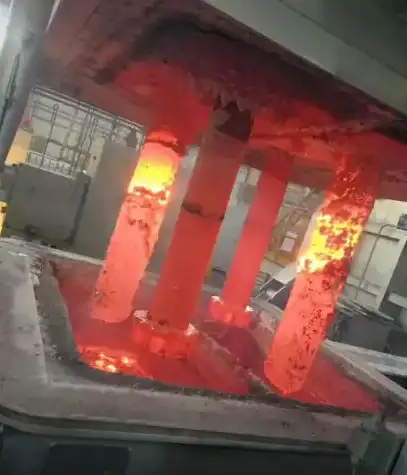
Principles of Direct Heat Transfer
The physics governing AdTech immersion heaters relies on conduction. The heating element sits inside a protective ceramic tube. This tube is submerged in the aluminum. Heat flows from the element, through the ceramic wall, and directly into the melt.
There is no air gap. There is no flue gas loss. The energy has nowhere to go but into the aluminum. This results in thermal efficiency ratings that consistently hover near 100%.
Core Components of the System
An effective immersion heater system consists of three primary components:
-
The Heating Element: Typically a resistance wire (NiCr) wound on a ceramic bobbin. It generates the thermal energy.
-
The Protection Tube: This is the interface with the molten metal. AdTech utilizes high-purity Silicon Nitride (Si3N4) or Sialon. These materials are non-wetting to aluminum.
-
The Control System: Thermocouples and PID controllers regulate the power input to maintain temperature within +/- 2 degrees Celsius.
Why Choose Electric Immersion Over Gas Top Heating?
The industry is shifting away from gas for holding furnaces and degassing units. The reasons are economic and metallurgical.
Energy Efficiency Comparison
Gas burners heat the atmosphere above the metal. To get the metal to 720°C, the air above it might need to be 1000°C. This creates massive waste. Heat escapes through the flue. Heat heats the refractory walls. Only a fraction enters the aluminum.
Immersion heaters operate differently. To maintain 720°C, the heater surface might only need to be 750°C. The temperature gradient is small. The transfer is direct.
Table 1: Energy Efficiency Comparison (Gas vs. Immersion)
| Feature | Gas-Fired Top Heating | AdTech Immersion Heater |
| Thermal Efficiency | 20% – 45% | > 99% |
| Heat Transfer Mode | Radiation & Convection | Direct Conduction |
| Dross Formation | High (due to surface agitation) | Very Low (surface remains calm) |
| Temperature Precision | +/- 10°C to 15°C | +/- 2°C |
| Oxidation Rate | High (superheated surface) | Minimal |
Reduction of Dross and Corundum Growth
Dross forms when aluminum reacts with oxygen. This reaction accelerates at higher temperatures. Gas burners superheat the surface. This causes rapid oxidation. The oxide layer thickens. Operators must skim this dross. Skimming removes good metal with the waste. It is a direct loss of profit.
Immersion heaters keep the surface cool relative to the bottom. The surface remains undisturbed. Less oxide forms. Less skimming is required. Metal yield increases.
The Critical Role of Silicon Nitride (Si3N4) Protection Tubes
The success of an immersion heater depends on the protection tube. The tube must survive in a hostile environment. Molten aluminum is corrosive. It attacks most metals. Iron dissolves instantly.
AdTech employs advanced Silicon Nitride (Si3N4) for our heater protection tubes. This material is superior to cast iron, silicon carbide, or alumina graphite for this specific application.
Non-Wetting Properties
Silicon Nitride does not wet with aluminum. The metal flows around it like mercury on glass. Because the metal does not stick, dross does not build up on the tube. This maintains constant heat transfer rates.
If dross builds up on a tube (common with cast iron), it insulates the heater. The element inside must work harder to push heat through the sludge. This causes the element to burn out prematurely. Si3N4 prevents this.
Thermal Shock Resistance
Foundries are harsh places. Temperature changes happen. Silicon Nitride has a low coefficient of thermal expansion. It can withstand rapid temperature changes without cracking. This durability ensures the heater can be inserted or removed for maintenance without catastrophic failure.
Technical Specifications and Performance Data
Engineers need data to make decisions. Below are the typical operational parameters for AdTech immersion heaters used in aluminum processing.
-
Power Density: Optimized to prevent tube surface overheating. Typically 20-25 kW/m2.
-
Operating Temperature: Up to 800°C for the melt (Element temp approx 1000°C).
-
Voltage: Customizable (110V, 220V, 380V, 415V)
-
Tube Diameter: Standard sizes range from 55mm to 150mm.
-
Immersion Length: Customizable up to 1200mm depending on furnace depth.
Power Calculation and Sizing
Selecting the right heater requires calculating the thermal load. You must consider:
-
Mass of the aluminum.
-
Specific heat capacity of aluminum.
-
Target temperature rise (or maintenance load).
-
Heat losses through furnace walls.
Table 2: Typical Heating Element Specifications
| Parameter | Specification | Notes |
| Element Material | NiCr 80/20 or FeCrAl | High resistance to oxidation |
| Insulation | MgO Powder / Ceramic Core | High dielectric strength |
| Cold Zone | Top 200mm – 400mm | Protects terminals from heat |
| Hot Zone | Submerged Section | Generates heat |
| Life Expectancy | 6 – 12 Months | Depends on usage and care |
Applications in the Casting Process
AdTech immersion heaters are versatile. They fit into various stages of the casting line.
Degassing Units and Filter Boxes
The metal cools rapidly during degassing and filtration. These processes occur between the holding furnace and the casting table. If the temperature drops too low, the casting fails.
Installing immersion heaters in the degassing box or CFF (Ceramic Foam Filter) box maintains the temperature. This allows the main furnace to operate at a lower temperature. This saves energy for the entire plant.
Low Pressure Die Casting (LPDC)
LPDC requires precise pressure and temperature. The holding furnace is often small. Immersion heaters are ideal here. They occupy little space. They provide exact temperature control. This consistency reduces scrap rates in wheel manufacturing and automotive casting.
Transport Ladles
Moving molten metal across a large facility results in heat loss. Heated ladle covers equipped with immersion units can keep metal molten for extended periods. This facilitates logistics in large foundries.
Installation and Maintenance Best Practices
Proper installation ensures longevity. Incorrect handling destroys ceramic tubes.
Vertical vs. Horizontal Installation
Vertical installation is standard. The heater hangs from the top. This places the least mechanical stress on the ceramic tube.
Horizontal installation is possible but risky. The tube acts like a cantilever beam. The buoyancy of aluminum exerts upward force. The weight of the tube exerts downward force. Over time, creep can occur. AdTech recommends vertical mounting whenever possible.
Wiring and Terminal Protection
The connection point (terminal head) must remain cool. It should not exceed 200°C. High temperatures oxidize copper connections. This increases resistance. Increased resistance creates heat. The terminal melts.
Use forced air cooling if the ambient temperature above the furnace is high. Keep the head away from direct flue gases.
Routine Cleaning Protocols
Even with non-wetting Si3N4, some oxides may float against the tube.
-
Lift the heater daily.
-
Visually inspect the tube.
-
Gently wipe any residue with a soft ceramic fiber blanket.
-
Do not hit the tube. It is a ceramic. It is brittle.
Addressing Common Problems and Troubleshooting
Operators may face issues. Here is how to solve them.
Problem: Heater Fails Prematurely
-
Cause: Overheating due to sludge buildup.
-
Solution: Check the furnace bottom. If the heater is buried in sludge, it cannot release heat. The internal temperature spikes. The wire melts. Keep the heater at least 100mm off the furnace floor.
Problem: Temperature Overshoot
-
Cause: PID controller not tuned or thermocouple placement is wrong.
-
Solution: Place the control thermocouple close to the heater but not touching it. Tune the PID parameters to account for the thermal lag of the ceramic tube.
Problem: Cracked Tubes
-
Cause: Mechanical impact or extreme thermal shock.
-
Solution: Ensure the hoist moves smoothly. Do not drop the heater into the metal. Preheat the tube above the melt for 15 minutes before submersion to drive off moisture.
The AdTech Advantage
Why specify AdTech? We integrate the entire thermal loop. We do not just sell a heater. We sell the ceramic technology.
Our manufacturing process for Silicon Nitride involves Cold Isostatic Pressing (CIP) and high-temperature sintering. This produces a density that rivals bearing steel. The porosity is near zero. Aluminum cannot penetrate.
Competitor tubes often use lower grade Sialon or bonded Silicon Carbide. These materials have higher porosity. Over weeks, aluminum infiltrates the pores. The tube becomes conductive. This can cause short circuits. It also makes the tube heavy and brittle. AdTech tubes remain lightweight and electrically insulating throughout their service life.
Table 3: Material Performance Comparison
| Material Property | AdTech Si3N4 | Silicon Carbide (SiC) | Cast Iron |
| Aluminum Wetting | Non-wetting | Slight Wetting | High Wetting |
| Corrosion Resistance | Excellent | Good | Poor (Requires coating) |
| Thermal Shock | Excellent | Good | Poor |
| Service Life | > 12 Months | 3 – 6 Months | < 1 Month |
| Iron Contamination | None | None | High |
Future Trends in Aluminum Heating
The industry is moving toward “Green Casting.” Carbon footprint reduction is mandatory.
Electric immersion heating runs on grid power. If the grid uses renewables, the melting process becomes carbon neutral. Gas furnaces always emit CO2.
Furthermore, the push for higher purity alloys (for aerospace and EVs) demands zero inclusions. Immersion heaters eliminate the turbulence that mixes oxides into the melt. AdTech is at the forefront of this transition, supplying the tools needed for next-generation metallurgy.
AdTech Immersion Heater & Si3N4 Tube FAQ
1. How long does an AdTech immersion heater tube last?
2. Can I use immersion heaters for alloys containing Zinc or Magnesium?
3. What is the maximum power rating for a single heater unit?
4. Do immersion heaters save money compared to gas-fired systems?
Beyond energy savings, the reduction in metal loss (less dross formation) and lower maintenance costs often result in a much lower Total Cost of Ownership (TCO).
5. How is the temperature controlled in these systems?
6. Can the heater be repaired if it fails?
7. Is preheating necessary before immersion?
8. What happens if the tube breaks while submerged?
9. Does AdTech provide custom sizes for specific furnaces?
10. How does immersion heating impact final metal quality?
Conclusion
The transition to immersion heater technology for aluminum melting represents a smart investment in efficiency and quality. AdTech combines high-performance heating elements with world-class Silicon Nitride protection tubes to deliver a solution that outlasts and outperforms traditional heating methods.
By switching to this technology, casthouses eliminate gas waste. They reduce dross generation. They achieve the tight temperature control required for premium automotive and aerospace components. The initial investment pays for itself through energy savings and material conservation.
For facility managers and metallurgical engineers, the choice is clear. AdTech immersion heaters provide the stability and efficiency required in a modern, competitive aluminum industry. Contact our engineering team today to design a heating solution tailored to your specific furnace requirements.
Extended Technical Analysis: Thermal Dynamics in Molten Aluminum
To fully appreciate the AdTech solution, we must examine the thermodynamic behavior of the melt. Aluminum has high thermal conductivity. This property works in favor of immersion heating. When heat is introduced internally, the aluminum itself acts as a conductor, spreading the energy rapidly throughout the bath.
Convection Currents
In a static bath, immersion heaters create natural convection currents. The hot metal near the tube rises. Cooler metal sinks. This gentle circulation ensures homogeneity without the turbulence caused by gas injection or mechanical stirring. Turbulence is the enemy of quality. It breaks the surface oxide skin. It folds oxides into the bulk metal. Immersion heating maintains a quiescent state. This allows inclusions to float or sink to the filter, rather than circulating endlessly.
Power Density Considerations
The concept of “surface load” (Watts per square centimeter of the tube surface) is vital. If the load is too high, the interface temperature between the tube and the aluminum becomes excessive. This can cause localized boiling or “hot spots.” AdTech engineers calculate the optimal surface area to keep the load within safe limits. This engineering prevents thermal stress on the ceramic material.
Materials Science: The Sialon Difference
Not all Silicon Nitride is created equal. Sialon is a ceramic alloy of Silicon, Aluminum, Oxygen, and Nitrogen.
The chemical formula is roughly Si-Al-O-N.
This material combines the strength of silicon nitride with the chemical stability of aluminum oxide.
Key Microstructural features:
-
Interlocking Grain Structure: The needle-like grains lock together. This stops cracks from propagating.
-
Low Porosity: AdTech tubes have near-theoretical density. There are no paths for aluminum to infiltrate.
-
Chemical Inertness: Sialon is practically immune to attack from fluxes and salts used in the casting process.
Operational Scenarios and ROI
Let us construct a hypothetical Return on Investment (ROI) scenario for a holding furnace.
Scenario: A 2-ton holding furnace.
Current Method: Gas burners.
Proposed Method: AdTech Immersion Heaters (3 units).
Gas System Costs:
-
Fuel efficiency: 30%.
-
Metal loss to dross: 2% per month.
-
Refractory maintenance: High (due to thermal cycling).
Immersion System Costs:
-
Energy efficiency: 99%.
-
Metal loss to dross: < 0.5% per month.
-
Consumables: Element replacement every 9 months.
The Calculation:
The energy savings are substantial. However, the metal savings are the game-changer. Aluminum prices fluctuate, but scrap is always expensive. Reducing dross by 1.5% on a high-throughput line saves tons of metal annually. The ROI for an immersion system is often realized in less than 8 months.
Installation Guide for Engineers
When retrofitting an existing furnace, consider the following layout strategies:
-
Placement: Avoid dead zones. Place heaters where metal flow enters or exits to ensure the heat is carried away from the source.
-
Depth: The bottom of the heater should be at least 150mm above the floor to avoid sludge. The top of the heated zone must be at least 150mm below the lowest metal level. If the heated zone is exposed to air while powered, the element will fail instantly.
-
Safety Interlocks: Install a level sensor. If the metal level drops, the power must cut off automatically. This protects the heater and the facility.
Environmental Impact and Sustainability
The aluminum industry faces pressure to decarbonize. Scope 1 emissions come directly from burning fossil fuels on-site. Scope 2 emissions come from purchased electricity.
By moving from gas (Scope 1) to electric (Scope 2), a foundry prepares for a green future. As the electrical grid becomes greener with solar and wind, the foundry’s carbon footprint drops automatically. Immersion heaters are a “future-proof” technology.
Furthermore, the reduction in dross processing reduces hazardous waste. Dross contains salts and oxides that are difficult to dispose of. Reducing dross generation at the source is the most environmentally responsible strategy.
AdTech Global Support
AdTech does not just ship a box. We provide technical consultation. Our team understands the nuance of alloy specifications. We know that heating 7075 alloy differs from heating 356 alloy. We assist with:
-
Thermal modeling.
-
Custom flange design.
-
Electrical control panel schematics.
-
On-site troubleshooting guidance.
We serve clients across the globe. Our immersion heaters operate in major automotive foundries, aerospace casting facilities, and aluminum billet casting plants. The reliability of our Si3N4 tubes has made AdTech a trusted partner in the non-ferrous industry.
Final Summary of Benefits
To recap, the implementation of AdTech immersion heaters offers a multi-faceted advantage:
-
Financial: Lower energy bills and reduced metal loss.
-
Operational: Less maintenance downtime and longer equipment life.
-
Quality: Superior metal cleanliness and consistent mechanical properties.
-
Environmental: Lower carbon emissions and reduced waste generation.
The technology is mature. The benefits are proven. The shift to electric immersion heating is not just an option; it is the standard for modern, efficient aluminum casting.