

A properly manufactured clay-bonded or isostatic graphite crucible will survive 80 to 150 melting cycles when handling aluminium, resist molten metal penetration through its non-wetting carbon surface, and maintain thermal shock resistance that ceramic or silicon carbide alternatives simply cannot match at comparable price points. That’s the conclusion we’ve reached after supplying crucibles to foundries across three continents and tracking failure data on thousands of units in actual production service.
If your project requires the use of Graphite Crucible for Aluminium Melting, you can contact us for a free quote.
Why Does Graphite Resist Wetting From Molten Aluminium?
The non-wetting characteristic that everyone mentions in marketing copy actually has a real physical explanation, and understanding it helps buyers make better purchasing decisions rather than just trusting a spec sheet claim.
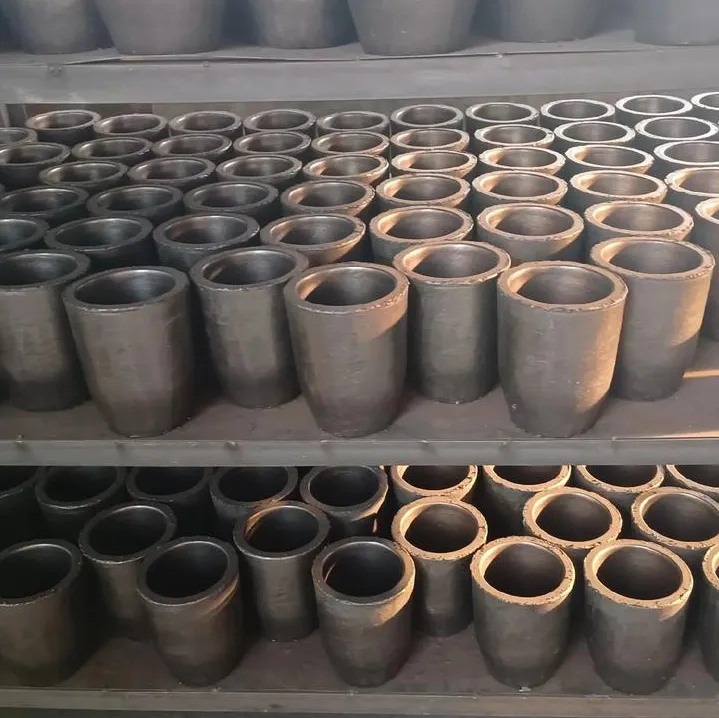
Graphite’s crystalline structure consists of carbon atoms arranged in stacked hexagonal layers, held together by weak van der Waals forces between the layers. Molten aluminium has a surface tension and chemical affinity that doesn’t bond readily with this layered carbon structure under normal melting temperatures. The result is a contact angle greater than 90 degrees between the liquid metal and the crucible wall, which in plain terms means the aluminium beads up rather than spreading and soaking into the material.
We’ve watched this play out directly in our workshop testing. When we pour molten aluminium into a properly fired graphite crucible and then tip it out, the interior surface stays remarkably clean, with minimal metal residue clinging to the walls. Compare that to a silicon carbide crucible of lower graphite content, where we’ve seen noticeably more metal adhesion and buildup after repeated cycles, eventually requiring mechanical cleaning that shortens the crucible’s working life.
This non-wetting property matters practically because it reduces contamination risk. Aluminium that doesn’t stick to crucible walls doesn’t pick up carbon or silicon particles from gradual erosion, keeping the melt cleaner for casting applications where chemistry specifications matter, particularly in aerospace and automotive component production.
The Role of Binder Composition
Not all graphite crucibles achieve the same non-wetting performance, and the difference usually traces back to binder composition and manufacturing process. Clay-graphite crucibles mix natural or synthetic graphite with fireclay and other ceramic binders, typically running 35-50% graphite content. Silicon carbide graphite crucibles substitute some clay content with silicon carbide for improved thermal conductivity, usually keeping graphite content around 25-40%.
Higher graphite percentage generally correlates with better non-wetting behavior and thermal shock resistance, but it also reduces mechanical strength and increases raw material cost. This tradeoff is exactly why we spend time during customer consultations discussing actual production patterns rather than just recommending the highest graphite content option by default.
What Makes a Graphite Crucible Durable for Aluminium Service Specifically?
Durability in crucible terminology covers several distinct failure modes, and aluminium melting stresses a crucible differently than iron or copper melting does. Understanding these differences prevents buyers from over-specifying for problems that won’t actually occur in their application, or worse, under-specifying and facing premature failure.
Aluminium melts at a relatively low temperature, around 660°C for pure aluminium and slightly lower for most casting alloys, compared to over 1200°C for iron. This means thermal shock from rapid heating and cooling cycles is less severe for aluminium crucibles than for those used in ferrous melting. However, aluminium foundries often run more frequent batch cycles per shift because of faster melt times, which means the crucible experiences more total thermal cycling over its service life even though each individual cycle is gentler.
Oxidation resistance becomes the dominant durability factor for aluminium service crucibles, since graphite oxidizes when exposed to atmospheric oxygen at elevated temperature, particularly above 500°C. A crucible sitting in an open-flame gas furnace experiences continuous oxidation exposure on its exterior surface, gradually thinning the wall over months of use. This is why proper glazing and surface treatment during manufacturing significantly extends service life, something we’ve verified through controlled wear testing at our facility.
| Failure Mode | Cause | Prevention Method | Typical Impact on Lifespan |
|---|---|---|---|
| Oxidation erosion | Exposure to atmospheric oxygen at high temperature | Silicon carbide glaze coating, proper firing | Can double lifespan when properly glazed |
| Thermal shock cracking | Rapid temperature change, cold charging | Gradual preheating protocol | Prevents most early-life failures |
| Mechanical impact damage | Rough charging, dropped scrap | Careful loading procedure, cushioned charging | Reduces sudden failure incidents |
| Slag line erosion | Chemical attack at metal-air interface | Higher graphite content, quality binder | Extends wall thickness retention |
| Base cracking from thermal cycling | Repeated heat-cool stress at bottom | Proper furnace stand support, even heating | Reduces catastrophic bottom failure |
We tell every new customer the same thing during onboarding: the crucible’s rated lifespan on paper assumes correct handling procedures. Plants that skip preheating new crucibles, or that let inexperienced workers drop scrap metal directly into the crucible from height, routinely see failure rates three to four times higher than plants following manufacturer handling guidelines.
How Long Does a Graphite Crucible Actually Last When Melting Aluminium?
This is probably the single most common question we field from purchasing managers, and the honest answer involves more variables than most suppliers admit upfront.
Under normal aluminium foundry conditions with proper handling, a quality clay-graphite crucible typically delivers 80 to 150 melting cycles before wall thinning or cracking requires replacement. Silicon carbide graphite crucibles, with their improved thermal conductivity and mechanical strength, can push this range to 150-250 cycles in well-maintained gas-fired furnace operations.
Several factors shift these numbers considerably in either direction, and we’ve compiled the following comparison based on field data collected from customer sites over multiple years of tracking.
| Operating Condition | Impact on Crucible Lifespan | Typical Cycle Range |
|---|---|---|
| Gas-fired furnace, proper preheat protocol | Baseline, standard wear | 100-150 cycles |
| Induction furnace use | Reduced oxidation exposure, longer life | 150-220 cycles |
| Frequent cold starts without preheat | Accelerated thermal shock damage | 40-70 cycles |
| High-frequency alloy switching | Increased thermal cycling stress | 60-100 cycles |
| Poor charging technique, mechanical impact | Premature cracking | 30-60 cycles |
| Continuous holding at temperature | Extended oxidation exposure | 70-110 cycles |
Interestingly, induction furnace use tends to extend crucible life compared to gas-fired furnaces, since the crucible experiences less direct exposure to oxidizing flame atmosphere and more even heating from the induced eddy currents. Several of our customers who transitioned from gas to induction melting reported crucible lifespan improvements of 40-60% purely from that atmosphere change, independent of any crucible specification upgrade.
We’ve also noticed that plants melting a single aluminium alloy consistently get longer crucible life than plants switching between multiple alloys frequently, since each alloy change often involves a full cool-down and reheat cycle that adds thermal stress compared to continuous same-alloy operation.
Clay-Graphite vs Silicon Carbide Graphite: Which Should You Choose?
This decision point generates more confusion than almost any other aspect of crucible selection, largely because suppliers market both types aggressively without always explaining the actual tradeoffs honestly.
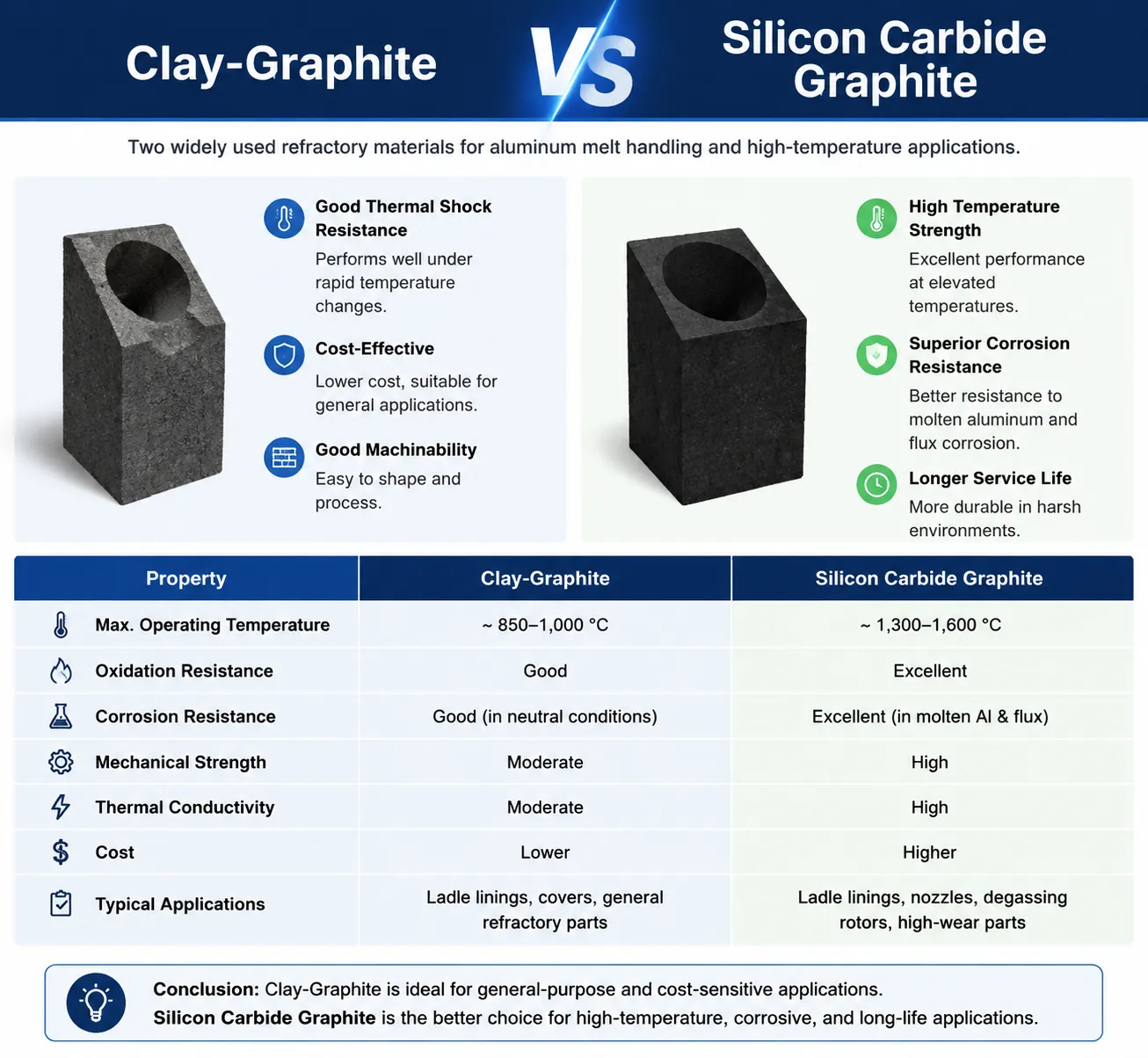
Clay-graphite crucibles use fireclay as the primary binder holding graphite flakes together, typically fired at lower temperatures during manufacturing. They cost less upfront, handle thermal shock reasonably well, and work fine for standard aluminium melting applications without unusual demands. Most small to mid-size aluminium foundries and jewelry casting operations do perfectly well with clay-graphite crucibles.
Silicon carbide graphite crucibles incorporate silicon carbide into the matrix alongside graphite and clay binders, producing a denser structure with notably better thermal conductivity and mechanical strength. This translates to faster melting times since heat transfers through the crucible wall more efficiently, plus better resistance to mechanical damage from rough handling. The tradeoff is a purchase price typically running 30-60% higher than comparable clay-graphite units.
| Characteristic | Clay-Graphite Crucible | Silicon Carbide Graphite Crucible |
|---|---|---|
| Purchase cost | Lower | 30-60% higher |
| Thermal conductivity | Moderate | High |
| Melt rate performance | Standard | 10-20% faster typically |
| Mechanical strength | Good | Excellent |
| Thermal shock resistance | Good | Very good |
| Typical lifespan (cycles) | 80-150 | 150-250 |
| Best application | General foundry, batch melting | High-volume production, frequent cycling |
| Non-wetting performance | Very good | Good to very good |
Our recommendation, based on years of matching customers to appropriate products, comes down to production volume. Shops running under 30 melting cycles weekly generally don’t recoup the price premium of silicon carbide graphite crucibles within a reasonable timeframe. Higher-volume operations running 50 or more cycles weekly typically see the extended lifespan and faster melt times justify the additional upfront cost within the first year of use.
What Size and Shape Options Matter for Aluminium Melting?
Crucible geometry affects melting efficiency more than many buyers initially realize, and getting the size wrong creates ongoing operational headaches that persist for the entire service life of that unit.
Crucibles for aluminium melting come in standard shape designations, most commonly the “A” shape with tapered sides and rounded bottom, or the “S” shape with more vertical walls suited for certain furnace configurations. Capacity ratings reference the weight of aluminium the crucible holds, typically ranging from small 10-kilogram units for jewelry and prototype work up to large 500-kilogram or greater units for production foundries.
We consistently advise customers against buying the largest crucible their furnace can physically accommodate, a mistake we see repeated often enough to mention specifically. Oversized crucibles running partially filled waste energy heating unused crucible volume and metal that isn’t there, while also creating uneven heat distribution that stresses the crucible walls unevenly over time.
| Crucible Size Category | Typical Aluminium Capacity | Common Application | Wall Thickness Range |
|---|---|---|---|
| Small (jewelry/lab grade) | 5-20 kg | Jewelry casting, prototyping, lab testing | 8-15 mm |
| Medium (small foundry) | 30-100 kg | Small production foundries, job shops | 15-25 mm |
| Large (production foundry) | 150-350 kg | Mid to high-volume casting operations | 25-40 mm |
| Extra large (industrial) | 400 kg and above | Large production facilities, continuous operation | 35-55 mm |
Wall thickness deserves separate mention because thicker walls don’t automatically mean better performance for aluminium specifically. Thicker walls do improve mechanical durability and slow oxidation-driven wall thinning, but they also slow heat transfer into the metal charge, extending melt time and increasing energy consumption per cycle. We generally recommend matching wall thickness to furnace type, thinner walls for induction furnaces where heat transfer speed matters more, and moderate thickness for gas-fired furnaces where oxidation resistance takes priority.
How Should New Crucibles Be Preheated and Broken In?
Improper initial use destroys more crucibles prematurely than almost any other single factor, and this is genuinely something we spend real time explaining to new customers because the manufacturing process leaves moisture and volatile binder compounds inside the crucible wall that must be driven out gradually.
A brand new crucible straight from packaging typically retains manufacturing moisture and unreacted binder material. Placing it directly into a hot furnace at full operating temperature creates rapid steam expansion within the wall structure, which frequently causes cracking or spalling before the crucible ever holds its first charge of metal.
Our standard recommendation, consistent with most reputable manufacturer guidelines, involves a staged preheating schedule. Start with the crucible at low heat, around 150-200°C, held for 30-60 minutes to drive off surface moisture. Increase gradually to 400-500°C over another hour, allowing internal moisture to escape without thermal shock. Only after reaching consistent temperature throughout the crucible wall should full operating temperature be applied for the first actual melting cycle.
Skipping this process to save time on a production day is probably the most common mistake we see among crews under schedule pressure, and it’s also the single most preventable cause of first-cycle crucible failure that we track in our warranty claim data.
What Are the Warning Signs a Crucible Needs Replacement?
Waiting for catastrophic failure, where molten metal breaches the crucible wall during operation, creates serious safety hazards and potential furnace damage that far exceeds the cost of a replacement crucible. Recognizing warning signs early prevents this outcome.
Visible surface cracking, even hairline cracks that don’t yet penetrate the full wall thickness, indicate structural weakening that will progress with continued thermal cycling. We advise customers to inspect crucibles visually after every cool-down cycle, checking particularly around the base and the metal-air interface line where the majority of wear concentrates.
Wall thinning, detectable through weight loss tracking or physical measurement where accessible, signals approaching end of service life even without visible cracking. Some of our more meticulous customers track crucible weight after cleaning at regular intervals, replacing units once weight loss exceeds roughly 15-20% of original crucible weight, since this correlates strongly with wall thickness reduction to unsafe levels.
Changes in melt behavior sometimes indicate crucible degradation before visual inspection catches the problem. If melt times noticeably increase without any change in charge material or furnace settings, degraded crucible wall integrity affecting heat transfer characteristics is worth investigating.
| Warning Sign | What It Indicates | Recommended Action |
|---|---|---|
| Hairline surface cracks | Early structural fatigue | Monitor closely, plan replacement within weeks |
| Deep cracks visible through wall | Advanced structural failure | Replace immediately, do not use |
| Excessive metal buildup on interior | Surface degradation, reduced non-wetting property | Clean thoroughly, evaluate remaining lifespan |
| Noticeable weight loss (15%+) | Significant wall thinning | Schedule replacement |
| Increased melt time for same charge | Reduced thermal conductivity from wall damage | Inspect for internal degradation |
| Discoloration or bulging at base | Base structural weakening | Replace before next production cycle |
What Handling and Storage Practices Extend Crucible Lifespan?
Beyond the melting process itself, how crucibles get handled between uses significantly affects total service life, and this is an area where we’ve seen enormous variation between customer facilities running otherwise identical equipment.
Storage in dry conditions matters considerably, since graphite crucibles left in humid environments between production runs reabsorb moisture that then requires re-drying before the next use, adding thermal stress each time. Facilities storing crucibles in climate-controlled areas, or at minimum away from direct exposure to washdown water and outdoor humidity, consistently report better lifespan outcomes.
Charging technique affects mechanical stress on the crucible substantially. Dropping large scrap pieces from height into an empty or partially filled crucible creates impact stress that accumulates as micro-fractures over repeated cycles, eventually leading to sudden cracking. We recommend loading larger pieces first at lower positions, adding smaller scrap and ingot on top, and generally avoiding any charging method that lets metal fall freely from significant height.
Furnace stand and support quality matters more than most buyers initially consider. A crucible resting unevenly on a damaged or improperly fitted furnace stand experiences concentrated stress points during thermal expansion and contraction, dramatically increasing crack risk compared to a properly leveled and supported installation.
How Does Crucible Choice Affect Melt Quality and Aluminium Chemistry?
Purchasing decisions around crucibles sometimes focus exclusively on durability and cost, overlooking the direct connection between crucible material and final metal quality, something that matters enormously for foundries serving aerospace, automotive, or other specification-sensitive customers.
The non-wetting property discussed earlier isn’t just about crucible longevity, it directly protects melt chemistry by minimizing carbon pickup from the crucible wall into the aluminium. Lower quality crucibles with poor graphite bonding or excessive porosity allow greater metal penetration into the wall structure, which over repeated cycles can introduce measurable carbon and silicon contamination into the melt, particularly problematic for high-purity aluminium alloy production.
We’ve run comparative chemistry analysis for customers concerned about this exact issue, testing aluminium samples melted in both new and heavily used crucibles. The difference in trace contamination becomes measurable once a crucible has exceeded roughly 70-80% of its rated service life, reinforcing the practical value of replacing crucibles proactively rather than running them until catastrophic failure.
Gas absorption is another quality factor connected to crucible condition. Cracked or degraded crucibles can allow furnace atmosphere gases to interact with the melt in unintended ways, potentially increasing hydrogen absorption that leads to porosity defects in finished castings. This connection between crucible integrity and casting defect rates is something we discuss regularly with quality-focused customers who track scrap rates back to root causes.
Selecting a Supplier: What Actually Matters Beyond Price
Crucible pricing varies enormously between manufacturers, and the lowest quoted price frequently correlates with shortest actual service life, creating a false economy that costs more per melting cycle over time despite appearing cheaper per unit.
We encourage buyers to ask suppliers directly about graphite source and content percentage rather than accepting vague marketing descriptions like “premium graphite blend” without specific numbers. Reputable manufacturers should readily provide graphite percentage, binder composition, and firing temperature data, since these directly correlate with the durability and non-wetting performance discussed throughout this article.
Asking for actual cycle count data from existing customers running similar production volumes provides far more useful information than manufacturer-stated theoretical maximums, which often reflect ideal laboratory conditions rather than real foundry floor performance. We always encourage prospective customers to request references specifically from operations similar to their own in furnace type, alloy range, and production frequency.
| Supplier Evaluation Factor | Why It Matters | Questions to Ask |
|---|---|---|
| Graphite content percentage | Directly affects durability and non-wetting property | What is the exact graphite percentage by weight? |
| Binder type and quality | Affects thermal shock resistance | What binder system is used, and what firing temperature? |
| Actual customer cycle data | Real-world performance versus marketing claims | Can you provide references from similar operations? |
| Manufacturing consistency | Batch-to-batch quality variation risk | What quality control testing occurs per production batch? |
| Warranty terms | Reflects manufacturer confidence in product | What specific defects does warranty cover, and for how long? |
Frequently Asked Questions
What is the difference between a graphite crucible and a clay crucible for melting aluminium?
Graphite crucibles contain substantial carbon content that provides non-wetting properties and better thermal conductivity, while pure clay crucibles rely entirely on ceramic bonding without graphite reinforcement. Clay-only crucibles generally offer lower thermal shock resistance and shorter service life for repeated aluminium melting cycles compared to clay-graphite composite crucibles.
Can a graphite crucible be used for melting metals other than aluminium?
Yes, graphite crucibles handle a range of non-ferrous metals including copper, brass, bronze, and precious metals, though the appropriate graphite content and wall thickness specification varies by metal type and melting temperature requirement. Crucibles optimized specifically for aluminium may not be ideal for higher-temperature metals without adjustment to composition.
Why does my new graphite crucible smoke or produce odor during first use?
This is normal and results from residual binder compounds and manufacturing oils burning off during the initial heating cycle. Following a proper gradual preheating schedule minimizes this effect and allows safe venting of these compounds without thermal shock damage to the crucible structure.
How do I know what size crucible I need for my furnace?
Match crucible capacity to your typical batch size requirement rather than your furnace’s maximum physical capacity, since running an oversized crucible partially filled wastes energy and creates uneven heating stress. Most manufacturers provide furnace compatibility charts matching specific crucible shapes and sizes to common furnace models.
Is it normal for a graphite crucible to develop small cracks over time?
Minor surface crazing is common and often doesn’t compromise structural integrity immediately, but any crack that appears to penetrate deeper into the wall thickness warrants close monitoring and likely replacement planning. Regular visual inspection after cooling helps distinguish cosmetic surface crazing from genuine structural cracking.
Does using flux or degassing agents affect graphite crucible lifespan?
Yes, certain flux compounds can chemically attack graphite crucible walls if used improperly or in excessive quantity, accelerating erosion at the point of contact. We recommend following flux manufacturer guidelines carefully regarding compatible crucible materials and application quantities.
What is the maximum temperature a graphite crucible can withstand?
Quality clay-graphite and silicon carbide graphite crucibles typically withstand temperatures well above aluminium’s melting point, often rated for continuous service up to 1400-1450°C, providing substantial safety margin above the 660-750°C range typically used for aluminium melting and holding operations.
How should I clean a graphite crucible between uses?
Light brushing to remove loose dross and oxide buildup after cooling is generally sufficient for routine cleaning. Avoid aggressive mechanical scraping that could damage the interior surface glaze, and never use water for cleaning while any residual heat remains in the crucible due to thermal shock risk.
Can graphite crucibles be repaired if damaged, or must they always be replaced?
Minor surface damage sometimes can be addressed with specialized refractory patching compounds designed for graphite crucible repair, though this is generally a temporary measure rather than a permanent solution. Any crack extending through a significant portion of wall thickness should result in replacement rather than repair attempts, given the safety risk of metal breakout.
Why do some graphite crucibles cost significantly more than others of similar size?
Price differences typically reflect graphite content percentage, binder quality, manufacturing precision, and firing process consistency. Higher graphite content crucibles cost more in raw material terms but often deliver proportionally longer service life and better melt quality protection, making per-cycle cost comparison more meaningful than simple unit price comparison.
Final Thoughts From Our Experience
After years spent testing, supplying, and troubleshooting graphite crucibles across foundries with wildly different production patterns, our conclusion remains consistent: the crucible is not a commodity item where lowest price wins long-term value. Matching graphite content, size, and shape to actual production volume and furnace type prevents the majority of premature failures we encounter during customer support calls. Proper preheating discipline and careful charging technique matter just as much as the crucible specification itself, since even a top-tier silicon carbide graphite crucible fails prematurely under poor handling conditions.
For any foundry or casting operation evaluating crucible options, our honest recommendation is to request actual cycle performance data from references running similar operations, verify graphite content specifications directly rather than trusting marketing language, and factor total cost per melting cycle into the purchasing decision rather than focusing solely on upfront unit price. The crucibles that deliver genuine long-term value are rarely the cheapest ones on the initial quote sheet.