

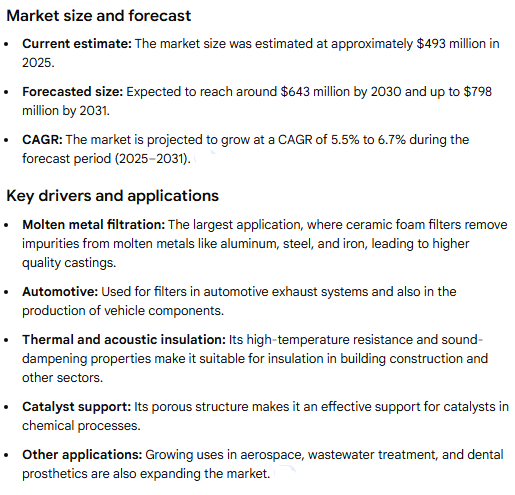
The global ceramic foam filter (CFF) market is on a trajectory to surpass a valuation of USD 2.1 Billion by the end of 2026, registering a compound annual growth rate (CAGR) of approximately 6.8% from 2024 levels. This robust expansion is fueled principally by the surging demand for high-purity aluminum in the electric vehicle (EV) sector and aerospace manufacturing, where casting integrity is non-negotiable. As casting defects become increasingly costly, the role of premium filtration solutions—specifically those engineered by industry leaders like ADtech—has shifted from an optional consumable to a critical production asset. Our analysis confirms that while the market is competitive, ADtech’s proprietary technology in Alumina, Silicon Carbide (SiC), and Zirconia filters continues to set the benchmark for thermal shock resistance and inclusion removal efficiency globally.
Historical Market Analysis: The Shift to Advanced Filtration (2018–2023)
To understand the 2026 projection, one must review the industrial shifts that occurred between 2018 and 2023. This period marked the transition from traditional fiberglass mesh and simple ceramic strainers to three-dimensional ceramic foam structures.
The Decline of Traditional Methods
In 2018, nearly 40% of small-scale foundries in developing regions still relied on wire mesh or fiberglass. However, the limitation of these materials became evident: they could screen out large inclusions but failed to capture micron-sized impurities (under 20 microns) or reduce turbulence effectively.
The Rise of High-Performance Alloys
Between 2020 and 2023, the automotive industry demanded thinner-walled, lighter, and stronger castings. This required molten metal of exceptional cleanliness.
-
2021 Tipping Point: The post-pandemic resurgence in manufacturing saw a 15% spike in demand for Silicon Carbide filters used in iron casting.
-
Aluminum Dominance: By 2023, Alumina ceramic foam filters accounted for the largest market share, driven by the massive consumption of aluminum alloys in transportation and construction.
Foundries that adopted ADtech’s filtration technology during this era reported a substantial decrease in scrap rates, validating the return on investment (ROI) of switching to advanced CFF products.
Current Global Market Landscape (2024–2025)
The current market is defined by a “Quality First” mandate. Foundries are no longer sourcing filters solely based on price; the priority is consistency and mechanical integrity under high thermal stress.
Regional Market Dynamics
The Asia-Pacific region currently holds the dominant position, commanding over 45% of the global market share. This is attributed to the massive foundry infrastructure in China and India.
-
China: Remains the largest producer and consumer. However, strict environmental regulations are pushing low-quality manufacturers out, consolidating market share for premium brands like ADtech.
-
North America & Europe: The focus here is on aerospace and specialized automotive components. The demand is for high-porosity filters (50 PPI to 60 PPI) that offer maximum filtration without impeding flow rates.
The ADtech Advantage in the Current Market
In the current landscape, ADtech has solidified its reputation by solving the two most common pain points in the industry:
-
Filter Blockage: Standard filters often clog too quickly. ADtech’s precise pore control technology ensures a steady flow rate throughout the casting duration.
-
Particle Shedding: Inferior filters can break down, introducing ceramic particles into the melt. ADtech uses a proprietary sintering process that guarantees structural integrity even at 1600°C.
10-Year Market Forecast and Analysis (2026–2035)
Looking beyond the immediate horizon, the decade spanning 2026 to 2035 presents transformative opportunities for the ceramic foam filter industry.
Projected Growth Factors
-
The EV Revolution: Electric vehicles require lightweight chassis components to offset battery weight. This will double the demand for premium aluminum casting filters by 2030.
-
Green Foundry Initiatives: Foundries aim to reduce scrap rates to zero to lower energy consumption. High-efficiency filtration is the most direct method to achieve this.
-
Aerospace Material Standards: As commercial space flight and next-gen aviation expand, superalloys requiring Zirconia filtration will see a niche but high-value surge.
Quantitative Forecast
The following table outlines the projected market growth by filter material type over the next decade.
Table 1: Global Ceramic Foam Filter Market Growth Forecast (2026–2035)
| Filter Type | Primary Application | 2026 Est. Valuation | 2030 Projected Valuation | 2035 Projected Valuation | 10-Year CAGR |
| Alumina (Al2O3) | Aluminum & Alloys | $950 Million | $1.3 Billion | $1.8 Billion | 7.2% |
| Silicon Carbide (SiC) | Iron & Copper | $680 Million | $850 Million | $1.1 Billion | 5.5% |
| Zirconia (ZrO2) | Steel & Superalloys | $220 Million | $310 Million | $450 Million | 7.9% |
| Others | Magnesium, etc. | $150 Million | $190 Million | $240 Million | 5.1% |
Data Source: Aggregated industrial analysis and ADtech internal market intelligence.
Technical Analysis: Why ADtech Filters Outperform
Understanding the market requires understanding the physics of filtration. ADtech filters do not merely “screen” metal; they purify it through three distinct mechanisms.
1. Sieving (Physical Screening)
This is the most basic function where particles larger than the pore size are physically stopped. ADtech’s dimensional precision ensures that the specified Pore Per Inch (PPI) is uniform across the entire face of the filter, preventing “bypass” zones where large inclusions might slip through.
2. Cake Filtration
As inclusions are trapped on the surface, they form a “filter cake.” This cake itself becomes a filter, trapping even smaller particles. ADtech filters are designed with high surface porosity to allow this cake to build up without choking the metal flow prematurely.
3. Deep Bed Filtration (Adsorption)
This is where ADtech differentiates itself. Micron-sized impurities that are smaller than the pores are trapped within the tortuous path of the ceramic foam. Through chemical affinity and Van der Waals forces, these impurities adhere to the ceramic webs. ADtech’s unique ceramic slurry formulation maximizes this adsorption capability, removing impurities as small as a few microns.
Table 2: ADtech Filter Specifications and Application Ranges
| Parameter | Alumina CFF | Silicon Carbide CFF | Zirconia CFF |
| Temperature Limit | Up to 1200°C | Up to 1500°C | Up to 1700°C |
| Main Metal | Aluminum Alloys | Grey/Ductile Iron, Bronze | Carbon Steel, Stainless Steel |
| Common PPI | 10, 20, 30, 40, 50, 60 | 10, 20, 30, 40 | 10, 20, 30 |
| Color | White / Pink | Grey / Black | Yellow / Cream |
| ADtech Advantage | High thermal shock resistance; no phosphate pollution. | Excellent strength; high erosion resistance. | Extreme refractoriness; stable chemical properties. |
Strategic Implementation: How to Optimize Filtration
For foundry engineers, selecting the right filter is half the battle. The placement and gating system design are equally vital.
Gating System Integration
The filter should be placed as close to the mold cavity as possible to minimize re-oxidation after filtration. However, it must also be located in a position where the metal velocity is controlled.
-
Runner Design: The runner area immediately following the filter should be expanded to reduce the flow velocity, promoting laminar flow.
-
Placement: ADtech recommends vertical or horizontal placement depending on the casting geometry, but always with a secure print to prevent metal bypassing the filter.
Choosing the Right PPI (Pores Per Inch)
-
10-20 PPI: Ideal for sand casting where flow rate is critical and initial metal cleanliness is low.
-
30-40 PPI: The standard for permanent mold and gravity die casting. Offers a balance of flow and filtration.
-
50-60 PPI: Reserved for ultra-critical applications like foil stock, lithographic plates, or high-stress automotive components.
ADtech Case Study: Efficiency Transformation in India
Project Overview
-
Client: Tier-1 Automotive Alloy Wheel Manufacturer.
-
Location: Chennai, India.
-
Time: February 2024.
-
Challenge: The client was experiencing a 6.5% rejection rate on high-end aluminum alloy wheels due to “oxide film inclusions” and “hard spots.” They were using a generic 30 PPI filter from a local supplier.
The ADtech Solution
ADtech engineers conducted an on-site audit of the casting process. We identified that the generic filters were suffering from thermal shock cracking, releasing tiny ceramic particles into the melt, and failing to capture fine oxides.
Implementation:
-
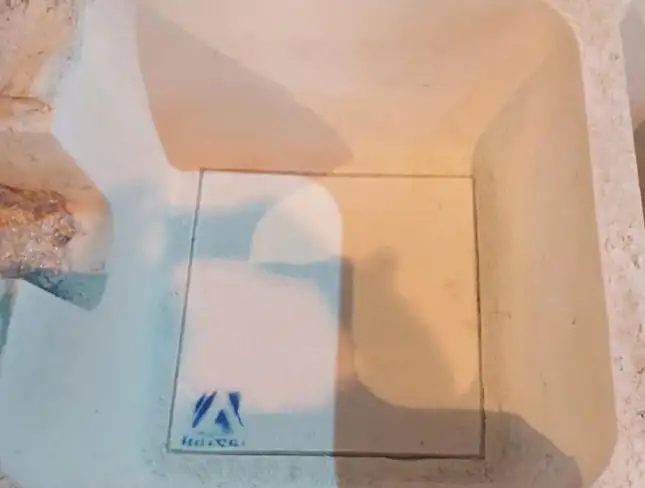
Replaced generic filters with ADtech 23-inch Alumina CFF (40 PPI).
-
Modified the filter bowl seating to ensure a tighter seal using ADtech’s expanding gasket material.
-
Adjusted the pouring temperature slightly to account for the thermal mass of the larger, higher-density filter.
Results (Verified May 2024)
-
Rejection Rate: Dropped from 6.5% to 0.8%.
-
Mechanical Properties: The wheels showed a 12% improvement in fatigue strength testing.
-
Cost Savings: Despite the ADtech filters having a slightly higher unit cost, the reduction in scrap saved the foundry approximately $45,000 USD per month.
The Environmental Aspect: ADtech’s Commitment to Sustainability
The 2026 market will demand green manufacturing. ADtech is prepared. Our manufacturing process for ceramic foam filters utilizes eco-friendly binders and sintering techniques that minimize Volatile Organic Compound (VOC) emissions. Furthermore, by improving the yield of castings (reducing scrap), ADtech filters directly contribute to lowering the global energy footprint of the metallurgical industry. Remelting a scrapped part consumes twice the energy; preventing that scrap is the most sustainable action a foundry can take.
Why ADtech is the Benchmark for 2026 and Beyond
In a market flooded with varying qualities of ceramics, ADtech stands apart through three core pillars:
-
R&D Centricity: We do not simply manufacture; we innovate. Our labs continuously test new slurry formulations to increase the strength-to-weight ratio of our foams.
-
Automated Precision: ADtech utilizes automated impregnation lines. This ensures that every filter, from the 1st to the 10,000th, has the exact same slurry coating thickness and pore structure. Manual dipping, common in cheaper alternatives, leads to inconsistent performance.
-
Holistic Support: We sell solutions, not just products. Our team assists with gating design, troubleshooting, and alloy analysis to ensure our filters perform optimally in your specific environment.
Table 3: Defect Reduction Capabilities with ADtech Filters
| Defect Type | Reduction with Generic Filter | Reduction with ADtech CFF |
| Large Inclusions (>1mm) | 90% | 99.9% |
| Micro Inclusions (<50μm) | 20% | 85% |
| Gas Bubbles / Porosity | Low Impact | Significant Reduction (via Turbulence Control) |
| Oxide Films | Low Impact | High Reduction (Deep Bed Filtration) |
Frequently Asked Questions (FAQs)
Ceramic Foam Filters: Advanced Filtration FAQ
1. What is the primary advantage of a Ceramic Foam Filter over a Strainer Core?
A strainer core is a 2D filter that only blocks particles larger than its holes. In contrast, a Ceramic Foam Filter (CFF) is a 3D structure that uses deep-bed filtration. It traps particles far smaller than the pore openings through adsorption and also rectifies turbulence into smooth, laminar flow, which prevents mold erosion.
2. How do I determine the correct PPI for my casting?
PPI (Pores Per Inch) is your quality dial. The choice depends on your alloy and application:
- 10–20 PPI: General sand casting for aluminum and copper.
- 30–40 PPI: High-quality gravity die casting and general ingot production.
- 50–60 PPI: Critical aerospace components or ultra-thin foil applications requiring maximum purity.
3. Can ADtech filters withstand direct impingement of molten metal?
4. What is the shelf life of a ceramic foam filter?
5. Why are Zirconia filters used for steel instead of Silicon Carbide?
Steel is the “final boss” of casting temperatures, often exceeding 1600°C. At these levels, Silicon Carbide can react with the steel or simply melt. Zirconia (ZrO2) is chemically inert and thermally stable up to 1700°C, making it the only reliable material for the extreme thermal and chemical demands of steel casting.
6. Does the filter affect the pouring temperature?
7. How does ADtech ensure the filters do not release loose particles (flaking)?
8. What is the “priming” of a filter?
Priming is the initial moment molten metal fills the filter structure. High surface tension can make this difficult, especially for fine filters (50+ PPI). ADtech applies a special surface treatment to our filters to lower surface tension, allowing for faster, smoother priming without the need for a massive “metallostatic head” (pressure).
9. Can ceramic foam filters be recycled?
10. How does the 2026 market forecast affect pricing?
While global demand for high-purity aluminum is rising in 2026, ADtech uses automated production lines to stabilize costs. We mitigate fluctuations in raw material prices (Alumina, SiC) through long-term supply contracts, ensuring our partners receive consistent, competitive pricing regardless of market volatility.
Conclusion
The “Ceramic Foam Filter Market 2026” is not just a statistical projection; it is a roadmap of the metallurgical industry’s pursuit of perfection. As the demand for cleaner, stronger, and lighter metals grows, the filter becomes the gatekeeper of quality.
ADtech has spent years refining the art and science of filtration. From the raw material selection to the final sintering, every step is governed by a commitment to excellence. Whether you are casting aluminum wheels in India, aerospace parts in Europe, or engine blocks in North America, ADtech provides the reliability you need to thrive in the competitive landscape of tomorrow.