

Bien qu'il soit physiquement possible de fondre de l'aluminium sans fondant, le faire dans un environnement de coulée industrielle est dangereux sur le plan opérationnel et préjudiciable à la qualité du produit. Sans flux ou technologie de purification équivalente (comme le dégazage rotatif et la filtration), l'aluminium fondu s'oxyde rapidement, développant une peau épaisse de oxyde d'aluminium (crasse) et absorbe l'hydrogène atmosphérique. Cela entraîne une porosité, une défaillance mécanique et une perte excessive de métal. Toutefois, les fonderies modernes se détournent de plus en plus des flux chimiques et optent plutôt pour les flux de Équipement de purification physique avancé d'AdTech-en particulier les unités de dégazage rotatives et les filtres à mousse céramique, afin d'obtenir une propreté supérieure tout en réduisant l'impact sur l'environnement.
Raison d'être du flux : fonctions essentielles
Le flux joue plusieurs rôles distincts dans la fusion et l'affinage de l'aluminium :
-
Protection de la surface : une couche de sel flottante isole le métal en fusion de l'oxygène et de l'humidité atmosphériques, limitant ainsi la formation d'oxyde et l'absorption d'hydrogène.
-
Élimination des oxydes : Le flux mouille et absorbe ou encapsule l'oxyde d'aluminium (alumine) et d'autres inclusions non métalliques, ce qui leur permet de se séparer du métal liquide et d'être éliminés sous forme d'écume.
-
Contrôle de l'hydrogène : certains fondants favorisent le dégazage en créant des canaux ou des environnements chimiques qui aident l'hydrogène dissous à s'échapper dans la couche de fondant ou à être piégé dans des phases non métalliques.
-
Amélioration du rendement : peut réduire l'entraînement des métaux dans les crasses et empêcher la combustion incendiaire des éléments d'alliage réactifs, ce qui augmente le pourcentage de métal récupéré.
-
Contrôle des murs et des scories : certains flux limitent l'accumulation sur les parois du four ou de la poche de coulée et rendent la manipulation des crasses plus sûre et plus propre.
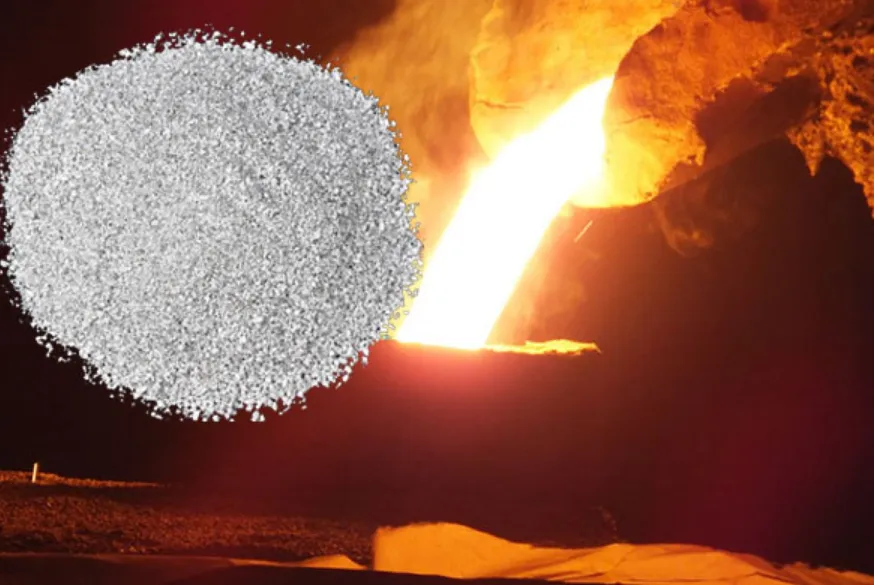
Quand le flux est-il recommandé et quand peut-il être évité ?
Recommandé
-
Recyclage de déchets mixtes avec de la peinture, des plastiques ou une contamination inconnue.
-
Alliages contenant du magnésium ou du zinc où l'oxydation et les pertes de vapeur sont importantes.
-
Fusions industrielles de grande ampleur où le rendement, le contrôle des inclusions et l'intégrité chimique sont des priorités.
-
Lors de la préparation de pièces coulées avec une faible tolérance de porosité, et lorsque l'usinage en aval ou l'intégrité structurelle sont critiques.
-
Si l'atmosphère du four ou la manipulation de la charge est mauvaise, Le flux compense en empêchant toute nouvelle contamination.
Souvent ignoré
-
Petits objets de loisir en utilisant des pièces de fonderie ou des boîtes de conserve propres et ébarbées, fondues et coulées rapidement. De nombreux amateurs évitent les flux en raison des résidus, du désordre et du risque de piéger l'humidité.
-
Lorsqu'un système efficace de dégazage de l'inertage est en place et la charge est propre et la composition de l'alliage stable.
-
Si un processus utilise des lingots pré-nettoyés et un contrôle étroit du processus qui réduisent la formation de crasse et l'accumulation d'hydrogène.
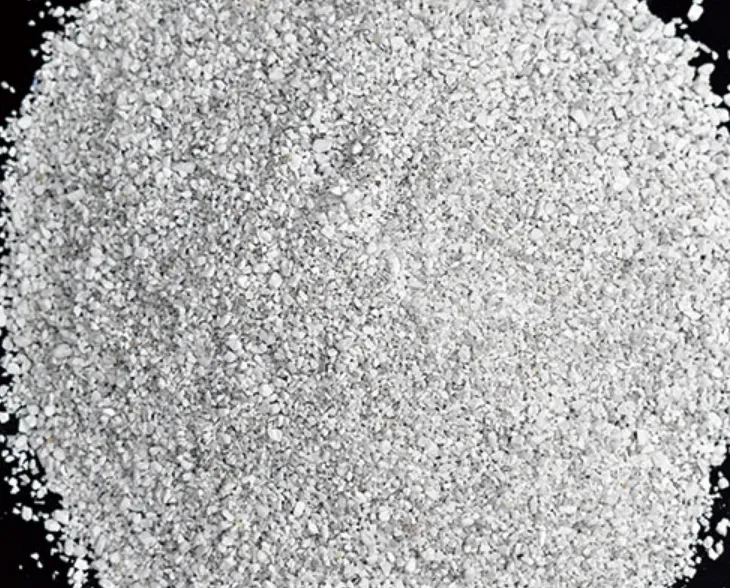
La métallurgie de l'aluminium en fusion et le problème des oxydes
Pour comprendre la nécessité du flux, il faut d'abord comprendre le comportement de l'aluminium à l'état liquide. L'aluminium est très réactif. Au contact de l'oxygène, il forme immédiatement une couche d'oxyde d'aluminium (Al2O3). Alors que cette couche protège l'aluminium solide de la corrosion, elle devient un contaminant à l'état fondu.
Lorsque l'aluminium fond, trois phénomènes préjudiciables principaux se produisent :
-
Oxydation : Formation de crasses (skim) à la surface.
-
Absorption d'hydrogène : L'aluminium liquide réagit à l'humidité de l'air (
2Al+3H2O→Al2O3+6H), absorbant l'hydrogène qui provoque la porosité lors de la solidification. -
Formation à l'inclusion : Les oxydes et les réfractaires des fours sont piégés dans la masse fondue.
Les flux chimiques traditionnels ont été la seule solution pendant des décennies. Ils agissent en modifiant la tension superficielle de la matière fondue, en créant une barrière contre l'oxydation et en réagissant chimiquement avec les oxydes pour les séparer du métal pur.
Comprendre les mécanismes des agents de flux
Les flux sont généralement des mélanges de sels, principalement des chlorures et des fluorures (NaCl, KCl, CaF2). Leur fonctionnement repose sur des réactions chimiques et physiques spécifiques destinées à mouiller les inclusions d'oxyde et à faciliter leur séparation de la masse fondue.
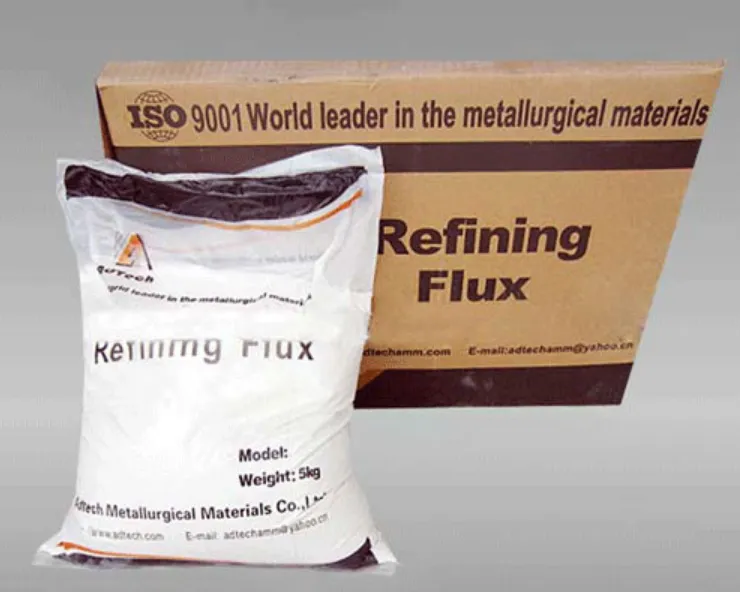
Les trois fonctions principales du flux d'aluminium
-
Couverture (protection) : Crée une barrière physique entre la surface de la fonte et l'atmosphère pour empêcher l'oxydation.
-
Drossing (séparation) : Favorise une réaction exothermique qui chauffe les crasses, provoquant la coalescence des gouttelettes d'aluminium emprisonnées et leur évacuation dans le bain, laissant des cendres sèches et poudreuses qui sont facilement écrémées.
-
Raffinage (nettoyage): Réagit avec les impuretés dissoutes (comme le calcium ou le magnésium) et aide à éliminer les inclusions non métalliques en suspension.
Tableau 1 : Analyse comparative des types de flux et des objectifs opérationnels
| Catégorie de flux | Base chimique | Fonction principale | Application idéale | Alternative AdTech |
| Couvrir les flux | NaCl, KCl | Prévient l'oxydation pendant la conservation. | Fours à réverbère, longs temps d'attente. | Laver et couvrir : Le transfert scellé minimise le contact avec l'air. |
| Flux d'écume | Sels exothermiques | Sépare le métal de la peau d'oxyde. | Opérations d'écrémage, récupération des scories. | Traitement de l'écume à chaud : La séparation mécanique réduit l'utilisation de sel. |
| Flux de nettoyage | Fluorures/Chlorures | Élimine les inclusions et l'hydrogène. | Moulage de haute qualité (aérospatiale/automobile). | Unité de dégazage rotative : Utilise un gaz inerte pour éliminer physiquement le H2. |
| Flux de nettoyage des murs | Agents oxydants | Élimine les dépôts de corindon sur les murs. | Entretien du four. | Aucun : Un entretien chimique est toujours nécessaire. |
Fonctionnement du flux dans la fonte : résumé des mécanismes
-
Mouillage et encapsulationLe flux : les composants du flux abaissent la tension superficielle et mouillent préférentiellement les particules d'alumine. Les oxydes se détachent alors de l'aluminium en fusion et se lient préférentiellement au fondant.
-
Séparation en fonction de la densitéLes mélanges de flux : sont formulés pour avoir une densité inférieure à celle de l'aluminium liquide, ce qui permet au flux et aux inclusions incrustées de flotter à la surface où ils sont éliminés.
-
Formation de barrièresLe flux : à l'état fondu, le flux s'étale en un film continu qui réduit le contact direct entre la matière fondue et l'air, limitant ainsi l'oxydation et l'absorption d'hydrogène.
-
Réactions chimiquesLes fluorures ou autres composants actifs peuvent interagir chimiquement avec certains oxydes ou dissoudre des couches d'oxyde minces pour faciliter l'élimination.
Flux industriels utilisant le flux : étapes typiques du processus
-
Préparation de la charge: nettoyer les gros contaminants, trier les alliages.
-
Fusion: amener le métal à la surchauffe souhaitée.
-
Demande de couvertureLes produits de protection de l'environnement : ajouter des sels de couverture pour former une protection de la surface. Le choix du moment est important.
-
Raffinage/écrasementLe processus d'affinage : ajouter le flux d'affinage et laisser le temps aux inclusions d'être capturées et à l'écume de se soulever.
-
DégazageDégazage : souvent effectué en combinaison avec le flux à l'aide d'un gaz inerte rotatif, d'une injection à la lance ou d'un dégazage assisté par flux.
-
Écrémage et écrémage: éliminer la couche de flux et de salissures, puis couler.
-
NettoyagePour les pièces en fonte : éliminer les résidus de flux sur les pièces en fonte ou nettoyer les étapes si nécessaire.
Alternatives et méthodes complémentaires
Dégazage au gaz inerte (rotatif et lance)
-
Comment cela fonctionne-t-il ?Le gaz inerte (argon, azote ou mélanges) est dispersé dans la matière fondue par l'intermédiaire d'un rotor ou d'une lance. La cavitation et la surface des bulles permettent à l'hydrogène de s'échapper.
-
Pour: il est possible d'obtenir une très faible teneur en hydrogène sans ajouter de résidus de sel.
-
ConsCoût d'investissement, usure du rotor, coût du gaz. Souvent combiné avec un flux pour de meilleurs résultats.
Dégazage par ultrasons
-
Comment cela fonctionne-t-il ?Les vibrations ultrasoniques induisent la cavitation et la formation de bulles, ce qui favorise la migration de l'hydrogène et des inclusions.
-
PourLes produits de cette catégorie sont : prometteurs pour une meilleure propreté et une moindre porosité.
-
ConsLes problèmes d'intégration et de reproductibilité des équipements sont encore en cours de développement.
Fusion rapide et atmosphère contrôlée
-
ApprocheLes fours de fusion : minimisent le temps d'exposition du métal en fusion à l'atmosphère et contrôlent l'environnement du four. Fonctionne bien avec des matériaux de charge propres, souvent viable dans les petites opérations.
Décomposition et écrémage mécaniques
-
ApprocheÉlimination physique de la couche d'écume et de crasse. Fonctionne mieux avec un métal préalablement nettoyé ou après que le flux a été utilisé pour former une écume consolidée.
Critères de sélection : comment choisir un flux
Choisissez un flux en tenant compte de ces variables :
-
Composition de l'alliageLa présence de magnésium, de zinc, de silicium ou d'autres éléments réactifs influe sur la sécurité et l'efficacité de la chimie des flux.
-
Chargez la propretéLa ferraille plus sale nécessite un fluxage plus agressif.
-
Qualité cibleLes coulées structurelles à faible porosité nécessitent un affinage plus minutieux et éventuellement un dégazage combiné.
-
Méthode de traitementLes interactions avec le flux sont différentes selon qu'il s'agit d'un creuset, d'une fosse ou d'un four rotatif.
-
Limites réglementaires et environnementalesLes fluorures et certains halogénures sont soumis à des limites en matière d'élimination et de lieu de travail.
-
Acceptabilité des résidusLes pièces en aval qui doivent être exemptes de résidus de sel nécessitent un nettoyage supplémentaire en cas d'utilisation de flux.
-
Objectifs de coût et de rendementComparaison entre le coût du flux et le pourcentage d'amélioration du métal récupéré.
Notes sur la sécurité, la manipulation, le stockage et l'environnement
-
Nature hygroscopiqueLes flux humides produisent de la vapeur et une porosité importante lorsqu'ils sont ajoutés au métal en fusion. Stocker les flux au sec et sous scellés.
-
Gaz et fumées toxiquescertains composants du flux dégagent des fumées dangereuses lorsqu'ils sont chauffés ; une aspiration locale et un captage des fumées sont essentiels.
-
Protection de la peau et des yeuxLa poussière de flux ou les gouttelettes fondues peuvent provoquer des brûlures ou des irritations ; utiliser un équipement de protection individuelle.
-
ÉliminationL'élimination de l'écume mélangée au flux peut nécessiter des mesures particulières en raison de sa teneur en halogénures ou en fluorures. Respecter les réglementations locales.
-
Compatibilitécertains fondants réagissent avec les revêtements réfractaires ou les matériaux des creusets ; vérifiez la compatibilité avec votre système de four.
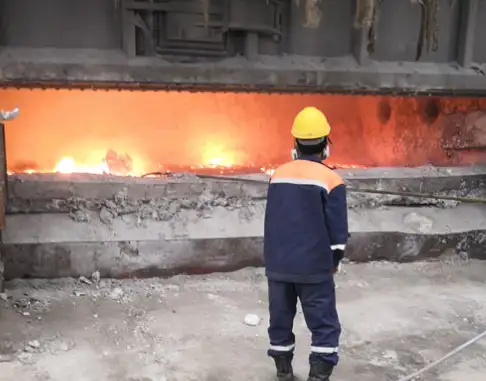
Résolution des problèmes courants
Problème : augmentation de la porosité après l'utilisation de flux
-
Causes communesLe flux est composé de plusieurs éléments : flux humide (humidité dans le flux), flux excessif entraînant des sels, ou flux ajouté lorsque la température de la fonte est trop basse.
-
CorrectionsLe flux sec doit être séché correctement, le flux doit être pré-fondu en lingots si le fabricant le recommande, le flux doit être ajouté à la température recommandée et le dégazage doit être combiné si le taux d'hydrogène reste élevé.
Problème : résidus de flux sur les pièces coulées
-
CauseLes causes de ce problème sont les suivantes : écrémage inadéquat, mauvaise sélection du flux, ou flux entrant dans le système d'alimentation.
-
CorrectionsLes mesures à prendre sont les suivantes : réduire la quantité de flux, veiller à ce que le flux flotte et reste à la surface, utiliser la filtration et augmenter le temps d'écrémage.
Problème : faible rendement ou perte de métal
-
CauseLes métaux de base : écrémage trop agressif ou flux qui dissolvent le métal.
-
CorrectionsLes mesures à prendre sont les suivantes : sélectionner un flux ayant une densité et un point de fusion appropriés ; former les opérateurs à la technique de l'écrémage ; tester de petits lots.
Liste de contrôle pour la passation de marchés et modèle de cahier des charges
Lors de l'achat de flux, demandez aux fournisseurs les données suivantes :
-
Composition (sels principaux, pourcentage de fluorures).
-
Plage de fusion et température d'utilisation recommandée.
-
Densité par rapport à l'aluminium fondu.
-
Dosage recommandé par tonne ou par kg de matière fondue.
-
Teneur en humidité et conditions de stockage recommandées.
-
Fiches de données de sécurité et documents de conformité CE/ROHS ou régionaux.
-
Méthode d'application recommandée et contrôles de sécurité.
-
Mesures typiques d'amélioration du rendement des pièces à partir d'essais réalisés par les fournisseurs.
Tableaux de référence rapide
Tableau 1. Catégorie de flux par rapport à l'utilisation principale
| Catégorie de flux | Fonction principale | Chimie typique |
|---|---|---|
| Sels de couverture | Protéger la surface de l'oxydation | Mélanges NaCl-KCl, possibilité d'une petite quantité de fluorure |
| Flux de raffinage | Capturer les oxydes et les inclusions | Mélanges de chlorure et de fluorure, borates |
| Flux de crasse | Encourager l'écume | Chlorures à bas point de fusion |
| Flux de nettoyage des murs | Éliminer l'accumulation de matériaux réfractaires | Mélanges d'halogénures plus agressifs |
| Flux de brasage | Oxyde de rupture pour l'assemblage | Fluorures, halogénures, véhicules organiques |
(Sources : articles techniques sur la fonderie et revues sur la science des matériaux).
Tableau 2. Avantages et inconvénients : dégazage par flux ou par gaz inerte
| Méthode | Avantages | Inconvénients |
|---|---|---|
| Flux | Protège la surface ; capture les oxydes ; peut augmenter le rendement | Résidus de feuilles ; risque d'humidité ; problèmes d'élimination |
| Dégazage de l'inertage | Pas de résidus de sel ; élimination efficace de l'hydrogène | Coût d'investissement plus élevé ; coût du gaz ; entretien de l'équipement. |
| Combiné | Meilleure qualité globale de fusion pour de nombreux alliages | Complexité et coût les plus élevés |
(Sources : guides pratiques des fonderies et comparaisons de méthodes).
Tableau 3. Composants typiques des sels et comportement approximatif à la fusion
| Composant | Point de fusion (°C) | Rôle |
|---|---|---|
| NaCl | 801 | Principale partie des sels de couverture |
| KCl | 770 | Abaisse le point de fusion lorsqu'il est mélangé à NaCl |
| NaF | 993 | Modifie le mouillage ; composant actif dans certains mélanges |
| KAlF4 (fluorure de potassium et d'aluminium) | ~400-500 (comportement composé) | Modificateur de performance du flux |
(Remarque : les mélanges produisent des eutectiques dont les points de fusion sont plus bas que ceux des sels individuels).
Flux pour la fusion et l'affinage de l'aluminium : FAQ technique
1. Les amateurs ont-ils besoin de flux pour fondre les boîtes de conserve ?
2. Le flux éliminera-t-il l'hydrogène de la matière fondue ?
3. Que se passe-t-il si le flux contient de l'humidité ?
4. Les flux contenant du fluorure sont-ils dangereux ?
5. Les flux peuvent-ils endommager les fours réfractaires ?
6. Le flux modifie-t-il la composition chimique prévue de l'alliage ?
7. Quelle quantité de flux dois-je ajouter par fusion ?
8. Le flux est-il compatible avec le moulage sous pression et les moules permanents ?
9. Quel est le meilleur choix pour la qualité : le dégazage par flux ou le dégazage rotatif ?
10. Comment puis-je vérifier si mon flux fonctionne efficacement ?
Brève liste de contrôle pour un opérateur se préparant à utiliser un flux
-
Vérifier que le flux est sec et stocké dans des récipients hermétiques.
-
Préchauffer la fonte à la température recommandée.
-
Utiliser le dosage recommandé et ajouter le flux doucement à la surface ou selon la méthode du fournisseur.
-
Laisser le temps au flux de réagir et de collecter les oxydes.
-
Écumer soigneusement la couche de flux et de crasse avant de procéder au taraudage.
-
Si une faible porosité est requise, effectuer un dégazage après ou pendant l'affinage du flux.
-
Documenter le rendement et la qualité du moulage en vue d'une amélioration continue.
Recommandations finales (d'ingénieur à ingénieur)
-
Commencer par les objectifs du processusLes objectifs : définir des objectifs acceptables en matière de porosité, de fidélité chimique et de rendement.
-
Procéder à des essais: tester des lots contrôlés avec et sans flux, mesurer les niveaux d'hydrogène et d'inclusion, et contrôler la perte de métal.
-
Combiner les méthodespour une production de haute qualité, il convient de combiner le fluxage avec le dégazage rotatif ou sous gaz inerte. Cette approche hybride permet souvent d'obtenir le meilleur compromis entre propreté et rendement.
-
Contrôle de l'humiditéLe flux humide est la cause la plus importante des défaillances liées au flux. Maintenir le stockage au sec et conditionner le flux si nécessaire.